21 August 2026

Where does Canon 603 Speak About Living a Desert Life?

[[ Hi Sister. Canon 603 doesn't say anything about living a desert vocation, but that's what you write about, so where does that come in? Do you see yourself living a desert vocation even though you live in a suburban apartment? How does that count as solitude?]]

Thanks for your questions. I will try to make this brief. The word eremitism means  (being about) desert dwelling. Eremos is the Greek word for desert, and eremite is a desert dweller or "hermit". Meanwhile, the constitutive elements of c 603 point toward the physical conditions of a desert dweller. What is important about this is that the call to be a desert dweller is the meaning of being called to be a hermit, NOT a call to merely (or even always) being alone -- though yes, in the midst of desert wastes, one is apt to find herself alone in a variety of ways. Remember that the desert Fathers and Mothers lived their eremitical lives in a variety of configurations: alone, with mentors or "elders", in groups of solitary cells, in the desert on the edge of villages, and in the deep desert, etc. Canon 603 recognizes the solitary eremitic or anchoritic life; that is, it recognizes individuals (not communities!) living desert life in the name of the Church. 

Of course, this does not mean that physical solitude is unimportant, but it does mean that it cannot be absolutized or defined as narrowly as some are wont to do (except in the case of pure reclusion). Physical solitude is not an end in itself. It serves communion with God, and thus too, all that is precious to God. "Solitude" can also mean wholeness, and for the Catholic Hermit this integrative and integrated form of solitude is a central dimension of what c 603 calls "the silence of solitude" -- itself the fruit of communion with God, with others, and with oneself. It serves our formation as an authentic human being and counterpart of God. This is part of the reason I tend to identify "the silence of solitude" not only as a major dimension of the context of hermit life, but as goal, and even as charism of the eremitical vocation.

Your last question about living in an apartment is something of an ironic one for me. One of the criticisms of apartment living I hear most often is that no one knows their neighbors. Yet, when one hears a hermit is living in an apartment complex --- no matter how well designed for privacy and quiet --- one immediately thinks that means the hermit is surrounded by busy, noisy, intrusive people 24/7.  In my experience at least,  this is not the case. It means a way of living apart from others in a space that allows for prayer, study, work, and rest, and at the same time assists one in being truly aware of one's neighbors, their needs, etc.

Desert living is about putting one's relationship with God first within a context designed to assist in (or "prove") this. One stretches oneself (or perhaps better, one is stretched) to one's limits physically, spiritually, emotionally, and intellectually; as one comes to know oneself more and more truly and deeply, one comes into greater and greater communion with God, who is the source and ground of both one's existence and the meaningfulness of that existence. 

To depend upon God in the way eremitical life calls for, to actually allow God to be God, that is, to allow ourselves to be loved by God and to love God in return, means precisely that we allow God to be God. Over time, in relationship with God, and only in relation with God and all that is precious to God, we become complete human beings. The pain of yearning for something we can never supply on our own but must receive as gift quiets down; it reaches a state of quies and echoes the hope of the Gospel's ultimate promises. Our hearts become hymns of praise, and our lives glorify God as everything we are and do is transformed into God's own prayer in our world. This is what it means to live towards and into "the silence of solitude". It is what we mean by living as those created by God. We become one with God, and are profoundly related to the whole of creation that also stands grounded in God. Our solitude, and the silence of solitude, is not merely some externally imposed silence or lack of noise one takes on in a forced act of will. It results from healing, reconciliation, and taking up residence in the very life of God in Christ. This particular martyrdom or witness is part of the way the hermit gives her life for the sake of others! 

15 August 2026

Congratulations, Sister Annie Gelles SHF and Dolphin GDB!!!

Sister Ann Marie and Earhart
 I just finished watching the graduation from the Guide Dogs for the Blind with Sister Ann Marie Gelles, SHF, and Dolphin, Annie's sixth Guide Dog throughout her adult life. (Annie is a big walker, and finding a dog that would be able to match her in speed and distance took some time.) Just two weeks ago, Annie celebrated her 50th jubilee as SHF, and she was able to join a later GDB class in order to attend both Jubilee and a two-week training course with Dolphie plus graduation.

Annie allowed Earhart, her last companion, to retire and return to one of her puppy raisers @26 months ago. Sister Ann Marie now only teaches Braille at the California School for the Blind part-time, and has been waiting for a new companion during this time. The graduation was lovely. There were four graduating students and their four Guide Dogs, plus a GD Buddy given to a younger girl. Each student was moved to tears by their new companion. What I thought Annie expressed more fully than most was how a Guide Dog can be a lifelong dream and need, and how her heart was full to bursting on this day because of Dolphie. (She thought her heart could not be any fuller than it was with Earhart, Honey, and the others, but as we each learn, if we are lucky, such love fills and expands our hearts beyond saying, and certainly beyond prior limits!!)

The puppy raisers also provided a wonderful picture of ongoing love because they called attention to the larger and extended family GDB actually is. With Annie and Dolphie, that larger family also includes, of course, the Sisters of the Holy Family, the Sisters of the Holy Names, and the Carmelite Sisters (especially Reno). Max helped raise Dolphin; She was his first Guide Dog puppy, and Max clearly loves her. As a part of the larger GDB family, he will, of course, stay in touch over the years. So, congratulations to Sister Ann and Dolphie, and to all the Sisters of the Holy Family who will be meeting their new community member this evening!!! Dolphie, you are one lucky doggo in so many ways and will enrich others' lives in uncountable ways as well!!!

Feast of the Assumption of Mary


I very much appreciate the Assumption of Mary as a sign of our life with God as inevitably embodied or incarnated, and this includes our lives post death. It was wonderful to read Father John Klassen's reflection for tomorrow and the way he stresses the nature of the human person as embodied Spirit. Those who stress that we are called to live disembodied spiritual lives that contrast with embodied or "temporal" lives forget that we Christians believe in resurrected life, and resurrected life is bodily life. Sister Laurel, Er Dio

A Spirited Whole


This feast of the Assumption of Mary is a celebration of the totality of the Incarnation. To believe that Mary was assumed bodily into heaven, that Mary is the first human being to follow in the footsteps of Jesus’ ascension into heaven, testifies to the dignity of the body. The body is not the discarded and expendable husk of the Spirit. The body is a flesh and blood, bone and sinew reality. Through our bodies, we as human beings come to know and believe; in them we are known and come to maturity in Christ.

The Assumption of Mary testifies that the human person is not split between body and soul, but is a living, breathing, spirited whole, wholly loved, wholly blessed, wholly redeemed by God. Mary enjoys what each of us will one day know and experience. As we celebrate her Assumption, we anticipate and hope for our own.

The Assumption of Mary also tells us something fundamental about God. In imagining a way to fulfill the situation of creation, God always puts the response of human beings front and center. God never does an end run on the human condition. God does not give up on the experiment and walk away, as if it doesn’t matter. With all of our cloudiness of vision, our divided loyalties, our many loves, God never bypasses the human situation.

The most complete manifestation of this is the sending of the Son, born of Mary, born under the law, as St. Paul instructs in the letter to the Romans. This says to me that our response, like that of Mary, and all of our faith-filled forebears, matters.

Fr. John Klassen

John Klassen, OSB, is a monk of Saint John’s Abbey in Collegeville, Minnesota.

12 August 2026

Respecting "the Most Humble of all Vocations"

[[Sister, are you aware that another hermit claims hermits never needed or wanted respect, so your argument that c 603 came about so the hermit vocation could be respected is invalid? What seems to be the point is that hermits are "the most humble of all vocations" and have never needed respect. Have you addressed this? Have you reversed your opinion?]]

Thanks for writing. I am aware. The main posts of this came up a couple of years ago, and I responded a couple of times around then. I have not only NOT reversed my opinion on this; my opinion has intensified as I have come to a more mature understanding of the vocation's ecclesiality. This vocation, when lived well and as the Church understands it, is worthy of respect. Every vocation and every person making a commitment to live such commitments deserves respect. (So do those who choose otherwise!!) With regard to being a c 603 hermit, I am not talking about seeking an unwarranted degree of prestige or recognition. Concerning c 603, I am speaking about a particular pathway to union with God, which is rare and countercultural and requires a demanding commitment to perseverance in the grace of God.

I don't see how humility necessarily means one cannot expect a vocation to be respected. After all, humility is a form of truthfulness, and a loving form of truthfulness at that. It does not mean denigrating oneself, but regarding oneself appropriately in light of who God makes us to be and the potential we carry within us for becoming God's true counterpart in our world. It seems to me that requiring respect for a vocation is really an appreciation of the way God works in and through us. Calling for respect for this vocation reflects an awareness of the dignity that belongs to the human person as a child and dialogical partner of God. That is certainly what led Bishop Remi de Roo to bring the question of making solitary eremitical life a canonical form of consecrated life to the attention of the Church Fathers at Vatican II. He knew the Hermits of St John the Baptist and highly regarded what they brought to and meant for the Church. It took the Church almost another 20 years from De Roo's intervention before Canon 603 was promulgated after a number of drafts and correlative discussions. 

The essential point, I believe, is that the countercultural life we call eremitical is significant for the life of the Church,  for appreciating the dialogical (and incarnational) nature of the human person, seeing clearly what it means to say the will of God is to be Emmanuel, and understanding that Jesus' entire life and death could be thought of as a desert existence no matter the number of people he taught, healed, preached to, or fed. He is the model of what it means to be a hermit and what Peter Damian called an ecclesiola, a little Church. All of this is part of the witness of the hermit's life, and while certain external conditions listed in the canon are necessary, it is the inner life of the hermit with God that is the heart of the vocation. It is this hidden reality that we especially respect, and part of the reason the vocation is seen as necessary to the life and well-being of the Church. 

Two additional points: First, I am aware that you have quoted someone on the notion that hermit vocations are the most humble of vocations, and, while I agree they require and exemplify humility, I dislike comparisons of the type provided. It seems to me that once we start saying one vocation is more humble than others (much less the most humble of all others!), we have adopted a more worldly way of regarding them. Secondly, I'm repeating what I have already written about this matter, so please check out other posts on the labels found at the bottom of this post. All my best!

06 August 2026

Feast of the Transfiguration (Reprise)

Have you ever been walking along a well-known road and suddenly had a bed of flowers take on a vividness that takes your breath away? Similarly, have you ever been walking along or sitting quietly outside when a breeze rustles some leaves above your head, and you were struck by an image of the Spirit moving through the world? How about suddenly being struck by the tremendous compassion of someone you know well, or seeing their smile in a new way and coming to see them in a whole new light because of this? I have had all of these happen, and, in the face of God's constant presence, what is in some ways more striking is how infrequent such peak or revelatory moments are.

Scientists tell us we see only a fraction of what goes on all around us (and this is without accounting for the reality that can only be properly perceived by faith). It depends upon our expectations.  In an experiment with six volunteers divided into two teams in either white or black shirts, observers were asked to concentrate on the number of passes of a basketball that occurred as players wove in and out around one another. In the midst of this activity, a woman in a gorilla suit strolls through, stands there for a moment, thumps her chest, and moves on. At the end of the experiment, observers were asked two questions: 1) how many passes were there, and 2) did you see the gorilla? Fewer than 50% saw the gorilla.  Expectations drive perception and can produce blindness. Even more shocking, these scientists tell us that even when we are confronted with the truth, we are more likely to insist on our own "knowledge" and justify decisions we have made on the basis of blindness and ignorance. We routinely overestimate our own knowledge and fail to see how much we really do NOT know.

For the past two weeks, we have been reading the central chapter of Matthew's Gospel --- the chapter that stands right smack in the middle of his version of the Good News. It is Matt's collection of Jesus' parables --- the stories Jesus tells to help break us open and free us from the common expectations, perspectives, and wisdom we hang onto so securely so that we might commit to the Kingdom of God and the vision of reality it involves. Throughout this collection of parables, Jesus takes the common, too-well-known, often underestimated and unappreciated bits of reality which are right at the heart of his hearers' lives. He uses them to reveal the extraordinary God who is also right there in front of his hearers. Stories of tiny seeds, apparently completely invisible once they have been tossed about by a prodigal sower, clay made into works of great artistry and function, weeds and wheat which reveal a discerning love and judgment which involves the careful and sensitive harvesting of the true and genuine --- all of these and more have given us the space and time to suspend our usual ways of seeing and empower us to adopt the new eyes and hearts of those who dwell within the Kingdom of God.

It was the recognition of the unique authority with which Jesus taught, the power of his parables in particular, which shifted the focus from the stories to the storyteller in the Gospel passage we heard last Friday. Jesus' family and neighbors did not miss the unique nature of Jesus' parables; these parables differ in kind from anything in Jewish literature and had a singular power which went beyond the usual significant power of narrative. They saw this clearly. But they also refused to believe the God who revealed himself in the commonplace reality they saw right in front of them. Despite Jesus' unique authority, they could not deny they chose to see only the one they expected to see; they decided they saw only  the son of Mary, the son of Joseph and "took offense at him." Their minds and hearts were closed to who Jesus really was and the God he revealed.  Similarly, Jesus' disciples too could not really accept an anointed one who would have to suffer and die. Peter especially refuses to accept this.

Looking at Today's Gospel:

It is in the face of these situations that we hear today's Gospel of the Transfiguration. Jesus takes Peter, James, and John up on a mountain apart. He takes them away from the world they know (or believe they know) so well, away from peers, away from their ordinary perspective,  and he invites them to see who he really is. In the Gospel of Luke, Jesus is at prayer --- attending to the most fundamental relationship of his life --- when the Transfiguration occurs. Matthew does not structure his account in the same way. Instead, he shows Jesus as the one whose life is a profound dialogue with God's law and prophets, who is in fact the culmination and fulfillment of the Law and the Prophets, the culmination of the Divine-Human dialogue we call covenant. He is God-with-us in the unexpected and even unacceptable place. This is what the disciples see --- not so much a foretelling of Jesus' future glory as the reality which stands right in front of them --- if only they had the eyes to see.

For most of us, such an event would freeze us in our tracks with awe. But not Peter! He outlines a project to reprise the Feast of Tabernacles right here and now. In this story, Peter reminds me some of those folks (myself included!) who want so desperately to hang onto amazing prayer experiences --- but in doing so, fail to appreciate them fully or live from them! He is, in some ways, a kind of lovable but misguided buffoon ready to build booths for Moses, Elijah, and Jesus, consistent with his tradition, while neglecting the newness and personal challenge of what has been revealed. In some way, Matt does not spell out explicitly, Peter has still missed the point. And amid Peter's well-meaning activism comes God's voice, "This is my beloved Son. Listen to him!" In my reflection on this reading this last weekend, I heard something more: "Peter! Sit down! Shut up! This is my beloved Son! Look closely!! Listen to him!!!"

The Lesson for Us Today:

The lesson could not be clearer, and yet, how hard it is for us to see what is right in front of us! Recently, I wrote about a view that sees the Church as "too temporal." This perspective is not merely concerned with the Church buying into models of power more appropriate to princes and potentates. It sees the entire Church, insofar as it is committed to this world, as having given itself over to something that is "not spiritual." But this perspective forgets it is speaking of a Church that lives in this world and mediates the Spirit to that world, a Church that mediates Christ's presence for those with eyes to see. It is not an either/or way of seeing, but a both/and way: both ordinary and extraordinary, both material and spiritual, both temporal and eternal. Central to this Church is the notion of Sacraments; in fact, the Church herself is a primordial sacrament, a sign where ordinary reality is allowed to shine forth the power and presence of God. They take the ordinary matter of our world and in them, see this transformed into the very power and presence of God. And yet, it requires the eyes of faith to perceive and appreciate this transformation. The either/or perspective I referenced above tends to see reality in a particularly Gnostic or neo-Platonic way. What it cannot see, and what remains scandalous to it is an incarnational God who is fully present in the ordinary matter of our world, divinizing it with God's presence. How very different is the Sacramental way of seeing reality!!

Here I am reminded of a story I once told of a video of a man who was given Enchroma glasses --- a form of sunglasses that allows colorblind persons to see color, often for the first time in their lives. By screening out certain wavelengths of light, someone who has seen the world in shades of brown their whole lives is finally able to see things they have never seen before; browns are transformed into yellows and reds and purples, and suddenly trees look truly green and three-dimensional while the colorful fruit of these trees no longer simply blend into the same-color background. The man was overwhelmed and overcome by what he had been missing; he could not speak, did not really know what to do with his hands, was "reduced" to tears, and eventually expressed it all as he hugged his wife in love and gratitude. Meanwhile, family members were struck by just how much they themselves may have taken for granted as every day they moved through their own world of "ordinary" color and texture. The entire situation involved a Transfiguration almost as momentous as the one the disciples experienced in today's Gospel.

Like Peter, like the Gnostic or neo-Platonist who divvies reality up into the temporal and the spiritual. And like the colorblind man who needed to wear the glasses consistently enough to allow his brain to really begin to process colors in a new way, we must take the time to see what is right in front of us. We must learn to see the sacred, which is present and incarnated in ordinary reality. We must listen to the One who comes to us in the Scriptures and Sacraments, the One who speaks to us through every believer and the whole of creation. We must really be the People of God, the "hearers of the Word" who know how to listen and are obedient in the way God summons us to be. This is true whether we are God's lowliest hermit or one of the Vicars of Christ who govern our dioceses and College of Bishops. Genuine authority coupled with true obedience empowers new life, new vision, new perspectives, and reverence for the ordinary reality God makes sacramental. 

There is a humility involved in all of this. It is the humility of the truly wise, the truly knowing person. We must be able to recognize how very little we see, how unwilling or unable we often are to be converted to the perspective of the Kingdom, how easily we justify our blindness and deafness with our supposed knowledge, and how even our well-intentioned activism can prevent us from seeing and hearing the unexpected, sometimes scandalous God standing there right in the middle of our reality.

05 August 2026

Chronic Illness as a Desert Vocation

[[ Dear Sister, what can I say to a diocese that doesn't believe that chronic illness is acceptable if one proposes to live a solitary eremitical life? The Vicar I spoke to said he thought the life is too austere for me because of my illness. He described the rigors of the life from several hermits' accounts in the early Church, and when he asked if I could live this degree of asceticism, I felt kind of ashamed and said, "No, probably not." But you know, I really think I can live as a hermit, and I believe God is calling me to do this. How do I explain things to my diocese?]]

Wonderful question and incredibly important in today's Church and world! Please look at other articles in this blog on Chronic Illness and Eremitical Life! The vocation you are petitioning to be consecrated in is first of all, a desert vocation. This means the one who chooses to live as a hermit chooses to live her life in a situation or context of liminality. She chooses to be a marginalized person living a literally eccentric (out of the center) life, and this liminality, of which her chronic illness is a major part, makes her more vulnerable and responsive to the deepest existential questions of being and meaning all human beings must contend with. Chronic illness will tend to radicalize these questions and allow the hermit to pose them with her life, and to do so with greater acuity, poignancy, and witness value than will hermits without such sources of foundational liminality.

Chronic illness represents a common desert experience. I say that because it is characterized and functions in the same way as other desert experiences. It locates the person on the margins of normal living, and makes them vulnerable as they pose the questions of being (existence) and meaning (purposeful life) as radically as they might. This is a vulnerability to God and the meaningful life God bestows on us. It witnesses to the way every prayer is answered with God's own presence. It is God's very Self that is the answer to prayers for healing, comfort, release from bondage and pain. Granted, we may not appreciate the forms in which such gifts come to us, but the hermit witnesses to this gift as she persists in living toward union with God. Desert vocations stress not only the importance of vulnerability, but the importance of encounter and relationality. 

If you can convey the powerfully vivid desert vocation chronic illness can be, you should do well in explaining your case. The rigors of eremitical life cannot be denied, but these do not have to be the same rigors the early desert Fathers and Mothers described. Anyone living with chronic illness knows how demanding such conditions can be! Each of us struggling with chronic illness is challenged to grow in patience, generosity, self-denial, openness to the will of God (who NEVER wills our illness per se, and who works to bring life and meaning out of it). As we allow God to be Emmanuel, our lives become witnesses, not to chronic illness, but to the loving presence of God that transforms us gradually and profoundly into images of his Crucified and Risen Son. This is the way the eremitical vocation works especially with those struggling with chronic illness. It is one of the most vivid expressions of and witnesses to the way God overcomes sin and death with obedient (attentive and responsive) life, and one the Church needs desperately.

You have no reason to be ashamed!! Persevere in your struggle with chronic illness and allow yourself to become more and more vulnerable to the dynamics of the desert it causes you to inhabit. I would bet that your own experience of the losses entailed by chronic illness, the loneliness it brings in its wake, the broken dreams, and marginality it casts you into, will test your faith and capacity for hope. It will be every bit as rigorous as eremitical life lived in the literal desert of earlier centuries, but in different ways!! Please remember me in your prayers and know I will do the same for you, your vocation, and your diocese whether or not c 603 is the route you decide to take!

01 August 2026

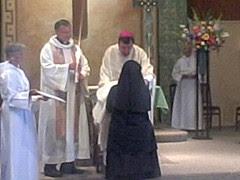
Sisters of the Holy Family Jubilee Mass, August 1, 2026


One of the things I did with my morning and early afternoon. Congratulations to all of the Jubilarians, but especially to Sisters Ann Marie Gelles and  M Aurora Perez. Seven Sisters celebrated Jubilees today for a total of 420 years of daily committed service as Sisters of the Holy Family. Sister Carole Pesce 75 years, Sister Marie Stafford 75 years, Sister M Aurora Perez 60 years, Sister Mary Lange 60 years, Sister M Sandra Ann Silva 60 years, Sister Ann Marie Gelles 50 years, and Sister Kathy Littrell 40 years. I cannot adequately say how inspiring such commitments are to me!

I am interested in learning later this month what the name of Annie's new Guide Dog will be. Thanks too to Father Gerald Coleman for a really excellent homily. I know he has been a friend to the Sisters of the Holy Family for some time; his homily showed a profound sense of who they are and it was great to hear him speaking a bit about Leo XIV's Encyclical, Magnifica Humanitas. Father is a Catholic moral theologian and the author of The Many Faces of Transgender as well as a more general work, Human Sexuality

Sister Annamarie and Bishop Barber

A special note: The Sister welcoming everyone and making the opening and closing remarks is Sister Annamarie Therese Colapietro, SNJM. One detail that touched me deeply was the fact that she is wearing an SHF cross on this occasion. You see, Sister Annamarie is the Canonical Trustee (commissary) or Congregational President for the Sisters of the Holy Family at this point in the congregation's life. 

Sadly, as most readers here know, as vocations to religious life dwindle in the Church and the median age of congregational members rises, this is becoming a more common canonical arrangement for groups reaching "completion." Though the women of the congregations involved make the decisions for the future of their own congregational resources and charism, they rely on younger members of the collaborating congregation to fill canonical roles. My understanding is that Sister Annamarie Therese has been a great gift to the Sisters of the Holy Family. It was a joy to see her wearing their cross/logo today.