Showing posts with label Rule as tool for discernment. Show all posts

04 November 2026

What Specifically Does the Church Hold You Responsible For? (Reprised from 2015 with new postscript)

[[Dear Sister Laurel, . . . What is hard to see clearly is what responsibility or responsibilities a hermit takes on. When you talk about [being a hermit] "in the Name of the Church," that refers to responsibility; I know that. But what specifically does the Church hold you responsible for? Is any of this based on the Bible, or is it all about Canon Law?]]

Scriptural Roots Exemplified:

Thank you for the questions.  Let me begin with the last one, which I believe is critically important. I think there are very clear Scriptural precedents for the Church's insistence that standing is inevitably associated with commensurate responsibilities. One of the most vivid is the parable of the Prodigal Son/Merciful Father. Remember that when the younger Son demanded "the property that would be his at his Father's death," he very specifically does NOT ask to assume the responsibilities of inheritance. In fact, he rejects these outright. Despite some English translations of the text, he asks for the "ousia", the very "substance" of the material or wealth portion of the patrimony that would come to him at his Father's death, but he does not use "kleronomia", the usual word for inheritance. This is significant because asking for the inheritance (kleronomia) necessarily includes acceptance of leadership for the family, their wealth, honor, and general well-being. In fact, it includes the pledge that one will give one's life for the family if need be.

Instead, this son effectively wishes his Father were dead, separates himself from the family, sells off his portion of the property for cheap (he does not bargain as is typical in the Middle Eastern culture but liquidates things quickly for whatever he can get in the moment), thus leaving his family in reduced circumstances; he then squanders the proceeds of his impulsivity, greed, and lack of compassion in "riotous (exorbitant) living" among foreigners. He becomes rootless, a wanderer without value or responsible role, someone who has exchanged the lasting or eternal for the entirely ephemeral. (By the way, it should be noted that in Jesus' day calling someone rootless in this way was an unpardonable offense; making oneself rootless was incredibly degrading.) 

Meanwhile, skipping ahead in the story, when the younger son returns home in yet even greater disgrace, he is restored to Sonship and will be honored by all the village as the Father's Son because of the robe, ring, and shoes with which his Father has clothed him. In other words, he has been re-established as one with genuine standing in the People of God and real responsibility within and for the family and the family's honor and wealth. With standing comes responsibility. To take what is due a Son and to do so while cutting all ties, betraying and sundering all relationships, and selfishly relinquishing all responsibility for one's family or the People of God is the very essence of sin in this NT parable. Despite some distorted approaches to spirituality, and the genuine limitations of life as a hermit, I would argue one cannot do these things in the name of eremitical life either. That way lies the disedifying isolation of counterfeits and curmudgeons rather than the ecclesial solitude of the Christian hermit.

Canonical Standing and Responsibilities:

 To accept canonical standing then (i.e., that which comes with public profession and//or consecration) is to accept the responsibility to act in whatever way one is commissioned by the Church to do in her name. The same is true with regard to Sacramental relationships and standing: Baptism (Sacraments of Initiation), Marriage, Ordination all come with specific responsibilities within the Church and for the very life OF the Church. In my own life, the specific obligations include: 1) an ecclesial vocation lived as an integral part of the Church's own life and holiness governed by both universal and proper law, 2) an eremitical vocation whose nature is defined by canon 603 and other canons related to consecrated or religious life. It includes stricter separation from the world (those things contrary or even resistant to Christ as well as those things which promise what only God can promise), assiduous prayer and penance, the silence of solitude, the evangelical counsels and all those imply, life according to an approved Rule I write myself, and the supervision of the diocesan Bishop and those he delegates to act as legitimate superiors and/or delegates (quasi-superiors).

In all this, I (and all diocesan hermits) am specifically responsible for living the eremitical life in the heart of the Church as a continuation of the prophetic life of the Desert Fathers, the pastorally significant lives of medieval anchorites, along with the hidden witness of so many other hermits, and for extending this rich tradition in ways which meet contemporary needs and speak to contemporary culture. 3) As a representative of these, I am also part of a parish and diocese; I was called forth from their midst and professed and consecrated in their presence, with them witnessing, supporting, and celebrating. As solitary as a hermit's vocation is, it is ecclesial, and so I live this life in my parish's midst and serve them and others as my eremitical life makes possible.

Bearing the parable of the Prodigal Son/Merciful Father in mind, as a Sister (that is, as a professed religious), I am responsible in various limited ways for dimensions of the life of this parish family. There is something similarly true with regard to the diocese as such, though ordinarily this is expressed in my commitment to parish life, or, occasionally, in diocesan events and diocese-wide celebrations, funerals, etc. It always means the parish and diocese are kept in my heart and prayer, but it sometimes means speaking at other parishes in the diocese, doing an occasional presentation at Contemplative Outreach or similar groups in the area, regarding desert spirituality, eremitical life, contemplative prayer, etc. In any case, I am responsible not merely to be a hermit, but to be a hermit in the heart of the Church and to appropriately allow the fruits of my own solitary contemplative life to nurture the life of the family I know as the local parish and diocesan Church.

In terms of the universal Church, I really do feel the obligation to live a life which is truly an extension of the eremitical tradition which has been part of her life since the 4th Century and certainly was an element of Jesus' own life, that of John the Baptist, Elijah, etc. And even beyond the universal Church is the world-at-large --- also searching, hurting, and yearning. Every person comes to communion with God in an essential solitude, and the hermit's life reminds them of this. At the same time, some effectively marginalized persons especially need the example of the hermit's solitude to come to a sense that their own isolation, no matter the circumstances causing or exacerbating it, can be redeemed through such communion.

Canon 603 is very specific about the hermit living her life for the praise of God and the salvation of the world. Her own prayer --- intercessory and otherwise --- is very important here, but so is the entire solitary life she lives as a public person in the Church. The very hiddenness of the hermit's life is, paradoxically, actually part of her public identity and witness. After all, most of the struggle, love, work, and prayer we all do in our lives is hidden "from the eyes of men" and sometimes that can tempt us to abandon this for notoriety, etc. A hermit reminds everyone that this is unnecessary and perhaps even illegitimate depending on what God wills in our lives. At the very least, the hermit's own life of essential hiddenness encourages patience and suggests a new way of seeing things. Especially, it encourages us to see the immense dignity of our lives and the significance of whatever we do in and with God, no matter how ordinary or how hidden.

So, I have a strong sense of responsibility in all of these ways. Moreover, as you very perceptively put it, the Church herself rightly holds me morally and legally responsible for living my life in these ways. Public profession and consecration establish a covenant between the individual professed and the Church more generally --- usually through an institute of consecrated life, but now with canon 603, through the hermit's diocese and local Bishop. The Church spells out some of this in the canon, but she fully (and rightly) expects the hermit who is publicly professed to concretize or make these obligations more specific in terms of her own prayer, study, reflection, and response to the grace of God as it comes to her through the relationships that constitute her life. This is another reason it is very important that there be sufficient formation and mutual discernment before admitting someone to profession and (then) consecration under canon 603. Through canon 603, diocesan hermits give their lives to Christ and to those who belong to him in what is intended to be an irrevocable gift. Thus, the Church that receives this gift needs to have the sense that the candidate has the necessary tools, sensibilities, maturity, and constitutive relationship with God and his Church to truly "flesh out" (or even incarnate) all of the potential which is profoundly embodied in this brief but richly pregnant canon.

Canonical or non-Canonical Hermits: Standing Comes with Responsibility, Rights with Obligations:

My own understanding of the Parable of the Merciful Father (aka Parable of the Prodigal Son) colors the way I see people who seek (or pretend to!) the status or standing of consecrated solitary hermits without accepting the responsibilities the Church associates with such standing. One's life in the Church always comes with commensurate responsibility. Standing as a publicly professed and/or consecrated person in the Church codifies such responsibilities in law. The Prodigal Son was given a robe, a ring, and sandals signifying his new standing in the family. It is not hard for the diocesan hermit to see or hear echoes of this story as the Bishop presents (or clothes her in) the prayer garment, eremitical tunic or scapular, and profession ring, or as he presents her a copy of his formal approval of her Rule, which establishes it as binding on the hermit in law as well as morally.

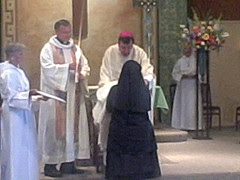
Resonances of the Son's renewed acceptance of his place in protecting the patrimony of his family and People are not far from the hermit's heart when she makes her vows in the hands of the Bishop while resting them on the book of Gospels, or signs those same vows on the altar, or is congratulated and welcomed in her new standing by friends, family, and especially the whole parish community at the Eucharistic Feast. I would think the lay hermit who lives her eremitical life by virtue of her baptismal consecration alone might well perceive similar resonances with 1) her baptism, which initiates her into the family of followers of Christ, 2) her anointing with chrism, 3) her clothing with the white baptismal garment, and 4) the giving of the baptismal candle, which is accompanied by the commission to keep it burning brightly as a witness to others. In either case, and in all other instances of ecclesial commissioning, standing in the Church comes with responsibilities, and rights are accompanied by obligations. The matter is both canonical and profoundly Scriptural, but as I understand it, it is Scriptural long before it is canonical.
_________________________________________________________

** I want to note here something that was not included when I first wrote this piece, namely, that because canonical standing is about both rights and responsibilities or obligations, it is not the kind of "status" associated with pride, arrogance, and some of the things that I  and others associated with c 603 have been accused of recently. 

The obligations assumed with public profession and consecration bind the person under the virtue of religion.  All vows do so. [[“A vow is a deliberate and free promise made to God concerning a possible and better good which must be fulfilled by reason of the virtue of religion.”]] However, this occurs with a different weight with public vows than with private vows: [[ Accepted by the Church’s authority, Public vows are binding in Church law and carry the full weight of the virtue of religion.]] This means that breaking or abandoning a (public) vow is always a grave matter and can thus be a mortal sin. 

Private vows involve a different weight than public vows; even so, this in no way makes them or the vocation they mark to be insignificant, or as something one might treat as a "has-been" kind of thing when one begins to feel they are "no longer [much of a] challenge or sacrifice". One needs to get private vows dispensed by one's pastor, for instance! The dispensation of public vows, even when entirely voluntary, is a bit more complicated and weighty in the eyes of the Church, and so, one presumes, in the eyes of God. 

30 October 2024

Have I been About the Creation of Precedents and Protocols with this Blog?

[[Hi Sister Laurel, I wondered what you make of the charge that you have made up all kinds of precedents and protocols for solitary hermit life under c 603? Is that really what you have been about with this blog? Does the charge have any merit, after all, not everything is written in c 603? Thanks!]]

Thanks to you as well; I am grateful for the question and surprised I have never received it before. Someone asked recently about the age of c 603 given that I have only been consecrated as a hermit for 17 years, but that was not quite the same question. When I look back at this blog over the past 17 years, I see one in which I have explored the nature and implications of c 603 and the vocation it governs.  As far as I know, I am responsible for only two precedents: 1) the post-nominal initials Er Dio (and variations like Erem Dio and ED), which Bishop Vigneron approved in 2008 on the anniversary of my consecration, and 2) a process of discernment and formation for c 603 hermits and their dioceses, drawn from my own experience of the challenging and formative nature of writing a liveable Rule, and which I have outlined here in brief form over the past several years. The first of these is pretty well established as diocesan hermits from a number of countries are permitted by their bishops to use these initials to indicate they are diocesan hermits. Everything else has been a part of my exploring this vocation and looking carefully at the implications of the canon and the public and ecclesial nature of the calling.

I am particularly pleased that these two precedents either already have been or are now being more widely adopted. The second one is by far more important, but I am still working on writing up the process of discernment and formation I have used with several dioceses/candidates thus far, so that is not yet ready for publication. One problem (but not the only one) is that some dioceses, it seems, don't have the staff to create a small team to accompany the candidate. Accommodations can be made, though this (small team with competent c 603 mentor approach) is still an ideal way to proceed to assist a good candidate, 1) to write a liveable Rule, 2) to educate themselves and the diocesan staff on this vocation, and 3) to discern and cooperate in God's formation of a sound vocation. Everything else here, I think, has been a function of my learning about my own vocation, exploring its depths and all of the rights and obligations which I embraced at perpetual profession and consecration. Though perhaps too repetitive, the questions folks ask have been really helpful here. Sometimes they stem from what I have written, sometimes from misunderstandings they are passing on, sometimes from simple curiosity or a hostile spirit, and sometimes they have been the result of someone wanting to become c 603 and asking questions that apply to their aspirations. 

The answers are never simply made up, however. Of course, they don't simply restate c 603 or the Catechism's paragraphs 920 and 921, because these are not the only texts that apply to the c 603 hermit. Other canons apply, whether because of the vows, the use of the term Catholic, religious garb, not-for-profit status, etc. Hermits' individual Rules also apply here. Too, I know to some extent how my diocese handled things (including frequency of meetings with three bishops and the Vicar for Religious while we had an interim bishop), and I have anecdotal material on other dioceses as well that I can draw from, including from the years before I was consecrated. And of course, the Church's theology of consecrated life applies, as it does to any consecrated vocation in the Church. So, what do I make of the charges that I almost single-handedly created precedents and protocols for c 603 vocations and distorted the canon and the vocation in the process? Well, at best they are exaggerated or significantly overblown, and at worst they are simply made up out of whole cloth while disregarding not only the canon's prehistory beginning with Vatican II, but the 24 years of c 603 life that preceded my own consecration and writing. 

What I find particularly hard to wrap my head around is that anyone could actually believe I have been so wildly influential rather than seeing instead that the Bishops, canonists, other c 603 hermits, and I are all exploring canon 603 in light of the Church's theology of consecrated life and therefore are simply coming to some of the same conclusions!! Yes, I write about the vocation from within it. I explore the implications of this new and ancient form of life. I think I appreciate what is possible for and required by it better than someone looking at the canon from the outside (which would include a lot of chancery staff and canonists), but c 603 already had a history of people living and exploring it before I was consecrated or began to write!  Of course, Bishops can and do certainly imagine, study, speak to others with experience of the canon, and have done so since @1983. And yes, today this might even include a few of them reading this blog, but that is still a far cry from my having been as influential as the "charges" have sometimes made out!

To summarize, when I began this blog, I wanted to explore the vocation and perhaps share it with anyone interested. It was relatively new despite the years since it had been published in the revised Code of Canon Law and was similarly unknown in parishes or among parish priests. I had not expected to find c 603 beautiful in the way it combines a vision of eremitical life embodying non-negotiable elements with the flexibility of a personal Rule inspired by the Holy Spirit in a way that captures the unique freedom of the consecrated hermit; I had not expected questions and answers would become the basic format of the blog, nor did I anticipate becoming something of an authority on this vocation. If that is what has occurred (and I believe that, to some very limited extent, it has), then I am grateful to God for that. Still, that I have overturned the "traditional" solitary hermit vocation and distorted c 603 with my writing here, or that I have single-handedly established all kinds of precedents and protocols, is fanciful! 

20 August 2024

Questions on Increasing Standardization of C 603 Vocations in the Future

[[Good morning Sr. Laurel, I have a couple of questions that I hope you can answer. First, how serious do you think local bishops actually take the eremitical vocation? In light of the recent temporary consecration of a transgender person, who by his own account doesn’t live the vocation, by a bishop I’ve begun to question just how knowledgeable some bishops are in regard to consecration as a hermit in the Church or how serious they take said consecration. It’s almost like the hermit vocation is seen as a dumping ground for people who desire a religious life but don’t “fit” in more typical expression.

Secondly, do you anticipate a time when diocesan/canonical hermits will become more standardized in regard to elements of the Rule of Life each individual writes? I understand each hermit is a solitary who lives their approved Rule in solitude but am curious as to the possibility of some aspects of the vocation be more standardized or at least perhaps clearer guidelines installed. I’d appreciate your thoughts. Thank you for all you do and for your blog. ]]

Thanks for these questions. Let me say at this point that they are important (as events during the Spring indicated emphatically); I completely agree that we sometimes see bishops implementing c 603 in ways that are both disedifying and irresponsible given the source and value of the vocation. Even so, I don't believe the answer lies in the direction of standardization precisely, but in the direction of educating bishops and their chanceries regarding the nature, charism, and significance of the vocation as a gift of God to the Church. Standardization, especially in terms of the hermit's Rule of Life, penalizes both solitary hermits living the vocation as the Holy Spirit calls them to, and those who take appropriate time and care for discernment and formation of such vocations. Where standardization will not work, however, appropriate guidelines and some critical expectations (which may be what you are envisioning) will. For instance, I recently wrote about the things a liveable Rule of Life should contain and the way that should be contextualized. You may have read this:

[[Each diocesan hermit's Rule of Life will capture 1) something of the hermit's experience of God as God has been at work in her life over the years, 2) her understanding of and commitment to the foundational elements of c 603, and 3) especially her experience of and faithfulness to redemption in Christ known and celebrated in the Gospel. These three are then contextualized within a public and ecclesial vocation lived for the sake of God, his Church, and all that is precious to God. [The hermit must show an understanding and commitment to these two foundational elements as well as to numbers 1-3!!] Together these constitute a personally integrated program of solitary eremitical living as a disciple, and too, as a spouse of Christ who truly is the hermit's Beloved. In other words, every facet of the c 603 hermit's Rule is transparent to and reflects the Gospel of God in Christ and is lived in the name of the Church.]]

People working to assist a hermit candidate for c 603 profession and consecration will expect a Rule of Life to meet these guidelines, and they will give the hermit candidate time to write such a Rule -- a very weighty project indeed! In the process I am currently working on and proposing to the Church, the writing of a truly liveable Rule combines these five elements and provides the framework for a substantial formation period and process. The diocesan team, along with a consulting c 603 hermit, learns as the hermit does what constitutes such a vocation and a liveable Rule under c 603, and they will discern whether this specific candidate is truly called to such a public and ecclesial vocation through the way they work on and complete this critical project. In other words, the writing of one's Rule, given the guidelines mentioned above, serves as the framework for both discernment and formation of a c 603 vocation. It will take time to do well,  and it will also provide for the basis of conversations between the candidate and diocesan team and consultants, as well as help assure that the candidate and the diocese understand and have embraced the c 603 vocation as a God-given gift before any profession of vows.

My main complaint about standardization is that one can get a person desiring to be professed to jump through any hoops provided in canon law (or in a diocese's particular approach), but this does not mean the person has a vocation. This is especially true when we are speaking of the addition of canonical stages and time frames. In community life, these kinds of requirements are helpful and appropriate, but in solitary eremitical life, there is no community to help assess the way the hermit is proceeding or maturing in their eremitical life. Moving through stages and time frames can be done so long as one is sufficiently motivated (or desperate enough) to do that. This does not ensure one has a vocation. As one of my Directors reminded me about her time as Vicar for Religious and Assistant Vocation Director of the Diocese of Oakland, "discernment is an art;" formation is very much the same. So, while standardization can assure good hoop jumpers, your suggestion of guidelines along with clear expectations allowing for flexibility are very much more workable for solitary hermits. These begin with the single concrete requirement of the canon, namely the writing of a (liveable) Rule of life because the Rule must include every element of the canon and demonstrate an experiential understanding of and commitment to these. 

I don't know that we will ever get every bishop to understand the nature of solitary eremitical vocations, much less to regard them as a gift of God to the Church we must adequately esteem and protect, but I am convinced that is the direction we must take to prevent more situations like the one you mentioned. While in general, I tend to believe most bishops take c 603 seriously, particularly when they are clued in regarding the importance of the vocation -- hence my surprise with Bp Stowe's actions in Cole Matson's regard -- I think we really must take the time to educate them and their staff regarding the charism of the vocation. We must especially do this in a way that helps them understand why the vocation is critical to the life of the Church, and why we expect the Church to admit to profession only those who are prepared for that, are truly called by God, and who believe whole-heartedly in the vocation they propose to become publicly and ecclesially responsible for.

12 August 2024

Evaluating this Blog and Other Questions re Discernment

[[Sister Laurel, does c 603 say, "Besides private profession"? I looked and couldn't find that so I wondered if I had a bad translation. Can bishops remove canonical approval from someone when they speak out publicly? Also, does a person's bishop read their public media, their blogs, etc. One hermit I know says bishops should be doing this, and I wondered if you agree.. . .If you find another hermit disagreeing with you about something important, like the way you live solitude, or wear a habit, or things like that, what do you do?]]

Thanks for your questions. No, canon 603 does not say, "besides private profession . . ." Not only are those words not present in the canon (I am sure your translation was just fine), but what eremitical life is being contrasted with are institutes of consecrated life. This means canonical Religious Congregations and Communities. The canon reads, [[Besides institutes of consecrated life. . .]] and then goes on to state that the Church now recognizes eremitical or anchoritic life. Institutes of consecrated life do not use private vows. They are public vocations with public vows and now, with canon 603, so too is solitary eremitical life lived under the canon. Similarly, the word "profession" is not used for private vows because the act of profession is a public one that always initiates the person making such a profession into a new state of life. Using private and profession together is an oxymoron. The bottom line is that c 603 establishes c 603 hermits or anchorites in the consecrated state just as religious in communities are established that way.

Regarding speaking out publicly and what you call "removing canonical approval", as I have written before, the use of the term "canonical approval" ceases to be helpful after one is admitted to canonical standing. What is at stake once one is professed is not approval, canonical or otherwise, but standing in law. If one's bishop determines that some action one has taken is seriously contrary to one's profession and consecration, then he can take actions to dispense the hermit's vows and remove her from the consecrated state of life. But let me be clear, depending on what we are talking about, the action would have to be very serious indeed. Ordinarily, a serious transgression would require a correction and warning that one is jeopardizing one's eremitical life in this way and then too, a second transgression in spite of the correction and warning. (Usually, we are dealing with patterns of behavior that the hermit refuses to change despite significant chances for rehabilitation.) Even then, the hermit can appeal the finding that deprives her of her vows and state of life. Simply speaking out on some issue or another is unlikely to rise to this level.

 I would assume that bishops and/or delegates will know about a hermit's blog, and certainly, they will know about it if the hermit posts frequently as I do. (This will indicate it is important in her life in some way, and most superiors will know what is important to someone they are working with.) Moreover, if the blog is useful in exploring dimensions of c 603, dealing with problems in implementing it, etc., they might encourage this activity. In other words, I don't see any reason bishops should not be reading a person's blog; they might truly benefit from it.

Excursus: Most diocesan hermits begin blogs, but few continue with the exercise. I have begun to invite other diocesan hermits to contribute here occasionally if they have something regarding eremitical life, spirituality, or c 603 life and spirituality particularly --- if they would like to share. I know that this blog has been helpful to some canonists and bishops, and of course, it has been helpful to those seeking to become c 603 hermits, so it would be really excellent if we could broaden the voices available here and deal with things I may not ordinarily focus on or be strong in. (So, notice to c 603 hermits, especially if I have not met you yet, if you feel like you would like to write a piece for this blog, please let me know. There are a couple of kinds of posts here that might already prepare the way for such contributions, we can pretty much do what it takes to make it work for you.)  A couple of persons are already thinking about what they might contribute, and one canonist has already written something on lauras; please give it some thought and prayer. (If you are a non-canonical hermit and would like to contribute to this blog, please let me know what you have in mind and we'll see what we can do!!)

That apparent tangent indicates that bishops do find this blog helpful in some ways and my sense is that a number of bishops may have read this blog during the kerfuffle with Cole Matson after Pentecost and found it helpful. I don't know whether Bp Michael Barber knows about or reads this blog, but I know my delegates are aware of it because I share about my writing with them, and at least sometimes, specific pieces and issues. In the beginning, I had some decisions to make about the place of this exercise in my life, particularly things like whether to allow comments or not. (My decision on that was that it made the boundary between my hermitage and the public too porous; I disallowed comments.) And over time it has assumed a shape and importance I never really expected. That means that I am not concerned with what any given bishop actually thinks of pieces within the blog itself. It does not matter if a single bishop here or there disagrees with my keeping a blog; it has been significant for my growth and contributed to an understanding of c 603 which is beneficial to the Church and to this specifically ecclesial vocation.

But of course, this blog is not the last word on c 603!! It is a contribution to ongoing discussions, nothing more nor less. If I find someone disagreeing with me on something important, the first thing I will do is listen and pray about it. The next thing I will do alongside these other things (if I think there could be merit in the disagreement or know the knowledgeability and trustworthiness of the person commenting) is to reread my Rule and the way I spoke there about solitude (your question's example), for instance. If there are footnotes in the Rule, or newer references I should also check, I will do that. Finally, especially if I am troubled by something or otherwise uncertain, I will bring the topic to my Director and discuss it and the way I am living it with her. The person who disagreed might represent a valid challenge with God asking me for something more or something different through their observations. At the same time, staying with your example of solitude, some versions of solitude are less about eremitical solitude than they are about isolation. While I believe in reclusion (which is always profoundly rooted in and dependent upon community), I regard isolation as unhealthy and unworthy of being chosen. 

Remember that, these kinds of questions can come up again in various ways over the years and will have been discussed and discerned as they do. If changes in my Rule were needed, then they were made. Still, the bottom line in all of this, I think, is that my Rule is something I live and tend to trust. It reflects a particular vision of canon 603 that the Church has approved as representing God's will for me. I don't live someone else's vision of c 603, but the one I have come to in dialogue with God in all the ways God speaks to me. If that means rejecting someone else's way of living the terms of the canon, for instance, then I will do that. If that means changes in praxis or understanding (and the rewriting of portions of my Rule), then I will discern and accomplish those necessary shifts.

15 March 2024

Canon 603 Hermits: How Important is a Background in Religious Life?

[[Dear Sister, I was wondering if Canon 603 works better for those who have been in religious life before living as a hermit? I was thinking that those who have been in religious life before already know a lot, have developed a solid spirituality, and may have less to change or let go of, if you know what I mean. Have you worked with former religious who want to become hermits? Do they make better hermits than those without a background in religious life?]] 

Interesting questions! I think this is the first time they have been asked. Yes, I have corresponded with and sometimes even worked with Sisters who felt they were called to life as hermits, though my personal experience in this work is relatively limited. I don't know that former religious make "better hermits" under c 603 than those without any experience of religious life, but of those I have worked with, the foundation supplied by initial formation in community seems to be almost indispensable. That "almost" is important because canon 603 does not explicitly require one have been in religious life prior to entering into a mutual discernment process with one's diocese re canon 603. Still, when I met and introduced myself as a diocesan hermit to Bishop Remi de Roo who was responsible for the intervention at Vatican II that eventuated in c 603 in the revised Code of Canon Law, the first question he asked me was whether I had come to eremitical life from (cenobitical) religious life. (Bishop De Roo had been the bishop protector of about a dozen monks who had left long histories in monastic life. This experience led him to make the intervention at the 2nd Vatican Council regarding recognizing eremitical life in the consecrated state. He certainly understood the importance of a strong background in religious life.)

The equivalent of such a background can be gotten apart from religious life, but it takes dedicated work on the part of the candidate with the assistance of others to do that. Moreover, the time initial formation takes before first vows is correspondingly longer for those who have no background in religious life. Moving from no background in religious life to truly discerning a call to eremitical solitude and preparing for a life commitment in this state of life is a long process and while the lion's share of this formation occurs in the hermitage alone with God, it must still be supervised and directed. This requires not only spiritual directors, but mentors as well. One key to discerning readiness for such a commitment is the canon's requirement that one write a Rule of Life. Many candidates fail in this specific requirement because the degree of experience and learning it requires is very significant indeed. Such failures seem to happen more frequently in those without a background in religious life.

I should also point out that those who have lived religious life before discovering a call to eremitical solitude must let go of many things too. Sometimes they also have still to develop the strong spirituality you refer to, not least because their life of prayer is no longer mainly communal. The individual schedule that works best for them may not yet be known and require experimentation over time. For instance, it might take them some time to discover that they pray best in the middle of the night or that they are late night people rather than early morning people (or vice versa). 

The freedom to set one's own schedule can be quite challenging. Learning that one does not have to be active at all times, that "praying always" does not mean merely saying prayers and might (at least superficially) look like "wasting time" in the eremitical life. Finding what resources one needs for praying Office alone will take experimentation and sustaining a sense of God's presence in the absence of faithful brothers and sisters may require extra attention. Finding ways to become truly self-supporting, as well as locating a good place to live in the silence of solitude is essential and takes time and sometimes special training and corresponding resources. Too, the hermit will need to learn new ways of understanding and living the evangelical counsels that living alone and being self-supporting requires. Religious poverty will differ in some significant ways as will religious obedience. Also, dealing with personal illness, whether acute or chronic, will be different than doing that in community. For some, these transitions are very difficult to negotiate and so is the underlying freedom and sense that it all depends on their own discernment.

The point is that whether one comes to eremitical life from a long period in religious life or from some other background, there will be a significant learning curve that occurs over a similarly significant period.  Every consecrated solitary hermit's life is similar to every other hermit's life in major ways (that is, they all include the central elements of canon 603) and yet, it seems to me that what is more striking is the variation each life reveals. I know some diocesan hermits as well as several hermits who are exploring c 603 and preparing for profession and/or consecration. Each one embraces and lives the central elements of the canon differently than the others because their life with God differs from that of other hermits. I think it is important that anyone working with candidates for profession under canon 603 understands this and that they let go of any sense that schedules, prayer practices, etc, must look the same from hermit to hermit. (Chancery personnel have as much to learn about hermit vocations as anyone else!)

It remains critical to understand that while c 603 does not formally or explicitly require a background in religious life, even so, writing a Rule of Life suitable to the living of such a life requires significant experience and formation that is more usually gotten in religious life. It can be done, yes, but I personally believe it is a relatively rare candidate for profession that will be able to accomplish this particular requirement without a background in religious life. Ironically, one of the best ways to determine the formation a person has and also still needs is by reading their Rule, or working with them as they write it. Thus, again, while c 603 does not explicitly require a background in religious life, it may be the case that the authors of the canon strongly implied the necessity of such a background by making the hermit responsible for writing their own Rule.

17 February 2024

Followup on Does a Rule Need to be Perfect: More on Writing Several Rules over Time (Reprise)

[[Dear Sister, thanks for your reply to my question. What happens if I don't want to write more than one Rule and my diocese doesn't ask me to? What I have written so far seems fine to me and I can't see revising it. Besides I am not much of a writer.]]

Good questions and similar to others I have been asked (another person said they weren't much of a writer, for instance, and wondered what then?). The purpose of the suggestion of writing and using several different Rules over time is first of all to assist both the candidate and the diocese in maintaining a discernment process that is both long enough but not onerous to either relevant diocesan personnel or the candidate herself.

Sometimes it takes a while for the quality of the vocation to become clear to the diocesan staff working with the candidate. Indications of growth can be more clearly seen in the quality of the Rule (or portions of the Rule) being submitted --- especially since the hermit's life is lived in solitude and not in a house of formation with intense oversight and more constant evaluation. Moreover, dioceses are not responsible for the formation of a hermit; that occurs in solitude itself. Even so dioceses must evaluate the way the individual's formation in eremitical solitude is proceeding and they may be helpful in making concrete suggestions or supplying access to resources from which the candidate might benefit. Several different Rules written over a period of years will uncover areas of strength, weakness, and even deficiency and allow the diocese to respond both knowledgeably and appropriately.

What tends to happen when a diocese does not have such a tool to use is either the relatively immediate acceptance of candidates as suitable for discernment or a more or less immediate dismissal as unsuitable. Dioceses cannot usually follow the hermit's progress sufficiently closely otherwise and without such a tool they may have neither the time, the expertise, nor the patience to extend the discernment period sufficiently. Likewise they may not have the basis for helpful conversations with the candidate that such Rules can provide. I have always felt fortunate to have had a Sister work with me over a period of five years and during those years to actually meet with me at my hermitage. She listened carefully, consulted experts in the eremitical life and its formation and discernment, and generally did what she could in my regard; still, I believe the tool being discussed here would have assisted her and the diocese more generally. It would have helped me as well.

Of course, you are free to write one Rule and trust that that is sufficient in providing insight into your vocation for your diocese. Perhaps it will be sufficient to govern your eremitical life for some time as well. If you have a background in religious life and are familiar with the way Rules are written and function that is much more likely. Similarly, of course, your diocese is free to adopt whatever approach works best for them as well. I personally suggest the use of several Rules written over several years so that dioceses have 1) sufficient resources (including time) for discernment, so 2) the process of discernment and formation will not be curtailed prematurely or stretched endlessly and fruitlessly. I also suggest it so that 3) the candidate herself has a kind of structure which allows what happens in the freedom of solitude to be made clear to her diocese while assuring sufficient time for that to mature. (It is important to remember that the process of writing is a very significantly formative experience itself and contributes to one's own discernment as well.)

Ordinary time frames (for candidacy, novitiate, juniorate, and perpetual profession) do not really work for solitary hermits because the hermit's time in solitude is not so closely observed; neither does it have the degree of social interaction which is a normal element of growth in religious life. Beyond these there is a rhythm to life in eremitical solitude which will include both "tearing down" and building up and which occurs according to God's own time, not to a more or less arbitrary or even more usual temporal schema. Something must replace or at least approximate some of the functions the more usual elements of life in community serve but do so instead in terms of the diocese's relation with the candidate. It must allow and assist both candidate and diocese to have patience with this unique and sometimes counterintuitive process of formation. Moreover, both hermit candidate and diocese must recognize that the eremitical life is about the quality of the journey with God itself and not become too focused on destination points per se (postulancy, novitiate, juniorate, etc).

To summarize then, the use of several Rules written to reflect stages or degrees of growth as the candidate herself is ready to do this helps ensure both individual flexibility from candidate to candidate as well as sufficient length of time and patience on everyone's part to assure adequate growth and discernment. It is merely a tool, though I believe it could be a very effective one in assuring authentic vocations are recognized and fostered.

10 September 2023

What Happens to a Canon 603 Hermit if a New Bishop is Installed?

 [[If, for example, a (diocesan) hermit had a new bishop come to the diocese, and that bishop did not want (diocesan) hermits, the (diocesan) hermit would need to find a diocese in which the bishop was accepting hermits under his direction, and relocate.]] 

Dear Sister, is this quote true? I read it on a hermit's blog. . . . I checked with someone at the chancery and they said they would need to check with someone else, but they also thought not. Just wanted to check with you as well. I am not up to moving to a new diocese, particularly if it means uprooting every part of my life as this would!! Especially, I am not up to starting this process all over again in another diocese.]]

Thanks for writing. I am glad you decided to check this out. Your chancery contact was correct in his/her impression. The quote is mistaken.

If a diocesan Ordinary is replaced by another, and that new bishop doesn't want to profess hermits under c 603, he doesn't generally have to do so --- except in one case. Even then it would be a matter of acting in good faith and charity to complete something begun under his predecessor, not a matter of having no choice. Suppose a hermit has been temporary professed under c 603 in the hands of his predecessor and has continued to live her vocation in a faithful way. In that case, she should be able to count on being admitted to perpetual profession in a timely manner by the new bishop so long as she and those responsible for her vocation continue to discern that diocesan eremitical life is her vocation. If that hermit is already perpetually professed, however, the new bishop needs to accept that it is his role to supervise this vocation in some substantive way. This specific vocation comes to him with his assumption of responsibility for the diocese, and he needs to accept that, no matter how personally challenging he finds this. The hermit who is perpetually professed and consecrated does not have to uproot, search for a willing bishop, find another SD, locate housing, parish, etc., and incur the expense of such a move simply because one bishop does not want to use a Canon that is already in effect in universal law.

I have not run into a case where someone who is either preparing for profession or who has already made a temporary profession is simply left high and dry when a new bishop is installed. I am aware of one situation where the Archbishop will be retiring in another year or so; even so, in this specific case there has been an auxiliary bishop overseeing the individual's progress; the general sense is that the candidate can confidently continue on with the process of discernment and formation she has been working through for more than a year and a half now and do so under the auxiliary. Hermits seeking profession under canon 603 do not move through the process all at the same speed, and they are not ready for profession at the same time. One of the things we are trying to get dioceses to recognize is that writing a liveable Rule -- as required by the canon --- takes significant experience and time. The process of discernment and formation is more individualized for this vocation than any other I know. The process of writing a Rule helps with both of these, both for the candidate and for the discernment team. Chanceries do tend to know some of this and act in good faith regarding admission to profession.

Further Considerations and Possibilities:

Your own situation raises the difficulties of moving to another diocese very clearly. The demands they would place on you to continue following this vocation would be inordinate and unacceptable, especially given both CC 603 and 605 that are universally binding within the Church. You have not said whether you are temporary professed or not, but I do agree that even if you are in temporary vows now, moving to another diocese would essentially mean starting over again. I think that would be true even if your current bishop and those others who have worked with you over the years wrote glowing recommendations. I think it is really important that you find a way to ease your concerns in this matter as much as possible. If the new bishop is not here already, get an appointment with the current Ordinary as well as with the chancery personnel who have been working with you during the past years, and apprise them of your concerns. 

If they can assure you your own discernment/formation process will continue without the prospect of it being derailed because of a new bishop, then excellent! If this assurance cannot be given, another option might be for the diocese to anticipate perpetual profession and celebrate this before your current bishop leaves office. If this is not possible, however, try to get a sense of what you still need to do so that you are ready for that step as soon as possible. If you are working on your Rule, then try to get an assessment of where that is still weak or incomplete. There are posts on writing a Rule on this blog, including a new post on "the basics". Much of writing a Rule has to do with sufficient experience and reflection. What you include in your Rule will be used by your diocese to help determine your own readiness for perpetual or definitive commitment. Do get some specific answers from vocation personnel in regard to their own work with you. At least this will help ensure both they and you are clear about your progress and any concerns regarding your vocation.

And, of course, if you are already definitively professed and consecrated, you have nothing to worry about in any case. Still, if the incoming bishop does not want C 603 hermits, one thing you may want to consider is that he may also not plan on supervising your vocation as C 603 calls for. Neither may he be able to do so. In that case, if you have not already done so, I recommend you ask your current bishop to approve a delegate with whom you will meet in place of or in addition to the local ordinary. Hermits ordinarily choose their delegate, but some bishops will assign them. In either case, a delegate serves as a quasi-superior and can ease the burden on the bishop by meeting with the hermit more frequently than bishops can ordinarily do. I work very closely with my delegate(s) and that has seen me through various bishops and degrees of availability. Moreover, since my co-delegate(s) are both women Religious with backgrounds in formation and leadership, our level of sharing is greater than it might be with a bishop I see but once or twice a year. Just something to consider.

07 September 2023

On Writing a Rule of Life: Additional Suggestions --- the Basics

While I don't want to bore readers by repeating what else I have said about writing a Rule, and while I want to refer folks to all of that as valuable, I sometimes hear from or work with people who are struggling with the task and need a bit more help. Yes, a Rule should deal with the elements of the Canon and yes, the Rule should reflect the way God works in one's life --- and, if possible, the way God has done this over a number of years, but what if it still all feels unwieldy, and, because of the richness or complexity of one's life, it is unwieldy? How should one proceed then? Here are a few suggestions: First, begin with the basics. 

If you are planning on writing a Rule for life under Canon 603, begin by writing a separate document that addresses the central elements of the Canon. This will not be your Rule, but it will contribute greatly to your ability to write such a Rule. (Even if you are not planning on being professed and consecrated under Canon 603, the central elements will speak to the life you are living as a hermit.) Those elements are 1) assiduous prayer and penance, 2) stricter separation from the world, 3) the silence of solitude, 4) the Evangelical counsels (poverty, chastity in celibacy, obedience), 5) embracing this calling for the salvation of the world and the glory and praise of God, 6) under the supervision of the local ordinary, 7) according to a Rule of Life one writes oneself. So, to begin with, choose one or two of these elements to focus on. (I recommend beginning with a couple of the first four.)

Once you have done this, answer the following questions for each element. First, what is it?? If you have chosen assiduous prayer and penance, to reflect on and write about, for instance, be sure to define how you understand all of the terms in that phrase. What is prayer? Penance? How do you understand these things now, today? What does the Canon call for by requiring assiduous prayer and penance? What does assiduous mean in this element? What does it NOT mean? (For instance, it may or may not mean saying prayers all day; certainly, assiduous penance is unlikely to mean wearing a hairshirt or cilice or refusing to take the medicines one needs to feel and be well!!) Write as much as you know personally about these terms. Secondly, how do you live this element of the Canon today? Describe all the elements of your life that are part and parcel of  "assiduous prayer and penance". Do not write about what you hope one day to live but what you live today. This is no place for idealizing things. God is at work in your life and appears to have brought you to this place. Articulate and claim how that is happening now, today.

With some elements of the canon, defining what they are is more challenging. For instance, did you notice that that canon does not read silence and solitude, but rather, "the silence of solitude"? While this term includes external silence and physical solitude, it is also more than these. Thus, you will need to define the individual terms that make up the element required by the canon, and you will also need to define the larger element that is more than the sum of its parts. If you don't understand this personally yet, define what you can and say how you live what you can define, but make a note for yourself about what you have not yet defined! It is something you will need to understand and write about before admission to perpetual profession. 

Something similar is true for "stricter separation from the world". What does the term, "the world" mean in this phrase? This is not what some folks think it means and it is not even what some religious and monastics have said from time to time!! What does it not mean, or at least, not primarily mean? How about the word stricter? Stricter than what? What limits can or even must legitimately be put on the term "Stricter" -- assuming it does not mean absolute!? "Separation" needs to be looked at as well. What is healthy separation (generally, for most hermits, and also for yourself), and what is not? For some, this term calls for complete reclusion and a support structure to assist in this, while for others, complete reclusion would result in the destruction of one's psychological health and vocation. I think you see what I mean when I speak of answering the questions, "What is it?" and "How do I live it?" Again, no idealizing. Keep your writing in the present!

The third question I suggest you answer with regard to each central element of the Canon is, "Why is this important?" Various ways of looking at this question include: why is it important for religious life generally? How about eremitical life more specifically? Why is this element important for the Church or her witness to Jesus Christ and the Gospel? Does it bring a special clarity or vividness when lived by a hermit? Are there any groups of people for whom a hermit's living this will be especially important and in what way? And finally, why is this important for your own life with God? In what ways has this element helped you to see and grow to be the person God has called you to be? What allows you to speak with confidence that this is what God has called you to? Whatever further questions help you to say why this element is important and thus needs to be included in both the Canon and your own Rule can be added as needed. In any case, allow these questions to rumble around inside yourself until you have clear answers to them. As you continue discerning and being formed in this vocation, do as Rainer Marie Rilke suggested to the young poet and "live the questions"! 

Doing so may help you answer the fourth question I suggest you answer, namely, how have I grown in my understanding and living out of this element of the vocation? I have told the story before that I did not even include stricter separation from the world in the first Rule I wrote for my diocese. There were several reasons for this including the fact that I didn't understand what this meant or asked for from me and that I wasn't sure I saw the need for such a stance toward "the world". However, the next time I wrote a Rule (during prep for perpetual profession) I included this element and my growth in understanding and living this element was significant! It was a question that had indeed roiled and rumbled around inside of me as I read more widely on the topic and grew in my vocation.  Because I took the elements of C 603 seriously this one was one of the questions I definitely lived as I approached all aspects of my life prayerfully.

Once you have done this exercise for all of the elements including each vow (or their correlative values) included in C 603, you will find you have a major portion of the heart of your Rule already complete and you will be able to draw on this document as you actually compose your Rule. I would urge you to take your time in this. If I were working with someone to assist them in writing a Rule, I would expect this stage of things to take at least a year or two. At least I would not be surprised were that the case. One will need to research terms and their usage throughout the history of eremitical life,  and in religious life more generally. One will need to reflect on and pray about these terms, make decisions on levels of validity and importance, and then, try them on for size over time. One will need to articulate why one lives whatever definitions of each element one does, and why one rejects or finds other definitions or understandings unhelpful or even unhealthy. All of this takes time, research, prayer, reflection, discussion with those who accompany one in one's journey toward profession and consecration or private avowal, and then too, the struggle to put all of it into words that reflect one's own vision of what it means to live out the terms of Canon 603 or solitary eremitical life in the 21st Century.

I'll return with more suggestions in the future. Some of these will be about the essential elements the Canon does not mention but which need to be reflected in an effective Rule of Life --- things like work, recreation, relationships, support systems (including spiritual direction and oblature with a specific monastery, etc.), finances, and more. For now, consider this part 1 of "Additional Suggestions".

17 March 2022

Retired with Questions on Living Eremitical Life

[[ Hi. I am recently retired, and, although I still have some obligations "in the world," I spend most of my time at home, where I live alone. For several weeks now I have been living an eremitic life while at home or similarly alone. I am wondering about eventually making private vows, initially for very short periods. But I have a concern. Currently, since I can "walk away" at any time, I can sincerely pray, for example, "Jesus, I am living this way because I want to be united more closely with you." But after making a vow, I'm worried that all I could pray is, "Jesus, I am living this way because I promised I would." Can you provide any advice on this? ]]

Thanks for your questions. First, I would say it is way too early for any kind of vows, private or otherwise. I appreciate you are living a period of solitude right now, but it is not eremitical, not yet anyway. Remember, you have retired and are in a transitional period of greater solitude. This is not eremitical solitude; eremitical solitude is not transitional solitude. You are beginning to negotiate how you will live retired life with all the questions that raises about how and why you are going to live moving forward in whatever way you choose to do that. Also, we are still dealing with the pandemic's enforced solitude in most places. Neither is this eremitical solitude --- though for some it might grow into this. Give yourself at least a year of living as you are. Also begin working regularly with a spiritual director who can assist you in this transitional time of discernment and bereavement (for there is serious loss upon retirement). 

If you mean your time to be eremitical, then after a transitional year, begin to make your life truly eremitical in all the ways a hermit would be living this time. (My concern here is that you deal with bereavement and loss before trying to become a hermit in a focused way. That ordinarily takes more than a year, but at the end of a year you might be in a position to focus on becoming a hermit as you continue transitioning in a new mode. The two things will overlap to some extent, but in the beginning, I think you must give attention to different things during this time, first to transitioning and bereavement, and then to eremitical life per se.)

Especially continue to ask yourself why you are doing this. Because there is only ONE reason to be living eremitical solitude, namely, God calls us to do so. So, does God seem to be calling you to this? If so, do you want to truly respond to that call in this way or not? At that point you might write yourself a Rule or set of guidelines regarding how God wants you to live this response of yours. Central to this Rule or set of guidelines will be an account of the ways God works in your life and how you respond to that working. There will be values you want to witness to, practices you want to model. There will be a vision of the life you are choosing to live. A Rule, Plan of Life or set of guidelines should reflect all of these. Live these for another year or two. With the assistance of your director, modify them as needed in the direction of how you feel called by God to live and continue living in this way for another couple of years; if at this point you are still clear that you are called by God to this, then, if you need to do this, write a liveable Rule you propose to live for at least five years. 

At this point you might be ready to make private vows for a period of a year or two which you can renew as needed until you are ready make a perpetual vow. (Please note: what changes and has been changing here is your understanding of and increasing ability to live the life, not your intention to love God in the way you are called. Remember that whenever one makes a vow, one intends to live it wholeheartedly for the rest of one's life. Even temporary vows are made with this deep intention. The idea is that while a vow may by temporally limited, one's gift of self to God is not. If you cannot do this, I would suggest you hold off making even a temporary commitment.)

If, at every point you can affirm not only that you want to be united more closely with Jesus, but can also say, "Jesus, I feel you calling me to unite myself to you in this specific way", a vow is not going to change that in the way you believe (or fear). It should express, codify, and strengthen your commitment of self. It is true that sometimes after making the vow, in the course of years you may feel at times that you are only living this because you committed to doing so. So? What if you were speaking of another relationship, one with a good friend where you committed to always "having their back" or something. Would that promise or commitment vitiate the friendship? Or is it a way of honoring and protecting the friendship in good times and bad? Are you friends merely because you promised you would have this person's back or did you promise what you did because of something deeper and very real? With vocations these same dynamics can be at play and your vow can hold you until you regain a better sense of things -- or as you negotiate seemingly chaotic periods of growth where you move "from faith to (deeper) faith".

After all, you discerned with the assistance of your spiritual director that were called to this and you responded with an eventual commitment.  (I am assuming this will be the case.) Your commitment was called for by what you discerned. Generally speaking you felt called and therefore made a commitment; you must always be able to say you live the commitment your were called to make. If your commitment keeps you responding to God's call when things are difficult, that is a good thing. It is a vow working as it is meant to work. If you cease to feel God is calling you to this life, then, again with the help of your director, discern whether you can continue keeping your commitment or not. Would this be false of you, insincere, merely willful, or is it the right thing to do until you regain a sense of what God is calling you to??

What I am saying throughout this is that only over time, with the help of a spiritual director, and lots of prayer, can you come to clarity on whether God is calling you to eremitical life. A commitment should not be made too early, but once it is made, it should help you to continue living a committed life. The commitment, if made rightly and based on good discernment, should strengthen the way you are living and intensify your love for Jesus. If it becomes empty in some way, it obliges you to get back in touch with your original motivations and sense of call. It obliges you to discern afresh and get in touch with what you initially discerned if that is possible. If, after some months of praying and working with your director on this, you cannot do that, then perhaps it is time to leave that commitment and this attempt at being a hermit behind.

I sincerely hope this is helpful. Please get back to me if it raises more questions.

In that light please see the addendum on this post above (It is the next post in the queue). I say a bit more about time frames (definitely not carved in stone) and the reason for them. I may decide to append them to this post, but they should do as the next (later) post. (https://2022/03/addendum-on-retired-and-seeking-to-live.html)

06 January 2022

More on the Process of Discernment and Formation of c 603 Hermits

 [[Hi Sister Laurel, I have read some of the things you have written about the discernment and formation of eremitical vocations. You seem to disagree with dioceses that establish time schemata associated with the canonical stages of religious life. Is that accurate and if it is, why do you disagree with it? You stress an approach which depends upon a candidate or hermit writing several different versions of their Rule of Life over time. How does this differ from a set period of candidacy, novitiate, and juniorate? What happens if someone using your approach decides they want to keep on writing new Rules and never come to the place where they need to leave the idea of eremitical life behind?]]

Happy New Year to you, and thanks for your questions. To clarify one point for accuracy, what I disagree with is not dioceses but canonists who write about approaches to implementing c 603 which are strong on canonical time frames, and formal stages, even as they are woefully short on an understanding of eremitical life or the central elements of canon 603 and the ways a person grows in these. As a corollary, I also disagree with the application of time frames which work well in a communal context but are insensitive to how fluid time can and often needs to be in a solitary eremitical context. Finally, I am amazed at canonists who write in ways meant to codify time frames for growth in solitude but show no sense at all that there are different kinds of solitude --- some transitional, some geared toward growth, others fostering a kind of personal decompensation, some escapist, others individualistic, some assisting life in community, and so forth. 

Eremitical solitude is not transitional, nor is it escapist or individualistic. One may need a period of transitional solitude when one leaves a given context or situation (like active ministry or religious life) just as one will need some times of transitional solitude during bereavement, for instance, but whether these will ever grow into eremitical solitude is unlikely or at least uncertain given the rarity of eremitical life itself. One needs to take care with the type of solitude one is dealing with in a candidate and since types or forms can and do overlap and confuse, it can take time to determine what one is dealing with --- more than it takes in community, for example. 

A Process NOT a Program:

What I have written about on this blog is not a program of discernment and formation (which, I think, is what time frames are meant to define) but a process. In the process I have tried to describe, the diocese provides sufficient support for the person discerning a c 603 vocation --- a small discernment and formation team, for instance, composed of the Vicar for Religious, and someone with expertise in formation in contemplative and/or eremitical life along with input from the person's spiritual director, and/or delegate. The process is driven by the "candidate's" own growth and needs. 

These will be reflected by the Rule she writes for herself at any given stage of discernment and formation, and the Rule will serve as a guide for discussions re the presence of an eremitical vocation, readiness for profession, resources required (extended time in monastic silence, lessons in praying the Divine Office or other forms of prayer, assistance with establishing cottage industries, classes in theology, Scripture, instruction in the vows,  etc). There should be a clear difference in the first Rule a would-be-hermit writes and the second, or third, or seventh, or tenth!! The formation team should be able to see progress in the person's lived experience and understanding of canon 603 and its constitutive elements. More, they should see signs that the person is growing in personal wholeness and holiness, that she is thriving in (and toward!) the silence of solitude even in the midst of the struggles it will also bring or involve.

In such a process the canonical stages appropriate to cenobitic life (life in community) simply have less meaning and are less quantifiable or even distinguishable. In any case such "stages" would need to be applied not according to a specific timetable, but according to one's readiness for the responsibilities associated with each stage of the life per se --- and these are not the same as those in coenobitical life. (A hermit is not being prepared to take on varying degrees of canonical responsibility within a congregation, but instead is being prepared to take a representative place in a living eremitical tradition.) It seems to me that the marker of such readiness is the capacity to write a liveable Rule of life after having written several experimental and less adequate Rules reflecting the would-be-hermit's growth in the life. 

On mistaking the inability to write a liveable Rule as a sign of no vocation: 

I have known people desiring to be c 603 hermits who spent several years trying and failing to put together a Rule. This did NOT necessarily mean they were not called to the life, but rather that they had a good deal to learn and especially, a lot to become consciously aware of before they could articulate it in the way a liveable Rule requires. For instance, to write a liveable Rule which concretely reflects a commitment to be open and responsive to God at work in one's life, one needs to cultivate all of those skills which are part and parcel of truly listening to/for God. One needs to know something of Who God is and who they themselves are, how God has been at work in their lives and the ways they have responded most fruitfully or refused to do so and why. Until one reaches some real degree of this level of awareness, they may be a lone individual, but they have not entered into eremitical solitude --- even as a novice hermit --- and they are certainly not ready to write a liveable Rule of Life.
This means the first several years of beginning to live as a hermit may be full of learning entirely new things, developing new skills, becoming aware in ways one was not aware before, and essentially undergoing a unique kind of conversion of mind and heart which is necessary to being a hermit in some "essential way". The process cannot be rushed, nor should it be shoehorned into the canonical time frame that works for religious living in community. And yet, this shoehorn approach is the one most canonists take, and so too, most dioceses that decide to implement c 603. If a person has not written a liveable Rule in the first couple of years after approaching a diocese with a petition for profession under c 603, dioceses are apt to dismiss them as unsuitable candidates for such a profession. 

Partly, I believe this occurs because the diocesan personnel don't have the first clue about how to accompany a budding solitary hermit on their own journey of discernment and formation, and partly it is due to the more fundamental failure to understand the distinction between lone individual and hermit in the first place. Equally foundationally problematical is the fact that diocesan staff, never having tried to do this themselves, often seem to believe writing a liveable Rule is a simple task that anyone should be able to do without assistance or significant preparation. Nothing could be further from the truth. Sometimes candidates are dismissed as unsuitable because the diocese doesn't actually believe in the hermit vocation at all --- though this lack of belief is rarely explicitly admitted; in such instances dioceses will not be able to accompany a candidate in the way needed. After all, if one does not esteem the vocation, one will hardly take the time needed to appropriately regard the process it requires for a candidate to embrace and be able to represent such a vocation! The process I have outlined on this blog serves to assist both the candidate and the diocese in taking solitary eremitical vocations seriously in a way which is organic to the vocation, to canon 603 itself, and therefore, is not unnecessarily onerous to either the candidate or the diocese.
Necessary Time Limits:


Your question about what is equivalent to the "perpetual doctoral student" problem where someone keeps writing and writing on their dissertation but never concludes it is well taken. There must be some time limits --- or at least there must be signs the hermit candidate is moving towards perpetual profession and the wholeness/holiness of an authentic vocation --- if the formation team is to continue working with them effectively. Otherwise, the process breaks down and everyone's time and energy are wasted. On the other end of the scale, there must be minimum time limits as well. A diocese must be clear that formation in religious life, while helpful, is not identical to that of the solitary hermit, nor in the Roman Catholic Church is canon 603 meant to define a "solitary religious" as the Episcopal Church allows in their canon law, but rather a true and solitary hermit (who is also, therefore, a religious). 

For someone leaving religious life in community (especially in active ministry), time for transition from life in community and active ministry, to adult life in a parish environment  (presuming they entered relatively soon after college), to contemplative life (if one really feels called to this), then to contemplative life in solitude (again, if one continues to feel called to this), and then to eremitical life per se must be given and required. This is so because each of these steps (especially in the beginning) can take various vocational forms, and these too must be discerned and established. Again, asking the candidate to write a Rule of Life which reflects her growing (or shifting) sense of these realities in her life can serve as a focus for ongoing discussion, direction, formation, and discernment of readiness to move in a somewhat more formal way from step to step toward profession as a canon 603 hermit. Time frames can serve as guidelines in all of this and for a lot of it, one needs only a good spiritual director. 

It is only once one is transitioning from contemplative life to even greater solitude that one begins discerning eremitical life per se and may reasonably consider and discern consecrated eremitical life under c 603. At this point approaching a diocese is meaningful, but not truly before this. When one approaches a diocese prematurely (especially before one is a hermit in the essential sense I mentioned above) one may merely ensure that one's true vocation is not realized, much less recognized.

On the Problem of Shoehorning "Vocations" into more usual Canonical Timeframes:

While there are a number of benefits to the process I have outlined, one of its real strengths is the fact that it does not ask a person to approach a diocese prematurely but allows a person to work carefully with her director until it is relatively clear that she really has an eremitical calling. At that point the person has already undertaken a significant personal discernment process which she can then share with the diocese and should be relatively ready to discern with her diocese whether or not she is ultimately called to a canon 603 (a solitary diocesan hermit) vocation. If a person approaches the diocese before this (before, that is, the various transitional forms of solitude, etc., have been worked through, for instance), everyone involved may mistake being a lone pious individual, for being a person with a vocation to eremitical solitude. Professing a lone individual who then calls herself a hermit is destructive to the vocation per se and will make canon 603 itself apparently incredible. On the other hand, if one approaches a diocese prematurely, a diocese can err in the opposite direction, and may decide the process is taking too long and simply dismiss the person as unsuitable for c 603 profession. 

The tendency to shoehorn c 603 vocations into the canonical time frames associated with canonical religious life in community makes either of these mistakes likely. In the first instance, the eremitical vocation is demeaned or trivialized, and the diocese may decide not to risk professing anyone under c 603 in the future. In the latter instance, a specific public (canonical) eremitical vocation which is a unique gift of the Holy Spirit, may be lost to the Church even though the individual can continue to live fruitfully as a privately dedicated (non-canonical) hermit. Remember that canon 603 was originally written because a number of vocations to eremitism with long preparation in monastic life had no way to be recognized canonically or lived according to the monastic house's proper law. 

As a result, years lived in solemn vows had to be relinquished, the monastics secularized, and ways to live as hermits explored apart from publicly vowed religious life. The long preparation for such a call was not accidental to discovering a vocation to eremitical solitude, but essential to it. For this reason, canon 603 also requires long preparation even though the diocese is not directly involved in most of it. This cannot and must not be forgotten; it is part of the canon's own history and nature.