Showing posts with label canonical standing --- relational standing. Show all posts

13 November 2026

Canonical Standing, Ecclesiality, and Publicly Accepting the Patrimony of the Church as Personal Responsibility

Dear Sister Laurel, posting about the rights and responsibilities you have as a consecrated hermit was helpful to me in understanding the place of law in your life. The reference to the parable of the prodigal son gave me an entirely new insight on the parable, but also on the way one might view canonical rights and responsibilities. You used the word covenant in your piece. Are canonical vows a way of becoming part of a covenant where one is responsible for [some part of] the family's patrimony or inheritance? 

This is a great question! Thanks!! I know I referred to all of these things in the post you referenced, though I may not have explicitly drawn the conclusion you have asked about. That you did so is really excellent and helpful to the conversation on this blog on the nature of ecclesial vocations. I haven't thought through your question sufficiently to give you a really good answer, but let me say a bit about it and come back to it another time. 

First, yes, the profession involved establishes a juridical relationship, but ecclesiality is more than this relationship. Genuine ecclesiality involves mutual responsibility so that not only does the hermit contribute her lived experience and her developing understanding of and ability to articulate the vocation's meaning, but the diocese accompanies, discerns, and, hopefully, learns not only about the eremitical life itself, but finds a vivid witness to the truth of the Gospel. For instance, in my own life, I am sure of the following things I am meant to witness to:

1) The fundamental nature of human existence is to be Emmanuel and to allow God to be Emmanuel. Even in our most abject aloneness, we are God-with-us. The challenge is to allow this consciously and in/with the whole of our lives. Solitude is never about being completely alone. It is always about being alone with God. Hermits know this well, and when they live their vocations in a healthy way, that brings them to human fullness, wholeness, and holiness, they do so through the grace of God alone. It is this observation that caused Merton to write: [[(the Hermit) owes this not only to himself but to his community that has gone so far as to give him a chance to live it out. . . . this is the chief obligation of the . . .hermit because, as I said above, it can restore to others their faith in certain latent possibilities of nature and of grace.]] (Contemplation in a World of Action, p. 242) Each of us is called to live a life where God is Emmanuel. This is the way we are brought to human fullness; it is the very nature of true humanity --- humanity made to be imago Christi.

2)  "God's grace is sufficient for us. God's power is perfected in weakness." In my own chronic illness and disability, this fundamental relationship we speak of as Emmanuel can, and is meant to shine through. It is my sincerest hope that my own wounds and scars become a witness to the fact that nothing can separate us from the love of God. (Rom 8)  As John 12:4 says, [[When he heard this, Jesus said, "This sickness will not end in death. No, it is for God's glory so that God's Son may be glorified through it." (Remember that glorified means not only honoring God, but allowing him to become real in space and time and made known or revealed to others.)

3) That human beings are existential "questions" in search of an equally existential "answer". (I'll clarify this abstract language later.) In my hermit life I know that hermit life reveals the human person most vividly as a profound question in search of the answer that is God. I believe I witness to this and canon 603 serves as a powerful framework allowing that witness.

It is my canonical relationship to the Church that allows my life to witness in these ways in the name of the Church --- both on her behalf, and with her authority (and supervision). The Gospel to which I witness and which I live daily in both weakness and in grace, is one I am covenanted in law to live my entire life for. Here law is important in establishing the stable, lasting state which such a commitment needs if it is to be lived fully, exhaustively, and over the whole of one's professed life in a world that militates against it at every turn. I and the Church understand this as the way I am to live my life for the praise of God and the salvation of others. This is an essential element of c 603 that prevents eremitical life in the Church from being or becoming an isolated or individualistic life lived for one's own sake alone. 

These elements and others are part of the Church's patrimony, the inheritance into which we are initiated and which we call the Good News!!! I have been especially entrusted with these dimensions of that patrimony by the Church. In my perpetual profession and consecration in 2007, I accepted this responsibility along with rights that assist me in carrying it out. Canon 603 itself assists in this by providing not a list of things to do (one who reads the canon in this way has not yet learned to read it adequately), but a vision of Christian life that transcends the limited vision I have been able to see in the midst of trauma, illness, and disability. 

I believe that this Canonical framework and vision help make of my eremitical life something really meaningful within and for the sake of the Church --- especially with regard to the chronically ill, the disabled, and the otherwise marginalized. Each of us needs to know how truly meaningful our lives are in Christ, no matter how limited, poor, powerless, etc. Catholic Hermits witness to this in the silence of solitude and the desert of their hermitages, and because of a specific covenantal relationship entered into at profession and consecration, they do so in the name of the Church. Thus, it is called to become a visible expression of the Church's own mission and holiness; the Church recognizes and celebrates this by giving the vocation a particular standing in law. The bottom line here is, as you say: canonical vows are absolutely a way of becoming part of a covenant in which one accepts specific responsibility for the family's patrimony or inheritance. That is part, and perhaps represents the heart, of the very nature of an ecclesial vocation.

04 November 2026

What Specifically Does the Church Hold You Responsible For? (Reprised from 2015 with new postscript)

[[Dear Sister Laurel, . . . What is hard to see clearly is what responsibility or responsibilities a hermit takes on. When you talk about [being a hermit] "in the Name of the Church," that refers to responsibility; I know that. But what specifically does the Church hold you responsible for? Is any of this based on the Bible, or is it all about Canon Law?]]

Scriptural Roots Exemplified:

Thank you for the questions.  Let me begin with the last one, which I believe is critically important. I think there are very clear Scriptural precedents for the Church's insistence that standing is inevitably associated with commensurate responsibilities. One of the most vivid is the parable of the Prodigal Son/Merciful Father. Remember that when the younger Son demanded "the property that would be his at his Father's death," he very specifically does NOT ask to assume the responsibilities of inheritance. In fact, he rejects these outright. Despite some English translations of the text, he asks for the "ousia", the very "substance" of the material or wealth portion of the patrimony that would come to him at his Father's death, but he does not use "kleronomia", the usual word for inheritance. This is significant because asking for the inheritance (kleronomia) necessarily includes acceptance of leadership for the family, their wealth, honor, and general well-being. In fact, it includes the pledge that one will give one's life for the family if need be.

Instead, this son effectively wishes his Father were dead, separates himself from the family, sells off his portion of the property for cheap (he does not bargain as is typical in the Middle Eastern culture but liquidates things quickly for whatever he can get in the moment), thus leaving his family in reduced circumstances; he then squanders the proceeds of his impulsivity, greed, and lack of compassion in "riotous (exorbitant) living" among foreigners. He becomes rootless, a wanderer without value or responsible role, someone who has exchanged the lasting or eternal for the entirely ephemeral. (By the way, it should be noted that in Jesus' day calling someone rootless in this way was an unpardonable offense; making oneself rootless was incredibly degrading.) 

Meanwhile, skipping ahead in the story, when the younger son returns home in yet even greater disgrace, he is restored to Sonship and will be honored by all the village as the Father's Son because of the robe, ring, and shoes with which his Father has clothed him. In other words, he has been re-established as one with genuine standing in the People of God and real responsibility within and for the family and the family's honor and wealth. With standing comes responsibility. To take what is due a Son and to do so while cutting all ties, betraying and sundering all relationships, and selfishly relinquishing all responsibility for one's family or the People of God is the very essence of sin in this NT parable. Despite some distorted approaches to spirituality, and the genuine limitations of life as a hermit, I would argue one cannot do these things in the name of eremitical life either. That way lies the disedifying isolation of counterfeits and curmudgeons rather than the ecclesial solitude of the Christian hermit.

Canonical Standing and Responsibilities:

 To accept canonical standing then (i.e., that which comes with public profession and//or consecration) is to accept the responsibility to act in whatever way one is commissioned by the Church to do in her name. The same is true with regard to Sacramental relationships and standing: Baptism (Sacraments of Initiation), Marriage, Ordination all come with specific responsibilities within the Church and for the very life OF the Church. In my own life, the specific obligations include: 1) an ecclesial vocation lived as an integral part of the Church's own life and holiness governed by both universal and proper law, 2) an eremitical vocation whose nature is defined by canon 603 and other canons related to consecrated or religious life. It includes stricter separation from the world (those things contrary or even resistant to Christ as well as those things which promise what only God can promise), assiduous prayer and penance, the silence of solitude, the evangelical counsels and all those imply, life according to an approved Rule I write myself, and the supervision of the diocesan Bishop and those he delegates to act as legitimate superiors and/or delegates (quasi-superiors).

In all this, I (and all diocesan hermits) am specifically responsible for living the eremitical life in the heart of the Church as a continuation of the prophetic life of the Desert Fathers, the pastorally significant lives of medieval anchorites, along with the hidden witness of so many other hermits, and for extending this rich tradition in ways which meet contemporary needs and speak to contemporary culture. 3) As a representative of these, I am also part of a parish and diocese; I was called forth from their midst and professed and consecrated in their presence, with them witnessing, supporting, and celebrating. As solitary as a hermit's vocation is, it is ecclesial, and so I live this life in my parish's midst and serve them and others as my eremitical life makes possible.

Bearing the parable of the Prodigal Son/Merciful Father in mind, as a Sister (that is, as a professed religious), I am responsible in various limited ways for dimensions of the life of this parish family. There is something similarly true with regard to the diocese as such, though ordinarily this is expressed in my commitment to parish life, or, occasionally, in diocesan events and diocese-wide celebrations, funerals, etc. It always means the parish and diocese are kept in my heart and prayer, but it sometimes means speaking at other parishes in the diocese, doing an occasional presentation at Contemplative Outreach or similar groups in the area, regarding desert spirituality, eremitical life, contemplative prayer, etc. In any case, I am responsible not merely to be a hermit, but to be a hermit in the heart of the Church and to appropriately allow the fruits of my own solitary contemplative life to nurture the life of the family I know as the local parish and diocesan Church.

In terms of the universal Church, I really do feel the obligation to live a life which is truly an extension of the eremitical tradition which has been part of her life since the 4th Century and certainly was an element of Jesus' own life, that of John the Baptist, Elijah, etc. And even beyond the universal Church is the world-at-large --- also searching, hurting, and yearning. Every person comes to communion with God in an essential solitude, and the hermit's life reminds them of this. At the same time, some effectively marginalized persons especially need the example of the hermit's solitude to come to a sense that their own isolation, no matter the circumstances causing or exacerbating it, can be redeemed through such communion.

Canon 603 is very specific about the hermit living her life for the praise of God and the salvation of the world. Her own prayer --- intercessory and otherwise --- is very important here, but so is the entire solitary life she lives as a public person in the Church. The very hiddenness of the hermit's life is, paradoxically, actually part of her public identity and witness. After all, most of the struggle, love, work, and prayer we all do in our lives is hidden "from the eyes of men" and sometimes that can tempt us to abandon this for notoriety, etc. A hermit reminds everyone that this is unnecessary and perhaps even illegitimate depending on what God wills in our lives. At the very least, the hermit's own life of essential hiddenness encourages patience and suggests a new way of seeing things. Especially, it encourages us to see the immense dignity of our lives and the significance of whatever we do in and with God, no matter how ordinary or how hidden.

So, I have a strong sense of responsibility in all of these ways. Moreover, as you very perceptively put it, the Church herself rightly holds me morally and legally responsible for living my life in these ways. Public profession and consecration establish a covenant between the individual professed and the Church more generally --- usually through an institute of consecrated life, but now with canon 603, through the hermit's diocese and local Bishop. The Church spells out some of this in the canon, but she fully (and rightly) expects the hermit who is publicly professed to concretize or make these obligations more specific in terms of her own prayer, study, reflection, and response to the grace of God as it comes to her through the relationships that constitute her life. This is another reason it is very important that there be sufficient formation and mutual discernment before admitting someone to profession and (then) consecration under canon 603. Through canon 603, diocesan hermits give their lives to Christ and to those who belong to him in what is intended to be an irrevocable gift. Thus, the Church that receives this gift needs to have the sense that the candidate has the necessary tools, sensibilities, maturity, and constitutive relationship with God and his Church to truly "flesh out" (or even incarnate) all of the potential which is profoundly embodied in this brief but richly pregnant canon.

Canonical or non-Canonical Hermits: Standing Comes with Responsibility, Rights with Obligations:

My own understanding of the Parable of the Merciful Father (aka Parable of the Prodigal Son) colors the way I see people who seek (or pretend to!) the status or standing of consecrated solitary hermits without accepting the responsibilities the Church associates with such standing. One's life in the Church always comes with commensurate responsibility. Standing as a publicly professed and/or consecrated person in the Church codifies such responsibilities in law. The Prodigal Son was given a robe, a ring, and sandals signifying his new standing in the family. It is not hard for the diocesan hermit to see or hear echoes of this story as the Bishop presents (or clothes her in) the prayer garment, eremitical tunic or scapular, and profession ring, or as he presents her a copy of his formal approval of her Rule, which establishes it as binding on the hermit in law as well as morally.

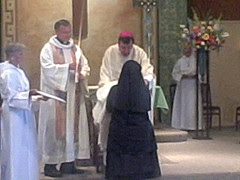
Resonances of the Son's renewed acceptance of his place in protecting the patrimony of his family and People are not far from the hermit's heart when she makes her vows in the hands of the Bishop while resting them on the book of Gospels, or signs those same vows on the altar, or is congratulated and welcomed in her new standing by friends, family, and especially the whole parish community at the Eucharistic Feast. I would think the lay hermit who lives her eremitical life by virtue of her baptismal consecration alone might well perceive similar resonances with 1) her baptism, which initiates her into the family of followers of Christ, 2) her anointing with chrism, 3) her clothing with the white baptismal garment, and 4) the giving of the baptismal candle, which is accompanied by the commission to keep it burning brightly as a witness to others. In either case, and in all other instances of ecclesial commissioning, standing in the Church comes with responsibilities, and rights are accompanied by obligations. The matter is both canonical and profoundly Scriptural, but as I understand it, it is Scriptural long before it is canonical.
_________________________________________________________

** I want to note here something that was not included when I first wrote this piece, namely, that because canonical standing is about both rights and responsibilities or obligations, it is not the kind of "status" associated with pride, arrogance, and some of the things that I  and others associated with c 603 have been accused of recently. 

The obligations assumed with public profession and consecration bind the person under the virtue of religion.  All vows do so. [[“A vow is a deliberate and free promise made to God concerning a possible and better good which must be fulfilled by reason of the virtue of religion.”]] However, this occurs with a different weight with public vows than with private vows: [[ Accepted by the Church’s authority, Public vows are binding in Church law and carry the full weight of the virtue of religion.]] This means that breaking or abandoning a (public) vow is always a grave matter and can thus be a mortal sin. 

Private vows involve a different weight than public vows; even so, this in no way makes them or the vocation they mark to be insignificant, or as something one might treat as a "has-been" kind of thing when one begins to feel they are "no longer [much of a] challenge or sacrifice". One needs to get private vows dispensed by one's pastor, for instance! The dispensation of public vows, even when entirely voluntary, is a bit more complicated and weighty in the eyes of the Church, and so, one presumes, in the eyes of God. 

16 February 2026

"Acting in the Name of": Another Shot at Common Definitions including Catholic Hermit

[[Dear Sister, what does it mean to say someone lives hermit life in the name of the Church? You use this phrase a lot. If I am a Catholic and want to live as a hermit, wouldn't I be a Catholic hermit? Doesn't baptism mean I can use the name Catholic? I am sorry to ask this because I know you have answered it before, but I am missing something and am not quite sure what that is. If it's not something having to do with prestige, why not? Isn't standing about prestige? I am not sure how you are using these terms either. Would I have standing as a hermit? I also heard someone say that while your bishop acted to profess you publicly, this doesn't mean that your hermit life is public so you should be more hidden. Is this so?]]

Thanks for your question. While I have answered or tried answering these and similar questions for awhile now, apparently there is something I have not been clear about so it is a good thing that you bring your questions again with an added request for a particular definition. First of all, to act in another's name means to be entrusted by them with some task or responsibility which you do with their authority and while representing them and their wishes and wisdom, their values, actions, spirit, etc. Ambassadors act in the name of a country or monarch, for instance, and they may set many of their own perspectives, values, etc aside in doing so. By the way, while a Catholic lives a Catholic life, and so, lives that life in the name of the Church, this does not mean that everything they do is specifically done in the name of the Church. For instance, if you are an athlete at the Olympics, this does not mean you compete "in the name of the Church". (The flag you would compete under is not the flag that flies over the Vatican!) Still, as a Catholic, to some extent, you would represent the Church's life with your own life, and so, with the integrity of your competition. C 603 hermits are specifically entrusted with the responsibility to live solitary eremitical life under c 603 "in the name of the Church". 

This means the Church has discerned the vocation with them and determined that they can serve God and the Church's consecrated life (etc!) publicly in this specific state of life. Such persons have been Catholics, and likely, they have been Catholics AND hermits for some time. But until the Church has extended (and the candidate has accepted) the canonical rights and obligations that are associated with their profession and Divine consecration, one has not yet become a Catholic Hermit in the consecrated state, one who lives this life in law and with the authority of and responsibility to the Church (or, that is, to God through the Church's mediation). At the same time, not everything I do is specifically done in the name of the Church (I don't write this blog in the Church's name, for instance), but everything I do or fail to do (and here I include this blog and other writing I do) is part of the way I represent this ecclesial vocation, and so part of doing it well, or doing it badly.

Catholic Layperson AND Hermit:

Baptism alone absolutely means you can (and should) use the name Catholic. You are a Catholic and live as a lay person (a member of the People of God, λαος του θεου), and you are called to do so in the name of God and of the Church. You have been called and commissioned to witness to the Catholic faith and the truth of the Gospel of Jesus Christ entrusted to this Church with your entire life, and you have accepted this call and commission publicly in your baptism. This also means you are bound by the same canons (universal or catholic norms) that bind any other lay person by virtue of their baptism. You can also live as a hermit, though you would be doing so privately, without the Church extending further canonical rights and obligations marking such a vocation; you remain a Catholic AND a hermit (or a Catholic lay hermit, or a Catholic "non-canonical" hermit) unless and until you change that with a "second consecration" under c 603, for instance.  Your "standing in law" is as a Catholic lay person, meaning you live your life in the lay state, and your standing as a hermit would then be part of this specific state of life. Hermit life itself, in that case, is not specifically undertaken in the name of the Church, nor would your commitment to hermit life have been specifically received by the Church. It would remain significant, and its significance would differ in some ways from that of a canonical hermit.

Non-canonical does not mean illegal!

A bit more about common Catholic usage (hoping this is helpful): non-canonical, despite the sound of the term, does not apply to a Catholic's whole life as though the person is non-canonical or without law, much less illegal, because the laity are all bound by certain canons. Rather, it means a non-canonical hermit lives eremitic life itself without the additional law that becomes binding in some commitments the Church receives and commissions. Also, I should note that the use of lay has two senses, the first is hierarchical. In the Roman Catholic Church, which is hierarchically "ordered", one who is not clergy is lay. Anyone not a priest (or in orders) is laity. This is the hierarchical sense. The vocational sense is a bit different, and it is what I mainly concern myself with in this blog. Here we add the consecrated state, which draws from either/both clergy and laity. There are clerical, consecrated, and lay states of life, and it is possible for one to be a priest in the consecrated state or a lay person in the consecrated state. Men Religious who are not priests/deacons and women Religious are also laity, though we say they are in the consecrated state of life because of the additional ecclesial commitments and canons that define this state of life for them.

Publicly can also be used in two senses:

Publicly is also used in two senses usually, but in terms of vocations, we are not talking about the common sense of "out among ordinary society". "Publicly" here is about being in the midst of and seen by the public. It can mean notorious. But in the Church, to say a vocation is a public one means that it is marked with and defined in terms of public rights and obligations. It is the antithesis of a private state that is not bound by specific public rights and obligations. Your own baptized state is a public one; it is not a private state marked by a private commitment. So are marriage, religious profession, ordination, and consecrated virginity, though they all are certainly characterized at the same time by appropriate degrees of privacy. An essentially hidden vocation like that of the c 603 hermit is also a public vocation; that term has nothing to do with notoriety or the amount of time spent out of the hermitage with others. Yes, the rest of the Church (and the larger world) has the right to expect the person to live her commitments. This is because these commitments (and thus, her vocation) are not private even though her vocation is essentially hidden! 

Most appropriately, public vocations are celebrated at Mass, where public commitments are made and received by the Church. Again, this is not about notoriety but about the assumption of public rights and obligations within the Church that allow the entire Church to have new expectations and a sense of God at work in their midst in this way. In your question about my bishop professing me in public, he did so, not because he is a public figure acting in public, but precisely because we were celebrating the "making" (the perpetual profession and Divine consecration) of a public vocation in the Church. While it is "right and just" that such acts of worship occur within Mass  (profession and consecration are acts of worship where God is glorified by receiving and consecrating the person making profession), the fact that c 603 vocations are little-known and less understood public vocations in the Church makes public (open) celebration within Mass additionally important.

As you can tell from the discussion of "standing in law" above (the real meaning of the term status) and the reference to the glorification of God just made, the term "status" is not about prestige, nor does this kind of standing necessarily indicate a lack of humility. I agree that sometimes people gain prestige from certain vocations and states of life. They are honored for these. In the very best instances, prestige is awarded because the vocations are lived well, serve, and are inspirational for the Church as a whole. Most of the religious men and women I know hate being put on some kind of pedestal, and especially treated like they have some kind of direct line to God. And, though I know some genuinely holy people, they definitely understand that all of us in the Church are called to be saints; the call to holiness is the ordinary and universal call assumed by all persons in their baptism! Meanwhile, the hiddenness of my life has much more to do with the journey I am making in and to union with God that no one can see. If you want (let me know), I will write about that in a separate post.

I sincerely hope this is helpful!

15 May 2023

On Baseline Values: Fundamentals and Diversity in Eremitical Life

[[Dear Sister, you recently wrote, "What is absolutely critical is that in some way the hermit writing the Rule combines the requirements of Canon 603 with her own life story, not because she cannot let go of her life before the hermitage, but because in every way, the Rule she is proposing to live indicates the continuation and fulfillment of a long journey towards redemption by God's love. It spells out a coherent way of living out the victory of that redemption as it has unfolded to bring her here and still continues to unfold in this new commitment." I was struck by a couple of things. First, your vision of solitary eremitical life as a continuation of a redemptive journey that began long before one reached the hermitage (or the hermitage stage), and secondly, that your Rule could not be used by anyone else; you were not writing for a group. 

In approaching the canon in this way, I really like the flexibility and personal integrity this allows for, but I was wondering how great is the danger of hermits who really aren't living the silence of solitude at all? If your Rule looks very different than that of another hermit, then who judges what hermit life really looks like? What happens if one person discerns a call to limited ministry as you have, and another says no to that? Won't people be confused by this? It seems a particular problem if no one spells out the baseline values for silence, solitude, prayer, penance, etc., so who does that? I don't mean hermits need to meet the kinds of rigorist qualities some have written about in the last several years --- you know, absolute silence, total hiddenness, and all of that -- but what does it mean to live a life of the silence of solitude (and the other elements of C 603) no matter who you are? Do you see what I mean? I also have some questions on time frames, temporary vs perpetual professions, and things like that, but I'll hold those for now. . .]]

Thanks for writing again. Your questions are very well-taken and I appreciate them. I will need to come back to parts of these in further posts. With Canon 603, as I have noted many times, we find a uniquely written canon that combines elements that are non-negotiable (that is, they must be defining terms of the hermit's life or s/he is not a Canon 603 hermit) and great flexibility, because these elements or terms are less legal terms with entirely fixed meanings, than they are gates or doorways to Mystery, specifically, the Mystery of Love-in-Communion. In other words, Canon 603 itself represents a vision of eremitic life that allows for room to grow, explore, make mistakes, make corrections, discern, submit to ongoing formation, consult, and so forth. The terms identified as non-negotiable are themselves mysteries more than terms with single, limited or common meanings --- especially when these meanings are set from the outside by those who know nothing of the life. Yes, there are foundational, "beginning," or common senses to these terms, and these foundational senses set a high bar for the hermit, but what is also true is that once one has truly entered the world of eremitism, once solitude has opened herself to the hermit and the hermit has accepted the invitation, these beginning senses open to even greater richness marked by paradox and surprise.  

One of the surprises is that each foundational term must be defined in terms of relationality (including that between oneself and 1) one's true or deep self, 2) one's God, 3) others, and 4) the whole of creation). Each term describes a living reality, dynamic in the way it opens us to it and itself to us. I have always loved Star Trek's various series and the opening of each series refers to the last frontier, identifying this with space, outer space. But hermits know the truth is different than this. The last frontier is inner space and from there, the inner life of God (him)self. What Canon 603 spells out, it seems to me, are the basic requirements for a person to make such a journey as a hermit: stricter separation from the world, assiduous prayer and penance, the silence of solitude, commitment to the evangelical counsels, an approved Rule of Life, lived in a desert context with supervision! (One piece of this single picture which will witness to all of the other elements is the hermit's stability and perseverance in cell -- more about this later). 

Remembering the importance of relationality, especially as one begins the inward journey in earnest and is tempted to mistake isolation for solitude or individualism for individuality; we need to stress that the reason one makes the journey is for the salvation of others. Alternately stated, the hermit makes the journey she makes in the way she does so that God might truly be the God he wishes to be, God-With-Us, (not simply God-With-her). Because the hermit's journey, that is, the way she uniquely poses the question of existence with her own life involves a particular desert quality, the way God is Emmanuel will correspond and be revealed in her life in a different way than occurs in the life of a ministerial religious, for instance. This difference must be evident. And yet, this life is lived for the sake of God and God's entire creation; relationality stands at the center of the hermit's life just as it does for any Christian.

As you well note, all of this requires certain baseline values for the terms of the canon. There must be external silence and physical solitude and there must be "enough" of these in the right configurations to provide a context for and support such an incredible inner journey. At this level of these terms, there must be silence and solitude sufficient to define the hermit's world in visible or identifiable ways and allow other elements to do the same, but which, at the same time, are not confused with the end or purpose of the life itself. Silence and solitude need not be absolute, for the measure of the hermit is not the degree of external silence or (physical) solitude she embraces, important as these are, but the journey they help facilitate into (and of) her deep self and the very Life of God. The same is true of the other elements; they must be sufficiently definitive of the life the hermit is living to allow for the specific journey the hermit is proposing to make with her life. At the same time, these defining elements are not to be absolutized but rather are meant to serve the goal of allowing God to be God-With-Us and Us to be completed in God for the sake of others. 

You asked if the diversity of vocations will be confusing to folks. I think that is doubtful so long as the dioceses who have hermits show real care in their discernment and each vocation shows clear signs of being defined by the constitutive elements of the canon. (No more professing "hermits" who live contemplative lives on the weekends alone while working highly social jobs during the week, or those for whom the term "hermit" is merely a metaphor describing personal eccentricity and a failure to "fit in"!!) Perhaps more importantly, I don't believe folks will be confused so long as the vocations they are exposed to are healthy, vital vocations centered in Christ and clear embodiments of Canon 603. I don't think any hermit I know believes they live eremitical life the only way it can be lived. There has always been diversity in such vocations. We each recognize that while we must and do live the defining elements of the vocation as faithfully and paradigmatically as God calls us to do, variations in the appearance of the vocation are possible depending upon how God works in a particular life. 

So who decides about all of this? The hermit does this with the assistance of her delegate and spiritual director. The bishop and diocesan staff who help discern such vocations also discern whether the vocation in front of them rises to the level of an ecclesial eremitical vocation or not --- is this person really living a life defined by the silence of solitude, assiduous prayer and penance, stricter separation from the world, and so forth and are they called to live this in the name of the Church? What needs to be strengthened if this is so, for instance? In what ways does the person still need to grow into the vocation in order to make an initial or even a definitive profession and what will assist in that? How have things changed for this hermit in the past several years in her continuing faithful response to God's eremitical call? Finally, if the diocese is being assisted by a mentor who is already c 603, then s/he will be helping in this same discernment. 

After perpetual profession the hermit is assisted by her delegate, spiritual director, bishop (this will be true less frequently in most cases), and others with the expertise needed. She will speak with other hermits, and of course, first, last, and in between, she will pray regarding the way she perceives God calling her. Folks will need to be able to trust that there is a framework in place for all of this precisely because she is living an ecclesial vocation; if there are concerns, these will need to be brought to the hermit and (usually through her) to those involved in assisting her to live her vocation with integrity. Sometimes clearing up such concerns is merely a matter of educating folks about what a hermit is and what eremitical life looks like apart from entrenched stereotypes and imposed rigidities by those truly unfamiliar with the life. And sometimes, the diocese itself will learn from such conversations and find ways to take more care in their discernment of such important vocations! Hopefully, however, the hermit's place in the faith community will be strengthened and she will be supported to grow in her vocation as she, in the silence of solitude, witnesses to the sufficiency of God alone to complete us as human beings!!

I hope this is helpful! Definitely get back to me with your questions on time frames, etc.

29 June 2020

Canonical Hermits, Non-Canonical Hermits, and Humility

[[Dear Sister, do some hermits chose not to become canonical because of their humility? I have read one hermit who chose not to do so because she wished to remain "small" and another because she wished to remain "hidden". Is there an advantage in making such a choice for these reasons?]]

Thanks for your questions. Let me define humility as I understand it and then try to answer your question about smallness from that perspective. Humility is a form of honesty, specifically, a form of loving honesty (both elements are critical here) about who one is (and who others are) in light of the way God sees us. We are humble when and to the extent we regard ourselves (or others) in the same way God regards us, neither disparaging ourselves (or others) nor engaging in self-aggrandizement. I have written here before about this and especially on the distinction between something that is truly humbling and something which is instead, humiliating. Too often in various threads of spirituality, the verb associated with humility has been mistakenly construed as 'humiliate'! But God does not humiliate --- ever! God's love humbles us. It reveals our true dignity. It raises us to the ability to see clearly and lovingly just who we and others are in light of God's own deep regard for and delight in us.

There can be many sources of the notion that canonical vocations are about pride or a lack of humility. Consider, however, that if God calls some to be diocesan hermits under c 603, it is also the case that acceptance of such a vocation might well be a wonderfully humbling experience. Surely it could be argued that God would intend any vocation to be a humbling (or humble-making) experience rooted in God's love for that person and those to whom they are called to minister in this specific way.  No? My own sense is that we tend to associate pride or arrogance with canonical standing because we often neglect to ask ourselves whether or not God calls anyone at all in this way. If a way of life represents a form of divine call, why should we assume that those who seek this specific form of life lack humility or that the way of life lacks sufficient "smallness" where another form of the vocation (non-canonical eremitical life, for instance) does not?

I participated in a couple of conversations this last couple of weeks on a list on "Hermit Vocations" --- a list apparently made up largely (but not exclusively) of self-designated hermits in the lay state. I was saddened to find the degree of judgment I did which is present regarding diocesan (c 603) hermits and the arrogance or pride they were thought to reveal simply in having sought (and been granted!) canonical standing. One opinion was that for those seeking standing in law under c 603 "was all about show" and concern with externals. It is seriously harmful to any form of eremitical life to paint them with such a cynically broad brush and I was surprised to find this response to be so immediate and, in some ways, pervasive. But, to be misunderstood is nothing new with eremitical vocations and I think the question of God's call is critical here: If canonical standing is something God wills for at least some hermits, then how can we automatically conclude that canonical standing and all it brings is something only the arrogant or prideful embrace? (By the way, please note that when folks criticize canonical hermits they tend only to criticize solitary canonical (or diocesan) hermits, not those living eremitical life in canonical communities. I wonder why that is?)

I am not certain what you are asking when you speak of advantages in making decisions in terms of "smallness", for instance, but I believe one's personal discernment can certainly benefit from being concerned with one's own personal and spiritual strengths and weaknesses and how the grace of God is working in the Church and one's own life to make the very best of these. If this means realizing that one sees diocesan eremitical life as lacking in "smallness" or "hiddenness", then it can certainly be of benefit to work through all of this with one's spiritual director. Similarly, if one is looking for a "higher" or "purer" form of eremitical life, perhaps one needs to spend some time working through this aim and all that motivates it. At the same time, if one is unable to see the real value in non-canonical eremitical life, the dignity and worth of such life, then one needs to work through whatever it is that causes one to see this form of eremitical life in this way. Whenever we get into competitive ways of seeing that accent "better", "superior" or "lower", "meaner", "purer," "less pure," etc, it is time to take real care regarding what is going on in our own hearts.

That said, it is important to also ask if there are ways each form of eremitical life challenges the other to greater authenticity. For instance, canonical standing calls hermits to understand that the eremitical vocation belongs to God and the Church, not to the individual. It calls hermits to find ways to embrace, live, and express the truth that eremitical life serves others from within the Church --- whether or not the vocation is technically an "ecclesial" vocation or not. Canonical standing emphasizes the place of mutual discernment and formation, both initial and ongoing, and the necessity for regular spiritual direction and participation in the sacramental life of the church. It does not allow one to substitute license for genuine freedom. It stresses the need for a Rule, a vision of how one is to live the life and a commitment which binds in conscience and as well as in law, and which affirms what is foundational and what is not. Lay (non-canonical) eremitical life reminds hermits of the roots of eremitical vocations in the life of the Church, the profound prophetic character of hermit vocations as typified by the Desert Abbas and Ammas, and others throughout the history of the Western church. These two forms of solitary eremitical existence should be in conversation with one another, NOT in competition.

 There are temptations associated with each form of eremitical life. For instance, it is true that canonical standing can lead to the temptation to consider canonical hermits as "better" hermits than non-canonical hermits. This particular temptation needs to be assiduously eschewed and that may require one learning to see oneself merely as called to one valid form of eremitical life rather than another equally valid form. If one has a problem with pride, for example, then perhaps that is a good reason for one's diocese to require one to live as a hermit without the benefit of canonical standing until one appreciates the way God works in and through lay or non-canonical hermits. Even so, the conversations I have recently had remind me that non-canonical hermits can easily fall into the same trap -- that is, they can easily believe they are "better" hermits than canonical hermits because, for instance, they are more like the Desert Abbas and Ammas who did not have (and of course could not have had!!) canonical standing (institutional standing and support in law), or are (supposedly)  "smaller," or "more humble," or more "hidden."

But to get back to your questions and what I began this post with, namely, an understanding of humility, in all of this we need to recognize that real humility does not engage in such a competitive way of characterization and discourse. Real humility recognizes that both canonical and non-canonical eremitical life can be rooted in the call of God;  though they differ in their relative canonical rights and obligations, both have all the dignity and importance of true vocations of God and both can reveal the tremendous diversity and freedom of eremitical life.

24 June 2020

On the Correspondence Between Paul Giustiniani's Vision of Eremitical Life and The Central Elements of c 603

Dear Sister, I saw an exchange between you and another hermit on a list for hermits. (I am not one but I aspire to be.) He is non-canonical and you are canonical. Near the end of the discussion he said that you and he have completely different conceptions of hermit. I wondered what the differences are between his notion of a hermit and your own.]]

Thanks for the question. I can't say very much about his idea of eremitical life because I haven't seen him post much about it. He has cited the work of Merton's friend, Dom Jean LeClercq and his fine work,  Alone With God. I believe all of his ideas of hermit life come from there since he made a comment which contrasted other forms of eremitical life with that found in Alone With God.  The conception of the hermit in this book is Paul Giustiniani's, a Monte Corona Camaldolese founder and hermit who broke away from the original Camaldolese when he was driven to reform them. His eremitism as described by LeClercq, was constituted as a 1) pure contemplative, 2) living in solitude and pure poverty or simplicity, 3) living in and with God in Christ and aiming for total union with God. One other thing which might be said to contextualize or provide a framework for all of these, and constitute a fourth element is what Paul Giustiniani  describes as 4) the "role of the hermit in the church." This is really critical because how ever we approach those first three elements above, insofar as we are Christian hermits, we must do so within the Church and on behalf of the Church. It is also here in relation to this last element, that, in reflecting on the eremitical vocation and other vocations in the church, Giustiniani perceives the importance of diversity within unity.

In other words, Giustiniani's vision opens up a strong notion of the hermit whose solitude is marked and framed by community with and within the whole church in Christ, including what we would call today, "A preferential option for the poor" and all the necessary conditions of a life of the silence of solitude in order to grow in communion with Christ to the point of union. The ecclesial framework of eremitical life was very important to Giustiniani. So are states of life which allow for differing expressions of the eremitic life. Giustiniani accepts that the religious (we would also say consecrated) state is far safer for living a good eremitical life. This is so because it allows for  Rule and legitimate superior who can exercise the ministry of authority. Generally speaking, that is my understanding of Giustiniani's view of eremitical life.

Dom Robert Hale, OSB Cam
Now, I don't know this for certain but it seems to me the authors and consultants on c 603 drew in major ways from Alone with God and the concerns and observations of Paul Giustiniani when they created this first-ever universal (canonical) way for solitary hermits to become the kind of hermits Giustiniani always desired. Canon 603, the canon by which my own eremitic life is lived sounds to me very like what Giustiniani considered essential for good hermits on their way to union with God in Christ; it includes: 1) stricter separation from the world, 2 assiduous prayer and penance, 3) the silence of solitude, 4) the evangelical councils embraced by vow or other sacred bond, all 5) lived according to the Rule the hermit writes for herself and all lived 6) under the supervision of the diocesan bishop (who exercises the ministry of authority for the hermit).  The two approaches to eremitic life seem very similar to me, so I can't understand how the person you referred to might have affirmed he and I each hold completely different conceptions of what a hermit is. If he doesn't hold Giustiniani's view of ecclesial import and the place of obedience and legitimate superiors, then he has not said that. At the same time, he does seem to hold some antipathy towards institutionalization and considers it antithetical to eremitical life -- so in that he may differ from both Giustiniani and myself depending on what is meant by "institutionalization."

This is very general and was merely meant to describe Giustiniani's view of eremitical  life and the way it largely corresponds to canon 603. Please ask for clarifications if there are things you want me to go into in more detail. I am actually pretty excited to reread Alone With God and to consider where I am in my life in comparison to what Paul Giustiniani describes and even requires, so I will post more on this comparison I think. It's a great subject and if you have more questions, it could be helpful because they would fit right in. Again, thanks for the question!

28 January 2020

On the Profound Benefits of Canonical Standing

[[Dear Sr. Laurel, I am one who considers himself a non-professed solitary. I have considered consecration under Canon 603, but have not found a reason to follow-through. Essentially, I envision formal consecration as a matter of primarily professing poverty, chastity, and obedience, but without benefit. For instance, confessed hermits do not receive stipends, medical insurance, pensions, or help establishing their life work, as other consecrated folk do. Recently, I read one of your posts that mentioned the "benefits" of consecration, but you did not list them; would you please expound on this topic?]]

Thanks for your question. I believe I have recently said "without benefit of consecration" rather than speaking of "the benefits of consecration" but it is true I believe consecration is beneficial to the Church as well as to the hermit and those she serves with her life. It is true that canonical (consecrated) solitary hermits do not receive stipends, insurance, pensions, assistance establishing one's life's work (which is eremitical life, nothing less and nothing other), financial support for library, retreat opportunities, housing, or expenses associated with limited apostolic ministry, and so forth. However, I think that this way of measuring the benefits of this vocation, is narrow and even superficial. It is also, at least ostensibly, self-centered. In any case, it is incomplete at best.

Thus, as I measure the benefits of canonical eremitical life, I do so not only in terms of associated rights, but in terms of obligations as well as in terms of others' expectations and the grace associated with consecration. Especially, I measure them in terms of the responsible freedom and witness value canonical standing and consecration create and sustain. Note that this way of measuring the "benefit" of consecrated eremitical life necessarily points directly to its benefit to others; it points directly to the Church and world as a whole, as well as to the hermit herself. Thus the term I use to "contain" and reflect on these dimensions of the consecrated or canonical eremitical vocation is "ecclesial"; that is, this vocation belongs to the Church and participates in a conscious, deliberate, and public way in the proclamation of the Gospel entrusted to her. 

All of the characteristics of public or canonical vocations contribute to this proclamation, and this is so whether we are speaking of the vows, the Rule a hermit writes, her stricter separation from the world, the silence of solitude, limited apostolic ministry, or the supervision of the vocation by legitimate superiors. All of these elements help produce a responsible freedom in the hermit which is very specifically directed to the living of the Gospel in the service of God, the People of God and a needy world. Moreover, because the Church herself recognizes and constitutes these vocations canonically, they are capable of doing so in ways private dedication ordinarily cannot and will not do. This is one of the reasons I persisted in pursuing canonical standing. It became clear to me that the Holy Spirit was working in my life in a way which made of my life a unique proclamation of the Gospel, especially as it so often is stated in paradoxical terms: divine power perfected in weakness, comfort in suffering, wealth in poverty, completion and wholeness in brokenness, and so forth.

You identify yourself as a solitary. Perhaps I can contrast that with the way I see my own vocation precisely because I am canonically professed and consecrated. Of course, I don't know how or why you use the term so I am not commenting on that, but I will say that because of the ecclesial and eremitical nature of my vocation I just can't use the term solitary as a definition of my life. The emphasis in the word solitary seems to me to stress aloneness and a lack of significant bonds; this, in turn, seems antithetical to who I am called to be.  At the very least it is a dimension I do not want to emphasize at the expense of the significant bonds associated with ecclesial vocations. Neither do I want to substitute a generic or unspecified solitude in place of desert spirituality as the Episcopal canon seems to do. Yes, I am a solitary hermit, that is, one who lives a very particular kind of solitude rooted in desert spirituality but without belonging to a community (aka, an institute) of hermits. Even so, it is my canonical standing which explicitly links aloneness with significant bonds and establishes the whole as a paradigm of paradoxical gospel meaningfulness. It is canonical standing that both requires and allows me to live my whole life in terms of the Gospel and, as one with an ecclesial vocation, to do this in the name of the Church.

At every moment I and other diocesan hermits are both called and empowered to do this in the very heart of the Church for the sake of the proclamation entrusted to her for the salvation of others. I understand the benefits of profession and consecration under canon 603 in these terms. When I write about the vows, canonical standing, responsible freedom, or freedom vs liberty and the capacity to become the person God calls me to be, or about the importance of the ministry of authority in this, etc., I am describing the benefits of canonical standing. I am doing this as one whose consecration means she is participating in and has been entrusted with the rights and  obligations of an ecclesial vocation in which she can become her truest self --- and in doing so, serve others and glorify God. Thus, again, I resist seeing myself as a solitary, while the way I measure the benefits of consecration is not in material terms, but in who I am called and empowered to be in light of this ecclesially mediated Divine call and setting apart.

04 January 2019

Once Again on the Importance of Canonical Standing in Nurturing and Supporting the Eremitical Vocation

[[Dear Sister, I wondered if one of the reasons you support canonical standing for hermits has to do with the difficulty and importance of people understanding that solitude is more about communion or community than it is about isolation? What I was thinking was that it takes people to discern whether one is living an isolated life or one of eremitical solitude and the individual might not even know the difference. I also wondered if countering stereotypes of hermits is part of this same need for canonical standing or Church approval. Is this the reason the Church requires the hermit to jump through so many "hoops" to be professed canonically? I think you have written about this some. Lastly, I wondered if your own distinction between isolation and solitude as a "unique form of community" is rooted in your own experience of isolation or of growing to maturity in eremitical solitude? I don't think you have said much about this.]]

Thanks for your questions. They are excellent and it is very cool to hear you were wondering about this! I think I have written about all of these things except perhaps my own experience with/of isolation; I know I did some writing about the importance of canonical standing in On Hermit Ministry and the Call to Become God's Own Prayer and there may be another recent article that did the same. You might check under the label "solitude vs isolation" to see some of the ways I have approached this topic, especially as the place of the Church's discernment is revealed; the same is true of the label "eremitism as ecclesial" (or variations of this). One clarification, I do think canonical standing is important for hermits who live their vocations in the name of the Church, and I believe that strictly speaking, eremitical life is a gift of God to the Church and World which needs to be governed and supervised --- not always easy with such a prophetic vocation, but necessary nonetheless. At the same time I believe that many more than these relative few (consecrated/canonical hermits) are called instead to be lay hermits and to live eremitical life with the aid of spiritual directors and the support of their parishes; I also believe that the Church and world can and should benefit significantly from these lay eremitical lives --- no less than they do from the lives of consecrated hermits.

Difficulties in Discerning the Difference between Isolated Persons and Hermits:

That said, I do agree that there can be a significant difficulty in discerning the difference between an isolated person and one who has been embraced by and herself embraced eremitical solitude. (Remember that Merton writes poignantly about the necessity of solitude herself opening the door to the one who would be a hermit!) It requires a real knowledge of the person's heart and her commitment to and relationship with Life, Truth, and Love,  not merely a sense of the external silence and physical solitude of the person's life. I also agree that the process of discernment associated with the relatively long journey toward eremitical profession and consecration (always public or canonical in nature!) is a central way the Church lays bare and resolves this difficult question on a case-by-case basis. But the general difficulty remains and is evident even in newsletters, etc., which are meant to support and nurture eremitical vocations per se. One of the reasons I am not particularly enthusiastic about the self-identification so prevalent in forums like that of Raven's Bread (a newsletter for hermits, solitaries, and others who love solitude), for instance. is because just about anyone can call themselves a hermit and never feel a need to draw important distinctions regarding motivation, personal woundedness vs relative wholeness, historical and ecclesial understandings of the vocation, or to attend much to the tradition of eremitical life.

In today's excessively individualistic society everything from  an intolerant or self-indulgent cocooning to agoraphobia and misanthropy can be subsumed under the rubric "eremitism" in order to attempt to validate expressions of selfishness and woundedness while escaping the need for responsibility to Church and world in regard to a vocation which is meant for the edification of others via a unique proclamation of the Gospel of Jesus Christ. This tendency to re-brand any number of social deficiencies and "disorders" as "eremitism" because solitude is defined only in terms of physical aloneness goes hand in hand with the tendency to rebrand or redefine license as authentic freedom. But eremitical solitude is only partly about physical solitude; at its heart it is about communion -- communion with God, with oneself, and with all others, communion which vividly defines the nature of the human being as a covenantal reality and human freedom as the counterpart of divine sovereignty.

In any case, just because someone says, "I am a hermit" in today's world does not mean they are one --- at least not as the Church understands the term; you are exactly right in pointing to the need for discernment in this. Even more important than the distinction between solitude and isolation in the need for canonical standing is the way in which this distinction is achieved and the reality it witnesses to in the authentic hermit: namely through her experience of the love of God in Christ which heals and transforms isolation into solitude. Because the canonical hermit is very specifically called and commissioned to live a solitude which vividly and consciously proclaims the life and love of God, the mutual discernment of the canonical process is necessary and helpful for all eremitical vocations. This is so because such a vocation results in wholeness, holiness, and a freedom expressed in compassionate self-gift rather than an isolation associated with personal woundedness, lack of freedom, a lack of generosity, and the incapacity for compassion or sacrifice. Distinguishing between these dimensions (solitude vs isolation, healthy withdrawal vs unhealthy withdrawal) in oneself is difficult; they can co-exist, especially in the beginning of an eremitical life when so much is ambiguous and still needs to be sorted out, integrated, or formed.

Fooling Ourselves and Misleading Others: The Importance of Mutual Discernment

Moreover, apart from this, our ability to fool ourselves and justify isolation --- especially by applying a label like "hermit" to validate this, by uncritically comparing ourselves to "hermits" of different centuries with different (and sometimes less valid) or actually unhealthy sensibilities and spiritualities, or (when unhealthy withdrawal or selfish isolation are met with skepticism or concern) by concluding, for instance, that we are simply misunderstood by "the world" which we believe we are somehow superior to spiritually or otherwise --- is simply too easy to do. But in these situations the so-called "hermit" will never witness adequately to the power of the love of God which unites her with all God loves; she will never be able to proclaim the Gospel in the unique way a hermit called to human wholeness and holiness will.

It takes others to assess and assist the hermit in assessing the real nature of her physical solitude, her deep motivations, her understanding of the nature of the vocation itself, the place of her relationship with God in Christ and others, and her own wholeness and holiness, if they are to truly discern the presence of an eremitical vocation. This has always been true in the church but it is much more urgent since canon 603 and the possibility of dioceses accepting hermit candidates without long formation in religious and/or monastic life.  Further, because of the individualism of our society, eremitism looks like many other things today  but at its heart it is generously (sacrificially) countercultural. Thus, because it is lived for others it is not a facile rejection of the world outside the hermitage nor an expression of spiritualities which falsely hypostasize and demonize "the world". (See posts re Thomas Merton's treatment of the notion of "the world" for explanations of this.)  Countering this false and destructive approach to the world around us and other stereotypes and misconceptions is certainly a part of the importance of canonical standing and the sometimes-lengthy discernment those seeking profession require.

After all, how can a church be expected to profess individuals to a genuinely compassionate and generous eremitical life without making sure the distinction between isolation and eremitical solitude is something candidates for profession and consecration have come to understand on the basis of long-experience, prayer, and even struggle to love effectively while embracing the life of a hermit? I sincerely believe the "hoops" we often refer to having candidates jump through are not usually onerous and are completely reasonable as the Church attempts to adequately embrace and celebrate the gift which God has given her in the midst of a world so often marked and marred by individualism and license. This is especially true given the uniqueness of each vocation and the way each candidate serves to educate the Church on the way the Holy Spirit brings individuals to an authentic eremitical vocation.

My Own Experience of the Distinction Between Isolation and Eremitical Solitude:

Your question about my own experience of isolation and growing to maturity in solitude is very perceptive. I insist that solitude is a unique experience of community partly because I have experienced the unhealthiness or destructiveness of isolation (physical, emotional, etc.) and its antithesis in the healing character of solitude,  partly because psychology and theology stress the importance of human relatedness (theology stresses this is our very nature), and partly because my own growth in solitary eremitical life (including the inner work I have undertaken over the past couple of years with my director) have each underscored this in its own complementary way.

Taking all these things together I would say I have been exploring the distinction between isolation and solitude for the whole of my life; I began long before I began doing so in a conscious way by focusing on eremitical solitude as a result of the publication of canon 603 in 1983. A number of factors made this necessary, not least significant childhood experiences of isolation and the effect of medically and surgically intractable epilepsy from the age of @ 19.  Similarly, the really positive influences in my life have underscored the communal nature of solitude along with the solitary pole of all community; that has been especially true with violin and orchestral playing, but also with academic work in Theology, my experience of community in religious life, work with physicians and others, and the gift of friendships, parish relationships, etc.

Without the deep and extensively-rooted sense that solitude represents the redemption of isolation, or the profound experience of being communal at our core, I do not know how I could have made sense of eremitical life or embraced it as a divine vocation. Thomas Merton's Contemplation in a World of Action captured my imagination but it did so because it spoke to and built on my life-experience of isolation vs. solitude. Without the experience of having the whole of my life being called to this particular form of self-gift, or the sense of the significance such a life holds where even many discrete gifts and talents are relinquished in order to witness to the way God alone creates, calls, and completes us as covenant partners in a relationship foundational for authentic human being, I could only have rejected eremitical life as the epitome of an unhealthy and inhuman withdrawal. For a host of reasons through the whole of my life I have been uniquely sensitized to isolation and marked with a hunger for genuine solitude. The inner work I have undertaken as part of spiritual direction is a commitment to being made more and more whole and holy in this kind of deeply relational or communal solitude.

By the way, in my emphasis on the ecclesial nature of this vocation this same dynamic is a defining element. While it is true that I often speak of ecclesial vocations in terms of ecclesial rights, obligations, and stable and governing structures, the communal nature of every such vocation is at the heart of the term "ecclesial". Ecclesial vocations represent vocations summoned forth by God from the "called ones" constituting the ecclesia. We say canonical hermits live eremitical life in the name of the Church and by that we mean such hermits are specifically authorized to live these vocations in the power and as an instance of the presence of the ecclesia. In other words, all such vocations are commissioned by the Church; they are nourished by, embraced on behalf of that community and missioned by and for that same community as well as those outside it; finally they are lived in a way which edifies (builds up) the faith community/ecclesia. While it does happen, it is hard for me to conceive how someone claiming to be called by God to be a canonical hermit could  honestly accept consecration to this ecclesial vocation if she failed to appreciate the communal dimension of her solitude and was committed to an individualistic isolation instead of eremitical solitude.

29 July 2016

Clarifications, Part II: Verifying the Identity and Standing of Consecrated Catholic Hermits

[[What the author seems to be saying is that any Catholic can become a consecrated Catholic hermit merely by making private vows. She DOES seem to be saying canon 603 is merely an option for solitary consecrated hermits that Bishops may or may not use --- whatever they prefer. So here are my questions: if any of this is true what prevents a completely mad person who is out of touch with reality, simply can't get along with others, and has crazy ideas of God and religion from making these private vows and then calling themselves a Catholic Hermit? What prevents them from pretending to represent the Catholic Church's understanding of eremitical life? Do pastors check out people introducing themselves as "consecrated Catholic Hermits?? And where does their supposed "consecration" come from? It doesn't seem to be from God or the Church. Does the Catechism really support [corrected typo] this the way Ms McClure says it does? You haven't explained how Ms McClure goes wrong there yet have you?]]

Now that all the vocabulary and the text of the CCC is out of the way (and has established the meaning of Consecrated Life in the section Ms McClure referred to) I can answer your other questions.

One of the reasons the Church is so careful about vocations which are mediated and celebrated with public (canonical)  professions and all that goes with those is precisely to prevent the problems you envisioned and others as well. Public vocations are carefully discerned and recognized as literal gifts of the Holy Spirit to the Church and World. Canonically consecrated hermits represent God's own vocational "creation" and image the Church's vision of eremitical life; thus they are responsible for continuing the desert tradition in a divinely empowered, humanly attentive, mindful and dedicated way. Moreover, they do this in the name of the Church who has discerned the vocation with them, admitted them to profession and mediated and marked their consecration by God as an act and continuing reality in which the Church shares publicly. In this way God in Christ entrusts them with this sacred and ecclesially responsible identity, charism, and mission on behalf of God and all those God holds as precious.

There are fraudulent "Catholic Hermits" out there. That's a sad but real fact. Sometimes they are just as you have described them, at least somewhat mad and out of touch with reality with crazy ideas of God, spirituality, etc. Sometimes they are entirely sane with a sound theology and spirituality but have not been able to be admitted to profession or consecration. For these persons it may simply be difficult to accept the fact that they cannot be consecrated and are asked to remain lay hermits (hermits living eremitical lives in the lay or baptismal state alone). These latter may not understand why they are not "Catholic hermits" since they are Catholic AND hermits; more, they may be WONDERFUL hermits and a gift to the Church in every way, but the truth remains --- they have not been consecrated or commissioned to live this life in the name of the Church. Unless and until they have been given and accepted this constellation of rights (and obligations) in a public (canonical) rite of profession and consecration they are not Catholic Hermits.

These latter vocations may be from God as much as any consecrated  hermit's vocation is from God. The difficulty is in knowing whether that is the case or not. Similarly these vocations may be exemplary in ways we would expect either any dedicated or consecrated vocation to be, but again, there is simply no way of knowing. The Church has had no place in discerning, forming, receiving the individual's dedication, and has no role in supervising the vocation or assuring ongoing formation. For someone to live eremitical life in the name of the Church these are just some of the things which must be squared away or provided for. There is nothing excessive in these requirements; they protect people and they protect the vocation itself. In a society and culture whose driving pulse seems to be individualism and where it would be so easy for a consummate individualist to call themselves a hermit --- and even a "Catholic Hermit" at that, precautions must be taken. Because canonical hermits represent the Church in ways a lay hermit does not one must be able to trust they are who they say they are. Otherwise people can be hurt.

Generally pastors do check on the credentials of a consecrated person showing up in their parish unless, of course, the person is already well-known and established. But yes, in the case of a consecrated solitary hermit the pastor would either ask around (other pastors, et al) or contact the diocese and be sure the hermit 1) is professed and consecrated under canon 603, and 2) is in good standing with the diocese or chancery. Diocesan hermits, as I have noted before have a certain stability of place and cannot move from the jurisdiction of their legitimate superior (local ordinary) unless the bishop of a new diocese agrees to become responsible for her and for her vows.

Most diocesan hermits possess a sealed (meaning embossed or stamped with the diocesan seal) and notarized affidavit issued at profession testifying to their canonical standing and providing the date and place of profession and consecration. (This is akin to a baptismal or other sacramental certificate and a copy is kept in the person's file at the chancery.) A pastor could easily ask to see such a document (or a hermit could simply present it as a courtesy); in its absence he might ask who the hermit's legitimate superior is --- expecting the response to be the local bishop and probably an assigned or chosen delegate. If the hermit is a member of an institute of consecrated life and is in the parish while on exclaustration, for instance, then she would again have the proper paper work to establish her bona fides for the pastor. When this is all squared away the way is open for introducing the hermit to the larger parish membership in a way which establishes the authenticity of the hermit's ecclesial identity and place in the life of the faith community. (None of this need detract from the significant role lay hermits play in the life of a faith community by the way, and they too can be identified as the lay hermits they are.)