Showing posts with label Desert Abbas and Ammas. Show all posts

06 December 2025

On the Importance of the Laity and Lay or Non-Canonical Hermits in the Contemporary Church

[[Dear Sister, it has always been hard for me to understand how some people can be called to consecrated life and others are not. That just seems exclusivist to me. You wrote that everyone is expected to live some form of the evangelical counsels, but not everyone is called to do it as Religious men and women do. If I am a lay person I am wondering how I live the evangelical counsels. Do I make vows? Also, if I want to be a hermit and desire to live like the Desert Fathers and Mothers did, will the Church recognize me as a hermit? What if I make private vows? Is it possible for me to try to become a canonical hermit and be refused? Isn't that exclusionary? Why do dioceses refuse people? I heard a hermit saying that Jesus never rejects us, but isn't the Church rejecting those who want to be c 603 hermits when they refuse to consecrate them in this way? I am still struggling with the sense that lay persons in the Church are second class citizens.]]

Thanks for your questions, and also for the heartfeltness of your comments. I have struggled with the same issues in the past. In important ways, Vatican II's focus on the role of the laity was dealing with the same set of questions and sense that you have described above. Those called to lay vocations, and not to consecrated or ordained life, felt like second or third-class citizens. What this meant for the Church itself was that it had not reflected sufficiently on the nature of the lay vocation, nor appreciated it sufficiently to convey the esteem it felt for it (and sometimes, apparently failed to feel for it!). What the Church recognizes is that all three states of life, lay, consecrated, and ordained, are essential for the Church as Church. All three are required and contribute to the truth, beauty, integrity, and holiness of the Church as the Body of Christ. All three witness to the Church's call to holiness, though they will do so in different ways. 

In Vita Consecrata, John Paul II commented that he could not imagine a church composed of just priests and laity. Here he was pointing ot he importance of consecrated life for the Church. However, the same could be said of the laity. It would be impossible to imagine a Church composed of only religious or consecrated persons and the ordained! It would be impossible to imagine a Church given over to the kind of holiness or missionary presence Jesus represented in our world, and called all his disciples to, if the Church had no laity. Vatican II spoke of the call to holiness, not as an exclusionary or elitist vocation meant only for a minority of its members, but as a universal one. When we begin to reflect adequately on the laity, we begin to look at vocational pathways of every sort: family, education, business, medicine, science, law, politics, etc. Similarly, we consider all the ways society is created and sanctified, all the ways the world is cared for, explored, honored, healed, and even made sacramental through the Church's living presence. The lion's share of these vocational pathways and the ministry associated with them belongs to the Catholic Laity. Critically, when we look at ministry in the Church today, we reflect on the way the laity shares in the priestly, prophetic, and royal offices of Christ, so that today we speak of lay ecclesial ministry --- something that would have been impossible prior to Vatican II and the years following the Council. What would the Church be without the laity? Not the genuinely Catholic Church of Christian discipleship and witness to the Kingdom of God!

While I write mainly about the nature and significance of my own vocation here, I have tried, over the past decade and a half and longer, to indicate my appreciation for hermits who choose to or otherwise need to remain "non-canonical" or lay hermits -- just as the Desert Abbas and Ammas were. I continue to think it is unquestionable that the majority of hermits in the Church are not canonical hermits, whether under the canons and proper law of institutes of consecrated life, or under c 603, dedicated as it is to solitary hermits, and sometimes, lauras of solitary hermits. Online listserves, Facebook sites, etc., demonstrate this to me, as do newsletters like that of Raven's Bread. What I would love to see and what I have tried to encourage is that some of these hermits give time and energy to writing about their vocations, to make them known, and to explore their significant place in the Church.  They live these lives for the sake of others, and they do so specifically as laity. Share what this call is!! Demonstrate who it serves and how!!! Especially, indicate how it helps the Church appreciate not only the eremitic vocation, but the importance of the laity for the Church and the World!!!

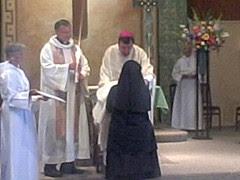
You asked if you do this, will the Church recognize you as a hermit? Well, I can tell you that the Archdiocese of Seattle is doing that today and has been doing so for a number of years.  The (newer) Archbishop there (Paul D Etienne) is not consecrating new c 603 hermits, and is accepting the commitments of lay hermits in the Archdiocese at Eucharistic liturgies. Look into this. Check into your own diocese and see if they would be open to something similar. There is, of course, absolutely nothing wrong with being a hermit living your vocation in the lay state. It is not about being second-class or "illegal" as one online commentator puts the matter, however, the exploration of such a vocation and discovery of its significance in and for the Church must be done by those embracing such a vocational path and helping to make it a real presence in the Church. I personally believe that c 603 gives the entire Church permission to pay attention to and esteem solitary eremitic life today. It has helped establish this form of eremitical life as a significant contemporary vocation, not a long-gone, irrelevant vocation that died out in the Western Church several centuries ago! One does not have to be consecrated according to this canon to benefit from it!! What one does have to hold strongly to, however, is the Church's teaching on the laity made freshly present at Vatican II and synods thereafter. This will take real courage and vision in a Church that is still in the throes of a crippling clericalism!!

I know I haven't answered all of your questions, but I sincerely hope I have answered those that might give you a pathway to consider lay eremitic life anew. The Desert Abbas and Ammas lived their lives as laymen and laywomen, not only for the sake of personal holiness, but because the Church needed them to do so when it became relatively easy to call oneself a disciple of Jesus Christ in the Roman Empire. We need such men and women today, calling all Catholics to such discipleship in the midst of a world that seems to have forgotten where and why Jesus lived out an exhaustive incarnation of God's love. Deserts come in all shades and stripes, including urban settings; stricter separation from the world involves a freedom from enmeshment in that which is resistant to Christ, and an obligation to love God's good creation into wholeness. The evangelical counsels assist in both of these. ** I would not be surprised to find God calling a whole host of new Desert Abbas and Ammas, not to canonical eremitic life, but to non-canonical or lay eremitic life today!! Perhaps you are one of these!

_________________________________________________

** You could make private vows, but every Christian is called to live these counsels in their own state of life. That would mean embracing the values of poverty (or simplicity), chastity (which is really about generously and appropriately loving others in Christ), and obedience (an attentive listening and responsiveness to God in every situation). How anyone is to implement these counsels apart from religious or consecrated life depends on each person's creativity and faithfulness. What the laity are not called to is religious poverty and religious obedience.

03 December 2025

Becoming All Fire (Reprised)

 In the apothegmata (sayings) of the Desert Fathers and Mothers there is a famous story. It was rooted in the personal experience of these original Christian hermits but it resonated with a line from today's reading from Paul's second letter to Timothy:  [[For this reason, I remind you to stir into flame the gift of God that you have through the imposition of my hands.]] A young monk, Abba Lot, came to an elder, Abba Joseph, and affirmed that he had done all that he knew to do; everyday he did a little fasting, praying and meditating. He maintained hesychia (stillness) and purged his thoughts to the best of his ability. He wondered what else he should be doing. The story concludes, [[Standing up, the elder stretched out his hands to heaven, and his fingers became like ten lamps of fire; and he said to him, "If you are willing, you can become all flame!"]]

I suspect most of us have experienced the formal laying on of hands that occurs during the reception of some sacrament or other. If we are not ordained we would still have experienced this at confirmation and during the reception of the anointing of the sick. Some of us who were baptized as adults may have experienced this during our initiation into the Church. In every case the laying on of hands signifies the gift of the Holy Spirit and the mediation of a kind of vocational event, a call to discipleship in and of the love and presence of God in Christ. (The sacrament of anointing has been called a vocational sacrament to be sick in the Church, a call to proclaim the Gospel of God's wholeness and holiness in and through the weakness and even the relative brokenness of illness. cf. James Empereur, Prophetic Anointing) And of course there are all the other ways God lays hands on us as "his" love comforts, heals, and commissions us to God's  service. I wonder if we realize the invitation these occasions represent, the invitation not merely to be touched and enlightened in so many ways by the love and presence of God, but to be so wholly transformed by him so that we become "all flame"!

This is another way of describing the coming of the Reign of God among us. In today's readings the Kingdom of God is not so much a place as it is an event. Jesus described it this way: [[Go and tell John what you see and hear: the blind receive their sight, the lame walk, lepers are cleansed, the deaf hear, the dead are raised, and the poor have good news brought to them.]] (Matt 11:4-5) And we know that beyond this, the coming of this mysterious event often involved the healing of those with inexplicable illnesses and forms of unfreedom or outright bondage, victims of the demonic in human hearts and the world at large. According to tomorrow's readings the seeds of  this event are planted deep within us, a potential harvest which is natural to us and whose fullness we cannot even imagine. With every encounter with Jesus, every encounter with the Word of God, every direct or mediated experience of the love of God, this human and vocational potential is summoned or drawn to fruition.

One of the privileged ways this encounter occurs just as it did in Jesus' time is through Jesus' parables. These are stories which quietly draw us more and more into the world Jesus calls home, the world of friendship with God, the countercultural world whose values and life we call prophetic. I have written about parables here before --- about their power to summon us out of this world, to empower us to leave our baggage behind and to embrace the newfound freedom of an enlarged and hallowed humanity. It is a world which, through the narrative power of the Word made flesh, transforms and commissions us to return to that same world we left and act as Christ-for-others --- in the world but not of it. Jesus says, "the Kingdom of God is like. . ." and our minds and hearts alert to the promise and  challenge of a reality we cannot explain, a mystery we cannot comprehend unless, until, and to the extent it takes complete hold of us.

This gradual but continual process of call, encounter, response, and missioning is the way the event we know as the Kingdom of God comes, first to us and then to others we meet and minister to, then to the whole of creation. And it is what the Gospel writers are calling us to today. May we each find ourselves grasped and shaken, comforted, healed and commissioned, disoriented and re-oriented by the Word of God that comes to us in Christ. And may we each come to know and believe the truth of our own potential and call --- that we are not merely meant to be touched here and there by the fire of God's love and presence, but that we are made, called, and commissioned to "become all flame" in and through that love. Amen.

02 September 2025

A Few Thoughts on Praying Always

[[Sister Laurel, what does it mean to pray always? Are hermits supposed to be a model of this? If so, how can every person be called to pray always? Thank you!]]

Great questions and ones I have not written much about, unfortunately. Thanks for asking them!! I actually believe that the essence of the eremitical vocation is to pray always, and even more, to become a person who represents God's own prayer in our world. This, of course, does not mean saying prayers always, but rather being focused on, and actively allowing God to be God at every moment, especially within us. I have written here many times that we are constituted as dialogical beings, meaning, by our very nature, we are related and responsive to God who is a constitutive part of us. St Catherine of Genoa said it this way, "My deepest me is God".

Regular prayer is part of learning to pray always; the essence of prayer is allowing God to work within us and, by extension, in our world. We choose to spend dedicated portions of our day in focused prayer, but in this and in other ways, the essence of prayer is about the pervasiveness of God in our lives and our response to that. Brother David Steindl-Rast identifies gratitude as the heart of prayer. There is a wonderful Desert Abba story about praying always. It involves two different very approaches to this reality with the second provided by Abba Lucius as a "word" of wisdom to the "Euchite" monks who seek him out. It goes as follows: 

“Some of the monks who are called Euchites went to Enaton to see Abba Lucius. The old man asked them, ‘What is your manual work?’ They said, ‘We do not touch manual work, but as the Apostle says, we pray without ceasing.’ The old man asked them if they did not eat, and they replied they did. So he said to them, ‘When you are eating, who prays for you then?’ Again, he asked them if they did not sleep and they replied they did. And he said to them, ‘When you are asleep, who prays for you then?’ They could not find any answer to give him.

He said to them, ‘Forgive me, but you do not act as you speak. I will show you how, while doing my manual work, I pray without interruption. I sit down with God, soaking my reeds and plaiting my ropes, and I say, “God, have mercy on me; according to your great goodness and according to the multitude of your mercies, save me from my sins.” ‘So he asked them if this was not prayer ,and they replied it was. Then he said to them, ‘So when I have spent the whole day working and praying, making thirteen pieces of money more or less, I put two pieces of money outside the door and I pay for my food with the rest of the money. He who takes the two pieces of money prays for me when I am eating and when I am sleeping; so, by the grace of God, I fulfil the precept to pray without ceasing.’

The Euchites were a group whose approach to "praying always" and to spiritual life itself was literalist and dualistic. What this means in the present context is that they took Jesus' admonition to pray always not just seriously but narrowly, simplistically, and in a way that caused them to exclude supposed "non-spiritual" activities like work (though not eating or sleeping!) from being the medium of prayer. In other words, only some aspects of their daily living could be considered spiritual or be transformed into prayer, the place where God was active in their lives. What Lucius pointed out was that this approach to "praying always" led to failure and even hypocrisy because what was considered prayer (or the truly spiritual) only involved limited aspects of the human person's life. He at least provided for others so that prayer continued for him while he ate and slept! What was true of the Euchite monks was that all they did, apart from necessary eating and sleeping, was pray, but this was not at all what Christianity means by praying always. 

What was also true about Abba Lucius' lesson was that praying always meant finding ways to allow God's activity to pervade one's life, and also to draw others into that prayer with our generosity and trust. Even when Abba Lucius treats prayer in terms of saying literal prayers, he opens prayer to the larger world around him, creating a community of persons who commend one another to God. God's presence and activity are allowed to pervade Lucius' world, and thus, he prays always. There is a similarly challenging story in John Climacus' Ladder of Divine Ascent (26th step). He writes: It can happen when we are at prayer, some brothers come to see us. Then we have to choose either to interrupt our prayer or to sadden our brother by refusing to answer him. But to love is greater than prayer. Prayer is one virtue amongst others, whereas love contains them all. It is important to understand, I think, that the Desert Abbas and Ammas regarded relationships as particularly important. At the same time, their emphasis on the priority of love allows them to develop a theology of prayer that is less narrow than that of the Euchites.

Prayer meant being open to God's presence and activity. Formal prayer periods are not the only times the Desert Abbas and Ammas did that.  They were present to God, yes, and they were present for others, both in the desert and also in the Church for which they lived such austerity and solitude. Saints throughout the ages have observed that the essence of prayer involves loving well and living one's life in gratitude. To pray always then, is not about constantly saying prayers, treating some things as sacred and other things as profane, or artifically divvying our lives up into the religious and the secular. To pray always is about recognizing God's presence and action in everything and living as those who are grateful for that presence. When we do that, we become persons in and through whom God is allowed to be at work in every way possible for the sake of God's Kingdom (reign or sovereignty). It is not too much to say that as we grow in this dynamic process, we become God's own prayer in this world. 

Absolutely, I believe hermits are called on to be paradigms of the journey toward Union with the God we know best as Emmanuel, God with us. However,  as I have written recently, I also believe every person is called to some form of this specific journey as the very goal and nature of what it means to be genuinely human. The way the journey unfolds and appears, the vocational paths it takes, for example, will differ from person to person, but it remains a universal vocation to which everyone is called.

27 April 2025

Becoming all Fire (Reprised from 2018)

 In the apothegmata (sayings) of the Desert Fathers and Mothers there is a famous story. It was rooted in the personal experience of these original Christian hermits but it resonated with a line from today's reading from Paul's second letter to Timothy:  [[For this reason, I remind you to stir into flame the gift of God that you have through the imposition of my hands.]] A young monk, Abba Lot, came to an elder, Abba Joseph, and affirmed that he had done all that he knew to do; everyday he did a little fasting, praying and meditating. He maintained hesychia (stillness) and purged his thoughts to the best of his ability. He wondered what else he should be doing. The story concludes, [[Standing up, the elder stretched out his hands to heaven, and his fingers became like ten lamps of fire; and he said to him, "If you are willing, you can become all flame!"]]


I suspect most of us have experienced the formal laying on of hands that occurs during the reception of some sacrament or other. If we are not ordained we would still have experienced this at confirmation and during the reception of the anointing of the sick. Some of us who were baptized as adults may have experienced this during our initiation into the Church. In every case the laying on of hands signifies the gift of the Holy Spirit and the mediation of a kind of vocational event, a call to discipleship in and of the love and presence of God in Christ. (The sacrament of anointing has been called a vocational sacrament to be sick in the Church, a call to proclaim the Gospel of God's wholeness and holiness in and through the weakness and even the relative brokenness of illness. cf. James Empereur, Prophetic Anointing) And of course there are all the other ways God lays hands on us as "his" love comforts, heals, and commissions us to God's  service. I wonder if we realize the invitation these occasions represent, the invitation not merely to be touched and enlightened in so many ways by the love and presence of God, but to be so wholly transformed by him so that we become "all flame"!

This is another way of describing the coming of the Reign of God among us. In today's readings the Kingdom of God is not so much a place as it is an event. Jesus described it this way: [[Go and tell John what you see and hear: the blind receive their sight, the lame walk, lepers are cleansed, the deaf hear, the dead are raised, and the poor have good news brought to them.]] (Matt 11:4-5) And we know that beyond this, the coming of this mysterious event often involved the healing of those with inexplicable illnesses and forms of unfreedom or outright bondage, victims of the demonic in human hearts and the world at large. According to tomorrow's readings the seeds of  this event are planted deep within us, a potential harvest which is natural to us and whose fullness we cannot even imagine. With every encounter with Jesus, every encounter with the Word of God, every direct or mediated experience of the love of God, this human and vocational potential is summoned or drawn to fruition.

One of the privileged ways this encounter occurs just as it did in Jesus' time is through Jesus' parables. These are stories which quietly draw us more and more into the world Jesus calls home, the world of friendship with God, the countercultural world whose values and life we call prophetic. I have written about parables here before --- about their power to summon us out of this world, to empower us to leave our baggage behind and to embrace the newfound freedom of an enlarged and hallowed humanity. It is a world which, through the narrative power of the Word made flesh, transforms and commissions us to return to that same world we left and act as Christ-for-others --- in the world but not of it. Jesus says, "the Kingdom of God is like. . ." and our minds and hearts alert to the promise and  challenge of a reality we cannot explain, a mystery we cannot comprehend unless, until, and to the extent it takes complete hold of us.

This gradual but continual process of call, encounter, response, and missioning is the way the event we know as the Kingdom of God comes, first to us and then to others we meet and minister to, then to the whole of creation. And it is what the Gospel writers are calling us to today. May we each find ourselves grasped and shaken, comforted, healed and commissioned, disoriented and re-oriented by the Word of God that comes to us in Christ. And may we each come to know and believe the truth of our own potential and call --- that we are not merely meant to be touched here and there by the fire of God's love and presence, but that we are made, called, and commissioned to "become all flame" in and through that love. Amen.

08 April 2025

Series on the Desert Abbas: Become who You Are


Greetings during this fifth week of Lent! I must begin my comments with a reminder of the quote from Dietrich Bonhoeffer I have used many times, "Not everything that happens is the will of God, but inevitably, nothing that happens, happens outside the will of God." It is critical that we understand the suffering we do not as the will of God, but that we remain consoled that all of our suffering can and will be used by God for good. God will bring good out of everything for he is greater and encompasses it all with his will to be Emmanuel! In the above video, this is one lesson we hear as Bishop Eric Varden, OCSO summarizes the life of Antony, the Desert Abba. 

What we also hear is what can happen to us as we reach the bottommost depths of our hunger and yearning for both God and our own wholeness, our own Self. It is there, in that place of deepest solitude, that we meet both God and our truest Self. This is what I have been writing about for the past weeks in terms of the experience of existential solitude and penetrating this reality deeper and deeper until, finally, we come to a degree of wholeness or holiness we have never known before, and the I we have been becomes a we. E E Cummings, whose poetry I have used to help me write about this process, also wisely says, "it takes courage to grow up and become who you really are." For that too describes this journey to the depths of existential solitude. It is about growing up and becoming who we truly are.

This was Antony's quest and task, ultimately accomplished by the grace of God, even in the terrible loneliness and darkness of a death-and-demon-haunted cemetery,  and then, in the deeper solitude of the inner (physical) desert where Antony spent another 20 years. Whatever our vocational path, we are each called to negotiate our existential solitude and to do as Antony did and become "really real", or, in other words, to become who we really are in and with God. After all, as e e cummings also reminds us, "there's nothing as something as one." The language of oneness and union, the paradox that we are only truly One when we become a "We" with and in God, may seem hard to understand but it is really just a way of talking about what it means to believe in a God who has chosen from the beginning to be Emmanuel and who, in turning to us in search of a counterpart, will allow nothing, including death itself, to come between us and his love. 

At the same time, Antony's story reminds us that the journey to the depths of our being, that place within us beyond all woundedness and brokenness, takes real courage and an energy we might often fear is insufficient or altogether lacking. But it is in the depths of our hunger and abject weakness that we discover God drawing us to Himself and thus, to our truest Selves. Our hunger does not mark God's absence; rather, it is the presence and power of God at work within us. Here, in our weakness where God's power is truly made perfect, that is, where it achieves its goal or telos (2 Cor 12:9), we find real peace and a sustaining hope as, free of all striving and ego, we allow God to embrace and raise us to new life as the persons we really are.