Showing posts with label ecclesiality -- implicit and explicit. Show all posts

29 March 2026

Summarizing Dimensions of Ecclesiality in c 603 Vocations

[[Hi Sister Laurel, you have written a ton of articles mentioning the ecclesiality of the c 603 vocation. Could you do me a favor and repeat the most important conclusions you have drawn about this? I don't guess this idea of "ecclesiality" will matter to most people, but I am becoming a c 603 hermit in a few years (my bishop is thinking 3-5 years), and understand I really need to think about this dimension of the vocation. I don't mean for you to do the work for me, but I want a place to start from and a place I can go back to so I was hoping you could provide this. I really have read some of what you have written and will read more!! Promise!! One thing that concerns me is if having an ecclesial vocation means I am saying I am more important in the Church than my family members. I don't think you are saying that, but it is not clear in my own mind. So, can you help me with this? Thanks very much, whatever you decide!]]

Thank you very much for the questions, comments, and request. I am happy to repeat what may be my most important conclusions (or maybe they are just paragraphs where my writing was clearer than in other places)!! I've chosen two paragraphs taken from Peter Damian's Letter #28, a fairly recent article. 

In recent years, I have stressed that the canonical eremitic vocation is ecclesial. This does not mean that other hermits, especially non-canonical hermits, do not belong in an integral way to the Church, nor that they do not give their lives to the Church. Instead, it means that canonical hermits have accepted a public role in the very life of the Church that reminds every person, at least implicitly, of the two dimensions Peter Damian and Ponam in Deserto Viam put at the center of understanding eremitical solitude (in our oneness we are always part of a multiplicity, and in our multiplicity, we are one in the Spirit). Part of this witness by hermits embracing ecclesial vocations requires a canonical commitment to the life of the Church as consecrated hermits to consciously witness to and build up the very nature of the Church and the consecrated life within it. Solitude in such vocations is marked by a serious and radical aloneness, and at the same time, it participates in and reflects community in an equally radical way. One source says it this way, [[the solitude of the hermit is a solitudo pluralis, a corporate solitude, and (her) cell is a miniature Church.]]

The canonical hermit participates fully in the Sacramental life of the Church. She prays the Church's official prayer (Liturgy of the Hours); she may join with other hermits in lauras --- including virtual lauras that are non-geographic and allow for the strengthening of ecclesial bonds and witness. She lives her life according to an approved Rule of Life and under the supervision of Bishops (and often, accepted delegates) and spiritual directors. She does not live an individualistic life where canon law is dismissed as something only legalists or the "less spiritual" or "more temporal" choose. Instead, she allows herself to become subject to additional canons beyond those associated with baptism alone, because she understands that hermit life is a radically ecclesial and incarnational life, that, in a unique way, sees the multiplicity in one, and the one in and as the many. She wants to witness to this double reality in her own life and to do so officially for the sake of the Church and world.** Of course, it goes without saying that no hermit is alone because she lives with and from God, but what is also true is that no hermit is ever alone because we each carry the entire Church with us in our solitude. In fact, we are that Church.]]

Your concerns about misunderstandings of the term ecclesial in "ecclesial vocation" are important. I am glad you are trying to define this for yourself. When you write your Rule, some sense of the ecclesiality of your vocation should probably be visible to the chancery team working with you. My own take on this dimension of the vocation is that it reflects the heart of the hermit's humility in embracing a vocation God has "designed" to call the Church to be true to her own vocation as Pilgrim People of God. She cannot live this adequately except as an act of genuine humility. Canon 603 hermits witness to an abject dependence on God alone, and at the same time, they witness to the fact that Christ has established a Church in which those who travel "the Way" might journey together in lonely dependence and inspired solidarity in Christ

Empowered by the Holy Spirit, the hermit holds these two pieces of truth together in her own life, and the resulting reality and witness are consecrated by God and embraced by the Church at a public act of profession and consecration. (The Camaldolese celebrate this way of being as "Living Alone Together") I don't know a more vivid example of this journey to union with God in communion with the whole People of God in the silence of solitude, than that of the solitary consecrated hermit --- a journey at once radically solitary, deeply communal, and undertaken in a hiddenness that witnesses to ineffable Mystery. To do this, not only for the marginalized who find themselves both radically alone and, mistakenly, without value in our world, but for the entire Church, which can and has sometimes forgotten her pilgrim nature, is a great privilege! Paradoxically, it is a privilege we can only accept and live in the deep humility this very same privilege actually inspires! Doing so in any other way would make us incapable of serving the Church as we are called to do, and as this People of God needs. 

What the c 603 hermit says with her life is that every member of the Church, in whatever smallness or greatness they find themselves in terms of the world, are called to be the heart of the Church and to call the Church to be true to herself and her head. Every person is called to be him/herself, as fully as possible in, with, and through God. When looked at from this perspective, no vocation is more important than another, no person is more exalted or humble than another. And, of course, no vocation is to go uncelebrated or unrecognized -- just another facet of the ecclesial nature and witness of the consecrated hermit vocation. I hope that can reassure you with regard to the question you have about your vocation and your family. 

My prayers for your preparation for consecration under c 603!! Every day of this will be important. Nothing will be lost or a waste of time. That is true even if you should discern that this is not your call at this time. Live it and live into it well!! Meanwhile, all good wishes for a profound and fruitful Holy Week! 

14 September 2024

Ecclesiality, a Mutually Conditioning Dynamic Between Church and Solitary Hermit

[[ hi Sister! Are you saying that the Desert Fathers and Mothers had ecclesial vocations the institutional Church didn't recognize? I am not sure I see how the vocation of the Desert Fathers' calling belonged to the Church before the Church knew it herself.]] 

Hi there yourself! Yes, I am saying that in one way the vocations lived by the Desert Abbas and Ammas were deeply and essentially ecclesial because they were lived for the sake of the Church and called her to all the things eremitical life holds for the Church. In particular, the desert Abbas and Ammas did what c 603 (and other) hermits do today in showing the Church her own heart, a heart rooted in prayer, the Lordship of Christ, the Evangelical Counsels, humility, and stricter separation from the world. In living countercultural lives dedicated to encounter and dialogue with God. Additionally, I am suggesting that the formula, "ecclesia semper reformanda est" was a dimension of what hermits called the Church to and reminded her she would always need to be. These lives (vocations) belonged to the Church even when the Church did not recognize this and their witness was profoundly ecclesial even as they lived apart from the larger Church.

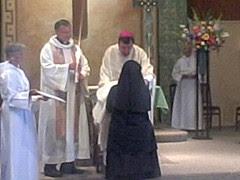
However, in a second way, the way I ordinarily speak of ecclesial vocations, the Desert Abbas and Ammas did NOT have an ecclesial vocation because they were not explicitly commissioned by the Church to live as hermits. Today we have canonical hermits in congregations and orders (institutes of consecrated life) as well as c 603 hermits who are actually and explicitly commissioned by the Church to remind her of all the things the Desert Fathers and Mothers did, but by explicitly living these things in the heart of the Church as the Church itself commissions us to do. My argument was that the Church herself took a long time to recognize and make canonical these specific vocations, but doing that was part of a journey towards greater authenticity both for the Church and for hermits more generally. C 603 specifically created the option for public and ecclesial solitary hermit vocations that represent the Church's own internalization of the values of the desert Abbas and Ammas in universal law. By creating statutes on the diocesan level, bishops had done this for anchorites and hermits through some centuries, but never in universal law. With c 603 the Church finally made the solitary hermit life an intrinsic part of the public and essential life of the Church and in this way also bound herself to the values the hermit lives, including the prophetic witness some hermits (like the Desert Abbas and Ammas) have been known for. In other words, she realized (made explicitly real) what had only been implicitly real to this point.

The ecclesiality of c 603 vocations is something every c 603 hermit must come to understand and value deeply, and at the same time, it is something the Church herself must come to see and profoundly esteem. As I reflect on the dioceses that have failed to implement c 603 I recognize that some fear they cannot do justice to this vocation because they lack the chancery staff, for instance. Others recall the stereotypes and caricatures of authentic eremitical life I referred to in my last post and want no part of such egregious distortions of eremitical life. Some, simply think the vocation is about keeping folks out of the limelight by shunting them into a hermitage --- a way of taming problem children of all sorts. But some are afraid of the witness of hermits in the heart of the Church, afraid they will introduce a bit of inspired instability in a Church insufficiently in touch with its need to reform itself. I don't believe these fears achieve consciousness in these bishops and chanceries, but I do think the nervousness these chanceries experience over contemplative and eremitical vocations points to this.

When I write about the ecclesiality of c 603 vocations I almost always say the vocation belongs to the Church before it belongs to the hermit. What I must also say, I think, is that hermits and anchorites through the centuries have called the Church to claim, nurture, and protect this birthright as they held onto the fact that they lived this vocation on behalf of the Church. They were not individualists, nor pseudo hermits separated from the Church, but instead, were men and women deeply imbued with the Gospel and in love with Christ's Church living life for her sake. With canon 603 the Church has claimed this vocation explicitly and is on the way to doing so fully. The relationship of the c 603 hermit to the Church is critical for the hermit being all that God calls her to be and also for the Church being all that God calls it to be as well. Just as the Church entrusts the hermit vocation to individuals under c 603, these hermits reveal to the Church her own generous and humble heart, not in the power and might associated with this world, but in a weakness where God's grace is sufficient and God's power is made perfect.