[[ Hi Sister, Joyful Hermit is putting up videos (cf
Joyful Hermit Speaks) saying that if a hermit needs to have their vocation esteemed and celebrated at a public liturgy, maybe they should wait to become a diocesan hermit until they understand the vocation better. She suggested it is up to the hermit to tell the Bishop that saint hermits would never agree with a public Mass and lots of people [attending], etc. I heard her saying that it is up to the hermit to take responsibility about where and how her consecration would occur, so, the whole piece is about telling the bishop what is appropriate!! I also heard her challenging diocesan hermits who had public Masses with numbers attending of lacking not only understanding of the hermit vocation but also humility as well.]]
Thanks for writing, and for the link. I watched the video and I essentially heard what you did. It seems to me that this video was apparently in partial response to my post on the appropriateness of celebrating hermit professions at Mass. The idea that a hermit who has been admitted to profession and (in time) even to consecration by this local Church would tell her diocese (Canonists, liturgists, Vicars, and Bishop), that despite what the Rubrics for the Rite of Perpetual Profession say, the hermit knows better and that having a Mass (when appropriate) is up to her, is completely ludicrous to me. This is an ecclesial event, not merely a personal one!! In any case, JH's position proves the case, I think, that she does not understand what it means to have an ecclesial and public vocation with responsibilities to the Church (the People of God) and rights they have granted to her.

Your referent makes this all about c 603 hermits demonstrating a lack of humility, both by agreeing to a public Mass and in petitioning for and accepting canonical standing in the first place. She rails against anyone respecting a hermit or esteeming a God-given ecclesial vocation and claims that no self-respecting hermit (pun intended) would ever desire this. She claims that if a hermit needs esteem, then perhaps they are not ready to become a c 603 hermit.
But to whom is she speaking? No one is talking about hermits
needing to be esteemed in some unhealthy way! No one is talking about a hermit demanding a public Mass, seeking canonical standing, or anything else because they need esteem or the respect of others in a disproportionate and egoistically-driven way!!
On the contrary, we are speaking about the fact that every person both deserves and needs respect as a human being. This is a fundamental need that is vital to our being able to love ourselves or others as well as allowing ourselves to be loved by others. In the work I do, respect is recognized as an essential need, as necessary to health and life as air and water and food and sunshine. If a hermit cannot admit that they need and are due respect -- just as every other person in, or dimension of God's good creation needs and deserves respect --- then they are apparently so completely out of touch with their own God-given and divinely-valued humanity, that they should give up even the pretense of being a hermit!! They will only ever be a parody or caricature of such a thing --- and God knows, we have had enough of those through the centuries!
I am thinking of the words of the Magnificat. [[My soul magnifies the Lord, my spirit rejoices in God my savior, for he has looked with favor on (or, he has esteemed or regarded) his lowly servant, and from this day all generations will call me blessed! The almighty has done great things for me and Holy is his Name.]] When I write about the Church coming to esteem the eremitical vocation as a gift of God, I am writing about regard for the favor, esteem, or regard of God's grace. Never were a woman and her vocation given more respect or held in higher esteem. At the same time, never was there such a humble woman!! The two things are not contradictory, they do not cancel each other out somehow; they belong together. To know (in that deep Biblical sense of the term,) that one's vocation means to be aware that one is favored by God, does not mean one lacks humility. It is a simple recognition of truth which is the very root of humility. To accept that from God, including through the mediation of the Church, and doing so in joy and love is the act of a humble person!!!

Yes, there have been unhealthy forms of spirituality throughout the centuries and so-called "hermits" have been among their most notorious representatives. Some were guilty of self-loathing and, I would argue, some forms of penance or asceticism were the outworking of such self-hatred. All this is part of the reason the Church took such a long time to recognize eremitical life as a potential state of perfection or consecrated life. However, the notion that c 603 was only created to prevent abuses and not to demonstrate esteem for a divine gift to the Church is blatant ignorance. To suggest as well that no real hermit needs God's favor or regard -- much less that of the Church!-- or that they should not need to be able to respect themselves, in turn, is to deform the vocation into something destructive and incapable of serving either God or others. Instead, it betrays the eremitical vocation and the God who is its author.
One of the witnesses hermits give is to the singular favor God holds for and reveals (or at least seeks to reveal) to every individual no matter how ill, weak, poor, inadequate, etc they might be otherwise. God esteems each of us, calls us to be his beloved, loves and cherishes us with an everlasting love, and completes us so we might witness to all of this for the sake of others. God respects or values our humanity sufficiently to become one of us and to welcome us into God's own life in the Ascension. I wrote recently about the glorified bodily existence we will one day know in God's eternal presence. God esteems us in this way; he loves us dearly and calls us to be his adopted daughters and sons. He sends us out as disciples of Christ to minister (and hermits he sends into solitude to become ministers --- embodiments of the very ministry they are called to.). Can we really suggest that none of that demonstrates respect, esteem, or regard? Can we really affirm that we do not need respect, esteem, or regard from God (or from others, including our colleagues and superiors) simply to stand on two feet and face the day??
.jfif)
To repeat the position that kicked off your referent's comments on this, the Church chose to make the solitary eremitical vocation a canonical one. She did so because she believed it to be a gift of God to the Church and showed that she esteemed this vocation precisely as a gift of God, not because hermits were giving her problems
(in fact, solitary hermits had almost totally ceased to exist in the Western Church; all the Church had to do was to ignore any that remained to ensure that death spiral was completed). Even if this was untrue, one does not give someone canonical standing simply to correct abuses. Besides, without officially recognizing (and thus, esteeming) hermit life in law, what abuses would there be??
A standard or norm must be established in law before there can be abuses. In any case, esteem for this relatively rare gift of God to the Church was why c 603 came into existence; it was the reason Bishop Remi de Roo made an intervention at the Second Vatican Council to ask the Church to recognize eremitical life as a call to a state of perfection or consecrated state. De Roo had come to know this vocation through the dozen or so hermits he served as Bishop Protector for in British Columbia; as a result, he recognized the prophetic gift to the Church this vocation is.
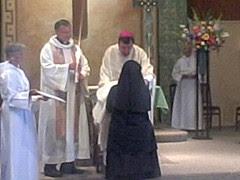
In the celebrations the Church holds,
the one being celebrated is never primarily the hermit herself (though she is also being assisted to embrace, and thanked for saying yes to God's call as she returns self-gift for self-gift); it is God who is being celebrated and what God's gift of Self means for people in our world. The hermit who is being consecrated by God celebrates this by receiving God's gift of self, a gift that consecrates specially, within an assembly of the People of God. That is why it is appropriate to do this at Mass! Mass is the place where we are quintessentially recipients and God is the Giver par excellence; it is the place where we are each made a unique part of the People of God
and God is made real in space and time in, with, and for us! What an appropriate context for the consecration of a canonical hermit!! In terms of this more limited discussion, however, let me simply repeat, a canon 603 vocation, like any other gift of God, is worthy of respect, especially when we contrast this contemporary vocation with the centuries-long background of eccentric and misanthropic stereotypes that populated the world through the centuries --- and evidently in some ways, into this one as well.


.jpg)





.jpg)


 Posts
Posts