Showing posts with label Are c 603 hermits considered Religious men and women?. Show all posts

16 October 2025

Another look at Pope Leo's Address to Hermits

[[Hi Sister! I heard an online hermit [name omitted] complaining that Pope Leo "left out" the "traditional historic" hermit from his recent address to hermits in Italy. She felt it was divisive and argued that c 603 hermits wearing habits and styling themselves as Sister or Brother was about mimicking genuine religious and was basically false. She also wondered if the traditional, historic hermits were no longer welcome in the Church, especially since there is such an emphasis on diocesan hermit (sic) being social when the others were not. She thought not still being in the Church was a good thing for these reasons.  On another note, I was happy to see she spoke of everyone being called to union with God, but I was disappointed to hear her suggesting there was no difference in their vocations really. I don't think she picked up on Pope Leo's reference to diocesan hermits as exemplars of what is a universal calling. Oh, she also made a point of the fact that traditional historic hermits were not limited to a single diocese, but were hermits in or of the universal Church. I think you have written about this before, haven't you? (I couldn't locate the post myself.)]]

Thanks for your email! All of these topics, except the complaint against Pope Leo, "leaving out" the "traditional historic" hermit, are things I have heard or read over the years from the person you mentioned. It is the questions that I want to deal with here, however, not their source. The complaint against Pope Leo fails to appreciate the brevity and context of his address, namely, he was making his comments to diocesan hermits who had travelled to Rome for the Jubilee. I know this because I was invited to attend with (perhaps) some small (read tiny!!) chance to speak with Pope Leo while I was there. Unfortunately, I could not attend. If one is speaking to diocesan hermits about the significance of their vocation, and the address is to be a brief one, one's comments will necessarily be limited and focused as Pope Leo's were, to diocesan hermits!! (Still, as I note below, Leo did recognize the diocesan hermit's necessary engagement with the stream of history, so that must not be missed or dismissed.)

I thought Pope Leo's comments were amazing in the way they touched on the really central aspects of the c 603 vocation. Beginning with Jesus' conversation with the Samaritan woman, Leo outlined the fundamental vocation everyone has to worship God in Spirit and truth. That is incredibly important and absolutely foundational for understanding the nature of eremitical life and the way it is an exemplar for every person's fundamental vocation. It was a wonderful beginning that set the stage for hearing everything else Leo spoke of and understanding the paradoxical nature of a vocation to the silence of solitude. Leo also touched on the ecclesial nature of the vocation, especially its solidarity with others (per the great quote from Evagrius Ponticus) and its open relationship with the ecclesial body and body of history. Leo captured the dialogical nature of this vocation 1) with God and one's deepest Self in the secret sanctuary of the heart, 2) with others and all of creation, and 3) with the Church itself and the eremitical tradition, which the c 603 hermit embodies.  

It is interesting (though saddening) to me that the hermit you mentioned felt it was a good thing to leave the Church in light of the Pope's comments on solidarity (the deeply social nature of hermits). This solidarity is an expression of the vocation's ecclesiality and is an essential element of the eremitical vocation as the Catholic Church understands it. To reject it and the paradoxical way the elements of c 603 must be understood is perhaps to admit one is not really a hermit, but rather, remains simply a pious loner. The essential nature of eremitical life, as Pope Leo outlined it, may surprise some, but it is exactly the profoundly and canonically ecclesial vocation c 603 outlines and codifies. In any case, c 603 does not do away with non-canonical or lay hermits, nor does it push them out of the Church. This is a kind of destructive all-or-nothing way of thinking that lacks nuance and is invalid. Much of what Pope Leo said applies to non-canonical hermits as well. But again, in his brief address, he was speaking to an assembly of c 603 hermits called and commissioned to be exemplars of the solitary eremitical vocation and the universal call to union with God. He was not excluding anyone.

As I have written before (you were correct), the diocesan hermit is a hermit in and for the universal Church, though she especially serves her local diocesan Church. S/he lives eremitic life in the name of the Universal Church and has been granted and accepted the rights and obligations associated with that place in the Church's life. However, her immediate legitimate superior is the Bishop of the diocese where she resides and in whose hands she is professed. (Delegates serve as quasi-superiors on the Bishop's and the diocese's behalf.) This is an issue of subsidiarity and an example of the effective exercise of the ministry of authority. The Church always administers or exercises such things at the most local level possible. This respects the genuinely dialogical and loving character of such ministry; after all, superiors need to know and genuinely love those with and for whom authority is exercised. They need to know the local Church in which such persons are embedded and serve. I will try to locate the post you were thinking of and link it below.

Thanks again for your outline of the online comments. They were especially helpful in providing an opportunity to look again at Pope Leo's address and consider how truly complete and well-ordered his comments therein were. It is wonderful to hear the way these resonate with my own lived and reflected experience of c 603 life, and that of others I am in contact with. I especially loved the way he begins with Scripture, draws a picture of the very core of the vocation in speaking about the human heart where worship occurs, and then draws from significant representatives of the desert tradition, in this case, from Evagrius Ponticus. What Pope Leo did in this brief address was to also capture the dialogical nature of the eremitic life in regard to its contemporary manifestation and its historical origins and foundation. He essentially affirmed that this relatively new c 603 life is authentically eremitic and reflects the desert tradition with integrity, even when that surprises people and calls for reflection and explanation. 

Moreover, Leo made very clear the way this vocation is lived for others, and serves the Church it reflects. This service is not about an occasional or limited foray into active ministry, though hermits may engage this way. Neither is it about an occasional act of charity one may do for someone who comes to one's door seeking a word, though hermits will surely do this as well. Instead, it is the service flowing from the worship occurring in the inviolable tabernacle of the hermit's heart at every moment of the hermit's life as she grows more and more transparent to God and the love and truth God is. In this way, the hermit mediates God/love/truth in and to a world badly in need. Pope Leo also addressed this point beautifully. Yes. This was truly a very fine address and a gift of God to the Church and world for the sake of this vocation and those called to live it! Or, maybe better, I should have said this was a gift of God to this vocation and those who live it for the sake of God, the Church, and God's entire creation!

_______________________________________________________

I just realized I did not address your comment regarding c 603 hermits "mimicking religious". I have addressed this before, especially on the basis of comments made in the Handbook on Canons 573-746. For the dedicated post I put up on this topic 5 years ago, please see: Are C 603 Hermits Religious?

Diocesan Hermits and Subsidiarity (This linked post was written about six years ago and can also be found under the tag, "subsidiarity".)

Pope Leo's Jubilee Year Address to Hermits (For the post with the entire address)

09 April 2025

On Respecting and Honoring Eremitical Life and Associated Questions

 [[Sister Laurel, did you say canon 603 came into being because hermits needed to force the church to respect hermits? I am quoting someone here: [[this other person has written that it is because the hermit they needed to force the church to recognize and respect Hermits that they hadn't been recognized and respected enough in other words to have a place or a position and I think that that's probably from the hermit's perspective why a few of them got a certain Bishop a Bishop de Roo to sponsor and to Lobby this for them with the Bishops and he they got it through in 81 it got included in the updated version of the canon law codex of canon law of the Catholic Church. ]] Did hermits lobby for this? Why would they do this?

She also said, [[so I see a good purpose for it as far as the Bishops are concerned but there's nothing mentioned about publicizing  yourselves or wearing a habit or having a title of your name or or postnominal letters after your name Er Dio or having a public Mass when you do your vows or a reception or a videotape of it that you put online none of that it's it's not really something we need to promote if God's calling Hermits he'll call them and they'll know it it's not like a matter of oh let's get the word out and recruit people to be canon law Hermits so that we can develop a movement and get some respect around the Catholic church and have a place and a position of prestige and status and power .]] 

And also when speaking of the Church not really needing c 603, because hermits are supposed to be humble, she said, [[what's the point of having the law then really because Hermits don't need to be recognized and don't need to be respected and don't need to have a place of honor in the church we're nothing to God's all of any vocation we are the least we are the least and the to be the most hidden and the most um obscure and humble . . .]] I think you are clearly the person she is referencing in these comments.]]

Yes, I agree, I am the one being focused on in these comments. I have written about the reason for c 603's establishment and the intervention by Bp Remi de Roo after serving as Bishop Protector for a colony of hermits who were required to leave their solemn vows in order to live as hermits. I am also the one who wrote about the need to honor the eremitic vocation, but not individual hermits --- I said nothing about that, and I certainly never used the idea of "forcing" the church in any of this. Neither did I speak about hermits gaining a position of power and prestige or starting a movement and recruiting people. When I have spoken about status, it has been about status in the sense of legal standing, which is granted to hermits in ecclesial vocations who assume additional canonical rights and obligations beyond those of their baptism. I have also spoken about mentoring those discerning and forming such vocations and working with their dioceses to assist in an area few have real experience of. This has nothing to do with recruiting and I think characterizing efforts to serve the Church and c 603 vocations in this way is offered in bad faith.

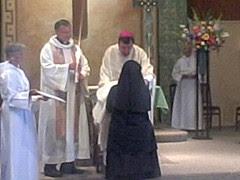
I am sorry the person you are quoting has not managed to accept the fact that c 603 hermits are recognized as women and men Religious despite the fact that they do not belong to a religious institute. I have cited canon lawyers' opinions on this matter, and of course, bishops and dioceses regularly approve the wearing of habits, prayer garments, cowls, rings, etc., and grant permission for use of the title Sister or Brother. They mark these things in profession liturgies, in fact. In a Church marked by new kinship and service of one another, the importance of such titles has less to do with prestige and power than it does with commitments to fostering the Kingdom of God as a countercultural reality. Post-nominal initials are common in consecrated life and tend to mark not only membership in specific institutes, but charisms, and even the shape of one's consecrated life. Diocesan Hermits use a number of recognizable post-nominals. Er Dio (for eremita dioecesanus, or diocesan hermit) seems to be best known. Such initials indicate a public, consecrated, and ecclesial vocation with public vows. They represent a life commitment and allow us to drop the title (Sister, Brother, or Father), especially in correspondence and publishing.

Finally, I have written in the past regarding the reasons Bishop Remi de Roo intervened at the Vatican II Council to argue for the making of eremitical life a state of perfection in the Church. He had worked with about a dozen hermits who had made exceptional sacrifices in order to live a call to eremitical solitude, and, highly aware of their character and the history of the vocation, recognized that in the Church's failure to recognize eremitical life in this way, it had done a disservice to a significant vocation without which the Church actually could not be the ecclesia God calls her to be. While these hermits would have understood the importance of keeping their monastic commitments, I don't know that they actually lobbied for canonical recognition. Given what I have written about existential solitude and the vocation of the hermit, I suspect that Bishop de Roo was at least somewhat sympathetic to an observation made by Thomas Merton. Along with pointing out that the Fathers of the Church had assigned hermits a high, even the highest place among Christian vocations, "because hermits aspire more than anyone else to perfect union with Christ in contemplation", Merton said: 

[[the exigencies of Christian life demand that there be hermits. The kingdom of God would be incomplete without them, for they are [persons] who seek God alone with the most absolute and undaunted and uncompromising singleness of heart.]] Disputed Questions, p 166

Most Religious I know today would not buy into the "higher, highest" way of appreciating vocations (I reject it entirely), and most hermits I know would be pretty uncomfortable viewing eremitism in this way. Still, we do recognize the uniqueness of a vocation that serves as a paradigm of the universal quest for authentic Selfhood with God and the place of both existential and physical solitude in that quest. If the Church values eremitical vocations for the place and role they hold in the very life of the Church itself, then I can't see where marking that with respect offends against humility. In fact, I experience such recognition, especially in relation to an ecclesial vocation, as an intensification of my own call to humility. Paradoxically, it is one's failure to respect oneself and one's vocation, or to recognize the fundamental Christian values of dignity, respect, and honor deserved by every person and every vocation that truly offends against humility!