.jpg)
Wow! So you have read this blog for a very long time!! First, thanks for that! It is really gratifying. Yes, wearing a habit helps me live my vocation, and so does wearing lay clothes or "civvies". Both are reminders of something central, so both serve in their own way. With regard to wearing a habit, I am reminded of several things: religious poverty is the most common association, I think, along with one's consecration to an ecclesial vocation. It is this latter association that wearing a habit makes most strongly for me. That is especially the case when I am attending liturgy. There I belong most completely and witness to something that belongs to the Church as something challenging and empowering to the others. Because the habit (including the cowl) signals a second consecration building on and somehow going beyond the original consecration of baptism, it can call on others to live their baptismal consecrations, and it can do so without any sense of elitism. Moreover, it says to the Church that God is at work in the Church in hidden and powerful ways, and encourages others to trust in the truth of the resurrection and the power of prayer.
When I wear my habit outside the hermitage or liturgy, my sense of its witness value is somewhat different. Yes, it calls people to recognize the reality of the Church and the Kingdom of God as a countercultural reality existing in their midst. (It calls me to remember my commitment to and representation of these things as well!) It also signals something beyond that, something puzzling and provocative. I think it points to the reality of Mystery that stands at the heart, and as the ground and source of everything. It points to God and, of course, to the idea of committing one's whole self to that God. It also reminds me of history and the long tradition of eremitical and religious life in which I stand. This is part of the countercultural nature of the vocation, and part of its eschatological nature as well, because while locating me within a current of history it also locates me within currents of transcendence and reminds me to see my immediate surroundings in light of something larger and more eternal. The habit has been modernized, but in this way it has not lost its historical resonances.
.jpg)
So, what about wearing ordinary clothing or "civvies"? These also help me to live my vocation, and I think they help those who know me to live their own as well. Certainly I hope so. For me "civvies" reminds me of the ordinariness of my life and vocation. It is not elitist, not cut off from others in the name of some unhealthy isolation (eremitical solitude is a unique form of community or, as Pope Leo recently wrote citing Evagrius Ponticus, solidarity). It is certainly a somewhat unusual vocation when measured numerically, but when it is looked at in terms of the various situations that marginalize people everyday of their lives (poverty, trauma, chronic illness and disability, inability to live their potential for various reasons, etc, etc.), or when it is looked at in terms of the existential solitude marking every person's life whether they are socially marginalized or not, eremitism is a vocation that captures most vividly the dynamics of human existence.
When I wear civvies, I am most strongly reminded of this dimension of my life. (Ironically, I am sometimes struck by a sense of existential solitude or even of "not belonging" when I am wearing ordinary clothes.) At the same time, ordinary clothing can be helpful in signaling to others the dignity and importance of their own baptismal consecration and vocation. Vatican II brought into fresh perspective the insight that it is the sacrament of baptism that is the source and ground of every other vocation in the Church. It is the most important and absolutely essential sacrament. Orders is not. Religious consecration is not. Both of these build on (and so are given their inherent dignity) by the sacrament of baptism. It is the sacrament of baptism that calls us to and helps empower lives of authentic humanity. While I do not deny the importance and beauty of Orders or religious Consecration, it is important that I witness to the extraordinary ordinariness of a life committed to allowing God to be Emmanuel and (in Christ) to becoming Emmanuel myself. The use of ordinary clothes also does this.
.jpg)
**Several times now, I have heard it described by folks who wore a habit for a while while in "formation" with a newly-formed, unofficial, and non-canonical group, and who claim they stopped doing so because they felt like hypocrites or frauds. People approaching them had questions they could not answer and expectations they could not meet. For instance, people expected they were religious who had been formed and commissioned by the Church to live religious life in her name, not someone who adopted the habit without real preparation or authorization, and, of course, they were not such people. No wonder they felt like hypocrites!!! One person writes about "standing out" in this way and, in part, criticizes every diocesan hermit's wearing habits on this basis.
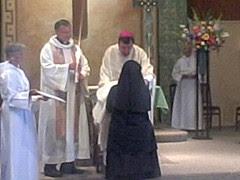
These people's experiences do not mean, however, that everyone wearing a habit is elitist or some kind of hypocrite. By the time a religious (including diocesan hermits), reaches perpetual profession and consecration, they know who they are in terms of this vocation. When authorized by the Church, they wear the habit comfortably though not complacently as a reflection of the truth of their identity in the Church, in the congregational or eremitic tradition in which they stand, and in God. It is a sign of service and availability (yes, even diocesan hermits are available to others); it is neither a sign that they are better Christians than others, nor that they are perfect. Still, it does remind them of what they are commissioned to be and aspire to, and, as noted in other posts, the profound Mystery that stands at the heart of both their being and calling.






.jpg)


 Posts
Posts