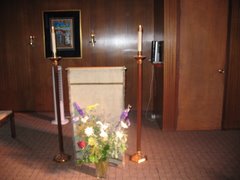
Dear Sister, not sure how to ask this so I'll just go ahead and give it a try. Last weekend we celebrated the Feast of Corpus Christi and our pastor moved the tabernacle back behind the altar from where it had been located in the main part of the Church. He had been planning this for a while but said the feast was the perfect time to do this. He said it was about putting Jesus right back at the center of things where he should be! Someone sitting near me explained that this was not what Vatican II called for. They said this was against what Vatican II called for but I didn't really understand his explanation. Was it really against Vatican II and didn't Vatican II want Jesus in the center of things?did they move the tabernacle because people no longer believe in the Real Presence?
Also, what I really wanted to ask you, if a hermit didn't want to be part of a parish or diocese, could they still be a consecrated Catholic hermit? How about if they never attended Mass? I know the Church teaches that there is something called the mystical Body of Christ and that the New Testment says we are to become spiritual beings. Can a hermit become a spiritual being and not be able to attend Mass? I thought that Catholics were obligated to attend Mass every Sunday so I wondered how someone could be a Catholic hermit and not go to Mass except once in a while? Too, when you speak about an "ecclesial vocation" doesn't everyone have this kind of vocation? we all live our calling from inside the Church, don't we?]]

These are great questions, all of them! Thanks for asking, not only about the hermit vocation, but about last weekend's Feast (Solemnity) of Corpus Christi and the reasons the Church moved the tabernacle (in most cases) from behind the altar to another part of the Church where the reserved Eucharist could still be honored, but not during Mass itself! The shift in placement did not occur because Vatican II did not believe in the Real Presence any longer, but because having the tabernacle present right behind the altar in most churches was distracting from what was actually occurring then and there during the Eucharistic liturgy itself. If the church was or is a really large one and the location of the tabernacle was or is far enough behind the altar so as not to call immediate attention to itself during Mass, no post-conciliar movement was or is necessary, but in most parish churches, this location focused the assembly's attention on the already-consecrated and reserved Eucharist which was accessed only at the end of Mass when EEM's were given what they needed to accommodate the sick who could not attend Mass itself. Let me explain (I will answer your questions on the hermit vocation in a separate post, I think.).
When we come into church and move to our seats, we either genuflect or (for those of us with old knees!) bow to the altar before sitting down in the pew. We do this in part because of the presence of the Body of Christ reserved in the tabernacle, but also because of what takes place at the altar during every Mass, and because of the presence of the Book of the Gospels which is usually present and symbolizes the proclaimed Word until the entrance procession when it is relocated to be carried aloft during that part of Mass.* Vatican II looked freshly and very seriously at what is happening during every Mass and all the ways Christ is and becomes present during the celebration. Especially, Vatican II recognized that what was important is not what had happened at other Masses (and therefore, what was present already in the reserved Eucharist, but on something we had often not paid sufficient, if any, attention to when our focus was on the tabernacle and the reserved Sacrament, and perhaps on the ordained minister of that Sacrament.

Most everyone would be able to tell you, if they were asked, that what happens at Mass is the transformation of Bread and Wine into the Body and Blood of Christ. But, relatively speaking, many fewer would point to what happens to the assembly during Mass, or what happens when the Word of God is proclaimed, or who is involved in the transformation** of the Bread and Wine during the consecration besides the ordained minister who is presiding. After all, for whom is the priest presiding, and what does this say about the presence and activity of the Holy Spirit amongst the Assembly? Among the Lectors? In the Prayers of the Faithful and the reception of Communion? And why is it at Mass that the Church prefers the faithful all receive Communion with hosts that were consecrated at that Mass rather than from that reserved in the tabernacle? It is not meant to detract from the reality of the reserved Eucharist, after all. What I have just written here is suggestive rather than explicit, so let me make it more explicit.
These questions all point to the Sacramental or Mysterious presence (Sacramentum mysterium) of the Risen and glorified Christ during Mass and other liturgical celebrations. They call us to look out for and to be aware of, appreciate, and participate fully in what actually occurs at Mass, which includes and, without diminishing our reverence for the consecrated Body and Blood of Christ, is also a good deal more than the transubstantiation of Bread and Wine into the Body and Blood of the Risen Christ. Vatican II asked us to be aware of four related forms of Presence during the Eucharist: 1) in the Eucharist broken and shared (the glorified Christ made present in the species of bread and wine), 2) in the person of the minister who presides on behalf of the assembly, 3) in the proclaimed Word of God (which includes the homily or reflection), and 4) in the assembly, the People of God who have come together in Jesus' name. (CSL#7)
What I want to call your attention to here are the verbs involved in each of these Mysterious forms and occasions of Christ's becoming present. The assembly gathers in God's name. They listen, pray, support one another, read, make significant gestures indicating faith at work, and so forth. The presider presides on behalf of the entire assembly (of which he is a part; he has been ordained so that God's grace makes him capable of presiding with and for us). He unites his prayer with that of the rest of us, and thus, allows us to be constituted and worship as a single holy People (laos), so that "where two or three are gathered in (God's name), there the Risen Christ is present in and with us. (Mt 18:20). The Word of God is proclaimed and Christ is revealed (both made known and made real in space and time) in the proclamation of the Word of God. During Mass, this disparate group of persons (even when mainly composed of Catholics) is made capable of being and is made into God's own worshipping People in this world. In this worship, the Church comes to be the Church or Body of Christ as God calls it to be.
This consecration, this several-fold
revelatory event, this performative act of God exercised through his Word, and God's priestly People (including but not limited to the role of his ordained minister) is what happens at Mass each and every time we come together in the name of the Lord. Vatican II saw this clearly and reformed the liturgy in numerous ways in order to allow people to see and understand this. It is not just the bread and wine that are brought to the table of the Lord as gifts to be transformed. We, too, are brought to the altar to be broken open, transformed, and shared with others. As in the story on the road to Emmaus after Jesus' crucifixion and the destruction of all the disciples' hopes ("We thought he was the One!"), we come to know the risen One in the breaking of the bread and the sharing of the Word of God ("How our hearts burned within us when we heard. . . !"). What the Second Vatican Council wanted us to truly see and fully participate*** in was
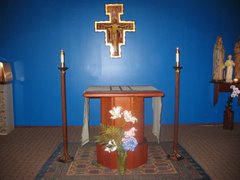
this Mass, this series of presences being made real in the contemporary Church's liturgy and worship. It is important to recognize the central presence of Christ in all of these ways, even when the tabernacle stands off to the side of the sanctuary, for instance.In order to symbolize all of this and to draw our attention away from the reserved Eucharist, the Church moved the tabernacle from directly behind (or even on) the altar to another still-honored place away from the altar itself. She wanted us to pay attention to the coming of Christ in the center of reality in all of the ways he comes to be present there. She wanted our liturgy to have an event at the center of its celebration, a mysterious and hard to perceive event of giving, receiving, and sharing with the world what comes to be on this altar, not something that occurred yesterday or last weekend, but something happening here and now, with, through, and in our very midst!! Thus, one of the pieces of the Church's teaching on Communion during Eucharist obligated the local church to consecrate enough hosts for everyone attending to Communicate without drawing from the tabernacle's store of reserved hosts whenever that was possible. (There is nothing wrong with drawing from reserved stores as needed, but the preference for freshly consecrated Eucharist calls our attention to what is happening here and now, including the fact that we as a People of God are being constituted as the very Body of Christ in both the breaking open of the Word, the breaking of Bread, the sharing of the cup, and our pouring out our own lives to God and one another in this liturgy. It is the altar of God standing beneath the image of the crucified Christ, along with the book of the Gospels enthroned nearby, NOT the tabernacle, that is the central symbol of all of this!!!

The GIRM (General Instruction on the Roman Missal) allows for the placement of the tabernacle behind the altar only when the space is large enough there so that our attention is not drawn away from the altar and onto the tabernacle itself. Most churches do not have adequate space for this so the tabernacle is moved a bit off to the side to another place of honor where it is accessible (to reserve the remaining unconsumed Eucharist after the Communion rite, or to reserve enough consecrated hosts to bring to the sick as an extension of the Mass itself.) If you are in a normal-sized parish church, the fact that your pastor decided to use the Feast of Corpus Christi to celebrate moving the tabernacle back behind the altar, particularly with the idea that Jesus was missing from the center of the events of the Mass, suggests he either does not understand Vatican II's teaching in this matter, or even that he dismisses it. After all, this movement undercuts VII's Eucharistic theology of multiple forms of presence,
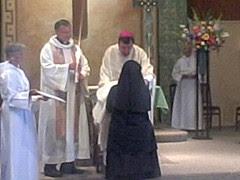
It is also likely to contribute to clericalism (a focus on the importance of the priest alone, to the denigration of the importance of the Sacrament of Baptism and the whole priestly People of God) at the same time. (More about this later if you desire it; the picture to the right should assist in seeing my point!) Moving the tabernacle back behind the altar in most churches does NOT move Christ back to the center "where he belongs". Instead, it assures that most people will not perceive him in the center of things where the Church wishes for us to
also look for, listen to, and celebrate his very real Presence, that is, in the proclaimed Word, and among the baptized, the People of God gathered together in Jesus' name as "the called ones" (
ecclesia). I see this as a terribly ironic failure to worship the dynamic and real presence of Christ in the Eucharist, not an honoring of it. The irony seems to me to be especially great when the move is made and celebrated on the Feast of Corpus Christi.
I sincerely hope this is helpful. I'll get to the second part of the question ASAP!!
* A story I have told here before: A few years ago, I was participating in a Mass at Saint Mary's College of CA, where Bishops Remi de Roo and John Cummins were saying Mass for a group attending a presentation de Roo was giving on Vatican II. (Remember, de Roo was the Bishop who made the intervention at the Council to recognize the eremitical life as a state of perfection.) I was carrying the Book of Gospels in the entrance procession. Before Mass, there was a quick rehearsal with everyone involved in the procession to work out who came first, where, when, and with whom to bow, etc, to be sure we were all on the same page and Mass proceeded smoothly and reverently. Bishop Remi de Roo turned to me and said, "You carry the Book of the Gospels. You bow to no one!!" I think that one statement made more of an impression on me and my appreciation of what it means to regard the Word of God appropriately during Mass than anything else I ever learned in school, no matter the level.
** The precise form of transformation involved here is called transubstantiation because the substance of bread and wine is changed into the glorified body and blood of Jesus.
*** When we speak of our full participation in the Eucharist, we are not merely speaking of not praying the Rosary or doing other devotional activities during Mass. Neither is it mainly referring to sitting or standing when asked, or singing along, listening when appropriate, or saying the appropriate responses. All of that is involved, of course. However, our full participation is about praying the entire Mass so that we too are brought to the altar and broken open with the Word, broken and shared or poured out with the Bread and Cup, made to be intimate members or sharers of the Body of Christ we call Church, and being commissioned to go forth to bring Christ to others as we proclaim the Gospel with our lives.





.jpg)


 Posts
Posts