Stillsong Hermitage is a Catholic Hermitage (Canon 603 or Diocesan) in the Camaldolese Benedictine tradition. The name reflects the essential joy and wholeness that comes from a Christ-centered life of prayer in the silence of solitude, and points to the fact that contemplative life -- even that of the hermit -- spills over into witness and proclamation. At the heart of the Church, in the stillness and joy of God's dynamic peace, resonates the song which IS the solitary Catholic hermit.
Showing posts with label Fr Gerald Coleman. Show all posts
One of the things I did with my morning and early afternoon. Congratulations to all of the Jubilarians, but especially to Sisters Ann Marie Gelles and M Aurora Perez. Seven Sisters celebrated Jubilees today for a total of 420 years of daily committed service as Sisters of the Holy Family. Sister Carole Pesce 75 years, Sister Marie Stafford 75 years, Sister M Aurora Perez 60 years, Sister Mary Lange 60 years, Sister M Sandra Ann Silva 60 years, Sister Ann Marie Gelles 50 years, and Sister Kathy Littrell 40 years. I cannot adequately say how inspiring such commitments are to me!
I am interested in learning later this month what the name of Annie's new Guide Dog will be. Thanks too to Father Gerald Coleman for a really excellent homily. I know he has been a friend to the Sisters of the Holy Family for some time; his homily showed a profound sense of who they are and it was great to hear him speaking a bit about Leo XIV's Encyclical, Magnifica Humanitas. Father is a Catholic moral theologian and the author of The Many Faces of Transgender as well as a more general work, Human Sexuality.
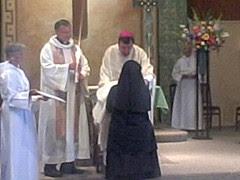
Sister Annamarie and Bishop Barber
A special note: The Sister welcoming everyone and making the opening and closing remarks is Sister Annamarie Therese Colapietro, SNJM. One detail that touched me deeply was the fact that she is wearing an SHF cross on this occasion. You see, Sister Annamarie is the Canonical Trustee (commissary) or Congregational President for the Sisters of the Holy Family at this point in the congregation's life.
Sadly, as most readers here know, as vocations to religious life dwindle in the Church and the median age of congregational members rises, this is becoming a more common canonical arrangement for groups reaching "completion." Though the women of the congregations involved make the decisions for the future of their own congregational resources and charism, they rely on younger members of the collaborating congregation to fill canonical roles. My understanding is that Sister Annamarie Therese has been a great gift to the Sisters of the Holy Family. It was a joy to see her wearing their cross/logo today.
Preparing to profess solemn (perpetual) vows in the hands of Bishop Allen H Vigneron, Diocese of Oakland (Videos and slideshow of the liturgy are found in early September 2007 Blog entries)
"Sister, receive this ring for you are betrothed to the eternal King: Keep faith with your Bridegroom so that you may come to the wedding feast of Eternal joy."
love is a place & through this place of love move (with brightness of peace) all places
yes is a world & in this world of yes live (skillfully curled) all worlds
e.e. cummings
Canonical Granting of Cowl, Solemn (perpetual) Eremitic Profession
"Sister, Be faithful to the ministry the Church entrusts to you to be carried out in its name."
Contact Information
Questions and comments are always most welcome. That is especially true of questions that "seem" basic and which I may never really address (or reflect on!) otherwise. Please email all queries to me at SRLAUREL@aol.com. I will share and respond to them as appropriate here on the blog, or privately if you wish.
Sometimes, email ends up in my spam folder. This is particularly true if you have not written me before. If you haven't received a response, please write again or resend the original while changing the subject line to indicate this is a second attempt.
Clothing in Cowl, Solemn Monastic Profession (not my own of course)
"We have already mentioned above that the basic motive for choosing the solitary life in a hermitage consists in an existential longing to meet and talk to God. The hermit chooses silence in order to enter fully into a dialogue; (she) chooses solitude in order to meet closely a personal presence. The way of the desert is thus not a stray and arid path, it does not lead to the negation of all the values of the world and of other people. Just the opposite: it is the way of mutual presence, dialogue, and friendship that shines where two freedoms and two hearts, divine and human, meet." The Eremitic Life, Fr. Cornelius Wencel, er cam, p.96
The Eucharist is the center of everything that happens in the hermitage.
"Hope is not the conviction that something will turn out well, but the certainty that something makes sense regardless of how it turns out" Vaclav Havel
"Thanks to his consecration, the hermit step by step makes true in his life those words about being the light of the world that is not to be put under a bushel, but on a lampstand. Indeed, the hermit's calling is rather paradoxical, which causes a good deal of suffering for him. On the one hand, he is called to solitude, but on the other hand, he must bear witness to God's Kingdom to countless people. This only seems to be a contradiction. Its ultimate meaning and value becomes clear to the hermit over the course of his life. The contradiction can be understood only in the context of the Trinitarian mystery. The mystery of an inner exchange of love that constantly overflows in the bosom of the Trinity is on the one hand secret and silent, but on the other hand it initiates historical revelation and the redeeming mission of the Son and the Holy Spirit. According to Origen, God is simultaneously the Silent One, the One who speaks and the One who is spoken about.
The hermit also wants to see his mission between, so to speak, two extremes: between his solitary and hidden prayer and the testimony he gives to the world; between silence and the need to speak out. The hermit's life would have been torn to pieces and left miserably incomplete if he had tried to build on the foundation of his own ideas. But fortunately, the way of the desert is not his own invention, but a gift of the Holy Spirit. This Spirit, the unifying principle of the mutual relationships of the Holy Trinity, is also the source of unity and peace in the life of the hermit. " (pp 107-8, The Eremitic Life, Fr Cornelius Wencel, er cam.)
"The Christian solitary today should bear witness to the fact that certain basic claims about solitude and peace are in fact true, [for] in doing this [they] will restore people's confidence first in their own humanity and beyond that in God's grace." . . . The hermitage represents for the individual and society that place where the hermit, 'can create a new pattern which will fulfill (her) special needs for growth. . .and confront the triple specters of boredom, futility, and unfulfillment, which so terrify the modern American." (Thomas Merton, Contemplation in a World of Action, pp 242, 241)
Links for other Diocesan Hermits" Blogs and Websites
"What the eremitic life aims at is an inner, unifying meeting with God. Thanks to such a meeting, the hermit can understand better (her) existence. The hermit, by an intuition of faith becomes aware that (her) calling makes no sense without Christ and his revelation. She learns that her dignity and the meaning of her life are clear and decipherable only in the context of proclaiming God's Kingdom. That is why the eremitic life means finding the meaning and goal of our life in Christ who is the Word of God pronounced in history. That is faith. Here we can say that the dynamism of faith is always present where a simple and loving heart listens carefully to God's word pronounced still anew in the course of time. This word is so powerful and creative that it leads off and renovates the faith of a Christian who, as a result can participate in eternal things. " The Eremitic Life, Fr Cornelius Wencel, Er Cam, p.97.
"The decisive point is that God has spoken. God has addressed us and the human person is created by God as dialogical. The human being is created by God to be addressed. Faith is receptivity to this word. This receptivity becomes explicit in the language of prayer. If I know who and what I really am (God's dialogical partner), I will burst spontaneously into the prayer of praise and thanksgiving." J O'Connell, The Mystery of the Triune God, (London, 1987), p. 146.
"The Christian's life with the Word is the decisive point which distinguishes Christian prayer from all other types of prayer. This point follows naturally from the unique foundation of the Christian experience, namely that God has spoken. Hence God is ever to be found in his Word and this Word can never be bypassed. The danger of bypassing the Word is the danger of all types of mysticism." (J O'Donnell, The Mystery of the Triune God, pp 148-9)
i am a little church(no great cathedral) far from the splendor and squalor of hurrying cities --- i do not worry if briefer days grow briefest, i am not sorry when sun and rain make april
my life is the life of the reaper and the sower; my prayers are prayers of earth's own clumsily striving (finding and losing and laughing and crying) children whose any sadness or joy is my grief or my gladness
around me surges a miracle of unceasing birth and glory and death and resurrection over my sleeping self float flaming symbols of hope,and i wake to the perfect patience of mountains
i am a little church(far from the frantic world with its rapture and anguish)at peace with nature --- i do not worry if longer nights grow longest; i am not sorry when silence becomes singing
winter by spring,i lift my diminutive spire to merciful Him Whose only now is forever; standing erect in the deathless truth of His presence (welcoming humbly His light and proudly His darkness)
e.e. cummings
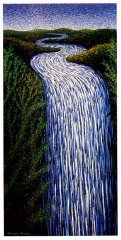
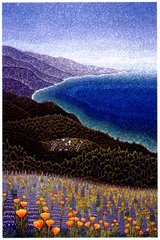
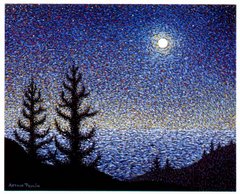
Fr Arthur Poulin, OSB Cam
Fr. Poulin’s paintings echo the Impressionists, yet he has developed his own original style. All his paintings begin with a black canvas. Through his contemplative process he starts with minute brush strokes, creating dots (mustard seeds) that will grow into the completed image. In the process he moves from darkness to light, the major theme of his work. When asked about his painting he speaks in terms of moving from the unknown to the known, from chaos to unity; which he sees as a sacred journey not to be feared.
The River, Fr Arthur Poulin, OSB Cam
Big Sur Spring, by Fr Arthur Poulin, OSB, Cam
Brief Rule of Saint Romuald
Sit in your cell as in paradise.Put the whole world behind you and forget it. Watch your thoughts like a good fisherman watching for fish. The path you must follow is in the Psalms — never leave it. If you have just come to the monastery, and in spite of your good will you cannot accomplish what you want, take every opportunity you can to sing the Psalms in your heart and to understand them with your mind. And if your mind wanders as you read, do not give up; hurry back and apply your mind to the words once more. Realize above all that you are in God's presence, and stand there with the attitude of one who stands before the emperor. Empty yourself completely and sit waiting, content with the grace of God, like the chick who tastes nothingand eats nothing but what his mother brings him.
Radiant Light by Fr Arthur Poulin, OSB Cam
Full Moon Over Big Sur by Fr Arthur Poulin, OSB Cam
The Dialogue of Love
"Christian prayer unfolds in a dramatic rhythm of two freedoms --- divine and human ---that interact with each other through the whole range of mutual relationships and attitudes. God gives us his love through the Spirit and He actively takes care of the world in dramatic action involving the whole of creation, a performance we can call Theodrama. (The Eremitic Life, Fr Cornelius Wencel, er cam, p 140)
Bursting Blooms, by Sr Kristine Haugen, ocdh
"God is bestowing a special favour on you by drawing you into the desert. The call is a matter of God's free choice; you will only be able to persevere in it by his condescension. You will always remember how privileged you are that God should love your soul, and as time goes on you will appreciate this all the more. . . . Humble and detached, go into the desert, For God awaiting you there, you bring nothing worth having, except your entire availability. . . .He is calling you to live on friendly terms with him, nothing else." The Hermitage Within
Blue Poppies, Sr Kristin Haugen, ocdh, Hermitage Arts
"Therefore, an authentic prayerful dialogue is possible only in the perspective of love. When two persons entrust themselves to each other in love, a wonderful drama of self-giving and co-possessing is played out. The closer the mutual relationships are, the more they determine all the levels of the two partners' personalities. The stronger the ties are, the more silence is needed and, paradoxically, the fuller the mutual understanding is. The knowledge and the fullness of self-giving that spring from prayer are related to the silence of love." (The Eremitic Life, Fr Cornelius Wencel, er cam, p 140)
Blue Lilies, Sr Kristine Haugen, ocdh, Hermitage Arts
"The hermit knows that it is possible to reach communion with God, who reveals his majesty and his mysterious, elusive presence in nature in a swift stream, in a quiet, misty valley, in the rolling waterfalls, in the ravishing smell of flowers. Prayer rooted in admiration of the world's natural beauty is an attempt to capture the manifest, but at the same time hidden presence of the eternal Mystery, a Mystery so great that it surpasses all that can be named, measured, or touched. Coming into a close, meditative contact with a mountain, a tree, or a flower, the person of prayer discovers that they are all anchored in a wonderful presence that reaches far above all we can know through hearing or sight." Fr Corneilus Wencel, The Eremitic Life, p160.
Cascade, by Sr Kristine Haugen, ocdh
Herons, by Sr Kristin Haugen, ocdh
"While discussing the eremitic life, solitude, and silence, we must never lose sight of the fact that the hermit , like any other Christian, lives in the community that is the Church. There is no doubt that (her) form of participation in the life of the Church differentiates (her) from many other brothers and sisters in faith. However, (her) whole existence is rooted in the community, and that is the key element that decides the Christian character of the way of the desert." (Fr Cornelius Wencel, The Eremitic Life, p 151.)