Thanks for your questions. Let me start with basic vocabulary. The term "public" can be used to refer to a kind of notoriety, a presence out in public, which contrasts with privacy. When we speak of hermits living a public vocation, this is NOT what we mean. The second way of using the term "public" refers to public rights and obligations. Here we are speaking of law and legal commitments. When hermits are said to have a public vocation, this is what we mean. Because these two senses are so different from one another, it should be noted that a hermit having a public vocation can ALSO live in significant physical hiddenness and privacy. That's not a problem; the two need not conflict.
My vocation is a public one in terms of its public rights and obligations. This means that the Church commissions me to live this vocation in a way that explicitly contributes to the life of the Church. The People of God have the right to hold certain expectations of me regarding my living out of my vows, my Rule, the living eremitical tradition, and my relationship with God in Christ. My commitment is a public one, not a private one. At the same time, the vocation entails significant privacy.
If someone is a non-canonical or lay hermit, they are living a private vocation. If they have vows, those vows will be private. The Church does not commission them to live as a hermit, nor do the People of God have a right to hold certain expectations of them regarding the way they live out their vows, their rule of life (if they have one), the living eremitical tradition, and their relationship with God in Christ. Their commitment is a private one, not a public one. Their lives may entail a good deal of privacy, or they may spend hours a day creating videos of themselves and opening the intimate details of their lives to the entire online world. The commitment itself is still a private one and no one has a right to expect more from their commitment than the canonical obligations that already apply by virtue of their baptism.
So, my Bishop's vocation is a public one in the sense provided here re rights and obligations, and so is mine. It is not the case that we speak of c 603 as a public vocation merely because the Bishop has a public role and vocation. We speak of it as public because the one professed and consecrated under this canon has a public vocation with new public rights and obligations.

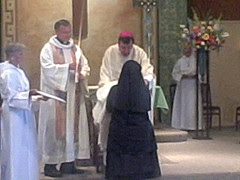
We celebrate the profession and consecration of such vocations at Mass and subsequent receptions because these are the normal avenues for the ecclesial celebration of life commitments. They are ecclesial events, not private ones, so the entire Church celebrates them together. I may have mentioned that at my consecration, during the Litany of the Saints, I had the sense that the whole Church, in heaven and on earth, was focused on this small patch of floor and what was occurring here in this single small parish and diocese. This was not about me per se, but about this vocation and the gift of God it is to the Western Church. It was about the Church reclaiming something she had let go of to some extent, and was enriched and challenged by, from the days of the desert Abbas and Ammas. Yet, in the midst of such a public celebration, the vocation itself is a hidden one, and it remains so. This is not a matter of contradiction; it is one of paradox.





 Posts