[[Dear Sister, did you make your vows to God or to a bishop? I keep hearing that c. 603 hermits make vows to a bishop, and non-canonical hermits make them to God. Which is it? I also keep hearing that c 603 hermits are full of self-importance, pride, and the need to feel admired and regarded. Are these things true? Are you proud in a vainglorious way of being a c 603 hermit?. . . What I can't understand is why the Church would admit people to consecration who are motivated in this way. I guess it also seems to me to call the motives of the Church itself into question. I don't hear anyone claiming that religious in community wearing habits or using titles are full of self-importance and the other things. Many are clamoring to get them back IN habits, and when they went to lay clothes, these same people went berserk! Do you hear these accusations from others or mainly from one person?]]
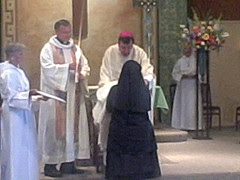
Thanks for your questions. I will make this answer relatively brief because I have answered similar questions and objections in the past. You can find them by checking the labels to the right of this response, or by searching using the search function in the upper left corner of this blog's screen. Like all c 603 hermits, I made vows to God in the hands of the local ordinary. The vocations of religious, consecrated hermits and consecrated virgins all belong to the Church before they belong to an individual. Moreover, they are mediated to the individual by the Church via the hands of a legitimate superior and/or the local bishop in the case of consecrated virgins. All valid vows in the Church, whether public or private, are made to God. All are significant and require meaningful discernment and respect. Public vows are also received in the name of the Church, and are both lived out and supervised in the same way. This last point is not the case with private vows. In any case, in my profession, the situation is not an either/or matter, but a both/and one. Vows are made to God in the hands of the diocesan bishop, who becomes the hermit's legitimate superior. In this specific role, he serves both God and the Church to whom the vocation belongs.

Yes, I am quite proud of being a c 603 hermit, but not in a vainglorious way. Adding that distinction in the way you did is really significant and very well done!! I am grateful to God for the way he has worked in my life: grateful for the promise made to me regarding the Church and what it would bring to my life, as well as bring my life to. I am grateful for everything in my life that has helped create the heart of a hermit; grateful beyond saying that the promise made when I was @ 14-15 years old and attending my first Mass is coming to fulfillment. I am grateful for the eremitical life and its importance in the life of the Church. I am grateful beyond measure for the challenge and richness of this vocation entrusted to me by God through the mediation of his Church, and I feel pride in looking at my life and what God has done and is still doing with it. Of course, that pride is conditioned with a sense of awe, surprise, and a sense of unworthiness. Yet, it is conditioned by the overarching sense that God is and has been the One doing all these things right along, even when I might have had no real sense of God's presence or of obeying him and allowing his will to be accomplished in me. At the same time, that healthy pride is real, and I believe it is as much from God reflecting God's own delight in me and this vocation, as any other good thing in my life.
My sense is the Church would NOT consciously admit folks motivated by vainglory to profession and consecration. Neither would she admit those who want to wear habits to eremitical life simply because they want to wear a habit or "stand out", etc. Many of the objections (or accusations) you have apparently heard are the ones the church has determined are NOT and will not be at work whenever they truly discern such vocations. That is especially true of eremitical vocations. No one coming to a diocese merely desiring to wear a habit, get a position of power, prestige, or be given the ability to ask for contributions or go non-profit, and no one seeking a diocesan dwelling, insurance, support, or the like, is likely to make it one day further into a serious discernment process. The person you have heard making accusations is, as several people have pointed out to me recently, mainly involved in character assassination while using stale and ineffective ammunition. It's a bit like firing BB's at a Cathedral and expecting them to knock it off its foundations! The main point, however, is, as you say, that this results in accusations that denigrate the Church herself and call into question the seriousness with which she takes vocations to the consecrated state. If you want me to look at that another time, just let me know.

Your last question is very fine and helpful. While I have been part of forums of self-identified hermits who do make similar accusations, in the main, these accusations tend to reflect a bias that is not borne out in my experience. The accusations coming my way tend to come from one source. As I reflect on the work I am doing both on this blog and in my other writing (Guidebook), what becomes clear is that my accuser and I are dealing with the c 603 eremitical vocation from two radically different levels of understanding. Mine is unapologetically Catholic. Ecclesially speaking, it is also deeper and more attuned to what the hermit is commissioned to live
in the heart of the Church for the sake of the Church and her proclamation. Thanks again for your questions, especially those having to do with pride vs. vainglory, etc. Your distinction in that question is a critical one!!





 Posts