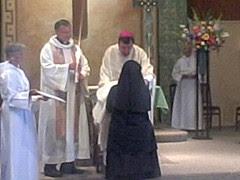
Bishop Mariann Edgar Budde gave a tremendous and tremendously courageous homily yesterday. My Scripture class is beginning the book of Acts tomorrow and something we will see again and again is the need for this kind of courage by those who understand that Jesus is NOW the Lord of this world in light of his resurrection and ascension. Acts reminded early Christians and us as well of the question, "What happens when the gospel comes to Rome with their deified emperors and announces a new king, Jesus?" What we have seen in the last two days is this same question worked out in the homily of an Episcopal Bishop and the responses of many who were offended by that homily.
22 January 2025
On the Homily From Post Inauguration Prayer Service by Bishop Mariann Edgar Budde
Posted by
Sr. Laurel M. O'Neal, Er. Dio.
at
12:51 PM
Labels: Bishop Mariann Edgar Budde, Foundations of unity, Plea for Mercy to newly inaugurated president
19 January 2025
A Brief Look at Cornelius Wencel's Writing on Work
Interesting question. Yes, I recognize the passage and know the context. It is from the section on "Work", pp119-125. What you describe represents a significant misreading of this passage because Wencel is speaking about the misguided drive to power, prestige, fame, and wealth so typical of worldliness --- a position I believe most hermits truly agree with. To read it properly, it is especially important to quote the rest of the paragraph (cf paragraph below in italics) and its immediate textual context as well as outlining a bit more of the larger context in which this passage occurs. Here that is.
Not in order to achieve his own perfection does the hermit set out on his solitary voyage. On the contrary, he considers his way and mission to be part of a great and common effort to change and renew the cultural and spiritual life of humanity. . . .The hermit strongly opposes misdirected work, which aspires only to achieve success, domination, prestige, and fame, and which can easily destroy other people's good.
There is nothing more foreign to the hermit than the clownery of a glittering career, success, and all those vulgar illusions that tempt the modern world. For the hermit, his work is one of elementary and daily activities, necessary for his own sanctification as well as for the sanctification of the world. It is not a mere object, money-maker, and article of trade, but it is rather a way of realizing his life's calling and approaching his life's fulfillment. Thus the hermit becomes a sign of protest against all the vulgar tendencies of modern civilization, which view work only in terms of productivity and money. Such a way of thinking, and consequently of acting, testifies to how much worldly affairs have degenerated and have gone far astray from what would have been a humanitarian and harmonious course of events.
In this section on work in eremitic life, Wencel is discussing not only the work hermits do but also why they do it. He wants to indicate the vast distinction between why a hermit works as s/he does as opposed to the reasons many folks in the world work and what motivates them. It is not that Wencel denies the importance of success, but he does recognize there are vulgar notions of success that are unworthy of human beings. We can see it today when billionaires act politically and in every other way possible to secure themselves and their own wealth and reputation at the expense of everyone else and thus, without appropriate concern for humanizing the world for everyone. When the rich and powerful act in this way as though the world is their playground flaunting their wealth, ambition, and self-centeredness, while disregarding the bodies of starved and otherwise impoverished children and the situations of the truly and desperately needy, I think it could rightly be described as vulgar clownery.If human work is to use human abilities and talents in a wise and proper way, and if it is going to build up the good of the person and society, it should be performed in an atmosphere of love. . .Only when we see work in such a manner can we get satisfaction, joy, and a sense of personal fulfillment from our activity. Work, when performed wisely and seen as an expression of human, love-motivated solidarity and service, turns out to be out to be a very concrete way of liberation. . . Cornelous Wencel, Er Cam, The Eremitic Life, pp 119-121
Work in the eremitical life is both much more modest and also more elevated in import, meaning, and motivation. We follow our daily routine, take on the projects our life opens to us for our own sanctification and the sanctification of the rest of God's creation, and work in this way for the whole of our lives. We trust that the modest work and efforts we put forth every day fit into God's plan for the whole of reality even when we have no real concrete sense of where this leads. When I was first consecrated (c 603) a journalist asked me what it meant for me to "be successful"; how did I measure success as a diocesan hermit? Her question surprised me, but I came to see it shouldn't have. "Success" is a significant norm in our culture; eremitical life is hard to place within usual notions of what it means to be successful. I answered in terms of personal integrity and faithfulness. At the end of each day could I say I had lived this life humbly, faithfully, in a way that was true to myself and God's call? This is still the definition of success I would use in answering the question today, almost 20 years later. It is not the definition of success "the world" glorifies.
We, hermits, are not about building the world's largest real estate empire, getting our pictures on the cover of Forbes or Fortune 500, gilding our living accommodations in gold and marble, dressing in designer clothes, or measuring success in terms of status, power, or material wealth. I believe Cornelius Wencel is correct when he refers to all of this in terms of glittering. . .vulgar illusions. These things are misguided. They are rooted in a falseness promising an ultimate happiness and satisfaction they can never provide; they cannot humanize or sanctify us. Instead, they demean and empty us of authentic humanity; they divide rather than unify and ensure the ongoing suffering of the least and the lost while adding even more persons to these ranks every day. They are precisely antithetical to what it means to be concerned with theosis or working towards the Kingdom of God.
Eremitical life (cf c 603) embraces and is partly defined in terms of "stricter separation from the world". In the passage you quoted, Wencel is talking about "the world" with which eremitical life (and all genuine Christian life) is in conflict. It is "the world" with no room at all for the Evangelical Counsels or Jesus' Sermon on the Mount with its Beatitudes. The plutocrats and kleptocrats of this "world" tend to laugh or scoff at such Christian values and vision. They ridicule those who embrace religious poverty, chastity, and obedience to image Christ and serve others. These are some of the folks Wencel has in mind when he draws two very different notions of success and work, the eremitical or radically Christian and the "worldly". In speaking as he does of hermits, Wencel also underscores that our work is rooted in concern for the world outside the hermitage. We do what we do for God's sake and the sake of all that is precious to God.
Posted by
Sr. Laurel M. O'Neal, Er. Dio.
at
3:43 PM
Labels: Cornelius Wencel Er Cam, Stricter separation from the world, Success in the Eremitic Life
18 January 2025
Feast of St Jaime Hilario, FSC
In honor of St Jaime Hilario, FSC, (1898-1937), I wanted to put up the following short video. Some of my own education happened at a Brothers of the Christian Schools institution and today I attend Mass regularly at St Mary's College of California. So today's feast day (on the Christian Brothers' Calendar) is poignant to me. I especially resonate with Jaime's story of having to leave the minor seminary because of a developing hearing loss and yet, remaining convinced that God was calling him to a vocation to consecrated life. Similarly, I resonate with his inability to teach in the classroom because of his disability and his responsiveness to a different way of living his call.
In his determination and despite his growing disability, he was admitted to the Christian Brothers and, in time, was professed and consecrated. He died as a martyr during the Spanish Civil War when, among others, Catholic teachers were executed. Martyrdom means witness and every Christian is called to witness to who God calls them to be and to the Gospel that empowers this call, even to the point of death (red martyrdom) and beyond. Brother Jaime, whose hearing loss had made classroom teaching impossible and thus, could have saved his life, was an amazing witness. He gave his life to honor both his vocation as a religious of the Brothers of Christian Schools (FSC), and the God who called him to follow Christ in this way.
Posted by
Sr. Laurel M. O'Neal, Er. Dio.
at
9:30 PM
Labels: Brother Jaime Hilario FSC, red martyrdom
Questions Pointing to a Hermit's Fundamental Experience and Vision of c 603 Life
In the main, these sound to me like the kinds of questions those just beginning to consider eremitical life might ask. They are good questions because, for the most part, they point to deeper and more fundamental issues an aspiring diocesan hermit is likely to need to implement and even struggle with. These questions might be an important part of that process, but they are less important than the underlying eremitical foundation that needs to be established. They are not questions to which I can give an answer that is carved in stone because each one must be worked out by the hermit over time with the assistance of a spiritual director or mentor as the hermit candidate begins to think about their Rule of Life. (And actually, these look like exactly the questions one might ask if one was creating a Rule of Life that was composed of "do's and don'ts" or "how often and how much" kinds of points rather than a Rule rooted in a lived experience of some years reflecting a vision of eremitical life under c 603.) Because these questions remind me of the questions asked by those who are new to eremitical life, especially if they have never been aided in writing a liveable Rule of Life (or who also may never have lived one before), I am going to approach them this way. I think that will be most helpful, particularly since the questioner agreed to my posting them here in the hope they could help others.
So, as I begin to respond to these questions, let me suggest that other posts I have put up here on writing a liveable Rule or writing a Rule of Life are important as background and should be referred to. The most important caveat I can reiterate is that if one is writing a Rule of Life that is truly liveable, it must be rooted in the candidate's lived experience. Expect that the process of preparing to write and writing such a Rule with the help of a mentor will, on average, take approximately two to four years depending on the degree of preparation one has in this. This process is important for candidates and their dioceses in discerning and providing the appropriate formation needed to live c 603 eremitical life well. A liveable Rule can never be just a list of things I do and things I avoid doing (though it will likely include some of these). Each of the questions above needs to fit organically and integrally into a sound vision of eremitical life that is edifying to the Church and world! They must demonstrate a sense of c 603 and what living the terms of that canon means and requires of the individual hermit!! All of my responses to these questions presuppose this fundamental truth.
How many spiritual direction clients in a day are prudent or wise? First of all, it must always be remembered that hermits who do spiritual direction are primarily hermits. We are called to live the silence of solitude and stricter separation from the world (i.e., that which is resistant to Christ), and only thereafter or within this foundational context are we involved in limited ministry. So, for instance, I don't see clients every day (or even every week) and I rarely see more than two or three on the days I do see clients. The same is true of mentoring other hermits or hermit candidates. To do more than this demands more time and energy than I have to give to this, and it begins to be destructive of my eremitical life itself. Others will have different circumstances than I do and may be able to see more clients. Even so, every c 603 hermit must remember that active ministry is always a part-time and significantly limited part of our lives. If we do this kind of work, it must spill over from our lives in the silence of solitude and draw us back into this context as well. Especially, it must not be a relief from our silence of solitude or something we do to give our lives meaning (though of course it can add to its meaning). Instead, it must be a limited activity we offer to others because our lives already have a fullness of meaning, the meaning that comes from being called to be a solitary hermit who witnesses to the Gospel of Jesus Christ. Our ministry to others is an expression of this meaning spilling over beyond the hermitage walls.
Unless the hermit is also a priest, or writes this requirement into his/her Rule, the c 603 hermit is not required (in Law) to say any hours of the Liturgy of the Hours. That said, it is really difficult for me to understand how a hermit living in and as part of the beating heart of the Church could live a day without praying the official Prayer of the Church in some significant way. Some hermits pray 2 or 3 of the hours (Lauds, Vespers, Compline, and Vigils or the Office of Readings are the major ones included here) while others pray at least some of the minor hours as well. We each need to discover the number of Hours necessary as an aid to praying our day, in fact, in praying our very lives day in and day out. For some, the LOH is really helpful in this, and especially, it allows us to be true to an ecclesial vocation reflecting belonging to and representing the long Judeo-Christian tradition of prayer. For many of us, praying the Hours also reminds us of our standing as religious under c 603. Personally, I understand the LOH to be a striking symbol of this (c 603) vocation's ecclesial nature and a significant way to ensure our lives are steeped in Scripture.
Diocesan hermits are allowed to have pets, of course. (Anchorites are often known for having a cat, for instance!) Your question is really about evangelical or religious poverty though. Some hermits would see the cost of caring adequately for a pet (food, medical care, time for adequate exercise and play, and training (not for cats, of course!)) as making such a pet an extravagance or a distraction. Others of us find the pets necessary as part of our vocation both to be fully human and to care for God's creation as we can. Poverty has never been defined in only one way in the history of religious life or the Gospel Counsels. So, for instance, Franciscan poverty is different from Benedictine poverty is different from Carmelite poverty, and so on.
| Myself with Merton the Tom (RIP) |
I do think it is important to have times (morning, afternoon, and evening, for example) to check and respond to email, yes. This is especially important when one has clients, one might need to get back to them quickly. Still, it is not something one usually schedules unless one has difficulty staying away from the computer!!). Instead, it is something one's schedule allows for when one is free from other activities/periods. For instance, I may check email and messages before breakfast or supper and again before Compline and bed. If I am writing for several hours, I may break from that and check email then because I am already working at my computer. (If I am journaling, that is a different matter, and while I may break for a cup of tea or a snack, I will not check email or messages then.) In this small matter too, it is up to the individual to reflect on what their lived experience has taught them and work out a solution that allows them to live the terms of c 603 and their own Rule with integrity.
Home visits or visits with relatives and friends should be worked out in the same way as appointments with clients, and access to email and messaging. What is truly healthy for the individual hermit and her way of life? What is truly loving? What can she manage financially or in terms of her schedule? When does contact with others begin to detract from the silence of solitude and stricter separation, for instance? For some people, time with family will be brief because we really do need to get back to our ordinary schedule and activities (families can be demanding in many ways!); frequency and duration are something a hermit must determine for themselves. I will make one caveat, though; namely, a hermit should be able to lay aside a lot of (the details of) her hermit life for the relatively brief time she is with her family. She should be present to these others as the person they (each) know and love. She must not "play hermit" or (within reason, of course) refuse to participate in the activities they enjoy and want to share with her. I once read a hermit write about "only talking about spiritual things" when with her loved ones. One can always ask what, when looked at in the way God does, is NOT a spiritual thing, but the way to approach this matter, I sincerely believe, is for the hermit to simply be entirely present in all she is and does with family and, in this way, bring God's love to bear (but also discover and contemplate this same love as it is present) within the family.
Generally speaking, there is no reason a hermit should not go to stores to pick up what is needed. It has all kinds of benefits both for the hermit and for those she might meet and talk with during such trips! Hermits are not recluses, at least the vast majority are not. I have my groceries delivered; I began that because of the pandemic. I continue it because it is very helpful and convenient for getting everything I need (I don't drive, so carrying things home is difficult). And sometimes I simply need to get out of my hermitage and, if needed, to run errands. At those times, I meet people, converse, maybe stop to have a brief coffee with someone who would like to talk, etc. Again, generally speaking, all of that is fine. The thing we need to be aware of is who we are in these times and what we truly need. If our eremitical life is sound, we will want to get back home as soon as is practicable, and we should be able to settle into our usual routine when we return.
Again, it is up to each hermit, her vision of the life, and her Rule of Life, to determine how she answers these and other questions. Circumstances change, and things that would be permissible at one time might be something one needs to skip at another. In all situations, our lives are lived in dialogue with God in the silence of solitude, and whatever choices we make need to continue and deepen or expand that dialogue.
Posted by
Sr. Laurel M. O'Neal, Er. Dio.
at
2:29 PM
Labels: Divine Office as Prayer of the Church, Ecclesial Vocations, eremitical poverty, home visits, limits on active ministry under canon 603, LOH, religious poverty, writing a liveable Rule
16 January 2025
What Does it Mean to be a Hermit in an Essential Sense? (Reprised from 2018)
Introduction:
That's such a great and important question! For me personally, articulating the definition of this phrase or the description of what I mean by it has been a bit difficult. It is a positive phrase but in some ways, I found my own senses of what I meant by this come to real clarity by paying attention to examples of inauthentic eremitical life, individuals who call themselves hermits, for instance, but who, while nominally Catholic, are isolated and/or subscribe to a spirituality which is essentially unhealthy while embracing a theology which has nothing really to do with the God of Jesus Christ. To paraphrase Jesus, not everyone who says "Lord, Lord" actually has come to know the sovereignty of the Lord intimately. In other words, it was by looking at what canonical hermits were not and could or should never be that gave me a way of articulating what I meant by "being a hermit in some essential sense." Since God is the one who makes a person a hermit, it should not surprise you to hear I will be describing the "essential hermit" first of all in terms of God's activity.
Related to this then is the fact that the hermit's life is a gift to both the Church and the world at large. Moreover, it is a gift of a particular kind. Specifically, it proclaims the Gospel of God in word and deed but does so in the silence of solitude. When speaking of being a hermit in some essential way it will be important to describe the qualities of mission and charism that are developing (or have developed) in the person's life. These are about more than having a purpose in life and reflect the simple fact that the eremitical vocation belongs to the Church. Additionally, they are a reflection of the fact that the hermit precisely as hermit reflects the good news of salvation in Christ which comes to her in eremitical solitude. If it primarily came to her in another way (in community or family life for instance) it would not reflect the redemptive character of Christ in eremitical solitude and therefore her life could not witness to or reveal this to others in and through eremitical life. Such witness is the very essence of the eremitical life.
The Experience at the Heart of Authentic Eremitism:
Whenever I have written about becoming a hermit in some essential sense I have contrasted it with being a lone individual, even a lone pious person who prays each day. The point of that contrast was to indicate that each of us is called to be covenantal partners of God, dialogical realities who, to the extent we are truly human, are never really alone. The contrast was first of all meant to point to the fact that eremitical life involved something more, namely, a desert spirituality. It was also meant to indicate that something must occur in solitude which transforms the individual from simply being a lone individual. That transformation involves healing and sanctification. It changes the person from someone who may be individualistic to someone who belongs to and depends radically on God and the church which mediates God in word and sacrament. Such a person lives her life in the heart of the Church in very conscious and deliberate ways. Her solitude is a communal reality in this sense even though she is a solitary hermit. Moreover, the shift I am thinking of that occurs in the silence of solitude transforms the person into a compassionate person whose entire life is in tune with the pain and anguish of a world yearning for God and the fulfillment God brings to all creation; moreover, it does so because paradoxically, it is in the silence of solitude that one comes to hear the cry of all in union with God.
If the individual is dealing with chronic illness, for instance, then they are apt to have been marginalized by their illness. What tends to occur to such a person in the silence of solitude if they are called to this as a life vocation is the shift to a life that marginalizes by choice and simultaneously relates more profoundly or centrally. Because it is in this liminal space that one meets God and comes to union with God, a couple of things happen: 1) one comes to know one has infinite value because one is infinitely loved by God, not in terms of one's productivity, one's academic or other success, one's material wealth, and so forth, 2) one comes to understand that all people are loved and valued in the same way which allows one to see themselves as "the same" as others rather than as different and potentially inferior (or, narcissistically, superior), 3) thus one comes to know oneself as profoundly related to these others in God rather than as disconnected or unrelated and as a result, 4) chronic illness ceases to have the power it once had to isolate and alienate or to define one's entire identity in terms of separation, pain, suffering, and incapacity, and 5) one is freed to be the person God calls one to be in spite of chronic illness. The capacity to truly love others, to be compassionate, and to love oneself in God are central pieces of this.The Critical Question in Discernment of Eremitical Vocations:
What is critical for the question at hand is that the person finds themselves in a transformative relationship with God in solitude and thus, eremitical solitude becomes the context for a truly redemptive experience and a genuinely holy life. When I speak of someone being a hermit in some essential sense I am pointing to being a person who has experienced the salvific gift the hermit's life is meant to be for hermits and for those they witness to. It may be that they have begun a transformation that reshapes them from the heart of their being, a kind of transfiguration that heals and summons into being an authentic humanity that is convincing in its faith, hope, love, and essential joy. Only God can work in the person in this way and if God does so in eremitical solitude --- which means more than a transitional solitude, but an extended solitude of desert spirituality --- then one may well have thus become a hermit in an essential sense and may be on the way to becoming a hermit in the proper sense of the term as well.
If God saves in solitude (or in abject weakness and emptiness!), if authentic humanity implies being a covenant partner of God capable of mediating that same redemption to others in Christ, then a canonical hermit (or a person being seriously considered for admission to canonical standing and consecration MUST show signs of these as well as of having come to know them to a significant degree in eremitical solitude. It is the redemptive capacity of solitude (meaning God in solitude) experienced by the hermit or candidate as "the silence of solitude" which is the real criterion of a vocation to eremitical solitude. (See other posts on this term but also Eremitism, the Epitome of Selfishness?) It is the redemptive capacity of God in the silence of solitude that the hermit must reflect and witness to if her eremitical life is to be credible.
Those Putative "Hermits" not Called to Eremitical Solitude:
For some who seek to live as hermits but are unsuccessful, eremitical solitude is not redemptive. As I have written before the destructive power of solitude overtakes and overwhelms the entire process of growth and sanctification which the authentic hermit comes to know in the silence of solitude. What is most striking to me as I have considered this question of being a hermit in some essential sense is the way some persons' solitude and the label "hermit" are euphemisms for alienation, estrangement, and isolation. Of course, there is nothing new in this and historically stereotypes and counterfeits have often hijacked the title "hermit". The spiritualities involved in such cases are sometimes nothing more than validations of the brokenness of sin or celebrations of self-centeredness and social failure; the God believed in is often a tyrant or a cruel judge who is delighted by our suffering -- which he is supposed to cause directly -- and who defines justice in terms of an arbitrary "reparation for the offenses" done to him even by others, a strange kind of quid pro quo which might have given even St Anselm qualms.These "hermits" themselves seem unhappy, often bitter, depressed, and sometimes despairing. They live in physical solitude but their relationship with God is apparently neither life-giving nor redemptive -- whether of the so-called hermit or those they touch. Neither are their lives ecclesial in any evident sense and some are as estranged from the Church as they are from their local communities and (often) families. Because there is no clear sense that solitude is a redemptive reality for these persons, neither is there any sense that God is really calling them to eremitical life and the wholeness represented by union with God and characterized by the silence of solitude. Sometimes solitude itself seems entirely destructive, silence is a torturous muteness or fruitlessness; in such cases, there is no question the person is not called to eremitical solitude.
Others who are not so extreme as these "hermits" never actually embrace the silence of solitude or put God at the center of their lives in the way desert spirituality requires and witnesses to. They may even be admitted to profession and consecration but then live a relatively isolated and mediocre life filled with distractions, failed commitments (vows, Rule), and rejected grace. Instead, some replace solitude with active ministry so that they simply cannot witness to the transformative capacity of the God who comes in silence and solitude. Their lives thus do not show evidence of the incredibly creative and dynamic love of God who redeems in this way but it is harder to recognize these counterfeits. In such cases, the silence of solitude is not only not the context of their lives but it is neither their goal nor the charism they bring to church and world. Whatever the picture they have never been hermits in the essential sense.
Even so, all of these lives do help us to see what is necessary for the discernment of authentic eremitical vocations and too what it means to say that someone is a hermit in some essential sense. Especially they underscore the critical importance that one experiences God's redemptive intimacy in the silence of solitude and that one's life is made profoundly meaningful, compassionate, and hope-filled in this way.
Posted by
Sr. Laurel M. O'Neal, Er. Dio.
at
10:57 AM
Labels: authentic and inauthentic eremitism, Being a Hermit in an Essential Sense, redemptive experience, Silence as Redemptive
12 January 2025
Does God Love Us Because We are Pathetic?
Thanks for the question! It reminds me of a question from the NT we will hear this week, namely, "What is man that you are mindful of him?"* I tend to agree with you on this, but I think the statement you are reflecting on raises more questions besides. I don't think God regards anyone in this particular way. My sense is that God sees us as we are, of course, and that means he sees us with all of our potentialities, struggles, accomplishments, failures, etc. He knows us intimately, better than we know ourselves, and he does not see us as pathetic (which is a human judgment) but rather as precious (a function of Divine love and delight). I think that is true whether we have sinned seriously, made terrible mistakes, or whatever. That does not mean that God sugarcoats things, or engages in some sort of denial about us. Rather, he sees the truth of who we are, the entire truth and of course, the deepest truth, and he loves us because we are his own and are made for him. Besides, love is the only thing that can truly call us to become the persons we are made to be.
God, after all, is Love-in-act. That is what and who God is as well as what it means for God to do what God does. I remember once being bothered by this thought because it seemed to me that perhaps God could not do anything BUT love me if he was Love-in-Act. I thought of this as some sort of coercive situation or as though God was limited and unfree in some important sense. It seemed to me that I could not trust such a God or his love if he could do nothing else. Eventually, I worked through the theology of it and realized that this was truly the fullness of Divine Freedom, not a limitation of it. I came to some of this realization because of the narrative in Genesis where human beings choose to know good and evil, that knowing good and evil does not represent knowing more than only knowing good does.The Old Testament shows us God renouncing such a way of judging us or our world when it speaks of God's decision never to destroy the world as occurred in the narrative of the great flood. The OT tells the story of God changing his mind, but as in other stories in the OT, this is really a way of revealing a very different God to the hearers of this story than they could have imagined. (It is simpler to reveal a God who supposedly changes his mind than it is to develop the theology of a completely different God out of whole cloth; it is simpler for people to accept as well!) In the New Testament, the central image of God's judgment seems to me to be that of harvest and this develops OT images like that of gleaning in the book of Ruth, for instance. God sees and summons the good, the true, and the holy out of the ambiguity of sinful existence and calls these to abundant life in himself. Moreover, he does so clearly and inevitably. That is the way of Divine judgment, the way of God's love and mercy. It demonstrates the way God sees us, precious, full of potential and fruitfulness.
It is also a sacramental way of seeing reality. We Catholic Christians look at ordinary limited and even flawed matter and, because we are part of a highly sacramental and incarnational faith, are capable of seeing the extraordinary nature of the most ordinary reality. We can imagine wheat and grapes becoming bread and wine which in turn can become the very Body and Blood of our Lord. Oil can be used to consecrate, strengthen, and heal us; water can become a means of washing away brokenness and godlessness while initiating us into the very life of God, and a few simple words in absolution or blessing, or a brief Scriptural passage** can raise us to greater wholeness and holiness as they feed some of our very deepest needs. God, in Christ, teaches us to see in this way, and I believe he especially asks us, in the power of the Spirit, to see ourselves this way, as both ordinary and extraordinary and at least potential incarnations of God. Again, we are precious, full of potential and fruitfulness --- or, in the words of Scripture, we are imago dei, the very image of God.Recently I was told a story about someone concerned about disappointing God. It's a common belief and I have heard (or entertained) the same concern many times. My immediate thought in response was that God could never be disappointed in us, though I thought he could be disappointed FOR us. When I reflected on my experience of that I realized it is because my own experience of God (especially in prayer and in the people who represent God to me) always has God seeing me in terms of deep truth, essential beauty, and indestructible potential. God is not naive. God, like others in my life, "sees everything" but God loves me beyond all of that (which means he both sees me more deeply and loves me into more abundant life). Even more, God continues to love in that way as I come more and more to allow my life to be defined in terms of this love! I continue to believe that God can be disappointed for me, but not in me; I especially can never believe the God I know loves me or any of us because we are pathetic.
Posted by
Sr. Laurel M. O'Neal, Er. Dio.
at
1:47 PM
Labels: a love that does justice, A Vocation to Love, imago Dei, Love-in-Act, pathetic? Divine judgment as harvesting
10 January 2025
When Concern for the Temporal is also Engagement with the Eternal (reprise from 2015)
Before I ask my questions I wanted to say I am grateful to you for your blog. I think it is probably helpful to people considering becoming hermits and for those of us with questions about spirituality generally. I also love that you share things like what gives you pleasure or post videos of your orchestra. Those posts reveal a lot about yourself and I personally enjoy that. My question is whether you see yourself growing out of a concern with temporal things or writing about these things? The other blogger thought these reflected a newly-wed stage of life; she also suggested that the concern with the temporal had a link with the US as opposed to other countries. I guess her blog readers come more from other countries and are not as interested in some of the questions you deal with. I don't see how she could know what countries your questions come from though.]]
Thanks very much for your comments and questions. No one ever asked me about what gives me pleasure before; I am sure at least some think there is nothing edifying about the experience of pleasure! As though the mere experience of pleasure implies one is a hedonist! Others have asked me to say more about my everyday life but I have not been able to do that; these questions seemed sort of invasive and also were a little hard to imagine what to say. Anyway, I enjoyed that question and I hope one of the things it indicates is the profound happiness associated with this vocation. Every aspect of it can be a source of real joy and yes, "pleasure" or gratification because it all reflects life with God and the quality of that. To some extent that anticipates your questions!.I may have told this story before, but I was once working with a hermit candidate in another diocese and he asked me how I balanced "hermit things" and "worldly things" in my life. When I asked him what he meant by worldly things he listed things like grocery shopping, doing the dishes and laundry, scrubbing floors, cleaning the bathroom and things like that. When I asked about "hermit things" he referred to prayer, lectio divina, Office, Mass, and things like that. In other words, he had divided the world neatly into two classes of things, one having to do with what most folks call "worldly" or "temporal" and those most folks refer to as "spiritual" or "eternal." What I had to try and make clear to this candidate was that to the extent he really was a hermit, everything he did every day were hermit things, everything he did or was called to do was to be an expression of the eternal life he shared in by virtue of his baptism and new life in Christ. A neat division into spiritual and temporal simply doesn't work with our God. The incarnation rules that out.
It is the place of disciples of Christ to proclaim the way the event of Jesus' life, death, and resurrection has changed our world and our destiny. Christians recognize that every part of our world and our lives can glorify God. That is, every part of our world and lives can reveal God to others. So, you see, I think the simplistic division of reality into temporal and spiritual is actually anti-Christian and I have said this in the past. Therefore, I don't think we outgrow our concern with the temporal dimensions of our lives. Instead, unless we refuse to allow this to occur through our all-too-human ways of seeing and thinking, they come more and more to reflect the presence of God and are consecrated or made holy (hallowed) by that presence and our awareness of it. Because my own vocation is a public one I feel a responsibility to share about elements of that vocation about which people raise questions. Moreover, many of the questions I have dealt with recently are related to becoming a hermit, discerning the distinction between legitimate hermits and counterfeits, fielding concerns about distortions in spirituality which can be harmful to people, etc. I think these are important.
Especially these questions lead to or are part of important discussions of truthfulness, personal integrity, pretense, shame, the dialogical and ecclesial nature of the eremitical vocation, the capacity of one's relationship with God to transform the deficiencies of her life into actual gifts, the nature of symbols, our faith as essentially Sacramental, the universal call to holiness and the sanctity of ALL vocations, the importance of lay eremitical life as well as of canonical or consecrated eremitical life, ministerial vs contemplative vocations, and any number of other topics. What may seem to be superficial matters, or matters far removed from the "spiritual" or "eternal" tend from my perspective as a theologian, a contemplative, and a Benedictine, to open unto far deeper issues. This is because they are part of an organic whole where the whole is essentially sacramental.However, there is another perspective that I should mention. The blogger you are citing is a privately dedicated lay hermit. She is certainly called to be responsible for her vocation but not in quite the same way I am for mine. She does not share the same rights (title, habit, publicly ecclesial eremitical life) nor is she publicly responsible for things like the quality of her rule, the importance and nature of a horarium, the place of legitimate superiors and the nature of obedience, the degrees and types of solitude one is called to embrace, degrees and kinds of work allowed, forms of prayer advised, approaches to penance, the charism of the life, etc. Because of this, she may not see these things or their depth and significance in the same way I do. That is hardly surprising.
Another matter that is never merely superficial is the way a hermitage or one's prayer space looks. Here appearance and function are profoundly related. Canonical hermits are publicly responsible for simple lives of religious poverty, obedience and celibate love in the silence of solitude. God is the center of their lives and their living space should reflect all of these things. What is as important --- since few people will actually come into hermit's living or prayer space --- is that a hermitage with too much "stuff" can be an obstacle to the life a hermit is called to live. I have been doing Spring cleaning off and on these past two weeks or so and that means getting rid of the accumulation of a year and more. This accumulation occurs partly because I don't drive and cannot simply take stuff to used book stores, thrift stores, the salvation Army, etc. Papers and books especially accumulate. Once the "stuff" is gone, even though the place was neat anyway, the feeling is simply much different. I personally feel lighter, happier, more able to "breathe", work and pray.
Further, the way my hermitage looks tends to be a good barometer of how well I am living my life. For me the richness and vitality of one's inner life is reflected in simplicity, beauty, light, and order. The opposite of these things can say that I am struggling --- sometimes spiritually, sometimes physically, and sometimes both; they may also cause me to struggle. On the other hand some specific forms of clutter and accumulation are associated with productive work and are a sign of the vitality of my inner life. In any case these "superficial" or "temporal" matters are a clue and key to attending to the state of my inner life with God and with others. I think a lot of people experience something similar. Again, we are talking about an organic whole in which inner and outer are intimately related and mutually influential.
The simple fact is that in our incarnational faith concern for and engagement with the temporal is how we are engaged with the Eternal and the ordinary way the Eternal is mediated to us. Resurrected life is Bodily existence and though we can hardly imagine what this means we must continue to hold these two things together in our understanding just as we hold the temporal and the spiritual together in our appreciation of reality as sacramental.
Posted by
Sr. Laurel M. O'Neal, Er. Dio.
at
10:13 PM
Labels: Benedictinism, contemplation as engagement, Ecclesial Vocations, engagement with the eternal, Everyday Mysticism, Incarnation, Jesus as Mediator, Reality as Sacramental
Feast of the Baptism of Jesus (reprise)
Of all the feasts we celebrate, Sunday's feast of the baptism of Jesus is one of the most difficult for us to understand. We are used to thinking of baptism as a solution to original sin instead of the means of our initiation into the death and resurrection of Jesus, or our adoption as daughters and sons of God and heirs to his Kingdom, or again, as a consecration to God's very life and service. When viewed this way, and especially when we recall that John's baptism was one of repentance for sin, how do we make sense of a sinless Jesus submitting to it?
I think two points need to be made here. First, Jesus grew into his vocation. His Sonship was real and completely unique but not completely developed or historically embodied from the moment of his conception; rather it was something he embraced more and more fully over his lifetime. Secondly, his Sonship was the expression of solidarity with us and his fulfillment of the will of his Father to be God-with-us. Jesus will incarnate the Logos of God definitively in space and time, but this event we call the incarnation encompasses and is only realized fully in his life, death, and resurrection -- not in his nativity. Only in allowing himself to be completely transparent to this Word, only in "dying to self," and definitively setting aside all other possible destinies does Jesus come to fully embody and express the Logos of God in a way which expresses his solidarity with us as well.It is probably the image of Baptism-as-consecration and commissioning then which is most helpful to us in understanding Jesus' submission to John's baptism. Here the man Jesus is set apart as the one in whom God will truly "hallow his name." (That is, in Jesus' weakness and self-emptying God's powerful presence (Name) will make all things Holy and a sacrament of God's presence.) Here, in an act of manifest commitment, Jesus' humanity is placed completely at the service of the living God and of those to whom God is committed. Here his experience as one set apart or consecrated by and for God establishes God as completely united with us and our human condition. This solidarity is reflected in his statement to John that together they must fulfill the will of God. And here too Jesus anticipates the death and resurrection he will suffer for the sake of both human and Divine destinies which, in him, will be reconciled and inextricably wed to one another. His baptism establishes the pattern not only of his humanity, but that of all authentic humanity. So too does it reveal the nature of true Divinity, for ours is a God who becomes completely subject to our sinful reality in order to free us for his own entirely holy one.
We are puzzled by one who is holy as God is holy and, as the creed affirms, "true God from true God" and who, evenso, is consecrated to and by the one he calls Abba --- and commissioned to the service of this Abba's Kingdom and people. A God who wholly identifies with us, takes on our sinfulness (our estrangement from God and from our deepest selves), and comes to us in smallness, weakness, submission and self-emptying is really not a God we are comfortable with --- despite three weeks of Christmas celebrations and reflections, and a prior four weeks of preparation -- is it? In fact, none of this was comfortable for Jews or early Christians either. The Jewish leadership was upset by JnBp's baptisms generally because they took place outside the Temple precincts and structures (that is, in the realm we literally call profane). Early Christians (Jewish and otherwise) were embarrassed by Jesus' baptism by John --- as Matt's added explanation of the reasons for it in vv 14-15 indicate. They were concerned that perhaps it indicated Jesus' inferiority to John the Baptist and they wondered if maybe it meant that Jesus had sinned prior to his baptism. And perhaps this embarrassment is as it should be. Perhaps the scandal attached to this baptism signals to us we are beginning to get things right theologically.
After all, Sunday's feast tells us that Jesus' public ministry begins with a ritual washing, consecration, and commissioning by God which is similar to our own baptismal consecration. The difference is that Jesus freely accepts life in a world under the sway of sin in his baptism just as he wholeheartedly embraces a public vocation to proclaim God's sovereignty. The story of the desert temptation or testing that follows this underscores this acceptance. His public life begins with an event that prefigures his end as well. There is a real dying-to-self involved here, not because Jesus has a false self that must die -- as each of us has --- but because in these events his life is placed completely at the disposal of his God, his Abba, in profoundest solidarity with us. Loving another, affirming the being of another in a way that subordinates one's own being to theirs --- putting one's own life at their disposal and surrendering all other life possibilities always entails a death of sorts -- and a kind of rising to new life as well. The dynamics present on the cross are present here too; here we see only somewhat less clearly a complete and obedient (that is open and responsive) submission to the will of God, and an unfathomable subjection to that which human sinfulness makes necessary precisely so that God's love may be exhaustively present and genuinely sovereign here as well.
Posted by
Sr. Laurel M. O'Neal, Er. Dio.
at
6:58 PM
Labels: Feast of the Baptism of Jesus
05 January 2025
In God Alone (Reprise)
This may be a different and more challenging version of this chant than some are used to. The instruments improvising over the chant sometimes, even often, seem to miss the mark. And yet, under it all, grounding and giving coherence to every note --- if only we have the patience and trust to hear it --- is the profoundly stabilizing refrain or antiphon, [[ In God alone my soul can find rest and peace, In God my peace and joy, Only in God my soul can find its rest. Find its rest and peace.]] As I listened this morning I found myself hanging onto the antiphon with a kind of fierceness during parts of this as I waited (and sometimes yearned intensely) for the improvising instrument to come to rest solidly again in the ground of the antiphon --- especially in the longer original recording.
So it is with us I think. We sing our lives improvising around this "theme" --- this internal antiphonal truth that sounds in our hearts; sometimes we seem to have journeyed so far as to have stopped listening and lost touch with it altogether --- though in our music-making we seek it still! And then, with patience, trust, and perseverance in our hearkening, we reconnect more clearly and come once again to that place of rest in God who alone makes sense of the whole of our lives --- even those bits which seemed to or may truly have lost touch with the Divine chant or "theme" grounding them.
For whatever else, the chant continues faithfully, unfailingly in a way that both shapes the improvisational journey and allows the player to finally come home once again despite the far and even foreign places to which they have traveled in the meantime: dissonances are resolved and the harmony of the whole is enriched with musical "stretches" and surprises that, rather than troubling or disturbing us, now delight and even move us with awe.
Posted by
Sr. Laurel M. O'Neal, Er. Dio.
at
10:06 PM
Labels: human beings as language events, Singing our Lives, Taize, Taize In God Alone, the Silence of Solitude, The Still Point
01 January 2025
An Invitation to Explore "Ponam in Deserto Viam"
Sure, we can try to work through Ponam in this way; it would be interesting and I am sure others will have questions (and likely insights to offer) as well. I have been asked several times over the past couple of years if I would write about Ponam; probably it is a good time to do that, and even more, to ask for contributions from c 603 hermits or those in formal discernment and formation processes with their dioceses!!
What I have written about the ecclesial nature of this vocation was not drawn from Ponam; it was a topic I first raised with Archbishop (then Bishop) Vigneron when I first met with him regarding my vocation on the Feast of the Sacred Heart in 2005. What I have written about a discernment and formation process is drawn from my own experience with c 603 and the task of writing my own Rule, but also from the example of the Desert Abbas and Ammas and, to a lesser degree, from the contemporary practice and theology of the Eastern Church --- I did not know about the novels of Justinian in the 6th Century until reading Ponam myself, but the (later) Western Church has similar transitions regarding solitary hermits and their relationship with the Church. Giustiniani's comments on solitary hermits might be an example of this even though this was rooted in the Church's requirements on reception of the sacraments.So, let me invite those who are interested, to read and contribute questions, observations, and insights into Ponam in Deserto Viam to do that. I think one way forward is for me to start by answering questions (whenever I get these) and then, over time if a true conversation eventuates, add relevant observations and insights from other readers. Suggestions are also very welcome! Please let me know if you are interested.
Posted by
Sr. Laurel M. O'Neal, Er. Dio.
at
3:17 PM
31 December 2024
HAPPY NEW YEAR 2025!!!
Courage is the measure of our heartfelt participation with life, with another, with a community, a work, a future. To be courageous is not necessarily to go anywhere or do anything except to make conscious those things we already feel deeply and then to live through the unending vulnerabilities of those consequences. To be courageous is to seat our feelings deeply in the body and in the world: to live up to and into the necessities of relationships that often already exist, with things we care deeply about. . .. To be courageous is to stay close to the way we are made. (Consolations, excerpt pp 49-50)
May the blessings of our God touch each and all of us with his sustaining love and empower us with his presence as Emmanuel!! All good wishes for a genuinely happy new year!
Posted by
Sr. Laurel M. O'Neal, Er. Dio.
at
9:28 PM
Labels: Courage, David Whyte, Happy New Year, Journeying
Does God want the Hermit "All for himself"?
Thanks for your questions. I think they are important. I see them as especially important theologically, that is, in what we are saying about God in this assertion. When we suggest that God wants someone all for himself it gives us a picture of God that is distorted. While it is true that we are each called to live as someone belonging entirely to God, we must recognize that in Christian theology such belonging is part of giving our lives entirely for the sake of others. Both of these things are true at the same time. It is a significant paradox where one belongs entirely to God so that one may give oneself entirely to all that is precious to God in the way God desires. But this is not precisely the same as God wanting someone just or all for himself. That characterization of God sounds selfish to me; it seems terribly self-serving (both of God and of the hermit making the claim) and that is certainly not the God Jesus reveals to us.
Canon 603 defines this (solitary hermit) life as one of stricter separation from the world, assiduous prayer and penance, and the silence of solitude. Certainly, this is embraced so that God might be the One he has willed for eternity to be, and yes, it is for the hermit's essential well-being as imago dei. As such, the vocation is about union with God, no doubt. But the canon itself says it is not only for the praise of God but for the salvation of the world. In other words, we give ourselves entirely to God so that this relationship, 1) reveals the nature of God to others, and 2) is fruitful in the way any Christian vocation is meant to be. Eremitical life is not a selfish one and the God who calls one to this life is not a selfish God, but a God who gives himself exhaustively to us and others through us, at every moment.
I can understand why you are having trouble arguing against this notion of God wanting someone for himself alone! I am also having trouble saying what is so profoundly disturbing about this notion (and it is disturbing enough to make me feel somewhat nauseous at the thought). It has, I think, something really fundamental, "ass-backward," as one relative of mine might once have put things!! Thinking back many years now, I have heard Sisters explaining their vocation to children by saying that God "wanted them for himself" as they talk about why they have embraced celibacy rather than marriage as they were consecrated to be the "Spouse of Christ". But while this explanation captures something of the special sense of being loved by God carried by the vocation, it is not accurate when taken at face value.This is because neither Jesus nor the One he called Abba want the Sister for themselves alone. God calls this Sister to this relationship because he wants the Sister's life for the sake of others and the missioning to others that being God's own both allows and requires if God is truly to be Emmanuel!! We can reasonably talk about being God's own, for instance, and I have written here that we are called to our vocations for God's sake as well as for our own and for the sake of all we touch ministerially. I recognize that this is, to some extent, pretty provocative language, but it falls far short of suggesting that God calls persons to reclusive eremitical vocations because he wants them all for himself!! I suppose I just can't get other seriously flawed notions of God out of my mind here; it reminds me of child sacrifice or throwing people over parapets or into pits of flames, or cutting their hearts out as part of sacrificing them to a god who desires such things. It is an essentially pagan notion of God, barely one step removed from blood sacrifice made to satisfy the anger or blood lust of a tyrannical god.
I promise I will think about this more (in fact, I am likely not to be able to cease thinking about it!), and hopefully, I will be able to say more about what is wrong with this notion, or at least say it more coherently. As you capture in asking the question, there is something slippery about the assertion and we don't want to deny God anything God truly wills or desires. But the idea that God could want someone just for himself alone is perverse when we are dealing with the God of Jesus Christ who reveals himself as self-emptying love-in-act. After all, God is not a human person-writ-large nor does "he" need or desire us in the way other human beings need or desire one another. He is "Wholly Other" and yet loves us exhaustively so that he (and we) may be given to (may love and serve) others in a similarly exhaustive way.
Posted by
Sr. Laurel M. O'Neal, Er. Dio.
at
8:25 PM


.jpg)


.jpg)


.jpg)

.jpg)