11 April 2025
A Contemplative Moment: Divine Light Experienced as Darkness
Posted by
Sr. Laurel M. O'Neal, Er. Dio.
at
8:13 AM
Labels: A Contemplative Moment, Divine Light Experienced as Darkness
10 April 2025
Followup on the Relation of Physical Solitude to Existential Solitude
Other hermits I have read or heard have stressed how someone is no hermit if they are known by others or spend time with them, or wear a habit, or use a recognizable title, and so forth. They stress the externals a lot, and for them, physical solitude is the key to determining whether someone is really a hermit or not. But you have sliced through all that in a couple of sentences in your last post. Is it your opinion that a hermit must be measured by the inner journey they undertake, rather than the degree of physical solitude they live? That's what I hear you saying. ]]
What excellent questions! Your first one about why I am writing this way now is probably not one I can answer to your satisfaction because it involves a personal experience that happened at the beginning of Lent, and I am not yet sure what I can or want to say about that. You'll need to be patient with me regarding that part of things. Still, I have tried to write about the essential hiddenness of this vocation and also to distinguish between physical solitude and a more existential solitude from fairly early on. I first used the term existential solitude around 2013, at least as part of a piece that includes that label. And earlier than that, I wrote about the quest for authentic selfhood, and the inner journey one is called to make, even if I failed to use the actual term, " existential solitude". As I looked over the articles with the label "essential hiddenness", however, the things I have been writing about this past month are present, but without the clarity of my recent posts. And that makes sense because sometimes we can only see things clearly or have the freedom to say what we need to once we have travelled beyond the struggle to a new place and perspective.
I don't want to undervalue the importance of physical solitude to the hermit vocation. The past year and a half, especially, and to a somewhat lesser degree the time since the pandemic, has been marked by very significant degrees of solitude of this type. To varying degrees, it is a prerequisite for the inner journey the hermit is called to make. Even so, physical solitude is not the reason for the vocation and must not be absolutized as some seem wont to do. As I noted in my last post, [[The eremitical vocation requires physical solitude, but it is not primarily about physical solitude, nor does it exist for the sake of physical solitude. Similarly, the hiddenness of eremitical life is not about external hiddenness, anonymity, etc., though it may benefit from these. Instead, it is about the hidden journey to the very heart of our being. This journey continues in one way or another, whether I am with others or not, and it is hidden from everyone, even those whose place in my life makes them a privileged sharer in this journey.]] Physical solitude can sharpen our existential solitude, but so can being with people. I think physical solitude, however, is the privileged servant of the existential solitary journey and is essential to authentic eremitism.I understand what you mean when you write about reading and hearing other hermits making physical solitude the key to the eremitical vocation, though. I agree that some seem too taken with externals (this includes those who criticize these) and even seem unwilling to look at the inner journey as the heart of the vocation. I absolutely believe the eremitical vocation and the authenticity of the hermit herself can only be measured in terms of the inner journey they have undertaken. Many people have embraced the newish phenomenon called "cocooning." Many others are misanthropes and agoraphobics, while in many prisons, criminals are locked in their individual cells for 23 hours a day. All of these and many, many more live physical solitude and are NOT hermits.
The examples could be greatly multiplied with scholars, artists, writers, the isolated elderly, many chronically ill, and others who live and work alone. Some try to validate their relative isolation by calling themselves hermits. Some of these even embrace some degree of piety and prayer. A small percentage of these may discover a genuine call to eremitic life. Even so, what tends to be missing for the majority is the intense, serious, and sustained inner journey to the depths of one's being involving an engagement with existential solitude.The Church professes and consecrates c 603 solitary hermits and has done so since Advent of 1983. Some argue that canonical standing is not necessary. I differ because I understand how difficult the inner journey I am speaking about actually is, and how much support it actually requires. Generally speaking, in the process of discernment and (initial) formation, those working with the candidate have a sense of the person being about this inner journey, or they do not admit them to profession or consecration. The outer signs of this vocation remind the hermit of the inner journey to union with God they are supposed to be about. These things remind the Church itself that it has such persons in its midst. At the same time, admission to profession and consecration (when these are legitimately pursued and granted to the hermit), says to the hermit in the midst of this journey that the Church recognizes she is called to this vocation, and helps empower her to stay the course! So does the supervision of the local ordinary and/or his delegate and the spiritual director.Of itself, living entirely alone is not all that important. It might even represent a failure to live with others or to be adequately socialized (remember those misanthropes and criminals!). But living alone or perhaps with one or two others in a laura, 1) with the approval and assistance of representatives of the Church, 2) within a local faith community, 3) all for the sake of an inner journey to union with God in, 4) a divine vocation that is, 5) paradigmatic of the ultimate call of every person that exists or will ever exist, is incredibly important. The externals of this vocation (including physical solitude) point at once to its ecclesial nature and remind us of its essential hiddenness. Even so, it is the inner journey to the depths of one's being and an active seeking of union with God that is the very heart of the call and justification for everything else, especially every sacrifice the vocation requires from us. It seems to me that a life committed to this particular journey is the only thing that actually merits the name "hermit".
Posted by
Sr. Laurel M. O'Neal, Er. Dio.
at
2:11 PM
Labels: c 603 and the purpose of my life, C 603 as paradigm, essential element in discerning eremitical life, Essential Hiddenness, existential solitude, inner journey, inner work and asceticism, Physical solitude
09 April 2025
On the Relation Between Physical and Existential Solitude
Great question and timely because I was thinking about doing just such a post! Thank you!! The interesting thing about existential solitude is that while physical solitude is critically important in helping us get in touch with this, being with other people in some instances can be similarly helpful. You remember I used the image of being more alone in a crowd than we are when we are by ourselves? This is an instance of being with others as a situation that also puts us in touch with our existential solitude. Remember that existential solitude is defined as that solitude that is intrinsic to being a human being. We are born alone, live alone, and die alone in this existential sense. There is always going to be a gap between ourselves and any other person. No one really knows our hearts or minds completely. We are always, at least partly, unknown and unknowable to others, as they are to us. That creates a sense of existential loneliness or solitude that only God overcomes.
In conversations with other hermits, we have spoken of this sense. It turns up for us most poignantly, I think, because each of us have very few people with whom we can discuss our lives with the expectation that they will understand what we are and why we do what we do. I have said before that usually folks think of hermits in some stereotypical way, probably because it is easier than having some huge cipher or question mark hovering over the word "hermit". Others narrow down the way they understand this vocation to "prayer warrior" --- a phrase I detest, not because I don't pray or because I don't, in fact, do significant battle with the demons of this world and my own heart, but because it is reductionistic, too belligerent, and contrary to the essence of this call. People in my parish are comfortable thinking of me as a religious, even a contemplative --- though here we are beginning to move close to being more than a bridge too far for them! Hermit is definitely beyond the usual bounds of understanding.On the other hand, we hermits have each other, and it is incredibly important that we do. Existential solitude can be very painful; to have others who are on the same journey, who know what you are feeling and how important it is, is incredibly critical to living this vocation well. What I find is that my time with those who haven't a clue about what I live or why often sharpens my sense of existential solitude, while my time with my Sisters in c 603, or my Director, my spiritual director, and a handful of others, encourage and accompany me in my journey even though it is one I must still make alone with God. I believe that for established hermits (less so for beginners), the time hermits spend with others will not detract from the journey into their inmost depths that they are called to. These times can actually sharpen, intensify, or otherwise enhance the journey, though in different ways, depending on the relationship.Physical solitude is absolutely critical, not only for getting in touch with one's existential solitude, but for learning to become aware of the deep hunger and thirst we have for wholeness, and thus, too, for God. However, sometimes physical solitude, when combined with the anguish or even the more tolerable pain of existential solitude, needs to be eased if we are to remain fully committed to the journey to the depths of ourselves, where we meet God and our truest self at the same time. The eremitical vocation requires physical solitude, but it is not primarily about physical solitude, nor does it exist for the sake of physical solitude. Similarly, the hiddenness of eremitical life is not about external hiddenness, anonymity, etc., though it may benefit from these. Instead, it is about the hidden journey to the very heart of our being. This journey continues in one way or another, whether I am with others or not, and it is hidden from everyone, even those whose place in my life makes them a privileged sharer in this journey. Granted, I try to share what the journey involves, to whatever extent is appropriate, but it remains essentially hidden, just as it remains essentially solitary.
Posted by
Sr. Laurel M. O'Neal, Er. Dio.
at
11:24 PM
Labels: Eremitical Hiddenness, Essential Hiddenness, Ever-Deepening Hunger for God, existential solitude, Physical solitude, The Eremitical Journey
On Respecting and Honoring Eremitical Life and Associated Questions
[[Sister Laurel, did you say canon 603 came into being because hermits needed to force the church to respect hermits? I am quoting someone here: [[this other person has written that it is because the hermit they needed to force the church to recognize and respect Hermits that they hadn't been recognized and respected enough in other words to have a place or a position and I think that that's probably from the hermit's perspective why a few of them got a certain Bishop a Bishop de Roo to sponsor and to Lobby this for them with the Bishops and he they got it through in 81 it got included in the updated version of the canon law codex of canon law of the Catholic Church. ]] Did hermits lobby for this? Why would they do this?
She also said, [[so I see a good purpose for it as far as the Bishops are concerned but there's nothing mentioned about publicizing yourselves or wearing a habit or having a title of your name or or postnominal letters after your name Er Dio or having a public Mass when you do your vows or a reception or a videotape of it that you put online none of that it's it's not really something we need to promote if God's calling Hermits he'll call them and they'll know it it's not like a matter of oh let's get the word out and recruit people to be canon law Hermits so that we can develop a movement and get some respect around the Catholic church and have a place and a position of prestige and status and power .]]
And also when speaking of the Church not really needing c 603, because hermits are supposed to be humble, she said, [[what's the point of having the law then really because Hermits don't need to be recognized and don't need to be respected and don't need to have a place of honor in the church we're nothing to God's all of any vocation we are the least we are the least and the to be the most hidden and the most um obscure and humble . . .]] I think you are clearly the person she is referencing in these comments.]]Yes, I agree, I am the one being focused on in these comments. I have written about the reason for c 603's establishment and the intervention by Bp Remi de Roo after serving as Bishop Protector for a colony of hermits who were required to leave their solemn vows in order to live as hermits. I am also the one who wrote about the need to honor the eremitic vocation, but not individual hermits --- I said nothing about that, and I certainly never used the idea of "forcing" the church in any of this. Neither did I speak about hermits gaining a position of power and prestige or starting a movement and recruiting people. When I have spoken about status, it has been about status in the sense of legal standing, which is granted to hermits in ecclesial vocations who assume additional canonical rights and obligations beyond those of their baptism. I have also spoken about mentoring those discerning and forming such vocations and working with their dioceses to assist in an area few have real experience of. This has nothing to do with recruiting and I think characterizing efforts to serve the Church and c 603 vocations in this way is offered in bad faith.
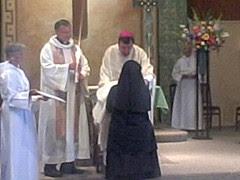
I am sorry the person you are quoting has not managed to accept the fact that c 603 hermits are recognized as women and men Religious despite the fact that they do not belong to a religious institute. I have cited canon lawyers' opinions on this matter, and of course, bishops and dioceses regularly approve the wearing of habits, prayer garments, cowls, rings, etc., and grant permission for use of the title Sister or Brother. They mark these things in profession liturgies, in fact. In a Church marked by new kinship and service of one another, the importance of such titles has less to do with prestige and power than it does with commitments to fostering the Kingdom of God as a countercultural reality. Post-nominal initials are common in consecrated life and tend to mark not only membership in specific institutes, but charisms, and even the shape of one's consecrated life. Diocesan Hermits use a number of recognizable post-nominals. Er Dio (for eremita dioecesanus, or diocesan hermit) seems to be best known. Such initials indicate a public, consecrated, and ecclesial vocation with public vows. They represent a life commitment and allow us to drop the title (Sister, Brother, or Father), especially in correspondence and publishing.Finally, I have written in the past regarding the reasons Bishop Remi de Roo intervened at the Vatican II Council to argue for the making of eremitical life a state of perfection in the Church. He had worked with about a dozen hermits who had made exceptional sacrifices in order to live a call to eremitical solitude, and, highly aware of their character and the history of the vocation, recognized that in the Church's failure to recognize eremitical life in this way, it had done a disservice to a significant vocation without which the Church actually could not be the ecclesia God calls her to be. While these hermits would have understood the importance of keeping their monastic commitments, I don't know that they actually lobbied for canonical recognition. Given what I have written about existential solitude and the vocation of the hermit, I suspect that Bishop de Roo was at least somewhat sympathetic to an observation made by Thomas Merton. Along with pointing out that the Fathers of the Church had assigned hermits a high, even the highest place among Christian vocations, "because hermits aspire more than anyone else to perfect union with Christ in contemplation", Merton said:
[[the exigencies of Christian life demand that there be hermits. The kingdom of God would be incomplete without them, for they are [persons] who seek God alone with the most absolute and undaunted and uncompromising singleness of heart.]] Disputed Questions, p 166
Most Religious I know today would not buy into the "higher, highest" way of appreciating vocations (I reject it entirely), and most hermits I know would be pretty uncomfortable viewing eremitism in this way. Still, we do recognize the uniqueness of a vocation that serves as a paradigm of the universal quest for authentic Selfhood with God and the place of both existential and physical solitude in that quest. If the Church values eremitical vocations for the place and role they hold in the very life of the Church itself, then I can't see where marking that with respect offends against humility. In fact, I experience such recognition, especially in relation to an ecclesial vocation, as an intensification of my own call to humility. Paradoxically, it is one's failure to respect oneself and one's vocation, or to recognize the fundamental Christian values of dignity, respect, and honor deserved by every person and every vocation that truly offends against humility!
Posted by
Sr. Laurel M. O'Neal, Er. Dio.
at
9:31 PM
Labels: Are c 603 hermits considered Religious men and women?, Er Dio, Thomas Merton
08 April 2025
Series on the Desert Abbas: Become who You Are
Posted by
Sr. Laurel M. O'Neal, Er. Dio.
at
10:10 PM
Labels: Abba Antony, Bishop Eric Varden OCSO, Desert Abbas and Ammas, Dietrich Bonhoeffer, e e cummings
Followup on "if everything happens that can't be done"
Great questions, thanks!! I love ee cummings' poetry and did my first published article on his "what if a much of a which of a wind" in the Explicator, a journal for the explication or interpretation of poetry. I had also done a college presentation on that poem and "if everything happens that can't be done" and my professor worked with me on writing it up for the journal. I learned more about the incredible depth of cummings' poetry, and about writing in general, in the next weeks of rewriting and rewriting for Jeanne Nichols than I had throughout school until that point. It takes time to fully see what cummings is doing in the sections of his poems; setting off sections in parentheses from those outside the parentheses is something he loves to do. So, returning to these poems is a complete joy for me, especially since I had not done even my bachelor's in Theology, much less my graduate work (Systematic Theology) when I wrote that first article!! To return to him now, after 42 years as a hermit reflecting on God and the nature of eremitical solitude is to realize even more clearly how profound cummings' theology was right from the get-go all those years ago.
So, regarding your questions, if you read the whole poem again and then focus on the parenthetical section dealing with books in each stanza, what you will see is that cummings is setting "book learning" off against an almost ineffable experience of two people profoundly in love with one another. What he tells us is that book learning couldn't have planned this or instructed one in "how to" here. A loving relationship is a living, growing thing, and even the smallest bud falls outside the scope of book learning; books, after all, "don't grow". They are not alive. But relationships and those that enter into them are living things, as is love; these grow, falter, wither, die, and sometimes blossom in fullness. One cannot capture or come to know love in or through a book, not love's wisdom, beauty, challenge, joy, or its meaning. Books are meaningful, yes. Cummings affirms this, but at the same time, the "we" he is celebrating is far more full of meaning and life than any book could ever be. One learns to love only by loving, and when two people come together in this way, it is meaningful and joyous beyond imagining or telling.I don't think e e cummings is anti-intellectual; at the same time, he understands the place of the intellect and the ways life and love surpass it. He writes consistently in many of his poems about the ineffable nature of the person who is truly alive. Being truly alive, and so, an individual, conflicts with those who are merely "everyones" or "anyones". Similarly, I don't think cummings was describing a strictly mystical experience of union with God, though I have to say that his sense of what happens when two persons come together physically as well as psychologically and spiritually in love is very consistent with what happens when a person experiences union with God. Cummings's work is about love and coming to fullness through love. While that is true of human relationships, it is even more true of the Divine/human relationship. Thus, even if cummings was "merely" writing of human love, his poetry can also be used to reveal the telos or goal of Divine/human love.
What it means to be a "we" is that to be a complete human being, a human person who is known by and knows God, implies being united with God. On some very foundational level, God and the human person are indivisible. Being one and being a we coincide. When I write about the silence of solitude as goal, this is what I am talking about --- a human person coming to fullness of being and meaning, who is therefore living out the joy of a loving union with God. Solitude here involves oneness of being, meaning one is whole, complete, and holy because one lives in union with God. The potential for this is always present within us, just as God is always present within us. We can learn and choose to be those "going it alone" or standing without God, or those who are truly dependent upon God. The paradox is that true individuality means existing in, from, and for God and those God loves, while standing without God has to do with being individualistic, egoistic, and isolated or even alienated from our deepest self and others, including God.For the hermit, then, there is a vast difference between individualism, egoism, isolation, and individual wholeness or holiness, theonomy, and solitude. I think cummings captures these two with his contrast between an I that stands yearning and apart from others, and a "we", where we become fully ourselves only in a relationship constituted by love. The height of this latter state is found in the "we" of union with God. I suppose that my own experience could be called mystical, yes, since it is the fruit of an experience of the profound Mystery that lives at the core of my being and created the universe. In this coming to be our truest selves, there is certainly a union involved ("we're wonderful one times one"). At the same time, I know from past prayer experiences that there is a good deal more in front of me. This recent experience is full of peace, hope, and promise ("there's somebody calling who's we") -- though I cannot begin to imagine it, of course.
Posted by
Sr. Laurel M. O'Neal, Er. Dio.
at
8:52 PM
07 April 2025
There's Somebody Calling Who's We
if everything happens that can't be done
When I think about existential solitude, or times of great loneliness and suffering, I am aware now of the line in the poem that says, "there's somebody calling who's we". I have never had the experience of being abandoned by God, though I have been aware of feeling God's remoteness at times. In my young adult to adult life, I have lived in light of the sense that I am a dialogical reality, constituted by an ongoing conversation with God, who is the source and ground of being and meaning. Similarly, I have long had the sense that we are each called to be united with God. In this sense, each one of us is called to be a "we." In this union with God, we become most truly ourselves, and God becomes most truly the One he wills to be, Emmanuel. We also move further away from isolation and individualism in the process. Mostly, we know shadows and echoes of this "we" as we fall in love with other people, live with them, accompany them, celebrate, and grieve with them. And sometimes, as mystics tell us, we can know and be known by God in such a way that together we become the "We" we are meant to become.
For the hermit, this "we" defines the hidden heart of eremitical solitude. Coming to and witnessing to the universal call to become a "oneness" (a unity marked by wholeness and holiness) that is also a "we" is the work and mission of the hermit's vocation. It is the reality that constitutes both the anguish and the unalloyed joy of her life and calling. While I don't think e e cummings was a mystic -- at least not in the usual sense -- there is no doubt that he understood love and what happens when a person comes to fullness in themselves in relationship with another. I especially love the way Cummings creates a kind of breathlessness and topsy-turvy quality in his imagery of what happens when the impossible is actually realized. I am struck by how well he captures the joy of union undimmed despite allusions to moments of incompleteness, yearning, and searching. Cummings' journey is one where he moves from merely "believing in" love to actually knowing the fullness of being and meaning associated with an I becoming a We.
This is another way of talking about dying to self (i.e., dying to the I of individualism, egoism, and isolation) and becoming the one (whole and holy) who is fully alive in the "we" we each are potentially. "(with a spin/ leap/ alive we're alive)". This is what it means to love and be loved, especially by God. It is more than Cummings could have imagined (he says so clearly in the poem), nothing he could have learned in books, or been taught by even the wisest of teachers (who, like even the dumbest of teachers, know better than to try!). For Christians called to live our lives toward union with God, it is also more than we can imagine. And maybe that is also why the hermit vocation is so little understood today. Union with God is something we are each made for. That God is called and wills to be Emmanuel tells us this. The anguish and yearning of existential solitude tell us this. The fact that the Church needs, professes, and consecrates hermits, who say this with their lives, tells us this. For each of us, "there's somebody calling who's we".
Posted by
Sr. Laurel M. O'Neal, Er. Dio.
at
4:12 PM
Labels: e e cummings, egoism, genuine solitude, if everything happens. . ., individuality vs individualism, redemption of isolation, solitude vs isolation
02 April 2025
On Monastic or Eremitic Stability
Thanks for your question! Yes!!!! You are exactly right that the video and especially the reference to the Desert Abbas' apothegm crystallizes the value of stability in monastic life. Though I have heard some misunderstand the meaning of stability when used in this regard, it does not refer to emotional stability, or "stabilizing one's emotions." Instead, it refers to the practice of monastics to make profession in one monastery and commit to staying there for the rest of one's life unless one is sent to help found another monastic house.
The fundamental spiritual insight into this value is rooted in the recognition that while one remains in the same place or continues the same basic rhythm and patterns of behavior (horarium) day in and day out, one will go deeper and deeper in one's relation to one's true self and one's relationship with God. Those who profess (or otherwise practice) monastic stability are convinced that everything they truly need is found here in this monastery. The monk binds himself to this faith community and to learning to love in concrete ways, to forgive oneself and one's confreres both often and completely, and to allow himself to be shaped by his brothers' needs and concerns just as Christ did. When coupled with the other vows and values of monastic life, the monk or hermit is led more and more to attend to God as the one reality necessary for the fulfillment of every dimension of a truly human life --- every relationship, every aspiration, everything one is and does.
A hermit practicing this form of stability in her hermitage can go a couple of different ways. The first is not the way the hermit is meant to go, but it can happen without competent spiritual direction and appropriate initial and ongoing formation. This is the way of self-centeredness and dissipation. In the search for God (seeking God), one can find oneself unable to focus and turn to book after book after book (for instance) without going particularly deep into any of them. Bishop Varden speaks about this in his series on the Desert Abbas. When the monk treats the monastery library (or the books in one's cell or hermitage) as a kind of casual buffet and nibbles at every author, every Church Father, or Doctor of the Church, but truly fails to drink deeply from or be profoundly fed (much less inspired, challenged, and changed) by any of them, he is betraying or failing in his commitment to stability -- among other things.Similarly, someone whose eremitical life is inauthentic can focus on this external fault or flaw and then another one and then another one, without ever truly seeking the reason for the fault or flaw that resides much deeper within the person. It is possible to "paper over" one's deep woundedness or illness with confessions of one's more superficial faults and then celebrate God's (unfortunately) equally superficial forgiveness when, instead, authentic eremitical life calls us to a much deeper engagement with both our own brokenness or woundedness and the grace of God. What is sometimes missing, then, is a deep engagement with or resulting understanding of the texts themselves, their still-unfamiliar authors, or the God the texts sought to consider, put one in touch with, and celebrate. This kind of superficially engaged approach to monastic or eremitic life is a form of dilettantism antithetical to monastic life and its commitment to stability.
The second way a monastic or hermit embracing stability can go within their monastery or hermitage is deeper, ever-deeper. While one is apt to read widely as a monastic or hermit, one is also apt to become very well-read and relatively expert in a particular period of history, specific authors, certain topics, etc. In my own life I can look at several topics that have interested me for decades now: chronic illness as vocation and sometimes as eremitical vocation, the redemption of isolation which we then recognize as "the silence of solitude," c 603 as an ecclesial vocation, the discernment and formation of such vocations, and the Theology of the Cross and God's will to be Emmanuel -- God With Us. These are related topics (the last two function as keys to or even "keystones" in this relatedness), and each tends to call for and lead, at least indirectly, to greater depth of understanding in the others. Even more importantly, however, they are significant signposts of my own inner journey and the nourishment and theological content I have needed in order to go deep -- through and beyond my own woundedness, to the God of Life who dwells in that paradoxical place of existential loneliness and betrothal. Thus, when I am occasionally criticized for continuing to spend time writing here about c 603 as though I am "unspiritual", too "coldly intellectual," and "obsessed with law" rather than gospel, for example, it hardly matters!One of the reasons I insist on the need for hermits (including very experienced hermits) to work regularly with a competent spiritual director is precisely to prevent one's eremitical life from assuming the first pattern as things get difficult, or tedious, or even apparently absurd -- and when things are sailing along and looking fine as well! When darkness obscures the path, when God is silent (as God mostly is!), when suffering kicks up clouds of doubt and tempts to despair, or when none of these things are happening and all goes well, working with a director can help one to stay the course and go deeper. A good director can also ask the questions needed or suggest the journaling and Scripture reading (etc.) that will help to get us back on our path when we have stepped off course or seem to have stalled in our journey.
Conversations with such persons can help us express both the darkness and light we experience, articulate the struggles we must negotiate, and share the failures and successes that mark and move us from faith to faith. Similarly, they can help us learn to listen to both ourselves and God in ways that will allow our journey to continue toward genuine wholeness and holiness. This kind of ongoing reflection, encouragement, and wisdom is critical in such a perilous and significant undertaking. It is indispensable for eremitic stability and thus, for a life that is not to be wasted in some form of self-centered dilettantism. Remaining in one's cell can, unfortunately, mean learning nothing and failing to grow as a truly loving person (a danger for every hermit), while pretending both to oneself and others to be living a demanding, authentic eremitical life. On the other hand, it can introduce us to the encounter and engagement with existential solitude so essential to our humanity and to learning everything "the cell" (stability) has to teach us.
Posted by
Sr. Laurel M. O'Neal, Er. Dio.
at
2:35 PM
Labels: ongoing spiritual direction, outgrowing spiritual direction?, Stability, Stability as Personal and interpersonal
01 April 2025
Remain in Your Cell: From the Desert Abbas by Bishop Eric Varden
Posted by
Sr. Laurel M. O'Neal, Er. Dio.
at
10:59 PM
Labels: Abba Arsenius, Bishop Eric Varden, Remain in your Cell
30 March 2025
Further on Chronic Illness and Discerning a Vocation to c 603 Eremitic Life
Bearing this in mind, I believe God calls us not in spite of our weaknesses, frailties, etc., but because of them. Vocations are always a part of God's redemptive will and are always about our own redemption as well as that of others. While I don't believe God willed me to be ill/disabled, I absolutely believe he chose me to be a hermit in part because of my illness. That is, my illness is not an accident linked to the substance of my vocation, but instead is part of its very substance. What I am saying is that I believe that God called ME to this vocation, not me sans illness, or me sans my gifts and potentialities, or even me sans my own sinfulness -- though neither did God call me to this vocation to celebrate these things.** My illness and disability are part of God's own call to me within the contemporary Church because they are a central dimension of my Selfhood. As I understand it, this is a desert vocation, and chronic illness and disability are part of the desert that makes such a call possible and meaningful for me -- and also for others, of course.
At the same time, my chronic illness and disability are indications of a profound need for God's love and life. They call out for redemption and echo the same calls from billions and billions of others in our world. They call out for being and meaning, and are a sharp reminder of my whole Self's call for these things. Likewise, when God in Christ is allowed, to redeem our lives --- to love us and be merciful to us, to strengthen us, to inspire and empower us to live truly human lives, whole and holy despite chronic illness and disability, then we will see the purpose of our vocations coming to fruition. Similarly, the world will be able to see it clearly and benefit from it. This becomes a significant part of what it means for God to will to be Emmanuel. In considering this, I also think of the gospel's affirmation that we are the clay and God is the potter. While I am not defined by my illness or disability (I, like anyone with an illness or disability, am very much more than these things!!), my illness and disability are elements of that clay, not only because they help shape the way I live this vocation, but because they are constitutive parts of the person I am.Of course, they might not have been, they need not be, and I would continue to be myself nonetheless. Even so, they are real and currently condition my entire existence; I believe God's wisdom was shaped by considerations of these things as part of calling me to eremitic life. In part, I believe this because, while I have many gifts that I might have made use of for the sake of God's promises and plans, I also have significant frailties that cause me to seek God in an intense and more and more all-consuming way. My own illness and disability are clearly part of this.
Posted by
Sr. Laurel M. O'Neal, Er. Dio.
at
8:27 PM
Labels: chronic illness and disability as vocation, chronic illness and eremitical life, chronic illness as vocation, discerning eremitical life, e e cummings, Frederich Buechner, vocation defined by Buechner
Parable of the Merciful Father: The Choice for a Truly Human Form of Prodigality (reprised)
Commentators tend to name today's Gospel parable after the Merciful Father, because he is central to all the scenes (even when the younger Son is in a far-off place, the Father waits silently, implicitly, in the wings). We should notice it is his foolish generosity that predominates, so in this sense, he too is prodigal. Perhaps then we should call this the parable of the Prodigal Father. The younger son squanders his inheritance, but the Father is also (in common terms and in terms of Jewish Law) foolish in giving him the inheritance, the "substance" (literally, the ousias) of his own life and that of Israel. His younger Son treats him as dead (a sin against the Commandment to honor Father and Mother) and still this Father looks for every chance to receive him back.
Posted by
Sr. Laurel M. O'Neal, Er. Dio.
at
1:24 PM
Labels: Parable of the Merciful Father
Followup Questions on Chronic Illness and Discerning a Vocation to c 603 Eremitical Life
While the vocation still takes strength, perseverance, and courage, chronic illness and other frailties can provide the good ground out of which hermit life and God's redemption may grow. They are part of the penitential life of a hermit when the hermit is chronically ill or disabled. At the same time, no, I am not saying chronic illness is a necessary part of an eremitical call for everyone. I am thinking of a quote by Sister Kathy Littrell, SHF, who once said, [[One does not need to be a Sister to do what I am doing, but I need to be a Sister to do what I am doing.]] A variation of this, then, is [[While most folks will not, and do not need to be hermits to live chronic illness as God wills them to, I needed to be a hermit to do so.]] Similarly, while most hermits do not need to be chronically ill or disabled to live the constitutive elements of eremitical life, I have found that chronic illness/disability, far from being an obstacle to this, allows me to live these elements more radically than most desert settings would have done.
Posted by
Sr. Laurel M. O'Neal, Er. Dio.
at
12:00 AM
Labels: chronic illness and disability as vocation, chronic illness and eremitical life, discerning c 603 vocations, James Empereur, Sister Kathy Littrell SHF, vocation to being ill in the church
28 March 2025
A Contemplative Moment: Loneliness
Posted by
Sr. Laurel M. O'Neal, Er. Dio.
at
4:11 PM
Labels: existential solitude, loneliness, paradoxical God, Paradoxical vocations, Thomas Merton


.jpg)