09 April 2025

On Respecting and Honoring Eremitical Life and Associated Questions

 [[Sister Laurel, did you say canon 603 came into being because hermits needed to force the church to respect hermits? I am quoting someone here: [[this other person has written that it is because the hermit they needed to force the church to recognize and respect Hermits that they hadn't been recognized and respected enough in other words to have a place or a position and I think that that's probably from the hermit's perspective why a few of them got a certain Bishop a Bishop de Roo to sponsor and to Lobby this for them with the Bishops and he they got it through in 81 it got included in the updated version of the canon law codex of canon law of the Catholic Church. ]] Did hermits lobby for this? Why would they do this?

She also said, [[so I see a good purpose for it as far as the Bishops are concerned but there's nothing mentioned about publicizing  yourselves or wearing a habit or having a title of your name or or postnominal letters after your name Er Dio or having a public Mass when you do your vows or a reception or a videotape of it that you put online none of that it's it's not really something we need to promote if God's calling Hermits he'll call them and they'll know it it's not like a matter of oh let's get the word out and recruit people to be canon law Hermits so that we can develop a movement and get some respect around the Catholic church and have a place and a position of prestige and status and power .]] 

And also when speaking of the Church not really needing c 603, because hermits are supposed to be humble, she said, [[what's the point of having the law then really because Hermits don't need to be recognized and don't need to be respected and don't need to have a place of honor in the church we're nothing to God's all of any vocation we are the least we are the least and the to be the most hidden and the most um obscure and humble . . .]] I think you are clearly the person she is referencing in these comments.]]

Yes, I agree, I am the one being focused on in these comments. I have written about the reason for c 603's establishment and the intervention by Bp Remi de Roo after serving as Bishop Protector for a colony of hermits who were required to leave their solemn vows in order to live as hermits. I am also the one who wrote about the need to honor the eremitic vocation, but not individual hermits --- I said nothing about that, and I certainly never used the idea of "forcing" the church in any of this. Neither did I speak about hermits gaining a position of power and prestige or starting a movement and recruiting people. When I have spoken about status, it has been about status in the sense of legal standing, which is granted to hermits in ecclesial vocations who assume additional canonical rights and obligations beyond those of their baptism. I have also spoken about mentoring those discerning and forming such vocations and working with their dioceses to assist in an area few have real experience of. This has nothing to do with recruiting and I think characterizing efforts to serve the Church and c 603 vocations in this way is offered in bad faith.

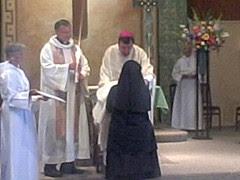
I am sorry the person you are quoting has not managed to accept the fact that c 603 hermits are recognized as women and men Religious despite the fact that they do not belong to a religious institute. I have cited canon lawyers' opinions on this matter, and of course, bishops and dioceses regularly approve the wearing of habits, prayer garments, cowls, rings, etc., and grant permission for use of the title Sister or Brother. They mark these things in profession liturgies, in fact. In a Church marked by new kinship and service of one another, the importance of such titles has less to do with prestige and power than it does with commitments to fostering the Kingdom of God as a countercultural reality. Post-nominal initials are common in consecrated life and tend to mark not only membership in specific institutes, but charisms, and even the shape of one's consecrated life. Diocesan Hermits use a number of recognizable post-nominals. Er Dio (for eremita dioecesanus, or diocesan hermit) seems to be best known. Such initials indicate a public, consecrated, and ecclesial vocation with public vows. They represent a life commitment and allow us to drop the title (Sister, Brother, or Father), especially in correspondence and publishing.

Finally, I have written in the past regarding the reasons Bishop Remi de Roo intervened at the Vatican II Council to argue for the making of eremitical life a state of perfection in the Church. He had worked with about a dozen hermits who had made exceptional sacrifices in order to live a call to eremitical solitude, and, highly aware of their character and the history of the vocation, recognized that in the Church's failure to recognize eremitical life in this way, it had done a disservice to a significant vocation without which the Church actually could not be the ecclesia God calls her to be. While these hermits would have understood the importance of keeping their monastic commitments, I don't know that they actually lobbied for canonical recognition. Given what I have written about existential solitude and the vocation of the hermit, I suspect that Bishop de Roo was at least somewhat sympathetic to an observation made by Thomas Merton. Along with pointing out that the Fathers of the Church had assigned hermits a high, even the highest place among Christian vocations, "because hermits aspire more than anyone else to perfect union with Christ in contemplation", Merton said: 

[[the exigencies of Christian life demand that there be hermits. The kingdom of God would be incomplete without them, for they are [persons] who seek God alone with the most absolute and undaunted and uncompromising singleness of heart.]] Disputed Questions, p 166

Most Religious I know today would not buy into the "higher, highest" way of appreciating vocations (I reject it entirely), and most hermits I know would be pretty uncomfortable viewing eremitism in this way. Still, we do recognize the uniqueness of a vocation that serves as a paradigm of the universal quest for authentic Selfhood with God and the place of both existential and physical solitude in that quest. If the Church values eremitical vocations for the place and role they hold in the very life of the Church itself, then I can't see where marking that with respect offends against humility. In fact, I experience such recognition, especially in relation to an ecclesial vocation, as an intensification of my own call to humility. Paradoxically, it is one's failure to respect oneself and one's vocation, or to recognize the fundamental Christian values of dignity, respect, and honor deserved by every person and every vocation that truly offends against humility!

08 April 2025

Series on the Desert Abbas: Become who You Are


Greetings during this fifth week of Lent! I must begin my comments with a reminder of the quote from Dietrich Bonhoeffer I have used many times, "Not everything that happens is the will of God, but inevitably, nothing that happens, happens outside the will of God." It is critical that we understand the suffering we do not as the will of God, but that we remain consoled that all of our suffering can and will be used by God for good. God will bring good out of everything for he is greater and encompasses it all with his will to be Emmanuel! In the above video, this is one lesson we hear as Bishop Eric Varden, OCSO summarizes the life of Antony, the Desert Abba. 

What we also hear is what can happen to us as we reach the bottommost depths of our hunger and yearning for both God and our own wholeness, our own Self. It is there, in that place of deepest solitude, that we meet both God and our truest Self. This is what I have been writing about for the past weeks in terms of the experience of existential solitude and penetrating this reality deeper and deeper until, finally, we come to a degree of wholeness or holiness we have never known before, and the I we have been becomes a we. E E Cummings, whose poetry I have used to help me write about this process, also wisely says, "it takes courage to grow up and become who you really are." For that too describes this journey to the depths of existential solitude. It is about growing up and becoming who we truly are.

This was Antony's quest and task, ultimately accomplished by the grace of God, even in the terrible loneliness and darkness of a death-and-demon-haunted cemetery,  and then, in the deeper solitude of the inner (physical) desert where Antony spent another 20 years. Whatever our vocational path, we are each called to negotiate our existential solitude and to do as Antony did and become "really real", or, in other words, to become who we really are in and with God. After all, as e e cummings also reminds us, "there's nothing as something as one." The language of oneness and union, the paradox that we are only truly One when we become a "We" with and in God, may seem hard to understand but it is really just a way of talking about what it means to believe in a God who has chosen from the beginning to be Emmanuel and who, in turning to us in search of a counterpart, will allow nothing, including death itself, to come between us and his love. 

At the same time, Antony's story reminds us that the journey to the depths of our being, that place within us beyond all woundedness and brokenness, takes real courage and an energy we might often fear is insufficient or altogether lacking. But it is in the depths of our hunger and abject weakness that we discover God drawing us to Himself and thus, to our truest Selves. Our hunger does not mark God's absence; rather, it is the presence and power of God at work within us. Here, in our weakness where God's power is truly made perfect, that is, where it achieves its goal or telos (2 Cor 12:9), we find real peace and a sustaining hope as, free of all striving and ego, we allow God to embrace and raise us to new life as the persons we really are.

Followup on "if everything happens that can't be done"

[[Hi Sister,  I have always liked ee cummings' poetry, but I haven't always been able to make sense of it. In "if everything happens that can't be done",  what is the point of the parenthetical sections about books? Is cummings anti-intellectual? Do you think that e e cummings was speaking about God (like the "we" of the Trinity), or was he describing a mystical experience of union with God, or something else? Could the poem be interpreted in more than one way?  Also, you wrote, And sometimes, as mystics tell us, we can know and be known by God in such a way that together we become the "We" we are meant to become. I am not sure what it means to be a "we" or to be called to be a "we". Is this a mystical experience you have had?]]

Great questions, thanks!! I love ee cummings' poetry and did my first published article on his "what if a much of a which of a wind" in the Explicator, a journal for the explication or interpretation of poetry. I had also done a college presentation on that poem and "if everything happens that can't be done" and my professor worked with me on writing it up for the journal. I learned more about the incredible depth of cummings' poetry, and about writing in general, in the next weeks of rewriting and rewriting for Jeanne Nichols than I had throughout school until that point. It takes time to fully see what cummings is doing in the sections of his poems; setting off sections in parentheses from those outside the parentheses is something he loves to do. So, returning to these poems is a complete joy for me, especially since I had not done even my bachelor's in Theology, much less my graduate work (Systematic Theology) when I wrote that first article!! To return to him now, after 42 years as a hermit reflecting on God and the nature of eremitical solitude is to realize even more clearly how profound cummings' theology was right from the get-go all those years ago.

So, regarding your questions, if you read the whole poem again and then focus on the parenthetical section dealing with books in each stanza, what you will see is that cummings is setting "book learning" off against an almost ineffable experience of two people profoundly in love with one another. What he tells us is that book learning couldn't have planned this or instructed one in "how to" here. A loving relationship is a living, growing thing, and even the smallest bud falls outside the scope of book learning; books, after all, "don't grow". They are not alive. But relationships and those that enter into them are living things, as is love; these grow, falter, wither, die, and sometimes blossom in fullness. One cannot capture or come to know love in or through a book, not love's wisdom, beauty, challenge, joy, or its meaning. Books are meaningful, yes. Cummings affirms this, but at the same time, the "we" he is celebrating is far more full of meaning and life than any book could ever be. One learns to love only by loving, and when two people come together in this way, it is meaningful and joyous beyond imagining or telling.

I don't think e e cummings is anti-intellectual; at the same time, he understands the place of the intellect and the ways life and love surpass it. He writes consistently in many of his poems about the ineffable nature of the person who is truly alive. Being truly alive, and so, an individual, conflicts with those who are merely "everyones" or "anyones".  Similarly, I don't think cummings was describing a strictly mystical experience of union with God, though I have to say that his sense of what happens when two persons come together physically as well as psychologically and spiritually in love is very consistent with what happens when a person experiences union with God. Cummings's work is about love and coming to fullness through love. While that is true of human relationships, it is even more true of the Divine/human relationship. Thus, even if cummings was "merely" writing of human love, his poetry can also be used to reveal the telos or goal of Divine/human love.

What it means to be a "we" is that to be a complete human being, a human person who is known by and knows God, implies being united with God. On some very foundational level, God and the human person are indivisible. Being one and being a we coincide. When I write about the silence of solitude as goal, this is what I am talking about --- a human person coming to fullness of being and meaning, who is therefore living out the joy of a loving union with God. Solitude here involves oneness of being, meaning one is whole, complete, and holy because one lives in union with God. The potential for this is always present within us, just as God is always present within us. We can learn and choose to be those "going it alone" or standing without God, or those who are truly dependent upon God. The paradox is that true individuality means existing in, from, and for God and those God loves, while standing without God has to do with being individualistic, egoistic, and isolated or even alienated from our deepest self and others, including God. 

For the hermit, then, there is a vast difference between individualism, egoism, isolation, and individual wholeness or holiness, theonomy, and solitude. I think cummings captures these two with his contrast between an I that stands yearning and apart from others, and a "we", where we become fully ourselves only in a relationship constituted by love. The height of this latter state is found in the "we" of union with God. I suppose that my own experience could be called mystical, yes, since it is the fruit of an experience of the profound Mystery that lives at the core of my being and created the universe. In this coming to be our truest selves, there is certainly a union involved ("we're wonderful one times one"). At the same time, I know from past prayer experiences that there is a good deal more in front of me. This recent experience is full of peace, hope, and promise ("there's somebody calling who's we") -- though I cannot begin to imagine it, of course.

07 April 2025

There's Somebody Calling Who's We

I recently posted a footnote to an article I put up recently on chronic illness and the eremitical vocation. In responding to a canonist's comment about the way illness shapes our responses to vocation, I suggested that chronic illness and disability were a substantive part of my eremitical vocation. I said that God called ME to this vocation, not me sans illness, or even me sans sinfulness, but the whole of me, and that included chronic illness and disability. I also suggested that God did not mean to celebrate these things, but they are still intrinsic to MY vocation. In the footnote, I wanted to clarify that God does indeed celebrate ME and my life, and I came to a greater sense that this meant celebrating the fact that the "I" that I am is really a "we". As I wrote that, I was reminded of an e e cummings poem I have loved since the late 1960's, "if everything happens that can't be done".

 if everything happens that can't be done

(and anything's righter
than books
could plan)
the stupidest teacher will almost guess
(with a run
skip
around we go yes)
there's nothing as something as one

one hasn't a why or because or although
(and buds know better
than books
don't grow)
one's anything old being everything new
(with a what
which
around we come who)
one's everyanything so

so world is a leaf so a tree is a bough
(and birds sing sweeter
than books
tell how)
so here is away and so your is a my
(with a down
up
around again fly)
forever was never till now

now i love you and you love me
(and books are shuter
than books
can be)
and deep in the high that does nothing but fall
(with a shout
each
around we go all)
there's somebody calling who's we

we're anything brighter than even the sun
(we're everything greater
than books
might mean)
we're everyanything more than believe
(with a spin
leap
alive we're alive)
we're wonderful one times one

When I think about existential solitude, or times of great loneliness and suffering, I am aware now of the line in the poem that says, "there's somebody calling who's we". I have never had the experience of being abandoned by God, though I have been aware of feeling God's remoteness at times. In my young adult to adult life, I have lived in light of the sense that I am a dialogical reality, constituted by an ongoing conversation with God, who is the source and ground of being and meaning. Similarly, I have long had the sense that we are each called to be united with God. In this sense, each one of us is called to be a "we." In this union with God, we become most truly ourselves, and God becomes most truly the One he wills to be, Emmanuel. We also move further away from isolation and individualism in the process. Mostly, we know shadows and echoes of this "we" as we fall in love with other people, live with them, accompany them, celebrate, and grieve with them. And sometimes, as mystics tell us, we can know and be known by God in such a way that together we become the "We" we are meant to become.

For the hermit, this "we" defines the hidden heart of eremitical solitude. Coming to and witnessing to the universal call to become a "oneness" (a unity marked by wholeness and holiness) that is also a "we" is the work and mission of the hermit's vocation. It is the reality that constitutes both the anguish and the unalloyed joy of her life and calling. While I don't think e e cummings was a mystic -- at least not in the usual sense -- there is no doubt that he understood love and what happens when a person comes to fullness in themselves in relationship with another. I especially love the way Cummings creates a kind of breathlessness and topsy-turvy quality in his imagery of what happens when the impossible is actually realized. I am struck by how well he captures the joy of union undimmed despite allusions to moments of incompleteness, yearning, and searching. Cummings' journey is one where he moves from merely "believing in" love to actually knowing the fullness of being and meaning associated with an I becoming a We. 

This is another way of talking about dying to self (i.e., dying to the I of individualism, egoism, and isolation) and becoming the one (whole and holy) who is fully alive in the "we" we each are potentially. "(with a spin/ leap/ alive we're alive)". This is what it means to love and be loved, especially by God. It is more than Cummings could have imagined (he says so clearly in the poem), nothing he could have learned in books, or been taught by even the wisest of teachers (who, like even the dumbest of teachers, know better than to try!). For Christians called to live our lives toward union with God, it is also more than we can imagine. And maybe that is also why the hermit vocation is so little understood today. Union with God is something we are each made for. That God is called and wills to be Emmanuel tells us this. The anguish and yearning of existential solitude tell us this. The fact that the Church needs, professes, and consecrates hermits, who say this with their lives, tells us this. For each of us, "there's somebody calling who's we".


A note on the image: I received this image (A girl joyfully embracing and being embraced by the universe or, perhaps, by God) from a friend in Milan (Parabiago), Italy. Luisa was an AFS foreign exchange student when I was in high school. She was a senior when I was a sophomore and we became friends. She remains a friend and the occasional source for great music, art, etc. In any case, I love this picture and thought it was perfect for this reflection.

02 April 2025

On Monastic or Eremitic Stability

[[Hi Sister Laurel, in the video you put up yesterday and the reference to the classic "Remain in your cell and your cell will teach you everything," is this all part of the reason monastics make a vow of stability?]]

Thanks for your question! Yes!!!! You are exactly right that the video and especially the reference to the Desert Abbas' apothegm crystallizes the value of stability in monastic life. Though I have heard some misunderstand the meaning of stability when used in this regard, it does not refer to emotional stability, or "stabilizing one's emotions." Instead, it refers to the practice of monastics to make profession in one monastery and commit to staying there for the rest of one's life unless one is sent to help found another monastic house.

The fundamental spiritual insight into this value is rooted in the recognition that while one remains in the same place or continues the same basic rhythm and patterns of behavior (horarium) day in and day out, one will go deeper and deeper in one's relation to one's true self and one's relationship with God. Those who profess (or otherwise practice) monastic stability are convinced that everything they truly need is found here in this monastery. The monk binds himself to this faith community and to learning to love in concrete ways, to forgive oneself and one's confreres both often and completely, and to allow himself to be shaped by his brothers' needs and concerns just as Christ did. When coupled with the other vows and values of monastic life, the monk or hermit is led more and more to attend to God as the one reality necessary for the fulfillment of every dimension of a truly human life --- every relationship, every aspiration, everything one is and does.

A hermit practicing this form of stability in her hermitage can go a couple of different ways. The first is not the way the hermit is meant to go, but it can happen without competent spiritual direction and appropriate initial and ongoing formation. This is the way of self-centeredness and dissipation. In the search for God (seeking God), one can find oneself unable to focus and turn to book after book after book (for instance) without going particularly deep into any of them. Bishop Varden speaks about this in his series on the Desert Abbas. When the monk treats the monastery library (or the books in one's cell or hermitage) as a kind of casual buffet and nibbles at every author, every Church Father, or Doctor of the Church, but truly fails to drink deeply from or be profoundly fed (much less inspired, challenged, and changed) by any of them, he is betraying or failing in his commitment to stability -- among other things. 

Similarly, someone whose eremitical life is inauthentic can focus on this external fault or flaw and then another one and then another one, without ever truly seeking the reason for the fault or flaw that resides much deeper within the person. It is possible to "paper over" one's deep woundedness or illness with confessions of one's more superficial faults and then celebrate God's (unfortunately) equally superficial forgiveness when, instead, authentic eremitical life calls us to a much deeper engagement with both our own brokenness or woundedness and the grace of God. What is sometimes missing, then, is a deep engagement with or resulting understanding of the texts themselves, their still-unfamiliar authors, or the God the texts sought to consider, put one in touch with, and celebrate. This kind of superficially engaged approach to monastic or eremitic life is a form of dilettantism antithetical to monastic life and its commitment to stability.

The second way a monastic or hermit embracing stability can go within their monastery or hermitage is deeper, ever-deeper. While one is apt to read widely as a monastic or hermit, one is also apt to become very well-read and relatively expert in a particular period of history, specific authors, certain topics, etc. In my own life I can look at several topics that have interested me for decades now: chronic illness as vocation and sometimes as eremitical vocation, the redemption of isolation which we then recognize as "the silence of solitude," c 603 as an ecclesial vocation, the discernment and formation of such vocations, and the Theology of the Cross and God's will to be Emmanuel -- God With Us. These are related topics (the last two function as keys to or even "keystones" in this relatedness), and each tends to call for and lead, at least indirectly, to greater depth of understanding in the others. Even more importantly, however, they are significant signposts of my own inner journey and the nourishment and theological content I have needed in order to go deep -- through and beyond my own woundedness, to the God of Life who dwells in that paradoxical place of existential loneliness and betrothal. Thus, when I am occasionally criticized for continuing to spend time writing here about c 603 as though I am "unspiritual", too "coldly intellectual," and "obsessed with law" rather than gospel, for example, it hardly matters!

One of the reasons I insist on the need for hermits (including very experienced hermits) to work regularly with a competent spiritual director is precisely to prevent one's eremitical life from assuming the first pattern as things get difficult, or tedious, or even apparently absurd -- and when things are sailing along and looking fine as well! When darkness obscures the path, when God is silent (as God mostly is!), when suffering kicks up clouds of doubt and tempts to despair, or when none of these things are happening and all goes well, working with a director can help one to stay the course and go deeper. A good director can also ask the questions needed or suggest the journaling and Scripture reading (etc.) that will help to get us back on our path when we have stepped off course or seem to have stalled in our journey. 

Conversations with such persons can help us express both the darkness and light we experience, articulate the struggles we must negotiate, and share the failures and successes that mark and move us from faith to faith. Similarly, they can help us learn to listen to both ourselves and God in ways that will allow our journey to continue toward genuine wholeness and holiness. This kind of ongoing reflection, encouragement, and wisdom is critical in such a perilous and significant undertaking. It is indispensable for eremitic stability and thus, for a life that is not to be wasted in some form of self-centered dilettantism. Remaining in one's cell can, unfortunately, mean learning nothing and failing to grow as a truly loving person (a danger for every hermit), while pretending both to oneself and others to be living a demanding, authentic eremitical life. On the other hand, it can introduce us to the encounter and engagement with existential solitude so essential to our humanity and to learning everything "the cell" (stability) has to teach us. 

01 April 2025

Remain in Your Cell: From the Desert Abbas by Bishop Eric Varden


 Remain in your cell and your cell will teach you everything. This is a key piece of desert wisdom, and it is key of all spiritual growth. In this presentation, we have a nuanced interpretation of this saying, namely, we seek a single-minded focus on God and we do so for the sake of others, whatever "cell" is in our own life and call. Especially important is the focus on the cell as a place where we come to know ourselves and God intimately. It is in the cell that physical solitude gives way to existential solitude and one does battle with the demons of one's own heart. I hope this taste will cause you to look for the rest of the series.

30 March 2025

Further on Chronic Illness and Discerning a Vocation to c 603 Eremitic Life

I wanted to continue the post I put up a couple of days ago. (cf., Followup on Chronic Illness) Specifically, I had not responded to the following affirmation: [[at the same time it is not what we bring that ultimately determines the truth of our call, even if it shapes how we may live it.]] and I want to do that. 

I tend to be in disagreement with this. I do agree that, ultimately, of course, a vocation is always a gift of God who calls as he will, but even so, I believe what we bring matters immensely to the truth of our vocation. That is because I do not believe a divine call is ever only about God alone. In this, I am thinking partly of the Frederick Buechner quotation that is so popular among consecrated women and men today: [[Vocation occurs where our greatest joy meets the world's deepest need.]] Thus, while I absolutely believe a call comes from God, I believe it is also shaped by God in the very giving of the call, both by God's awareness of our own deepest joy and the world's deepest needs.

Bearing this in mind, I believe God calls us not in spite of our weaknesses, frailties, etc., but because of them. Vocations are always a part of God's redemptive will and are always about our own redemption as well as that of others. While I don't believe God willed me to be ill/disabled, I absolutely believe he chose me to be a hermit in part because of my illness. That is, my illness is not an accident linked to the substance of my vocation, but instead is part of its very substance. What I am saying is that I believe that God called ME to this vocation, not me sans illness, or me sans my gifts and potentialities, or even me sans my own sinfulness -- though neither did God call me to this vocation to celebrate these things.** My illness and disability are part of God's own call to me within the contemporary Church because they are a central dimension of my Selfhood. As I understand it, this is a desert vocation, and chronic illness and disability are part of the desert that makes such a call possible and meaningful for me -- and also for others, of course. 

At the same time, my chronic illness and disability are indications of a profound need for God's love and life. They call out for redemption and echo the same calls from billions and billions of others in our world. They call out for being and meaning, and are a sharp reminder of my whole Self's call for these things. Likewise, when God in Christ is allowed, to redeem our lives --- to love us and be merciful to us, to strengthen us, to inspire and empower us to live truly human lives, whole and holy despite chronic illness and disability, then we will see the purpose of our vocations coming to fruition. Similarly, the world will be able to see it clearly and benefit from it. This becomes a significant part of what it means for God to will to be Emmanuel. In considering this, I also think of the gospel's affirmation that we are the clay and God is the potter. While I am not defined by my illness or disability (I, like anyone with an illness or disability, am very much more than these things!!), my illness and disability are elements of that clay, not only because they help shape the way I live this vocation, but because they are constitutive parts of the person I am.

Of course, they might not have been, they need not be, and I would continue to be myself nonetheless. Even so, they are real and currently condition my entire existence; I believe God's wisdom was shaped by considerations of these things as part of calling me to eremitic life. In part, I believe this because, while I have many gifts that I might have made use of for the sake of God's promises and plans, I also have significant frailties that cause me to seek God in an intense and more and more all-consuming way. My own illness and disability are clearly part of this. 

I cannot imagine God calling me to a more perfect vocation for all of this and, more especially, for (the sake of) his church and world. Eremitic life calls me to wholeness and holiness, it provides space for illness and disability while challenging me not to allow my life to be defined by these; it demands I develop many of the gifts God created me with while it also makes of my frailties the good ground of fruitful and compassionate ministry, and it summons me to an intimacy with God I might not have appreciated as much without illness and disability. (Especially important is the compassion that grows out of our woundedness when that is redeemed by the grace of God!) Finally, with and in Christ, it absolutely makes of my life a living incarnation of Paul's divine affirmation, [[My grace is sufficient for you; my power is perfected in weakness.]]

**While I am emphatic that God did not call me to this vocation to celebrate illness, or sinfulness, for instance, I am equally clear that God did call me to this vocation to celebrate their redemption, and I can even say that God called me to this vocation to celebrate God and who I am in Him!! God has been with me in every step of my life, and as alone as I may have felt during difficult times, it is clearer to me than ever that that "I" was and am a we! (cf e e cumings one times one: "there's somebody calling who's we". . ./we're wonderful one times one) So, while I was not called to celebrate illness or sinfulness, I am definitely called to celebrate my truest Self, and the redemption and transcendence of these lesser things in God.

Parable of the Merciful Father: The Choice for a Truly Human Form of Prodigality (reprised)

 Commentators tend to name today's Gospel parable after the Merciful Father, because he is central to all the scenes (even when the younger Son is in a far-off place, the Father waits silently, implicitly, in the wings). We should notice it is his foolish generosity that predominates, so in this sense, he too is prodigal. Perhaps then we should call this the parable of the Prodigal Father. The younger son squanders his inheritance, but the Father is also (in common terms and in terms of Jewish Law) foolish in giving him the inheritance, the "substance" (literally, the ousias) of his own life and that of Israel. His younger Son treats him as dead (a sin against the Commandment to honor Father and Mother) and still this Father looks for every chance to receive him back.

When the younger son comes to his senses, rehearses his still seemingly-exorbitant terms for coming home ("I will confess and be received back not as a Son, but as a servant,"), his Father, watching for his return, eagerly runs to meet him in spite of the offense represented in such an act; he forestalls his confession, brings his Son into the center of the village thus rendering everything unclean according to the law, clothes him in the garb of Sonship and authority, kills the fatted calf and throws a welcome home party --- all heedless of the requirements of the law, matters of ritual impurity or repentance, etc. Now we truly begin to see a new and unimagined prodigality which outstrips the younger son's imagined responses in every way! Meanwhile, the dutiful older son keeps the letter of the law of sonship but transgresses its essence and also treats his Father with dishonor. He is grudging, resentful, angry, blind, and petty in failing to recognize what is right before him all the time. He, too, is prodigal, allowing his authentic Sonship to slowly die day by day as he assumes a more superficial and "dutiful" role instead. 

And yet, the Father reassures him that what is the Father's is the Son's and what is the Son's is the Father's (which makes the Father literally an "ignorant man" in terms of the Law, an "am-haretz"). Contrary to the wisdom of the law, he continues to invite him into the celebration, a celebration of new life and meaning. He continues to treat him as a Son. The theme of Law versus Gospel comes up strongly, though merely implicitly, in this and other readings this week, though at first we may fail to recognize this. Paul recognizes the Law is a gift of God but without the power to move us to act as Sons and Daughters of God in the way Gospel does. When coupled with human sinfulness it can --- whether blatantly or insidiously --- be terribly destructive. 

How often as Christians do we act in ways which are allowed (or apparently commanded) by law but which are not really appropriate to Daughters and Sons of an infinitely and prodigally merciful Father who is always waiting for our return, always actively looking for us to make the slightest responsive gesture in recognition of his goodness even while we are still far off,  and always waiting for us to "come to our senses,"? In today's Gospel, we are assured that our God, contrary to all customs of propriety and divine dignity, will run to us and enfold us in the sumptuous garb of Daughterhood or Sonship. Indeed, in Christ, he has already done so! And yet, how often is our daily practice of our faith dutiful, and grudging, but little more? How often do we act competitively or in resentment over others whose vocation is different than our own, whose place in the church (or the world of business, commerce, and society, for that matter) seems to witness to greater love from God? How often do we quietly despair over the seeming lack of worth of our lives in comparison to that of others? Whether we recognize it or not, these attitudes are those of people motivated by law, not gospel. They are the attitudes of measurement and human judgment, not of incommensurate love and generosity. 

At the beginning of Lent, we heard the fundamental choice of this season and the heart of all choices put before us in any season, "Choose life, not death." Today, that choice is sharpened and the subtle forms of death we often choose are set in relief: will we be Daughters and Sons of an infinitely and, in this world's terms. a foolishly Merciful Father --- those who truly see and accept a love that is beyond our wildest imaginings and love others similarly, or, will we be prodigals in the pejorative sense, servants of duty, those who only accept the limited love we believe we have coming to us and who approach others competitively, suspiciously and without generosity? Will we be those whose notions of justice constrain God and our ability to choose the life he sets before us, or will we be those who are forgiven to the awesome degree and extent God is willing and capable of forgiving? Will we allow ourselves to be welcomed into a new life --- a life of celebration and joy, but also a life of greater generosity, responsibility, and God-given identity, or will we simply make do with the original prodigality of either the life of the younger Son or that of the elder? 

After all, both live dissipated lives in this parable: one flagrantly so, and one in quiet resentment, slavish dutifulness, and personal unfulfillment. The choice before those living the latter kind of Christian life is no less significant, no less one of conversion than the choice set before the younger son. His return may be more dramatic, but that of the elder son demands as great a conversion. He must move from a quiet exile where he bitterly identifies himself as a slave rather than a free man or (even less) a Son. His own vision of his life and worth, his true identity, are little different than those of the younger son who returns home rehearsing terms of servility rather than sonship. 

The parable of the merciful Father puts before us two visions of life, and two main versions of prodigality; it thus captures the two basic and, in some ways, antithetical meanings of prodigal: wasteful and lavish. There is the prodigality of the sons, both elder and younger, who allow the substance of their lives and identities to either be cast carelessly or slip silently away, the prodigality of those who lose their truest selves even as they grasp at wealth, adventure, duty, role, or other forms of security and "fulfillment". And there is the prodigality of the Father who loves and spends himself generously without limit or condition -- even to the point of scandal according to society's rules. In other words, there is death and there is life, law and gospel. Which form of prodigality will we choose? For indeed, the banquet hall is ready for us and the Father stands waiting at this very moment, ring, robe, and sandals in hand.

Followup Questions on Chronic Illness and Discerning a Vocation to c 603 Eremitical Life

[[Sister Laurel, I think one of the things that struck me [and raised the question about chronic illness and discerning an eremitical vocation] was somewhere you had mentioned being able to offer chronic illness as a gift in this call, and my knee jerk reaction was, "yes, we bring ourselves and our gifts, talents, sorrows, etc., but at the same time it is not what we bring that ultimately determines the truth of our call even if it shapes how we may live it." 

At the same time, as in any call, we are to bring forth our uniqueness as part of our self-gift, and disability is part of it. In other words, the truth of one's call is not determined by a unique gift one can give to God. I feared that the blog readers might use that idea of "unique" and feel inadequate in discernment. Put differently, if it takes the monumental ability to offer God disability to figure out that the eremitic life is for you, how is an able person to discern that it is for them as well because they don't have a unique gift?]]

Thanks for following up on your earlier questions. I am not sure what I actually said or what you read, so this will just have to look at the ways in which I might have been speaking about chronic illness and disability as gift. The first is the way you have taken it in your second paragraph. That's entirely valid, of course, and an important way of approaching the whole notion. We bring our whole selves as a gift, and chronic illness and disability might be part of that. However, another way of approaching it, and one I am more likely to have written about is from the perspective of allowing God to redeem chronic illness or disability, to make it a significant grace, to transfigure what was really simply a burden and personal weakness so that instead it becomes the ground for proclaiming the Gospel of God in Christ with a unique vividness and paradoxical power. 

I have no real sense of how I might be able to give God my illness as a gift, except to the extent I can allow it to become the basis of a divine victory of meaning over meaninglessness, and fullness of life over a diminished sense of living. In other words, I cannot see chronic illness being a gift unless it participates in God's promise of redemption in some way. This is the only way something so negative and life-denying could become a life-affirming gift. In part, this will depend on one's vocation and whether or not it serves to allow God to achieve the victory he does over absurdity (meaninglessness) and death (the diminishment or curtailment of life) in all the ways illness or disability cry out for. There are a number of vocations that would not have done this in my own life; instead, they would have accentuated my illness as a serious deficiency, possibly exacerbated it by judging it, but certainly have had no room for it --- or for me as one who suffers in this way. Eremitical life not only has room for chronic illness as an instance of desert experience, but it provides the space, time, and focus that brings one's entire life into a profound engagement with God so that it ALL might be redeemed and transfigured.

The motto I adopted at my consecration is from Paul's 2nd Letter to the Corinthians: [[My grace is sufficient for you, my power is perfected in weakness.]] (The second half of this is engraved on my profession ring.) While I can say I am inspired by that in several ways and aspire to letting it be true in those same ways, I can also say that it is the truth of my life in terms of chronic illness and disability. The fact and fruitfulness of God's loving mercy is something I know most fully in my weakness. God's mercy is an expression of a powerful love that can redeem any negative reality by bringing good from it. When I think of chronic illness as gift, it is that set of dynamics I am thinking about. Fr James Empereur, sj, once wrote a book on the Anointing of the Sick called Prophetic Anointing, in which he wrote compellingly about a vocation to being sick in the Church. I see the Sacrament of the Sick in the same way, and I also see chronic illness and disability themselves as potential vocations, not because God wills these things (he does not), but because he wills to be God With Us in every moment and mood of our lives.

I think you can hear how eremitical life provides the context and means to allow God to redeem my illness and transform it into a grace. In this weakness, God's love and mercy are perfected. I turn to God more and more fully in part because of my illness/disability. At the same time, I do so because my eremitical vocation calls for this as well. I turn to God in this way for God's own sake, so that his will to be God-with-us can be fulfilled. In the midst of this process, God's will for me is also realized, not only despite my illness, but even in and through it. My life comes, over time, to proclaim the Good News of God's sovereignty, God's Kingdom, not only in strength, but in weakness. In other words, Chronic illness becomes a gift, not only to me, but also to the Church and even to God.

At the same time, I am not saying that chronic illness is a prerequisite for discerning an eremitical vocation. Still, eremitic life is always about allowing God to redeem our weaknesses and frailties, our incapacities along with the realization of our potentialities. We embrace the silence of solitude, stricter separation, etc., so this redemption may be sought and received with a particular focus and intensity. Moreover, again, we do so for God's sake and the sake of all that is precious to God. We do it so that God's will and gospel may be fulfilled in our world. One traditional way of perceiving eremitical life is to accent its difficulty and the need for candidates to be able-bodied, strong enough to manage the rigors of the life. I see it somewhat differently. 

While the vocation still takes strength, perseverance, and courage, chronic illness and other frailties can provide the good ground out of which hermit life and God's redemption may grow. They are part of the penitential life of a hermit when the hermit is chronically ill or disabled. At the same time, no, I am not saying chronic illness is a necessary part of an eremitical call for everyone. I am thinking of a quote by Sister Kathy Littrell, SHF, who once said, [[One does not need to be a Sister to do what I am doing, but I need to be a Sister to do what I am doing.]] A variation of this, then, is [[While most folks will not, and do not need to be hermits to live chronic illness as God wills them to, I needed to be a hermit to do so.]] Similarly, while most hermits do not need to be chronically ill or disabled to live the constitutive elements of eremitical life, I have found that chronic illness/disability, far from being an obstacle to this, allows me to live these elements more radically than most desert settings would have done.

Thanks for the opportunity to clarify some of this! I want to respond to your "kneejerk reaction" in another post and think about it a bit more before I do that. 

28 March 2025

A Contemplative Moment: Loneliness


by
David Whyte

Loneliness
is
the doorway to unspoken and yet unspecified desire. 
In the bodily pain of aloneness is the first step to understanding how far we are from a real friendship, from a proper work or a long-sought love. Loneliness can be a prison, a place from which we look out at a world we cannot inhabit; loneliness can be a bodily ache and penance, but loneliness fully inhabited also becomes the voice that asks and calls for that great unknown someone or something we want to call our own.

Loneliness is the very state that births the courage to continue calling, and when fully lived can undergo its own beautiful reversal, becoming in its consummation the far horizon that answers back.

In the grand scale of things, loneliness is a privilege. Human beings may have the ability to feel aloneness as no other creature can, with a power magnified by intelligence and imagination. Animals may feel alone in an instinctual way, moving naturally and affectionately toward others of their kind, but human beings may be the only beings that can articulate, imagine, or call for a specific life they feel they might be missing.

Loneliness is the substrate and foundation of belonging, the gravitational field that draws us home, and in the beautiful essence of its isolation, the hand reaching out for togetherness. To allow ourselves to feel fully alone is to allow ourselves to understand the particular nature of our solitary incarnation; to make aloneness a friend is to apprentice ourselves to the foundation from which we make our invitation to others. To feel alone is to face the truth of our irremediable and unutterable singularity, but a singularity that can kiss, create a conversation, make a vow or forge a shared life. In the world or community, this essential singularity joins with others through vision, intellect, and ideas to make a society.

Loneliness is not a concept, it is the body constellating, attempting to become proximate and even just with other bodies, through physical touch, through conversation or the mediation of the intellect and the imagination.

Loneliness is the place from which we pay real attention to voices other than our own; being alone allows us to find the healing power of the other. The shortest line in the briefest e-mail can heal, embolden, welcome home and enliven the most isolated identity. Lonely human beings are lonely because they are made to belong. Loneliness is a single malt taste of the very essentiality that makes conscious belonging possible. The doorway is closer than we think. I am alone; therefore, I belong.

in
Consolations, the Solace, Nourishment, and Underlying Meaning
of Everyday Words. pp 99-101

27 March 2025

On Growing Towards Perfection: Journeying in the Direction we are Born For (Reprise)

 In thinking about Lent I remember a time when the commandment to "be ye perfect as your father in heaven is perfect" had come up for me. The first time was in an email to my director, referring to the use of the term "total commitment" in something I was reading in relation to our work together. I wondered what "total" meant in the context involved; I couldn't understand it as even conceivable, much less possible, and that, it sounded like, could jeopardize everything. She wrote back, pointing out the similarity of the word "perfect" in the NT and the difficulty of defining it. She then defined "total" contextually, in a less absolute (but no less personally demanding) way, a way which corresponded to the needs of the work being done and which, yet again, was a matter of "trusting the process" and the changes, healing, and growth it brings about. (This, of course, involved trusting the grace of God in all the ways it is ever mediated to me over time and that was especially true in this process!)

Other instances of meeting the word "perfection" had to do with Lent itself, with the God I was somehow supposed to come to image more perfectly and who was defined as perfect only in terms of static Greek categories: (omnipotence, omnipresence, immutability, etc.) --- categories that often seem at odds with the living God of the Old and New Testaments. Another had to do with consecrated life and the older usage regarding being called to "a state of perfection". Again, I thought, as I always do, that being called to perfection meant being fully human because I think being authentically and fully human is at least part of this call to perfection --- but somehow the word "perfection" continued to raise obstacles within and for me. It is a problem all by itself. I would bet I am not alone in this. In fact, I know I am not; one of the reasons women Religious rarely refer to "states of perfection" these days is because to do so seems elitist and divisive. It can also lead to needless or unwarranted anxiety over hypocrisy and failure.

So, I went back to the original text --- not something I do often enough these days --- and was reminded that the word translated as perfection is τελειος (teleios) --- from the Greek telos (τελος) which refers to the goal, end, or fulfillment of something. (Jesus is the telos or end/goal/fulfillment of the Law, for instance.) That was suggestive of being goal-directed or of having reached a goal (some have defined this call to perfection in terms of "maturity") but it still left me little further along in my thoughts and prayer. Then, while in Tahoe for a week, I was reading a book by William O'Malley on Parables, and not far into the book, O'Malley begins to discuss the difficult word "perfection". (God does indeed work in surprising and delightful ways!) O'Malley also notes that the Greek is teleios (τελειος) but in light of that word, he went on to define the call to perfection as the call to be "heading in the direction [we] are born for".  And that made "total" (!) sense to me. It is a refreshingly dynamic way of defining perfection (a way which is appropriate to the God who is "verb more than noun", who is Love-in-Act) in an unfinished and evolving universe; it also reduces anxiety or concerns about hypocrisy and elitism and is able to free folks from any unhealthy perfectionism. Perfection, in the sense Jesus and the New Testament used the word, is not about having reached, much less achieved a static state without flaws or frailties, but instead, it is about being true to the journey; it is about being on a pilgrimage to authenticity with, in, and towards life in God.

Last Sunday, we celebrated the Gospel story of Jesus' Transfiguration. We often use the term transfiguration in the sense of change or transformation, but when we think about the transfiguration of Jesus, the only thing that changed was the way Jesus appeared to others. Jesus was transfigured in their eyes but he himself remained who he was right along. The disciples saw him for who he really was, namely, a truly human being living fully with, in, and towards life in God. They rightly saw him as the glory of God, the revelation of the love and mercy which every human being is called and born to be. Whether they were aware of this or not, what James, Peter and John saw in Jesus was also an image of their own telos, the end or fulfillment of their own journeys to authenticity and maturity in, with, and through God. They saw an image of human perfection --- a man well on his way in his journey to fully reveal the glory of God in ordinary life situations. Jesus was heading towards Jerusalem with all that implied and involved; he was on his way to the Cross and the exhaustive revelation of a Divine power which would be perfected in weakness; he was on his way toward changing the very nature of reality by reconciling that same reality to God, destroying (Godless) death and by effectively giving creation a place in the very life of God. In other words, He was "perfect" (teleios) because he was "heading in the direction [he] was born for" and in no other direction.

So many times, Jesus could have turned aside or away. There were so many times he could have chosen a different path, one which was good, fruitful, respectable, admirably religious, and apparently "law abiding" (in terms of the Torah) --- but which was not about heading in the direction he was born to head. But, as he did during his time in the desert, he chose to do what he was born (or baptized) to do. He entered the desert having heard from God that he was God's beloved Son who did indeed delight God. He grappled with what that meant both in personal and pastoral terms. And finally, he chose to respond to the deep call of God to be that person and live that identity in the ordinary and extraordinary things of life. This choice was one he renewed again and again throughout the course of his public life with every act of compassion and self-emptying. In the process, he renewed the course of his journey with, toward, and on behalf of God's sovereignty and the extension of that "Kingdom of God" to all God holds as precious. Jesus affirmed and reaffirmed a commitment to the same perfection we are each called to, namely, an authentic and God-centered humanity lived for others. And isn't this what Lent gives each of us the space and encouragement to do?

A few folks have emailed and suggested that by focusing on the work I have already been engaged in with my director I am failing to do what Lent really calls for. That, they believe, is inexcusable in a consecrated (canonical) hermit who lives this life in the Name of the Church! Apparently, they suggest, in outlining my plans for Lent, I have not made a sufficient commitment to additional prayer, penance, and almsgiving. But thus far, in this (in 2017) now-10-month-journey, I have called "inner work" what my director and I have been engaged in is a profound desert-time where I grapple with 1) my identity and 2) with God's call to be myself as fully and freely as possible. This is the call to be perfect as God (Him)self is perfect --- nothing less.

We are each involved in a journey towards authenticity and (simultaneously) communion with God. As with Jesus, it is a single journey where we may have to renounce what is usually recognized as "respectability" in order to embrace genuine holiness --- just as we may need to embrace brokenness to be reconciled to God, self, and others, or to live the joy and freedom of life in and of God. The question Lent asks and gives us space and time to answer with our lives is, "are you headed in the way you were born to be headed?" Are you headed in the way your heart has been shaped throughout your whole life by the Love-in-Act we call God? If not, if you are impelled and even compelled by something else, how will you change course? What paths do you need to leave behind? What ways of being? What obstacles to freedom, personal deficits, woundedness, etc., will you need to work through and let go of?  How, after all, will you embrace the call to be "perfect", the call to be "heading in the direction you were born to be heading"?

25 March 2025

Promises Fulfilled in Surprising Ways: Feast of the Annunciation

I wonder what the annunciation of Jesus' conception was really like, factually, what the angel's message (that is, God's own mediated message) sounded like, and how it came to Mary. I imagine the months that would have passed without Mary having a period and her anguish and anxiety about what might be wrong, followed by a subtle sign here, an ambiguous symptom there, and eventually the full realization of the inexplicable fact that she was pregnant! That would have been a shock, of course, but even then it would have taken some time for the bone-deep fear to register: "I have not been intimate with a man! I can be killed for this!" Only over more time would come first the even deeper sense that God had overshadowed her, and then, the assurance that she need not be afraid. God was doing something completely new and would stand by Mary just as he promised when he revealed himself originally to Moses as: "I will be who I will be," --- and "I will be present to you, never leaving you bereft or barren."

In the work I do with people in spiritual direction, one of the tools I ask clients to use sometimes is dialogue. The idea is to externalize and make explicit in writing the disparate voices we carry within us: it may be a conversation between the voice of reason and the voice of fear, or the voice of stubbornness or that of impulsivity and our wiser, more flexible selves who speak to and with one another at these times so that this existence may have a future marked by wholeness, holiness, and new life. As individuals become adept at doing these dialogues, they may even discover themselves echoing or revealing at one moment the very voice of God which dwells in the deepest, most real parts of their heart as they simultaneously bring their most profound needs and fears to the conversation. Almost invariably, these kinds of dialogues bring strength and healing, integration and faith. When I hear today's Gospel story I hear it as this kind of internal dialogue between the frightened, bewildered Mary and the deepest, truest, part of herself which is God's own Word and Spirit (breath) calling her to a selfhood of wholeness and fruitfulness beyond all she has known before but in harmony with her people's covenant traditions and promise.

This is the way faith comes to most of us, the way we come to know and hear and respond to the voice of God in our lives. For most of us the Word of God dwells within us and only gradually steps out of the background in response to our fears, confusion, and needs as we ponder them in our hearts --- just as Mary did her entire life, but especially at times like this. In the midst of turmoil, of events which turn life plans on their heads and shatter dreams, there in our midst will be the God of Moses and Mary and Jesus reminding us, "I will overshadow you; depend on me, say yes to this, open yourself to my promise and perspective and we will bring life and meaning out of this; together we will make a gift of this tragedy (or whatever the event is) for you and for the whole world! We will bring to birth a Word the world needs so desperately to hear: Be not afraid, for I am with you. Do not be afraid, for you are precious to me."

Annunciations happen to us every day: small moments that signal the advent of a new opportunity to hear, embody Christ, and gift him to others. Perhaps many are missed and fewer are heeded as Mary heeded her own and gave her fiat to the change which would make something entirely new of her life, her tradition, and her world. But Mary's story is very much our own story as well, and the Feast of Christ's nativity is meant to refer to his being born of us as well. The world into which he will be brought will not love him really --- not if he is the Jesus our Scriptures and our creeds proclaim. (We bear this very much in mind during Lent and especially at the approach of Holy Week.) But our own fiat ("Here I am Lord, I come to do your will!") will be accompanied by the reassuring voice of God: "I will overshadow you and accompany you. Our stories are joined now, inextricably wed as I say yes to you and you say yes to me. Together we create the future. Salvation will be born from this union. Be not afraid!"

Introduction: Linkage Between Holy Saturday and Existential Solitude?

[[Sister Laurel, you wrote, [[The ability to live resurrection life on the other side of the deep loss and anguished questions of Holy Saturday, and to do so for the sake of God and others, marks the authenticity of an eremitical vocation.]] I understand what you have written before about authentic eremitical vocations I think, but your reference to Holy Saturday surprises me. I figured you were not doing this just because of it being Lent and that it must have something to do with existential solitude, but I am just guessing. Could you explain your reference? Is your understanding of Holy Saturday linked to the experience of existential solitude? If so, I have never gotten this impression from homilies or reflections on the Triduum.]]

First, thanks for your comments and questions. I wasn't expecting such a question so soon so I can only give you something of a preliminary response, but your question is very fine and I did want to give you a little to think about until I can write more.

 Yes, I think the linkage between Holy Saturday and the experience of existential solitude is very significant. In order to approach that let me refer you first to an article I have posted here several times over the years as we move toward Holy Week and the Triduum. You can find it here: In Darkness We Wait in Hope. That piece speaks of the profound questions raised by the death of Jesus and the (potential and actual) loss of hope of the disciples who had trusted he was God's Messiah. It speaks of Holy Saturday as a day of loss and grief, but also one of nascent hope. It should point out, but does not, that it is also the day the disciples huddled hidden from the authorities, the meaningfulness and even the fact of their entire lives now thrown into doubt, and the brink of despair by the execution of the convicted criminal they thought was God's anointed.

As I recount some of that, I think you can hear the resonance it has with what I have written recently on existential solitude, the deep questions it involves, and the profound hunger for being and meaning it is associated with. What I wrote last week was:

For me, this is the deepest paradox of our existence, namely, that often we know God best in our hunger and it is in the sharpening of our hunger that we know we have been drawn closer to God by Godself. As a hermit, I am coming to know that on this side of death, the greatest consolation we can know is not so much that we are filled by God, but rather, that our hunger for God is developed, sharpened, and deepened. This profound hunger, however, can also be extremely painful since God is not only the ground and source of being, but of all meaning as well. To yearn for being and meaning and all these imply and require, can lead us to the very brink of despair unless and until we realize that, paradoxically, this agonizing hunger for God is itself the deepest sign of God's presence and love we can know, entirely unadulterated as it is by egoism. Jesus' cry of abandonment, especially in the presence of so much other suffering, is at once the measure of his greatest hunger and a sign of God's undoubted love echoing within him.

It was the experience of this hunger that opened me to a very much clarified understanding of my own existential solitude. Over the years, that solitude has been marked by an extended Holy Saturday experience. For instance, I remember once having a conversation with my director where I noted that the rhythm of my life never quite seemed to match the rhythms of the liturgical seasons and feasts. The Church was celebrating Easter and I was still living Holy Saturday, for instance! This was not a bad thing, but it was challenging, and I knew that I wanted to spend some time with the experience, studying, praying, meditating and writing about it. My director noted that it was likely that a lot of people in today's world experienced a similar challenge and that my own attention to this could benefit many. I believe she was correct; meanwhile, the explicit linkage between this extended experience of Holy Saturday and existential solitude per se only came full circle in what led to my writing the above-quoted paragraph last week.

The Triduum is a multi-layered, multi-faceted liturgy embodying and symbolizing many different moments and moods. Unfortunately, Holy Saturday and the loss, grief, bewilderment, liminality, and profound questions associated with the experience of Jesus' death seem to me not to be given sufficient time or space in our lives. We need time to question, to doubt, to wrestle with our own inadequate theologies, and to recognize this experience of deep struggle, questioning, grief, and even anguish-on-the-way-to-genuine-hope rooted in resurrection, and this time is something our world generally does not allow us. Existential solitude is a universal reality. Every person knows it to some extent, yet really experiencing it in all of its depth is not something even our ordinary liturgies and homilies encourage or allow. Holy Saturday, I think, is meant to provide us some of the time we need to experience this specific form of solitude. Too often, it is too quickly collapsed into Easter, or treated as a time to prepare the church building for Easter Sunday liturgies. Even the  Easter Vigil liturgy seems to me to be less vigil-like than we need.

Somehow, while it is critical to live in light of the resurrection, we seem to have forgotten that it is the certainty of Jesus' resurrection that truly allows and actually invites us to plumb the existential depths of need, hunger, emptiness, grief, betrayal, loss, doubt, potentialities, and so much more. Hermits retire to hermitages to undertake this perilous and ultimately promising journey. I think contemplatives in general do the same. The people who do the kind of inner work I have been engaged in for the past number of years have the tools and opportunity to do similarly. The Church, in her wisdom, gave us the Triduum, and especially Holy Saturday (from after the Passion on Good Friday) to spend time getting in touch with this reality in a privileged way. I am sure I will be writing more about this over the next three weeks as we approach Easter. For now, I hope this preliminary response is sufficient!