Showing posts with label Canon 603. Show all posts

21 March 2015

Some Reflections on Why Canon Law is Important to the Diocesan Hermit

[[Hi Sister, have you always been interested in Canon Law? Do diocesan hermits have to have this kind of interest or knowledge? (Suppose I couldn't care less about this kind of stuff, could I still be a hermit?) One friend said that hermits usually don't care about laws, their freedom is contrary to that and everything I have read about hermits stress their freedom. Is there some way in which he is right or are consecrated hermits kind of "law and order types"? Are those hermits who do their own thing misrepresenting this vocation?]]

Have I always been interested in Canon Law? Nope, definitely not. My own interest is very limited and circumscribed, namely, it is confined to canon 603 and to the life defined there. In a broader sense that and my own history means being interested in the canons on religious life as well; after all a number of those apply to those professed as c 603 hermits, but I can't say canon law per se holds much interest for me apart from the life I have been commissioned to live in the name of the Church. Theology is a much more compelling and pervasive interest for me and my interest in this canon specifically often has to do with the theology and spirituality it seeks to express and protect. Often this involves ecclesiology (theology of the Church) and the way individuals are made responsible for embodying theological truth.

Thus, my interest has also grown over time. It has been spurred by several ideas which are integral to canon 603, not least, 1) the ecclesial nature of the vocation, 2) the amazingly beautiful combination of non-negotiable elements and individual flexibility c 603 codifies, 3) the responsiveness of this canon to history and its capacity to reflect and protect the solitary eremitical tradition as part of the Church's own patrimony, and 4) the lesson that canon law follows life and law serves love. I don't think we necessarily always see these things clearly in canon law (or any law for that matter) but we do see it in the case of canon 603. Especially important here and with regard to #1 above is the way the canon (and canonical standing more generally) creates stable relationships which are essential for ecclesial vocations. The idea that the canon legislates, establishes, and protects those relationships necessary to live this life well and in a prophetic way was tremendously surprising and impressive to me.

While canonical hermits do not usually need much of this kind of knowledge (we have canonists and Vicars who handle canonical details with regard to vows and other things), some, like myself, are interested to the degree that c 603 is new and codifies in universal law a new form of consecrated life. Thus, we tend to be interested in this canon, how it came to be, why it exists, and so forth, and some few of us reflect on the way the canon works in our own lives and the vocation more generally; as noted above we are interested in the relationships it establishes in law, the purpose of these, what we would be living apart from the canon and how it differs because of the canon and things like this. Because as hermits our need for legal recourse or canonical consultation is rare at best once we have been admitted to perpetual profession we are ordinarily otherwise completely free to follow our own Rule of Life without worrying about canonical matters. On the other hand, most of us do have an interest in the canon and its normative character when this is being denied or contravened publicly by folks pretending to represent consecrated eremitical life. In any case at least one diocesan hermit here in the US is a canonist working for a diocese so an interest in canon law is at least not antithetical to the eremitical life!

Am I a Law and Order Type? 

I don't think I am particularly a "law and order" type, nor are most of the hermits I know. Of course we respect law and see its importance in society and the life of the Church. We are not antinomians or anarchists. Rather, we recognize that c 603 is an historic canon and those I know do feel both honored and obligated to live our lives with a real cognizance of what is finally possible in universal law because of it. There is something really startling and humbling when one realizes one is part of a long-awaited and fought for extension of an ancient tradition into a contemporary situation, and therefore, that one is part of a relative handful of hermits now living a new ecclesial vocation in the name of the Church. Personally, I believe the eremitical vocation has the capacity to redeem (heal and give meaning to) the lives of many people who are isolated by life's circumstances and I feel proprietary about the significance of the canon for this reason as well.

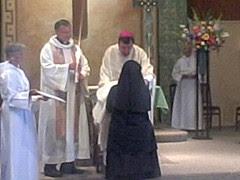
Sister Ann Marie OCSO signs Solemn Vow Formula
Especially clear to me is that if the canon is to be used in this way however, it needs to be mediated by the Church and cannot simply be one more occasion of the divisive, individualist, "do your own thing" tendency of our modern world. As far as I can see, that tendency only leads to greater isolation and greater need for redemption. We all know how empty a life of merely "doing your own thing" can be. Imagine how that is exacerbated when one is already searching for meaning, or already feels isolated or as though they do not fit in! My own experience of this vocation says that whether lived canonically in the consecrated state or non-canonically as a hermit in the lay state, for instance, the eremitical life lived in the heart of the Church witnesses to a solitude which is dialogical and contrary to any individualistic isolation. Canon 603 recognizes this clearly when she defines the life as one "lived for the praise of God and the salvation of the world." If the eremitical vocation is allowed to be degraded into another instance of "do your own thing" or "don't give a damn about the Church's laws or decrees", etc, then we will have lost one of the really unique gifts of the Holy Spirit!

Misrepresenting Facts to the Vulnerable, A serious Pastoral Matter

Thus, when a person who neither understands canon 603 nor lives under it or in an institute of consecrated life, but still falsely claims to be a "professed religious" and "consecrated Catholic Hermit" while writing, [[Perhaps it is best for all of us, and maybe especially us consecrated Catholic hermits, to not get too caught up in the ins-and-outs of the temporal Catholic rules and laws and the raft of interpretations of those rules and laws]] it strikes me as particularly self-serving and pastorally insensitive. (Neither is it particularly accurate; a single  two paragraph canon is hardly a raft of laws nor is c 603 exactly a hotbed of interpretive controversy.) It especially says to me this person has not really understood the reason the Church takes care whom she consecrates and how, whom she professes in this or that vocation and why. In my experience people searching for a way to belong, a way to redeem their own isolation, a way to ensure the meaningfulness of their lives are legion in our world --- and perhaps especially in our culture. They are also more vulnerable to people offering a less difficult or at least more individualistic way to embrace religious life.

We do these persons no favors when we tell them to do whatever they wish, call themselves whatever they wish and never mind about the "temporal laws" of the Church. We do them no favors when we misrepresent facts, misread texts, or treat Canon Law as though it is an option we can ignore while arrogantly calling ourselves "consecrated Catholic hermits" and thus claiming under our own authority a designation only the Church herself can permit us to use. Especially we do these persons no favors by encouraging them to embrace pretense in the name of the God of Truth.

In the end to do that is to betray their deepest longings and treat them as though they are either too unimportant to God to be called to live a significant (meaningful) vocation, or simply too weak to bear the vocation God truly HAS extended to them. This is so because in the Church, standing in law ("status") is always associated with the gift and challenge of responsibility. We do not recognize a person's real dignity nor show genuine respect for them by extending standing (much less allowing them to pretend to standing which is) without commensurate responsibility. In any case, while the institutional Church is not perfect, generally speaking she uses canon law to order and protect her charismatic life, not to stifle it. She uses law to make certain that freedom is not degraded into an irresponsible license. The diocesan hermit does something similar with her Rule and, of course, Canon law, legitimate superiors, and the other mediatory structures and relationships of the Church. These things ordinarily help INSURE the freedom of the hermit, they do not hinder it.

Authentic Freedom:

You see, authentic freedom is the power to be the persons we are called to be in spite of limitations and constraints. In the diocesan hermit vocation, or any vocation to the consecrated state in the Church God calls the person and that call is mediated through the structures of the Church. The charismatic dimension of the Church is always mediated in this way. Catholic hermits are not folks who simply do whatever they want (your friend's more commonly held sense of what it means to be a hermit sounds like more of a stereotype to me); they are persons who do what God wills; Catholic hermits are those who live an eremitical freedom (the will of God) as that is mediated not only in solitude, but in and through the structures of the institutional Church.

In my own experience the Church's canon law here provides some of the necessary structure permitting a person to concern themselves wholeheartedly with prayer, the silence of solitude, and the rest of the eremitical life without concern for whatever the world says, believes, values, etc. Moreover, they do so within the very heart of the Church. That is true whether they do so as canonical (consecrated) or non-canonical (lay).  In fact, that is true even when they are fighting for a new way while accepting the current truth of their situation. (The monks who accepted secularization while struggling for something like Canon 603 and living under the protection of Bishop Remi De Roo are exemplars of this kind of creative and risky freedom.) Freedom involves constraints. License is a different matter.

Doing your own thing may pass for freedom, at least for a time, but such persons tend to find they are marginalizing themselves and exacerbating their own sense of unfreedom and meaninglessness. In theological terms they are opting not for the way of the Kingdom and the Life of the Spirit but instead for the way and spirit of the world. The irony is that such persons are therefore more apt than those living fully within the Church's constraints and structures (canonical, liturgical, theological, etc) to be in a destructive bondage, whether that is to insecurity, shame, their own personal failures in life, a fear of meaninglessness, loss, grief, illness, or whatever drives a need to define themselves; whatever creates and grounds this kind of arrogance is not a symptom of freedom but of slavery.

Living Eremitical life inside and Outside the Church:

But let me be clear. A person who truly lives the hermit life without doing so under canon 603 is still a hermit and can live the life in a completely authentic and exemplary way for others --- whether those folks are hermits or not. In this these hermits would be in line with the Desert Abbas and Ammas who actually lived their lives in protest to the worldliness of the Church that had allied itself with the State after Constantine's Edict of Milan. If one has not been consecrated through the mediation of the Church as part of an Institute of Consecrated Life or under c 603, one can certainly still live eremitical life as a lay hermit, a hermit in the lay state of life (or, if one is a priest, in the clerical state of life).

One could also leave the Church and pursue an eremitical life in open protest to what one might see as the Church's compromises with worldliness (and the way some folks write of Canon 603 and the Church's use of law more generally seems suggest they see these as a terrible compromise with worldliness). I personally think this is unnecessary and misguided; I would not understand it but it is a choice I would respect at the same time for its honesty. What is not okay, what I personally cannot respect, is effectively thumbing one's nose at the Church's clear understanding, law, and sacramental structures while fraudulently calling oneself a "Catholic Hermit" and thus, claiming one is living this life in the very name of the Church. I do think that is a clear misrepresentation of this vocation. Of course, if any person claiming to live eremitical life in the name of the Church is also not really living an exemplary eremitical life but instead is merely trying to validate personal isolation and failure, that, it seems to me, would also be a serious misrepresentation of what the Church understands as the eremitical vocation.

18 March 2015

Will Canon 603 Become the Norm for All Consecrated Hermits?

[[ Is canon 603 a kind of experiment? Is it only used for some consecrated hermits? The poster at [link omitted] says that: "In today's Church, this is no small matter, and it seems that bishops and future hermits will desire this proviso. In time, it may become the norm for consecrated Catholic hermit profession."]]

Let me  first say (repeat) that today there are two routes to profession as a consecrated (canonical) Hermit. The first is as part of a congregation or community (an institute) of hermits like the Camaldolese or Carthusians. In such a case these religious, monks, and nuns live their consecrated lives under both Canon Law (universal law) and the congregation's own law (proper law) --- their Rule, Constitutions, and Statutes. In such cases while Canon Law already applies juridically to their lives in many ways, canon 603 does not. Sometimes institutes of consecrated life will allow an individual to live as a hermit. If they do, this will be because the institute's proper law (the law which is proper to this congregation itself only) allows this but the person is not professed as a hermit. The second route to canonical profession and consecration is as a solitary hermit under Canon 603. Other canons which are part of the Church's universal law of religious life will also apply to this individual but Canon 603 is the defining canon which provides for the hermit's legitimate superior and defines the hermit's proper law as a Rule or Plan of Life she herself writes.

Canon 603 is not an experiment although it is a relatively new canon governing a new (since 1983) and rare form of consecrated life, namely the solitary eremitical life lived outside or without membership in a community or institute of consecrated life. Despite the fact that those of us living it or those administering it are still finding our way with it together, it is not going to become the norm for consecrated Catholic hermits more generally. Those belonging to communities (institutes of consecrated life) already are bound to legitimate superiors and have proper as well as canon law to which they are bound through their vows. If someone in one of these groups wants to become a solitary hermit, they will need to pursue Canon 603 itself along with exclaustration and/or an indult of departure. Neither is it, then, a "proviso" one might or might not use and still be a solitary  consecrated hermit. Canon 603 is already the norm for solitary Catholic hermits. Solitary eremitical life is the new form of consecrated life that Canon 603 establishes in universal law. It is the very purpose of the Canon, nothing more or less, and nothing other. For further information, please see posts on Canon 603 -- history.

Meanwhile, privately vowed or dedicated individuals wishing to become solitary consecrated hermits (solitary canonical hermits) can see their chancery personnel for assistance in entering or petitioning to enter a mutual process of discernment and pursuing this under Canon 603. Chancery personnel may well explain to these individuals that they are lay persons and not considered consecrated hermits or professed religious; they will also explain the scope and purpose of canon 603 to be clear about what the person is petitioning to begin a discernment process in regard to. However, there is a chance that if a person shows up on the chancery doorstep insisting they are a consecrated hermit already, despite not being canonically professed, they will not be seen as a good candidate for discernment --- at least not at that point in time.

10 March 2015

Canon 603 and Some Misconceptions

[[Sister Laurel, what does it mean to call canon 603 a "proviso"? Here is the passage [from something I read online] that has me confused, [[What is cited in The Catechism of the Catholic Church and in the proviso of CL603, and by virtue and fact of the specific vows required of each state of life in the Church, should suffice to explain why consecrated Catholic hermits (and also the consecrated virgins and widows) are part of the Consecrated Life of the Church--although they can have originally derived from the Hierarchy or the Laity.  Likewise, consecrated Catholic hermits (virgins, widows, religious brothers and sisters) are not representative nor part of the Hierarchy of the Catholic Church, as in Holy Orders of priests and bishops.]] I am also confused by the following [also from something I read online] [[The Catholic aspiring to the consecrated state of life as an eremite, must then fulfill the requirements in profession of vows and live in accordance with the cited specifics in the Catechism of the Catholic Church, of the institutes of the consecrated life of the Church.And, if the aspiring hermit requests and a bishop agrees, then to fulfill the additional provisions of Canon Law 603.]]

I can understand why you are confused. There are several problems with the first passage cited. First Canon 603 is not a "proviso". It is not a conditional statement or stipulation attached to an agreement. It is a norm which, by itself alone, provides for and defines a form of consecrated life lived in law and in the name of the Church. I don't know why anyone would refer to c 603 in this way unless 1) she does not understand the word proviso, or 2) she is trying to make of c 603 a conditional option added to a larger binding contract or set of statutes which then may or may not be used by a diocese at their discretion. In such a case she is simply mistaken in this. Granted, canon 603 is a Canon in the larger code of canon Law of the Roman Catholic Church. Perhaps it could bear the name "provision" since it provides for a singular form of consecrated life (though this fails to capture the normative nature of a canon) however, it does not have a conditional or provisional character. So, I understand and share your confusion with such a characterization. I think the poster's mistaken meaning is made clear in problem # 6 below.

The second area of difficulty is the division of the People of God into Lay and Hierarchy. The proper terms are ordinarily laity and clerics or laity and clergy or even lay persons and ordained. Though the entire Church is hierarchical we also technically refer to the hierarchy of the Church as the clergy from Deacon to Bishops and higher. When we refer to the consecrated state of life or "consecrated life" however, which can be drawn from either laity or clergy, the Church is very careful to point out that this does not constitute part of the hierarchical structure of the Church; this is important because once not so long ago our Mass prayers referred to priests, religious, and laity as though there were three castes and religious were part of the hierarchical structure of the Church. This contributed to the highly problematical notion that lay life was an "entry level" vocation and religious (or consecrated) life was a 'higher' vocation with priests being even higher.

Today we note that the term lay has two distinct senses, 1) a hierarchical one in which laity includes all baptized who are not clerics (this also implies all religious and consecrated persons who are likewise not also clerics), and 2) a vocational one in which those in the lay state are contrasted with both religious (those publicly professed), consecrated persons (those in the consecrated state of life), and the clergy (the ordained). So, for instance, vocationally speaking I am a religious and member of the consecrated rather than the lay state of life. Hierarchically speaking, however, I am a lay person. My pastor, for instance, is also a religious and member of the consecrated state of life vocationally speaking. Hierarchically speaking, however, he is a cleric or priest. Lay hermits (those with private vows or even without them) are lay in both the vocational and hierarchical senses of the term. This is why in sec 873ff the CCC notes, "The term "laity" is here understood to mean all the faithful except those in Holy Orders and those who belong to a religious state approved by the Church."

The third problem is that the Catholic Church does not presently have consecrated widows who belong to the consecrated state of life or the "consecrated life" in the Church. While this vocation existed in the ancient Church and Pope John Paul II wrote about it hoping it would be included in canon law to be made part of Church life once again as a public and ecclesial vocation, and while some Bishops have accepted the dedication of widows and are required to be open to "new forms of consecrated life" (c 605 requires this), Canon 605 also states that any new form of consecrated life must be ratified by the Vatican (the Pope). In the case of a vocation to consecrated widowhood this has not been done. It therefore does not represent a form of consecrated life in the Church today though there are significant hopes that one day this will change.

The fourth problem is with the reference to Catholic Hermits or other members of the Consecrated state not being representative of nor part of the hierarchy of the Catholic Church as are priests and Bishops. This sentence is confusing because it can be read two ways: 1) Consecrated Life is not representative of the hierarchy or 2) Consecrated Life is not representative of the Church nor is it part of the hierarchy. While the consecrated state of life does not constitute part of the hierarchical structure of the Church, those in the consecrated state are certainly representative of the Church herself. They are specifically commissioned to live out the various forms of consecrated life in a representative way in the name of the Church. Thus they are Catholic religious or Catholic hermits. Lay persons live the lay state similarly which is why they may call themselves Catholics or Catholic laity. The lay state is entrusted to them when they are consecrated in baptism and they are commissioned through the Sacraments of initiation to live it well. This means every member of the Church is representative of the Church in some way --- though I agree, they are not all of the hierarchy. Some are representative of the clerical state (Catholic priests and deacons). Bishops, Archbishops, Cardinals, and Pope represent the hierarchy proper while all are part of the Laos tou Theou. Unfortunately, it sounds like the poster you cited could be arguing a form of clericalism which says only clergy represent the Church!


The fifth problem comes in your second citation and has already been written about in a previous post here. The term "institute" refers to a religious community or congregation of some sort, not to a legal norm, requirement, principle, or statute. Consecrated life has three basic forms, community life (both ministerial and contemplative in a variety of institutes), solitary eremitical life (c 603), and consecrated virginity lived in the world (c 604).

The sixth problem is related to problem #1 above. As noted above, Canon 603 is not a set of "additional requirements" appended to these other supposed "institutes" and requirements. It is the ONLY way in which a person can become a solitary member of the consecrated eremitical state of life and thus live that life in the name of the Church. If one wants to become a consecrated hermit without joining a congregation it MUST be through this canon. There is NO OTHER way. Neither oneself nor one's diocese can choose another option (say, private vows) nor treat this canon as optional or "provisional" and still allow one to enter the solitary consecrated eremitical state. This is what makes canon 603 so very unique; it extends the category "religious" and thus, the possibility of public vows and consecration to a person without any link to an institute of consecrated life. (cf Handbook on Canons 573-746, p. 55 on c 603.2)

The seventh problem is also related to treating Canon 603 as a set of "additional requirements" but more specifically suggesting these are added to the Catechism of the Catholic Church and other requirements or "institutes" of the Catholic Church. The CCC is an important compendium of the teaching and life of the Church meant first of all for bishops. Then, through the bishops as the ordinary teachers of the faith, the CCC is meant to provide every Catholic a basic sense of what the Church believes and teaches as well as how her members live this faith. However, in regard to the consecrated eremitical life it is more descriptive than prescriptive. For hermits belonging to Institutes of Consecrated Life, what is prescriptive of their life (what prescribes how they are to live while extending commensurate rights and marking their ecclesial obligations) is law, namely, canon or universal law, and the Institute's own proper law (the constitutions, statutes, and Rule proper to each individual institute).


For the solitary hermit consecrated under canon 603 what is prescriptive of her life is similar: Canon law (especially c 603 but other canons as well), and her approved Rule (given a formal Bishop's declaration of approval). The Rule, which the hermit writes herself, serves as the c 603 hermit's own "proper law" while Canon 603 in particular especially represents universal law in her life. The Catechism of the Catholic Church describes dimensions of such lives but is not binding in the same way universal and proper law are. In fact, some parts of the CCC (like paragraphs 920-921) must be read in light of the Code of Canon Law (as well as the Catechism's own glossary), not the other way around! To put the Catechism in a more primary place and add c 603 as a "proviso" or an additional, conditional requirement, for instance, is to completely misunderstand the nature of the CCC, its relation to Canon Law in these matters, and especially then, the vocation to solitary consecrated eremitical life and the role of c 603 in that life.

Thanks again for your questions. They were excellent. For the time being, I am going to distance myself from the continuing list of misconceptions being posted on the blog you have cited. Not only is it Lent, but I have some other writing, another project, and one other question to complete, which means I won't be able to get back to you again for several days in case you have further questions; (it may be Saturday or later before I can do this). Besides, this matter of the distinction between lay hermits and hermits consecrated under canon 603 really has been explained here many times in one way and another, several times quite recently, and I am feeling a tiring and kind of sad futility in trying to clarify or even occasionally correct what may, at least for some persons who blog about this, really be a willful distortion and refusal to hear.

You see, it is one thing when a single critical and canonically obscure or complex word is misunderstood here and there or when there is legitimate and honest disagreement between knowledgeable people; it is another when entire texts are wrested from their ecclesial context and twisted in a thoroughgoing way to conform to an entrenched delusional system. Your own question made me aware that perhaps the situation I was addressing was more the latter than the former so I am grateful you posed it for that reason too. The first kind of situation can and should be dealt with through discussion; both persons come away ahead then. The second cannot. While I feel strongly that canon 603 needs to be better understood, and more strongly that folks not be misled, it is that second kind of situation from which I need to distance myself.

Meanwhile, your own questions and those of any reader here are something I am happy to continue responding to --- though from now on it may be without the passages they cite. Thus, I encourage you to please feel free to check older posts under the appropriate labels if questions remain or are raised in the meantime.

19 January 2015

On canon 603 and Herding cats

[[Hi Sister Laurel, in a blog with a long article about Roman Catholic Hermits one writer notes that  "defining Canon Law for Hermits is as practical as herding cats". I think the comment was meant facetiously since the article is a positive one. The author said it was a topic he would return to but I'm not sure whether he has done that. What do you think about the comment? Is canon 603 impractical?]]

Hi and thanks for the question. I am familiar with the article you mentioned, partly because the author referenced something I wrote here on the issue of supposed drawbacks of canon 603. The article you cited is a fine blog introduction to the state of hermits in the Roman Catholic Church today and can be read here: The Hermit in Roman Catholic Canon Law. I have read other articles in the blog occasionally and I definitely recommend it. Unfortunately, I don't know either whether the author followed up on the "herding cats" comment. On one hand it certainly makes me laugh in recognition. Anyone trying to achieve consensus with even a handful of other hermits can assuredly relate. Even so I think the image is flawed. Keeping that in mind, my initial response is that the truth or falsity, the accuracy or inaccuracy of the statement really depends upon at least two things.

The first is the purpose of canonical legislation; if Canon Law is meant to create an exhaustive and detailed norm or set of norms to which every hermit must be conformed without exception or flexibility then the statement is entirely true. No such law or canon could be composed, much less enforced. Such a project would be futile. However, if canon law is meant to set up a general norm by which the movement of the Holy Spirit can be discerned and responded to in significant ecclesial ways then the statement is false. That is, in such a case the project would not be nearly so futile as the comment might suggest. The second thing upon which the truth or falsity of the statement depends is whether and in what sense we consider hermits "individualists".  I am not sure how most folks regard canon law generally, but I would be VERY surprised to hear any authentic hermit living the nuts and bolts of an eremitical life who would consider canon 603 to be an attempt to impose an unnatural uniformity on genuine hermits much less on individualists who merely want to do what they want when they want to do it. I honestly believe that any authentic hermit, whether canonical or non-canonical, reflecting seriously on the nature of canon 603 will recognize the gift it is to both the Church and world in defining the essential nature of Christian eremitical life and freedom.

I have reflected on the nature of Canon 603 in a relatively focused or persistent way for the last 10-11 years and again (in my introduction to this canon) more superficially from about 1983-1989. Today, of course, I look at it from from the inside, as someone professed accordingly, and as I have written before here (cf Supposed Drawbacks of Canon 603) I find it to be an amazing blend of certain non-negotiable elements and the flexibility (also a defining element in authentic eremitical life) which comes from the experienced hermit writing her own Rule. Together these serve the eremitical tradition and the individual hermit's authentic freedom to explore and embody this vocation in contemporary circumstances. More, because the canon understands that genuine Freedom is lived within historical constraints the Canon defines and codifies those elements necessary to allow the Holy Spirit to move and guide a hermit in her exploration of the undefinable depths of solitary life with God and to do so as part of a living tradition.

Canon 603 does not attempt to define every particular of the hermit's life. Neither do bishops nor delegates responsible for supervising the lives of diocesan hermits. To do so would "cripple" the Holy Spirit and curtail human freedom necessary for and a sign of spiritual growth rather than establishing a context which helps ensure these. It DOES seek to differentiate, I think, between individuality and any exaggerated individualism however. One of the really popular conceptions of the hermit is the consummate individualist. They are, stereotypically, the persons who eschew community,  reject peer pressure, and go their own way. They are seen as persons who march to their own drummers, who live off the grid, who are often self-centered, curmudgeonly, anti-institutional, antinomian or anarchical, and anti-social. This means that quite often we have called such persons hermits. It is a common and legitimate usage for the term "hermit" but it is not what the Church means by the term. Rather than a definition that centers on individualism, the Church recognizes eremitical life as a unique expression of the covenant life which issues in true individuality. Hermits, in ecclesial terms, are individuals who live a solitude which both fosters and witnesses to the foundational relationship with God every person IS.

Canonical Hermits MAY be (or at least begin as) individualists, but their vocation calls them to allow this to be tempered and channeled by their dependence on God and their openness to God's will and purposes within the context of the faith community we call church. In time the individualist is transformed into a contemplative individual whose heart, mind, and spirit are inspired and shaped by the Holy Spirit to reflect the silence of solitude in an ecclesial context. As I am sure I have written here many times, one of the reasons canon 603 stresses the eremitical life is lived for the praise of God and the salvation of the world is to underscore the distinction between the covenantal life of the Christian hermit with its incredible individual integrity and authentic freedom and the self-centered license or the isolation of the individualist.

This conversion from autonomy to theonomy, that is from being a law unto oneself to being moved by and obedient to the sovereign will of God in a desert context, is an aspect of what I have identified here before as the necessary and essential transition from lone individual to hermit which must precede the possibility of admission to even temporary profession. The Holy Spirit has worked in this way within the Christian tradition for two millennia and given the epidemic of ego-centric individualism in today's culture I think it is important to understand eremitism as something fundamentally different than a call to individualism or even as a call which accommodates individualism. Perhaps it is one of the rare and paradoxical ways in which God combats an individualism which drives so much worldliness and its need for reconciliation. In the case of canon 603 the church has found an effective if imperfect way of codifying the elements essential to an inspired (charismatic) and consecrated eremitical life.

At bottom the truth is that while every hermit is different from every other hermit, what it means to be an eremite in terms of canon 603 is not defined by these differences but by the significant similarities recognized and forged by the constitutive elements of ecclesial eremitical life. In other words eremitical life as understood by the Church is something individuals are formed in by the love of God through stricter separation from the world, assiduous prayer and penance, the evangelical counsels, and the silence of solitude in an ecclesial context according to a Rule the Hermit writes herself. The Canon recognizes and affirms this in a normative way.

The dynamic involved in its creation is an example of the wisdom we hear in tomorrow's Gospel lection: The Sabbath (or the law) is made for man, not man for the Sabbath (or the law) . In approaching the Church's creation of canon law for hermits we must understand that the law (canon 603, etc) is made for the sake of the vocation, not the other way around. As a result we must understand that not every "hermit" in the common (individualist) sense of the term will either desire or be able to live in this way for the sake of God and others. But then, not every "hermit" in the common sense of the term will have been called by God to human wholeness and completion via this specific route. In fact, history tells us very few will. In creating canon 603 the Church is not attempting to herd cats; instead it is attempting to characterize, nurture, protect, and govern a vocation which some relative few in humanity's immense "clowder" will embrace obediently and wholeheartedly to best fulfill God's own purposes for their lives and his Kingdom.

08 December 2014

Seeking in Solitude: New Monograph on Eremitical Life

There is a new book out focusing on selected forms of Roman Catholic eremitical life which are contributing to the development of eremitical life today. Among these Bernadette McNary-Zak treats Camaldolese, American Carthusian, Cistercian, and Diocesan or canon 603 eremitical life.

While Seeking in Solitude is essentially concerned with documenting important dimensions of the resurgence of the phenomenon of eremitical life since Vatican II and the Revised Code of Canon Law, it does an especially fine job of dealing with the ecclesial dynamic of the eremitical vocation generally and distinguishing eremitical solitude from mere isolation, as well as treating the triple good or triple advantage of the Camaldolese charism. From my own perspective the single significant limitation of the book is the choice of the Hermits of Bethlehem (Paterson) as a typical expression of c 603 life. At the very least it seems to me that McNary-Zak should have noted that this is actually an exceptional case; while lauras which do not rise to the level of religious communities are possible and are assuredly one way of protecting both solitude and communion, canon 603 is meant to protect, nurture, and govern solitary eremitical life; thus it is unfortunate that solitary diocesan hermits were not also treated in a way which balanced the picture given.

One of the later topics covered in the book which may be new to some is that of eremitical space and the conscious structuring of that sacred space which is so central to contemplative life. In this I think McNary-Zak's otherwise intriguing analysis could have benefited from references to urban hermits (whose creative contributions in this regard she, unfortunately, largely passes over in silence); even so this is an important discussion with far reaching implications for contemporary culture and spirituality for which readers will be grateful. Readers of this blog will also find much that is familiar in the book, especially with regard to the way in which the dialectic of freedom and ecclesial responsibility/expectations as well as the synthesis of the ancient and the contemporary are negotiated and faithfully embodied in the life of the Roman Catholic hermit today. I definitely recommend it.

11 June 2014

Question on Religious Poverty and the Diocesan Hermit

[[Dear Sister, Can a hermit own her own property? In particular I was thinking if it was small and only sufficient for her needs. What is your status with regard to your hermitage? How does this line up with your vow of poverty?]]

Please do check other posts on poverty since I have written about this before (one link is included at the end of this post). Yes, hermits may certainly own their own hermitages. So long as they can maintain the property and care for themselves this is probably the best way to go. Remember that diocesan hermits are required to be self-supporting so although they live very poorly and in some cases have executed a cession of administration as part of their vow of religious poverty, poverty for the solitary hermit does not involve a vow which prohibits them from owning anything. That is more fitting for a hermit who belongs to a community which provides for their care and ordinary needs.

I rent the place where I live. Since my vow of poverty is in line with a Benedictine conception of poverty as well as with the requirements of canon 603 I own a number of things a Franciscan hermit might not, for instance, nor someone living in community where the congregation shares some essentials and have physical facilities which support the common life. I have a significant theological library and a good spirituality collection besides because I need these for my own work and spiritual nourishment as well. (These are pretty standard in community of course.) I own a computer which allows me to write and serves as a window on the world around me --- but also allows limited contact with others in case of need or question. I own the wherewithal to listen to liturgical music -- thus iPod, CD's, CD player, etc. I maintain the necessary accouterments for a small chapel where Eucharist is reserved. Further, the expenses which fall to me additionally include: rent, utilities,  cable/phone, insurance, food, education, retreat, spiritual direction or supervision, transportation, clothing, recreation, and health/exercise needs.

My own vow of poverty reads as follows: [[I recognize and accept the radical poverty to which I am called in allowing God to be the sole source of strength and validation in my life. The poverty to which my brokenness, fragility, and weakness attest, reveal that precisely in my fragility I am given the gift of God’s grace, and in accepting my insignificance apart from God, my life acquires the infinite significance of one who knows she has been regarded by Him. I affirm that my entire life has been given to me as gift and that it is demanded of me in service, and I vow Poverty, to live this life reverently as one acknowledging both poverty and giftedness in all things, whether these reveal themselves in strength or weakness, in resiliency or fragility, in wholeness or in brokenness.]]

You see, the heart of religious poverty for me is dependence upon God which issues in a reverence for all that is part of my life. This attitude shapes my approach to owning and spending, to using and having, to acquiring or giving back, but it also shapes the way I see myself and others. Because God is first and last in importance, because he is the source of my life's meaningfulness and richness, and because I am committed to allowing that to be more and more true as life goes on, this means that I really have less need to own things, less need for novelty instead of the real newness God brings to everything and less need to shore up my own poverty and brokenness with "stuff." In any case, you might want to look at the following article as well on the matter of religious poverty: Eremitical Poverty and the Diocesan Hermit

07 June 2014

Followup on the Paradox of Canon 603

[[Sister Laurel, are you saying in your post on the paradox of canon 603 [Paradox of Canon 603that lay or non-canonical hermits should  have the same kinds of structure built into their own lives as canonical hermits? I don't mean they should exist in law (de jure) but that they should have people who fill roles similar to those your Bishop and delegate fill for you?]]

Yes, that is exactly what I am saying. I don't know anyone, especially those trying to live contemplative lives in the depths of both their own heart and God's own heart who can do this without the checks and balances provided by relationships like those with a spiritual director, pastor, friends, and church more generally. It becomes even more important for those proposing to go off on their own in relative isolation from others. As Dom Jean LeClercq (20C.) notes in Chapter III of Alone With God, [[There must be a vocation. To recognize it, we must know what it is not. The illusion of false vocations is by no means unreal.]] Nor are these less unreal in our own century!

Even with authentic and carefully discerned and formed vocations one piece of wisdom the Church has shown for centuries in her approach to actual recluses is that they are only allowed within certain established Orders or Congregations --- and those with a healthy and long eremitical history. The vocation is encouraged in these congregations, as are other forms of greater solitude which do not rise to the level of actual reclusion, but those allowed to become recluses are "vetted" for spiritual as well as psychological health and maturity. The actual call to reclusion is mutually discerned with the leadership of these congregations according to guidelines established in their own proper law. In the Camadolese constitutions part of the section on reclusion reads:

By the unity of faith and charity, the recluse remains in community with his fellow monks and with all: "The Church is at the same time one in all and all in each; simple in plurality by the unity of faith, multiple by the bond of charity and the variety of gifts; because from the One come all" (St Peter Damian's letter #28 sometimes called "Dominus Vobiscum", section 11) . . .The prior is to prudently ascertain whether the monk who requests this permission has the necessary human, psychological, and spiritual maturity. 

The experience of reclusion shall be granted at first for determined, brief periods of time; however, the reclusion can be suspended when the recluse or the prior finds there are legitimate motives for doing so. The prior shall show fatherly concern for the recluse by assisting him with frequent personal visits and guaranteeing him the necessary quiet. For his part, the recluse must know he remains always united to the father of the community by obedience. Constitutions and Declarations of the Camaldolese Congregation of the Order of Saint Benedict pp 25-26

In the history of eremitical life Paul Giustiniani (Camaldolese) once determined that because the Church had changed her own praxis regarding reception of the Sacraments and participation in ecclesial life solitary eremitical life could no longer be considered legitimate. Dom Jean LeClercq cites Giustiniani: [[The second kind of hermits are those who, after probation in the cenobitic life, after pronouncing the three principal vows and being professed under an approved Rule [note well the structure and formation required here], leave the monastery and withdraw to live all alone in solitude. . .Such a life. . . is more perfect than the cenobitic but also much more perilous. It permits no companionship but requires that each be self-suficient. Therefore it is no longer permitted in our day. The Church now orders us to hear Mass often, to make our confession, and to receive Communion. None of those can be done alone.]] LeClercq, Alone With God, "Forms of Hermit Life"

Instead Giustiniani called for the establishment of lauras of hermits, colonies of hermits whose individual hermitages were linked by paths (hence the name lauras) whereby the dangers of solitary eremitical life could be avoided and the benefits of community (including Rule, superiors, vows, liturgy, etc) could be shared. Centuries before, the Camaldolese founder, St Romuald, traveled around the countryside where, according to the sound of some accounts, he found "hermits" behind every bush or in every cave mostly doing their own thing without benefit of Rule, vows, or superior (mentor, director, etc). He was appalled by what he found, not only because of laxness or its similarly unhealthy counterpart in penitential rigor, but because of the individualism and eccentricity which was so very prevalent in such instances and many others. One of the primary efforts Romuald made was to bring hermits together or at the very least to establish them under the Rule of Benedict according to the example of his own life --- something which will have far-reaching consequences in the regulation of their lives.

You see there are two distinct dangers to the eremitical life prevalent throughout this history and the whole history of eremitism itself. The first is that eremitical life will be swallowed up in community life. This is largely what happened as cenobitism replaced the life of the desert Fathers and Mothers. Later cenobitism came to distrust the impulse to eremitical solitude. The second is that eremitical life will merely become an instance of individual pique, whim, distortion or delusion that separates itself off from the vision and life of the church in any sense at all, etc.

We see this in hermits who reject the necessary ecclesial dimension of this vocation and buy into a "do-your-own-thing" kind of "spirituality" --- whether they do so as progressives, conservatives, or eccentrics more generally. SS. Romuald, Peter Damian, Paul Giustiniani all dealt with both of these dangers and so has the church throughout her history in statutes established more and less locally by dioceses throughout the centuries to clarify and protect the vision of eremitical life she perceives as a gift from the Holy Spirit.. In the contemporary Western Church canon 603 is the contemporary solution to this problem codified in universal law --- at least insofar as people determine to live, whether de jure or de facto according to the church's own vision of what eremitical life means and entails.

It seems to me that those who do not seek to become canonical hermits, to whatever extent they desire to live eremitical life within the Church as true daughters and sons of the Church, will structure their lives according to the single norm for eremitical life that exists in universal law. While they may not have legitimate superiors they will have spiritual directors and pastors to help them journey safely and profoundly into the depth of their own hearts and the heart of God. They will have a few trusted friends who will confront, console, and challenge them with the truth they see in their lives. They will participate in and make integral to their lives the Church's own Sacramental and liturgical life. They will have some sort of Rule as well as an understanding of and commitment to the elements of canon 603 that pertains to all eremitical life in the Church.

Especially they will avoid the individualism so decried by the Camaldolese founders and reformers mentioned here and honor the fact that an authentic vocation to solitude depends on community even as it is cautious not to be swallowed up in it. Similarly they will acknowledge and honor the flip side of that coin, namely, that community requires solitude and the Church needs those living a solitary life. Hermits cannot be healthy or authentic without the Church nor will the Church be healthy without hermits. This too is an implication of the passage cited from St Peter Damian's letter, Dominus Vobiscum above. Paul Giustiniani says the same thing; it is cited in LeClercg's essay on "The Hermit's Vocation: Role in the Church" in Alone With God.

The Paradox of Canon 603: Structure in the Service of Life With and In God Alone

[[Dear Sister, because you are professed under a Bishop does this make you a kind of quasi religious order? Does a lay hermit have to go more their own way than a canonical hermit or do they have to do without a "middleman" like you have? Is it more a matter of launching into the unknown than with the canonical hermit?]]

Thanks for the questions. I think I know what you are trying to ask with the second and third questions but let me suggest that the answers you are seeking (and the questions you are asking in these) are a bit too black and white, too desirous of a yes or no response. Back to those in a moment.

The answer to your first question, however, is no, diocesan hermits are not some sort of a quasi religious order constituted by Bishop and hermit. They are simply religious and represent a change in the way that term is used in the Roman Catholic Church precisely because they do NOT belong (via public profession) to an Order or congregation. One of the reasons I use the term "solitary eremitical life" to describe this (and one of the reasons the Church herself uses it more and more in profession formulas of diocesan hermits) is to indicate that it is NOT a matter of belonging to or constituting a religious order, quasi or otherwise. While the Bishop is my legitimate superior and while my delegate (or any delegate really) serves in a capacity as the hermit's superior or quasi superior on both the hermit's behalf and that of the diocese, and while my vocation is both profoundly and formally ecclesial, I remain a solitary hermit whose eremitical course is charted in the dialogue between myself and God alone.

The paradox here is real and acute. Of course both my Bishop and my delegate (as well as Vicars for Religious, et al) are privileged to share in some parts of that dialogue and are responsible for keeping their fingers on the pulse of my vocation just as I am responsible to listen carefully to them, but generally there is nothing intrusive, presumptive, or overbearing in their place in this dialogue. They are actually called to and responsible for mediating God's own call as well as my own response, but for that very reason, as I understand the term anyway,  they are not "middlemen" in my relationship with God --- no more than, for instance, my pastor proclaiming the Word of God is some sort of middleman between me and that same Word. In any case, despite some overlap in common usage, I think there is a far more significant difference between a mediator and a middleman in these cases so I don't accept its use here.

This anticipates your second question. What gives me pause there  is precisely the use of the term "middleman" which makes it sound as though the vocation is not also and always a matter of what happens between the hermit and God alone. But perhaps your usage here is a consequence of my recent stress on the ecclesial and normative nature of the vocation. If so let me clarify the picture a little. While the reality of ecclesial mediation is a strong one in terms of the call to an ecclesial vocation, that does not detract from the fact that very much like the lay hermit the essence of the canonical hermit's life is the dialogue that occurs between herself and God alone. There is a paradox here, an emphasis on both/and rather than on either/or.

It is a bit like  the dynamics of spiritual direction where part of the director's primary obligation is to stay out of the Holy Spirit's way;  the Spirit, after all, is the "real" director! The spiritual director may assist a directee in her own hearkening to the Spirit in her life and will actually mediate or participate in the mediation of God's word to the directee --- even, and often especially, in her silence and listening --- but in doing this she gives the Spirit the sacred space to work! The Church mediates the call (and the hermit's definitive response) to an ecclesial vocation but at the same time this means her job is to allow God to be the source, ground, and goal of this vocation --- and therefore, to give God space to work in both the hermit's life and in her own as well! To the degree the director or superior, for instance, do this they will truly mediate God's own voice to the hermit. After all, they are not merely reporting what God says to them --- as, on the other hand, a middleman  might. Except in the most general sense they are unlikely even to know what God is saying/doing in the hermit's life at this particular moment! But of course, that is not their responsibility. Instead they are mediators and the hermit listens to the God who comes to her and to all of us in this or similar ways.

You see, with regard to your third question, every hermit's life is a matter of launching out into the unknown --- or rather, into the infinitely mysterious depths of life in God. But no one can do this without some degree of structure and/or established context. No one can do this without significant help charting and navigating their course. No one --- not even the truest mystic (and maybe especially the true mystic!) --- can do it without the mediation of the Church and her people! What canonical standing does is create a stable and legal context for this journey or voyage where shipwreck can be avoided, whether it occurs in the deep waters of contemplative prayer, is occasioned by the seduction of sirens we all too-easily mistake for the voice of God, or is (the far more likely) foundering that regularly occurs in the doldrums or on the shoals of the journey.

Because every true eremitical call is a gift of the Holy Spirit to the Church intended for the praise of God and the salvation of others the entire Church has a stake in each one. In and with her canonical vocations she will signal to everyone the place of the church in supporting, nurturing, and governing all eremitical vocations. The Church similarly signals especially to all hermits (both non-canonical and canonical)  that the eremitical vocation is not a way simply to do your own thing or to validate mere eccentricity --- including "spiritual" eccentricity! This is particularly important in an age seemingly ruled by individualism and even narcissism. While she does this by means of canonical standing more generally she also does so in terms of and by the existence of canon 603 itself.

Canon 603 is Normative of the Eremitical Life in the Church for ALL hermits:

Remember that the first part of this canon applies to every hermit in the Church because it defines the Church's own vision of the shape of this particular (eremitical) journey into God --- the dimensions of it, that is, that she can see and which are necessary on the part of ANY person claiming to be a serious voyager in this eremitical way: assiduous prayer and penance, stricter separation from those things which are resistant to Christ as well as some very good aspects of God's own good creation, the silence of solitude, a Rule or Plan of Life, the evangelical counsels, and a healthy life within the Church itself. While not every hermit will be given (nor desire or petition for) standing in law, canon 603 signals that eremitical vocations are genuinely inspired or charismatic realities in our contemporary day and age and further, that every authentic Christian eremitical vocation will be shaped accordingly and be an ecclesial reality in at least the most general sense of that term. 

What I mean is that, each one, when authentic, will be lived within the Church, be nourished by her Sacra-mental life, be fed by her Word, be sensitive to and participate to some degree or way in her missionary and evangelizing impulse (which, after all, is the very impulse of God!), and finally, CAN only exist in relation to and with the "assembly of called ones" the church is. At the same time each authentic eremitical life will involve a launching out into the unknown or at least the unplumbed depths of life in and with God.

This is, in fact, what canon 603 makes possible for both canonical and lay hermits simply by its existence within the Church! Again, it is the freedom the constraints of this canon permit whether de jure or simply de facto, that is, whether the hermit exists in law or simply in fact. What is up to every authentic hermit, non-canonical or canonical is that they allow themselves to live out both parts of this paradox in the way God calls them to. In other words, whether she is canonical or non-canonical, every hermit sharing in the vision of authentic eremitical or anchoritic life the Church has actually codified in canon 603 will also share in the this-worldly dimensions of the Church that allow such a voyage into the depths of God to be more safely made and the delusions and illusions so common to some "spiritualities" to be avoided. Neither is called to "go their own way" but rather God's --- and both are called to do so according to the vision and understanding of eremitical life the Church has codified in canon 603.

Diocesan Hermits as Hothouse Blooms?

You may remember that once I wrote a post contending with the assertion that canonical hermits were "hot house blooms" nurtured and cultivated while non-canonical hermits were wild roses trying to survive on their own without assistance, etc. In that post I listed the similarities that exist between non-canonical and canonical hermits. It might be a good idea to link you to that post here for a discussion which also takes into account the difficulties of living as a lay or non-canonical hermit but paves the way for this post as well. (Thus please see: Diocesan Hermits as Hothouse Blooms?)

31 May 2014

RC Hermits vs Episcopal Solitaries, Followup

I have written recently that I had begun to think perhaps Episcopal solitaries were not always identical to Catholic hermits because the term hermit is a richer or at least a much more specific and demanding one than solitary and implies desert living and spirituality. The Rule of an Episcopal Anchorite confirmed this for me but today in response I also received an email from an Anglican solitary living in the UK. signed, ____ ,SCL (single consecrated life) writes:

[[I am an Anglican Consecrated Woman living in the UK (Single Consecrated Life; SCL).  I am sometimes referred to as a "solitary" because I live on my own, but in reality I am more like your Roman Catholic Order of Consecrated Virgins; OCV's.  I work. . . to provide for myself. . . . I was professed in the Single Consecrated Life and I've been in life vows for over 10 years.  My spirituality is Carmelite and when I am not obliged to work or go to Mass I remain in my little "enclosure", my very ordinary house and garden. (Ellipses used to maintain privacy) 

Many of those who are "solitaries" are NOT hermits.  There are quite a few retired professionals who have become SCL's and who like to think they are hermits because they live on state pensions and no longer have to work for their living!  I would say that probably only 1 or 2 out of twenty Anglican "solitaries" are REAL hermits. [These others are] People who go driving round to religious communities, the latest conferences and get-togethers and announcing they are "hermits".........!  ]]


So, many thanks for that response. It helps clarify wonderfully not only why canon 603 spells out the normative requirements of an eremitical life but why I have often commented that a lone pious individual is not necessarily a hermit. Eremitical solitude is a different animal than the solitude of  social isolation or the solitude associated with bereavement, retirement, prison, etc. While these can be transformed or transfigured into eremitical solitude, and while that solitude certainly can build on these, they must not be mistaken for it. Moreover, as a consequence of the original question, I have now been able to read some terminologically confused blogs by Episcopal solitaries who fail to adequately distinguish between being a solitary religious and being a hermit. The Roman Catholic canon 603 does indeed serve to protect a tradition and vocation; it is not merely about professing and consecrating individuals who neither can nor perhaps desire to be part of a Religious Institute. It is about professing solitary hermits, not individuals who desire to simply "do their own thing" for instance.

29 May 2014

Canon 603: Normativity and the Prevention of Distortions, Abuses, Counterfeits and Frauds

[[Sister, you wrote that Bishop Remi de Roo gave several different reasons for asking the II Vatican Council to make eremitical life a state of perfection and include it in canon law. Could you please post these here? I could not copy them.]]

Sure. They are 1) The fact of a growing renewal of the life, 2) the sanctifying value of the hermit's life, 3) the hermit's contribution to the life of the church. This would include the hermit's prophetic role, a modeling of the Church's call to contemplation and the centrality of prayer, being a paradigm of the way we are each called to confront evil within our own lives and world, or allow heaven (God's own life shared with others) to interpenetrate our reality, etc 4) the ecumenical value of the hermit's life (especially re dialogue between Eastern and Western Christianity) 5) a correction of the impression that the evangelical counsels is limited to institutionalized community life known as religious life. Question continues:

[[I can see where these really are positive reasons for establishing Canon 603. Was it also a way to regulate the growth of the vocation or minimize distortions or abuses even if these weren't the reason the Canon came into existence? Thank you.]]

Yes. to point out the normative and ecclesial nature of canon 603 vocations is to say that the Church desires to respond to the Holy Spirit in authentic ways. This also therefore means that abuses, distortions, disedifying stereotypes, and destructive eccentrics or eccentricities cannot mask themselves as Catholic hermits or the stuff of canon 603 life as well as that the Church has a stake in being sure this does not occur. The big difference between noting that canon 603 ALSO helps prevent abuses and saying that it actually grew out of an attempt to deal with abuses should be clear. Since these elements are something of an informal vision of the place of the eremitical vocation in the Church, and since they are positive and ecclesially focused, they too underscore that the flip side of the positive normative nature of the canon involves the prevention of abuses.

What remains true however, is that unless the Church was (and is) faced with a true gift of the Holy Spirit  in eremitical life no canon would be necessary; nor would any exist. The Church could simply ignore (as "hermits", not as needy people!) the fraudulent or counterfeit "hermits" populating the various wildernesses (including internet sites!) of the world. The corollary then is that with this canon (i.e., this norm) the proliferation of counterfeits and frauds alongside those very few authentic vocations who consider this vocation seriously because of the canon, makes recognizing, exploring, and honoring the normative nature of the canon even more critical. While it is not meant to validate eccentricity and inauthenticity, it does pique the interest of many lone individuals who will never be professed accordingly for these same reasons (and better ones as well!).** As former detective Monk might say, in this regard Canon 603 is both a blessing and a curse.

I am not entirely sure about the idea that the canon was meant to regulate the growth of such vocations if by that you mean it was meant to prevent there from being lots and lots of them, for instance. The Church knows this is a relatively rare vocation and that few are called to human wholeness in this way. However, the specific non-negotiable  or defining elements of the canon do prevent just any lone pious person from thinking of themselves (much less portraying themselves publicly) as a hermit just as it prevents some of the practices which would surely proliferate without it: e.g., solitary apostolic religious for whom being a hermit is a "metaphor" for their lives, misanthropes, and others seeking to validate their strangeness or their failures at charity and relationships by applying the word "hermit" to their lives, Saturday-only contemplatives, married hermits, and any number of other examples I have mentioned in the past 7 years.

You may have noticed that I posted an answer to the question as to whether the Episcopal solitary was the same as the RC Hermit. In fact, it turns out that the Episcopalians use a canon which is sort of a catchall for unusual cases --- cases in which a person is not professed as part of a recognized Order or Community, for instance. While the solitaries I know personally in the Episcopal Church live lives which resemble my own in all the elements Canon 603 requires of the hermit, the Canon under which they are professed does NOT spell out these elements in the same way Canon 603 does. Thus, while I don't know if the Episcopal Church has problems with Bishops professing individuals as "solitaries" even if they do not live a desert spirituality, this too makes it clear that Canon 603 does limit the growth of the vocation to those persons who DO live its central and non-negotiable elements.

** Should anyone doubt that Canon 603 (and those professed under it) has subsequently led to MANY people seeking to be professed accordingly one story might help here. I was speaking to a Vicar for Consecrated Life about his diocese's experience with hermits, hermit candidates for profession, etc. This diocese has professed one diocesan hermit in the history of the canon, and that was only within the past decade. However, he said that every month (he may have said every week, I can't recall exactly now) people approach the diocese seeking to be admitted to profession as diocesan hermits. None of them has gotten as far as this one diocesan hermit in regard to the process of discernment and admission to public profession. (Note well that this is a diocese open to having diocesan hermits.)

If we take the lowest average possible while omitting periods of holidays and possibly the Summer months (and my sense is this is a fairly conservative number) that means that of at least 100 or so persons seeking admission to profession as a diocesan hermit in the past decade only 1 has been professed under canon 603 in this one diocese. Many dioceses of course have professed none and some have actually determined they will profess none in the foreseeable future. (There are significant pros and cons to this decision.) A few have professed several (we sort of laughingly call them "hotbeds" of eremitical life!). I think this too indicates that Canon 603 does naturally limit the growth of this vocation --- and rightly so. It also indicates, I think, why it is important to write publicly about this canon and the meaning of its central or defining elements. Some of these people will  actually one day become diocesan hermits if they can only come to understand and embrace the life it defines. Others never will, while a number of others probably never should.

25 May 2014

Followup Questions on Ecclesial Vocations, Canon 603, Freedom, Constraints, and Commitment

[[Dear Sister Laurel, I am so profoundly grateful for the article in which you tackle some of the differences between lay and canonical eremitism.  One thought that struck me was, when a person opts to remain a lay hermit (or solitary as in the Episcopal Church), might that imply that the words, the obligations, of Canon 603 could be modified?  Well, now, I mean, what if my understanding of solitary life is different in some ways? ]]

Of course one can remain a lay hermit in either Church community and act with the same Christian freedom but with greater liberty in some ways as well. While I think that canon 603 is remarkably adaptable (witness the fact that no two diocesan hermits write the same Rule, follow the same horarium, or approach the question of active ministry in exactly the same way), and while I have never found the relationship with superiors to be onerous, it is true that in accepting the rights and obligations associated with a public commitment to and under canon 603, I am not able to simply explore anything that captures my imagination or shape my life in any way at all. While I think the non-negotiable elements of canon 603 apply to any form of eremitical life worthy of the name (and here I mean stricter separation from the world, the silence of solitude, and assiduous prayer and penance as well as some form of the evangelical counsels and the notion that this is lived according to a Rule the hermit herself writes --- all for the praise of God and the salvation of the world --- I can't really imagine or recall a meaningful or authentic eremitical life that wasn't an expression of these in one way and another) the other elements are not strictly necessary and certainly not in the same way for lay hermits.

You clarify your question when you write: [[I do not feel that my vocation is an ecclesial one.  It would exist if there were no institutional religion on the face of the earth.  Ideally, the church and its structures should be supports for spiritual life, not members of the church living to support the church qua institution, and a top-heavy one at that. Yes, Jesus described us as part of himself, himself and the father as one, so that we are all members one of another.  But where does he say that law should be multiplied and that each personal spiritual expression must be defined by a hierarchical structures of men? I take advantage of the church for my prayer.  I go on retreat at RC retreat houses.  But any manifestation of institutionalism just doesn’t work for me.  I feel as if, were I much younger and went through the steps to become a professed Hermit, I would probably then run away to have more freedom.  And I know the freedom of life in Christ.  It’s just that that is not quite the same as any hypothetical freedom of life in the Church.]]

The Church seems pretty present in your life:

 Well, first of all let me point out that in "taking advantage" of the Church as you describe, or even in considering canon 603 as a guide for your life in some way, reading about hermits (much less articles BY hermits!), considering writing for your church publication or newsletter, seeking spiritual direction, etc, etc, you are indeed dealing with expressions of the institutional church. While an institution, organization, or even an organism can become deformed or dysfunctional the simple fact is that even the simplest grouping of people will have institutional elements, rules, customs, standards, values, common beliefs and practices (rituals, etc), boundaries, and so forth. In your own home I know for a fact that you have instituted (note that word!) some of these in order to protect and nurture the quality of your eremitical (solitary) life. Because of this you also know, I think, that the constraints applied here have led to a real freedom to pursue your vocation as you perceive and receive it from God.

I think what you are concerned with is not the institution of the Church which is a living reality manifest in even the least among us (which is one reason Peter Damian referred to hermits as eccesiolae -- little churches) but, as you say, institutionalism, which is a rather different animal. To that end I would caution you not to throw out the baby with the bathwater.  Similarly, I think you are confusing freedom with license to some degree. The same caveat applies here. When I chose to seek admission to vows, whether as a Sister in community or as a solitary hermit under canon 603 it was my experience that I was choosing among goods and that though there were significant constraints in the choices I had made, these served a deeper freedom.

No place we go or choice we make in this world is free from constraints --- even when those are the constraints of age or heath or intelligence, etc. The task is always to choose that set of constraints (or embrace them in a way) which allows God to do the very best within and with these. To do otherwise is indeed to choose a merely hypothetical freedom and to mistake mere license for genuine freedom. So long as we are not choosing sin vs faithfulness or indulging our falsely autonomous self I think our choice is always not so much freedom versus unfreedom as it is the choice between one expression of freedom and another one, one set of constraints and another one. If the constraints associated with the expression of freedom you choose do not serve you well or are impossible to bear, then by all means, you should select a different expression of freedom (by which I do not mean a different version of freedom) with a different set of constraints insofar as that is possible or prudent --- for sometimes, as you well know, our inability to bear constraints points to our own need for growth, faith (trust), and conversion. That is one of the key lessons of monastic (and eremitical) stability.

On Constraints and Commitment

One point here, of course, is that we cannot do away with constraints. That is simply impossible. Constraints help define our truest freedom. They are the result and the way of genuine commitment! Commitment always entails both constraints and freedom; in fact the language of commitment is that of responsibility and obligation. Both curtail our liberty while they lead to a more profound freedom. Another is that the constraints  themselves are not the point; the reality (or true freedom) they serve is. You also write: [[If it comes right down to the truth of the matter, I feel very deeply and definitely Christian, and called at the same depth to a life of liberty in solitude, with no one and no rules or expectations of how I’m going to live.  I trust myself, I trust in Jesus to lead me.  Because I’ve begged for this opportunity for so many years, studied about it, lived bits and pieces up until the past few years when I’ve been able to “grow” it, I feel pretty clear that the openings which have come my way, in bunches and with the feel of God all over them, this is what I’m called to. ]]

You may recall that  at one point when you wrote me before you said, [[I am writing a provisional Rule of Life and the variety of hermit lives and Rules raise some questions for me. For instance] if someone is a true Christian, and who can judge that?, and says she is a hermit, lives alone sincerely giving herself to prayer, to the heart of the world and by extension and above all, to God, what makes her less a hermit? Less "worthy" (and I know how you hate that distinction) of being called a hermit?]] I responded: [[Dear Poster, Thanks for your questions! If you take a look at the content of your conditional sentence above you will see that you have laid down some very stringent requirements for recognizing someone as a hermit (although I personally would switch God and world in your sentence so that the heart of God comes first and then the heart of the [next] world by extension). Essentially you have described what I refer to as the distinction between a person merely living alone (implicit in your post) and a desert dweller or hermit (which you actually describe explicitly):

IF someone is a true Christian
IF she consciously claims the life of a hermit (desert dweller) and lets that define her (desert spirituality)
IF she lives alone (or, in cases of real need, with a caregiver who does not get in the way of her Rule and actually allows her to live it as fully as she feels called)
IF she sincerely gives herself (not just a bit of time here or there) to prayer, (add penance, silence, solitude and the silence OF solitude).
IF she lives in the heart of God (or is genuinely committed to doing so) and by extension gives herself to the world in this way. . . (all of this I refer to especially as the silence of solitude). The devil is in the details.]]

Definitions as Constraints that Free Words to Have Meaning

I might also have noted in that post that your very description implies a set of constraints which allow you to see or establish the reality of someone and the genuineness of their commitments. Definitions are nothing more than constraints which allow (i.e., free) a word to be meaningful in a particular way. If you look carefully at your own life you will finds rules and other constraints galore. There is simply no meaningful or truthful life without them, and there is certainly no way to be the persons God calls us to be without them. Freedom, after all, is the power to be the persons God calls us to be and that also means not being the persons so much of reality (including our own super egos) tells us we can or cannot, must or must not, should or should not be.  The whole question is full of constraints --- those we must embrace to be true to ourselves and those we must eschew at the same time if we are to reject or at least refuse to collude with our false selves. Sin is a reality; false selves are realities; the presence of cultural voices and norms which militate against truthful or authentic humanity not only exist, they are rampant.

In my own life I also trust myself and I certainly trust Christ to guide me. He has never failed in that. But I also know myself as sinful and I know that the Rule I follow, the Canon which governs my life, the Word of God I focus my life on and in, the Sacraments that only come through the institutional Church, and  the superiors I am obligated by vow to listen carefully to in obedience, are some of the privileged and necessary ways I hear Jesus speak to me daily, sometimes even moment by moment. That is especially true not only with regard to Scripture and prayer, but with regard to my delegate, to those friends who know me well and challenge me to transcend and leave behind the false self who so often is too much a dominant voice in my life. Even so, I do not always listen well or respond generously or lovingly. These bits of "institutional life" are part of the way Christ speaks to me, but for that very reason I also need them to help mediate the grace which transforms my mind and heart. To be frank, I believe anyone who says they can hear Christ adequately apart from the institutional Church is probably kidding themselves. Calling the ecclesial the body of Christ is not merely some touching bit of poetry; it is also literally true.

You see, I could not say with you that my vocation would exist "if there was no institutional religion on the face of the planet". If Christ's church did not exist neither would my vocation; that is true because it is profoundly Christian in every way, not simply because it is a formally ecclesial vocation. I need Christ --- not least to call me to authenticity in the desert. I need Christ to show me the difference between isolation and solitude, between real independence in God (what Tillich called theonomy) and individualism, between the eremitism of the Tom Leppards of this world and his own. And that means I need the mediation provided by the Body of Christ. There is no resurrected Christ unless there is also still an embodied Christ and that implies a Church. By the way, while I am sure you meant no offense, let me point out there is absolutely nothing hypothetical in the freedom to which Christ has called me through and within his Church. I sincerely wonder if you and I are really all that different.

Discerning one is not Called to an Ecclesial Vocation:

The bottom line, however is that you have clearly identified that for the time being at least you are NOT called to embrace an ecclesial vocation. There is a thread of anti-institutionalism running through your heart and mind which, in some ways mirrors the concerns and lives of the Desert Fathers and Mothers. The difference is that the Desert Fathers and Mothers truly loved the Church and worked at their lives as an important part of being and encouraging the existence of what they perceived to be the TRUE Body of Christ and its Gospel. You see, they were committed to that and that made their vocations ecclesial in yet another and profound sense. While I don't think you are entirely different than they are they did have rules, customs, mentoring, etc to prevent them from simply going their own way on a whim (or in the clutches of the noonday devil!). I believe that is also true of you but some of what you have said makes me wonder. In any case, your desire to be entirely free of rules, etc means you will spend a lot of energy and time re-inventing the wheel. In some ways it will mean you will fail unnecessarily. In some ways it means that bias will keep your heart closed to some of the central ways Christ's presence comes to us and challenges us to commit ourselves and be remade. But it also means that to the extent you are truly committed to and in Christ you may discover a way to be a prophetic presence in the world which I will not.


As to your original question none of the essential terms of the canon can be modified in any significant way if one wants to live the vision of the eremitical life Christ's own Church sets forth as consistent with her tradition. Remember that the central elements of this canon were also lived by the Desert Fathers and Mothers who ALSO were engaged in a profound and extensive criticism of the worldliness of the Church. Indeed, they are part of these elements' very source as normative.

How you or anyone else chooses to embody these elements is actually part of the flexibility of the canon --- within limits of course (remember words can be emptied of meaning). Part of the canon need never apply to you, namely section 2 which reads, [[A hermit is recognized in law as one dedicated to God in a consecrated life if he or she publicly professes the three evangelical counsels, confirmed by a vow or other sacred bond, in the hands of the diocesan bishop and observes his or her own plan of life under his direction.]] You need never embrace any part of this section of the canon. You, like many other lay people will live as a hermit or solitary in exemplary ways perhaps, but you will simply not do so in the same way as one publicly professed/consecrated in an ecclesial vocation.