Important questions. Thanks!! One key to understanding the phrases in Par 16 of Ponam is Par 15. In these references, Ponam is exploring the nature of eremitical solitude and the way it represents and even defines the ecclesial role of the hermit life. It says, [[In the Latin tradition, as Peter Damian (1007-1072) wrote. . .radical solitude most carefully defines the ecclesial role of the hermits' way of life. Hermits are like a microcosm of the world and the Church in miniature. Therefore, they cannot forget the Church and the world which they represent in their totality. The more one is alone before God, the more one discovers within oneself the deeper dimension of the world. With an expressive phrase, Peter Damian underlined this openness:
. . .by virtue of the Holy Spirit, who is in each one and fills all, on the one hand one perceives a singularity [or perhaps singleness or solitariness] that has plurality in itself [solitudo pluralis], on the other hand a multiplicity that has singularity [or perhaps, singleness] in itself [moltitudo singularis].

"Truly the Church of Christ is so joined together by the bond of love that in many it is one, and in each it is mystically complete. Thus we at once observe that the whole Church is rightly called the one and only bride of Christ, and we believe each individual soul, by the mystery of baptism, to be the Whole Church. . . . If you search diligently through the open fields of Holy Scripture, you will find the Church is often represented by one man or one woman. And although, because of the great number of people, the Church seems to be many parts, it is still one and simple in the mystical federation of one faith and one divine regeneration.. . . And so we conclude . . . since the whole Church is symbolized in the person of one individual, . . .holy Church is both one in all and complete in each of them; that is to say, simple in many by reason of their unity of faith, and multiple in each through the bond of love and the various charismatic gifts [gifts of the Holy Spirit], since all are from one, and all are one." (The Fathers of the Church, CUA Press, pp 262-263) emphasis added
Peter Damian's letter goes further and speaks about hermits who might misunderstand the nature of their vocation:
"It is possible that in their simplicity some of the brothers might be tempted while living alone to think that they are somehow separated from the community of the faithful, and that they would also be loathe to use the common language of the Church in their prayers." . . . For we are not here concerned with the number of persons but rather with the mystery of the Church's unity. Here indeed, unity does not exclude multiplicity, nor does multiplicity violate unity, for one body is at once divided among many members, and from the various members one body is made complete. Nor are many members lost in the unity of the body, nor is the wholeness of the body minimized in the multitude of its members." (Ibid. pp 271, 274)
.jpg)
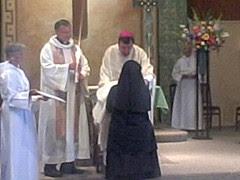
The canonical hermit participates fully in the Sacramental life of the Church. She prays the Church's official prayer (Liturgy of the Hours); she may join with other hermits in lauras --- including virtual lauras that are non-geographic and allow for the strengthening of ecclesial bonds and witness. She lives her life according to an approved Rule of Life and under the supervision of Bishops (and often, accepted delegates) and spiritual directors. She does not live an individualistic life where canon law is dismissed as something only legalists or the "less spiritual" or "more temporal" choose. Instead, she allows herself to become subject to additional canons beyond those associated with baptism alone, because she understands that hermit life is a radically ecclesial and incarnational life, that, in a unique way, sees the multiplicity in one, and the one in and as the many. She wants to witness to this double reality in her own life and to do so officially for the sake of the Church and world.** Of course, it goes without saying that no hermit is alone because she lives with and from God, but what is also true is that no hermit is ever alone because we each carry the entire Church with us in our solitude. In fact, we are that Church.
.gif)





 Posts
Posts