[[
Dear Sister, it has always been hard for me to understand how some people can be called to consecrated life and others are not. That just seems exclusivist to me. You wrote that everyone is expected to live some form of the evangelical counsels, but not everyone is called to do it as Religious men and women do. If I am a lay person I am wondering how I live the evangelical counsels. Do I make vows? Also, if I want to be a hermit and desire to live like the Desert Fathers and Mothers did, will the Church recognize me as a hermit? What if I make private vows? Is it possible for me to try to become a canonical hermit and be refused? Isn't that exclusionary? Why do dioceses refuse people? I heard a hermit saying that Jesus never rejects us, but isn't the Church rejecting those who want to be c 603 hermits when they refuse to consecrate them in this way? I am still struggling with the sense that lay persons in the Church are second class citizens.]]Thanks for your questions, and also for the heartfeltness of your comments. I have struggled with the same issues in the past. In important ways, Vatican II's focus on the role of the laity was dealing with the same set of questions and sense that you have described above. Those called to lay vocations, and not to consecrated or ordained life, felt like second or third-class citizens. What this meant for the Church itself was that it had not reflected sufficiently on the nature of the lay vocation, nor appreciated it sufficiently to convey the esteem it felt for it (and sometimes, apparently failed to feel for it!). What the Church recognizes is that all three states of life, lay, consecrated, and ordained, are essential for the Church as Church. All three are required and contribute to the truth, beauty, integrity, and holiness of the Church as the Body of Christ. All three witness to the Church's call to holiness, though they will do so in different ways.
In
Vita Consecrata, John Paul II commented that he could not imagine a church composed of just priests and laity. Here he was pointing ot he importance of consecrated life for the Church. However, the same could be said of the laity. It would be impossible to imagine a Church composed of only religious or consecrated persons and the ordained! It would be impossible to imagine a Church given over to the kind of holiness or missionary presence Jesus represented in our world, and called all his disciples to, if the Church had no laity. Vatican II spoke of the call to holiness, not as an exclusionary or elitist vocation meant only for a minority of its members, but as a universal one. When we begin to reflect adequately on the laity, we begin to look at vocational pathways of every sort: family, education, business, medicine, science, law, politics, etc. Similarly, we consider all the ways society is created and sanctified, all the ways the world is cared for, explored, honored, healed, and even made sacramental through the Church's living presence. The lion's share of these vocational pathways and the ministry associated with them belongs to the Catholic Laity. Critically, when we look at ministry in the Church today, we reflect on the way the laity shares in the priestly, prophetic, and royal offices of Christ, so that today we speak of lay
ecclesial ministry --- something that would have been impossible prior to Vatican II and the years following the Council. What would the Church be without the laity? Not the genuinely Catholic Church of Christian discipleship and witness to the Kingdom of God!
While I write mainly about the nature and significance of my own vocation here, I have tried, over the past decade and a half and longer, to indicate my appreciation for hermits who choose to or otherwise need to remain "non-canonical" or lay hermits -- just as the Desert Abbas and Ammas were. I continue to think it is unquestionable that the majority of hermits in the Church are not canonical hermits, whether under the canons and proper law of institutes of consecrated life, or under c 603, dedicated as it is to solitary hermits, and sometimes, lauras of solitary hermits. Online listserves, Facebook sites, etc., demonstrate this to me, as do newsletters like that of
Raven's Bread. What I would love to see and what I have tried to encourage is that some of these hermits give time and energy to writing about their vocations, to make them known, and to explore their significant place in the Church. They live these lives for the sake of others, and they do so specifically as laity. Share what this call is!! Demonstrate who it serves and how!!! Especially, indicate how it helps the Church appreciate not only the eremitic vocation, but the importance of the laity for the Church and the World!!!
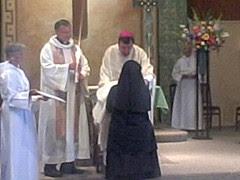
You asked if you do this, will the Church recognize you as a hermit? Well, I can tell you that the Archdiocese of Seattle is doing that today and has been doing so for a number of years. The (newer) Archbishop there (Paul D Etienne) is not consecrating new c 603 hermits, and is accepting the commitments of lay hermits in the Archdiocese at Eucharistic liturgies. Look into this. Check into your own diocese and see if they would be open to something similar. There is, of course, absolutely nothing wrong with being a hermit living your vocation in the lay state. It is not about being second-class or "illegal" as one online commentator puts the matter, however, the exploration of such a vocation and discovery of its significance in and for the Church must be done by those embracing such a vocational path and helping to make it a real presence in the Church. I personally believe that c 603 gives the entire Church permission to pay attention to and esteem solitary eremitic life today. It has helped establish this form of eremitical life as a significant contemporary vocation, not a long-gone, irrelevant vocation that died out in the Western Church several centuries ago! One does not have to be consecrated according to this canon to benefit from it!! What one does have to hold strongly to, however, is the Church's teaching on the laity made freshly present at Vatican II and synods thereafter. This will take real courage and vision in a Church that is still in the throes of a crippling clericalism!!

I know I haven't answered all of your questions, but I sincerely hope I have answered those that might give you a pathway to consider lay eremitic life anew. The Desert Abbas and Ammas lived their lives as laymen and laywomen, not only for the sake of personal holiness, but because the Church needed them to do so when it became relatively easy to call oneself a disciple of Jesus Christ in the Roman Empire. We need such men and women today, calling all Catholics to such discipleship in the midst of a world that seems to have forgotten where and why Jesus lived out an exhaustive incarnation of God's love. Deserts come in all shades and stripes, including urban settings; stricter separation from the world involves a freedom from enmeshment in that which is resistant to Christ, and an obligation to love God's good creation into wholeness. The evangelical counsels assist in both of these. ** I would not be surprised to find God calling a whole host of new Desert Abbas and Ammas, not to canonical eremitic life, but to non-canonical or lay eremitic life today!! Perhaps you are one of these!
_________________________________________________
** You could make private vows, but every Christian is called to live these counsels in their own state of life. That would mean embracing the values of poverty (or simplicity), chastity (which is really about generously and appropriately loving others in Christ), and obedience (an attentive listening and responsiveness to God in every situation). How anyone is to implement these counsels apart from religious or consecrated life depends on each person's creativity and faithfulness. What the laity are not called to is religious poverty and religious obedience.





 Posts
Posts