I noted in the first part of this "Open Letter" that one of the objections to what I had written about consecrated virginity for women living in the world, was that this notion of secularity was not part of the charism of the vocation, because the phrase "in the world" was merely an add-on -- a way of saying, "not in the monastery" but not of characterizing this expression of vocation itself. After pointing out that this vocation is an ecclesial one, the Consecrated Virgin I have been corresponding with wrote as follows (and generously allowed me to comment on this on this blog):
[[But I can say with confidence that 'secularity' is not an element of the particular 'charism' of consecrated virginity. If secularity was an element of the central charism then even monastics who received the same consecration would be obliged to it !
CONSECRATION [being set apart]for God and a married life with Christ which leads to spiritual fecundity thus serving the mission of the church is the Trinitarian seal caused by the Rite of Consecration to a life of Virginity. The fact that this seal is also for women not living in monasteries but who continue to live in the ' world outside the monasteries' -------- is a mere add-on to the title of the rite in the Roman Pontifical which has no direct relation to the 2000 yr old charism itself.]]
I would respond that, the phrases "living in the world" or "in the world" are not, as far as I can tell, mere add-ons in the sense above, but phrases which substantially qualify the Charism of Consecrated virginity. To suggest what you clearly do about language describing a Rite which was specifically revised to allow for women living in the world seems naive to me. The usage does mean that the women being consecrated are not monastics or cloistered Religious, but it means far more than this as well. Neither is the term apostle (one sent out) or its adjectival form "apostolic" merely a superficial add-on. As noted, these terms occur in the Rite itself in the homily supplied therein. Canon 604 itself uses the phrase "in harmony with their state," in reference to service of the church which, it seems to me, must indicate a distinction between nuns (who may also receive consecration as virgins) and women living in the world since they are both in the consecrated state. (Ordinarily we would distinguish religious from lay states, but that cannot be the case here so the distinction must be between two other states. Those two states and ways of living one's life and ministry must be Religious and Secular. The ability to associate --- though not as an institute --- it seems to me, is given specifically here, despite the canonically already-established right of all persons in the Church to form associations, precisely to underscore and support the secularity of this form of consecrated life under canon 604).
Also, where you see a single charism with no clearly and substantive secular variation (as contrasted with its Religious one), I see a single Charism (consecrated virginity and all that entails in its central symbolism) with two distinct charismatic expressions (one Secular and one Religious) --- analogous perhaps to the single profession and consecration of religious who may then also have differing charisms (cloistered, ministerial and all the variations of those), or, better perhaps, analogous to the distinction between secular and religious priests (one Charism but two expressions). In any case, I see no theological problem with suggesting the Holy Spirit works in two distinct ways with the same basic charism nor in seeing consecrated virginity at the same time as a multi-faceted gift to the church and world. My sense is the Church herself was aware of that and celebrates it in renewing this rite as an option for women living in the world. At the same time, however, I cannot see secularity as merely one of many possible expressions of the Charism. The Church recognizes two such expressions: Religious and Secular --- though, with regard to (consecrated or sacred) Secularity I would agree that there are a multitude of possible ways to live out this basic expression.
Further then, I don't see where the emphasis on secularity differs from the original consecrated virgin tradition enough to be considered a rupture with it. Rather, I see the complete usurpation of the vocation by nuns (or, much better said perhaps, the reservation of the Rite to cloistered Religious) as a kind of break with the original vocation's secularity: though also a development, it was too one-sided or exclusive and represented a kind of turning this vocation on its head. Canon 604 as an option for women living in the world, it seems to me, recovers something which pre-dated the exclusive use of the Rite by cloistered nuns (or the existence of cloistered nuns at all for that matter) and the Church has emphasized the nature of this recovery by revising the Rite and specifically using the language of secularity and apostleship. I would need to see a substantive study of the original vocation in the primitive Church which concludes on verifiable grounds that the original virgins were essentially or functionally cloistered (or else all desert Ammas) to be convinced otherwise. My own reading of the NT and extra-scriptural sources does not support this; instead such a treatment seems anachronistic to me.
Finally, an accent on the ecclesial nature of the vocation does not conflict with secularity. Diocesan priests are secular priests and clearly have an ecclesial vocation, namely a vocation which is mutually discerned by Church and individual, mediated by, and undertaken or exercised in the name of the Church. Secularity per se has to do with the world which includes God's good creation. Thus the Church is not antithetical to the world in the broadest sense of that term, nor, in her best (and holiest) moments, is she set completely apart from it. She functions apostolically and as leaven to minister to and within the world and is meant to transform it and assist in bringing it to fulfillment. An essential part of this, and one more necessary at this point in history than at other points, is that she now does this through women who embody a vocation to consecrated virginity and all that means, and who do so precisely in their secularity. These women, more than cloistered religious or than CV's acting instead as quasi-religious, will be able to effectively serve as true prophets in a world which trivializes sex as well as commitment while commercializing the former as well. It seems to me that a woman who lives and operates in greater separation from "the world" can be more easily dismissed by that same world as living an irrelevant and somewhat isolated lifestyle. I don't think this is what the Church had in mind with Canon 604.
28 September 2011
Postscript to An Open Letter to Consecrated Virgins on Sacred Secularity


27 September 2011
An Open Letter to Consecrated Virgins on Sacred Secularity

The posts I put up on the significance of the secularity of Consecrated virginity for women in the world (C 604) have evoked some interesting correspondence. In one exchange a Consecrated Virgin from India (I will be happy to include her name if she gives permission) made two points in the main: 1) secularity is not part of the Charism of the CV under Canon 604 because the reference to "in the world" in the Rite was merely an "add-on"; the original vocation was not secular in any sense, and 2) in her own country the emphasis on the secularity of this vocation has resulted in the destruction of the vocation's actual charism. Consecrated virgins in India find themselves regarded as having second rate vocations at best and essentially unrecognized or slighted while Religious were given preference for positions like EEM, etc. In celebrations of the day devoted to Consecrated Life, CV's were not included. Thus, this CV posited that the solution to the problem was ignoring the secularity of the vocation and emphasizing its nature as consecrated.
Since I think her her problem is not completely unique, and since I find her solution really exacerbates the problem, I want to post an open letter to all CV's (edited here and originally sent to this individual), but especially to those Consecrated Virgins who feel sympathetic to the solution she suggests. In this letter I address the second point above. I will post my response to the first point separately.
Poignantly, she writes: [[ I come from a real life context where the focus on secularity has caused a rupture from the original charism. A context where consecrated virginity is treated as the vocation to be a pious single lay woman subordinate to clergy and religious and called to be hidden leaven in the world. A temporarily professed religious is given preference over a consecrated virgin when there is need of a Eucharistic minister. Consecrated virgins are not called for Church celebrations of the Day of Consecrated life on February 2.The focus on secularity is killing the charism. Ignoring the secularity which comes by default seems more helpful in living the original charism of this recently rediscovered vocation in the church.]]
Identifying the Problem, Finding the Real Solution
Dear [Consecrated Virgin],
I sympathize with your situation but I think you have misdiagnosed the problem and have the solution backwards. The only way to get people to honestly regard your (plural) vocation is to cease pretending to be something you (consecrated virgins generally) are not, namely quasi-religious whose relationship to the world is less than integral, and to live out a call to sacred secularity as radically as you (plural) can. Of course, and very unfortunately, a church which does not adequately regard secularity will treat Religious with greater regard. This is a long established bit of ecclesiastical dysfunction rooted in a distorted theology of secularity which must be combatted. Further, you come from a country where priests in some Rites are associated with a particular caste, and where people are still dismissed or esteemed on the basis of castes. I think this makes dealing appropriately with the class-ism of the church much more difficult. Neither your local ecclesiastical nor your cultural situation (both of which involve a denigration of groups of people, which, in one case, is Seculars or non-Religious) is resolved by denying the dignity and importance of secularity.
For you are a consecrated virgin sent as an apostle proclaiming the gospel which says there is neither Jew nor Greek, slave nor free, male nor female. It is not acceptable in light of this to treat any form of consecrated life as better or lesser than any other. For that matter it is not acceptable to treat any divine vocation as greater or lesser than another. While I think you both know and agree with these assertions, what I think you have missed seeing is that if you ignore or treat secularity as secondary or merely an "add-on" indicating simply that you do not live in a monastery, you will actually be supporting the very problem you decry. Yes, you must fight to be understood as consecrated women, but you cannot and must not do this by denigrating (even subtly or implicitly) lay or secular vocations in the process. To emphasize one's consecrated state at the expense of secularity or the laity (which is what I hear your statements doing -- though inadvertently, I am sure) is as illegitimate theologically and pastorally as what is being done to consecrated virgins in your country. In the end you are actually denying the truth and effectiveness of your own consecration. It is somewhat analogous to denying one's femininity while asserting (or trying to assert) one's humanity because men are esteemed where women are not. In doing this one ends up actually denigrating what is the essence of one's own humanity, one's womanliness, and becomes a parody of what one is made and called to be. In essence, in fighting for the regard which is rightfully yours as consecrated women in the Church, you have joined the "enemy" (i.e., a worldly mindset which judges worth based on classes, etc) and denigrated the laity and secularity in the process. This, as I am sure you well know, is emphatically NOT what Vatican II intended.
Neither is it the solution to your predicament, for I believe you have lost sight of (or chosen to ignore) precisely the element which allows your vocation to make profound and challenging sense in today's Church and which would be a key to resolving this predicament for so many others --- not least those who find themselves resenting that they are "only" called to be lay persons (called to the extraordinary dignity and challenge of baptismal consecration) and/or those whose main arena of activity is the saeculum. This is one of the places the power of paradox becomes so very evident --- along with so much of Christian theology which stresses the subversion of the status quo and dominant paradigms by self-emptying, losing one's life, the perfection of power in weakness, a foolishness which is far wiser than the wisdom of men, becoming a fool for Christ, etc. In every way, Christianity is countercultural and those who wish to serve as icons of the body of Christ need themselves to truly be countercultural in the same way.
Implications for Consecrated Virgins Living in the World
What this means for Consecrated virgins is the assertion, not the denial of their secularity. When I say this I don't mean one should downplay one's consecration but rather assert it precisely IN its secularity. The two are NOT opposed any more than Jesus' divinity is opposed to his humanity or his Mother's consecration by God requires she retire from or denigrate the world in which she works out her motherhood. (Do we really think Mary was not an essentially contemplative and completely involved presence in her world? Do we not hear when she is given as a Mother to all of us that she is a Mother in and to the world? Even while she is a model to Religious, is she not also, and perhaps more poignantly, a model to Seculars?? Would she have been offended if told her vocation was to one of sacred secularity?) I don't think so, but the point is that these two things (consecration and secularity) do not conflict because the world is essentially good and holy, and because it is meant to be Sacrament of God's presence. Undoubtedly it takes workers within it to help recover its wholeness and holiness in God and bring it to fulfillment; it takes workers within it who truly believe that heaven and earth are called to interpenetrate one another and that God is meant to be all in all. This is the vision of reality which underlay Vatican II's insight and insistence on a universal call to holiness --- a vision which does not allow us to denigrate, even implicitly, ANY vocation by treating others as superior.
 The consecrated virgin living in the world must be committed to the subversion of any other notion of heaven and earth, reality essentially divided into sacred and profane, etc. Instead she must embrace a Sacramental view. She must also, I think, be committed to the subversion of schema of the world which sees some vocations as higher than others, some as "only" that of a devout layperson, some vocations (assuming they are lived well!) as more closely following Christ than others, some as secular when that means opposed to the sacred. (It is one thing to say that one practices a poverty or chastity that is more literally like that practiced by Christ and another thing entirely to say that one vocation follows Christ more closely (is more an instance of discipleship) per se. The first describes the way one expresses one's discipleship, the second refers to discipleship itself.) There is absolutely no reason to necessarily see Religious as better disciples of Christ than those living in and committed to the world (seculars), and consecrated virgins living in the world are meant to help the Church and world realize (come to know and make this real) as acutely and thoroughly (radically) as they can.
On Hierarchies and Anti-Hierarchies: "The first shall be last and the last shall be first."
One of the ironies of the Church, I think, is that she is hierarchical and actually prepares the way for a Kingdom which is anti-hierarchical. Too often, however, the hierarchical nature of the Church has been nothing more than an echo of the very worst class distinctions (and correlative denigrations) of the world. Your own local Church seems to do this by echoing the class structure of the surrounding society --- it continues to be a church which does not effectively value the lay vocation or even the consecrated vocation to a sacred secularity. (Unfortunately, your own offense at a temporarily professed Sister taking precedence over a consecrated virgin is also an instance of this, I think. It is interesting and disturbing to me that you would actually distinguish this religious as "temporary professed" for instance --- as though there would have been no (or at least less a) problem if she had been perpetually professed.) Vatican II was a step (a quantum leap in fact) away from the values of the world and towards those of the Kingdom of God. Consecrated virgins living in the world are called to implement this subversive vision in the most radical way possible ---- by reminding us all that the world is meant and called to be paradise, and that the Kingdom is NOT hierarchical as we so often see in a fallen world, but is instead the place of "the great reversal" where all of our worldly values (including hierarchy of every kind) will be turned on their heads. (I believe this is what Jesus was saying with, "the first shall be last" --- not that he was positing a new kind of hierarchy. Rather I think he was saying. "The kingdom will be unimaginable" --- for a world in which the last would be first was truly unimaginable.)
This is truly challenging even in a culture not structured on castes, but, I can see where it would be far more challenging for the CV living in such a culture itself. Still, Christ was a countercultural presence (and was despised by both the Romans, Greeks, and Jewish leaders because of it). He did not cave in to the values which surrounded him, but lived and died with integrity in the face of them ---- and redeemed them through that living, dying, and rising. Consecrated virgins are called to no less. Jesus did not retire to the desert for the whole of his life, but worked out his own vocation in the world in a way which did not leave the world unchanged. Consecrated virgins are called to no other, and, in their own way, no less.
A final Plea
I implore you (again, plural) then not to accent consecration to the exclusion or denigration of secularity. Embrace secularity as the means for your consecration to be truly meaningful. Make it clear to those whose values you decry that the universal call to holiness is both truly universal and a call to exhaustive holiness. Do not let your consecration as a virgin living in the world make second class (or less) the consecration to baptism which is the fundamental vocation grounding all others, nor (even implicitly) let it denigrate the saeculum which you are called to remind both Church and world is the Sacrament of God's Incarnational presence. Also, do not fear being a more or less hidden leaven. Let your consecration be evident in the graces of spiritual motherhood and spousal love revealed (realized) in the world. Let it be evident, that is, in its proper secularity. I promise you that if you do that, you will shine as brightly and be as extraordinary and as clearly set apart for God as anyone (and especially as God or his Church) could wish. Embrace the radical Christian vocation of Sacred secularity, not hierarchy or the Greek version of compromise, and the literal mediocrity of what is called the middle way.
23 September 2011
On the Paradox of Sacred Secularity
[[Sister Laurel, by treating the vocation of the consecrated virgin as a secular vocation aren't you making it a part time, hidden vocation? If CV's are set apart by their consecration, doesn't it diminish the vocation to make it so strongly secular?]]
Thanks for your question. I hope you have read what I wrote about paradoxical vocations because I would like to build on that in my answer. There are essentially two ways of looking at reality. The first is what I referred to as the Greek way of seeing. This way tends to distrust paradox and sees the elements involved in the situation as truly conflicting with one another. So, for instance, it would be impossible for a Greek (i.e, one who thinks in this way) to see how one could be truly divine to the extent one is truly human, or truly rich to the extent one lets go of worldly riches, or for someone's power to be perfected in weakness (except in terms of exploitation of that weakness!). This way would consider the beatitudes' sheer foolishness, an incarnate God ridiculous, a crucified messiah even more so, etc. Instead of paradox Greeks tend to think: thesis, antithesis, synthesis. And so, they might see secularity as the thesis, consecration as the antithesis, and some form of balance or golden mean as the synthesis (and only reasonable alternative to insanity).
But Christians see things in terms of paradox, knowing that there is paradox at the heart of reality, at the heart of God's self-revelation, and at the heart of his revelation of the nature of human beings. We tend less to see reality in terms of thesis and antithesis as we do in terms of apparent conflict and deep identity (these two elements together comprise paradox). So too, we do not look for resolution in a synthesis which is expressed as some sort of golden mean, but instead in a truth which pushes both terms as far as one can to sharpen the apparent contradiction and assert (and hopefully reveal) their deep identity. Thus, it is possible for Christian theologians to speak of power perfected in weakness, life found in death, divinity revealed exhaustively in true humanity, meaning revealed in absurdity, sacred secularity, and so forth.
As I have noted before, I think the CV vocation is an essentially paradoxical one of sacred secularity, the call to be apostle in a way where one's consecration leavens (and sometimes, confronts!) the entire world of secular values, institutions, structures, relationships, etc. The word I used earlier was "thoroughgoingness." Nothing should be allowed to act as a barrier to this thoroughgoingness, but especially not one's consecration!! My point is the division of reality into sacred and profane is pre-Christian or other than Christian. With Christ, the veil between sacred and profane, temple and non-temple, even human (earthly) and divine (heavenly), was torn asunder. Such divisions are, in fact, a consequence of sin. Too often our approach to reality has forgotten this, and neglected the potentially sacramental character of all of the world. But Gaudium et Spes and Vatican II more generally recalled us to affirm these insights and the insight that every person was called to the same degree of holiness, even if the paths to this holiness differed.
It is not that the CV living in the world is hidden, but rather, that her presence is not marked out by exterior boundary lines and limits (as, for instance, is mine or that of other diocesan hermits who wear cowls, habits, and the like). I firmly believe her presence will be visible to the extent the spousal relationship she shares with Christ animates her being and ministry. Neither do I think that this can be a part time vocation, any more than I believe any public ecclesial vocation is a part time one. Dividing the vocation up into public worship and a completely private, personal spirituality would be a way of reinforcing the Greek disparity or dichotomous approach to reality. Seeing ALL that one does as potentially reflective of one's consecration and one's public vocation is what is called for for C 604 CV's, or anyone with a public ecclesial vocation.
I believe the Incarnation is the best model for understanding what I am trying to say. Jesus is Divine, but that Divinity is exhaustively expressed and revealed in his authentic humanity. If he becomes docetic (that is, if he merely seems to be truly human or is only partly human), then he also ceases to be truly divine as well (at least if we are talking about the real God here). Jesus has to be completely one in order to be wholly the other. It is a paradox which the Greeks could never accept, any more than they could accept a crucified (literally, a godless) God. An incarnate God, a God who participated exhaustively in every moment and mood of his own (now) sinful creation was ludicrous to the Greeks, and no real God at all; however, for Christians such a God proved and revealed his true divinity in precisely this way --- not in remaining remote or detached from this reality. Similarly, the CV living in the world is consecrated, but that consecration is proved and revealed precisely in the secularity of her vocation. Secularity does not detract from or diminish her vocation or consecration; it establishes the truth and exhaustiveness of it.
I hope this helps. Again, all good wishes.
Age Requirements for Consecrated Virgins Living in the World
[[Sister Laurel, do you agree or disagree that there should be age limits with regard to consecrated virginity? Why or why not?]]
Generally I think there should be age requirements at the lower end of the age spectrum only, but not at the upper end. I say this because I believe that consecrated virginity takes real maturity and life experience, and the discernment of such a call should be clearly distinguishable from other life situations and vocations.
Today young women have a variety of choices to make about how God is calling them, including religious life, marriage (which may well be a later call than we have allowed for traditionally), dedicated singleness, and eremitical life (which, in its solitary rather than religious form is definitely a second half of life vocation). I honestly don't see how one can make these choices wisely without experience and affective maturity. This includes not only an experience of dating, but advanced education (where appropriate, professional and theological training and experience, and ministerial experience) which enables one to have a clear sense of the importance of this vocation's unique secularity. It also would require time working with a spiritual director in order to develop a mature faith and prayer life which is self-directed in the power of the Spirit and disciplined similarly, and which is able to interface effectively with the world in which one works, lives, and, worships.
Thus, I would tend to believe that 30 is the absolutely lowest age generally wise for the consecration of virgins living in the world, and would suggest that 35 might be more prudent. Since this is not a Religious vocation and does not have the kind of formation program, checks, and supervision available to those entering Religious life or proceeding to perpetual profession, and since it truly does take time for a prayer relationship with Christ to crystallize in terms of being spousal or nuptial, and since even then this does not mean necessarily that one is called to this consecration, more time is required. We do not think it an exorbitant requirement that a nun or Sister be required to go through three or four years of initial formation before being allowed to make first profession, nor that they be required to continue supervised ongoing formation for as much as another six years in order to be admitted to perpetual profession (which, by the way, --- and contrary to what some CV's have written in stressing their own consecration --- is not only an act of self-giving or dedication but which includes solemn consecration by God through the mediation of the Church following and accompanying the making of vows). Neither do we think it reasonable to immediately profess someone showing up at the chancery door because they live alone and desire to be a diocesan hermit --- even if they have lived in solitude for some time. These vocations take years to mutually discern, and rightly so.
I think the conversation we have been having about the secularity of this vocation, and the fact that CV's under canon 604 are NOT called to a kind of quasi-religious life, nor to a vocation which is externally distinguished by veil, habit, promises of obedience, nor mandated specific prayer practices besides being a person of significant prayer, points up that some may embrace the vocation before working through (or to) its real challenges and demands. I am especially concerned that some would like to create a superior/subordinate or subject relationship of obedience with the Bishop that goes beyond the warm paternal relationship spelled out as essential in the Rite of consecration itself, and which is inappropriate for one truly living responsibly in the world. (It also will not serve or benefit the Episcopacy in quite the same ways as the warm paternal relationship can well do.) When such a superior/subordinate relationship is required to discern in detail how one should pray, dress, etc, in order to not be a matter of private or personal whim, I begin to suspect too-juvenile or immature notions of obedience and responsible freedom are at work -- especially for one living in the world.
I don't see or entertain the same kinds of concerns with the other end of the age spectrum, though certainly discernment and formation are still necessary --- which could take some time. Maturity is not simply a function of age though it most often requires minimal age levels to achieve.
16 September 2011
Consecrated Virgins and Objective Standards, More Questions

[[Dear Sister Laurel, I am a Consecrated Virgin and disagree with what you have written about the vocation, especially about objective standards or requirements. I believe that it is reasonable to ask CV's to do and their dioceses to require the following: 1) direct service to the church, 2) specific obligations for prayer and daily Mass, 3) poverty and obedience, 4) a significant bond with the diocese for which they were consecrated, and 5) that they be open about their vocation --- which openness may include some recognizable garb or symbol besides their rings. None of this seems too much to ask of consecrated women, especially if they are to be distinguishable from ordinary or even devout laywomen. Wouldn't you agree?]]
Well, I would agree with some parts of this and disagree with others; it all depends on what specifically each of these points means and how they are concretely expressed. There is an assumption underlying all of this and you have made it explicit in your last sentence, which I would like to note first. Namely, that Consecrated Virgins (or consecrated persons in general) are to be distinguishable from "ordinary" or even devout laypersons. My problem with that is that it seems, at best, a very short step to treating the lay vocation as the lowest vocation on a kind of "ladder" of vocations --- the kind of "entry level" vocation which is fine for the "called" but not for the "chosen". But the truth is that Lay life is, by definition, the life of the non cleric called to be adopted Sons and Daughters of God in Christ. It is rooted in a form of consecration which therefore has an intrinsic dignity and challenge to it which is both extraordinary and very demanding. While it is true that people lead nominally Christian lives which do not really measure up to the dignity of their vocation, the "ordinary" lay vocation is not ordinary at all and the "devout" layperson is merely someone living out that vocation with integrity. Considering lay vocations or lay life as a kind of "entry level" state with other vocational calls as "higher" calls would be a really serious mistake. Especially it would undercut the insight and thrust of Vatican II's recognition that the life of holiness represented by the lay life is part of a universal call to holiness and, though the shape of it may differ, is no less than any other call to holiness.
All of this shapes the way I approach your questions and, along with the particularly general nature of what you have laid out (more general than other versions of the same points I have actually read on blogs), makes me hesitant to simply agree or disagree. So, regarding your actual questions and requirements, what do I think? Let me take your points one by one.
1) direct service to the Church. The Canon which governs your life is clear that the vocation is one of service to the Church and to one's brothers and sisters. My experience of canons (limited, I admit) is that they say what they mean and mean what they say. Had the Fathers that formulated this Canon meant direct service, parochial service, they would have said so. Instead they qualified it with, and "in accordance with (in harmony with) their state." As noted in earlier posts, the consecrated virgin in the world is, by definition, called to a secular vocation, as well as an apostolic one. This means being sent into the world, not into the Temple as "vestal" virgins. Christ's Body is meant to feed and nourish the entire world, and the consecrated virgin is to do that in her unique way. I see this as a direct service to the Church, but then, my definition of Church is not merely, the "institutional Church" here. While I think consecrated virgins might well ALSO serve in ways the institutional Church requires (the symbol of virginity as a whole-hearted, loving, and countercultural gift of self would be critically important for youth in our parishes, for instance), I don't think the vocation per se should be defined only in terms of such service, especially as a full-time requirement.
2) specific obligations for prayer and daily Mass: I have already written a lot about the development of a sound Eucharistic spirituality which does not require daily Mass so I won't repeat that here, but I will talk some about requirements of prayer. The documents on this vocation encourages, but does not require, prayer of two hours of the Liturgy of the Hours. These are the same hours every person in the Church is encouraged to pray, and I think it is significant that the Church has not generally or specifically required more than this of the CV when she might easily well have done so. In some ways I would personally be fine with some form of MP and EP being made a requirement because I know many Benedictine Oblates, for instance, who, despite very active ministries and lives "in the world," do this and more and find it helpful. However, these Oblates are also monastics and called to inculcate monastic values where they live. Consecrated Virgins are not. I would also personally encourage (but not require!) some CV's to pray Night Prayer as well --- because I find it a gift myself, and critical for both ending my own day and preparing for night, sleep, death, and even the new day. But I encourage this on a case by case basis. With regard to the LOH, more than this (i.e., the full Liturgy of the Hours) seems to me to be a burden which could actually distract from the other prayer and work the consecrated virgin is called upon to do and be in the world.
Consecrated virgins (living in the world) should, of course, be women of prayer, and in point of fact, SECULAR women of prayer. Everything they do, every place they are present, every encounter, etc is meant to be a part of this prayer. They live in light of a special intimacy with Christ, but they do so in a way which calls every person to live out a similar but personal intimacy with Christ in the workplace, in their daily interactions, business dealings, families, and so forth. Will this look different than the lives of devout lay persons? Maybe, but maybe not. I would think it well might not in fact. Certainly the spousal relationship with Christ will shape everything differently than the spousal relationship of one who is married with children, and thus, has limitations the CV does not, but what this might look like is not clear to me. Still, it is a difference which the heart makes that is the measure of demonstrable differences here --- not additional external requirements re prayer. Should the consecrated virgin pray in the way, and to the extent she feels called? Yes, of course, but what is a significant prayer form for one may be unfruitful for another. Whatever the CV does to become a person of faithful and constant prayer, the distinguishing characteristic of her life will be the kind of love which stems from that prayer and with which she approaches the world.
3) poverty and obedience: One thing must be said up front here. All Christians are called to live the evangelical counsels in some sense, but this ordinarily does not mean religious poverty or religious obedience. It does not mean either of these things for a consecrated virgin living in the world either. Evangelical poverty GENERALLY means allowing Christ to be one's treasure. It means using wisely and for the good of the Kingdom whatever resources one has. It means being a good steward of the wealth of creation, and ordinarily it means, therefore, embracing a certain simplicity of life which allows ALL people to share in the world's wealth no matter their station in life. It does NOT necessarily mean one must be materially poor, however, -- and in this is the challenge which faces consecrated virgins. Unlike religious women, CV's are called upon to model the Gospel counsel of poverty in a way which speaks directly to those in the world who are truly responsible for the world's wealth and others' access to that. They are to be truly rich in Christ and witness to this precisely in the midst of the world which so needs such a witness. They will do so as corporate persons, homeowners, business owners, attorneys, civic leaders, etc etc.
With regard to obedience, the consecrated virgin is called to listen and respond to the Word of God not only in Church or their own rooms, but right in the midst of the world --- just as every person is meant to do. That listening and responding may certainly include a reflective dialogue with one's pastor, Bishop, etc in order to hear and consider one's response to the needs of parish and diocese as well, but it will not be formalized with a vow or promise to subject one's will to the will of these persons. That is characteristic of religious or eremitical obedience, but not the obedience of a CV living in the world. I think the CV's obedience will be more wide-ranging in focus than that of the Religious, then. She will (like religious women) pay careful attention to what is happening in the world, to politics, sociology, economics, etc, and respond as she hears God calling her to do, but at the same time she will do so in direct ways religious cannot always attain. Will this look differently from the obedience of devout laypersons? Perhaps. But if it does, it will be because the love which shapes her life has a somewhat different stamp than does Christ's love in the life of the devout layperson.
One caveat regarding obedience and promises or vows. I have heard many people wanting to make a vow of obedience because it seems to them to do one or all of the following: 1) mark them out as a person who is more intimately related to the institutional church; 2) mark them as someone who is more important (especially when one's legitimate superior is the Bishop) and somehow separated from the choices and responsibilities of others (lay persons) in the Church and world; 3) require a kind of subservience which can verge easily into a juvenile relationship with the world of adulthood. All of us, for instance, have had the experience of saying, at some point in our lives, "So-and-so (the boss, or professor, or whomever) wants me to report directly to him!" and we know how proud we can feel at those times. As a diocesan hermit with vows professed in the hands of the local Bishop, I have experienced the temptation associated with this myself. It is something to be eschewed! (Fortunately, competent persons who serve as legitimate superiors, delegates, etc, generally discourage these kinds of relationships and reject utterly an approach to obedience which is juvenile and blind! It is interesting to realize how universal this need to be answerable to someone is --- and how destructive it can become.) In any case, CV's wishing to make a promise of obedience to the local Bishop need to be clear re their motives and recognize that, even in the best cases, they are trying to adopt a form of religious obedience, but not the kind of obedience the world so badly needs modeled for those living in its midst.
4) A significant bond with the diocese for which they were consecrated: I honestly don't know what this means. It seems to me that CV's are surely called to be aware of the needs, dreams, potentials, and general state of their diocese and parish. They are surely called to serve those needs both parochially and in the wider world. Further, they are called upon to model such a relationship for others who might also take on such a responsibility and relationship. Is such a relationship insignificant? If this is a way of saying, "vows (or promises) of poverty and obedience" then it is a very narrow definition of the term "significant." For instance, despite the role I have in my diocese and parish, I know that there are people who are much more knowledgeable about and concerned with the needs and inner workings of these things than I am. They are an incredible gift to both parish and diocese in a way we really need. So, if you can specify more clearly what you had in mind, it would be helpful to me.
5) An openness about their vocation which may include distinguishing garb or symbol beside their ring. It is one thing to be open about one's vocation, and another to wear distinguishing garb --- especially when one's vocation is essentially secular and not to be marked off by garb which creates boundaries and separation. My understanding of the Rite of Consecration is that while it refers to the giving of the veil, this is understood to refer to a veil which is used during the consecration, and perhaps during liturgical celebrations (rather like my cowl is --- for I certainly don't wear it when I go to coffee with my friend on Sundays!). The wedding ring is a VERY significant symbol which at once marks one as committed, but also which is clearly understood and invites significant conversation. Obviously one should be open about who one is, and how one has been called, but at least a portion of this openness means openness about the secular nature of one's vocation.
It is not always easy to talk about the deepest things in one's life, especially the foundational love-relationship which defines one's existence above all others, for instance but this is what is required in Canon 604 (or any public vocation) and in the openness you allude to. To witness to a God who takes as spouse someone living in the world, working at the same kinds of jobs, facing the same economic challenges (including how to deal with personal greed and wealth), the same relational obstacles, threats, and disvalues (the objectification of women, the trivialization of sex and denigration of virginity, the notion that a woman is only complete when linked to a man, etc, etc) is a very challenging witness. It is also one that religious women (who are, by definition, marginalized from the world in ways the CV in the world is not) cannot undertake in the same way.
Thus, I honestly think CV's are called upon to do this without the protection or the facilitation which a habit, veil, or other distinguishing garb makes possible. They are espoused to Christ and the wedding ring is the sign of complete dependence upon this foundational relationship. It is, in its own way, a sign of the specific poverty appropriate to the Consecrated virgin.
I hope these answers are helpful.
P.S. I referred to the called vs the chosen in the beginning. By called I mean everyone whom God in Christ has summoned to himself. By chosen I mean all those who have indeed answered this call. I reject the notion that God calls some, and then, in another selection-like process elects others for special favor, and these are "the chosen." When Jesus says many are called but few are chosen it inevitably seems to mean the-all-composed-of-the-many are called, but of these, relatively few respond as grace enables them. There is nothing elitist in this at all -- and it is something today's Gospel seems to underscore, I think.
14 September 2011
Consecrated Virginity and Secularity, Some Questions
[[Dear Sister Laurel, I don't see how a vocation to consecrated life can be considered secular! When I grew up "secular" was played off against "religious" and was completely negative. It was associated with sin and evil. How could a consecrated virgin be called to secular life?]]
I think this objection is a common one and it is one I anticipated. I had already decided that I was going to write about the notion of Saeculum, the related term "secular" and the vocation I referred to as consecrated (or sacred) secularity because I think that problems with this term might be at the heart of people feeling like consecrated virginity is a second-class vocation or "not as good as" that of the nun or religious sister. After all, many of us remember times when Sisters were not allowed to eat or recreate with seculars (this could include one's family). Some of us may recall being met by the dismayed concern, "But they're not (add the unstated sentiment, "God forbid!") a secular institute are they?" upon informing someone we were joining a new community, for instance. So thanks for the question; your timing was perfect.
First, then, let's look at the term "World." It has several layers of meanings. First it signifies God's good creation, then the ambiguous (essentially good but sinful) world of space and time (history) in which human beings are normally active socially, politically, and so forth, and finally, the clearly pejorative sense of that which is resistant to Christ and unredeemed by him. All of us are called to avoid becoming ensnared or enmeshed in "the world" in the last sense, but mainly we continue to love and to live in the world in the first two senses of the term and minister to "the world" understood in the third sense.
Hermits, who differ somewhat from this general rule, for instance, are bound to stricter separation from the world primarily in the sense of rejection of that which is resistant to Christ, and secondarily and in a less absolute way to a stricter separation from the ambiguous reality of human history and activity. They may also be restricted from many aspects of God's good creation, but ordinarily this is a consequence of things like poverty, stability, etc, not a rejection of this dimension of the term "world." Their ministry is one of solitary contemplative presence with all that implies, and generally they are not called to much, if any, active ministry in the world (saeculum) in this latter sense. In other words, whether consecrated or lay, hermits are not called to be seculars or to secularity (which, it should be seriously noted, is NOT the same thing as secularism!). Thus, as noted, canon 603 spells out the vocation as one marked by "stricter separation from the world."
On the other hand, most Christian ministers are called to the saeculum (that which pertains to the world) as their primary sphere of ministry and presence. They are not called to participate in that which is resistant to Christ, but they are called to minister to it nonetheless. Thus, secular or diocesan priests, who are not Religious and do not have vows of poverty, chastity or obedience, live, minister in, and are primarily committed to the everyday world; most lay persons do likewise, and Consecrated Virgins living in the world are called to do similarly. Religious men and women may minister in the world, but their lives and commitments are qualified in ways those of these others are not. One thing which should be emphatically affirmed is that lay and secular are not synonyms. Another is that a spirituality and ministry worked out in terms of the saeculum is not inferior to that worked out in the monastery (for instance). Since Vatican II and Gaudium et Spes (The Church in the Modern World) the world is appreciated as "an appropriate sphere of the dedicated apostolic involvement of the baptized." (Schneiders, Sandra IHM, Finding the Treasure, 223)
I am going to continue quoting from Sister Sandra Schneiders here, because she says so very well what needs to be heard here, especially in conjunction with the discussion on Consecrated Virgins and some of these women's desire to become quasi-religious. [[. . .because world is not a theological pejorative term despite its long history of largely negative use, secular is not a pejorative term denoting inferiority in the area of spirituality or ministerial commitment. It is a positive term expressing the choice to situate one's committed Christian faith-life and mission primarily, directly, and in an unreserved or unqualified way within the sphere of this world and this time, considered as the locus and raw material of the coming Reign of God. Religious make another choice . . . in regard to their relationship with the world. Neither choice is superior or inferior; neither is more nor less conducive to holiness or committed ministry. They are two different choices made by different Christians in response to different vocations.]]
Sister Schneiders continues:[[To situate one's faith life and mission firmly and resolutely in the world in no way suggests that this world or human history are ultimate values in one's life or the furthest horizon of one's concerns. It means that the way one chooses to serve the ultimate value, God and God's Reign. is through direct and primary involvement in the realities of the "saeculum," in family, economics, politics, social life, and all the other structures and dynamics of intrahistorical existence. . . .Secular Christians [including, I would add, Consecrated Virgins under canon 604] are precisely seculars, and it is at least arguable that only by claiming the term secular in its fully positive, postconciliar sense will we begin to appropriate the theological truth that this world and its history are not called to final destruction but to transformation in the Reign of God and that the human race is not called to escape the human race, but to transform it. The secular vocation in its proper and positive sense. . .is the primary hope for the transformation of the world in Christ.]] (Again, Schneiders, Finding the Treasure, pp 233-34.)
The bottom line in all of this is that the renewal of Consecrated Virginity as a contemporary vocation is part and parcel of the conciliar and postconciliar accent on the world as a highly proper and significant sphere of apostolic involvement. To live a consecrated life of virginity which models the same values as Mary did in Bethlehem, etc, is a tremendous call. To live as spouse of Christ in the world he loves, died for, and seeks to transform in every aspect and dimension so that it might be brought to fullness in and of God is an equally tremendous call and challenge. But it is not religious life and cannot, without betraying its very nature, adopt the trappings of religious life. At the same time it is important to remember that consecrated, lay, or ordained life can ALL be secular depending upon the sphere in which one is called to minister. To say something is secular is simply to say the world is its sphere of concern, activity, and influence. As noted above, it is not a pejorative term.
In any case, I hope this at least begins to answer your questions.
12 September 2011
Surprised by a Hermit Writing about Consecrated Virginity
[[Hi Sister Laurel, I am surprised to see you writing about consecrated virginity. What caused you to do this?]]
Two or three reasons really. First, someone asked a question about CV's in conjunction with comments I had made regarding Eucharistic spirituality and the possibility of developing such a spirituality even if one does not attend daily Mass. Secondly, in that post I commented that I had myself thought of consecrated virginity as a "vocation in search of a job description" -- and that rather embarrassed me since I know several consecrated virgins. I was used to people (myself included) saying all the things a consecrated virgin was not, but really had not heard a positive, comprehensive, and particularly compelling statement of what the vocation was. Third, because of a reference made to some CV's desiring more general requirements in the daily life of the CV, I read some blogs by consecrated virgins and was surprised to hear what they were saying and disturbed by it as well. That led me to the USACV website and to the bibliography and links provided there, and especially to an article by Sharon Holland, IHM, entitled, Consecrated Virgins for Today's Church. That article was eye-opening and just what I needed to clarify the positive nature and content of this vocation.
The fact is that CV's are not well understood by most people in the Church, much less outside it. I find the language of "bride of Christ" beautiful, poetic, and something I personally resonate with (my own relationship with Christ is nuptial or spousal), but in general it does (or at least did) not clarify matters re CV's much for me --- and certainly not all by itself. However, the reading I did made the following connections or linked the following elements: 1) Church as Bride of Christ, 2) CV as Bride of Christ, 3) CV as icon of the Church, then 4) CV as a secular vocation, and 5) CV as a form of apostleship. When I combined all these elements I was struck by the fact that Consecrated virgins are apostles called and sent as icons of the Church into the world to witness to Christ's spousal love. They are therefore to extend the mission of the Church and live a kind of prophetic consecrated (sacred) and, indeed, virginal secularity in a sex-sodden world of rampant secularism or profane secularity. (More about what this actually implies below.) Once all the pieces were together I was blown away by what I had not understood or seen clearly about this vocation. Namely, it is significant (profoundly so) precisely in its virginal and consecrated secularity.
In other words, it is not meant to be a Religious or quasi Religious vocation. That is, it is not about being quasi Sisters or nuns though without the trappings of such lives or the benefits of community, for instance. It is instead a unique form of apostleship lived out in the world. What disturbed me in my own writing (when I congratulated friends who had been consecrated, for instance) was that I had found myself saying all the things it was not or did not mean, and could not go much beyond this, (e.g., CV's are not Sisters, do not have vows, do not wear habits, etc). While such clarifications are important, to be unable to state adequately and positively what the vocation is about pointed to a serious deficiency somewhere --- at least in my own understanding of it. In reading some CV blogs, however, I found women bemoaning the absence of these very things --- as though the vocation (or the dedication and consecration it involved) was not truly comprehensive enough or sufficiently significant in and of itself, and as though the Church promulgated Canon 604 without thinking things through adequately. That suggested the problem was not only my own lack of understanding.
I wrote about this vocation because it deserves to be understood positively, and because most CV's understand to what and where they are called. Some, however, underscore all the things it is not instead, and they do so by demanding the Church require these: prayer of all the hours of the LOH (Liturgy of the Hours), distinguishing garb besides a wedding ring (i.e., veils and clothing of certain colors and styles -- or lack thereof!), promises of obedience to one's Bishop thus making him a legitimate superior rather than a guiding Father or paternal partner, full-time work in direct Church service which makes the CV's ministry rather more parochial than the Church envisioned, I think, etc. As I thought about it it seemed to me that these demands (as proposed general requirements) undercut the very nature of the vocation and made it impossible to hear just what a radical call to apostleship it is.
I was also disturbed that no one seemed to be talking about the prophetic role of virginity itself, much less the countercultural witness virgins were called upon to make. Sex is trivialized and demeaned at every turn in our society and world. It is packaged, marketed, treated as a commodity everyone should try --- like the newest diet drink, for instance, and rendered unholy and diabolical (capable of tearing apart a world built on love, commitment, personal integrity, and the sanctity of self-gift) in the process. And yet, summoned by God through his church as apostles to this world, are consecrated virgins --- women whose consecration ring says clearly that they repudiate this denigration and trivialization while they support the values of commitment, personal integrity, and the sanctity of complete self-gift and sexuality itself. And they do not do this (act as apostles) as women separated from the world, but as consecrated women called to act as leaven within and thus, integral to the world.
Anyway, I have begun to truly understand what consecrated virginity under canon 604 is about, and I recognize even more clearly the danger of dealing with it in terms of what it is not --- whether we do that by innocently enumerating those things (though this can be helpful), or by clamoring for them as though the vocation is insufficient without them.
I hope that answers your question. All my best.
11 September 2011
Consecrated Virgins and Increased External Requirements: A Matter of resisting the call to Sacred Secularity?
Because of my earlier posts, and because I have not been up on the conversations of those CV's desiring additional external requirements, I have been reading the blogs of Consecrated Virgins. In one of them I found a portion of a post which seems to me to justify the concerns I wrote about in my recent posts. This particular Consecrated Virgin writes:
[[However, this doesn’t change the fact that complete, radical, sacrificial self-giving is still the goal to which I long to be called! Even if I can’t ever fulfill it perfectly, I still want my vocation to be that of a total, spousal, giving of myself to Christ in every single area of my life. I desire with every fiber of my being to be called to be concretely, literally, visibly—and entirely, without reserve or exception—given over to God and the Church. But, I have never wanted to strive for this end simply because it happens to be what I feel like doing at the moment; I want to strive for it because I have been explicitly called to do so by God, speaking through His Church. And I wanted the chance to say “yes” to this call in a public, binding, permanent, and “official” way. Yet my thought is that if the Church were in fact to see consecrated virginity as being a “less total” vocation than marriage, priesthood, or religious life, then it wouldn’t actually be my vocation to give everything to Christ in a radical way. I could still try to do this on my own, of course—but in that case it would just be an aspect of my own private spirituality. My formal place in the Church wouldn’t be that of one who gives her life wholly over to God, and in that specific sense I truly wouldn’t be “as good as a nun.]] Sponsa Christi, a blog by Jenna Cooper, Consecrated Virgin (Archdiocese of New York. Jenna asked that I credit her for this citation and for any references to her blog and I am happy to do so).
I have emboldened the sections which raise serious questions for me, and which seem to support my earlier comments. I have to say how very surprised I am by these sections. When I first encountered Ms Cooper she was not yet consecrated under canon 604. I could then well have understood all the comments about longing to be called explicitly by God through the mediation of his Church to a life of complete and sacrificial self-giving --- though I would suggest this can seem to denigrate baptismal commitments to some extent so caution is needed. I could also then well have understood dividing reality into private spirituality and public responsibilities. But Ms Cooper is NOW, a Consecrated Virgin, one who has assumed a public vocation through consecration by God and is, no matter what activity she engages in, a representative of this public consecrated state; these statements of yearning were, as far as I can tell, written post-consecration. In other words she HAS ALREADY BEEN CALLED to everything she mentions in these passages and has been called to them by the formal and public mediation of the Church. Nothing is left unchanged by such a consecration, nothing unclaimed by Christ, nothing in terms of spirituality or identity remains purely personal or private. What I (I hope mistakenly!) hear her saying is, "I was called forth and consecrated, but I long for God to call me to a deeper more extensive consecration and dedication of self than I already entered into. Canon 604's rite is inadequate for this; there must be more!"
Thus, it is also quite hard for me to understand how one can consider herself a Bride of Christ with a public vocation and believe that anything the Holy Spirit prompted her to do as part of that vocation could be considered completely private. Further, if the Holy Spirit calls a consecrated person he does so because the consecration has opened the person in particular ways to this grace. While the Church does not explicitly say to the person: "pray this way" (for instance), it is hardly possible to treat a genuine call to do so because it is part of who one truly is, as a kind of whim, as merely "something one feels like doing at the moment," and which therefore requires a new specific public commitment or permission in order to be valid. Instead the Church commissions the Consecrated Virgin to listen carefully and to discern what the Holy Spirit DOES call her to; it consecrates and commissions her precisely so that she may do this as an ecclesial person and one who is mature enough to act in the name of the Church in ways the Church has not completely envisioned in detail. This is part of the nature of the public vocation --- to explore what it means and to live it out responsibly as one discerns that one is called by God to x, y, or z and to do so without having others spell things out or give continuing specific permissions.
(By the way, I do not mean one should never check with one's delegate, Bishop, or director, etc, but, for instance, for diocesan hermits whose legitimate superior IS the Bishop, we tend to see our delegates several (4-6) times a year to let them know what and how we are doing, discuss problem areas, etc, and we see our Bishops once a year or so to fill him in on the same. (We contact him in between times if we need something significant or have some personal problem we need to put before him.) In the mean time, with the assistance of our director, we discern as we can and are relatively free to do so --- which includes the freedom to make mistakes! Our vow of obedience obliges us to this careful and continuing discernment, not to seeking permission for every new or different practice or prayer form. Our Bishops can (and do) certainly say yay or nay to some things, but ordinarily, despite vows of obedience in his hands, in my experience, the relationship does not focus on this kind of thing.)
When one is consecrated, one gives (dedicates) one's entire life (what else could the gift of virginity symbolize, by the way?) and, that gift is accepted and rendered sacred (consecrated) by God. This gift is also required to be given to others (commissioned) in service. As already noted, nothing within that life is held back at one's dedication (or profession) nor untouched by one's consecration. The usual analogy to this is baptism where the person becomes a new creation, or Eucharistic consecration where ordinary bread and wine is transformed into the Body and Blood of Christ --- external appearances (accidents) notwithstanding. The Church as mediator accepts the virgin's self gift in admitting her to the Rite of Consecration and consecrates her to service of God, his Church, and the world. The identity assumed is a public and ecclesial one. In general, no further call, no further new (formal) gift of self, no further validation is required. What is required is the assumption of the power of freedom in Christ, and the inspiration, creativity and courage of the Holy Spirit to explore and discover what this precise vocation calls for in terms of actual apostleship. The promise of these is given in the Rite of Consecration and the virgin commits her entire life as a vehicle for receiving and living these out.
In light of all this, I am reminded of the following text in the Rite of Consecration: [[They are to spend their time in works of penance and of mercy, in apostolic activity and in prayer, according to their state of life and spiritual gifts.]] While in the homily, it reads: [[Never forget that you are given over entirely to the service of the church and of all your brothers and sisters. You are apostles in the Church and in the world, in the things of the Spirit and in the things of the world. Let your light then shine before men and women, that your Father in heaven may be glorified, and his plan of making all things one in Christ come to perfection. Love everyone, especially those in need. Help the poor, care for the weak, teach the ignorant, protect the young, minister to the old, bring strength and comfort to widows and all in adversity.]] It is truly difficult to imagine a more explicit or comprehensive calling and commission!
The Church does not treat consecrated virginity as a second class vocation. Despite ignorant comments otherwise, the Church does not measure the gift of self in this vocation against the self-gift of the nun, or the diocesan hermit, or the ministerial religious, the diocesan priest, or the lay person --- whether married or dedicated single. Consecrated virgins should not do so either then. These vocations look and relate to dimensions of the institutional Church (and to the world) differently than one another, but this attests to the fact that they serve as leaven in different ways. For instance, I do not necessarily give more of my life than the privately (or the non-) vowed lay hermit, though I do so in a different way. I don't do nearly as much active ministry or work for the parish as most lay women in my parish, but that does not make my vocation second class to theirs. I do not make a vow of stability as my Camaldolese brothers and sisters do, but that does not make me committed to stability any less than they are. (Stability is a value I embrace in a number of ways even though I am not vowed to it.) Do I need to make such a vow to be truly committed to it? No. My eremitical life itself demands it and, as I have discerned this, I am expected to work that out without additional vows, etc. At the same time is stability simply a private bit of spirituality for me? No. I live it and do so as part of my public vocation. It is part of the gift eremitical life gives to church and world.
It does seem to me that one thing in particular could establish Consecrated Virginity as a second class vocation despite the fact that the Church does not regard it as such, and that is the post-consecration addition of requirements like visible garb, promises of obedience, responsibility for praying the entire Liturgy of the Hours (the documents re the vocation encourage the praying of Lauds and Vespers), full time direct Church service, and the like. If one has to legislate these kinds of things for all CV's then it suggests that the Church has been mistaken for the past 28 years and should never have consecrated anyone without them. It also suggests that, for some at least, this vocation really is still in search of itself and is uncomfortable with consecrated secularity. I know that is NOT the message we want to give, especially in a world where profane secularity and secularism are rampant and which so very desperately need apostles who speak directly and prophetically to these realities. The demand for additional requirements, separating garb, promises of obedience, and full-time direct service to (and in) the institutional church (all made in similar posts) narrows our definition of Church and ministry and limits the action of the Holy Spirit in this vocation to parochial institutions, positions, and ministries. Above all then, it seems to me, it suggests that the Church has not called sacred apostles to move out of the temple precincts and even into Cana or amongst the gentiles, when in fact, this is precisely one of the things she has done with Canon 604.
Consecrated Virgins have been given a tremendous gift and far-reaching permission (commission) to carry out their vocation in whatever way the Holy Spirit moves them. Presumably Consecrated Virgins have been given every grace in and through their consecration to do so as well without additional commitments, promises, garb, etc. It is certainly a vocation of the freedom of Christ, demanding as such freedom always is. I hope Consecrated Virgins demonstrate the adequacy and the incredible significance of their vocations in and of themselves precisely in the world where they were commissioned to serve as apostles!
08 September 2011
More Questions: On Hermits, Consecrated Virgins, and Eucharistic Spirituality
[[Dear Sister Laurel, do you think [the version] of Eucharistic spirituality [you have written about] works for non-hermits? What do you do with the Canon that requires you to attend Mass daily --- just ignore it? Some consecrated virgins argue that daily Mass attendance is something which should be required of them as consecrated women. How would you respond to them?]]
I do think this version of Eucharistic spirituality works for non-hermits. First of all I believe that everyone is called to let Eucharist work in their lives in a way which allows all of reality to be regarded as sacramental and to bring everything to a fullness of expression of the Word of God. Further, I think that every person is called to participate in the dynamics of self-emptying and resurrection (fullness) which are at the heart of the Eucharist. This is true no matter how often a person actually participates in the celebration of the Eucharist (so long as their participation per se is serious and allowed to serve as leaven for the whole of their lives). Some people are also called to share in the specifically eremitical dynamic of the redemption of isolation and its transformation into solitude. Often these persons cannot attend Mass with any regularity, but they can still live an essentially Eucharistic spirituality which is nourished and inspired by the Eucharist nonetheless.
As for the Canon you refer to, I am assuming you mean C 719, sec 2. Please note that this reads [[The celebration of the Eucharist, daily if possible, is to be the source and strength of the whole of their [members of religious institutes] consecrated life.]] All I can note is that this refers to the celebration of the Eucharist within the community itself --- something that is often not always practical today because of the shortage of priests. It also says, "if possible." I believe, therefore, that this canon recognizes that the Eucharist may and should well be the source and strength of one's life even if daily participation in it is not possible. In fact this is the focus of the text. Thus, while I don't ignore this canon, and while I believe it applies in a general way to diocesan hermits as well as to members of religious institutes, I also recognize that it is not meant to directly address solitary eremitical life, and is not as absolute in some ways as some people seem to believe. (For instance, it does not say, "Religious MUST attend daily Mass except when prevented by illness or other serious reason.") The focus of the Canon is on allowing Eucharist to be the source and strength of the whole of one's consecrated life, not on mandatory frequency of attendance per se. Regarding consecrated virgins, I really don't see creating a general requirement for all CV's. Consecrated virgins are a diverse group. Despite being women "living in the world" some are more contemplative than others, some more involved in ministry, some live their consecration in challenging ways amidst the professional and business communities, and others mainly within a parish community with ministry to these people, etc. Certainly they must embrace a serious Eucharistic spirituality, but that does not necessarily mean daily Mass any more than it means that for religious women or diocesan hermits. My own preference here is to be more discerning regarding those women who are consecrated as virgins living in the world (i.e., make sure they have mature prayer lives and spiritualities) and allow them to do as they personally discern they are called to in conjunction with their directors, Bishops, etc. In other words, require that they do as they discern is essential in their own case. Some will surely find that daily Mass is both possible and important; others will find it less possible, but both will find that the spirituality to which it summons them is indispensable and non-negotiable. It depends on the individual, those to whom she ministers, etc, as to what she discerns is critical for her own life and praxis at any given point or time.
I am not particularly up on the conversations of the CV's who argue that daily Mass should be made a general requirement, but I wonder if it might not reflect a need to make the vocation approximate that of women Religious and to separate CV's (or establish themselves as clearly or visibly separated) from the laity. Since consecrated virginity itself is not understood readily as a distinct or significant vocation, it may also represent, at least for some, a piece of feeling a need to have the Church spell out additional requirements which seem to validate the vocation. In some ways it has always seemed to me that reprising this calling has created a "vocation in search of a job description." It is hard for people to understand this vocation because the CV's are not religious and are also something other (though not more!) than devoted lay persons. IF the vocation has validity (and I genuinely assume it does) then it does not have this as a pseudo or quasi Religious vocation. CV's will need to establish themselves and an understanding of the nature and significance of their vocation, but this, it seems to me, will never be done if the obligations attached to their consecration and the canon which governs the life are treated as inadequate and additional requirements added after the fact. Either this vocation is genuine and has its own significant nature and charism within the church, or it does not. Multiplying required external observances does not take the place of a (perhaps!) missing charism and essential justification. Instead, to me anyway, such multiplication looks a bit defensive --- as though CV's are not comfortable with the inner justification of the vocation per se.
While it is undeniably true that vocations and especially an understanding of their implications for the life of the Church develop over time, it HAS to be noted that the Church did NOT establish attendance at daily Mass as a requirement when it published Canon 604 and it might easily have done so in 1983 understanding that this was essential to the vocation. The same is true with other things like Liturgy of the Hours, Rule of Life, distinctive garb (veil, etc), a commitment to religious obedience, etc. Was the Church naive in establishing the vocation? Did it fail to regard and legislate what was essential to it? Someone would need to seriously demonstrate this, I think, if they were to claim that certain practices were essential to the vocation itself despite not being part of canon 604.
In this and other matters it would be especially pertinent and interesting to hear what discussions were held about this canon before it was promulgated. How did other drafts read? (Canon 603 had numerous drafts; I assume the same is true of Canon 604.) How did Bishops understand the nature and significance of the vocation? Why were vows not required? Why no Rule of Life? Why no distinguishing garb? Why was the relationship with the Bishop described as unique but not in terms of his being a legitimate superior and with no provision made for a promise of obedience, for instance? It seems very significant to me, and probably illustrative of how the Bishops envisioned the vocation, that these things were NOT required given how natural doing so would have been. (We know that these things CAN be spelled out because some of them at least are spelled out for diocesan hermits in C 603. It also seems that the institutional Church generally desires external signs and explicit requirements and commitments like promises of obedience. But in this case they did not go this way. Why not?) What was the role of the CV in the early Church? How did what came to be religious life differ and why? Answers to these questions would help me to answer your question a bit more intelligently, and it seems to me that they are questions anyone arguing the need for more general requirements should be very conversant with.
In any case, to get back to your question about Eucharistic spirituality and daily Mass attendance, it seems to me that consecrated virgins are certainly called to develop and model an intense and encompassing Eucharistic spirituality, but it must be done according to each virgin's own discernment, vision, and sphere of ministry. Some virgins will model this especially for those who cannot get to daily Mass; others will model it for those who can. Some will do it for those who are more contemplative, and some will do it for those with very active lives in business and the professions, for instance. However, all (one sincerely hopes and trusts) will do so with devotion and personal integrity.
01 December 2010
Questions, Lay Hermits and Canons 604 vs 603
[[I am a little confused by some of the things you have written on your blog. I remember [someone] talking . . .about living as a lay hermit and your response was " good, the world needs more lay hermits" but it seem at times on your blog that you are against lay hermits, that you look down on them, that they are not a true expression. On another note, can you explain the difference between code 603 and 604? I'm sure you've written about it before but if you could " dumb it down" for me. ]]
 Thanks for the questions. I think it is probably important to read everything I have written about lay hermits, or at least to read about it apart from what I say about canonical or diocesan hermits. If one reads JUST what I say about diocesan hermits one could get the impression you have gotten. I am passionate and enthusiastic about my own vocation and I argue for its importance in a world which generally neither esteems nor understands it. Thus, I devote more energy and time to it than to the lay hermit vocation. If, however, you read what I say about the need for lay hermits, the dignity of the lay state, the need for all hermits to discern between calls to lay or diocesan eremitical life, I think the impression is more balanced and positive.
To restate briefly what I have said before on this, the two vocations are both valid expressions of the eremitical life. (Religious eremitical or semi-eremitical life is a third valid expression by the way.) Both are important and each may speak to different segments of the Church and world more effectively than the other. They have different rights and responsibilities within the church per se, though they overlap and may be identical in terms of the foundational elements of the life. Despite their hiddenness, one is a "public" vocation and one is not. The obligations of one flow directly from one's lay vocation and state, the obligations of the other do not but come from public profession and initiation into the consecrated state as well.
Yes, the world needs more lay hermits. It is my impression that in general lay hermits could speak to the problem of isolated people in unnatural solitudes better than canonical or diocesan hermits do (though I haven't seen or heard any lay hermits doing that, more's the pity)! They stand directly in the shadow and line of the desert Abbas and Ammas --- who were also lay hermits, and witness to a different kind of relationship with the local church than diocesan hermits do. They witness to the simplicity and freedom of the eremitical life in ways the diocesan hermit perhaps cannot do as easily or effectively (here some of the criticisms or concerns re institutionalization of the vocation may come into play --- at least in a cautionary sense). Lay hermits model the universal call to holiness, the universality of the call to contemplative prayer (which many people still believe is ONLY open to specialists), and the call to the silence of solitude (union with God) which every person is meant to embody in one way or to one degree and another; they can do all this better than the diocesan hermit who is perceived as a religious and, unfortunately, therefore somewhat distinct from the laity. I should note that lay hermits, precisely because they live without the benefits of habit, title, etc, also call diocesan hermits in a poignant way to live the life without becoming caught up in the approval/status game which is more typical of "the world" hermits and other Christians reject.
 Regarding the distinctions between Canons 603 and 604, they are significant. Canon 604 is the canon governing the conse-cration of virgins living in the world (i.e., not religious or hermits). It establishes them as consecrated women and brides of Christ and is thus a renewal or revival of this ancient vocation in the Church. (Some cloistered nuns have historically used the Rite of Consecration of Virgins on the occasion of their solemn profession and continue to do so today. Canon 604 revives the practice of consecrating women living in the world to a vocation which both predated and stood side by side this practice until about 1200. Consecrated Virgins living in the world are thus not nuns or "quasi nuns.")

The life of a consecrated virgin under Canon 604 may be fairly contemplative or quite active. She is expected to serve the Church by her life in whatever way suits and may do appropriate ministry with her gifts. She does not make vows but instead makes a proposal to live a chaste life; like diocesan hermits she is consecrated by God through the act of the diocesan Bishop. (All religious enter the consecrated state because they are consecrated by God and so do consecrated virgins living in the world.) She therefore lives the evangelical counsels in a way which fits her secular state despite not making vows to do so and has what is described as a "special relationship" with her Bishop.
Canon 603 is the canon governing the life of diocesan hermits. Hermits do not live in the world but rather in stricter separation from it. Like consecrated virgins they are in the consecrated state. Besides "stricter separation from the world", their lives are characterized by "the silence of solitude," and "assiduous prayer and penance," all lived for the glory of God and the salvation of the world. They also live the evangelical counsels and are obligated to do so by vow or other sacred bond. Their legitimate superior is their Bishop who may appoint or ask the hermit to select someone to act as a diocesan delegate, a quasi superior who meets with the hermit regularly during the year and serves both the hermit and the diocese on the Bishop's behalf. Diocesan Hermits write their own Rule or Plan of Life which becomes a morally and legally binding Rule on the day of their Profession. The Rule is ordinarily approved by a Bishop's Decree on that day and becomes the equivalent of proper law at that time. All of these externals aside, the vocation itself is a call to live the silence of solitude in stricter separation from the world, and this is simply not generally true of the vocation to consecrated virginity which is secular (lived in the world). They really are different vocations despite the similarities that also exist.
 Early in the history of these two canons (c.1984-90) we saw people being conse-crated under Canon 604 AND Canon 603, that is, they were consecrated under the second of these canons despite already being consecrated under one of them. (Usually 603 came second because it was not as easy to discern eremitical vocations and Bishops were less willing to profess individuals under it than to consecrate a virgin living in the world.) Those who wanted to be hermits accepted consecration under Canon 604 and were sometimes called "diocesan sisters" and only later were admitted to vows under Canon 603 (if this occurred at all). (Sometimes Bishops used Canon 603 to profess individuals but did not want to indicate these persons were diocesan hermits and also used the term "diocesan sister" to describe or designate them in the diocesan directory.)
However, this is no longer accepted or acceptable practice. The consecration of each of the two vocations is complete in itself and the vocations differ from one another (Cf Statutes of the Bishops of France on Eremitical life); each have their own dignity and character. One is secular, the other is religious. It is not acceptable to celebrate consecration under Canon 604 simply because a Bishop will not use Canon 603 in his diocese any more than it is acceptable for individuals in non-canonical or lay communities to use C.603 as a way to get canonically professed and consecrated. My point here is simply that one needs to truly discern to which vocation they are called (and the church needs to do this as well), for it cannot be both (the exception is when the CV later discerns a call to solitude and becomes a diocesan hermit under c 603; alternately, a hermit might find she is no longer called to solitude, be dispensed from her vows, and seek consecration as a Virgin living in the world).
I hope this is helpful. If it raises more questions please get back to me.
12 December 2008
Canon 603 as Male Counterpart of Canon 604?
[[Hi Sister O'Neal. Is it the case that Canon 603 is the male counterpart of Canon 604? I read recently that that was the case, but you are professed under Canon 603, right? So, how can that be? Are males admitted to consecration under Canon 604? Is there a male option similar to Canon 604 if they are not?]]
Hi there. I read the same thing about a year ago in a newspaper article about the consecration of virgins citing an associate professor of religious studies at a Catholic college. The passage read: [[While men wishing to affirm their vows of celibacy cannot be consecrated virgins, they can become diocesan hermits, a lay group of men similar to the consecrated virgins said (name), associate professor of theology. The archbishop has the power to deny this sacrament from candidates who he may not deem mature or independent enough. . .(name), said.]]
Assuming the paper is citing accurately (and I am not sure they are), it is an astounding mistake (or series of mistakes!) to make, not only because Canon 603 is used to profess AND CONSECRATE hermitesses or female hermits, but also because the life governed by Canon 603 is vastly different than that of Canon 604 (Consecrated virginity). I suppose there are some stereotypes about hermits that suggest they are male, but history disproves this from the very first years of the Desert Fathers and MOTHERS. So, the notion that men become hermits and women become consecrated virgins is just silly. Also, calling this consecration (Canon 604) a Sacrament is misleading and just plain wrong. So is referring to canon 603 men as lay hermits when they are consecrated hermits and so, no longer lay in the vocational sense of that word. (These particular errors convince me that the paper is not citing accurately here for the professor associated with the comments is knowledgeable about consecrated life and would not, I don't think, make such egregious errors!)
As for Canon 604 itself, no, men cannot be admitted to this consecration. Perhaps that seems unfair, but the canon represents a recovery of the very ancient Order of Virgins from the first years of the Church (men were generally called ascetics) and at this point the Church, despite discussing doing so has not opened this or a similar vocation to men. Today also, Canon 604 is for women in the world despite the fact that a version of the Rite is for nuns at solemn profession who are called to a strictly contemplative life; CV's living in the world (saeculum) may be drawn to contemplative prayer, but generally their entire lives as such are not separated from the world (meaning mainly that which is resistant to Christ and only secondarily to the saeculum and God's good creation) and involve direct apostolic service to the church and to the world to a much greater degree than a hermit's can ever do; nor are they therefore strictly contemplative.
Further, their vocation, no matter the tenor and intensity of their prayer lives, is not primarily characterized canonically as the hermit life is by stricter separation from the world, the silence of solitude, assiduous prayer and penance. What I mean is these are NOT the defining characteristics of the life of the consecrated virgin living in the world per se. Instead, what defines their lives is a consecration by God and a commissioning to serve God and his Church in the things of the spirit and the things of the world as paradigms of the Church as eschatological Bride of Christ. Neither do consecrated virgins make vows (chastity as a commitment is affirmed in the Rite of consecration itself but is not a vow), nor do they necessarily live according to a Rule of Life they write as do diocesan hermits.
Finally, as relatively uncommon as it still is today and will probably always be, consecrated virginity is much less rare a vocation than the eremitical call. Setting the two off against each other as male and female counterparts --- especially since there are female hermits --- completely neglects this reality. The comments cited above make it sound as if any male who wishes to consecrate his virginity in the service of God and his Church simply needs to approach a diocese about consecration and profession under Canon 603, never mind all the distinctions between the two calls. I suppose that is what is most frustrating about the comments cited. They show no sense at all that these two vocations are different in character and charism. It is for this reason the Church needs both --- not because they are male and female counterparts of one another, but because they are distinct vocations witnessing to different realities.


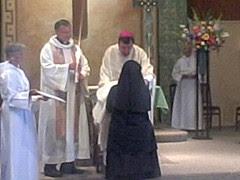



 Posts
Posts