[[Hi Sister Laurel, did you see the story about the hermit profession in the Fort Wayne-South Bend diocese? The story says two of these hermits live together. I wondered how that might work if the vocation is one of silence and solitude.]]
Yes, I did see the article. Several things about it surprised me. The first was that two of the women were living together; a second surprising thing was the specification of three canonical hermits in the diocese (if the number is correct it suggests a young woman professed several years ago may not have persevered). A third was that Bishop Kevin Rhoades has professed a relative "lot" of hermits in a fairly short amount of time (his tenure as Bishop of Fort Wayne-South Bend is only a few years and he has admitted four people to at least temporary profession under c 603).
Your question is a good one since c 603 is meant to govern solitary eremitical vocations. Lauras (colonies of no more than three) are permitted but these may not rise to the level of an actual community or institute of consecrated life. (cf Jean Beyer's work on this including his comments in Coriden'sThe Code of Canon Law, A Text and Commentary.) This means each hermit in such a colony should have her own Rule, her own bank account and source of income, her own horarium, spiritual director, diocesan delegate, etc. In lauras, hermits may come together regularly (usually weekly) for walks or Sunday dinner, festal offices, and daily Mass, but otherwise, their lives are lived in cell. This ordinarily includes daily office, meals, recreation, study, lectio, etc. All of these "requirements" would certainly hold for two diocesan hermits living together in the same residence. If the two women really are solitary hermits (as they are supposed to be under c 603) and not a couple of Sisters living a communal life (no matter how contemplative or prayerful) while using c 603 as a stopgap way to achieve canonical profession, then a few things will need to be true. First, the residence must be large enough for each to have an entirely private and silent prayer space or cell where she prays, does lectio, says daily office, sleeps, eats, studies, and recreates. (A staggered schedule could allow each woman to cook and eat in the kitchen/dining room separately from one another and a separate, dedicated library could allow for both to read or study in shared silence and solitude.)
 The Sisters could, if mutually agreeable, come together occasionally for office and dinner on Sundays or significant feasts just as they might schedule significant time together for shared prayer, a walk, a shopping trip, etc once or twice a week perhaps. They could also travel together to daily Mass, but conversation, if any was necessary, would also need to be minimal and each person's need for silence respected. Moreover, each one would need her own Rule and director along with absolute freedom and diocesan support in discerning the needs of her own solitary eremitical life; while accommodations would be required for the shared times and premises, the individual Rule would need to be sufficient for the Sister's own life as should her income, etc, should she be required to leave this residence. The possible reasons are several: the other Sister dies, either one decides she needs to leave eremitical life, either person discerns she requires a more physically solitary situation, the rhythms and nature of the two calls to solitary eremitical life are simply too different from one another, and so forth. Another reason includes changes in health which are substantial enough to affect both members of the house. More about this is below.
 Without these things, neither woman would be living an eremitical life and significantly, neither would be able to accommodate any divine call to greater reclusion --- which is an integral part of an eremitical call. (The need for greater reclusion can occur from time to time as well and this would have to be given priority over the already-scheduled times together.) Especially critical in the case of two older hermits is the provision for health care (including in-home caregivers) affecting one of the two hermits. For instance, one hermit should not be automatically expected to provide these things for the other while the presence of in-home caregivers could also considerably impact the silence and solitude of the second hermit's life. In a religious institute like the Carthusians, brothers and sisters provide all the care an elderly hermit or nun requires, but this critical responsibility which no Carthusian would turn over to an outsider does not fall to a single person. The eremitical vocation to the solitude of all the others in the Charterhouse is preserved while their communal commitment to being family for one another is also carefully maintained.
Likewise, in a laura of diocesan hermits, the cells are a sufficient distance from one another that visitors (caregivers, for instance) do not impact the others. Some lauras actually require a hermit needing full-time medical or in-home care to move to a nursing facility or infirmary. This may seem heartless or lacking in charity but in point of fact, it protects the vocations of the other solitary hermits. Remember these hermits are NOT professed as part of a community; their vocations are to solitary eremitical life. They neither have Sisters to care for them in this way nor are they necessarily called to do something similar for other members of the laura. The allowance of a laura for canon 603 hermits is something additional meant for mutual protection and support in solitude but it is not an essential part of the life defined by canon 603. It does not and must not change the nature of the vocation itself which is that of the solitary eremitical life. What I am saying here is the situation described in the diocese of Fort Wayne could certainly work for these two hermits but everyone must be clear about what each person's vocation really consists. Sufficient solitude and personal freedom to respond to God's call could be ensured but there are some significant caveats and also, some significant provisions for each Sister's vocation, both in the present and in case of future need, must be assured.
 By the way, I should add here as a kind of postscript that in the case of a serious illness, a solitary hermit living with another Sister might, with the assistance of her Bishop and SD, discern that for the space of a few weeks or months, it is important for her to assist the ill Sister to the best of her ability or tolerate others coming into the hermitage to care for her. Charity, it might be determined, required this. This might well necessitate a temporary suspension of parts of the Sister's Rule, for instance, which the Bishop may grant. However, it is also the case that as with work outside the hermitage, everyone should continue discerning the impact of this arrangement on the Sister's own health and vocation. Should either of these begin to suffer, or should the situation become more extensive in its demands of time and personal commitment, the Sister who is not ill should be free to say she cannot continue to assist in this way or even accommodate further intrusions in the hermitage's privacy or functional "cloister". A suitable resolution for both Sisters would need to be found, and the diocese which approved or even encouraged the common living arrangement would absolutely need to assist in this. Of course, this would be very difficult on a number of levels for all involved but this is one of the problems which could well be encountered by c 603 ("solitary") hermits who choose or are encouraged to live together.
[[My second question is why would the Church allow some consecrated Catholic hermits with private vows to live without legitimate superiors, move wherever they wanted and at the same time require other consecrated hermits with public vows to live in the same diocese where they were professed? Don't all consecrated persons have to be accountable to superiors and live where they are permitted? Anyway, it hardly seem fair that some consecrated hermits could live anywhere and others would be tied to a [specific] diocese. Joyful hermit at the blog A Catholic Hermit wrote that this is the way things are though.]]
First, let's be clear: hermits with private vows (unless they are ordained) are dedicated lay hermits. They are not consecrated hermits and have no right to call themselves Catholic hermits because they have neither been extended nor accepted the legal (canonical) rights and obligations associated with living the eremitical life in the name of the Church. Hermits who are publicly professed and consecrated by God through the mediation of the Church have been extended and accepted the public (canonical) rights, and obligations as well as the implicit expectations of every member of the Church who rightly sees her profession as a public matter. (N.B., priests who live as hermits without public vows either under c. 603 or as a member of a religious institute, are ALSO not consecrated hermits; they are ordained and hermits (hermits in the ordained state of life) but they are not members of the consecrated state of life.)
 Moreover, as I have also written here a number of times, public profession initiates one into a stable state of life. This means a number of things but mainly it means a series of legitimate relationships that are absolutely necessary for the accountable and authentic living of her commitment which are essential to the life itself. Part of this means such persons are not footloose and fancy-free. They are not and cannot be the equivalent of gyrovagues or Sarabaites so critically viewed in the Rule of St Benedict simply moving wherever the "spirit" moves them. They are tied to place and to superiors in some substantial way. With religious communities (institutes), for instance, the erection and suppression of houses associated with the institute are established according to canon and proper law. Such houses are approved by the institute's superiors and either the local Bishop or the Apostolic See and members live in these houses or, with proper consideration and permission, in the same area or diocese. (cf cc 606-616)
Somewhat similarly, secular or diocesan priests are incardinated into a diocese --- another instance of the Church's concern for stable relationships and accountability. They cannot simply move from diocese to diocese as they please while acting as a Catholic priest. Diocesan hermits are responsible to the local bishop who is their legitimate superiors. As I have noted here several times, in a kind of excardination and incardination, she may move to another diocese and remain a diocesan hermit if the Bishop there agrees to receive her as a diocesan hermit and act as her legitimate superior. Otherwise, such a move would find her vows either dispensed or rendered "invalid" (no longer binding) by the substantial change in her circumstances.
In all of these cases consecrated and ordained life requires stable relationships and ways of assuring accountability to the local and universal Church in whose name these persons live their lives. The reason a person with private vows can move wherever and whenever without reference to law or legitimate superiors is precisely because her commitment is a private one rather than a public one. Such a person is not publicly accountable for the eremitical life or tradition and has not been initiated into a stable state of life that would specifically allow for that. Lay hermits live their lives in the stable state into which they are initiated with baptism, confirmation and Eucharist. But to live as a consecrated Catholic hermit requires other stable relationships commensurate with a new stable state of life marked by additional rights and obligations.
 Because hermits in the lay state have neither been extended nor accepted additional rights or obligations beyond those of baptism this also means such a person has no right to style him/herself as a consecrated religious, a Catholic hermit, a professed religious (the term profession itself, by the way, implies public commitments and initiation into a stable state of life) or anything similar. What you describe would indeed be unfair. It would be inconsistent, and disedifying. Frankly, it would be hard to understand why any hermit would seek profession under canon 603 if the biggest difference between her vocation and that of a lay hermit with private vows is the fact that a lay hermit is free to do anything she wants whenever and wherever she wants without legitimate accountability while the publicly professed hermit is constrained by legal relationships and canons. In any case, don't be concerned about apparent unfairness; the situation you described or cited is simply not rooted in fact.
Once again it is important to remember the Church values and is directly responsible for vocations to the consecrated state in very specific ways. She is careful about anyone using the term Catholic to designate a vocation, enterprise, or institution without ecclesial authorization to the point of creating canons that prohibit this. Again a Catholic hermit, Catholic theologian, Catholic priest or religious, etc, must ALL have been granted the right to refer to themselves in this way. Baptism gives a person the right (and obligation) to call themselves and live as a Catholic. The other specifications (Catholic hermit, Catholic nun, Catholic priest, Catholic friar, etc.) require the admission to and acceptance of further legal (canonical) rights and obligations because these terms don't simply mean "a Catholic who is also a priest, nun, hermit, etc". Again, the use of the term Catholic in these examples and many others means someone who lives this vocation in the name of the Church and as an official representative of this very vocation. Such persons are directly accountable every day of their lives for the ecclesial commission the Church has extended to them. Not so with those whose commitments beyond their baptismal consecration are private rather than public.
P.S., I have added one final question from another person to this post since I don't really want to write about it separately. I hope you don't mind; it deals with the same post you asked about so it fits very well here.
[[Sister Laurel, is it true that first and final vows are not documented in the Church's institutes on eremitical life? I read this online and thought I would ask, [[However, this is yet one example again, of how bishops vary in attitude and norm for those they canonically approve or receive what they might call "first vows" (first or second or third or final vows are not actually required nor documented in the Church institutes on eremitic life).]]
First of all as I have noted in the past, the Church speaks of canons, norms, universal (canon) and proper (particular) law to refer to what this poster calls "institutes". The Roman Catholic Church does not use institutes in the way this poster does. Instead, in c 603, for instance, when the Church says, "besides institutes of consecrated life", she means "besides canonical congregations, communities and orders". The term "institutes" means societies, in this case, those of consecrated life.
 The use of institutes in the poster's sense has its roots in a misreading she once did of c 603 when she inserted the definite article "the" in the phrase already cited: "Besides the institutes of consecrated life. . ." This allowed her to mistakenly think of institutes as statutes and argue that c 603 was only a proviso that applied to some solitary consecrated hermits but not to others. Again, c. 603 is the norm for ALL solitary consecrated hermits in the universal Church. There are no solitary consecrated hermits (solitary hermits in the consecrated state) apart from c 603 hermits.
Secondly, and to answer your direct question, while canon 603 does not mention first vows but merely profession using vows or other sacred bonds, other canons in the New Code dealing with religious life DO refer specifically to temporary profession and perpetual profession. C 603 hermits are not bound by only one canon, but by those binding religious in the Roman Catholic Church more generally. Meanwhile, conferences of Bishops rightly hold that the eremitical life requires long testing and discernment which makes temporary profession at least prudent if not absolutely necessary. Hermits themselves know that admission to perpetual profession without long preparation is imprudent; temporary profession, though not strictly necessary with canon 603, is the usual way to become knowledgeable about what living the vows really means. Moreover, a profession by its very nature must be temporary or perpetual, and c 603 clearly requires a public profession. It is a mistake to say that such a practice including final or perpetual profession of vows or other sacred bonds and the necessary preparation for these are not actually required or documented.
06 September 2015
On Solitary Hermits, C 603, and Stable states of Life


08 July 2015
Replying to Objections and Misunderstandings
Thanks for your email. Yes, I saw the post (or posts) several months ago. I have written about all of these assertions in one way and another here so it did not seem necessary to respond, but since you ask, and since the post is actually being read perhaps I do need to cite and respond to the assertions in a more direct way. Maybe all these points need to be present in a single post I can simply link people to in the future. (While I do welcome all questions and will continue to do so, that would be a relief from having to write the same stuff yet again!) In any case, let me be clear that, as far as I am aware, none of these points is a matter of interpretation on which reasonable folks may differ. The assertions made by the poster cited seem to me to be rooted in misunderstanding or actual ignorance of language and usage many of us, myself included, take for granted. Probably we ought not do that. In any case, I have broken up the post you have supplied and answered each point below. I sincerely hope this is helpful.
[[There is no mention of the hermit having a "Superior" in either The Catechism of the Catholic Church or in Canon Law 603. The latter does state that the hermit who publicly professes the three evangelical counsels into the hands of the diocesan bishop, is to live his or her proper program of living under the diocesan bishop's direction. Thus, the hermit's director is by [church] law to be his or her bishop.]]
When a canon says that one makes their public profession in the hands of another (for instance, the local ordinary or diocesan Bishop) they are identifying that person as the legitimate superior of the one making their profession. As noted in other posts, the act of making one's profession in the hands of another harks back to feudal times when folks made acts of fealty in the hands of their political and legitimate superiors. Today there is a clear sense of intimacy about this act because it establishes a legal or legitimate relationship (and a moral one as well) in which the two people entrust themselves to this relationship -- though in very different ways -- so that a God-given vocation can flourish.
The meaning of this act was immeasurably enriched and made clearer to me when I first met with Archbishop Vigneron on the Feast of the Sacred Heart. At the end of that meeting he extended his hands and I rested mine in his while we both prayed for the process of discernment we were embarking on together. Later, when I made my vows in his hands while resting them on the book of Gospels, I recalled that first meeting and time with others where prayer was linked to resting my hands in theirs. It was especially poignant because of this. These relationships have been life giving to me and a source of the mediation of my vocation.
The bottom line here is that the actual words "legitimate superior" are not necessary. The concept is clearly present throughout. Canon 603 refers to public profession, to being recognized in law and to making one's profession in the hands of the local Bishop under whose direction the hermit will live her life. All of these imply or explicitly refer to the reality of legitimate superiors. Direction, for instance, does not mean spiritual direction (as in the work of a spiritual director per se --- even if that person is the bishop!) but rather is the general term for the exercise of authority by a legitimate superior. Meanwhile, the obedience owed one's legitimate superior differs in character from the general obedience one owes one's spiritual director, Scripture, one's pastor, et al. and this is clearly referred to via the presence of references to canon law and a personal Rule, Plan, or Program of Life.
As I wrote a while back, if one wonders if a hermit is legitimate (canonical), that is, if she is canonically commissioned to live her life in the name of the Church then ask her who her legitimate superior is. That works for any religious one is doubtful of as well. In a solitary hermit's case this will ALWAYS be the local diocesan bishop.
[[Rule of Life: Again, adopting an individual rule of life is not stipulated per se in the institutes of the Catholic Church or CL603 per the consecrated eremitic life. However, history and tradition of eremites who successfully and heroically lived a holy hermit life, as well as prudence and wisdom, suggest that determining and being true to a rule of life is a positive inclusion.]] and also [[ Can. 603 §1. In addition to the institutes of consecrated life, the Church recognizes the eremitic or anchoritic life by which the Christian faithful devote their life to the praise of God and the salvation of the world through a stricter withdrawal from the world, the silence of solitude, and assiduous prayer and penance.]]
The phrase "institutes of the Catholic Church" as some sort of law or statutes is not recognized usage. In any case, Canon 603 does not read "the institutes". Instead it says, "besides institutes of consecrated life canon law also recognizes the eremitic or anchoritic life" and by this it means, "Besides congregations, Orders, and communities of consecrated life canon law (the Church) also recognizes solitary consecrated eremitical life" and does so specifically in this canon. This portion of the canon outlines c 603 as the single recognized way to public profession for hermits who are not part of institutes of consecrated life. Regarding the assertion that a Rule is not an explicit requirement of canon 603, the canon also reads, "and observes his or her plan of life (vivendi rationem) in (the Bishop's) hands." The plan of life is ordinarily written out and approved by the Bishop. (The approval is formalized in a Bishop's decree of approval.) Sometimes it is called a Rule or "regula" or even Rule or Program of Life but what is really clear is that the canon specifies such a Rule or Plan.
[["Lay hermit": There is no such term or category as "lay hermit" in Church Law, The Catechism of the Catholic Church, Church Tradition, or Church History. Hermits [eremitics] are specified under the category of "The Consecrated Life," specifically 920-921, in The Catechism of the Catholic Church. In the 20th century, they are also specified in Canon Law 603. (The hermit vocation, by virtue of the required inclusion and profession of the three Evangelical Counsels [celibacy, poverty, obedience] and by specified program of life, preclude a hermit from being a lay person. ]]
There is no need for such a term in most discussions in canon law, etc. The reality is understood and, for instance, may be said to be referred to in canon 603.1. (603.1 refers to hermits generally and may thus also speak to lay persons who live as hermits. Canon 603.2 refers specifically to those recognized in law and who are consecrated hermits and together with 603.1 is a governing canon of their lives.) Paragraphs 920-921 of the Catechism may, despite their awkward location, also refer to both lay and consecrated hermits or they may in fact refer only to those who are consecrated. In any case, whether the term lay hermit itself is ever used (and it IS used cf the reference to Fr Mark Miles' Dissertation below in the paragraph beginning, "As I have written here . ."), the reality is clearly present in canon law. Here, without citing every canon specifically, is why I say so.
Vows may be private or public. Except for the consecration of virgins living in the world only when a baptized person makes public vows and is consecrated by God through the mediation of the Church in a public juridical act does that person enter the consecrated state of life. Those hermits making private vows remain lay persons if they were already lay persons and ordained if already ordained but they do not enter the consecrated state. The term "lay hermit" simply means a person in the lay state who is living as a hermit. It is distinguished from "consecrated hermit", "diocesan hermit", consecrated religious, and professed religious because all of these imply public profession and consecration through which one enters and takes on the legal (and moral) obligations and rights of the consecrated state. Since anyone may make private vows or write a Rule or program of life and live it there is nothing in these per se which preclude one from being both lay and a hermit. The majority of hermits have, in fact always been lay (or non-canonical).
As I have written many times here the unique thing about canon 603 is that for the very first time in universal law the solitary eremitical vocation is recognized in law as a "state of perfection" and those consecrated in this way are recognized as religious in the RCC. In other words, there were no solitary consecrated hermits prior to canon 603. Nor are there solitary consecrated hermits in the Western Church apart from canon 603. Canon 603 was created for the very purpose of admitting solitary hermits to consecration. Today the term lay hermit is used to distinguish those (non-clerical) solitary hermits who have not been admitted to the consecrated state under canon 603. I am reminded of Thomas Matus, OSB Cam's account of the life of Nazerena. He notes and Father Mark Miles emphasizes the importance of the following: [[On 2nd February Nazarena entered the Camaldolese Benedictine Monastery of St Anthony on the Aventine . . The important fact is that eventually Nazarena obtained an interview with the Cardinal Secretary of State who authorized her to live as a lay anchoress in the same Camaldolese Monastery. . .]] Canon 603: Diocesan Hermits in the Light of Eremitical Tradition. Miles, Mark Gerard, Rome 2003.
Remember that vocationally speaking the Church recognizes three states of life: lay (especially the married state of life), consecrated, and ordained. (Hierarchically speaking there are only two, lay and ordained.) A hermit may be a member of any of these states of life. Whether one is lay or ordained, initiation into the consecrated state (except in the single case of consecrated virginity) requires public profession and consecration. To say that private vows preclude a person from being a lay person is to misunderstand the nature and necessity of public profession in the initiation of one into the consecrated state. Unfortunately, it also denies that private vows of the evangelical counsels are even possible for those in the lay state. Moreover it says that the Church has two routes to living in the consecrated state of life, one which is canonical and under the direct supervision of legitimate authority and one which is not. Of course, this is hardly the way the Church works with regard to the gift of consecrated life.
[["Stability" (remaining in one locale): This is not required but may be what the hermit's earthly superior requests of the hermit. Some religious orders, whose members live as hermits, include "stability" in their professed three evangelical counsels.]]
Canon 603 does in fact require a form of stability of the diocesan hermit precisely because she lives her life under the supervision of the local Bishop and he is her superior in law. She must remain within the diocese where she has been professed unless another Bishop agrees to accept her as a diocesan hermit and allows her to make (or live her) vows in his hands. Since her own Bishop is relinquishing jurisdiction, he must also agree to the move and will confirm that the hermit is professed under canon 603 and in good standing in the diocese. In any case, though it may be transferred through a kind of excardination and incardination similar to the transfer of diocesan priests or somewhat analogous to the transfer of stability of monks and nuns moving to new monasteries, etc., stability is definitely required of the diocesan hermit. This is part of the legal relationships which obtain with public profession and consecration. Moreover, we can assume this means they are the will of God because they are an important way of protecting and nurturing this vocation for the benefit of the entire Church.
[["Dedication": There is no such term used to describe a Catholic hermit's profession of the three evangelical counsels [poverty, celibacy, obedience] and one who lives in accordance with the stipulations per Consecrated Life of the Church: The Eremitic Life, in The Catechism of the Catholic Church. [The term "dedication" is often used currently by Protestant Evangelicals and those of other denominations who do not practice infant Baptism; such as: make a "dedication" of their children to God or to live a godly life.]]]
Canon 603 reads as follows: [[A hermit is recognized as dedicated to God in the consecrated life if he or she publicly professes the evangelical counsels, confirmed by vow or other sacred bond. . .]] One's public dedication to God is marked by one's profession of the evangelical counsels via vow or other sacred bond. In other words one's profession represents a dedication to God. Vatican II consistently used the term "dedication" or similar terms meaning the giving of self to refer to the human dimension in public profession. The Divine element or dimension was referred to as "consecrare," since only God may sanctify, set apart as sacred, or consecrate. I admit that in light of all this it is hard for me to understand how one can contend there is no such term as "dedication" [or to dedicate] used to describe a hermit's profession of vows. On the other hand the distinction between dedicare and consecrare is profoundly Scriptural so it does not surprise me that some Protestants honor it in referring to the dedication of their children to God prior to sacramental baptism. Evenso, the attempt to deny this is part of the normative language of the Roman Catholic Church in speaking of public professions or of canon 603 itself is simply wrong.
One of the problems with the usage in the blog you have referenced and another possible source of misunderstanding is that the author uses the term Catholic Hermit to refer to any person who is Catholic and living as a hermit. I (and the Church herself) use the term Catholic Hermit to refer to any person who has embraced and been authoritatively admitted to a specifically ecclesial vocation which is lived in the name of the Church. To repeat myself (cf other articles on cc 216 and 300) there are canons which specify one cannot apply the term Catholic to an enterprise or role unless proper authority permits it. For instance, not every theologian who is a Catholic can call herself a Catholic Theologian (and her theology may indeed be profoundly Catholic nonetheless). Only those exercising this role with a specific mandatum may do so. Sometimes the mandatum is withdrawn and the person, though profoundly Catholic, is no longer allowed to consider or refer to themselves as a Catholic Theologian.
Not every religious institute may do so either, nor may every Catholic who is a hermit. A Catholic Religious Institute lives religious life in the name of the Church and is specifically authorized to do so. So too with a Catholic Hermit. Whenever one sees " a Catholic x or y", whether this is a person, an institute, radio station, or role it means (or should mean) this reality is and does what it does in the name of the Church. It means there has been a specific commissioning by appropriate authority to act in the name of the Church. The Catholic hermit lives the eremitical life in the name of the Church because the Church, in professing and consecrating her publicly has commissioned her to do so.
[[Married hermits: Both parties need to agree to their marriage rights being dissolved and with the choice to enter consecrated life and to choose celibacy. This may occur if they are older and the high calling and purpose of the married state of life is fulfilled so that the required Evangelical Counsels (poverty, obedience, celibacy) of the consecrated state of life could be met.]]
Marriage rights are not simply dissolved. Remember that Marriage is a Sacrament in which two persons become one flesh. The reason the Church does not allow divorce is because she understands that this bond is created by God and cannot be dissolved by man. Though it involves these, it is much more than the establishment of certain rights and obligations. If it is determined that no true sacramental bond was created then the marriage can be annulled, that is declared null or empty. An Annulment does not dissolve marriage bonds; it establishes publicly that no true (sacramental) marriage ever occurred. Neither does civil divorce end the sacramental bond; instead it puts an end to the civil rights and obligations associated with such a bond. This is why an annulment must also be sought after a civil divorce.
By the way, I should point out that every Christian is called to live some form of the evangelical counsels. Married persons are not called to religious poverty or religious obedience, but they are certainly called to a profound stewardship of this world's goods and a simplicity of life that is edifying; they are also called to an obedience to the Word and will of God which is profoundly challenging and world-changing. Private vows may include or specify the evangelical counsels but for married persons these will not include obedience to a legitimate superior or the relinquishing of one's own will. Neither will they include a commitment to poverty which is inappropriate for the effective raising of and care for children. Finally, again, lay hermits (hermits in the lay state) may or may not make private vows. They make sense if care is taken, but they are not required nor, again, do they initiate one into another state of life.
The idea that two older people may have "fulfilled the purpose of their marriage" --- which apparently refers to having and raising children is completely preposterous since one purpose of marriage is to bring one another to God and the commitment is one unto death. Having and raising children so they too may know God is likewise a significant purpose of marriage but not the whole of the matter. No person who is validly married can be admitted to public profession or to the consecrated state of life. This is because one must be free of all such bonds to take on the life bonds of other state of life. Similarly, one in the consecrated state of life cannot attempt marriage. Nor can one in the ordained state. If one makes vows of poverty, chastity and obedience while married they must be private vows. (I am not suggesting such vows are prudent or not, only that they must be private.) Such vows do not initiate (or attempt to initiate) one into a new state of life nor do they dissolve one's marriage, for instance --- which is another assertion the poster you cited has made in these posts.
Addendum: The Church as such has kept the requirements for hermits simple. It is diocesan Bishops who have added provisions for public profession of diocesan hermits.
While the Church as such has done a remarkable job of recognizing the freedom of the hermit and kept legal requirements to a minimum, the Revised Code of Canon Law and c 603 is universal law, not merely diocesan. Canon 603 and the recognition of and provision for canonical hermits in the consecrated state is binding within the entire Western (Latin) Church. It is true that each diocesan bishop is called upon to implement this canon as seems best to him while maintaining the character of canon 603 life outlined therein, however, he does so in service (and obedience) to universal law. It is also true that we tend to call c 603 hermits "diocesan hermits" but this is done to indicate 1) who the hermit's legitimate superior is, and 2) the specific stability attached to her commitment. It is akin to recognizing a Religious Institute as one of diocesan right. This designation does NOT mean the hermit is not recognized by universal law within the entire Church.
I hope this is helpful.
02 June 2015
On Wearing the Cowl While in Discernment
 [[Dear Sister, when a person is going through the discernment process of becoming a diocesan hermit can the cowl be worn?]]
Presuming you mean initial discernment with a diocese prior to admission to any profession, the simple answer is no. The cowl is only given with perpetual profession and then only when the diocesan Bishop grants the cowl canonically. (Not every Bishop does so and some hermits decide to use a different prayer garment.) A simple personal prayer garment can be used in private during the discernment period but cannot be worn publicly since this would imply public standing, rights, and obligations. Similarly, such a garment is NOT given to one by the Church but instead is privately or self-assumed.
 In monastic communities a modified cowl (short sleeves, for instance) is given with simple (temporary) vows (and sometimes a shortened tunic, cape, or otherwise modified cowl (sans sleeves) is given with entrance into candidacy and the novitiate). The full cowl is always reserved for solemn profession (in the picture to the right Sister Ann Marie, OCSO, will receive the full cowl after she signs her vows just as Sister Karen, OSCO is shown doing below). Generally. a person just discerning whether or not they are truly called to consecrated eremitical life under c 603 is not allowed to wear a habit of any sort. Doing so is also linked to a public state of life with public rights and obligations as well as with the Bishop's permission and ordinarily someone in initial discernment is not in such a position.
 Remember that a candidate for possible profession under c 603 is usually a lay person with the rights and obligations of any lay person. Because they are not being incorporated into a community in stages (postulancy, novitiate, juniorate, perpetual profession) with commensurate legal (canonical) rights and obligations they are solitary individuals bound "only" by their baptismal commitments. (I do not disparage such commitments by using "only" here. Baptismal commitments are extremely significant but public profession and consecration imply added canonical rights and obligations.)
Moreover, discernment as to whether one is actually meant to be a hermit of any sort can take a number of years. It simply makes little sense for such a person to be given permission to wear representative eremitical garb when they are neither hermits yet (the transition from lone individual to hermit in an essential sense is something one usually negotiates during discernment and initial formation) nor canonically responsible for the continuation and protection of a vital eremitical tradition. Traditionally, the cowl is associated with the assumption of responsibility for living and representing the fullness of monastic and eremitical life in a formal and canonical sense. When one sees the cowl this is what it indicates or symbolizes. To be faithful to and retain this meaning it is necessary to restrict the ecclesial granting of it to the occasion of perpetual or solemn profession.
I hope this is helpful.
18 May 2015
Jumping Through Needless Hoops? More on Writing a Rule of Life
 [[Hi Sister, maybe you have already answered this, but isn't it unreasonable to expect a person to write several different Rules over a period of 6-9 years? It does seem like a lot of needless hoops to make someone jump through. I can't believe that a first Rule would differ from a third or fourth Rule so much as all that. I mean it covers the basics or fundamentals of one's life. These don't change so dramatically in the life of a hermit do they? Isn't this really just busy work to give the diocese something to look at? So what do they look at if nothing really changes from one Rule to another? And what do they do if the hermit is not a writer? I am certainly not one so the whole prospect of my diocese asking me to do this would completely turn me off from pursuing profession under c 603!]]
Thanks for your questions. For those who are relatively new to this blog, and because I have not written about this recently, let me say that they refer to a suggestion I have made which allows a diocese and a hermit to engage in a process of formation and mutual discernment which 1) protects the freedom and solitude of the hermit, 2) provides a meaningful way the diocese can gauge the growth of the individual vocation before them and discern the suitability for and timing of eremitical profession and consecration, and 3) allows the hermit to take the initiative in working at both discernment and formation but in a significantly accountable way. Specifcally, over a period of about 6-9 years a candidate for consecration under c 603 will move through various natural stages in her formation and discernment as a hermit; as she does this she will mark --- as well as signal to those discerning with her --- her readiness to enter the next stage of the process by writing a Rule which, depending on the stage involved, will serve either relatively casually or more strictly and even canonically to structure and govern her life. The posts introducing this idea can mainly be found at Why Several Rules over a Period of Time? and under the labels, "Formation Programs?" and "Discernment" as well as, "Writing a Rule of Life".
Do Rules Change Much in the Life of a Hermit?
 Yes and no. The central elements of the Rule are unlikely to change significantly but the person's understanding of and relation to these elements will change significantly over time. The Rule this person writes at different points in her formation will reflect these changes especially as the person's life comes to embody them in more and more integral ways. Similarly then the elements of the Rule will cease to be merely external constraints as the person comes to explore and understand the depths of the realities to which they point. So, for instance, a Rule might speak of the silence of solitude in the beginning of a person's formative process and reflect a sense of external silence and solitude. While this sense will always remain, always be presupposed in any maturation in the silence of solitude, it will become less important than the deeper reality it expresses. Later on in her formation then, her Rule will reflect a sense that this element (the silence of solitude) is the goal of her life; for the hermit it will involve an essential quies which results from union with God and reflect a sense of being comfortable in her own skin --- possessing a wholeness without noisy striving or self-centeredness. In other words, the Rule's central elements begin more and more to define not only what the hermit does but who she is!
Similarly one might begin their approach to 'stricter separation from the world' by focusing on the things and people she cannot do or see but in time this element of the canon will reflect more the remaking of the hermit's heart into one that loves with a singleness and purity of focus. The physical separation remains and is presupposed in all else that happens in this solitary life, but it is the vision of the Kingdom and the claim the God of Jesus Christ has on her heart that will come to drive her understanding of this element or aspect of her eremitical life. The same kinds of changes tend to occur with the other non-negotiable elements of canon 603: poverty, chastity, obedience; there will be a deepening and broadening of experience and understanding which will be reflected in the subsequent Rule one writes.
As this process of internalization and integration occurs, the way the hermit comes to envision these elements changes and the emphasis in the Rule itself will also change to reflect this. In some cases an emphasis that was entirely absent will emerge as will a vision of eremitical life that was not present in one's first and/or second Rule. In this process the Rule's central or defining elements cease to be disparate requirements governing different parts of the hermit's life and instead come to express related emphases in a life reflecting the Gospel of God lived in solitude with God. A Rule written just prior to perpetual profession, for instance, is more likely to represent a vision of eremitical life lived in the 21st century with specific essential emphases than it is to be simply a list of things one contracts to do. Again, the Rule will often shift to define who the hermit is and her sense of mission and charism than it is merely a list of things she covenants to observe.
If one were to look at the various Rules a hermit writes over time this is the pattern one is likely to find. Even when the Rule itself does not explicitly reflect such changes through various versions, conversations with the hermit or hermit candidate is apt to elicit a clear sense of such change and growth. (If these conversations do not reflect such changes one has good reason to suspect either, 1) there is no eremitical vocation here, 2) the candidate is not living her Rule well (faithfully or wholeheartedly), or 3) something else is going on that is stunting or short-circuiting the formation process --- whether that centers on the failure of her (relationship with her) director, medical problems of one sort or another, or other difficulties. In such instances there need to be conversations with the candidate, her delegate, et al, to ascertain and resolve the problem.)
Jumping Through Needless Hoops?

Further, while it is true that the use of this process does give the diocese something to "look at" this is not objectionable; it is part of what they require as part of their own call to discern, encourage, assist in the formation of, and protect ecclesial vocations. The process I have outlined eliminates some of the guesswork and complete subjectivity from the entire discernment and formation process, and I believe it does so while protecting the hermit's freedom to respond to God as she hears God in solitude.
What if the Hermit/Candidate is not a Writer?
I don't think this is really an insurmountable problem. After all, I am not speaking of writing a dissertation or book or something similar on eremitical life. I am talking about writing a Rule of life which is actually required by the Canon itself. It is a document which reflect the hermit's experience and codifies her own wisdom about how God calls her to live her life. On the whole it is less about writing per se than it is about attending to and reflecting on the vocation one is called to live. The Rule codifies what is necessary for a person to do that. In my own experience, in writing the Rule I submitted to my diocese prior to perpetual profession, I spent about one full month writing (at least a few hours a day) but months and even years were given to reflecting on canon 603 itself and how its elements related to the way God was working in my own life. It seems to me that one needs far less to be a writer than one needs to truly be a contemplative who has come to know herself in light of God through an experiential knowledge of the constitutive elements of canon 603. I think that is by far the harder task, and probably the real obstacle to being able to write a Rule.

In a genuine eremitical life, none of this time and effort will be wasted. One is, after all, growing in, exploring, and learning to articulate who one is in light of one's solitary relationship with God. If one is never professed as a canon 603 hermit one has still benefited by the canon's requirement that one write a Rule because it has been a formative experience, not merely a sterile requirement to "get professed". Meanwhile, if one's diocese admits one to profession and then consecration as a diocesan hermit one will only be grateful for all the work it took to get there and will benefit from it in a more direct way every day for the rest of her life. In either case it is something like last Friday's Gospel passage: when the labor is accomplished and the child born, one forgets the pain it all took and feels only joy at the new life which has been brought forth.
14 May 2015
Canon 603 Hermits and Rejection of Vatican II

Thanks for your questions. I must admit I am curious as to why you are asking them; what raised them for you? But in any case, let me give them a shot. Labels like liberal and progressive are not always helpful, I don't think. I don't know what they actually mean a lot of the time. I thought of myself as progressive or liberal when I was a student. Later, though, I came to see myself as essentially conservative --- conservative in a way I consider genuinely healthy.
What I mean by this is I hold onto the core truth, try to understand it more and more fully, and then try to apply it in ways that lead to new life, growth, maturity, etc. Since God is both "always the same" and the source of continuing newness and surprise, I think this is the only way to go. Moreover, as a hermit, there is no doubt that I am part of a really ancient vocation whose roots are spiritually conservative but which is also incredibly prophetic and open to the newness to which that leads. When the roots are deep and lasting, newness is not a problem. That said, I don't know whether most c 603 hermits are progressive, etc. Only occasionally do I hear of hermits whose conservatism veers from healthiness into a dystrophic traditionalism. On the other hand, those whose eremitism is not profoundly conservative in the sense I have described are unlikely to last as hermits unless and until they develop the roots healthy conservatism and the truly prophetic require.
 Before I answer your questions about eremitical life and Vatican II let me point you to a video of a hermit professed according to c 603 in the post-conciliar revised Code of Canon Law. Though a bit long, it tells the story of the first contemporary solitary hermit in Ireland. Unfortunately, Sister Irene Gibson rejects Vatican II and the post-conciliar Church utterly. Her conservatism has become a less healthy traditionalism. From what I can see from this video, she and I disagree on almost everything theological except the fact that vocations are not a call issued and answered only once, but something we must respond to daily. Sister Irene believes this is because human beings are sinful and would fall away from their vocations otherwise. I accept that as a secondary reason, but contend the primary reason is that God is a dynamic reality calling us at every moment, and we are called to be responsive individuals whose "yes" is offered again and again.
I suspect Sister Irene's eremitical vows have since been dispensed because she really is entirely opposed to the contemporary Roman Catholic Church and exists in schism with it; she now lives with a Tridentine community of Sisters so far as I know, but nonetheless, I respect her and would say she was a true hermit with a true vocation to the silence of solitude. Whether she should ever have been professed as a canon 603 hermit is another question entirely. Her life says very clearly that God alone is sufficient and I admit I am quite impressed with her integrity and courage as someone living an intense solitude without even the support of her local (or national) Church for many years.
In the following video I think that despite the dislike with which she refers to the Roman Curia (" the bureaucrats in Rome"), her complete hatred for what Vatican II wrought, and a theology that, in my opinion, fails to do justice to either history or the God of Jesus Christ --- something that causes a distorted focus on sin rather than on the God of mercy --- there is a gentleness, a degree of humility, and real love for the people with whom Sister Irene interacts and for whom she prays. It is this capacity for humility, love, and compassion that grows in solitude, along with a capacity for silent suffering, that, I think, attests to the authenticity of Sister's eremitical vocation. The seriousness, reverence, and core of deep sadness and grief that informs a life which is truly loving only underscores this authenticity in my mind.
As for your questions regarding Vatican II and solitary eremitical life per se, I do not think it is possible to be a solitary hermit according to the Revised Code of Canon Law if one rejects Vatican II. First of all the very Code which allows for solitary hermits in universal law for the first time in the history of the Church is a result of Vatican II and the reforms achieved and envisioned there. It seems ironic in the extreme to me, not to mention inconsistent and more than a little self-serving and even potentially hypocritical to seek (or allow) profession under such a canon when one no longer believes in the Church whose life it reflects. Remember that canon 603 describes a life lived in the heart of the Church, a very specifically ecclesial vocation lived under the supervision of a Bishop of the contemporary (that is, post-conciliar) Church. It makes little sense to profess and consecrate someone within a Church they believe is a betrayal of 2000 years of ecclesial history. How, after all can they meet sacramental obligations? How can they vow obedience to God in the hands of a legitimate superior whose authority they reject? I think you see the problem.
 While at first glance this may seem to be a "perfect solution" for someone who, as you say, "rejects Vatican II but does not want to leave the Church," in reality, they have already left the Church --- for the Ecumenical Council is the highest expression of the Church's authority at work. Although I have never applied the term stopgap in this sense (I ordinarily mean something is a stopgap if it provides a pseudo-solution which plugs a hole in canon law for those who cannot be professed in any other way or who wish to circumvent canonical procedures already in place), I think you might be right in applying this term here.
The bottom line in this situation is that this is an entirely inadequate and imprudent "solution" to the problem of someone who rejects Vatican II but whom we might want to "keep" within the Church in some sense. (If the person is struggling with aspects of the Church, as, for instance, the desert Mothers and Fathers struggled with them while perhaps living a prophetic life within the Church, I think this is a different matter. It seems to me that Sister Irene might well have been in such a position when she was first professed.) One cannot be a "Catholic (c 603) Hermit" while at the same time rejecting the very Church in whose name one is professed, consecrated, and called to live the eremitical life. No true vocation allows for such disingenuousness; after all we are called by the God who is Truth to witness to Him and the Good News of his Christ Event.
 Sister Irene's situation may be more extreme than others but it helps underscore the ecclesial nature of the c 603 or diocesan eremitical vocation. I believe she was professed under c 603 in good faith and it is possible that she was professed before she had the experiences she describes regarding both Vatican II, the Greek Orthodox Mass, and her insight into the supposed nature of the post-conciliar Church. (Despite c 603 postdating VII by almost 20 years, I say this because the timeline of these events is not entirely clear to me from her comments.) Even so, whatever the timeline, at some point she essentially "left" the post-conciliar Roman Catholic Church (and later she left it in every sense for the Tridentine Church and religious life there).
If she was already professed, her vows under canon 603 would likely have been dispensed; if she made her profession only after coming to see the Church as she does, it would have been determined to be invalid. It is not so much that the Church should not be professing folks who have rejected Vatican II, though this is certainly true, but rather, that she really cannot do so validly because these persons have, in their heart of hearts --- as well as in terms of ecclesial worship and doctrine --- left the Church themselves, and simply cannot be thought of as living their lives in (much less as part of) her very heart.
28 April 2015
Contents of a Lay Hermit's Prayer Space?
 |
| Brother Emmaus O'Herlihy, OSB (Glenstal) Saint Romuald in Ecstasy Receiving the Gift of Tears |
Thanks for your question. I think the term chapel is a bit overblown and would consider not using it, especially not in the absence of reserved Eucharist or if the room is mainly used for other things besides prayer. I would use the term prayer space instead (oratory seems to have become the canonical equivalent of what is more commonly understood as a chapel so I am also avoiding it here). The answer is simply, "Whatever one needs to pray regularly and assiduously." My own space includes a comfortable chair for reading and some more occasional quiet prayer, a zafu and zabuton ( these replace my prayer bench for more formal periods of quiet prayer), a portable lectern or ambo (for singing Office) and a desk for journaling and study. There are book shelves, a large crucifix (which dominates the space and signals the cross is the center of my life), some art (Emmaus O'Herlihy, OSB, cf above, and Mickey McGrath, OSFS) and I use a Zen clock which can chime the hours to help mark parts of the day. My cowl hangs on the back of the door and is available any time I pray.
 I think the space should be neat, simple, light, attractive and comfortable in terms of temperature. It should reflect the silence of solitude which is so key to a hermit's life. Because I am officially allowed to reserve Eucharist, my own space includes a tabernacle with ciborium, a sanctuary light, and a small monstrance (it fits inside the tabernacle and is usually left there). I keep a small bowl made by a potter friend nearby for 1" x 2" cards with prayer intentions and requests. This can obviously work for lay hermits as well even though the Eucharist is not present. If, for instance, you were to keep a sanctuary light burning near such a bowl, the symbolism of living presence and constant prayer in communion with others -- all in the heart of the Church -- would still be quite strong. Next to or near their prayer chair most people like to include a small table upon which they may have some fresh flowers, a live green plant, or an orchid, a candle, perhaps a small statue of Mary or a favorite Saint, and their Bible and Office book. One might also have a small CD player or iPod with small speakers there or on nearby shelves.
 Remember, this is a functional as well as a sacred space; it is a place where the hermit's main work occurs which is how the space is sanctified. It is not a space which should call attention to itself (there should be no "chapel" sign on the door!), but if this is possible, it should be a private space --- a space where guests do not ordinarily go. Most folks do not have enough space for a completely separate room as their prayer space, but a lay hermit (or anyone living on their own) should be able to section off part off their living or sleeping area as an entirely adequate and dedicated prayer space. (By dedicated I mean this space is not used for anything else; it is a prayer space, not a place where one reads novels or connects to the internet, etc.)
 If your prayer space is a portion of a room also used for other purposes (sleeping, etc), you can use wooden or shoji screens to separate the actual prayer space from the rest of the room. The latter especially are movable, relatively inexpensive, simple and attractive. They also allow light to fill the space. I have seen pictures of a variety of personal prayer spaces or "chapels" and the ones which do not appeal to me at all are the ones where with a myriad of statues, relics, holy cards, etc. Usually these cover a table or some other structure the person mistakenly refers to as "an altar." I feel uneasy the moment I see these busy, incredibly noisy spaces. They tend to strike me as "showy" and perhaps "pious" (if Catholic kitsch is pious) but they are distracting to me and hardly prayerful. Of course, that is my own taste, my own aesthetic; it may not be yours.
 The basic question I think is, "What do you need to pray?" What do you need to quiet yourself, center, in and give yourself over to God acting within you? What do you need to do lectio, pray Office, do quiet prayer, or do the personal work spiritual direction requires? A corollary is, "What would distract you from your relationship with God or being present to and dependent upon God alone?" (This includes what might distract you from the demands of truly being alone with God. Sometimes it is a fine line between having what one needs -- books, a bit of art, liturgical music -- and having too much.) In other words, "What needs to be absent from a space dedicated to prayer?" I think only you can really answer these questions.
18 April 2015
Symbols of Perpetual or Solemn Eremitical Profession
[[Dear Sister, what are the symbols of an eremitical perpetual or solemn profession?]]
 Generally speaking the cowl is the primary traditional symbol of solemn or perpetual profession in monastic and eremitical life. A second symbol is the ring signifying espousal. Another is the crucifix worn or carried somewhere on one's person. So is a profession candle marking both baptismal consecration and this new consecration. My diocese required both ring and cowl (or other prayer garment --- whichever seemed best. Since I was a Camaldolese Oblate my diocese agreed the cowl was appropriate and the Camaldolese were consulted as well; they asked that the hood be cut differently from that of Camaldolese monks and nuns since I was not being professed as Camaldolese).
Temporary profession, on the other hand, can be marked by the giving of a prayer garment other than the cowl, by clothing in a habit and/or veil, by a scapular, etc. Not all diocesan hermits or their dioceses choose to use habits or cowls but all that I have heard of require the profession ring. Office books can be given to mark profession, as can a bound copy of one's Rule since this becomes legally binding on the day of profession. Strictly speaking, I am not sure the Office books are symbols of profession, but they are certainly meaningful signs of one's commitment and probably should be included in the rite. The Rule, however is a rich symbol and in particular, is both essential to the living of the life and plays a role almost daily in the mediation of God's continuing call and the hermit's faithful response to that.
Followup Questions on Discerning With One's Bishop
 [[Hi Sister Laurel, your posts about legal standing and what happens if a diocesan hermit disagrees with a Bishop give the impression that the relationship between hermit and legitimate superiors is oppressive. Am I mistaken? I admit I don't really care for the way the Church seems to want to be in charge of our lives or make moral decisions for us. Have you ever had a disagreement with your Bishop where you needed to rethink things and come to a different conclusion on them about the way you live your life?]]
Well, I am more than a little sorry if that is the impression I have given. It was certainly not my intention nor does it correspond to my experience. In my own experience the place of law and legitimate superiors do not ordinarily interfere with my freedom or my choices at all. When I think or write about the freedom of this life I have tried to make clear that there are constraints, as in any life, but that these qualify and focus my life in ways which serve my ability to explore the depths of eremitical solitude in the name of the Church. That is the fundamental thing I have been called to, the fundamental thing I have committed to doing, and it is the thing which my superiors and law itself are responsible for assisting me to do with integrity. Let me be clear that no one is heavy handed in this matter. Neither my Bishops (there have been several) nor my delegate simply tell me what to do. The point of my post regarding a disagreement with one's Bishop was that when there were differing conclusions with discernment in a genuinely serious matter (and whether or not hermits may work full time, especially in highly social situations, is one of these) a hermit may be asked to resolve the situation differently than her original discernment led her to do. This was because her vocation is an ecclesial one which is responsible for and affects more than her own life alone.
 Unfortunately, the hermit may not see this as clearly as her Bishop or delegate (though she might also see things more clearly, as might other diocesan hermits who live the life and are knowledgeable about the tradition); in such cases it is important that all parties share their own discernment in the process of seeking a resolution to the problem at hand. It remains true that if the Bishop should decide that whatever the best solution to the hermit's need for financial support, it is not (and can never be) full time work, she will not be allowed to do (or continue in) this. Hopefully, both Bishop, hermit, and the delegate will work together to seek a better solution which ensures the hermit's ongoing wellbeing but also protects her witness to the solitary eremitical life and the integrity of the eremitical tradition itself. Part of the reality of any vocation is ongoing discernment of the ways God is calling us and our continuing responses to that. A vocation is less something we "have" than it is something we receive and respond to freshly day by day.
 One of the important pieces of standing in law is that one is, for the most part, protected against arbitrary actions by others which might interfere with this ongoing responsiveness. If you have ever lived in a community or situation in which "power figures" inappropriately dictated what members might or might not do in the name of "governance", you will know what I mean when I say that standing in law can prevent and protect one from such vagaries of personality and agenda. Experiments in the governance of religious life have sometimes left openings into which stepped those whose (perhaps unconscious) desire was more for power than service. When I write about the relationships which are essential to the canonical eremitical vocation I am speaking about relationships that allow a hermit to live freely in the heart of the Church and devote herself to the silence of solitude while these others provide feedback and a sense of the needs of the Church more generally. It is, in my own experience, a true dialogue in which people cooperate for the good of the Church, her proclamation, and the eremitical life entrusted to her by the Spirit and is not at all oppressive.
 I have not had had any situations in which the way I live or propose to live my life have conflicted with the way a Bishop, Vicar, or others discern is appropriate. I have, on the other hand, certainly had conversations with my delegate which have caused me to rethink things and modify the way I live. Similarly we have had conversation which have furthered or clarified my own discernment in matters and occasionally we have had conversations where my own failure to adequately discern a course of action was "unmasked". (Actually, it was only unmasked to me, not to anyone else. As I once recounted here, my delegate once said, "I will be interested to hear your discernment [in this matter]" and my immediate thought was, "Busted!" because I knew at the moment she made the comment that I had not really done a thoughtful discernment.) It was pretty funny really. Certainly the demand that one discern seriously and discuss the process with superiors is not oppressive because in all cases my decisions are my own! Sometimes they simply aren't made alone. In my experience this ("I really am interested in hearing your discernment"--- whether stated implicitly or explicitly) is more typical of the way conversations go between myself and any superiors than simply being dictated to.
15 April 2015
What Happens When the Bishop's Discernment clashes with that of the Diocesan Hermit?
 Dear Sister Laurel, thank you for your response to my question about elderly and infirm hermits. I am the one who asked whether their vows would be dispensed. I am glad you also thought the blogger mentioned made some good points. She mentioned two other situations. One of them which dealt with full time work you have already responded to indirectly in a separate question. The blogger asked: [[ What if a hermit's financial circumstances are such that a change has occurred, and he or she needs to work part time or full time and the job available or to of which the hermit is capable is among many people or in highly interactive and noisy environment? Do they then need to be removed as hermits? Do they cease being part of the Consecrated Life of the Catholic Church? Would any charitable or wise spiritual director (bishop or not) demand the hermit's withdrawal, or negate the consecrated vocation? Would church law no longer recognize those who are CL603 hermits--with the bishop making a public statement to that effect?]]
The second one has to do with wearing a habit. She wrote the following: [[What if a hermit goes along wearing a habit for awhile, approved by spiritual director (or a bishop), and then realizes it prohibits the degree of passing unnoticed or being hidden from the eyes of men--that the hermit and his or her director have determined to be best for that particular hermit? What if the hermit decides to dress so as to blend in and not be noticed as different or be mistaken as a consecrated religious if not in the religious life? And is it wrong for a hermit to wear a habit if and when no longer a part of the consecrated life of the church as a religious? These aspects are determined by the hermit and his or her director, for there are always personal, individualized, and unique considerations to be made. Not up to others to judge.]]
 So here are my questions. Can [a] person's spiritual director determine these kinds of things? Can Bishops demand something other than the person's SD and the person discern are best for him. Should someone continue wearing a habit if they have left the consecrated state?
Thanks for writing again. Regarding the place and role of a spiritual director in such matters, the spiritual director will work with a person to help her discern what is best for herself and her vocation at any given point in time but cannot decide this unilaterally and sometimes may not agree with the decision at all. It is not her decision. Ever. She is not a legitimate superior but one who assists a client be attentive and responsive to the voice and movement of God in her life. Similarly if a directee working together with her SD discerns something seems to be the best decision or course of action, etc. this absolutely does not mean a Bishop must automatically agree with this discernment if he is the person's legitimate superior. (By this I mean if he is more than her Bishop but has assumed the place of legitimate superior in the rite of perpetual profession made in his hands.)
The Bishop will certainly consult with the person in this matter and she will share her discernment with him; he may also ask the SD to contact him with her opinion in the matter, but, so long as there is also a delegate in the picture, this is unnecessary and unlikely due to the confidential nature of the spiritual direction relationship. On the other hand he will speak with the hermit's delegate since she serves in precisely this role for both the hermit and the larger Church. Remember that the Bishop has other concerns and perhaps a wider vision of the matter at issue which must be accommodated as well as this specific discernment by the hermit. For instance, in the case of a consecrated solitary (diocesan) hermit let's suppose she determines (with her director's assistance) that it would be best for the hermit to work full time in a highly social job and that she believes the hermit can do this for a period of months without it adversely affecting her vocation. However, let's suppose the Bishop says no to this because as he understands things, 1) the canon does not allow this, 2) the witness it gives to the local and possibly the universal Church is disedifying, and 3) he is not entirely convinced the discernment is really cogent for someone with a genuine eremitical vocation.
 In such a case the Bishop will make a decision which contradicts the hermit's own discernment and he is entirely within his rights and obligations as Bishop to do so. If a hermit cannot live with this, then she will have to decide what happens next. Will she obey or not? Will she seek dispensation from her eremitical profession or not? Again, the Bishop has concerns which overlap those of the hermit (both are concerned with her vocation specifically and the eremitical tradition generally) but he is responsible canonically to protect c 603 and the consecrated eremitical life it expresses. Sometimes what seems best for the individual hermit is not also what is best for the Church or for the vocation more generally.
The hermit has to try and get her mind and heart around this fact and either embrace the sacrifice it requires --- if this is possible without compromising her own conscience --- or she will need to find another good-conscience resolution which protects not only her own vocation but the solitary eremitical vocation more generally. However, in such a significant matter -- a matter which weighs directly on the integrity and meaning of the canon --- if she cannot do this and the Bishop is unable to assist her to achieve a workable resolution while standing by his own prudential decision on the matter, then yes, the hermit's vows will very likely need to be dispensed and the hermit will cease to be a consecrated hermit in the Roman Catholic Church. You see, the Bishop, as the hermit's legitimate superior can certainly demand something the hermit does not feel is the best thing for her. This will usually not be done facilely and not without consultation, but it can happen. The judgment is NOT the individual hermit's alone precisely because her vocation is an ecclesial one; others (the church at large, other diocesan hermits or candidates, their own Bishops, etc.) have a stake in the decision being made and the local Bishop and to a lesser degree, the diocesan hermit's delegate, have responsibilities for making binding judgments in these cases.
On Wearing a Habit if One has left the Consecrated (religious) State?
 Should someone continue wearing a habit if they leave the consecrated state? No. While I understand the allure of such a decision and the difficulty of letting the habit go, the fact is that habits are symbols of public vocations. They are ecclesial symbols and the individual does not have the right to adopt these without the Church's permission and supervision. (A spiritual director, by the way, would not of him or herself have the right to grant this permission.) I wrote recently that symbols are living things, that they are born and can die but they cannot simply be created by fiat (cf, On Symbols and Ongoing Mediation or, On the Significance of the Designation Er Dio). When we are clothed with the habit and/or prayer garment (something the Church does, usually through the mediation of an institute of consecrated life, but also in the profession of hermits) we accept this symbol as our own; we step into a stream of living tradition and witness to it with our lives.
One of the reasons diocesan hermits do not adopt the habits of specific congregations (Dominican, Franciscan, Carthusian, Camaldolese) for instance is because they are not professed as part of this tradition. Their lives are neither canonically committed to nor shaped by members of these congregations who teach and model for them what this habit means in the history of the Church and the life of a religious of this specific spiritual tradition. In any case, the bottom line is that the wearing of a habit is an ecclesial act, an act of witness which the Church commissions and supervises. It is part of the rights and obligations associated with consecrated life. If one leaves the state she leaves these rights and obligations as well. Again, with rights come obligations and both rights and obligations are mediated by the Church, not by the individual.
 [[The blogger also wrote, [[Again, no consecrated Catholic hermit is like another anymore than there are two fingerprints the same in the whole world or that have ever repeated throughout the history of mankind.]] I think this blogger was trying to suggest that Canon law cannot place arbitrary constraints on an individual hermit and that each hermit is free to discern what is best for themselves. She seems to have a fundamental belief that canon law is harmful, especially in regard to hermits. Can you comment on this opinion?]]
I have written recently about the profound characteristics shared by diocesan hermits in spite of their uniqueness here: Significance of Er Dio as post-nomial initials. I don't want to repeat that since it is quite recent but I do suggest you take a look at it if you missed it or perhaps simply to refresh your memory. It is true that every consecrated hermit differs from every other hermit just as individual fingerprints differ. But all fingerprints have shared characteristics or overarching patterns of whorls, arches, loops and their subsets. Eremitical life also has such patterns and basic characteristics. Canon 603 lists these and the hermit uses them to define her life with her own necessary flexibility as she codifies these in her Rule or Plan of Life. Any individualism is at least muted and (one hopes) transformed by this process of configuration and the conversion it empowers. Hermits differ one to another, yes, but to the extent they are authentic hermits their differences represent a variation on a more important shared theme and charism, namely, the silence of solitude they are each and all called to live in the name of Christ and (for those who are ecclesially professed and consecrated) in the name of his Church. I believe that canon law is important for protecting a rare and fragile though vital ecclesial vocation; I have written about that here several times so please check out past posts on this. My opinion has not changed.
Postscript: there has been some confusion, I believe, because in Canon 603 the hermit is said to live her life "under the direction of the local Bishop". This has caused some to write "under their director's authority (whether bishop or not)" [paraphrase] and similar things. However, "direction" in canon 603 does not refer to a bishop doing or serving as spiritual director nor does it elevate the ordinary spiritual director to the same role as the Bishop; such levelling and confusion of roles is a serious misunderstanding of the language being employed here. Instead, the term "direction" (and thus, the director) refers to the general current usage in religious life where a director is a superior under whose legitimate supervision one lives one's life --- as in the case of a novice director or director of candidates, etc. Thus, to avoid confusion when speaking of canon 603, I tend to speak of "director" for spiritual director and of "legitimate superior" under whose supervision (rather than direction) one lives as a canonical hermit to refer to the local bishop. I will also use Director (capitalized) for the delegate and director (lowercase) or SD or spiritual director for that role/person.


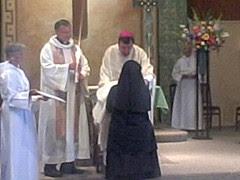

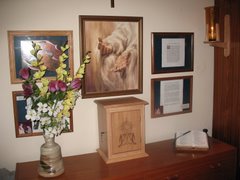


 Posts
Posts