[[Dear Sister Laurel, How do I find a diocese professing lay Catholics under canon 603?]]
 Generally, I do not recommend diocese-shopping for such purposes. I don't know any dioceses which would not be pretty cautious, suspicious, and even outright rejecting of someone engaging in such diocese-shopping. Similarly, since the eremitical vocation has a strong component of stability, shopping around for a diocese that will profess you might well cause doubt about any possible vocation. There are few situations which would make such a solution necessary
I have written a more detailed response to a similar question. Please see the label "Diocese-shopping" for that post. That main response is dated 26. March.2011; another post speaks a bit about such diocese-shopping as I recall. It is dated 4.December.2011. Please be aware that in order to be taken seriously by such a diocese you will need to have lived as a hermit for some time under competent spiritual direction and be able to demonstrate a good track record of stability in your parish or diocesan commitments. By this I am referring to the monastic value of stability which (risking serious over-simplification) is mainly a commitment to grow wherever you find yourself. If a diocese you move to is to take you seriously as a potential candidate for admission to profession you will likely need to have either tried to have entered a discernment process with your diocese and have been treated in bad faith, or perhaps have belonged to a diocese/province which has refused across the board to profess or consecrate anyone under canon 603. The only other situation I can think of off hand which might allow a second diocese to seriously consider you for c 603 profession would be if years ago you tried to be accepted and were deemed unready but now, despite your own growth in the vocation, the diocese will not reevaluate the matter.
Regarding your question more specifically, as far as I know, there is no list of dioceses with diocesan hermits although I understand that last year the Vatican started keeping statistics on us for the first time. Fewer (perhaps far fewer) than 1/4th of dioceses in the US have diocesan hermits, however. The only way to find out if a diocese MIGHT be open in time to professing you if you were to move there would be to call the chancery and speak to the Vicar for Religious or Consecrated life. Again though, no one is likely to be more than seriously reserved in responding to such a query because allowing you to move to a diocese cannot be done with even a suggestion that you might one day be professed as a diocesan hermit. The most they could and would probably tell you is whether they have diocesan hermits presently and are/or are open to professing suitable candidates.
04 November 2012
Question on Diocese Shopping


03 November 2012
Followup Questions on Illness and Horarium Changes.
[[Dear Sister Laurel,
Do you have to notify your Bishop when you are ill and need to change your horarium? How about his delegate? What if the change is not temporary? Do you stop being a hermit? Thank you.]]
 The simple answer is no. That is especially true in the short term. I do ordinarily let my delegate know if I am not well, but that is more to inform and to reassure her that all is pretty well nonetheless. As for the changes in horarium what is more fundamental is to continue living the elements of the canon the best way I can in spite of illness. Everyone expects that and they expect me to be able to do that or to ask for assistance if I need it. The horarium, though not unimportant, is actually less important (and more flexible) than the Rule itself and the values it embodies from Canon 603.
In Cases of Serious Illness
In cases of serious illness, then yes, everyone is notified --- not so much regarding the change in horarium as in regard to the seriousness of the situation. Pastor, Bishop, delegate or director, friends, family, are all notified. If the change in the horarium needs to be long-term then no, I don't cease being a hermit. I simply have to accommodate the new circumstances as best as I am able. Again, it is the elements of Canon 603 that have to be lived out no matter the situation. That may mean that someone comes in to assist me with chores a couple of times a week, or helps me shop, or brings over an occasional meal, for instance, but I don't cease being a hermit in such a situation. It may also mean meeting more frequently with my delegate or director for assistance in living well with the situation.
The horarium I keep at present is designed to serve me in living an eremitical life. It is not forced on me by someone else, nor did I copy it from someone. It is an expression of both my own strengths and weaknesses as well as the things that keeps my prayer life and capacity to minister to others in good shape; should these things change then the horarium also can and will change. I suppose I am saying it is not the horarium per se that makes the hermit; it is the hermit and her lived experience that makes the horarium. Thus, if an illness was to be long term that would mean changes in the schedule and also in commitments to others (my parish, clients, etc), but I would remain a hermit nonetheless. Nothing necessarily changes in my relationship with God or the essential way in which I am made whole in the silence of solitude.
The More Important Questions of Formation Implicit in Your Question
You may not have been completely aware of this but your question bears on the posts that have been put up recently on the importance of formation and ongoing formation of the hermit. Eremitical life, like all forms of religious life, has stages and one needs to be able to negotiate these changes while living out the central values of one's life. The capacity to negotiate changes in this way is one of the things that marks the person as an authentic hermit. I remember being asked once by an aspirant for canon 603 profession about how they should deal with the difficulty of balancing hermit things vs worldly things. The essential problem was that this person had not made a significant break with her prior life, and was not a hermit in any essential way. Thus, she considered certain things (praying, lectio, etc) as hermit things and things like dishes, laundry, housecleaning, etc as worldly things. The answer to her question was that everything she did within the hermitage was to be done as a hermit. (For that matter, everything she did outside the hermitage was to be done as a hermit.)
The same principle applies here. When a hermit is ill, they will "pray" their illness and it will become a special expression of the silence of solitude --- perhaps more difficult to live without assistance and more painful than what was lived prior to this --- but it will be an eremitical reality because and to the extent the one who is ill is a hermit herself. The horarium may be more flexible, but it remains an eremitical horarium. Thus, again, the importance of a sufficient formation and ongoing formation. One must be able to embody the central elements of the Canon and especially to live the charism of the vocation without some of the external tools and protection required at another stage of the life. During illness most of us regress some and if the illness is serious that may be more true, For this reason it is important that the hermit be adequately formed so that they continue to live the mature eremitical life they are called to live in even more demanding circumstances.
 Sister DK
Let me give you an example of what I mean. This Summer our parish put up a wall of faith in memory of those women in our lives who have inspired us. I put up a picture and description of a Sister I met when I was in initial formation. When I met Sister D. she had brilliant blue eyes and was bent over sideways due to scoliosis; she was also almost completely blind (and was completely blind within the year).
Once a great reader and even now always interested in the life of the community (she loved any chance to share news!), Sister still came to all community prayer and meals and spent the remainder of her day sitting in a straight chair in her room praying. To be honest, though I was tremendously impressed by her, what had happened to her terrified me then, and in some ways still does frighten me. However, she lived profoundly the silence of solitude in community and I feel her with me today. She reminds me of what it means to be a hermit at the end of one's life, and when one is ill and cannot do what one once did. Was this easy for her? No. Could she have lived this way without the ongoing formation of a faithfully lived religious life? I don't think so. My hope, of course, is that inspired by Sister D. and many others, I will live the truth of that as well as I am called to do as a diocesan hermit. This is another piece of what perpetual vows mean.
What do you do When you are Ill and need to change your horarium?
 Several times I have been asked what I do when I am sick and cannot keep my usual schedule (horarium) with regard to prayer and work, etc. Recently it was asked again because of comments I made about "hermits" using hours of TV to distract from their illness. I have not written about this mainly because I don't want to focus on my own illness, but there are some reasons to deal with these questions since everyone has periods when they feel really punk and just need to deal with the illness and do so prayerfully. One conversation on a Carthusian list came up in the past day regarding pain and what one does when one is in pain. From there the discussion moved to the place of music in dealing with pain. In any case it all raised the question for me regarding what I do when I am unable to keep my usual horarium.
 | |
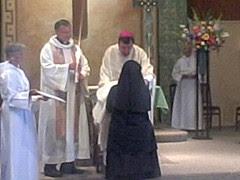
| Prostration prior to perpetual profession |
The first thing is that I take care of whatever physical needs I have. Medicines, fluids, food, and sleep (especially sleep) figure big time in caring for illness. I maintain my periods of quiet prayer usually (though not necessarily at 4:00am), but Office (for which I wear my cowl over my pajamas) is usually abbreviated to a single psalm prayed slowly. The canticle is usually added with a CD or iPod version, and I try to be sure to pray for people in my parish, those who have requested prayers. I may add another song I can listen to on iPod, etc. This works for all hours. Communion (for which I also wear my cowl over my pajamas) is similar except after a brief penitential rite, I read the Gospel out loud slowly, pray the Lord's Prayer and receive Communion. I will sometimes end this service with another hymn on my iPod or CD player and sometimes simply follow it with a period of quiet prayer.

 And what happens when it seems just too difficult to pray or when I can't focus enough to work, etc. One thing I like to do is listen to liturgical music --- old favorites a lot, but also Taize. Taize is especially nice because of its repetitiveness as well as its multi-layered musical interest. I use these for prayer periods, not for long periods of just listening. Meanwhile I bring whatever I am feeling to God during the Taize. Otherwise I like to simply to rest in the silence, simply rest in my knowledge of God's presence and the fact that I am in his care. These periods may be relatively brief and interspersed with reading or journaling or sleeping, but they are very important. Another form of prayer I do is the Jesus Prayer using a small bracelet of beads I wear around my wrist --- usually in conjunction with prayer for people in my parish, etc. Ordinarily I reserve this for when I am traveling or on a train but it is helpful in times of illness as well. One activity I like to do when I am not really able to do much else but want to maintain silence or listen occasionally to music is to set up a large jigsaw puzzle; this kind of activity allows for a lot of less formal prayer or reflection and is physically undemanding and restful as well. I have drunk a lot of hot tea while working on puzzles like this --- and also had some significant prayer experiences.
The question of TV comes up in some of the questions and the answer is yes, sometimes when I am sick I will watch TV --- but I really have to be pretty sick. I also have to be especially careful about this practice since as it helps to distract from how one is feeling, it can also keep a person from being aware of feeling well enough to get up and do something else. But yes, with caution and within limits, I sometimes watch TV when I am not feeling well. There are so many things about what TV does to me spiritually that I really don't like it ---- but it is fine for a movie or special program here or there. Otherwise I find it destructive of attentiveness and recollection. (I must say that as I learn more and more to "pray the situation" TV is especially dangerous to one's ability to do this!)
I hope this helps. I think that many could be helped by trying some of these things when they are not feeling well. The point is that one is as capable of praying when one is ill as when one is well, but that one may well need to change some things to do that. The main point is to be who you are, with all the limitations that are your own and to be this person WITH God.
31 October 2012
Rethinking Perpetual Profession as "Graduation": More on Ongoing Formation
[[Dear Sister O'Neal, I had always thought of perpetual profession as a kind of graduation. Maybe that is silly but it is how I thought of it. When you write about it being analogous to an advanced degree which says one is educated enough to continue learning on their own that changes things for me. In a way you are saying that perpetual profession is a kind of commitment to life-long formation though. Is that right? I guess I thought that after perpetual vows one was pretty free to go their own way but that is not quite true is it?]]
 Exactly right. Remember that in monastic life one of the vows is conversatio morum, or the conversion of life. This vow is usually thought to include religious poverty and celibate love (chastity), so monks and nuns often make the vows of conversatio morum, obedience, and stability. Canon 603 requires the vows of poverty, chastity (celibate love), and obedience, but the life to which one is committing in either case is the same --- a life of continuing, thoroughgoing conversion which requires ongoing formation.
Perpetual Profession is not the same as graduation. Instead it is more like the end of an apprenticeship and the beginning of one's life as a journeyman. One is no longer under the watchful eye of a novice master or novice director nor even the director of the juniorate, (or in the case of a diocesan hermit, the semi-watchful eyes of Vicars for Religious, etc from the diocese) and one is free to follow the impulses of the Holy Spirit pretty much where one discerns he is calling, but this is not an absolute freedom. One still must answer to God, to the Diocese (both chancery personnel and the people of the diocese), to oneself and one's Rule, and also to one's delegate and director --- though in differing ways. But let me give you an idea of how this works out practically since there is usually no one around saying either, "You must do x" or "you may not do y."
 Depending upon one's training, education, etc, over time a hermit is presented with a number of opportunities to minister in a limited way outside the hermitage. Generally, one's Rule provides one with the requirements one needs to live a healthy eremitical life, but some of these opportunities can be accommodated as well without difficulty. One prays about these, determines how they do or don't fit into one's life, what is needed in terms of time, preparation, etc, and also how this will benefit the individual's eremitical life. After this one will discuss the matter with one's director and/or delegate.
Occasionally the hermit may not have done sufficient discernment on the matter and will get themselves in trouble if they are not lucky! Still, they are not in this all alone and delegates and directors do help in determining what will be helpful and what will not --- even though they rarely if ever simply say, "Yes you may or no you may not!" (My own delegate almost NEVER directs me to do x or not do y, but she is keen to hear how I have discerned matters! Thus, I remember once mentioning a project I was considering doing to her and her response was a quiet, "I will be interested in hearing your discernment on this." At that moment the response that flew into my head was, "BUSTED!" In fact, I had NOT discerned this well and we both knew it! Needless to say, the proposed project was dropped and we never had much of a conversation about it either. At the same time I have not repeated such idiocy and learned from the exchange.)
I hope you heard the humor in this. I laughed when that incident happened and I still laugh at it today --- not only at my own silliness but at the marvelous way God works. What my delegate did was FAR more effective than a simple permission (or prohibition) might have been. She reminded me clearly of my own responsibility as perpetually professed, but also that I am responsible in direct ways to people who will assist me in my own decisions and growth. The freedom of the person who is perpetually professed is a freedom within limits or constraints --- a responsible freedom --- and for that reason, one does not stop growing so long as one lives the life. Thus, I meet regularly with my delegate and/or director to be sure that that growth continues and that my own discernment is not allowed to slip into carelessness or complacency, nor that my decisions become the fruit of mere impulsiveness.
At the end of a year I will meet with my Bishop to let him know how things are going, what is going especially well, what difficulties I have had in the past year, and how I am working things out. He may have suggestions or concerns which he then has a chance to express. A followup visit with my delegate may or may not be be necessary in light of the meeting with the Bishop, and a meeting between my delegate and the Bishop might also be helpful. Whatever needs doing will be done.
 If one were to read through the past five years of this blog I think they would see someone who has grown in her vocation because of perpetual profession (not in spite of it). It is true that I am no longer an apprentice or novice in the eremitical life, but it has taken time for me to grow into a person who is concerned not with only my own vocation and profession, but into one who is concerned with the nature and future of this vocation itself. Perpetual profession granted a kind of freedom to explore the vocation, to reflect on it more widely than I had been able to do before this. It has freed me to allow my life to be one of prayer and other limited ministry precisely because I am sure of my eremitical identity. I think that particular freedom is akin to what you were thinking of when you referred to perpetual profession as graduation.

29 October 2012
Followup Question on Ongoing Formation for the Diocesan Hermit
[[Dear Sister, is ongoing formation really necessary once one has been professed? If a person spends almost 10 or more years becoming a diocesan hermit, why should more formation be required?]]
 I think too often the sense we all have of "formation" is of the initial making of the person into a nun, or priest, or monk, or hermit. It is as though once we have reached perpetual profession or ordination then ongoing formation isn't at all necessary. But remember that a vocation, important as definitive (perpetual or solemn vow) commitments are, is not something one answers once upon a time and then just sails along in. Instead a call is something that comes to us each day and the response we give is one which is renewed and both extended and intensified day by day as well --- at least that will be true if we are growing in this vocation. In my own life I hear this call variously but I describe it as God calling me by name to be more completely his in the state of life to which I have been called. I can't imagine God ceasing to call me by name --- and of course the Scriptures affirm that this is the case (Isaiah 43), nor can I actually imagine a time when I will not have some further response, some part of myself to give more completely or some way in which I need to grow more authentically human.
 Ongoing formation is meant to allow this process to continue. It takes cognizance of the needs and deficiencies one has at various stages of life, and of course it honors the gifts and strengths which are evident at different points along the way. Diocesan hermits, like all religious at the point of perpetual profession, are admitted to definitive commitment because they have been determined to have a life vocation; they have been entrusted with a responsible role in that vocation's future with all that implies. In a sense such admission is a bit like an advanced degree; such degrees don't say the person has learned all they need to learn, but rather that they have achieved a level of education and growth which allows them to be trusted with the responsibility of securing their own continuing education and of sharing what they know in a new way. In a sense such degrees mark the person as a competent and responsible learner (rightly approached, one of the significant ways we continue to learn is through teaching others). Perpetual profession does something similar but with a tradition of prayer, spirituality, and faith; it is often only with perpetual profession that we begin to really claim as our very own a particular tradition --- especially as it is a promise to others. It certainly marks the event which makes us fully responsible for that tradition.

There are depths in any vocation which open to the person only over time. There are aspects of the history of eremitical life which may not have seemed too interesting or pertinent the first time one read or heard about them; and yet as the hermit claims this vocation and becomes responsible both for the eremitical Tradition and for the contemporary world's redemption these aspects may assume a new prominence for her. Note well that this is not merely an academic matter but one which demands the hermit be sensitive to the needs of the world around her and become more and more capable of addressing these by applying some piece or dimension of the charisma (gift) eremitical life is meant to be to the contemporary world. The more deeply she comes to live the charism of diocesan eremitical life, and the more attentive she is to the needs of those around her, the more fruitful her life will be.
I hope this is helpful. If it confuses or raises more questions, please get back to me.
15 October 2012
Rejecting Eremitical Vocations vs Creating Readiness for Eremitical Vocations
[[Dear Sister Laurel,
it seems to me that if Dioceses
don't agree that Diocesan Hermit candidates have adequate formation then
they should just not profess them until they HAVE adequate formation.
I mean that doesn't seem like rocket science to me! Also how can they
simply make a blanket judgment against the vocation itself? So what is
the diocesan responsibility in forming diocesan hermits? Is it really
possible for solitary hermits to get sufficient formation themselves
with a bit of help from a spiritual director? Thank you.]]
 Well,
I think you have hit the nail on the head here. Reaching the conclusion
you have is not rocket science, is it? First, a diocese is not actually
responsible for forming a hermit; they are primarily about discerning
the nature and quality of the vocation present before them. However, if a
diocese believes the person requires more formation before being
admitted to profession, they do need to work with resources available to
the hermit to help her determine a plan so that she can get this
formation. Thus, a diocese needs to be specific with the individual
involved with regard to what areas in which she is deficient , what kinds of
things would help with these, and so forth. The reference to needed
formation cannot be vague nor can it replace actual discernment on the
reality of the vocation itself. For instance, it is not okay to make an
aspirant for profession jump through a number of formative hoops if the
diocese has already determined she is not called to be a diocesan hermit
and will not be admitted to profession. The only way this could work is
if the diocese is honest with the person, says they are truly open to
seeing things in a new way once the formation issues are taken care of,
and then follows through with that.
Well,
I think you have hit the nail on the head here. Reaching the conclusion
you have is not rocket science, is it? First, a diocese is not actually
responsible for forming a hermit; they are primarily about discerning
the nature and quality of the vocation present before them. However, if a
diocese believes the person requires more formation before being
admitted to profession, they do need to work with resources available to
the hermit to help her determine a plan so that she can get this
formation. Thus, a diocese needs to be specific with the individual
involved with regard to what areas in which she is deficient , what kinds of
things would help with these, and so forth. The reference to needed
formation cannot be vague nor can it replace actual discernment on the
reality of the vocation itself. For instance, it is not okay to make an
aspirant for profession jump through a number of formative hoops if the
diocese has already determined she is not called to be a diocesan hermit
and will not be admitted to profession. The only way this could work is
if the diocese is honest with the person, says they are truly open to
seeing things in a new way once the formation issues are taken care of,
and then follows through with that.
It is true that
sometimes elements in formation can clarify areas of the candidate's
life which have caused questions about the reality or nature of a
vocation, but in such cases the candidate must know that admission to
profession is in serious doubt and that while further formation may
assist in clarifying matters and even help take care of areas which lead
to doubt, at the same time they may not change the doubtfulness.
Honesty and good faith communication is imperative in such
instances. Dioceses have not always been good at achieving this kind of
openness in communication. A candidate must agree to get the formation
they need --- especially since they bear the brunt of any expense or
time commitment required.
How can dioceses make such
blanket judgments against vocations per se? Excellent question but not
one for which there is a single answer. Some Vicars for
Religious (few I hope!), for instance, do not value the contemplative life; if this is
so, eremitical life will seem even less valuable. Some Vicars and even
Bishops may have seen abuses of canon 603 and have been put off by
these. Some dioceses realize that, despite the fact that dioceses do not
form hermits, working with hermit candidates involves a long-term
commitment to the person as well as a kind of patience and expertise their
usual work may not require. They may not be up to that for a single
vocation which is rare and seemingly not very fruitful or contemporary.
Also, the process of discernment here involves a life with which few Vicars
or even Bishops are really familiar in any meaningful sense at all.
It is not uncommon for the same stereotypes which plague the world at
large in regard to hermits to also plague chancery staff. Some dioceses
may indeed have had several poor candidates show up at the chancery door
looking for a sinecure, or may even have professed someone and had it
turn into a nightmare for everyone involved. Communities have ways of
socializing (forming) and supervising members at least partly simply by
living with them and also may ask them to leave before perpetual vows.
With hermits and consecrated virgins the same safeguards do not exist so
the diocese itself needs to be patient and careful over a longer period
of discernment.
 If
a hermit is admitted too soon to perpetual or even temporary
profession, especially if the diocese doing so has not confirmed the
adequacy of formation (or don't even know how to do so), if the diocese has
insufficient knowledge of the eremitical tradition and life, or if they are
unwilling to invest (and demand) the appropriate time for the formation
of a solitary eremitical vocation (which the hermit herself must
secure), then the eremitical vocation itself is endangered. In such
cases I would say better there be NO professions than bad ones. Even so,
a blanket refusal to profess anyone is obviously not optimal or even acceptable in the face of canon
605 (which requires Bishops be attentive to new forms of consecrated
life) and the movement of the Holy Spirit with regard to true vocations.
There are sound solitary eremitical vocations in a number of countries;
dioceses must become aware of that and learn from them. Meanwhile,
solitary hermits have gotten the formation they have needed to live this
life --- and most have done it "on their own" with assistance and
mentoring they themselves have acted to include in their lives. Most of
the time diocesan hermits are partly formed in religious life and only
late discovered a call to solitary life. Still, while it is a longer and
more difficult process for those who have no background in religious
life, it is generally possible for individuals to come to all that is
necessary to live this life by themselves with the assistance of a
director and an openness to doing what is necessary to learn and grow
theologically, spiritually, and humanly.
If
a hermit is admitted too soon to perpetual or even temporary
profession, especially if the diocese doing so has not confirmed the
adequacy of formation (or don't even know how to do so), if the diocese has
insufficient knowledge of the eremitical tradition and life, or if they are
unwilling to invest (and demand) the appropriate time for the formation
of a solitary eremitical vocation (which the hermit herself must
secure), then the eremitical vocation itself is endangered. In such
cases I would say better there be NO professions than bad ones. Even so,
a blanket refusal to profess anyone is obviously not optimal or even acceptable in the face of canon
605 (which requires Bishops be attentive to new forms of consecrated
life) and the movement of the Holy Spirit with regard to true vocations.
There are sound solitary eremitical vocations in a number of countries;
dioceses must become aware of that and learn from them. Meanwhile,
solitary hermits have gotten the formation they have needed to live this
life --- and most have done it "on their own" with assistance and
mentoring they themselves have acted to include in their lives. Most of
the time diocesan hermits are partly formed in religious life and only
late discovered a call to solitary life. Still, while it is a longer and
more difficult process for those who have no background in religious
life, it is generally possible for individuals to come to all that is
necessary to live this life by themselves with the assistance of a
director and an openness to doing what is necessary to learn and grow
theologically, spiritually, and humanly.
What is at
least equally essential however, is that dioceses themselves become
educated in regard to the eremitical life (especially the solitary
eremitical life). They must, for instance, know the difference between a
hermit and a pious person who lives alone; they must have done some
work in jettisoning the common stereotypes associated with the term
"hermit" --- but also be proficient in spotting those same stereotypes
when they show up in a candidate who has just arrived on the chancery
doorstep. They must have a sense that hermits are created by time as
well as by and for the silence of solitude and be
able to allow those to do their work in a candidate's life. They must
have a sense of the normally extended time frame for moving through a
discernment process and not be tempted to ignore it --- an act which
disrespects the vocation and fails to act with charity towards the
candidate. Finally they must understand the central elements of Canon
603, especially the silence of solitude and its function as charism of the eremitical life. As already noted, bishops are called and canonically required to be aware of and foster
new forms of consecrated life. While it is a serious commitment in time
given the rarity of these vocations, chancery personnel (Bishops, Vicars
for Religious or Consecrated Life, Vocations directors, etc) must
foster a readiness to patiently discern and assist such vocations
instead of simply rejecting their possibility out of hand.
12 October 2012
Why is it Diocesan Hermits can Wear Habits?
 |
| Sisters of Bethlehem (Not Canon 603) |
Thanks for your question. There are several reasons which make it appropriate to allow publicly professed hermits to wear habits. First, in light of canon 603 solitary canonical hermits are now seen as religious. In the Handbook on Canons 573-746 in the section on norms common to Institutes of Consecrated Life, canonist Ellen O'Hara, CSJ writes regarding canon 603 specifically, "The term "religious" now applies to individuals with no obligation to common or community life and no relation to an institute." Thus, the same canonical obligations regarding garb witnessing to consecration and religious poverty can be applied to diocesan hermits. (Note well that in all of this I am referring to canon 603 and those who make public vows under that canon. Privately dedicated hermits are not included in Sister Ellen O'Hara's characterization above.)
Secondly, the eremitical life is traditionally associated with an eremitical or monastic habit. Ordinarily an elder hermit granted the habit to the novice; s/he also monitored the wearing of it as a piece of mentoring the novice in the eremitical life. If the novice lived the life well, the habit stayed; if the novice did not live the life well, permission to wear the habit was withdrawn and the habit was taken away. This use of specific religious garb is older than any other in the history of Christian religious or monastic life. Since, along with congregations of hermits like the Carthusians and Camaldolese, c 603 represents a public, ecclesial continuation of this tradition, the granting of the habit is entirely appropriate to diocesan hermits, despite the fact that they are solitary hermits. The Bishop replaces an elder hermit or mentor, however, in granting permission for and clothing with the habit.
 Thirdly, the habit, today especially, marks the person wearing it as somehow "separated" from the world, not only in the sense of that which is resistant to Christ, but also to some extent from the world of social relationships and some related obligations. For instance, as I have noted before, vows of poverty, chastity, and obedience significantly qualify the ways in which the professed person relates to the world of commerce, relationships, and power. For hermits who are, in fact and by definition, more strictly separated from these than apostolic or ministerial religious, the habit can serve to remind her of this dimension of her vocation even when she is out and about. While it should not make her in any way remote or distant from those with whom she comes in contact, it signals a distinction which is not always appropriate in ministerial religious.
Permission to wear the habit, as noted above, is granted by the diocesan Bishop. Beyond this, it is customary (though not strictly required) that the hermit is clothed in a cowl or other prayer garment at perpetual profession. My own diocese required the latter (cowl or other prayer garment) and desired or were open to (but did not require) my wearing a habit. Still, some hermits may choose not to adopt these forms of garb and some dioceses may not require (or even be open to) either habit or prayer garment. Reasons vary. Some Bishops dislike allowing individuals who are not members of an institute of consecrated life to wear a habit (especially if the habit is typically Franciscan or Dominican or something similar --- a practice which cannot be allowed!); sometimes, however, this is a piece of legitimately discerning an authentic eremitical vocation (bishops or Vicars may say the diocese is not open to hermits wearing habits because sometimes folks who live alone merely want to wear a habit and are not really interested in the vocation itself or in living an authentic eremitical solitude).
Still, hermits professed and consecrated under canon 603 are generally allowed to wear habits if and when their Bishops agree. (Again, such permission, which seems to be granted by the majority of bishops with c 603 hermits in their dioceses, is usually not granted apart from profession, especially if the hermit is out in public because, as I have noted before (something which could be called a fourth reason), habits are associated with the assumption of public rights and obligations of a particular state of life (Religious). A habit is unnecessary and superfluous apart from the assumption of such rights and obligations, or such a state; it is also misleading and dishonest. People rightly associate habits with the assumption of public rights and obligations and tailor their expectations accordingly, It is for this reason habits are not usually approved apart from admission to vows. The cowl, when given, is always linked to perpetual profession and not to temporary profession.
09 October 2012
The Importance of the Lay Eremitical Vocation, Followup Questions
[[Sister Laurel,
is there some way to live as a lay hermit and ALSO do so, as you put it, 'in the name of the Church'? One of the problems I have is that the Church does not seem to know lay hermits exist. I don't think it is a vocation that is regarded by the Church. I guess I am asking if there is a way to avoid all the institutional red tape and requirements of canon 603 and also have the Church really CARE about lay hermits! It seems to me if the Church herself really esteemed lay hermits it would be a lot easier for people to accept that maybe this is what they are called to.]]

I think these are really excellent questions! My response to the first one is, unfortunately, no, I don't think there is any way to live this "in the name of the Church" in the sense of a special commissioning and consecration. But one still lives it by virtue of one's baptism and that particular commissioning --- that is, one lives it in light of the rights and obligations granted by baptism and so, one will be a part of exploring a contemporary form of life in the tradition of the desert Fathers and Mothers.
If one really wants to live the eremitical vocation per se "in the name of the Church" then one should pursue Canon 603 profession and consecration. I personally chose to do so especially because I thought the way God had worked in my own life added something special to the witness to the silence of solitude, namely, the redemption of the isolation related to chronic illness, and other similar situations. This was something I felt needed to be witnessed to in the Church in a more official way. Without public vows I felt somewhat "unfree" in this regard. I also chose to do so because I had lived vowed life and desired to continue living vows I had come to love but to do so now in a solitary
eremitical context. Without these two reasons I could have lived as a lay hermit without any substantive difference between that life and the one I live now. The presence of these two particular reasons suggested to me that God was calling me to pursue Canon 603 profession and consecration for reasons that had nothing to do with status nor with believing it was a "higher vocation," or something similar.
Your desire to avoid all the red tape of Canon 603 is understandable. Many lay hermits object to the various requirements, time frames, discernment processes, supervision, and other things that seem to them to constrict the degree of freedom they need within their lives. Although I don't agree with them in this I can understand their point of view. What seems to be important in your questions and desires is for the Church to really esteem the lay eremitical vocation. The question is how does one achieve this? The problem is that there is a bit of a vicious circle here, namely, lay persons won't generally embrace eremitical life unless the Church esteems it and at the same time the Church will not esteem it in more than principle if folks are not living it in exemplary ways. So who breaks the stalemate? It has to be lay hermits --- just as was the case for those desiring the eventual promulgation of canon 603. After all, the Church officially esteems both lay life and the eremitical life; she stresses the freedom and responsibility of lay persons to follow the promptings of the Holy Spirit in living out their vocations. She is open to seeing how lay vocational experiments really work and has learned important lessons from the desert Fathers and Mothers, so what more encouragement do lay hermits need?
A lay hermit could well live an eremitical life in the midst of her parish. She could reflect on the life, its significance, nature, etc and write about that. She could contribute on the parish or diocesan levels or she could begin a blog and write about the eremitical life, the importance of its counter-cultural witness and the ways she personally lives it out. And of course, she could be an encouraging and even inspiring presence to those in their parishes that had to live some forms of isolated existence due to illness, age, or other problematical circumstances. This could include modeling significant ways to live the evangelical counsels as all baptized are called to do even though the person does not have public vows and it might even include demonstrating the importance of a Rule of Life for any person attempting to live a truly Gospel life. All of this and more could be done better than a canonical hermit might well be able to do because the diocesan hermit is (or is often perceived to be) distanced to some extent by virtue of her canonical standing. What is important is that this be a true lay life lived from the graces of baptism in ways which speak profoundly and powerfully to every segment of the Church. it would be a vocation which had listened attentively to Vatican II's teaching on the laity (Apostolicam Actuositatem) and on the Church in the Modern World (Gaudium et Spes) and addressed the necessary contemplative dimension of implementing these documents in the contemporary church and world.
 If persons in the lay state of life could do this and effectively accent the generosity and love which compelled them to live this vocation, they would also go a long way to free the notion of eremitical life from stereotypes and distortions. Their lives would also underscore the notion that religious are not called to a higher form of holiness than the laity, and that contemplative life and some degree of the silence of solitude is important, indeed, foundational to all states of Christian life. Finally, if lay persons could do this they would go a long way towards assisting the whole Church to realize the goals and values of Vatican II. The hierarchy would come to appreciate the vocation and, more to the point perhaps, pastors would begin encouraging the (at least experimental) living of it in those they felt or even suspected were called to it.
07 October 2012
On the Significance of the Lay Eremitical Vocation --- Revisiting the Question
 [[Dear Sister Laurel, I have returned to thinking I am a lay hermit, and
nothing more, and though God can work miracles in our lives and does marvelous
things we could not foresee, at this moment I don't see anything so grandiose [as being admitted to profession as a canon 603 hermit] happening in my life. My life is marvelous in itself, and I try in all humility
to bury myself in His will, not thinking anything of myself as being in the
least special at all. I feel that God has consecrated me,
but any consecration the Church would do would have to be as a consecrated lay
man, and I still don’t see any provision in Canon Law for such a state; perhaps
you can clarify what other options may exist of which I am unaware.]]
[[Dear Sister Laurel, I have returned to thinking I am a lay hermit, and
nothing more, and though God can work miracles in our lives and does marvelous
things we could not foresee, at this moment I don't see anything so grandiose [as being admitted to profession as a canon 603 hermit] happening in my life. My life is marvelous in itself, and I try in all humility
to bury myself in His will, not thinking anything of myself as being in the
least special at all. I feel that God has consecrated me,
but any consecration the Church would do would have to be as a consecrated lay
man, and I still don’t see any provision in Canon Law for such a state; perhaps
you can clarify what other options may exist of which I am unaware.]]
 I will take issue with some of what you said and applaud some other things. First, any sentences referring to being a lay hermit and using words like "just" or "only" or "nothing more" to describe this are dead wrong and may well indicate you have not yet come to completely see how truly wonderful is the vocation to be a lay hermit or the way in which your life can speak to those right around you and the Church as a whole. You ARE consecrated. That happened for you at Baptism. I think you need to consider that part of what you are feeling is the reality of your baptismal CONSECRATION. There is no need for a separate vocation to be a "consecrated lay person" since lay persons ARE, by definition, consecrated or they would not be part of the laos, the laity, or People of God. I strongly suggest that part of what God may be calling you to is a stronger, clearer sense of the dignity and significance of an eremitical vocation lived in the lay state.
It is true this is not the same as being called to the consecrated state of life, but because there is nothing higher or more sacred than baptism which makes of us a new creation and calls us to an exhaustive holiness, neither therefore can we say that the consecrated state of life is a higher calling nor that the lay state is some sort of merely entrance-level vocation. As I have said many times here, these two states of life are different in their canonical rights and obligations, but neither is higher than the other. The language of objective superiority which Aquinas used does NOT translate in this way and Aquinas seemed to assiduously avoid implications of vocational inferiority or a lower vocation. I would urge you to drop any qualifying language which diminishes the dignity of the lay state or the significance of lay eremitical life. Whether or not this stage of your life leads to diocesan eremitical life it is an infinitely significant vocation and the model you are currently given to live out for all those persons living around you, many of whom are isolated elderly or chronically ill, etc, and need to be reassured of the significant value of their lives.
 But the truth is while you do not have the training provided by religious life you do have authority. You are a baptized lay person living (and learning to live) an eremitical life and coming more and more to understand what doing so means for those living in the world you inhabit all the time. You can speak to THIS vocation and this world with a particular authority and credibility I might myself have relinquished in accepting canonical standing. What I mean by this is that my own life is separated from those around me, not merely by eremitical life, but by my canonical standing. While I am very keen on witnessing to isolated elderly, chronically ill persons who are isolated by their illness, and others who may discover that eremitical life could redeem their isolation, In the past few years I have come to realize that lay hermits might well be able to speak with greater credibility to these people than someone with different standing in canon law. I suspect this may be a special charism which lay hermits have especially; that is, I think this may be a gift of the Holy Spirit which lay hermits bring to both the Church and the world in ways canonical hermits may not be as effective in bringing.
But doing this means taking the fact and dignity of one's baptismal consecration with complete seriousness. Of course God is not done bringing people to redemption in Christ by any means possible; you are absolutely correct in this, but the primary, essential, or foundational way God does this is through baptism. Bringing the charism mentioned above to the Church and world also means reflecting on the place eremitical solitude occupies in your own life. When you can speak clearly to yourself about what these mean you will come to appreciate what they mean or could mean in the lives of others around you. You could begin blogging about this perhaps, or finding ways at your own parish to speak about it. You have begun this process already. In what you wrote above you said, [[My life is marvelous in itself, and I try in all humility to bury myself in His will, not thinking anything of myself as being in the least special at all.]] I applaud the first part of this sentence --- for your life is indeed marvelous in itself. But you are entirely special and so is your call. All of us, by virtue of our birth and then again by virtue of our baptism and rebirth in Christ are infinitely significant and ultimately special. Genuine humility actually recognizes this and genuine spirituality is a grateful response to it.
 I ask that you try to imagine how many people who were once catechized and inculturated to believe that vocations to the lay state were second or third class vocations and yearn to really serve God in a "special" way would welcome hearing from a lay hermit that they simply have to recognize the truth of their lives as they stand right now! During this year of Faith where we celebrate the 50th anniversary of Vatican II and renew our commitments to its achievements this could be quite a gift for you to bring to the Church and world in your own unique way! In fact, in a Church where we once again have a growing clericalism and similar forms of hardening elitism it may be a critical mission God has given you. At this point in time you are a lay hermit and nothing less!! It is a crucial vocation. Whatever the future holds for you in regard to canon 603, the only thing which can diminish this lay eremitical vocation is appreciating it inadequately and living it badly. I urge you to embrace it as an infinitely significant vocation and really make it your own.
I will respond to other parts of your email as time allows, especially to those parts which make observations based on the situation outlined in my post on the diocesan hermit in the Archdiocese of Boston. In the meantime I ask that you look again at earlier posts reiterating the significance of baptismal consecration.
02 October 2012
Rules of Life: Why are they required for Diocesan Hermits but not for Consecrated Virgins?
[[Dear Sister Laurel,
why does a diocesan hermit write a Rule of Life when a consecrated virgin does not? As I understand it from what you have written, hermits are required to write a Rule of Life. Why aren't CV's required to do so in the same way? Is their vocation less significant? Less important?]]

Remember that a Rule functions is two main ways. First, it provides a vision of Gospel life rooted in both the eremitical tradition and also in the hermit's own story and experience. This vision honors both the past and the present. It allows the more abstract idea of hermit life to be lived in a concrete contemporary context. Since the hermit turns to the Rule frequently it serves as a touchstone to remind her of the way God has worked in history and especially in the Christ Event; it reminds her of how God has worked in her own life and in the lives of other hermits while it also affirms the way God needs to work though solitary hermits in the life of the Church and world today.
Besides reminding the hermit of these things, the Rule inspires her to persevere and live her vocation with integrity. It is especially important to have something like this when one's life is largely self-directed and counter-cultural. As I have noted before, on the negative side of things, the slide into mediocrity and lack of integrity is a very easy and quick one when one lives alone with only God as a companion. It is SO easy to let this prayer period or that period of lectio or journaling or study slide, to allow the silence of solitude which is not only the essential environment but also the goal of the life to be replaced instead by days of some silence and some solitude which allow one simply to relax and kick back. On the more positive side of things, it is easy to embrace other goods (choices for life with others, ministry to others, etc) which have a clear Gospel value and significance but which also may eventually lead one away from an eremitical life; the value of eremitical life is not always easy to see clearly when faced with such immediate needs and goods. A Rule presents the hermit with a vision of reality which is eremitical, a rare and mainly misunderstood life which is defined in terms of the silence of solitude, not merely a life of peace and quiet lived alone, and it reminds her how desperately the world and church needs her witness to the value of such a life.
 Secondly, the Rule functions in a legislative sense. It is law as well as Gospel and the hermit is bound canonically to live it well. She has a vow of obedience and the Rule serves the living out of this and the other vows of poverty and chastity as well. Besides the Gospel-rooted and eremitical vision of reality the Rule provides, it spells out the daily ways in which the hermit embodies these in her own concrete situation. Does she pray the Divine Office? Which Hours? When does she pray quietly and contemplatively? How does she live out poverty or chastity or obedience? What limited ministry does she do outside the hermitage? How does she ensure this does not threaten a life of the silence of solitude? What activities does she undertake outside the hermitage and when? With whom? How does she support herself, take care of health care, funeral and other kinds of needs?
The ways these are spelled out need not (and, in fact, should not be) in picayune detail or without room for flexibility, but there must be a basic listing of concrete obligations which are part of this particular hermit's living her vocation well. In negotiating the challenges and opportunities which come to her through parish community, friends, pastor, and so forth, this dimension of the Rule provides a baseline for serious reflection and consideration. Always it summons her back to the fundamental commitments and requirements of a HEALTHY life, and more, a healthy eremitical life of stricter separation from the world even as it frees her to respond within limits to new and legitimate challenges and opportunities to love and minister. Without the vision the Rule provides, however, there would be no way to achieve a faithful flexibility with regard to concrete obligations or to deal with the task of negotiating the challenges and opportunities that come her way.
More fundamentally, without the Rule the hermit is more than apt to simply become a more or less pious person living alone. There is nothing wrong with this per se, but it is not what she is called to nor is it the life or witness so many who are isolated by age or illness or circumstances need today. Bereft of an overarching vision and mission she may become individualistic and even narcissistic in the way she lives physical solitude. More positively she may commit to any ministerial request that comes her way imprudent as that may be. She may say yes to many goods and commit to love in ways which are necessary and typical for most Sisters but which also will make her something other than a hermit. As I have noted before negotiating this particular set of tensions between goods IS an inescapable piece of her vocation and she ought not eschew it. Still, she needs some assistance in negotiating it effectively and with integrity. The Rule essentially ensures that whatever she does, whether in cell or outside the hermitage she will do as a hermit.
 Now, what about consecrated Virgins? Why no required Rule for them? My own sense is that a CV can be a CV anywhere in any situation and may indeed be called to that. Whether active or contemplative she can embody the mission of the consecrated Virgin living in the world. She may well commit to praying certain Hours of the Divine Office, periods of quiet prayer, and so forth, and she may certainly benefit from living some sort of Rule, but she lives this calling "in the world" and that requires a kind of responsiveness to the everyday give and take, demands and invitations of the secular world which hermits are not called to. Of course it is absolutely not the case that the hermit life is more important or significant, but it is radically different, witnesses especially to a vastly different group of people, and in its own way, is less flexible and far more fragile. Thus both diocesan hermits and CV's can benefit from a Rule but for the c 603 hermit it really is indispensable; hence I think c 603 is wise in requiring it.
I hope this helps.
25 September 2012
Importance of Spiritual Direction for Hermits
[[Dear Sister Laurel, How important is it for a hermit to have a spiritual director? How do I find one? Can I work with one online? Also, will a diocese profess me without one? I am a hermit, by which I mean I live alone and avoid people, but I do not have a director; neither have I worked with one before. My parish priest hears my confessions, but he says this is not the same as spiritual direction and has suggested that if I am serious about being a hermit that I get a spiritual director. He said to check out your blog and see what I thought. He also encourages me to get more involved in parish activities and relationships with people in the parish. Would a spiritual director help me decide about these kinds of things?]]
 |
| Stillsong Hermitage Oratory |
First, my thanks to your parish priest for recommending this blog to you. I think you will find a lot of material that will be helpful on your journey, whether or not you ever live as a lay or consecrated hermit --- or even if you continue simply to live alone. Check out the labels in the upper right-hand column, and you should find stuff of interest. If not, do as you have already done and email me with your questions.
For the Hermit, Spiritual Direction is Indispensable
Second, though, your questions. A good spiritual director is critical, even indispensable to a hermit. No diocese will profess you without one, and more than that, no diocese is apt to treat your petition to be recognized as a hermit and admitted to canonical profession seriously without a history of spiritual direction and a recommendation from your director --- and rightly so. When living in eremitical solitude, especially as a solitary hermit, there are so many ways things can go awry that a good director really is necessary. After all, the human heart is an ambiguous, complex reality. By definition, it is the place where God bears witness to himself, but it is also a wilderness where one battles with demons --- the demons of anger, jealousy, fear, bitterness, resentment, boredom or acedia, etc, etc that can truly defile. A director can be immensely helpful in all of this, and in assisting us to grow into persons of authentic and profound love and sanctity. Similarly, one needs to negotiate the shifts that come with prayer and discern the significant decisions that need to be made regarding what one is called to in this area or that. For instance, you speak of avoiding people and living alone; a good director can help you determine the authentically eremitical motives for these things and tease apart the more unworthy reasons we may live alone or avoid people. She can assist you in discovering the difference between eremitical solitude and simply living alone as well; together over time, you can discern what it is God is truly calling you to, whether that means how you personally will live an eremitical life authentically or something else entirely.
Finding a Director
Regarding finding a director and working with one online, let's start with finding one. My suggestion is to speak to people in your parish and diocese who are already working with a spiritual director and ask them about who that is. Most Sisters have directors, many priests do as well, while many Sisters, as well as some priests, do direction. (It is not the same as hearing confession, as your pastor clearly understands.) Retreat Houses in your area will know of some directors and may even have one or two on the premises. Your chancery office may have a list of directors in the diocese, though I have found these are not always kept up to date. Another source of listings in your area is Spiritual Directors International. Not every director belongs (usually because of the annual fee), but you will get a good listing of folks who fit the bill in your area, so it can be a jumping off point. Finally, if you have any seminaries or theological schools in your area, most programs in pastoral theology or ministry require students to have a director so you can always check with them and see if they have a list of prospects. You will especially want a director who is knowledgeable about contemplative prayer and life (they do not need to be contemplatives, but they need to be contemplative pray-ers), and knowledgeable about the difference between eremitical solitude and simply living alone. Some background in psychology is helpful as well. If you are considering becoming a diocesan hermit, they should also have some background in formation and what it means to live the vows. What is most important is that they be persons of prayer in spiritual direction themselves; access to a supervisor is also very helpful.
On Working with Someone by Phone or Skype
 |
| Sisters of Bethlehem |
While I have some clients I work with by phone or skype when people live a distance from me, I also tend to require regular face-to-face meetings whenever they can be arranged. That means traveling here for these clients, but I have found it is an important and even necessary arrangement. Occasionally, I will accept a client for phone or skype-only meetings, but that person will have a history of receiving spiritual direction somewhere in their ongoing formation and be clearly able to benefit from the relationship even without face-to-face meetings. Sometimes I have clients that move out of the area; usually it seems a good idea to continue working together, and we do that via skype or phone; it tends to work better than with someone I don't know, except through skype, for instance, because we already know each other well. In working with persons who desire to be hermits, it is, I would argue, even more important for face-to-face meetings, as well as meetings in the hermit's own hermitage from time to time. Directing a hermit candidate is a bit trickier in some ways until the relationship is well-established, so I especially recommend these folks find a director in their own region or area and take the necessary time to build the relationship.
The Need for Friendship and Parish Involvement
Interestingly, your priest suggests you get more involved in the parish and in relationships there. Since he has read my blog, it sounds like he might regard the eremitical vocation and reject some of the common stereotypes hermits fall prey to. If this is so, it means his suggestions could be very well taken. In contrast to some stereotypes, solitary hermits need friendships and solid relationships with their own parishes and members thereof. This does not mean they can be with their friends as often as they would like or invite them over to the hermitage more than occasionally (though hospitality remains a desert value which must be honored), but it does mean that eremitical life is a healthy, loving, full life in God and for that reason being an integral part of the parish, even if one is rarely present beyond Mass, is important for the hermit and for the parish. In other words, misanthropes and curmudgeons need not apply!! I would suggest you speak with your pastor about why it is he has made his suggestion. If he has a real appreciation of the vocation and concerns about your own tendency to "avoid people," as you put the matter, I think you should listen to him. I know that for me personally, the description re "avoiding people" is a red flag. It is about the negative or peripheral rather than the positive or central dimensions of the life. But I don't know you at all, and this is a blog, so at this point, your comment is merely a red flag, nothing more than that.
Working with a spiritual director would indeed help you to discern what is going on in your own life and heart and also how it is God is calling you to serve him and those he loves and considers precious. It may be that you are called to eremitical life and to all that involves (including relationships, parish life, and a solitude which is rich with the Word and life of God. It may simply be that solitude for you is a transitional phase of your life; if so, working with a director will help you move through this phase creatively and in a way that witnesses to the grace of God. By all means, take your pastor's advice and talk to him frankly about his own perceptions. You need not agree completely, but these perceptions and opinions will factor into your own discernment and your work with your director.
11 September 2012
Followup Questions on Writing a Rule of Life: Should Bishops Write the Hermit's Rule?
 [[Dear Sister Laurel, I wanted to thank you for what you have written about writing a Rule of Life. I have been able to find a little bit of information online about this, but your own blog has the most information so far. I am not a hermit but I like the idea of living according to a Rule of Life and your posts have been really helpful. I do have a question. You have written about the benefits of writing one's own Rule and doing so on the basis of one's lived experience. You have also said that people should not write a Rule without having lived the life for some time. But what about someone writing a Rule FOR a hermit? Recently I read about a new diocesan hermit whose Bishop wrote her Rule. I guess you wouldn't agree with that practice. Am I right? Can you see this working in individual cases? Should it become a regular (no pun intended) practice for Bishops?]]
Objections to Bishops Writing a Diocesan Hermit's Rule: How the Rule Functions
Problems with the Practice of Bishops Writing a Diocesan Hermit's Rule
Possible Alternatives to Bishops Writing Rules for Hermits

One Sister with a background in leadership and formation I spoke with about this (and after I made the above comments in the original draft of this post) pointed out that a Bishop might well provide a Rule to a candidate at the beginning of a period of discernment and then, after a period of five years or so, expect the hermit-candidate to write her own Rule prior to accepting her for admission to profession. I think it is a VERY good idea. I would add that another revision might well be made before perpetual profession as needed (I believe it often will be). Moreover, I would suggest another Rule be written at the two or three year point rather than the five year point as one approached the possibility of temporary profession. This would allow the diocese a much better sense of the way the vocation is developing, the maturity with which the hermit is making the tradition her own, the degree to which she is living it out in dialogue with parish, universal church, and the contemporary world, the way in which she negotiates both the essential or non-negotiable elements of the life and the need for flexibility, the degree to which this is truly the vocation Canon 603 governs, and the world needs, etc. Not only would such a solution serve the diocese's own discernment in the matter, it would allow the candidate or hermit to educate the diocese (and chancery!!) about what a contemporary eremitical vocation is all about. Finally, it would give the hermit or candidate the needed opportunity to enjoy the formative and (for those truly called to the vocation) the confirming experience writing such a Rule usually is.
Summary of Objections





 Posts
Posts