I was drawn to a headline online about the growth of the number of hermits in Britain. The story was a huge disappointment, however, and it was annoying and frustrating to boot. With a subtext of genuine and rightful concern for an aging population in Britain, the reporter told two stories, one of which was the following:
 [[Tom Leppard is by no means an ornamental hermit. I interviewed him . . . for my book on English eccentrics. After a brutal convent education, and retired from the armed forces, Tom Leppard moved to London, which he loathed. It made him realise that every time in his life he'd been unhappy people had been involved. So Leppard vowed to become a hermit and moved to a remote part of the Isle of Skye. Before leaving London he had 99.2 per cent of his flesh tattooed with leopard spots, projecting his acute sense of apartness on to his skin.
That was more than 20 years ago. Tom is 73 now and – when we finally meet, after I track him down in his remote lair with the help of a local fisherman – he is wearing a woolly hat, a fleece with a flap that covers his groin, and very little else. His home, Paradise, as he calls it, is very neat. Most of his daily chores are aimed at keeping it that way. At the heart of his encampment is a cave made from the remains of a sheep pen and bits of timber from nearby beaches. He survives on tins of food he buys with the pension he picks up when he kayaks over to the mainland.
Before we can chat, he has to find his dentures. "Haven't spoken to anyone in a while, see," he explains. Leppard says he was lonely in London but never gets lonely now. But why choose such an extreme path? Leppard puts it simply: "I'm selfish. I've got all this," he nods at the view that sweeps past a flank of Scottish scarp. "And I want to keep it. I don't want to share it with anybody." As well as reminding us that it's possible to live without material possessions, by their example Woodcock and Leppard remind us not to confuse the words "alone" and "lonely". Companionship is not always a prerequisite to fulfilment. As our population gets older and we grow increasingly fond of living on our own, this is more relevant now than ever before.]]
Despite the humor (and the pathos) of the portrait it is one which causes authentic diocesan, lay, or religious hermits to cringe. It is a perfect example (though not as subtle as some) of the attempt to validate one's isolation by applying the term "hermit." I have to say I am surprised that --- important as are the concern for isolated elderly in Britain, and the message the author desires Leppard's life to convey --- the reporter could consider this particular portrait as one which reminds older persons that "companionship is not always a prerequisite to fulfillment," etc. How in the world the life of Tom Leppard represents one of "fulfillment" is an enigma I doubt the author could really explain.
 I am also surprised that although Leppard is surely not "an ornamental hermit" (a term which refers to solitary persons who might be hired to live at the bottom of someone's garden to serve as an estate "ornament" for instance) a life characterized as essentially wounded, bitter, selfish, misanthropic, and completely eccentric --- not to say bizarre --- could be seen as exemplary of authentic eremitical life. Yes, Leppard certainly illustrates all the stereotypes I have written about in the last three years, but really, is this the best the reporter could have done in the attempt to draw positive lessons for an aging British population, most of whom will live their last years alone? Unless the entire article was tongue in cheek (and I wholly and sincerely doubt it was!), the bottom line seems to be, "Not to worry, if you have to grow old alone, defensive antisocial craziness is a numbing comfort!"
But, this story was also like a splash of cold water reminding me that the number of people who know the term hermit applies to something far more positive and selfless than the story of Mr Leppard is very small indeed. My own circle of acquaintances and friends is very much an exception in this, and I need to remember that. Ordinarily, even if the attitude towards hermits is more neutral and less negative, the term "hermit" is simply one that meets blank stares. The percentage of people who ask me "What order are you?" and look completely lost at the response, "I am a diocesan hermit" is huge. Rarely do I hear, "Oh, I have heard of that!" Given the rarity of the vocation and the youth of the Canon governing it, not to mention the relative hiddenness of hermits living under it, this is completely understandable. In any case the term "hermit" is not well understood --- sometimes even by the church's hierarchy and chancery personnel whose job it is to discern and nurture such vocations!
 I had a couple of conver-sations with another diocesan hermit this week and this lack of under-standing came up as a real issue, especially with regard to Bishops and their chancery staff. What I came to conclude the bottom line in all of this is is a failure to understand not merely the essential elements of the life (a very real problem), but above all a failure to see clearly what constitutes the unique charism and mission of the diocesan hermit. I say this because once one understands how and why hermits are a gift to the church and world, and how it is they contribute concretely to the salvation of that world, one cannot really count the essential elements as negotiable or mistake counterfeit "hermits" for authentic ones any longer. Eremitical vocations, and especially those under Canon 603 need to understand and reflect the gift quality of the lives characterized in the canon --- and not in some merely abstract way, but in ways that the isolated elderly, among others, can really be empowered by and take hope from.
I have written a lot about the silence of solitude in the past week or so and I will return to this as I try to sketch out the unique charism of the diocesan hermit in greater detail. For the moment though it is important to see the vast difference between portraits like that of Tom Leppard and those of authentic eremitical life in the church. The latter do indeed affirm the things the reporter WISHED Leppard's life affirmed. They are indeed a gift of the Holy Spirit in this way. But counterfeits like Tom Leppard in this article make the vocation appear ridiculous and underscore the vast difference between lives characterized merely by silence AND solitude (aloneness), and those which are expressions of the silence OF solitude.
05 October 2010
Charism, Counterfeits, and Canon 603


06 September 2010
On the title "Catholic Hermit" (Response to Question)

[[Dear Sister, I am a lay hermit. I have read blogs by other lay (privately professed and consecrated) hermits who call themselves Catholic Hermits and also online comments by a canonist saying this is improper. I am Catholic and a hermit. Why aren't I a "Catholic Hermit"?]]
Hi there,
I have written about this before so please check for these under the labels in the right hand column, but the bottom line answer (and something I did not originally mention in the pertinent post) is that the importance of being officially commissioned to live, act, or minister in the name of the Church is addressed in canon law. One is prohibited from calling oneself a Catholic hermit, religious, etc, unless specifically authorized to do so. Let me begin there and then explain the reasoning for this.
Canon 216 states that any person may adopt apostolic activity through their own undertaking as appropriate to their own state and condition in life, but no such undertaking will adopt the name Catholic without the express consent of the competent ecclesiastical authority. What this means for you is that you may indeed live as a lay hermit without further permission; your baptism gives you this right and responsibility if you discern God is calling you to this. But you do this in your own name, not in the name of the Church for the Church has not been involved in the discernment or the mediation of such a vocation. Similarly then, you do not publicly represent the eremitical vocation on behalf of the Church, for the Church has not publicly accepted your commitment and commissioned you to do so. In other words you have not been commissioned to live eremitical life in the name of the Church. You DO represent the lay vocation on behalf of the Church and your own eremitical vocation is a part or expression of this.
Canon 216 may have been formulated to deal with new groups wishing to become religious institutes (though this is handled by C 300 which also limits the use of the term Catholic), but it works as well for hermits too. (By the way, it also works for theologians. Some of us are theologians while others with a specific commission from the Church have a right to the title "Catholic Theologian." Such a "missio" can be withdrawn and the person no longer has the right to call him or herself a Catholic theologian. One cannot, on one's own initiative, then, call oneself a Catholic Theologian simply because one is a theologian and a Catholic, for instance.) The reasoning, I think, is sound even if one is doing Catholic theology without a missio: One must be doing what one does in the sense the Church uses the term and with her formal approbation. We must be acting in her name when we use the qualifier "Catholic". Otherwise almost anyone could call themselves a Catholic theologian, or a Catholic Community/Congregation, etc and, unless they were working in academia, there would be no oversight at all --- and the meaning of the terms could be lost in the process. (Note well though: because one has not been given the right to call herself a Catholic theologian in no way indicates the person is anything other than profoundly Catholic IN her theology. It simply means she is not doing theology in the name of the Church with an actual formal commission or mandatum and all these entail or require.)
With regard to hermits, I think this reasoning is especially sound. We have people experimenting with all different degrees and expressions of solitary life. Only some are authentic life vocations. Some are transitional paths which are primarily therapeutic, for instance; others are attempts to build appropriate degrees of solitude into an active or apostolically oriented life, but are not really essentially eremitical. Some experiments are done by married people, some by those who really desire to live in community but have not been able to make that happen, and some are merely the choice of isolation (not eremitical solitude) by those who have been unable to succeed at life and whose motivations and lives are far from those the Church necessarily associates with Catholic hermits. Some bear no real resemblance to eremitical life at all, and only some are inspired by the Holy Spirit in a way which gives them lasting value. Only a few, therefore, fulfill all the requirements the church affirms should be absolutely characteristic of eremitical life in the Church --- and this includes the significant mutual discernment and mediation of the vocation which includes a public calling, consecration, and commissioning by ecclesiastical authorities and the acceptance of this by the hermit herself in a corresponding public act of dedication (profession).
The vocation of the Catholic Hermit therefore also includes embracing all the rights and obligations of such a commitment because this life is understood to be a gift to the Church and world given by the Holy Spirit, and one must consciously and publicly undertake the commitment to live out this charism (gift) as gift with integrity. (I think there is a huge difference between living a life because it works for me, and living a life because it is itself a gift of the Holy Spirit to Church and world. In my own eremitical commitment, for instance, a significant focus for reflection is on precisely the way this specific life is charismatic and meant to be lived for the good of church and world, and not simply on "what works for me". It continues to challenge and console me every single day, but it is NOT something I appreciated clearly before perpetual profession under Canon 603. I think this gift of appreciation is a piece of the grace that comes with profession. The reflection is certainly part of the commission of the diocesan hermit. My Bishop indicated this in his homily during the profession Mass when he noted for the assembly that I would be exploring what contemporary hermit-life meant and should look like.) For all these reasons then, it is these rare instances that the Church affirms with consecration by allowing public profession under Canon 603 (or under Canons governing religious eremitical life) and signals with the descriptive term "Catholic Hermit."
As noted in my prior post then, the term Catholic Hermit is applied to those who are canonically constituted and consecrated as hermits. It is applied to religious hermits as well as to those who have entered the consecrated state via Canon 603 and are examples of consecrated solitary eremitical life in the Church. These latter are persons whose entire life is publicly defined in terms of the central elements of the Canon, and the way they live these elements out is supervised by ecclesiastical authorities. As also noted in the earlier post then, parishioners and members of the dioceses where these persons live and are professed are allowed, necessarily, to have certain expectations of them which they are not necessarily allowed to have with regard to the lay hermit living some form of solitude in her own name (that is, privately). The key word in all of this is 'necessarily,' because public profession is linked to legal rights and responsibilities which are publicly assumed. It absolutely does NOT mean the diocesan hermit is a better hermit than the lay hermit, but merely that they each have assumed different rights and obligations; some (the lay or non-canonical hermits) have assumed those that come with and from baptism alone, while others (canonical hermits) assume rights and obligations that come from both baptism and public (canonical) profession and consecration.
I hope this helps. As always, if it raises more questions or is unclear, please get back to me. Also do check the labels below for related posts. Some will be repetitive and some will approach from a different perspective. They also may raise more questions.
21 March 2010
On Encouraging and/or Discouraging Canon 603 Vocations
[[Sister Laurel, do you encourage people to pursue eremitical vocations or do you discourage them? For instance, you criticized members of [name of project] for using the Canon for diocesan eremitism as a "stopgap" or "fallback" position. Shouldn't we be happy to have as many people pursuing this vocation as desire to do so? There are so few diocesan hermits, and so few religious vocations today that I am surprised to find people discouraging others from pursuing these.]]
 You are correct about my "Canon 603-as-stopgap-measure" criticism and I will explain that in a bit. Surprisingly (for I was surprised by the fact), I have found that I do generally discourage people from pursuing vocations to Canon 603 eremitism; that is, of the people who contact me curious about this as a vocational path I encourage only a fraction to pursue it and tend to suggest other vocational paths for the majority. I have recently looked at my own motivations for this reticence and I think they are worthy reasons. Let me explain, for I think it is a piece of the answer to your questions.
Throughout history there have been hermits from all religious traditions. At some points in this long story there have been more hermits and at other points fewer, but always the vocation has been recognized as a relatively rare one. I don't think this is generally because of undiscovered vocations or human cowardice, resistance, etc, but because of the very nature of both the human being and of the call to eremitical solitude. Human beings are social beings; ordinarily we grow to maturity and achieve individuation only through our relationships with others. The need for community is a part of our very nature. Our hearts are "dialogical realities" as Benedict XVI reminds us, and the God we image is himself a community of love. At the same time we are constituted in dialogue with God not only directly (as the deepest dynamic of our hearts) but through the mediation of and in relationship with other people. This communal dimension of our lives is essential. It cannnot be dispensed with, even for the genuine hermit, and ordinarily its requirements militate against a call to a life of physical solitude. Authentic calls to eremitical life are exceptions to the rule, and therefore, are both relative rarities and paradoxical in that they actually foster or enhance the dialogical character of one's life in these particular cases.
In Christian eremitical life, these insights are reflected in the characterization of eremitical life as the summit of monastic life, and by the insistence of people like St Benedict that those seeking to live in solitude should be well formed in their monastic lives, and no longer in the first flush or fervour of conversion. [[The second [kind of monk] are the anchorites, hermits --- that is those who, not in the first fervour of religious life, but after long probation in the monastery, have learned by the help and experience of others to fight against the devil; and going forth well-armed from the ranks of their brethren to the single-handed combat of the desert, are now able to fight safely without the support of others, by their own strength under God's aid, against the vices of the flesh and their evil thoughts.]] (RB 1) Benedict, who had lived as a hermit understood the vocation and his cautions and qualifications are as valid today as they were when he wrote his Rule.
While the language of combat with demons may seem a bit dated and off-putting for many today, the seriousness (and genuineness) of the enterprise it underscores should not be missed or minimized. One goes into the desert in response to a call to a hard-won conversion and humanization which is accomplished in dialogue with and through the grace of God alone. There is no room for mediocrity here (though there is assuredly great temptation to this!!), no sense that eremitical solitude, for all the joy and peace it possesses (and these are indeed substantial), is merely a pleasant time apart to recharge depleted batteries or balance the activity in one's life. Neither, as I have written several times before, is it a way to indulge one's selfishness, over-developed individualism, insecurities, lack of ambition or success at life, or misanthropy. What is at stake in a call to eremitical solitude is one's very humanity, nothing less. Further, it is a humanity at the service of Church and World, or it is not eremitical life.
For the hermit this is THE WAY to more complete healing, wholeness, and holiness, the way her ability to love others is perfected, the way she is most clearly made into imago Christi in service to others. If one misses the demanding and extraordinary character of this solitariness, one has missed something essential to the eremitical vocation. Above all one should not forget that relatively very few people are called to achieve the goal of their own humanity in this way. For most, the desert as a life choice would actually hinder growth as a person and prevent individuation or the achievement of true holiness. For most, this would be a destructive choice leading to actual dehumanization and illness. For the hermit, on the other hand, it is the necessary or indispensible full-time environment and occupation which God in his mercy and compassion calls them to so that they might achieve fullness of authentic humanity.
At the same time I argue the relative rarity of this vocation then, I recognize that among some groups of people there may be more vocations to diocesan or to lay eremitism than has been appreciated heretofore. The chronically ill constitute one of these groups, as do the bereaved and isolated elderly. So too, as I wrote just recently, may some prisoners in the unnatural solitudes of our nations's prisons. In each of these cases diocesan or lay eremitical life may be ways of redeeming the isolation, bondage, and brokenness of these situations and transfiguring them into genuine solitude thus making them occasions of essential wholeness and freedom. So, while I am convinced vocations to solitary (diocesan) eremitical life are rare, I am more than open to encouraging exploration of this call by those whose life experiences may suit them to such a call apart from monastic formation and life. For those who are younger and can enter a congregation which is eremitical or semi-eremitical to get the formation and challenge which life in community allows, I recommend this option rather than Canon 603.
Contrary to the way your questions are framed, this is not about numbers. It is especially not about finding a canonical alternative to an individual's inability to be professed in some other way to get the number of vocations to the consecrated life up, nor is it a fallback position for those seeking to enter religious life or to found a community only to find either that they are unable or that no one else joins them in their project! My criticism of the project you mentioned was rooted in these two concerns. When Canon 603 (which is meant to address and foster SOLITARY eremitical life, not communal or religious eremitical vocations) is used in this way the person doing so apparently demonstrates little or no sense of the nature or significance of this specific vocation, little or no respect for the unique charism it represents especially for our church and world, no real sense of what it truly means to discern a LIFE VOCATION, and a lack of respect for the actual divine vocations the persons being funneled into Canon 603 life are really called to. Add to this an overriding concern with trappings and externals, and other forms of fundamental dishonesty on the part of the head of the project (the specific topic of a previous post) and you have a more complete picture of the basis for my criticism.
While it is common to hear people bemoaning the dropping numbers of religious vocations today, what we should be hearing more of is an accent on authenticity. In the wake of Vatican II we recognize the universal call to holiness and have come to esteem the lay vocation and the vocation to marriage in ways we had not done adequately. Our ecclesiology (i.e, our theology of church) is much improved with decreased clericalization (including no longer treating religious as a semi-clerical caste which can do things lay persons cannot!). Further, we are coming to be increasingly aware that many in religious life prior to Vatican II may not have had genuine vocations, but also had no way to fulfill their needs to minister, etc apart from religious life. The lower numbers of religious vocations today may simply indicate that these remaining and contemporary vocations are mainly authentic and that the desire to serve or minister (an important but secondary concern) is now better met for most persons in other ways. Canon 603 eremitical life is a significant (that is, meaningful and important) vocation with the capacity to witness to aspects of the Gospel in ways other vocations may not do as vividly. It serves (and should serve) the church and world in redeeming unnatural solitudes and in humanizing and sanctifying a rare number of people --- and in witnessing to many many more. We cannot empty it of this significance or witness value by turning discernment into a piece of a numbers game (which is always more apt to be of men than of God) or refusing to wait for genuine (relatively mature, life-tested, and divinely inspired) vocations to walk through the chancery door.
I hope this answers your questions. You might want to check past posts on the unique charism of the diocesan hermit, as well as those on abuse of Canon 603 or the "Lemons and Lemonade" series of posts, for a more expanded discussion of some of the issues that fueled my criticism of the use of Canon 603 as a stopgap measure or fallback position. Articles on the time frames for becoming a diocesan hermit (also cf the "Lemons and Lemonade" series) might explain better the idea that this is generally a vocation for the second half of life. As always, if this raises more questions for you or is unclear in some way, I hope you will get back to me.
09 October 2009
Some Common and Pointed Questions re: Diocesan Hermits and Canonical Standing
The following is a compilation or aggregation of a number of fairly antagonistic questions or objections raised recently. They are important for any understanding of the importance of Canonical standing in the vocation of the diocesan hermit, and I think they are important in revealing the antipathy which exists in regard to canonical status. Because they are related I have combined them for the purposes of simplifying the process of responding in this blog.
[[Dear Sister, I just don't get why you stress the importance of canonical standing or why you see it as a positive thing. The earliest hermits were lay persons and lived a simple eremitical life which did not depend on egotistical statements of power or status. They were critical of the institutional church, not sellouts to its hierarchy or power structure! What has concern with law got to do with the love the hermit is supposed to represent? We all know what Jesus said about those who were more concerned with rules than with loving others. What has the hiddenness or spirituality of the eremitical life got to do with public vocations and canonical vows, titles, and habits? Isn't your proccupation with these things merely a sign of self-absorption and self-aggrandizement? Doesn't it indicate you do not respect or value the lay eremitical vocation?]]
Canon 603 (the Canon governing the life of diocesan or publicly professed solitary hermits) is only 27 years old. Prior to Canon 603 and since the time of Paul Giustiniani in the 16th century, the existence of solitary hermits, that is hermits who do not belong to a religious congregation which allows for their eremitical lives, was simply not supported by the Church in any substantial much less official way. Paul Giustiniani lived during a time when the Church recognized the importance of the faithful, and particularly religious men and women, receiving the Sacraments regularly and this recognition was codified in law (decretals, etc). Despite Giustiniani's esteem for solitary eremitical life, he was forced to conclude that it was no longer a valid way of living the eremitical life because it essentially cut one off from the life of the Sacraments, and so too, to some extent, from the life of the church.
And yet, solitary eremitical life continued to exist, sometimes more tenuously, sometime less, but without universal ecclesial support or approval, and so too then, without the encouragement or safeguards which could nurture such vocations. (Such vocations will always be rare, but their eccentricity should be a function of their prophetic quality --- the fact that they are out of the center or the commonplace --- not a matter of personal quirkiness or indiosyncracy. Ecclesial contextualization and canonical standing helps ensure this.) The first thing one should notice about the role of law in all this, especially with regard to Bl Paul's conclusions which are framed in terms of legalities and therefore could be mistaken as legalism rather than a more substantive concern, is that law is meant to protect both the integrity of the eremitical life (which is profoundly ecclesial) and encourage strong Sacramental lives in those modelling a particularly "heroic" spirituality for others. It reflects pastoral concerns and sensitivity, not an overweaning concern with rules for the sake of rules.
In 1983 Canon 603 was included in the Revised Code of Canon Law along with two other canons (cc 604 and 605) regarding "new" forms of consecrated life. For the first time ever solitary eremitical life was a possibility according to universal law. It was recognized officially as a gift of God to the Church and provision was made to allow individuals to pursue eremitical life as a specifically ecclesial vocation under the supervision of their local Bishop. The canon included a listing of essential or defining elements which characterized authentic eremitical life (silence of solitude, assiduous prayer, penance, and stricter separation from the world, for the praise of God and the salvation of the world), and set forth requirements to guide the stable and integral living of this life (for instance, a written Rule of Life which the hermit's Bishop approves, and public (canonical) vows of the evangelical counsels which establish the person in a public vocation within the church).
Again, what one should notice about Canon 603 is its deeply pastoral character and concerns, not only for the hermit herself, but for the eremitical vocation generally as a reflection of the work of the Spirit within the Church, and for the local and universal church and world in and for whom this vocation is lived. After all, such a calling serves these when it is lived well and with integrity, and it wounds and scandalizes them when it is not. Profession according to this canon establishes the hermit in a stable form of life which is associated with correlative and public rights and responsibilities which serve the Body of Christ and the World. In other words, the provisions of Canon 603 are part of the actual commission of the hermit to live her life for the salvation of the world and they assist her in carrying out that mission. It is simply a case that in regard to Canon 603 (my main concern in this answer) law (and therefore legal or canonical standing and reflection on the significance of these) serves love; it does not contradict or conflict with such a vocation or mission but expresses and enhances it.
For instance recently someone asserted that physical solitude had literally "nothing to do with the hermit vocation." What was important this person contended (the only thing necessary in fact), was the inner solitude of the "cell of the heart." However, Canon 603 specifies "stricter separation from the world" --- a specification which covers BOTH inner and outer solitude and recognizes BOTH as essential. One of the witnesses a hermit gives to our contemporary world is that the unnatural solitudes and various forms of isolation which life in our world fosters (the isolation of urban life, bereavement, chronic illness, old age, failure of life commitments, etc) can be redeemed. But how would my life as a hermit speak of that specific hope and promise to people who have become isolated physically as well as emotionally and spiritually if I do not live a very real physical solitude which is completely redeemed with God's presence? I could not, and this is especially true with regard to those persons who cannot simply choose to end their physical isolation. Thus, Canon 603 includes this, not merely because it is essential to my own life as a hermit, or to the vocation generally, but because it is one aspect of living this vocation "for the salvation of the world." By including this element in the Canon the church ensures not only that it is a normative part of the eremitical life and that one cannot redefine eremitical life in terms merely of an inner solitude of the heart (important as that is!), but that the diocesan hermit will reflect on and live out this dimension more and more fully and diversely for the sake of others!
Similarly, reflecting on the unique charism of diocesan eremitism which flows directly from the rights and responsibilites implied by canonical standing has more to do with understanding what expectations others may necessarily have of the Canon 603 hermit than it has to do with legalism or concern with canonical standing for its own sake. By reflecting on the gift which Canon 603 represents to the church and world, the diocesan hermit begins to penetrate her own vocation more and more deeply. She will come to understand its implications more profoundly, and she will be challenged to live that vocation with greater depth and integrity. Especially she will be challenged and supported in her growing appreciation of the concrete ways in which this vocation is lived for the sake of others. In part, such a realization stems directly from the contemplative life she lives, but in part it comes from reflection on the fact that in professing/consecrating her publicly the Church has extended to her specific canonical rights and responsibilities. It has not done so to contribute to the hermit's self-aggrandizement or because she has "sold out" to the institutional or hierarchical power structure and is now to be included in the "old boy's club of the church," but instead to humble and challenge her with a continuing ecclesially-mediated call of God (and help equip her with the wherewithal) to respond fully in a way which serves others with her life.
Thus my own preoccupation with these things comes from several places: 1) a kind of awe that God has worked in my life in the way he has and has called me to this vocation not only for my own sake but especially for the sake of others, 2) a greater sense of the importance of the diocesan hermit vocation with the unique charism which characterizes it and flows directly from the fact that the vocation is canonical; I have written before about this and, as noted above, defined this charism in terms of the necessary expectations others are allowed to have of such a publicly professed person. 3) a growing awareness that canonical standing both defines and protects the integrity of the vocation even while it challenges hermits (including lay hermits) to live up to the essential elements of that vocation, and 4) a sense that hermit life is profoundly ecclesial and therefore is never a matter of exaggerated individualism (nothing characterized by isolation or simple individualism or merely personal eccentricity should be called eremitism). A theology of eremitical life is profoundly related to the theology of consecrated life and a theology of church. So is the life itself. Please note that all of these aspects of my "pre-occupation" with the importance and place of canonical standing for THIS vocation have to do with a sense that the vocation is meant for the sake of others. None of it has to do with personal aggrandizement or ego (and the commitment to make sure that these do not become problematical is part and parcel of the canonical commitment itself; canonical commitment and standing obliges to greater humility, not less).
Some false antitheses:
Within the questions put to me and the objections against canonical standing which were raised there are, both implicitly and explicitly, a number of false antitheses. Law vs Love is the central one which has been implicit in everything I have said thus far. However there is a related tendency to characterize a concern with Canon law as a concern for non-essentials, with things which are marginal to the heart of the vocation itself or is merely phariseeism. Drawing this dichotomy simply fails to appreciate how Canon 603 serves the vocation, and how reflection on what it defines and codifies can be profoundly spiritual and relates to the very essence of the calling. A second false dichotomy includes linking canonical standing with valid vocations to eremitical life and non-canonical standing with invalidity -- as though only the canonical vocation is valid and significant while lay eremitical life is not. Nothing could be further from the truth, nor from what the Church holds to be the case. What I have said here many times is that both lay and consecrated expressions of the solitary eremitical vocation are valid and significant; in fact they are profoundly complementary and mutually illustrative and reinforcing, but for those very reasons they differ in significant ways as well.
A third false antithesis (which was raised along with the questions above) is that of intellectual vs spiritual --- as though being a theologian and/or a scholar of the eremitical or monastic life, or intellectual in one's approach to their fundamentals implies a failure to be sufficiently spiritual. This stereotype is not uncommon nor is it new. Anti-intellectualism is (disappointingly) alive and well today, but in regard to this antithesis, we must remember that the notion of a theologian with strong intellectual gifts and no real spirituality is often a caricature. The Holy Spirit works on and through the intellect just as She works on and through the heart. In fact, the dichotomy which is sometimes mistakenly absolutized between mind and heart fails to regard the completely complementary nature of these realities which are at the service of one another in all genuine spirituality.
A fourth false antithesis is that of setting off the public vocation of diocesan hermit against the hiddenness of eremitical life. I have written about this before so for now let me point out that to embrace a public vocation means to embrace publicly and canonically (the two terms are synonymous here) the rights and responsibilities of a vocation in a way which allows others to have necessary expectations of the one so committed. Public does not indicate notoriety in this context. Thus, a hermit becomes responsible to the larger church and world to live out the essential hiddenness of her vocation. Others may necessarily expect that she does this with integrity and in a way which serves others. They may indeed hold her accountable in ways they may not do with a lay hermit who has not accepted the public responsibilities of Canon 603, for instance. All of this ties in closely with the charism of the diocesan hermit and its expression in terms of necessary expectations which others may have of her. The point here though is that the public character of the vocation does not conflict with the hiddenness of the vocation. Instead it protects and nurtures it.
Looking at the public dimension of the vocation
As for habit, title, etc. they are simply a natural part of the public (and monastic!) aspect of the vocation. They indicate the acceptance of a public ecclesial identity with commmensurate rights and responsibilities in relation to the Church's own commission of the person. While they can become problematical in terms of ego, etc, ordinarily they serve to challenge to humility and to recalling that the whole of one's life is given to and for others. Again though, they are not automatically (or even ordinarily) indicators of self-aggrandizement, but rather a visible sign of the way the Holy Spririt is working in the Church and world through this individual life and vocation. Personally I would probably never mention them except for those who adopt them on their own authority and pretend to the vocations they symbolize. While these persons may be very well-intentioned and seek to serve others in this way, the act is still a fraudulent one and I think demonstrates a failure to esteem the lay vocation the person is actually called to at this point in their lives. Both are in serious conflict with a Christian vocation.
It is sometimes argued that once people were more commonly able simply to adopt a religious or eremitical habit and go off to live the life. However, that is certainly not true today, and in fact it was not the case in the days of the desert Fathers and Mothers either. In those earliest days the habit was given to a young monk by an elder, and if the monk proved unworthy the habit was taken back again. Later the habit was given by a priest and it was again taken back from those expelled from the desert. From this point on the giving of the habit became a solemn rite. (Regnault, The Day-to-Day Life of the Desert Fathers in Fourth Century Egypt) There are even apothegms in the Sayings of the Desert Fathers denouncing the imprudence of young monks adopting the habit on their own and declaring themselves anchorites.
Today, the prudence shown in the desert is duplicated and developed in the contemporary Church. She is careful in mediating God's own call or extending the rights and responsibilities of ecclesial vocations precisely because 1) they are ecclesial and not discerned or lived privately, 2) they come with correlative rights and responsibilities which are a part of being commissioned by the Church. For this reason clothing with the habit occurs in liturgical contexts which mark the assumption of these under authority, and celebrate the actual commissioning involved. Self-assumption of the habit is empty of all of this meaning and actually conflicts with it. In many ways I personally find such a practice ignorant (not least of the theology of commission, but also of the linking of responsibilities with rights and the theology of consecration), thoughtless (of the needs and expectations of others and their rights to have these met in someone wearing a habit or using a title), self-absorbed, and so too, a matter of ego and literal arrogance (where one arrogates or takes to themselves something they need to be commmissioned to take on). This is simply the normative practice of the Church, and it makes profound sense, so the argument that because once upon a time it was possible to simply take the habit and live a religious or eremitical life so we should be able to do so today is simply not cogent.
It may be surprising that such questions are common, and astonishing that they are posed with real animosity, but again, I believe it is a natural consequence of the church's having treated the lay vocation as second class for so very long, and often treating it as no vocation at all (for instance, by meaning only religious or priestly vocations when one spoke of "having a vocation" or "praying for vocations"). We must certainly put the lie to such positions and work to heal the injury done to those whose vocations (and lives) were invalidated by such positions. Evenso we cannot jettison important theological distinctions or lay all the blame at the door of Canon Law or those who have vocations to the consecrated state and who therefore fall under the Canons related to these in the process.
Neither, by the way, can we forget that the church uses lay and clergy as the hierarchical division which is fundamental to church life, but that this is NOT the same as the non-hierarchical distinction between lay, consecrated, and clerical states of life --- also very real in the life of the church and recognized in Canon Law by its codification of rights and responsibilities which are linked to each! (Briefly, I am saying that diocesan hermits, et al, have rights and responsibilities which flow from neither the lay state itself, nor from the clerical state. These are codified in Canon Law and so, are both implicitly and explicitly recognized in Law as differing from the lay state. They are specifically noted in the CIC to be non-hierarchical. Additionally, Canon 588 distinguishes between states of life (identified as lay, consecrated, and clerical in sec 1), and institutes (which are either clerical or lay in sec 2 and 3.) For this reason people who write about the rights and responsibilities of the consecrated state do not generally do so to Lord this state over the lay state. When I personally write to stress the non-hierarchical nature of such states of life for instance, I do so precisely to disarm such a superior-inferior approach or attitude.
31 March 2009
On Titles and Habits for the Diocesan Hermit
[[Dear Sister,
When does a hermit get the title Brother or Sister? How about the habit?]]
When I speak in various posts about the rights and obligations included with public profession, title is included. Ordinarily the hermit is not called Sister or Brother until they are professed, although I would think a Bishop could permit the usage for the serious candidate approaching certain profession. This is a different situation than in community life where a novice is given the title and (sometimes) a new name as soon as they are received into the community. Since for the hermit there really is no formal novitiate involved, and no reception into a community as a new sister or brother needing to be marked as truly belonging (a matter of increased legal rights and obligations as well as canonical relationships), either the hermit waits until profession or until her Bishop gives permission once the diocese is certain there WILL be a profession. From my experience, this latter situation is less frequently allowed than not. Again this is because the title is a sign of a commitment made publicly with public rights and obligations and rooted in new relationships the person has accepted canonically.
The same is true of the wearing of the habit. When the hermit's Bishop agrees it is appropriate, the wearing of the habit is associated with specific rights and obligations like the title itself, and these come with PUBLIC profession. The right to wear a habit is granted to one by the CHURCH as a sign of a specifically ecclesial vocation and identity; it is not assumed by the individual on her own. For the diocesan hermit candidate the Bishop may grant permission prior to profession to wear a habit around the hermitage but usually not in public, for instance; but even this is an exceptional practice.
All this is true because both titles and garb have significance in the church and beyond. They are associated with a particular witness to the way God is working in his Church and world through this individual, to a call which has been mediated by the Church, a vocation which has been carefully discerned and an identity and ministry which have been effectively consecrated and commissioned respectively. Both title and garb therefore come with a number of public expectations people have a right to hold with regard to the one styling herself as Sister (etc) or affecting a habit. (See labels on the unique charism of the diocesan hermit for posts on these expectations.) For these reasons they are not generally adopted by the diocesan hermit prior to or apart from her eremitical profession. Instead they are part of the "insigniae" formally given during liturgy after the public profession of vows. Beyond the habit itself is the use of the cowl by the hermit. The right to wear this garment is associated with solemn or perpetual profession in both monastic and eremitical life, not apart from this, not even with temporary profession.
17 January 2009
Congratulations to Sister Janet Strong, Erem Dio (or Er Dio)!

Congratulations to Sister Janet Strong, Erem Dio (or Er Dio)!!! On this feast of St Anthony of Egypt (one of the first hermits in the church) Sister Janet, who has been a diocesan hermit for 25 years, was given permission by her Bishop to adopt the post-nomial initials now officially associated with Canon 603 (diocesan) hermits. At Mass this morning Bishop Carlos Sevilla, sj, of the Diocese of Yakima gave a brief homily on the importance of names and noted that Sister Janet would now be known as Sister Janet Strong, Erem Dio (Eremita Dioecesanus).
Permisssion for use of the initials was first given by Bishop Allen Vigneron, Diocese of Oakland, on Sept 2, 2008, and, with their Bishop's permission, have been adopted or are in the process of being adopted by some diocesan hermits in New Zealand, Australia, Germany, Canada, and the US, etc. In particular, the initials point to the unique charism possessed and represented by the diocesan hermit and can also serve to indicate the consecrated state of this solitary hermit in situations where titles are not used (a practice common in some countries, and when a person publishes in certain journals, etc.). Unlike congregational initials which indicate members of an order or institute (OSF, OSB, CSJ, SHF, etc), Erem Dio (or Er Dio), points to the consecrated status of an individual (solitary) Canon 603 hermit who has a unique relationship with her Bishop (her immediate and legitimate superior in whose hands she makes vows) as well as with her own diocese and parish; she lives under her own Rule of Life which she herself has written, and is responsible for her own upkeep, etc. While diocesan (C 603) hermits may come together for mutual support in a Lavra or Laura, they remain solitary hermits with their own Rules, etc.
Postscript: I should also note that on this feast of St Anthony, we celebrate the feast day of the Camaldolese Monastery of St Anthony of Egypt in Rome. A house of Camaldolese nuns, this is also the place where Sister Nazarena lived in strict reclusion until her death in 1990.
11 December 2008
Diocesan Hermits and Lay Hermits, Once Again
[[ Are diocesan hermits lay hermits? I read recently that they were.]]
Hi, thanks for the question. I have answered it (at least indirectly) several times here, and will do so briefly again. Do check other posts on this matter (see the tags at the bottom of the post). Also, I hope that I can include a bit of new information which explains how confusion can arise. The short answer though is no, they are not.
The longer answer goes a little like this. By diocesan hermits I am referring to those who have been perpetually professed under Canon 603 and consecrated in that rite of profession. Consecration in such circumstances initiates one into or "raises one" to the consecrated state (again apologies, but this use of raises is the verb most often used; I prefer initiates one into, but this is something I am trying on for size and there may be a better term without the elitist conntations of "raised"). As the Church affirms in the 1983 Code of Canon Law, the consecrated state is per se, neither clerical nor lay even though some members may ALSO be clerics. Now it is true that other and earlier church documents (especially from Vatican II) use a different schema: clerical or lay. Using THIS schema religious life is lay life because it is not clerical. However, since 1983 the schema we are using recognizes the consecrated state as neither lay nor clerical, and this means that all forms of consecrated life [religious, eremitical (Canon 603), consecrated virginity (Canon 604)] are not lay.
Eremitical life may therefore be lay or consecrated. That is, one may make private vows (or other commitments) and live one's eremitical life as a lay person, or one may make public vows and be subject to the ecclesial consecration associated with the consecrated state. There are positive and negative aspects to either arrangement, and despite huge overlaps in the life's nature ( a life of greater separation from the world, silence, solitude, prayer and penance), there are differences in witness, accountability, expectations, and charism. Diocesan hermits, however, are not laity or "lay hermits," but instances and representatives of the consecrated state of life. At the same time, diocesan hermits are not religious in the sense that they are not vowed within a community even if they come together to support one another in a Laura or Lavra. (Canonists call them religious however, and note that this word now applies to those without a link to a community or congregation. cf Handbook on Canons 573-746). Thus, it seems to me that it would be a mistake to call them lay hermits simply because they are not religious in the former sense (or clerics usually). I suspect that what you read was a statement by someone using the older or alternate schema instead of the one represented in the 1983 revised Code of Canon Law.
Hope this helps.
22 November 2008
Part-time Hermits? Objections?
[[Dear Sister, you have objections to "part-time" hermits. You also are emphatic that the word hermit should not be used for just anyone. Can you please say more about your objections?]]

I am not sure how much more I can say about this topic, but yes, I will be happy to explain what I have written up until now. First, the use of the term hermit for just anyone: apparently there is something intriguing to people about the idea of being a hermit but what is focused on is the physical solitude, and not the underlying motivations for the life, the community or ecclesial aspect, nor that this is a contemplative life rooted in a relationship with God and all that he cherishes. What the hermit says with her life is that God alone is sufficient for us, and I mean that in two senses: 1) we are made for communion with and in him and all else (including all other relationships) is a piece of this, and 2) if we live with and for God alone, as hermits do, then that provides all we need for authentic human maturity and psychological well-being. Thus, hermits in their solitude affirm the first statement with their lives: God alone is sufficient for us, and they witness to others that the same is true for them. Of course others may also witness to this and be very far from being hermits. Every Christian, in fact, is called to make this statement with their lives, no matter their state of life. But hermits really accent the second statement, and no one else does so in the same way. It is what makes their lives eremitical: they live with and for God alone in a more literal sense (others are a significant piece of this because the hermit cherishes what/whomever is cherished by God), and that is sufficient for them and their achievement of human maturity and psychological well-being.
While the first aspect mentioned is critical to the quality of the eremitical life, it is this latter aspect of the eremitical vocation which makes it truly eremitical. The hermit vocation is the vocation of a SOLITARY, not merely an introvert or loner (indeed, the hermit may be neither of these), not someone who has a bit of physical solitude on the weekends or when the spouse and children leave the house for a few hours, but a true solitary --- one who has given her life, body and soul to God and witnesses to what life with God alone can be. Hermits are those persons who live with, in, and from God alone 24 hours a day, 7 days a week. While their love for God, and his for them will spill over and touch and include others, there should be no doubt that the primary environment of their lives is both the physical and inner solitude peculiar to the hermit. There should be no doubt that their inner and outer lives consciously reflect an accepted identity as a hermit.
So, why is all this important? Why can't a mother who prays while others are out of the house call herself a hermit, and why shouldn't she? Why can't a person who goes off to solitude on the weekends call himself a hermit, and why shouldn't he? I may have used the term "truth in advertizing" before somewhere in these blog posts, but let me use it again. The first reason these persons cannot call themselves hermits has to do with truth in advertizing. They ought not call themselves hermits because they simply are NOT living contemplative lives in solitude (each word in this phrase is important to the definition of a hermit). The second reason is related and has to do with witness. Hermits are the ones in the Church who say with their lives that it is possible to live ALONE with God for the whole of their lives and that their lives are meaningful, and in fact, that one may come to human wholeness and holiness in this way. They say that while this is a rare vocation, the person who finds herself in physical solitude and cut off from others for whatever reason: illness, bereavement, etc, has a life which is still infinitely precious and significant, and can continue to grow or develop into greater and greater fruitfulness --- an almost unimaginable fruitfulness in fact. The hermit witnesses to this truth even if the person can no longer work, has lost friends whose lives move at a different speed and rhythm, or struggles with illness which seems to dehumanize and cut off all human possibilities for growth or life, because these things are merely one side of the equation; God's grace is the other, and the hermit witnesses to what is possible when human weakness and limitations are joined by the grace of God.
 The hermit's life therefore speaks in a special way to these people, people who will not have a husband (wife) and children returning at the end of the day, people who cannot spend their days cleaning FOR husband and children or planning outings, or shopping for them, people who have no one to comfort them in their pain and no breaks in the continuing solitude of their situation. The numbers of persons who live like this today are phenomenal, and someone calling themselves a hermit when they no more live a solitary life without respite is insulting and insensitive not only to authentic hermits who do live healthy and truly solitary lives, but to those living in the unnatural solitudes of illness, bereavement, old age, abandonment, etc, without choice or options otherwise.
These reasons all have to do with the witness value of the eremitical life, but we need to look at the reasons which have simply to do with the nature and quality of the hermit life itself even apart from witness value --- and again, it is a matter of truth in advertizing. By definition eremitical life is solitary life, that is, life lived in, with, for and from God ALONE. Solitude (inner and outer) does its work over time, it develops, grows, changes the human heart only over time and in physical solitude. Consistency is necessary, and consistency here means long term ongoing physical solitude. This is not necessarily the same as complete reclusion, but to call oneself a hermit when one simply spends a few hours a day alone, but waits for the return of husband and children, or when one works with others all week (even if one never speaks to them), and then goes camping or fishing alone on the weekend is analogous to someone calling herself a mother because she baby sits several days a week a few hours in the morning and afternoon. I suspect any mothers reading this would merely laugh at how ridiculous such an idea is. The same is true when hermits hear of people who build a little solitude into their lives calling themselves hermits. We both know "these people don't have a clue" --- not about real motherhood and its unceasing demands and concerns, or about giving one's life (one's whole life) for these others, nor about solitude or what it means to live as a solitary, and certainly not about what it means to be thrust back on God as the sole source of strength and meaning in one's life --- the essence of Christian eremitism.
A few days of solitude is usually welcome for most people: time to rest, read, pray, reflect, and even then the first 24-48 hours might be very difficult as silence challenges them initially. A few hours of solitude a day can also be quite welcome, and can be used fruitfully for prayer, rest, chores, etc, but in each case the solitude is temporary and one does not need to deal with the dark parts of the human heart, with the demons which inhabit our personal worlds. These things can be put off, and may not even appear because after all, the solitude is only partial. As noted above, one is not completely thrust back upon God alone to make sense of one's life, one is not faced with ALL OF ONE'S SELF AND LIFE in an environment where it MUST be faced. Distractions one has left behind (TV, work, relationships, etc) may not fill the hours of solitude themselves, but they wait in the wings moderating the solitude, either because someone is coming home at the end of the day, or because one can return to one's REAL world if one just guts this relatively brief period of solitude out. One's life makes sense APART from solitude: marriage, children, work, etc, and solitude itself may be the real distraction (even prayer can be a distraction!).
The point here is that such part-time solitude is relative, and also that it is neither as deep nor as intense nor as all-claiming and challenging as is genuine eremitical solitude. A trip to the desert is simply not truly a desert experience if one arrives in one's RV and drives away at the end of the day or week, even if one hikes out for a few hours each day. One may experience the desert to some extent in this way, but it is not truly a desert experience. (That could be had if one hiked out a few miles and then realized one had forgotten one's compass, lunch and canteen and would need to spend the night out alone without food or shelter, for instance. THEN one begins to sense the difference between an experience of the desert and a desert experience.) You see the distinction I think. Similarly then, one may experience solitude without ever coming close to solitary experience, without ever being a solitary.
 But this is not true of the hermit. Her life makes sense within solitude, as a solitary because her life says that these things are an essential function of her relationship to God and living with and for God alone. Her experience of solitude is a desert experience. It is in solitude that she comes to grapple with the darknesses of her own heart, with the demons that do indeed inhabit this desert in which she lives. Yes, there can be occasional distractions (a direction client, Mass (I use the term distraction here only to the extent this is not a solitary experience), an orchestra rehearsal, an occasional dinner with friends), but unlike the person whose "solitude" is merely part time, whose children return to tell about their days, whose husband comes home to eat together and share the same bed, the hermit's solitude always beckons, at meals, at bedtime, while one does laundry or cooks for oneself alone. Every activity, and even the distractions merely point to her solitary existence. She knows she cannot justify that existence with motherhood or marriage, or even with productive work. Prayer cannot be just an important aspect of her life, much less a pleasant distraction from her usual activities. It must be THE work of her life (the work of God in her), her very lifeblood which sustains her without question. Either her life makes ultimate sense in and through her solitude because God has called her to this WITH and in HIM, or it is the greatest and most tragic absurdity a person can devise. This is the risk the hermit takes in faith and the desert is the place this is lived out.
I think there is still a great deal to say here (especially since I have not spoken of semi-eremitism), and I had not expected that, but hopefully I have begun to answer your questions. We ought not allow just anyone to call themselves hermits because doing so empties the term of meaning. It strips away the boundaries which definitions set up. Definitions are drawn on the basis of experience, they are not arbitrary. There are many many people who live lives with some degree of time alone to pray. Every person actually fits (or should fit) this picture in one way or another. Do we call all these people hermits? Of course not, no more than we call teenagers who babysit regularly Mothers. These people have time for solitude and should take it, but they do not live solitary lives with all that means. On the other hand there are many people in our world living true desert experiences already who could find the word hermit gives meaning to lives that otherwise seem to have none in worldly terms, but that cannot happen if the word hermit is emptied of meaning by dilettantes.
15 September 2008
Problems Related to the Misuse of Canon 603 by Non-Canonical Communities
I wrote a post awhile back defending the linkage between Diocesan Hermits and specific spiritual traditions. What I argued there was that specific spiritualities (Benedictine, Franciscan, Camaldolese, et al) could contribute to rather than detract from the diocesan charism of the diocesan hermit. Hermits are part of both eremitical/monastic and, if they are diocesan, cathedral traditions and can draw from both in living out their eremitical lives. However, as I have also written in other posts, the diocesan hermit is first of all Diocesan, not Camaldolese, not Carthusian, etc. Better perhaps, they are Diocesan who MAY apply various spiritualities to their commitments as Diocesan. In particular they are not hermits who are merely using Canon 603 to circumvent the inability of a non-canonical community to profess members canonically. This would indeed, as the author of the Sponsa Christi blog wrote three months ago, defeat the purpose of being diocesan. More than that, in my estimation, it would be dishonest and create problems on a number of different levels.
The fundamental difficulty (or set of difficulties) relates to a lack of clarity as to what is the primary context for one's eremitical life. Is it one's community or is it one's diocese and parish? I have already seen one case where someone ostensibly professed under canon 603 approached the entire admission to profession to his Bishop (and to the public) as a canonical profession in community; canon 603 was supposedly the usual means the community's hermits used to make solemn profession. Because the community's status was misrepresented to the Bishop (inadvertently by the candidate for profession who was also deceived to some extent!) he later determined the vows made were private not public vows. (The situation is more complex than this, but this is enough of the "gist" of it to point to the kinds of confusions that can occur when Canon 603 is misused in this way.) One question in particular this raises then (others follow) is has one embraced eremitism because one has accepted the charism of diocesan eremitism? Or is this merely a way of achieving canonical profession when one's community is not allowed to profess canonically? Is one's profession first of all an expression of one's commitment to parish and diocese and does it especially reflect the kind of stability such a commiment implies, or is it an expression of one's more primary commitment to a religious community?
Problems regarding discernment and formation are pieces of this fundamental difficulty with context. First discernment: who is the primary ecclesial representative in the process of discernment? Is it the diocese, that is the Bishop and his representatives, or is it the community, and if a non-canonical community then who has discerned and formed the vocations of the formators? Is the Bishop admitting to profession (or presiding at the profession) on behalf of the community, or under the authority of Canon 603, and who will be the hermit's legitimate superior? Likewise, has the hermit candidate herself truly discerned a vocation to diocesan eremitism or is Canon 603 being used because access to it seems to be less difficult than the canons governing religious life and the foundation of institutes?
Questions relating to formation would also need to be raised then. Who is in charge of formation for such a hermit? Is it non-hermit members who are themselves not canonically professed and not preparing for this? Beyond this but related to it as well, who, besides the hermit herself, is responsible to the church for the this vocation? Who attests to it in the name of the Church? Who nurtures it and is officially responsible for its continued development and integrity? When a person petitions for Canon 603 status and admission to profession and consecration in this way, the Bishop and his own diocesan officials are responsible for discernment. They are also responsible for being sure adequate initial and continuing formation is gotten by the candidate or professed hermit. If a community is involved then does the Bishop or the community have the primary say in formation and discernment? (And of course, is this completely understood by all involved?) Who follows through on all of this; who is the legitimate superior? (In the situation described above, the Bishop told the person to go to his community for permissions, advice, etc. They, on the other hand told him to go to his Bishop as his "legitimate superior." Neither would take responsibility for the hermit and as a result, he fell through gaping cracks that should not have been there and would not have been had Canon 603 not been abused in the way it was.)
Related to both discernment and formation is the further question of who writes the Rule of life? In Canon 603 what we read is that the hermit lives her own Plan of life under the direction of the diocesan Bishop. While it is not stated specifically, I understand this as implying the person writes her own Rule. Why is this important? Why not just borrow a Rule that has already been written and approved, whether by another hermit, a community or Congregation, etc? Well, in this matter I think the Church has shown real wisdom, and I grow to appreciate it more and more as I see individuals borrowing from or adopting Rules they did not write themselves. In a situation demanding serious discernment of a vocation one of the primary ways to ascertain the nature and quality of the vocation one has is to look at how the hermit candidate lives her life. More, one needs to see the theology that informs it, the reasons for embracing the life, the values, goals, and practices underpinning and motivating it. The very best way to do this apart from (but along with) private interviews is to look at a Rule or Plan of Life which an individual hermit has herself written.
Not only is the writing of a personal Rule a tremendously demanding and probative exercise, it is also one of the most powerfully consolidating and formative exercises a hermit will undertake in preparing for profession and consecration. (By the way, it is an exercise I would recommend to anyone preparing for vows, whether under Canon 603 or as a member of a Congregation under another Rule. If you choose to take on such an exercise allow several weeks for its completion beyond the weeks and months you take considering it prior to actual writing.) To bypass this requirement of Canon 603 and allow the hermit to simply adopt a Rule which she herself has not written is to miss a particularly important element in the discernment AND formation processes. The results may be very disappointing, and they will surely mean that the hermit candidate misses an important opportunity to clarify and claim her own journey as completely as possible; additionally they will mean a failure to clearly embrace the charism of diocesan hermit (as opposed to being a religious hermit in a community with its own Rule). It is this I think the author of "Sponsa Christi" was partly referring to in her own blog, and if so, then she was completely correct in this.
Some canonists have been clear that Canon 603 is not to be used to give canonical status to members of non-canonical communities who cannot grant such status themselves. It is NOT meant to be a way of skirting the process and issues in becoming canonical as a community. As I have written before, there is a reason my Diocese insisted on the formula at the beginning of my vow formula per se: "I earnestly desire to respond to the gift of vocation to the eremitical life . . . as a solitary hermit." While I am an Oblate with Transfiguration Monastery, and am in that sense Camaldolese Benedictine, I am first of all a Diocesan Hermit, not a religious one. While I can join other diocesan hermits in a Lavra, I remain a solitary hermit with my OWN Rule of Life, eventhough that is subsumed under the Rule of Benedict and the Constitutions of the Camaldolese. (I must say that my command of the Benedictine Rule, or its command of me is still in its infancy, and while I live by it as PART of what my own Rule enjoins on me, I am very glad to be bound to my own Rule which, at this point in time at least, is far and away more intimately expressive of who I am and who I feel called to be.) While I maintain a good relationship with (my) Prioress (and one which is formative and supportive) my legitimate superior is my Bishop and those he has appointed or delegated. Above all then, my commitment is to diocese and parish and my stability is here. This is the charism I have discovered and embraced in accepting profession and consecration according to Canon 603. It is what I seek to reflect in the adoption of the initials recently authorized by my Bishop. This, I think, is what Canon 603 envisioned and continues to envision; to attempt to use the Canon in other ways is to betray not only its spirit but its very content.
One final note: my concern with this is not a concern for law for law's sake. As I have written in other posts the unique charism of the diocesan hermit can be framed or expressed in terms of expectations which others necessarily may have because of the hermit's status as canonical AND diocesan. These expectations are a direct outgrowth of discernment, formation, supervision, authorization, and commitment and consecration. While it is true that the non-canonical hermit may live the basic characteristics of the eremitic life as well as or even better than the diocesan hermit she does not share in their unique charism nor are others allowed to necessarily have the same expectations they have of someone with canonical standing. Canon 603 is meant to ensure the solitary eremitical life of the diocesan hermit and to do so on behalf of the church and world.
02 September 2008
New Initials for the Diocesan Hermit: Erem. Dio. or Er Dio (Diocesan Hermit)
Awhile ago I requested permission from my Bishop to adopt the use of certain initials to indicate my status as a diocesan hermit. The initials suggested were Erem Dio, or Er Dio standing for the Latin version of diocesan hermit (eremita dioecesanus). It was understood that this would be precedent setting, and could well be adopted by other diocesan hermits (hermits professed under Canon 603 and responsible to their local Ordinaries for the general living out of their profession and Rule). Up until this point individual c. 603 hermits have adopted initials which indicated their personal spirituality (Franciscan, Benedictine, Carmelite, etc) but have had to take care not to use the initials of a particular community or congregation since they are not professed as part of said community. Unfortunately, this was really inadequate as it missed completely their status and charism as diocesan. There has been no standardized designation for diocesan hermits, and there has been a felt need for several different reasons:
First of all, the diocesan hermit who is a solitary hermit shares a unique relationship with Bishop and Diocese. She has a unique charism and place in the life of the Church which, so far as I can tell, is not matched by non-canonical hermits or by those canonical hermits living in community. Whether the diocesan hermit's spirituality is essentially Benedictine, Franciscan, Carmelite, Augustinian, Cistercian, Carthusian, etc. what is more important is the fact that they are professed and find their most fundamental identity in their solitary and diocesan status, responsibilities, and affiliation. This fundamental identity translates into a unique charism (gift quality) and mission; the hermit is a gift to church and world, but this is particularly worked out on the diocesan level in terms of her own parish and in obedience to her own Bishop. Thus, while I am Camaldolese Benedictine (I am not A Camaldolese Benedictine because I am not professed as one!) and while I highly esteem and honor this tradition, first and foremost I am A diocesan hermit who happens to also be Camaldolese Benedictine in spirituality and as an oblate.
Secondly, it has become somewhat common (though illegitimate) for some hermits who are non-canonical (and not in the process of becoming canonical per C. 603) to use the title Sister and even adopt initials after their names despite not being publicly professed. One person I corresponded a while back with used HS (apparently for Hermit Sister) followed immediately by a lower case "p" (HSp) for private vows. Since only those publicly professed (or preparing for this) have assumed (or are preparing to assume) the juridical rights and responsibilities associated with either the title or such initials, this was confusing and, as far as I could tell, contradictory and misleading. (Why use what indicates a public vocation and juridical status --Sister, HS --- and then add a letter that proclaims one as privately professed??)
Several diocesan hermits liked the idea of identifying themselves as a hermit sister (or brother), but we came to see that it was our status as solitary and diocesan (Canon 603) which really distinguished us so that HS, HB, Er or Erem were really inadequate unless, for instance, Rome decided only Canon 603 hermits could use such initials. That was unlikely to happen for some time, if ever. Thus, adding Dio (for diocesan, dioecesanus) became a significant clarification of canonical standing as well as pointing to the Canon 603 hermit's unique charism.
Thirdly, it has happened that individuals with no sense of a diocesan eremitical vocation have begun unofficially to embrace Canon 603 as a possible way to circumvent the lengthy and somewhat difficult process of canonically establishing a community. (A semi-eremitical or eremitical community living under a single Rule is not the same as a Laura of diocesan hermits who come together but retain their own individual Rules. Canon 603 (it is suggested implicitly, though not explicitly) allows for the latter; according to canonists it is not meant to be the means to the former, nor should it be used by those looking for a canonical loophole to get themselves professed as a hermit who is really part of a community or would-be community.)
Again, there needed to be a way of designating the hermit whose immediate LEGITIMATE superior was her Bishop per Canon 603, and who, as perpetually professed as a SOLITARY hermit was not on the way to becoming a member of a community of hermits under another superior and single Rule. Erem Dio (or Er Dio) seemed to do this. The same was true with regard to non-canonical (lay) hermits who use the language of Canon 603 without ever being consecrated by the Church under this canon. They are significant and important instances of the lay (and eremitical) vocation, but despite similarities in life (silence of solitude, prayer, penance, etc.) do not share in the charism of the diocesan hermit nor in a public vocation to the consecrated state. The public has a right to a clear distinction between these two vocations because the rights, obligations, and expectations of one differs from that of the other. (Please see other blog articles on this topic.)
Fourthly, at least in the USA, it is common for religious men and women who publish to use their first and last names along with congregational initials while dropping Brother or Sister or Father. (Actually this is common in many contemporary contexts.) Thus in Review For Religious and other journals, for instance, my name would show up as Laurel M O'Neal, but with no real indication that I was consecrated (or in what way) because (except for those associated with oblature: (OblSB Cam, or Oblate, OSB Cam --- which are usually not used publicly) I have no congregational initials. (Review For Religious usually adds a small statement referring to the person as Sister or Brother, etc, but this is not really enough to immediately indicate one's state of life as a consecrated hermit. For this reason too we looked for a way of adopting US usage while clearly indicating consecrated standing. Laurel M O'Neal Er Dio, or Laurel M O'Neal, Erem Dio seemed to fit the bill.
Today, on the anniversary of my perpetual profession I heard from my Bishop on this matter. He gave permission for the adoption of the initials mentioned above, (Erem Dio, Er Dio). It was, I think, a thoughtful decision which involved discussion on several levels and comes at a perfect time. Thus, we have a new designation in the Church (my Bp was clearly aware this was precedent setting), and one which, it is hoped, other diocesan hermits may adopt and find helpful in a number of ways --- not least in spurring them to further reflection on, definition and claiming of their identities and charism as diocesan -- that is, as solitary hermits who are publicly consecrated in an ecclesial vocation.
31 July 2008
The Unique Charism of the Diocesan Hermit: Another look at Aspects of Desert and Benedictine Stability
 Throughout its history monasticism has recognized several kinds of stability. Augustine Roberts, OCSO, in his work, Centered on Christ, A Guide to Monastic Profession lists five different forms: 1) stability in cell,(this form was made famous by the Desert Fathers and Mothers) 2) stability under an Abbott (who might be the spiritual Father of several monasteries), and associated with Cistercians of the 12-13th centuries; 3)Stability on the pillar (associated with Simeon the Stylite, certain hermits, anchorites, and recluses who were closed up, walled off, or chained to walls); 4) stability of a traveler, which may seem like an oxymoron, especially given Benedict's comments on gyrovagues, but which allowed temporary movement to another monastery; and 5) stability in (the) community, which is Benedict's interpretation of the value, and which involves stability in the community of profession.
It seems to me that the diocesan hermit is asked to embrace implicitly (if not explicitly by vow) the fifth and first forms. (Non-diocesan hermits (that is non-canon 603 hermits) may be called primarily to that stability associated with the desert Fathers and Mothers but are not called to stability in the community in the same sense the diocesan hermit is. If they live in a laura or monastery, they would certainly be called to stability in community, but not in the same way a diocesan hermit with her commitment to diocese and parish.) I think everyone is used to thinking of a call to stability of the cell; who has not heard the comment, "Remain in your cell and your cell will teach you everything"? But, the notion of a "stability in community" which binds the diocesan hermit in a particular way is less familiar, I suspect.
 During the rite of my solemn profession last year, Marietta Fahey, shf (rather than a Deacon) did the formal "calling forth" on behalf of the diocese. Since the profession liturgy involves the literal mediation of God's call to the hermit as well as her response, and since the rite of calling forth is a direct expression of this, the formula we used was, "On behalf of the Church of the Diocese of Oakland and the Faith Community of St Perpetua('s Catholic Church), I call forth Sister Laurel O'Neal." At the time I was clear that diocesan status bound me to the diocese itself, but I had not considered as much the parish dimension of my commitment. And yet, I was clear that I was being called out of this specific assembly, this specific faith community and also as I have written before, it is this specific community which supports me in my vocation on a daily basis. Yet, it seems clear that the rite of profession itself prepared for my own reflection on the unique charism of the diocesan hermit and its relation to Benedictine stability; it (the rite) was also informed by it and became an expression of it.
But another thing this particular piece of my profession rite underscores is the personal nature of that stability. While it is true stability generally binds one to a place, it is far more fundamentally communal or relational. As Roberts affirms, [[Stability is personal. It is interpersonal communion, or, more precisely, it is perseverence in this communion.]] In embracing Benedictine stability as a diocesan hermit one commits oneself to a community, first (or more generally) to a diocese, and then (or more immediately) to a parish. For the diocesan hermit this is the community in which one's profession is made and in which it is lived out. While for truly legitimate reasons one might change one's stability, it seems to me that a diocesan hermit considering the unique charism of their vocation would need to discern these with the same seriousness a Benedictine monk or nun in a monastery discerns such things.

A second value of stability it seems to me is hope. Hope is rooted in the certainty that God can work to the good in all situations in one (or in those) who love him and therefore allow him to love them. Stability very much addresses this virtue because it underscores the need (and ability) to find God where one is, to come to holiness in the limited and conditioning circumstances in which one finds oneself. Stability is the value that underscores the incarnational essence of Christianity, the fact that our God comes to us in weakness, in the unexpected, even shameful events of our day to day lives. Ours is the God who dwells and remains with us in all of life's moments and moods; He calls us to remain with him in the same way. Prayer happens not in idealized situations (though it happens in ideal ones), but more usually in the situations that are far from ideal and often apparently adequate for nothing else! Stability commits us to lives of holiness and prayer wherever we find ourselves. For the diocesan hermit who often lives as an urban hermit, stability is the value that reminds us all that it is the nitty gritty pressures and irritations of everyday life that become the womb of the pearl of great price. Contemplative life need not be lived in the literal desert or mountain environment, but it must be lived in the solitude and communion of the heart of God, and THAT reality is available to us wherever God is found if only we will "remain in him." (John 15)
 A related value of stability is perseverance. In the Rule Of Saint Benedict they are synonyms. Our society or culture is not particularly committed to this. It is instead a culture of quick fixes, and when that is not possible, quick escapes. We run out on marriages, children, relationships where the going gets demanding, courses of study, jobs, our employees and employers, parishes, particular church denominations, etc, etc. You name it and we ordinarily look for the easy way out, the place or situation where the "grass is supposedly greener," or where we face less difficulty and need to be less concerned with doing right in difficult circumstances, acting with patience, sustained courage, integrity, or loving profoundly and faithfully. This disvalue is personal, yes, but it is also interpersonal and affects negatively our culture and society. Meanwhile, its opposite, perseverance/stability cuts the heart out of our tendency to look for quick fixes and escapes; it commits us to giving each situation, each person, each set of circumstances all the time, prayer, effort, and work needed to allow the seeds of life, growth, wholeness, and indeed, holiness, to take root and grow to maturity. In this sense it is the parable of the wheat and the tares that remind us of the value of and need for stability.
 In any case, it seems to me that the diocesan hermit is called upon to embody these values in unique and intense ways. Yes, she is to remain in her cell and allow it to teach her all things. Even this can be a witness to others simply in their knowing it is happening somewhere in their midst (which, as noted in other places on this blog, is a central reason for public profession and consecration). But a diocesan hermit is also called to stability in community. She is able to catalyze or otherwise contribute to the growth of community in hidden and not so hidden ways --- and she has an obligation to do this as part of the eremitical life and mission! Most particularly she will do so on the parish level, and in a day when sensitivity to the vitality and importance of local churches and base communities remains quite high, this is a significant aspect of her unique gift/charism to church and world. Stability is rooted in other personal and interpersonal or communal values as well. Perhaps I can say more about those in another post.


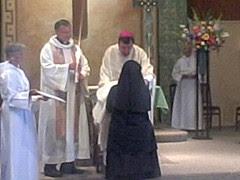



 Posts
Posts