[[Sister O'Neal, thank you for answering my questions on profession when one does not really want it. The lay hermit I was speaking of said that while she didn't believe this was what [Jesus] was calling her to, she would turn in her paperwork and then if it really seemed to be wrong for her, "I can always decline the kind offer of canonical approval, can't I?" It sounds to me like this hermit doesn't understand what is being offered to her or why. Does this happen a lot? Are there hermits out there who feel this way about their vocation? I wonder if a person could really embrace a life of solitude if they did.]]
You are right about the lack of understanding here. To begin with it is very unlikely anyone is "offering to profess" this person given the level of ambivalence and even potential disingenuousness she admits to. In short though, she does not feel called and nothing can be done in the absence of a sincere heart-felt sense of being called. As I have noted before admission to profession is not so much an offer or invitation the Bishop makes (especially not in order to "approve of someone") as it is the way he extends the rights, obligations, essential freedom, and call to the covenantal life of an ecclesial vocation to the person he is also convinced is called by God to this. When the Church admits to profession she mediates this divine call to the person in a formal, definitive, and solemn way and receives the person's definitive response in a way which establishes a sacred covenant marked by vows, structured legally (canonically and by Rule), and supported by all of the relationships the Church recognizes as essential to living such a covenant well and fruitfully. The language of "approval" hardly begins to convey this rich content and has only very limited utility in such a situation; I tend to avoid it while those stressing the supposed status (in the inaccurate sense of prestige) of canonical standing (standing in law) tend to use and misuse it exclusively.
 IF a Bishop invited a person to "turn in her paperwork" he has more likely invited her to let him and others take a look at her Rule or Plan of Life, and perhaps, to participate in a serious and mutual discernment process. (No other paperwork is required at this point; in time Sacramental certificates, declarations of nullity if applicable, etc, indicating a person is free to be professed will be required when it seems the person is a suitable candidate --- though the declaration of nullity would be sought immediately because its lack is an impediment to profession and discernment hardly makes sense with such an impediment in place.) During this process, should she (or anyone in such a position) come to be convinced she is NOT called by God to this, she (or anyone in such a position) has a responsibility to notify the chancery and withdraw from the process. I would therefore be very surprised to learn that a situation like the one you referred to EVER really happens and more surprised to hear there is ANY diocesan hermit who feels this way about his/her vocation. (A hermit who decides she has made a mistake in accepting admission to perpetual profession will, after serious consultation, ask to be dispensed from her vows. If the vows are temporary she can (again after serious consultation) either seek a dispensation or decide to continue the discernment appropriate to such vows until they lapse and it is time to apply (petition) for perpetual profession.)
Your next to last question is the most important, and the most interesting one because it raises the prospect of living a life which is contrary to what one truly feels called to when that life is a rare way to achieve human wholeness and holiness anyway. It raises the question of integrity and what it really means to be called by God and to respond to that call with one's whole self. It raises questions about embittered "hermits" who are icons of isolation and misanthropy, but are nothing like hermits in real life --- at least nothing like the hermits who are truly citizens of the Kingdom of God living the incredibly joyful and fulfilling "silence of solitude." For now your questions underscore the kinds of things chanceries watch out for when people come seeking to be hermits under canon 603.
 I think the bottom line must be that the person recognizes canon 603 as a gift of God to the Church and is awed and excited by the sincere sense that she might just be one of the persons who are publicly called and commissioned to live this gift. She will have found that through the grace of God eremitical solitude brings her to a wholeness and holiness she could not achieve as well in other contexts. She will be in love with God but also deeply in love with those he also loves as he loves the hermit.
The silence of solitude she lives will be rich and filled with relationships: first with God, but through God with her parish, friends, other hermits around the world, and those in the diocese more generally. If she has a blog there will be friends from there as well though there may be very little contact. For some very few hermits there will be a call to reclusion; for one of these her love for others will be mediated only through her love for and relationship with God. Every genuine hermit is open to this possibility and to growing towards it. Again though, what one will note in such hermits and all canon 603 hermits is a sense of awe, responsibility, and great joy at being called to live publicly committed lives which continue the tradition of the Desert Fathers and Mothers in the contemporary Church. It really is an awesome thing to be called to love and serve God and others in this way.
Post script: Sorry, I didn't answer your last question explicitly so let me come back to that. Would someone be able to embrace a life of [eremitical] solitude if they felt they were not really called to it by God [or felt this call deep within themselves]? I can't see how. One wonders how people live any life if they feel profoundly that God has not called them to it. I would imagine a sense of resignation and quiet desperation would accompany much of such a life. But with solitude where the heart of the vocation is communion with God, and where often or for much of the time the only relationship one experiences directly is that one has with God it would be very much more problematical to try and live such a life.
This would be complicated by the fact that God calls us to serve others with our lives and such a person would also be missing the way God is calling them in particular to serve others. The examples I have seen of those trying to live in such a way (and I have seen at least a couple) turn God into a source of monstrous theology and make of their own lives one of unrelenting suffering and victimhood. These are dressed up in pious language of course, but the combination is pathological on every level and the result is extremely sad and destructive, to say the least.
28 March 2013
Discerning Canon 603 Life as a Gift of God


19 March 2013
What if a Bishop Retires? Will a Candidate Still be Professed?
[[Dear Sister Laurel, what would happen if a Bishop had approved a hermit for consecration according to canon 603 and then retired or became ill and was replaced by a new Bishop?]]
 I can only say what the possibilities would be, and speak in likelihoods, but generally my own sense is that the profession and (with perpetual vows) consecration would go ahead with the new Bishop. If the person is already under temporary vows it is possible that a new Bishop would ask them to renew these at the appropriate time until he can get to know her and the vocation more specifically and admit her to perpetual profession and consecration. If there had yet been no temporary profession then it is likely the new Bishop would admit the person to these for a period of three to five years as the process of discernment continued.
You see, the discernment process for this vocation does not involve ONLY the Bishop nor is this only a personal decision of his, but instead it is one made on behalf of the Church. Long before a hermit candidate speaks to the Bishop (at least in my experience) she has met with Vocations personnel or the Vicar for Religious or for Consecrated Life. These meetings are periodic and give both persons a chance to really know one another. In my own process of discernment one Vicar met regularly with me in my own hermitage over a several year period. She also traveled to a hermitage in another part of the state to speak to the Prior about what was needed to live a healthy eremitical life because this was not something she was familiar with first hand. At another point in the process I met with co-Vicars and we took the steps needed so that they would be able to make a recommendation to the new Bishop. During that period (about a year or year and a half) I wrote another version of my Rule or Plan of Life which was submitted to canonists for approval, made sure all the paperwork necessary was nailed down, and waited to hear from them on any "loose ends", as well as on their decision. They recommended the Bishop profess me and asked me to make an appointment with him.
In that meeting the Bishop made clear his intention of meeting with me several more times, learning all he could about the eremitical vocation, reading anything I had written (articles, Rule, etc) --- he wanted to meet me BEFORE reading anything I had written --- and only then making a decision about professing me. About a year later he made his decision. My sense is this is all fairly typical. What I hope is clear is that the discernment process is fairly lengthy and careful, but also, that this is not simply the Bishop's decision --- though it is ultimately his of course. If a person has reached the stage where a Bishop has agreed to profess her and he becomes ill or retires, the Bishop replacing him would be likely to accept the seriousness and competence of his recommendations and those of his curia in admitting this person to vows. After all, the person's petition is a serious one and she has gone through a lengthy discernment process; it would hardly be just to simply dismiss her or her petition and the process or the work of one's curia.
I have also written about this before in response to a question which was put more negatively and in that response I noted that it was possible for a Bishop who did not believe in the vocation for some reason to refuse to profess anyone --- though one hoped it would not be a decision driven merely by personal bias. One would hope that someone already in temporary vows would continue and be professed perpetually even by such a Bishop once he got to know her and the vocation itself. Still, I do think it is unlikely that someone whose petition to be professed under canon 603 had been approved by the outgoing Bishop would not be at least temporarily professed by the new Bishop out of respect for his predecessor's decision.
14 March 2013
Should Hermits be Professed at a Parish Mass?
[[Dear Sister O'Neal, I have heard that professions of diocesan hermits need not take place during Mass and that those insisting on making their profession during Mass are opting for something which canon law does not require; I also heard it is something which goes against the hiddenness and simplicity of the hermit vocation. Is that correct? The person who said this asserted that the Catechism and Canon law say that there needs to be no big service and there can even be just a sign of commitment. A public celebration is not necessary or even appropriate. The idea of having lots of people attending seems to be something some hermits need for ego, or as a sign of being "approved of" etc. You made vows at a public Mass. Why did you choose that option?]]
 It has been a while since I heard these arguments about ego and canonical "approval". I am disappointed they are being made once again. I have tried to be tactful in responding to the attitude and errors involved, not always successfully; I admit that that is a bit taxing sometimes. Still, there is an essential tension between the public character of this vocation and the call to essential hiddenness or stricter separation of the diocesan hermit. Exploring this tension is something I enjoy and believe is important even apart from statements like those you have asked about; for that reason let me approach your questions from that perspective.
While it is true that initiation into religious life (what is called reception into the community for instance) is not allowed to take place during Mass, and while first, simple, or temporary vows which will be liturgically a relatively simple matter may or may not take place during Mass, perpetual or solemn vows are a different matter and the Church says clearly that it is appropriate that these occur within the context of a public Mass where attendance can be high (par 43 Rite of Religious Profession for Women, "It is fitting that the rite of profession by which a religious binds herself to God forever should take place on a Sunday or a solemnity of the Lord, of the Blessed Virgin Mary, or of a saint distinguished in the living of the religious life." and again, no 45, "Notice of the day and hour should be given to the faithful in good time so they may attend in greater numbers." )
Other prescriptions delineated in this Rite involve the use of the cathedral or parish church, making the profession at the chair and in the sanctuary, use of fitting solemnity but also eschewing lavishness unbecoming religious poverty, sufficient bread and wine for all, what is necessary for the giving of insigniae, etc. Could a hermit choose to do something else? I suspect they could; whether it would be theologically and liturgically appropriate is something the hermit and her Bishop would need to determine. Certainly the hermit could choose a Mass with a more intimate setting, especially for temporary profession, but again, it is the Church herself that specifies the appropriateness of wide attendance and publicity in her own Rite of Religious Profession.
You see, none of this has to do with ego or the hermit's desire for public recognition; it has to do with the Church's esteem for this vocation and the appropriateness of a liturgical celebration for life commitments like this. (Thus we do the same with Baptisms, marriages, consecrations, and ordinations --- whenever public commitments are made which establish the person in a new public identity or state in the Church .) As
for the claims that the CCC and Code of Canon Law say a hermit need not have a service
and may use only a sign of commitment, I don't know anywhere that either book says anything about this with regard to canon 603 hermits. Canon Law (cc 654-658, the section spelling out the law re profession of religious says nothing about this; C 603 itself is merely clear that the hermit may
make vows or other sacred bonds. It says nothing about the context in which
these are to be made. The CCC does not address either issue of course. In other words,
these claims seem to me to be specious and simply plucked out of the ether.
It is true that in
dealing with private vows the Church tends to expect these to take place outside
Mass so people do not confuse them with public vows or vows made and received in
the name of the Church. Perhaps the person you are quoting was speaking of
private vows rather than public ones and something other than either the CCC or
Canon Law per se. Alternately perhaps s/he got the references wrong. The issue of sources aside, it remains possible s/he was speaking of temporary canonical vows or professions, but perpetual or solemn vows and actual consecration are a different matter and there is no way one makes a solemn commitment like this without a liturgical celebration (Mass).
 Your
question about my own profession taking place at a Sunday Mass seems to be tied to
the notion that it was done out of ego. Let me correct that idea. First , I did not choose to have a Mass; my diocese naturally set up a date and
time when the Bishop would preside at my profession and the appropriateness of
this occurring at a Mass was understood by everyone. This is not simply custom but at heart a reflection of our sacramental theology and theology of church. So my pastor and I worked with the diocese and used the official texts for the Rites of Religious Profession; I also worked with a canonist and Vicar for Religious to assure all was done in a way which was legitimate and
appropriate.
Your
question about my own profession taking place at a Sunday Mass seems to be tied to
the notion that it was done out of ego. Let me correct that idea. First , I did not choose to have a Mass; my diocese naturally set up a date and
time when the Bishop would preside at my profession and the appropriateness of
this occurring at a Mass was understood by everyone. This is not simply custom but at heart a reflection of our sacramental theology and theology of church. So my pastor and I worked with the diocese and used the official texts for the Rites of Religious Profession; I also worked with a canonist and Vicar for Religious to assure all was done in a way which was legitimate and
appropriate.
Details which were worked out in advance included the texts of the
vows or vow formula (I used a vow formula I had used before but with some slight changes for the occasion), the insigniae (ring, cowl) and other things (candle, vows to be signed during
Mass), readings, and all the persons who would be participating in the liturgy
apart from the assembly (servers, lectors, cantors, delegate, concelebrants, etc). The diocese provided a worksheet for all of these
things and, immediately prior to the Mass, provided several legal documents which needed
to be signed apart from the vow formula itself. (That is signed on the altar --- in this case by the bishop, myself, my delegate and the pastor of the parish.) In other words, this was a diocesan matter undertaken on behalf of the universal Church, not something I desired out of ego; it was undertaken because the Church clearly saw it as completely appropriate and significant.
But let me be equally clear: there is no doubt I would always choose to make perpetual profession
during a Mass. Theologically and liturgically this would have been completely fitting
for the solemnity and significance of the event. It should be clear that life
commitments of this sort which also mediate God's consecration and the commissioning of the Church are appropriately done during
Mass where the effective (real-making) symbolism of self-gift, consecration, and commissioning are clearest and
paradigmatic. This is also important since the person making the commitment is assuming public/legal rights and obligations which affect the entire Church, and
which most intimately affect her local Church --- both diocesan and parish
communities. While the hermit may live a life of essential hiddenness, the act of
perpetual profession is both a public and an ecclesial one. It is an act of love celebrating the God who calls us to life in union with him, espousal to Christ, and communion with one another. It marks and implicitly celebrates all the forms of love that have brought the person to this moment: Divine, familial, community, friends, et. al. It is only appropriate that all of these people should be able to participate in such a celebration of love and grace --- and of course that it be done at Mass where Christ is uniquely present, proclaimed, and received.
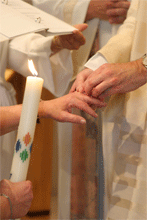 Further, the Rite of Profession marks a commissioning to make this love even more fruitful in the future and says we do this together. No authentic hermit is ever truly alone and that is certainly true of a diocesan hermit. Not only does she live with and from God, but she lives at the heart of the Church and is publicly commissioned (at the very liturgy we are discussing in fact) to do so in an essential hiddenness. Such life is always nourished by the Church (especially in Word and Sacrament) even as this same life nourishes the Church as a whole. Finally, I should note that if it is appropriate for strictly cloistered nuns to celebrate their own solemn professions in the
sanctuary of a church open to visitors (and in the mind and position of the Church it certainly is!), then it is appropriate for the diocesan hermit to do similarly because in either case we are celebrating the Holy Spirit's gift to the Church, a gift which is part of her call to prayer and holiness, a gift which is meant to inspire and nourish her in this goal.
Further, the Rite of Profession marks a commissioning to make this love even more fruitful in the future and says we do this together. No authentic hermit is ever truly alone and that is certainly true of a diocesan hermit. Not only does she live with and from God, but she lives at the heart of the Church and is publicly commissioned (at the very liturgy we are discussing in fact) to do so in an essential hiddenness. Such life is always nourished by the Church (especially in Word and Sacrament) even as this same life nourishes the Church as a whole. Finally, I should note that if it is appropriate for strictly cloistered nuns to celebrate their own solemn professions in the
sanctuary of a church open to visitors (and in the mind and position of the Church it certainly is!), then it is appropriate for the diocesan hermit to do similarly because in either case we are celebrating the Holy Spirit's gift to the Church, a gift which is part of her call to prayer and holiness, a gift which is meant to inspire and nourish her in this goal.
07 March 2013
Clarifying an Argument

First, let's be clear that the Church has never held that in religious profession Sisters or nuns merely become engaged to Christ or that there is not a genuine espousal in the original Semitic sense. Keeping that in mind let's temporarily hold onto the crude hypothesis put forward by some CV's that some are "engaged" and others are "married" just to explore the importance of omitting the spousal language, imagery, symbolism and the prayer of consecration as the Church requires for a woman participating in both rites (Perpetual Religious Profession and Consecrated Virginity). As I will argue below, you are correct that persons become espoused when they are consecrated. It is for that reason the Rite of Perpetual profession omits this when the consecration of virgins is to be received as well as the Rite of (Solemn or Perpetual) Profession.
My argument went something like this:
1) if the meaning of the spousal imagery, language, and symbolism in the Rite of Profession is essentially different than in the Rite of Consecration of Virginity, that is, if it means engagement in the first rite and marriage in the second (as one CV's argument would imply), why should anyone omit these things from the first Rite? Quite the contrary: if these elements are the means to becoming engaged in the first Rite and married in the second, and one is moving from engagement to marriage, these things should be retained
2) Similarly, if a Religious "consecrates herself" in the Rite of Profession, but is consecrated by God in the Rite of Consecration of Virgins, and if the two prayers of consecration or solemn blessing are therefore different in meaning and significance, then why shouldn't they be repeated in the two Rites? Omitting them from the first Rite for someone receiving/participating in both Rites only makes sense if their meaning is essentially the same. Otherwise the Church's concern with duplicating these portions of the Rites is unwarranted. There are theological reasons for confirming Religious do not "consecrate themselves" but this underscores those.
 3) Espousal only occurs once, and for this reason the Church omits all associated spousal language, imagery, and symbolism from the first Rite (Solemn Profession) ONLY if the nun is going to also participate in the Rite of the consecration of virginity. The dynamic of dedication and consecration which forms a whole is only "completed" in the two Rites together when a nun is ALSO receiving the consecration of virgins.
4) Similarly, it is because the language, imagery, and symbolism is part of effecting and marking the same espousal that the Church includes it in the Rite of Solemn profession for those NOT receiving the consecration of virginity. Likewise the prayer of solemn blessing or consecration (also an effective or performative language event) is used in profession for those NOT participating in the Rite of Consecration of virginity because such a consecration is received only once. In other words the act of mediation of God's consecration of the person by the Church symbolized in the prayer, even when the two Rites are separated in time, is only accomplished ONCE for each nun but it MUST be completed in one Rite or the other because the nun does not consecrate herself.
5) What differs (or can differ) is not the basic spousal bond, but the graces, charism and commission attached to the two vocations. My sense is that ordinarily the consecration of virginity makes more explicit the spousal bond but this may not always be so. What emphatically would NOT happen in a monastery of nuns for instance would be some being "engaged" to Christ and others actually "married" to him. In all cases, whether through the consecration of the rite of religious profession or the addition of consecration of virginity the Sisters are espoused to Christ.
I hope this is helpful.
06 March 2013
Called to Canon 603 and yet "sickened" by Canon 603 eremitical life?
[[Hi Sister Laurel, are hermits called to profession by their parishes or Bishops? I guess I am asking if a person could feel adverse to becoming a canon 603 hermit but be called to it by parish, diocese, or Bishop? I heard someone calling herself [name omitted] suggest this. She doesn't think canonical status is a good thing and says she is even sickened by it. She says she believes it will not and should not last as an option because of all the abuses by Bishops and hermits, but also that she would be willing to accept it if her Bishop said he wanted this. Her point is that there are graces for the church and for the hermit which come from public profession so she is open to these graces.]] (redacted)
If I understand your first question, the answer is no, this is not the way things work with regard to this (or any!) vocation and especially not ecclesial vocations. While a diocesan hermit is called forth from her faith community by representatives of the Church on behalf of God and the entire Church during the Rite of Religious Profession, and while both hermit candidate and Church are involved in a serious mutual discernment process up through this point (and beyond it if the vows being made are temporary), this is not like a community discerning that perhaps someone from their midst should serve as deacon and then assisting and supporting them in going through the training and formal discernment process, for instance. Still, please note that even in such cases the person must themselves truly discern the vocation and the Church still may or may not concur. This means they must see its value, believe profoundly it is a gift of the Holy Spirit given to the Church and world, and also feel certain in their heart of hearts that God is calling them personally to this. Only when this is the case is it really possible for the Church hierarchy to truly discern the truth of this for this diocese and at this point in time.
Remember that when we are called to a vocation and especially to an ecclesial vocation like Religious life, ordination, or consecrated virginity we take on not only our own personal vocations but a place in the living tradition of that vocation itself. I honestly don't see how someone who actually felt "sickened" by the vocation itself, who thought it would and should die out, or who was merely undertaking it because they were asked to do so could represent it authentically. Surely we could not say this was the Holy Spirit's work in their lives because they simply have no love for any of this, not for the vocation, not for the way the Holy Spirit is working through this specific vocation, not for those others who do feel so called, and not for the unique gift the vocation represents and which those representing it are called to live with heart, mind, body, and soul.
 The underlying question here is the nature of true obedience which is at the heart of all genuine discernment. While all of those vowed to obedience will be asked to do things from time to time they may not fully agree with, they simply cannot go against their heart of hearts and still be truly obedient to the will of God in their own lives. Obedience is not merely about "doing what one is told"; it is about listening intently to the voice of God in one's life and acting on that. A major part of that is surely listening to one's own deepest convictions. More, doing what one is told and simply disregarding or denying the contrary voice of one's own heart is not authentic discernment either although it has sometimes been mistaken for this. In the case you have described, presuming the person is actually in honest dialogue with the Bishop (or diocese) about this, both the Bishop (or his representatives) and the candidate are called to listen intently together to determine the will of God in this diocese and in the life of this person.
On the graces attached to public profession:
Yes, there are graces attached to public profession. But these are not something that can be externalized, concretized, or reified, and then piled into a basket to be showered on the candidate (or others) like rice after a wedding. The graces are not extrinsic to the actual call/response itself. In other words if the Church is not mediating a true call and the hermit is not responding to one the profession will not be the grace-filled event it is meant to be. Grace always has to do with the powerful presence of God and in the act of public profession this powerful presence is unleashed in the heart of the hermit and in the life of the Church as well. Thus, we see the hermit becoming more herself, experiencing a freedom she may have only opaquely sensed was possible, and otherwise bearing fruit in many different ways in her own life, the life of the parish and diocese, with regard to this vocation, etc.
In the ecclesial and personal act of profession the person commits her entire self to God and therefore, to her vocation, to the church in Christ, and as a result God is able to work in her life in ways which are not generally possible apart from such a commitment. Another way of saying this is that in making a whole-hearted commitment, the person opens herself to the active and powerful presence of God in ways she has longed and been called to do. Of course this will bear fruit. But what a different picture of profession stems from the situation described in your question! The idea that a person who did not truly feel called, is sickened by the vocation itself, is acting on someone else's desires and not those of her own heart simply does not comport with the idea of authentic profession; it will hardly be a grace-filled occasion in the way one truly called experiences it or the way a Church depending upon authentic discernment of the will of God at every level experiences it.

Abuses by Bishops and Hermits:
As a reader of this blog you are probably aware I have no great sympathy for actual misuses and abuses of canon 603. I have written about several that have occurred over the last three decades as well as tendencies which can lead to actual abuses or misuses. I have also written about the consequences of such misuse or abuse. Still, it is not the case that this is common. Far more often we are merely dealing with a learning curve with both Bishops and hermits coming to greater experiential understanding not only about the eremitical vocation but to its shape and significance for the contemporary Church and society at large. Canon 603, as I have written, balances non-negotiable or essential elements which have been present throughout the history of eremitical life with a Rule written by the hermit herself which allows her to shape these elements faithfully but personally according to her own authentic discernment of God's call in her life. This is PART of the nature of the call itself and a piece of what public profession requires of the hermit, how ever she determines she is meant to do this.
The variations we see in canon 603 hermits (age limits, habits or none, titles or no titles, vows or other sacred bonds, location of hermitage, horarium, differences in ministries apart from prayer alone, level of participation in parish life, and a number of other things) are mainly a function of the healthy interplay of these two dimensions of the canon as hermits, their Bishops, delegates, pastors, Vicars, and others discern what the Holy Spirit is calling them and the Church to in regard to canon 603. Remember that there are very few rules or laws in place about the use of canon 603 beyond the content of the canon itself. There is no sense that this is changing and I think that is a good thing. However, general experience and prudence figures into all of this in significant degrees. Thus, for instance, we generally find this is a second half of life vocation and though there is no rule about this, the Church will assess the wisdom of professing younger vocations as solitary hermits on a case by case basis. (Ordinarily they do better to try their vocations in an eremitical or monastic community.) Errors may occur in this and in other things, but this does not necessarily mean anything has been misused or abused, much less that variation means abuse is rampant.
 It is when the actual nature of the life defined in the canon, or the essential elements themselves are disregarded that we get actual abuses. So, a canon meant to govern solitary eremitical vocations should not legitimately be used to create communities and skip the canonical process already established for that; a life of full-time ministry outside the hermitage with contemplative prayer on Saturdays should not use canon 603 simply because there is no other canon available to profess individuals; persons who have been unsuited to religious life, or who have failed in other life endeavors, nor those who live alone ought not automatically be assumed to be called to canon 603 profession much less be admitted to this. While individuals may seek to use the canon in these and other illegitimate ways, at the level of the chancery itself my own sense is that in the main canonists and Bishops do not often allow these persons to be professed and Vicars or Vocation personnel do not entertain such petitions. Exceptions are problematical, no doubt, and they must be addressed, but they are still exceptions.
Bottom Line:
I don't personally believe any Bishop would actually ask a person who felt the way this person says she feels about canon 603 eremitical life to even consider becoming a diocesan hermit --- at least not if she is honest with him. Clearly there are a number of significant reasons for this. It may be that speaking this way allows someone to temporize and thus deal in increasingly effective ways with some sort of disappointment that she is not called to this or deal with the fact that her diocese will actually not profess her. But whatever the reason, I think her expectations and approach are, at best, unrealistic and misleading regarding the nature of vocation, discernment, obedience, public profession and the graces and import of public profession within the church.
04 March 2013
Should our Focus be ONLY on what makes vocations distinct from one another?
[[Dear Sister, if espousal to Christ is an icon of the Church it seems to me that married couples would also serve in this way. But if this is true, then how does the witness they give differ from that of religious and consecrated virgins? I am trying to understand what distinguishes these vocations. If EVERYONE'S vocation represents an instance of the spousal bond with Christ, then doesn't the vocation of the CV lose its distinctiveness? You quoted one CV a few weeks back who said if the vocation didn't have its own mission and identity she hoped it would simply be suppressed. Doesn't your theology empty this vocation of distinctness? Doesn't it lead to the very situation this CV outlined?]]
First, let me quote the passage you are referring to just so it will be available: [[ I often think that it will be good if CV lives its own ancient charism like the virgin-martyrs in today's world . But if it is called to modify its charism and embrace what other vocations like secular inst and laity already are called to live, then I personally would prefer if CV is totally suppressed by the Church or used as a ceremony or rite available to all vocations of consecrated life but not as a vocation with its own identity and mission.]]
Regarding the Sacrament of Matrimony, it is true that it represents an icon of the Church and of the spousal bond with Christ shared by everyone in the Church. Remember that Pope Benedict wrote: [[This means that Christ and the Church are one body in the sense in which man and woman are one flesh, that is, in such a way that in their indissoluble spiritual-bodily union, they nonetheless remain unconfused and unmingled. The Church does not simply become Christ, she is ever the handmaid whom he lovingly raises to be his Bride and who seeks his face throughout these latter days.]] (Called to Communion) While Benedict was writing here in part to establish the Trinitarian nature of espousal it follows clearly that married couples are icons of the Church as spouse or Bride of Christ. Further, it is important to note that both males and females serve in this way.

Every vocation reminds us of dimensions of what we are ALL called to. There is NO vocation which is merely distinct or meant to point to the specialness of the one called. In other words there will always be overlaps in the nature of each vocation because each one images and witnesses to Christ and the Trinity. Ordained priesthood makes explicit and paradigmatic dimensions of the priesthood of all believers and the call to be Christ for others as Christ was given for others. Similarly Religious life makes explicit and paradigmatic lives of prayer, service, and the evangelical counsels rooted in a spousal relationship with Christ all are called to in some way. Consecrated virgins are called to make explicit the spousal bond every Christian is called to and to live out the gifts of spousal, maternal, and virginal love which are the perfection of every act of Christian ministry and care; some (those living in the world) are called to do so in a way which summons anyone living a secular life to such authentically human ways of being. Others do so as persons separated from "the world" by vows and cloister and also call all to authentically human being.
 While the things that distinguish vocations from one another are important, focus on them need not blind us to the deep similarities and foundations they share. Only as we are aware of and honor these can we truly esteem the one who is their source rather than the one who is gifted by him. Vocations' diversity and special charisma are important because the Body has different functions and needs but there is a universality about these as well. For instance, every life can and should witness to the nature and place of solitude in the redemption of isolation but few can do so as effectively as hermits. This is part of the gift all eremitical lives are to the whole church and world --- not because only hermits are called to authentic solitude, but because we ALL are.
  Beyond this, lay hermits may be able to speak more powerfully about this to many people who will never have standing of any kind than will a diocesan hermit who has been given standing in law. On the other hand, the diocesan hermit may (and only may) be able to witness more effectively to others about the history of the eremitical vocation in the church as well as to its ecclesial nature and its normative characteristics and significance by virtue of her standing in law. Though there are meaningful differences, the two vocations are essentially the same; where they differ is in graces, charisms, and mission. It would be a terrible mistake to argue that these qualitative differences are necessarily the same as differences in essence. The challenge is to honor BOTH commonalities and differences. The result of failing in this is elitism and an inability to truly witness in the ways the Church calls on us to do. Remember that martyrdom refers to witnessing with one's life to the love of God for us in Christ. That love is a covenantal or spousal love offered to all and meant to turn this world and its values on their heads.
22 February 2013
Misunderstandings Revisited
[[Dear Sister O'Neal, I wrote you the post about CV's as brides and religious as engaged and about your not esteeming the CV vocation and calling it secular because of that. I think you understood my questions. Could you please answer them for me? Is this direct enough? I don't understand what you mean by "passive aggressive nonsense." Thank you.]]
First, thanks for trying again. I appreciate the fact that you dropped the assumptions you were making about my motivations and attitudes. Thank you for that.
According to the post I put up a couple of weeks ago, the questions I outlined were as follows: [[ 1) Are CV's Brides of Christ in a sense different from Religious women and should they be esteemed for that identity? (In your post I think this boils down to the elitist, "Shouldn't we esteem them because they have been chosen for such a special identity?") 2) Am I reacting negatively to CV's living in the world either because they are REALLY Brides and I am "only engaged" to Christ (assuming this is even the case), or because I don't care for the bridal or spousal imagery attached to both vocations? and, 3) have I actually somehow said that the vocation of the CV living in the world is not wonderful and worthy of recognition because I consider it a secular vocation?]] I also want to briefly add something about Religious tending the eschew the spousal imagery and identification because your post referred to that.
First, is there a difference between CV's as Brides of Christ and Religious as Brides of Christ? Are they Brides or espoused in a different sense from one another? Is one a Bride and the other not? To begin with then, I think we have to understand that the spousal language and imagery in both the Rite of Consecration and the Rite of (Perpetual) Religious Profession is strong and rooted in Baptism. Both speak of Christ as the person's only Bridegroom and there is no sense given that one reference is metaphorical while the other is literal. Further, both rites include a prayer of consecration and the giving of a ring; there are other elements of the rite which have specifically nuptial significance as well. Thus, in the case of nuns ALSO being consecrated as virgins all of these specific elements are omitted from the Rite of Perpetual profession so that they are not duplicated. (cf. Rites, v. II, Chapter III, Consecration to a Life of Virginity, par 7.) This signals to me that the spousal nature of these elements is explicit and identical in both Rites. Were they different in significance duplication would not be a problem and the Church's caution about doing so would be unnecessary. (This is especially true were the spousal elements to indicate "engagement to Christ" in the (prior) Rite of Perpetual Religious Profession and actual marriage in the (subsequent) Rite of Consecration of Virginity, as one CV has mistakenly argued in her blog.)
From all of this two things seem clear to me then. First, the Church does not allow a duplication of consecrations (thus, there is ONLY one prayer of solemn blessing or consecration used, even when the two Rites are separated in time) which suggests they do not differ essentially. Neither, then, does she treat the Religious' profession of solemn vows as the equivalent of the prayer of consecration as though "Religious consecrate themselves" with the vow formula itself. She clearly expects the effective (mediatory) prayer of consecration to be included in some way which "completes" the dual movement we identify as dedication/consecration in the Rite of Perpetual Profession itself --- whether with the additional use of the Rite of Consecration of Virgins or without it. Thus, if the nun is not receiving the consecration of virgins, the prayer of solemn blessing or consecration (the meaning is the same for these terms) as well as the giving of the ring, and all of the nuptial language throughout the Rite, are definitely used during her liturgy of solemn/perpetual profession. Secondly then, it seems clear to me that the nuptial imagery and language are similarly significant and essential in both Rites; for that reason, while they are not to be duplicated, neither are they to be ultimately omitted; that is, they are only omitted temporarily in anticipation of their use in the additional Rite when it is used.
Because of this I would have to argue there is no essential or fundamental difference in the senses in which Religious and CV's are espoused to Christ. Where there may be some qualitative differences however, are in the graces and charisms of the two vocations --- at least in the directness and explicitness of these. For instance, it is the call of CV's to live out the graces of spousal, maternal, and virginal love and to do so recognizably and explicitly. The CV is graced in ways which allow these forms of love to be specifically fruitful in her life and, I would think, explicit in her ministry; doing so is the distinct gift she brings the Church and world --- but not because she is wed to Christ and Religious are not. In living these forms of love out explicitly she serves not only as an icon of the Church (which is Bride of Christ) but of the generosity of Mary in regard to God and those he loves, as well as a witness to the Kingdom of God in which we each and all live in unbroken union with God so that no one will be given in marriage.
 Religious are also called to live out spousal, maternal, and, if not also virginal, then celibate love. (In the early Church the term virginity did NOT refer only or even primarily to physical intactness. Instead it referred to a kind of wholeness and undividedness of person which allowed the virgin to dispose of herself according to her own free choice. Note well that we still call St Perpetua a virgin martyr despite her marriage and childbearing.) Throughout the history of religious life the vow one made was one of viginity and the spousal theme was "elaborately developed" (Schneiders, Selling All, 121). The recovery of the Rite of consecration of virgins living in the world does not change this part of the Church's Tradition nor does it deprive Religious Profession of this character. Rather, it extends it explicitly into the secular realm and underscores the value of physical virginity (as well as purity of heart) in a sex-saturated world. Today we find that despite this history most Religious today prefer the language of chasity or consecrated celibacy and tend to accent remaining "unmarried for the sake of the Kingdom" rather than "marriage to Christ" in part because this accent expresses their availability and the charism of their vocation better than the term marriage.)
Even so, as Sister Sandra Schneiders writes: [[The life option expressed by profession is the commitment to love Jesus Christ totally, absolutely and forever, and to express and embody that love (which is the calling, of course, of all the baptized) in the complete and exclusive self-gift of consecrated celibacy (which is not the calling of all the baptized).]] and again, [[The commitment to religious life is a commitment to a person, Jesus Christ, in irrevocable love expressed in a particular form, namely, lifelong consecrated celibacy analogous to marriage, which is a commitment to the spouse in irrevocable love expressed in the particular form of lifelong and total monogamy. This commitment is a total self-gift that has an absolute priority in one's life and begins with no qualifications or loopholes or "ifs" and "only ifs". ]].
Thus, Religious too are graced in ways which make their relationship/union with Christ primary and model Mary's own obedience and fecundity. They too live lives which are icons of the Church's relationship with Christ the Bridegroom (the Rite of Religious Profession makes this clear). However, ordinarily they are commissioned to live these graces out differently and oftentimes less explicitly than CV's. (Obviously some Religious feel called to live these out in more explicit ways than others so this is not a distinction carved in stone. It is merely generally so.) Still, the bottom line seems to me to be that CV's living in the world are called to live these graces out in a life of eschatological secularity while Religious are not. Again, I have to say both Religious and CV's are similarly espoused to the Christ as Bridegroom but the variety of graces, commissions, and charisms attached to this foundational identity differ.

Your second question is based on a misconception I already addressed both above and in the earlier post. It is NOT THE CASE that Religious are "engaged" while CV's are "really married." Certainly the Church has NEVER held this to be so. It may be based on a misunderstanding of the two stages of Jewish marriage in which betrothal means marriage already. (cf other posts on this.) Beyond this, my own relationship with Christ is subjectively nuptial, that is, I experience myself completed by Christ both as a person generally and as a woman more specifically in a relationship which has a singular (or, better, what seems to me to be an amazing or literally awesome) mutuality about it. This relationship is presupposed in all I am and do. So no, no sour grapes here.
However, what is also the case is that I do not feel any call to identify myself primarily or publicly as a "Bride of Christ". Instead, despite the fact that this status is both objectively and subjectively real for and precious to me, I feel a call to allow this to be foundational to my identity but to remain mainly implicit in my vocation. What is explicit is my call to solitary eremitical life, the life of the vows, and my service to the Church and world through these. There is nothing I do or am that is not profoundly affected and qualified by my nuptial relationship with Christ or the graces of spousal, maternal, and virginal love which stem from and accompany it (some, I think, more than others and at different times of course), but I do not feel called to identify these graces explicitly or publicly as the essence of my vocation nor are they the specific or explicit gift or charism I am called on to bring the Church and World. For my own vocation they are ordinarily an entirely private intimacy I share with God alone. So, once again, no sour grapes here.
 Regarding your third question, I have absolutely NOT suggested that the vocation of the CV living in the world is somehow unworthy by referring to its secularity. As I have noted before, I sincerely believe that it is ONLY in accepting this vocation's secularity that it can be properly understood and esteemed by the entire People of God. Otherwise it can come across to people as half-baked ("why didn't you go 'all the way' and become a nun?") badly motivated, ("is this just for nun wannabe's who were unsuited to religious life or who simply were unable to embrace a call to sexual intimacy and "real" marriage?") or anachronistic ("Why is reprising this vocation important for the contemporary Church? It seems irrelevant and a step backwards.").
I also sincerely believe that the vocation is esteemed by the Church (though it remains less than understood by the majority of Catholics whose only or at least primary experience of consecrated life is Religious life) and the only thing which could turn it into a second class vocation is the belated imposition of requirements which make the vocation quasi but not fully Religious and which therefore, minimizes, mitigates, or even wholly rejects its secularity. Doing this would ensure the vocation continues to be misunderstood as half-hearted or half-baked and invite seeing it as a stopgap or fallback vocation just as some (e.g., the LA Province) were originally concerned would be the case.
P.S., there are several significant reasons Religious generally eschew the spousal imagery so long exclusively associated with their vocations. (Obviously for some this imagery is as central and explicit as it is for the CV living in the world.) All of these reasons are significant, but for the time being I want to leave this matter with the reason I mentioned above, namely, the sense that linguistically the phrase "unmarried for the sake of the Kingdom" better expresses their availability and call to a non-exclusive love for all of God's own than does the term "Bride of Christ." I am not arguing whether this is the case or not; I am merely stating a well-established general sense of the matter among contemporary women Religious.
28 January 2013
On Hermits and Secular Vocations once again
[[Hi Sister Laurel, I like the idea of hermits living in the desert of the world and ministering to it fulltime. Think of all the hermits we would have if everyone living alone and ministering in the world were hermits! I don't see the conflict between secularity and hermits. It just seems like a wide open field of mission for hermits.]]

Of course there is no doubt that hermits are all capable of doing many forms of ministry. For instance, I could be working full time in a parish or parish school, teaching theology in a college or graduate school, doing full time spiritual direction, working as a chaplain in a hospital or hospice, writing full time, besides varied part time ministries wherever needed to supplement these. (I should note that I would be VERY happy to be doing any of these things were I called to that.) Similarly, there is no doubt all these and many many more are worthy and necessary ministries. The problem is that hermits by definition are not called on to be involved in the world to anywhere near this extent nor is this kind of ministry the primary gift they are empowered by the Holy Spirit to bring to the world. You can therefore have people doing full time ministry in the way you envision it, or you can have those same persons (hermits) living the silence of solitude with all that entails, but not both. In other words as soon as a hermit leaves the hermitage/cell in the way you describe, they cease being hermits.
Similarly, a call to desert solitude means significant withdrawal from the world in all of its dimensions. Vows of Religious poverty, religious obedience, and consecrated celibacy significantly marginalize the hermit in terms of the world just as they do every other Religious, but additionally, the hermit is called to stricter separation from the world because she is called to the silence of solitude in a desert vocation. A desert vocation means a call in which one is dependent upon God alone (as far as that is possible today!). In such a vocation one faces the poverty of one's own self apart from God as well as the richness of life when God is allowed to be one's sole source of meaning and validation. Thus, one does not build oneself into the various dimensions the world offers as avenues of productivity, meaning, service, value, and security but instead trusts in God and witnesses to the wisdom of such trust in stricter separation from the world and the silence of solitude. This is the essence of the life; it is not optional nor accidental to it.
 Obviously every vocation is lived on this planet and is, to some extent, in contact with and influenced by what happens there. However, simply being on the planet, or even in the neighborhood does not make a life or vocation secular in character. The Church does not use the term secular in this way in describing such a vocation. Thus, a monastery situated in an urban setting remains monastic and Religious rather than secular --- even when the neighborhood is invited in for prayer occasionally. A hermitage or hermit's cell located in an apartment complex in the midst of San Francisco does not make the vocation a secular one either. Secularity is not merely a function of one's street address. A cloistered nun may speak to the world powerfully precisely in her life of separation and prayer, silence, solitude, stability, and community. There is, of course an aspect of ministry to such a life and also a prophetic quality. Still, the life is not essentially ministerial in the way we usually use that term, nor is it secular or, thus, called secular by the Church. Were a cloistered nun to leave her monastery in order to engage in what is becoming known as a ministerial religious life (and even mobile ministerial life), she would simply cease being a cloistered nun in the process. In order to remain one thing and embrace the freedom which is pertinent to that thing, the nun gives up the freedom to be or do another thing. So too with the hermit.
Similarly, a person who is free to buy into and build themselves and their faith lives into all the dimensions of the world (economy, political realm, family, business or industry, etc etc) does not cease having a secular vocation because they choose to live simply or according to Kingdom values and the love of God. It is the person's essential freedom in these matters which mark them as secular. You, for instance, as a baptized Catholic (I am assuming this, I admit) are free to live a secular vocation in whatever way you desire. You can live simply or you can acquire and amass wealth in order to spend it on the needy, influence the way decisions are made in industry, politics, etc (or use it for any other worthy thing you choose); you can work for causes, travel to the four corners of the world spreading Gospel values, run for political office, help build industries that are, for instance, eco friendly and contribute to responsible stewardship of the world and generally put your life and your resources to whatever use you should choose according to the values that govern your life. In other words, precisely because you are called by God to a life which is NOT constrained by the kinds of limits and relationships implied in public vows/Religious life, you are secular and free to exercise your Baptismal consecration in almost unlimited ways by virtue and in terms of the saeculum (the world and things pertaining to the world).
A hermit is simply NOT free in any of those ways. Instead, she is profoundly free to explore the relationship of the human being with God. She is free to plumb the depths of this relationship in a way few others are. In fact, she is called and commissioned to do so. Her public vows create significant constraints and marginalize her from secularity, but so do her Rule of Life, her relationships to legitimate superiors, the requirements of canon law, and her commitment to the silence of solitude. Friendships, time or contact with family, ability to travel, ministerial options, and many other things mentioned just above are significantly limited or even curtailed for the hermit. Her vocation is not only NOT a secular one, it is more strictly separated from the world (or "the things of the world") than the vocations of most Religious men and women. Thus, the Church is clear this is NOT a secular vocation --- even in the case of a lay hermit. Of course this is not to say that it is superior to a secular vocation; it is not. It is what it is and that is Religious and eremitical rather than secular.
I sincerely hope this helps.
20 December 2012
Can one be Taught or Trained to be a Hermit?
 [[ Dear Sister, I read your post on stopgap vocations and went to the website mentioned there. I was struck by a number of things on the latest blog entry but the following was especially so in light of your post. This group apparently seeks to find ways to allow individuals to become hermits if they have some interest in doing so and they have an eye towards setting up a novitiate eventually --- which I assume means creating a community. In the meantime they are trying several different paths to get their members formation and consecration as hermits though this is clearly not their first choice of vocation.
One of these apparently was to send one of their members who would eventually be the novice mistress to a consecrated hermit in order to learn how to hermit which she would then teach to the others. That never happened it seems. Another plan is to send the individuals to their diocesan chanceries to seek consecrated hermits who can help them become hermits and then seek consecration in their dioceses. I think you are correct that this is using canon canon 603 as a stopgap way to get people professed, but what also strikes me about it is how little understanding there is of how one actually becomes a hermit. Can one actually go to a diocesan hermit and be taught or trained to be a hermit?]]
Thanks for the question. There is both a simple answer and a not-so-simple answer to your question. The simple answer is no, to the extent we are dealing with a genuine vocation, one cannot simply be taught or trained to be a hermit. Hermits are FORMED and they are formed in solitude, silence, assiduous prayer and penance, and stricter separation from the things which are resistant to Christ. They are formed most specifically in an ongoing relationship with God which dominates and orders everything else in their lives so that their lives witness to the truth that God alone is enough. Further and more fundamentally, even before hermits are formed they are CALLED. Formation is always the way we shape, educate, and train someone who is called by God to live in this way. Unless one is called no amount of training or education will make one a hermit --- certainly not, that is, as the Church uses the term.
Remember that the call to eremitical solitude is a call both to human wholeness and holiness; only very few human beings are truly called to achieve this goal in solitude. "Interest" in pursuing an eremitical life as a way to get consecrated when a cenobitical project fell through is emphatically not the same thing as pursuing eremitical solitude because one feels profoundly called to the completion that is theirs in God and very far from responding to a call in which one will be made both whole and holy in solitude. One can certainly be taught to keep a horarium, to pray in the ways a hermit prays, and if one has the temperament one can learn to tolerate and even like silence and solitude, even long term silence and solitude; however, by themselves this does not make the person a hermit. It may only make them relatively pious and isolated; and it may still mean they are only about pursuing their own goals, not those God has for them or for those for whom they live. One key difference I think is the heart created by and for the silence of solitude. One called and formed as a hermit develops the heart of a hermit in and for the silence of solitude --- a heart with which, as one friend reminded me, we hear the anguished cry of the world, and a heart which makes us God's own prayer. For the hermit this heart thrives in and expresses the silence of solitude even when the hermit ministers or otherwise shares in community. That is truly a rare vocation.
 The idea that someone could go to a diocesan hermit (or, even worse, correspond with them), get a few lessons on being a hermit, and then come back and train people in that is completely ludicrous to me. If that person were willing to BECOME a hermit (and if said diocesan hermit actually could allow -- or get permission to allow -- her the space and time for that), then we are looking at a commitment of years and even then, the "student" might well find she is not called to this, and certainly not to living it as a solitary hermit elsewhere for the whole of her life. Along with this, of course, there is the idea of placing a non-hermit who is not a religious, has never lived the vows, and has herself not been formed as a religious or educated in the theology or spirituality of eremitical or religious life in charge of forming others on the basis of a few "lessons" from a diocesan hermit. No hermit I know would even pretend to be able to do such a thing. It is not surprising this all never came to be, but it is also fortunate it did not.
Another thing that makes the answer more complicated is that of course it IS possible for candidates for profession and consecration under canon 603 to gain from education and training from already-perpetually-professed hermits. Perhaps more important though is long term formation in monastic or eremitical silence. A network I belong to (Network of Diocesan Hermits) is sometimes asked to assist such candidates by their dioceses. We mentor such candidates and try to help them with the more typical difficulties and obstacles to living the life. However, there are some pretty steep limits in this assistance. We do not do spiritual direction, nor do we pretend to have a formation program for hermits. We do not -- nor, despite our experience living the life or various expertises in spirituality, spiritual direction, and theology, do we --- generally feel ourselves capable of creating one.
Further, the person must be verified by their dioceses to be a good candidate for profession and consecration under canon 603. This means that they have already been screened to some extent, are not in the first blush of conversion, and show some promise of being a suitable candidate. (It does NOT necessarily mean the diocese is tending toward professing them at this point in time, nor that they ever will be professed.) They must be participating in regular spiritual direction and meeting regularly with diocesan personnel. (Both the candidate and the diocese needs to be invested in the discernment and formation processes.) It remains very clear to the professed hermits that hermits are made in solitude, and more specifically, in the environment and for the purpose specified by canon 603. If one is not called to this vocation there is very little we can do to "make" them a hermit. Because of this it sometimes happens that the work tends to strip away the mask of eremitism which really hides the face of isolation and individualism or shows us a situation where canon 603 is being used as a stopgap approach to profession and consecration.
I also have read the blog article you refer to and am glad of the chance to answer your question. Thanks for posing it. The ignorance and misunderstanding regarding eremitical life evident there are not unusual and they come up here fairly often, but usually without the hubris involved in the project you referred to. Eremitical vocations tend to be strange to us and counterintuitive given the importance of society in creating whole human beings. They really must be treated reverently as a true mystery --- as any vocation must. To treat them as something which can be manufactured by those without real understanding (or by those with understanding) is something I feel VERY strongly about. So again, thanks for your question.
19 December 2012
The meaning of the term "Stopgap vocations"
As a result of a recent and simplistic mischaracterization of my position on another blog (Cloister Outreach), I wanted to clarify what I mean when I object to using Canon 603 as a "stop-gap vocation" and why that is. Let me be clear that I do not object to hermits becoming cenobites at some point in their religious lives. If a hermit feels genuinely called to do that at some point after discerning and living an eremitical life in good faith for some time, then well and good. But that is not what the term stopgap vocation implies nor is it the situation I have been concerned with.
 The term stopgap means just what it says, something is being used to stop (close) the gap which exists between an immediate situation and the ordinary options which exist to address or resolve the situation. An emergency tracheotomy is a stopgap solution to a more lasting and ordinary solution to the problem of respiratory problems due to blockage of the airway, for instance. Taping two pieces of broken eyeglass frames together is a stopgap solution to the problem of broken spectacles until one can either get the frames repaired or buy new ones. Employing untrained and incompetent people to fill security posts at the airport in a time of increased fear and terrorist threat is a stopgap solution. In the area of vocations when someone seeks to live a cenobitical (that is, a communal) life and to be publicly professed and consecrated as a cenobitical religious but have a number of mishaps in making this happen, turning to canon 603 to get themselves publicly professed and consecrated is a stopgap solution to the problem --- especially if they are doing so with an eye towards becoming a community when that becomes feasible in financial and other ways down the line. It is also an abuse of canon 603 which is meant to govern, profess and consecrate those who have seriously discerned a LIFE vocation to solitary diocesan eremitical life. Beyond this it is dishonest and COULD actually be a fraudulent act depending on circumstances.
Another example (and one which is ordinarily much less sinister but still requires caution) would be someone who is forced to leave religious life because of health issues and who seeks to use canon 603 to continue in public vows and consecration without actually ALSO and SUBSEQUENTLY discerning a true vocation to eremitical solitude. (As I have said many times, eremitical solitude is more than simply living a pious life alone and the call to eremitical solitude must be discerned separately from a call to ordinary monastic solitude or from one's own coming to terms with such loss.) Similar but once again more sinister examples involve those who have failed at community life but who still want to be "Sisters" or "wear a habit", those who have failed at life (work, relationships, schooling, individuation in general) and who are looking for a socially acceptable and even estimable way to validate that, and so forth. For many, canon 603 seems to offer a solution to their quandary. Again, however, in each of these cases (except perhaps that of the person who has been forced to leave religious life by illness -- a situation which requires extra caution and discernment) Canon 603 is being misused and the entire idea of a LIFE vocation with solemn commitments and consecration is being betrayed.
If one attempts to use Canon 603, which is geared to SOLITARY eremitical vocations and their protection and governance, to get someone consecrated so that they can THEREAFTER form a community of hermits and skip all of the necessary canonical steps to approval as an institute of consecrated life, this is using Canon 603 as a stopgap solution to the problem. Not only is this a betrayal of the Canon itself, but it is a betrayal of the charism or gift quality the vocation to solitary eremitical life brings to the Church and World. (Please see other posts on the charism of the vocation, or on "the silence of solitude as charism" and "the redemption of isolation" for an understanding of what I mean here.)
At the beginning of the history of Canons 603 and 604 some provinces (the Archdiocese of Los Angeles, etc) refused to profess and/or consecrate anyone according to canons 603 and 604 (consecrated virgins living in the world). They rightly worried that these canons could be used as fallback options or that they really indicated a merely fallback "vocation" for those who failed at religious life and they did not want that. Abuses can and have occurred with c 603 and 604 but the value of these canons and the vocations they govern cannot simply be denied as a result. Even so I know of a couple of other dioceses who have joined LA in its boycott of such vocations precisely because of such abuses. Of course, authentic vocations are also a reality and the Church recognizes this. Unfortunately, the misuse of canon 603, for instance, by those seeking to use it as a stopgap means to consecration could continue to be the basis for greater and greater caution in this regard and even to a functional or virtual suppression of its use. It is really imperative pastorally as well as theologically and spiritually that we do not allow such abuses and misuses to occur.
In any case, I hope my usage is clear, and the nature of my concerns regarding the importance of this abuse are demonstrated in the above, however briefly that may be.
Writing a Rule of Life, Negotiating the Tensions between tradition and the contemporary situation
[[Dear Sister O'Neal, when you write about writing a Rule of Life you speak of needing to draw from or even "subsume" the Rule under a larger "vital" Rule like that of St Benedict. You explain that most of us are not spiritual geniuses capable of writing a Rule which challenges to sufficient growth. At the same time you are clear that the hermit must write her own Rule and that it must be more than a list of things to do and not do. You don't like the idea of a hermit simply copying a Rule nor do you think someone should write the hermit's Rule of Life for them.
 What I am wondering is if there isn't a conflict between some of these things. For instance, if we are not spiritual geniuses and need to subsume any Rule we write under a larger living Rule, why not simply adopt that one? Or why not allow someone else to write the Rule for us? Wouldn't it be safer spiritually? There have been times when the Church demanded new communities adopt already-established Rules. Doesn't canon 603's norm that the hermit write her own Rule fly in the face of the wisdom behind that decision? ]] [redacted]
What really terrific questions! You have clearly read everything I have written on this (meager though it is!) and thought about it along with some pertinent Church history I never mentioned. In responding I suppose the first thing I would suggest is that conflict is not the right word, but yes, I agree completely that there is tension between what we read in other Rules, what we live and write ourselves, and also between that and the larger Rule under which we might choose to subsume the Rule we write. The process of becoming able to write and then writing a Rule is complex. The work MUST be our own in some really deep and essential way --- and that will include the deficiencies and weaknesses in our own spirituality and lives which must be grown beyond with the help of spiritual leaders who surpass our own wisdom in every way. It is only in dialogue with these others (and other Rules) that we can truly find our own voice and, more importantly, the will of God which shapes the way we will live our vocations.
As with any dialogue there is the danger we will lose (or simply give away) our own voice, distrust our own perceptions and wisdom or our own experiences and sensibilities. On the other hand, there is the danger that we will not really engage the "other" in this dialogue but merely carry on a self-centered monologue. But a true conversation and this specific dialogue is essential; it is the way tradition is honored and extended in new ways and into new situations. It is the way genuine charisms are discovered and incarnated and mission fruitfully embodied and fulfilled. Dialogue of this sort has always been important. When we look at the relationship of canon law and proper law in religious life, or the similar relationship between the Rule and the congregation's constitutions we are looking at a dialogue. At every point the need to negotiate the tensions between these, to honor tradition and the universally valid and the new historical situation which also mediates God's call and will is a central piece of living our vocations --- whether we are contemplatives, ministerial or apostolic religious, hermits, lay persons, or priests.
Canon 603 requires the hermit write her own Rule because it requires the hermit be an active participant in the dialogue between contemporary eremitism and the long history of Christian (and other) eremitical life. As I have said before, no one can do this for her; it is part of being a diocesan hermit publicly professed under Canon 603. In a very real way, it is a key element in claiming this unique vocation for oneself and for the contemporary Church.
 My limited sense of the reasons for the Church's practice of requiring the adoption of already-existing Rules by new congregations or commun-ities is that this was intended to limit the spread of heretical practices and beliefs within religious congregations. There is some wisdom in this, especially when the proper law of the congregations can allow for necessary flexibility and adaptations in praxis and mission. What this means is that the dialogue mentioned above was and often still is carried out in this particular way in religious congregations. But, when it is authentic, eremitical life has always been more individual without being individualistic. In some ways each hermit, especially when they are solitary hermits as opposed to those belonging to a congregation of semi-eremites, is analogous to the founder of a congregation, the one in whom the tension between traditional and contemporary is specifically negotiated. The Rule they write and live by is not meant for a community but for an individual and a great deal of what characterizes cenobitical Rules and the spirituality of their founders simply will not apply to them in any meaningful way.
Thus, Canon 603 calls for each hermit to take on this task of 1) negotiating the tensions mentioned above and 2) writing a viable Rule themselves which is the expression of their ongoing commitment to this task. Living such a life may not be free of risk, but it is certainly the task every solitary hermit must embrace or cease to be solitary hermits. Similarly, then, the Rule the hermit writes is not free of risk either; one may lose one's voice entirely or fall into mere idiosyncrasy and individualism. When this happens the Rule one writes will either not be adequate to live an eremitical life or at least to live one's OWN eremitical life, but despite these risks, writing a Rule is the natural expression and codification of the dialogue the hermit is negotiating. Of course, several things can help minimize the risk involved including subsuming this personal Rule under an established Rule, submitting to the supervision and input of Bishops, canonists, other hermits, and delegates, and reading widely in the history of eremitical life are some of these, but at the same time care must always be taken that these steps do not short-circuit or betray the dialogue the hermit is called to negotiate and embody in her daily response to her call. After all, in a very general sense, this is part of the gift she brings to the Church and World and a piece of the challenge with which she confronts every Christian seeking to live the Gospel in contemporary life.
15 November 2012
On the Appropriateness of the term Formation
[[Dear Sister, when you write about formation or ongoing formation very little of it involves formal instruction etc. Instead you begin with "custody of the cell" and most of your ongoing formation seems to be by yourself. Is the term formation appropriate since no one is forming you? Does formation for the hermit differ from that of other monastics? Is one more manipulative than the other?]]
 I suppose the term formation does give the impression of formal classes and a kind of coercive shaping by others into a monk or nun or hermit. But formation really means being socialized in a way which, over time, forms us into persons of prayer, silence, solitude, community, and so forth. It is the case that when one enters a given congregation certain values will predominate so that one is socialized with the charism of a Franciscan or Dominican or Carthusian, etc. Still, today this process of being formed is not manipulative, nor is it coercive. It is instead a process of gradually shaping or conforming one's heart, mind, habits, sensibilities, and so forth to a model one sees all around oneself. While one measures one's behavior, activities, and attitudes according to a Rule and horarium, even more important is the presence of community members who embody the Rule in a pervasive way. Some persons reject the term "formation" --- usually on the inadequate basis of older programs in religious life which have generally been replaced today --- but it seems to me that it is an appropriate term just as it is appropriate for the pitcher into which the potter is shaping or forming the clay or perhaps for the sculpture which Michelangelo perceived he actually freed from the stone in which it was imprisoned without form or identity.
Formation for hermits has always been something achieved with the help of an elder or mentor. Sometimes this has been through modeling and sometimes it has been more demanding and directly instructive or even punitive. For those who suggest this process was never coercive, etc, I would remind them of the story of Romuald who went to learn his hermiting from an elder. They would sit together and Romuald would read or recite. When he made a mistake the elder hermit would whack him on the ear with a rod. Eventually Romuald made a mistake and, before his master could strike him yet again on that ear, Romuald asked him to use the other ear as, he reported, he was almost deaf in the first ear. While the desert Fathers and Mothers seem to have been less heavy handed in their direction, I suspect there is no reason to think that this kind of practice was not fairly common and acceptable, not only around 1000 AD, but earlier on in the history of monastic life.
 But even with this bit of history, eremitical formation certainly differs in some ways from highly structured cenobitic models. One is called to the silence of solitude and it takes silence and solitude, prayer and penance to contribute to it as the essential environment of the hermitage and further to reach it as a goal. When I spoke of custody of the cell I meant keeping the rhythm and customs which allow the hermitage to be a place where one can be "socialized" in this particular way of prayer, peace, and holiness. Rather than learning to live in community or being formed in the specific values which mark a religious belonging to a particular Order or religious family the solitary hermit learns the community of solitude and is formed in the compassion which attends knowing the truth of oneself more and more profoundly. Meanwhile, one grows in the graced capacity for a gentle and loving self-discipline and self-direction and one certainly develops the capacities for solitary study, lectio, contemplative prayer, writing or other expressions, and so forth. The important thing to remember is that in any hermitage, God is the primary "formator" while others merely assist in the process. This really tends to be true in monasteries as well.
In the silent solitude of the hermitage two truths predominate: the fragility and weakness of the hermit and the unconditional love of God which marks the hermit as precious and gifted beyond reckoning. Together these two result in a growing humility, a more and more authentic and honest identity rooted in the God of truth, which allows the hermit to love not only God and herself, but others as well. This will also entail letting go of much that was contrary to such an identity and healing past woundednesses. Again, I think it is appropriate to call all of this specific socialization "formation" though it is not in the least manipulative. Of course, I would argue that contemporary monastic formation in general is not manipulative or coercive either.


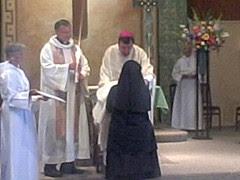



 Posts
Posts