Showing posts with label Diocesan Hermit. Show all posts

12 November 2012

On Battling Demons, St Anthony's Temptation, and the Importance of Myths

[[Dear Sister Laurel, you have written about demons in the past. Do you really believe in demons? How about powers at work from outside us? When I read the desert Fathers a lot of what they say is incredible to me because there is so much reference to demons. The story of Anthony and all the hideous noise that occurred as he battled demons while people passing by heard the fighting is part of that. I just can't buy it. Is there a way to understand this that is not so primitive or mythological?]]

St Anthony'sTemptation by Bosch

Thanks for the questions. The desert is known in two integrally related ways. It is first the place where we are closest to God and may know and be known by him most intimately, and secondly it is the place where people meet demons face to face and battle with them in order to come to terms with their own humanity and claim it more fully. A desert vocation, that is the vocation of the hermit, is especially therefore, a vocation where one does battle with demons and comes to terms with and claims her humanity more fully through the grace of God. But we need to know what the desert Fathers and Mothers were talking about when they spoke of demons and the place of the desert in all of this. Whenever I have written about this I have spoken mainly of doing battle with the demons inside my own heart --- because for me that is the primary struggle that goes on in my life. While there may have been more of a tendency to personify these demons at the time of the desert Fathers and Mothers, I think this is mainly what they were speaking of and secondly of the powers and principalities in our world which are also at work within and upon us.

Consider what the desert (or any wilderness) is like. You are there, God is there, and often, with the exception of wild animals and a barren landscape, that is pretty much all there is. At every moment you are thrown back upon yourself and God (though you may not realize God's presence at this point and may not have yet begun to seek him). To survive with the (perhaps unknown) grace of God you must find the resources within yourself to hunt, find water, create shelter, protect yourself from predators, stave off weather, hunger, boredom, hopelessness, and tedium; you must manage bodily needs, take care of injuries and illness, etc etc. This will mean dealing to some extent with your own insecurities, your own fears, prejudices, ignorance, and allergy to failure on a daily, even hourly basis. You will not survive otherwise. Further, you must deal with the loneliness, the isolation, the loss of all those things (role, position, money, relationships) that made your life valuable in worldly terms. There are no books, no electric lights, no TV's, no computers or internet, no musical instruments or iPods, nothing to distract you from yourself and the God who summons you to your truest self. Even while one is working quietly, one's mind is churning and one's heart is often in turmoil.

And perhaps you will begin to seek out God. If so, the heart that is in turmoil is the place you will enter now in a more concerted way. If you thought the region outside you was wild and threatening, wait until you enter your own heart. It is, after all, at times like these we begin to meet the darker or "shadow" parts of our selves as well as the giftedness and virtuous dimensions. In trying to feed and shelter ourselves we dealt to some extent with fears, insecurities, prejudices, ignorance, etc but now we face them full on --- now when there is nothing to distract us from looking into our own hearts. And besides these demons are so many more! Greed, arrogance, envy, pride, rampant ambition, perfectionism, laziness or a failure of will, a selfishness that rules out compassion, resentment, a tendency to manipulate others or the world around us in order to be loved or appreciated, evasiveness or outright dishonesty. The list goes on and on. If one has not been loved as one ought to have been there may be hatred and a really fearful rage and despair as well. And then there are the roots of these things --- for they do not come from no where! Thus, there are the "demons" which occupy our memories as well! They too must be exorcised in their own way.

One thing must be emphasized, however, especially given the focus of this question and answer. Our looking at the darknesses of our own hearts in such a situation is dependent upon the light and love of God (as well as upon our memory of all those who have loved us throughout our lives). It is the one who is loved and knows herself to be loved as only God loves who can look at her own sins against love and the darknesses of her own personality fully and honestly. But the process of coming to know God's love AND coming to see and deal with one's darker aspects is often a long and messy process. The desert Fathers and Mothers rightly described it in terms of a struggle which was fraught with temptation and which could even be described in the terms Anthony's battle was described. Like Jacob wrestling with an angel and coming away limping,  or Anthony coming out torn and haggard, we do not come away unmarked from our own battles with our demons --- even when God is fully victorious. This is true even when we are ministered to by angels and eventually come to (or usually dwell in!) a place of peace and light.

So, yes, there are certainly ways to make sense of the stories of Anthony's struggle or those of the other desert Fathers and Mothers which are less "primitive or mythological". Today we use Jungian psychology among other things to speak about the shadow side of ourselves, etc. But let's also be clear just how powerful those myths are. They tell us a story whose profound truth we can each recognize on some level, whether we are hermits or not. Imagine for a moment what it would feel like to have someone threaten to make a secret part of your life known to others at a business meeting. If you can feel this, even a little, then you know the truth of the fact that the revelation of the demons which inhabit our lives can be a terrifying proposition. Imagine instead unpacking a container full of secrets and private darknesses in front of someone who doesn't much like you or these things about you (the way some of us feel about ourselves, for instance, especially if we have not really known God's love).

Imagine doing this with someone who loves you profoundly. Still probably not very easy to undertake. But also imagine that these things you are trying to unpack LIKE the darkness, hate the light and that as you reach for each one it fights your efforts to reveal it and set it aside. Imagine it battles you and the God you seek as a betrayer of critical secrets and a threat to its very life. Or, imagine that once you have looked at the demon, even obliquely, you simply cannot get it out of your sight or mind.  If you are dealing with impatience (or an inability to resist being critical, or some form of inordinate desire etc.), impatience (etc) then becomes a howling animal struggling to insinuate and assert itself in every situation. Now imagine these things reside in your very heart and you are entering there instead to try to confront and deal with them. One's heart, precisely because it is by definition the place where God witnesses to Godself, is not always going to be the most placid of places; when we are battling its demons this is even truer. Images like these help us to see at least part of what we are all really up against in growing in intimacy with God. Stories like that of Anthony help us see what eremitical life (or life stripped of distractions and luxuries, what we call desert living) can involve. I would argue these stories are really quite sophisticated conveyors of profound truth, especially when seen as dramatizations of our inner lives, or externalizations of the hidden dynamics and struggles hermits and others live in order to come to healing and holiness.

It is easy to think that we do not carry within us some really dark and awful depths with the power to distort, disrupt, and destroy, or that these only come from outside us; this is especially so when they seem to take control of our lives and literally dehumanize us. I am not denying that forces outside us exist and influence our world (e.g, what Paul called powers and principalities), but on the whole I think this is a fuller picture of the reality of spiritual struggle and growth both now and in the days of the desert Fathers and Mothers.

I hope this is helpful.

04 November 2012

Question on Diocese Shopping

[[Dear Sister Laurel, How do I find a diocese professing lay Catholics under canon 603?]]

Generally, I do not recommend diocese-shopping for such purposes. I don't know any dioceses which would not be pretty cautious, suspicious, and even outright rejecting of someone engaging in such diocese-shopping. Similarly, since the eremitical vocation has a strong component of stability, shopping around for a diocese that will profess you might well cause doubt about any possible vocation. There are few situations which would make such a solution necessary

I have written a more detailed response to a similar question. Please see the label "Diocese-shopping" for that post. That main response is dated 26. March.2011; another post speaks a bit about such diocese-shopping as I recall. It is dated 4.December.2011. Please be aware that in order to be taken seriously by such a diocese you will need to have lived as a hermit for some time under competent spiritual direction and be able to demonstrate a good track record of stability in your parish or diocesan commitments. By this I am referring to the monastic value of stability which (risking serious over-simplification) is mainly a commitment to grow wherever you find yourself. If a diocese you move to is to take you seriously as a potential candidate for admission to profession you will likely need to have either tried to have entered a discernment process with your diocese and have been treated in bad faith, or perhaps have belonged to a diocese/province which has refused across the board to profess or consecrate anyone under canon 603. The only other situation I can think of off hand which might allow a second diocese to seriously consider you for c 603 profession would be if years ago you tried to be accepted and were deemed unready but now, despite your own growth in the vocation, the diocese will not reevaluate the matter.

Regarding your question more specifically, as far as I know, there is no list of dioceses with diocesan hermits although I understand that last year the Vatican started keeping statistics on us for the first time. Fewer (perhaps far fewer) than 1/4th of dioceses in the US have diocesan hermits, however. The only way to find out if a diocese MIGHT be open in time to professing you if you were to move there would be to call the chancery and speak to the Vicar for Religious or Consecrated life. Again though, no one is likely to be more than seriously reserved in responding to such a query because allowing you to move to a diocese cannot be done with even a suggestion that you might one day be professed as a diocesan hermit. The most they could and would probably tell you is whether they have diocesan hermits presently and are/or are open to professing suitable candidates.

03 November 2012

Followup Questions on Illness and Horarium Changes.

[[Dear Sister Laurel,
       Do you have to notify your Bishop when you are ill and need to change your horarium? How about his delegate? What if the change is not temporary? Do you stop being a hermit? Thank you.]]

The simple answer is no. That is especially true in the short term. I do ordinarily let my delegate know if I am not well, but that is more to inform and to reassure her that all is pretty well nonetheless. As for the changes in horarium what is more fundamental is to continue living the elements of the canon the best way I can in spite of illness. Everyone expects that and they expect me to be able to do that or to ask for assistance if I need it. The horarium, though not unimportant, is actually less important (and more flexible) than the Rule itself and the values it embodies from Canon 603.

In Cases of Serious Illness

In cases of serious illness, then yes, everyone is notified --- not so much regarding the change in horarium as in regard to the seriousness of the situation. Pastor, Bishop, delegate or director, friends, family, are all notified. If the change in the horarium needs to be long-term then no, I don't cease being a hermit. I simply have to accommodate the new circumstances as best as I am able. Again, it is the elements of  Canon 603 that have to be lived out no matter the situation. That may mean that someone comes in to assist me with chores a couple of times a week, or helps me shop, or brings over an occasional meal, for instance, but I don't cease being a hermit in such a situation. It may also mean meeting more frequently with my delegate or director for assistance in living well with the situation.

The horarium I keep at present is designed to serve me in living an eremitical life. It is not forced on me by someone else, nor did I copy it from someone. It is an expression of both my own strengths and weaknesses as well as the things that keeps my prayer life and capacity to minister to others in good shape; should these things change then the horarium also can and will change. I suppose I am saying it is not the horarium per se that makes the hermit; it is the hermit and her lived experience that makes the horarium. Thus, if an illness was to be long term that would mean changes in the  schedule and also in commitments to others (my parish, clients, etc), but I would remain a hermit nonetheless. Nothing necessarily changes in my relationship with God or the essential way in which I am made whole in the silence of solitude.

The More Important Questions of Formation Implicit in Your Question

You may not have been completely aware of this but your question bears on the posts that have been put up recently on the importance of formation and ongoing formation of the hermit. Eremitical life, like all forms of religious life, has stages and one needs to be able to negotiate these changes while living out the central values of one's life. The capacity to negotiate changes in this way is one of the things that marks the person as an authentic hermit. I remember being asked once by an aspirant for canon 603 profession about how they should deal with the difficulty of balancing hermit things vs worldly things. The essential problem was that this person had not made a significant break with her prior life, and was not a hermit in any essential way. Thus, she considered certain things (praying, lectio, etc) as hermit things and things like dishes, laundry, housecleaning, etc as worldly things. The answer to her question was that everything she did within the hermitage was to be done as a hermit. (For that matter, everything she did outside the hermitage was to be done as a hermit.)

The same principle applies here. When a hermit is ill, they will "pray" their illness and it will become a special expression of the silence of solitude --- perhaps more difficult to live without assistance and more painful than what was lived prior to this --- but it will be an eremitical reality because and to the extent the one who is ill is a hermit herself. The horarium may be more flexible, but it remains an eremitical horarium. Thus, again, the importance of a sufficient formation and ongoing formation. One must be able to embody the central elements of the Canon and especially to live the charism of the vocation without some of the external tools and protection required at another stage of the life. During illness most of us regress some and if the illness is serious that may be more true, For this reason it is important that the hermit be adequately formed so that they continue to live the mature eremitical life they are called to live in even more demanding circumstances.

Sister DK

Let me give you an example of what I mean. This Summer our parish put up a wall of faith in memory of those women in our lives who have inspired us. I put up a picture and description of a Sister I met when I was in initial formation. When I met Sister D. she had brilliant blue eyes and was bent over sideways due to scoliosis; she was also almost completely blind (and was completely blind within the year).

Once a great reader and even now always interested in the life of the community (she loved any chance to share news!), Sister still came to all community prayer and meals and spent the remainder of her day sitting in a straight chair in her room praying. To be honest, though I was tremendously impressed by her, what had happened to her terrified me then, and in some ways still does frighten me. However, she lived profoundly the silence of solitude in community and I feel her with me today. She reminds me of what it means to be a hermit at the end of one's life, and when one is ill and cannot do what one once did. Was this easy for her? No. Could she have lived this way without the ongoing formation of a faithfully lived religious life? I don't think so. My hope, of course, is that inspired by Sister D. and many others, I will live the truth of that  as well as I am called to do as a diocesan hermit. This is another piece of what perpetual vows mean.

What do you do When you are Ill and need to change your horarium?

Several times I have been asked what I do when I am sick and cannot keep my usual schedule (horarium) with regard to prayer and work, etc. Recently it was asked again because of comments I made about "hermits" using hours of TV to distract from their illness. I have not written about this mainly because I don't want to focus on my own illness, but there are some reasons to deal with these questions since everyone has periods when they feel really punk and just need to deal with the illness and do so prayerfully. One conversation on a Carthusian list came up in the past day regarding pain and what one does when one is in pain. From there the discussion moved to the place of music in dealing with pain. In any case it all raised the question for me regarding what I do when I am unable to keep my usual horarium.

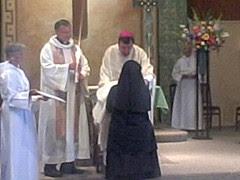
Prostration prior to perpetual profession
Here is where a Rule is particularly helpful because a Rule reminds us of the values we must live and the things which are most important for living a healthy eremitical life. Optimally Rules are not about lists of things one must do so much as they are about who one is and what inspires and enables one to be that. Thus, the elements of the life remain how ever one is feeling: stricter separation from the world, assiduous prayer and penance, the silence of solitude, the vows, and (I'll include) whatever work one undertakes in the hermitage. Notice though that these elements are not defined in terms of specific things to do. They also have more to do with the person one is: a person of prayer, a person living the silence of solitude, a person more strictly separated from the world, bound by vows and committed to living this life for the salvation of others. So how does this help when one is ill, and what specifically do I do when I am not feeling well?

The first thing is that I take care of whatever physical needs I have. Medicines, fluids, food, and sleep (especially sleep) figure big time in caring for illness. I maintain my periods of quiet prayer usually (though not necessarily at 4:00am), but Office (for which I wear my cowl over my pajamas) is usually abbreviated to a single psalm prayed slowly. The canticle is usually added with a CD or iPod version, and I try to be sure to pray for people in my parish, those who have requested prayers. I may add another song I can listen to on iPod, etc. This works for all hours. Communion (for which I also wear my cowl over my pajamas) is similar except after a brief penitential rite, I read the Gospel out loud slowly, pray the Lord's Prayer and receive Communion. I will sometimes end this service with another hymn on my iPod or CD player and sometimes simply follow it with a period of quiet prayer.

Work periods vary. Usually I will simply journal or do some blogging. This is especially helpful for times I am in pain and waiting for meds to kick in (It is also one of the reasons posts get put up in the middle of the night here!) If I feel up to writing then I will do that, but I tend not to meet with clients during these times. Chores around the hermitage tend to go by the wayside for the time being. For the majority of the time I will read and sleep. (Reading may be some light spiritual reading but it also includes books by writers like Laurie King, Naomi Novik, Anne Perry, etc.) As for errands, depending on the situation I may run simple quick errands myself but for more than this I will accept help from people in my parish (shopping, dropping off a meal, trips to the doctor.)

And what happens when it seems just too difficult to pray or when I can't focus enough to work, etc. One thing I like to do is listen to liturgical music --- old favorites a lot, but also Taize. Taize is especially nice because of its repetitiveness as well as its multi-layered musical interest. I use these for prayer periods, not for long periods of just listening. Meanwhile I bring whatever I am feeling to God during the Taize. Otherwise I like to simply to rest in the silence, simply rest in my knowledge of God's presence and the fact that I am in his care. These periods may be relatively brief and interspersed with reading or journaling or sleeping, but they are very important. Another form of prayer I do is the Jesus Prayer using a small bracelet of beads I wear around my wrist --- usually in conjunction with prayer for people in my parish, etc. Ordinarily I reserve this for when I am traveling or on a train but it is helpful in times of illness as well. One activity I like to do when I am not really able to do much else but want to maintain silence or listen occasionally to music is to set up a large jigsaw puzzle; this kind of activity allows for a lot of  less formal prayer or reflection and is physically undemanding and restful as well. I have drunk a lot of hot tea while working on puzzles like this --- and also had some significant prayer experiences.

The question of TV comes up in some of the questions and the answer is yes, sometimes when I am sick I will watch TV --- but I really have to be pretty sick. I also have to be especially careful about this practice since as it helps to distract from how one is feeling, it can also keep a person from being aware of feeling well enough to get up and do something else. But yes, with caution and within limits, I sometimes watch TV when I am not feeling well. There are so many things about what TV does to me spiritually that I really don't like it ---- but it is fine for a movie or special program here or there. Otherwise I find it destructive of attentiveness and recollection. (I must say that as I learn more and more to "pray the situation" TV is especially dangerous to one's ability to do this!)

I hope this helps. I think that many could be helped by trying some of these things when they are not feeling well. The point is that one is as capable of praying when one is ill as when one is well, but that one may well need to change some things to do that. The main point is to be who you are, with all the limitations that are your own and to be this person WITH God.

31 October 2012

Rethinking Perpetual Profession as "Graduation": More on Ongoing Formation

[[Dear Sister O'Neal, I had always thought of perpetual profession as a kind of graduation. Maybe that is silly but it is how I thought of it. When you write about it being analogous to an advanced degree which says one is educated enough to continue learning on their own that changes things for me. In a  way you are saying that perpetual profession is a kind of commitment to life-long formation though. Is that right? I guess I thought that after perpetual vows one was pretty free to go their own way but that is not quite true is it?]]

Exactly right. Remember that in monastic life one of the vows is conversatio morum, or the conversion of life. This vow is usually thought to include religious poverty and celibate love (chastity), so monks and nuns often make the vows of conversatio morum, obedience, and stability. Canon 603 requires the vows of poverty, chastity (celibate love), and obedience, but the life to which one is committing in either case is the same --- a life of continuing, thoroughgoing conversion which requires ongoing formation.

Perpetual Profession is not the same as graduation. Instead it is more like the end of an apprenticeship and the beginning of one's life as a journeyman. One is no longer under the watchful eye of a novice master or novice director nor even the director of the juniorate, (or in the case of a diocesan hermit, the semi-watchful eyes of Vicars for Religious, etc from the diocese) and one is free to follow the impulses of the Holy Spirit pretty much where one discerns he is calling, but this is not an absolute freedom. One still must answer to God, to the Diocese (both chancery personnel and the people of the diocese), to oneself and one's Rule, and also to one's delegate and director --- though in differing ways. But let me give you an idea of how this works out practically since there is usually no one around saying either, "You must do x" or "you may not do y."

Depending upon one's training, education, etc, over time a hermit is presented with a number of opportunities to minister in a limited way outside the hermitage. Generally, one's Rule provides one with the requirements one needs to live a healthy eremitical life, but some of these opportunities can be accommodated as well without difficulty. One prays about these, determines how they do or don't fit into one's life, what is needed in terms of time, preparation, etc, and also how this will benefit the individual's eremitical life. After this one will discuss the matter with one's director and/or delegate.

Occasionally the hermit may not have done sufficient discernment on the matter and will get themselves in trouble if they are not lucky! Still, they are not in this all alone and delegates and directors do help in determining what will be helpful and what will not --- even though they rarely if ever simply say, "Yes you may or no you may not!" (My own delegate almost NEVER directs me to do x or not do y, but she is keen to hear how I have discerned matters! Thus, I remember once mentioning a project I was considering doing to her and her response was a quiet, "I will be interested in hearing your discernment on this." At that moment the response that flew into my head was, "BUSTED!" In fact, I had NOT discerned this well and we both knew it! Needless to say, the proposed project was dropped and we never had much of a conversation about it either. At the same time I have not repeated such idiocy and learned from the exchange.)

I hope you heard the humor in this. I laughed when that incident happened and I still laugh at it today --- not only at my own silliness but at the marvelous way God works. What my delegate did was FAR more effective than a simple permission (or prohibition) might have been. She reminded me clearly of my own responsibility as perpetually professed, but also that I am responsible in direct ways to people who will assist me in my own decisions and growth. The freedom of the person who is perpetually professed is a freedom within limits or constraints --- a responsible freedom --- and for that reason, one does not stop growing so long as one lives the life. Thus, I meet regularly with my delegate and/or director to be sure that that growth continues and that my own discernment is not allowed to slip into carelessness or complacency, nor that my decisions become the fruit of mere impulsiveness.

At the end of a year I will meet with my Bishop to let him know how things are going, what is going especially well, what difficulties I have had in the past year, and how I am working things out. He may have suggestions or concerns which he then has a chance to express. A followup visit with my delegate may or may not be be necessary in light of the meeting with the Bishop, and a meeting between my delegate and the Bishop might also be helpful. Whatever needs doing will be done.

If one were to read through the past five years of this blog I think they would see someone who has grown in her vocation because of perpetual profession (not in spite of it). It is true that I am no longer an apprentice or novice in the eremitical life, but it has taken time for me to grow into a person who is concerned not with only my own vocation and profession, but into one who is concerned with the nature and future of this vocation itself. Perpetual profession granted a kind of freedom to explore the vocation, to reflect on it more widely than I had been able to do before this. It has freed me to allow my life to be one of prayer and other limited ministry precisely because I am sure of my eremitical identity. I think that particular freedom is akin to what you were thinking of when you referred to perpetual profession as graduation.

But what perpetual profession really means is that one assumes (and is canonically entrusted with) the role of inheritor and missioner of a tradition. With perpetual profession one becomes, for instance, a Religious living out the charism and mission of a particular congregation --- including carrying within her the tradition and history of all of those who have done so before. One knows or comes to know herself in this way where before she really did not. It was a role she was preparing to be entrusted with more and more. She is part of a larger story than her own quest to become a Dominican (etc). Instead, she IS a Dominican or a diocesan hermit or whatever it is and accepts a place in the living tradition of the vocation. Still, it is a living tradition --- one which others will be drawn to and live out; her life is one which, for good or ill, will be a model and inspiration for others who may desire to become part of this story and responsible for its continued telling. When considered this way thinking of perpetual profession as graduation hardly works --- not at least when we think of graduation as achieving the end of formal education, schooling, learning, and training! For the perpetually professed these things do not really end.

29 October 2012

Followup Question on Ongoing Formation for the Diocesan Hermit

[[Dear Sister, is ongoing formation really necessary once one has been professed? If a person spends almost 10 or more years becoming a diocesan hermit, why should more formation be required?]]

I think too often the sense we all have of "formation" is of the initial making of the person into a nun, or priest, or monk,  or hermit. It is as though once we have reached perpetual profession or ordination then ongoing formation isn't at all necessary. But remember that a vocation, important as definitive  (perpetual or solemn vow) commitments are, is not something one answers once upon a time and then just sails along in. Instead a call is something that comes to us each day and the response we give is one which is renewed and both extended and intensified day by day as well --- at least that will be true if we are growing in this vocation. In my own life I hear this call variously but I describe it as God calling me by name to be more completely his in the state of life to which I have been called. I can't imagine God ceasing to call me by name --- and of course the Scriptures affirm that this is the case (Isaiah 43), nor can I actually imagine a time when I will not have some further response, some part of myself to give more completely or some way in which I need to grow more authentically human.

Ongoing formation is meant to allow this process to continue. It takes cognizance of the needs and deficiencies one has at various stages of life, and of course it honors the gifts and strengths which are evident at different points along the way. Diocesan hermits, like all religious at the point of perpetual profession, are admitted to definitive commitment because they have been determined to have a life vocation; they have been entrusted with a responsible role in that vocation's future with all that implies. In a sense such admission is a bit like an advanced degree; such degrees don't say the person has learned all they need to learn, but rather that they have achieved a level of education and growth which allows them to be trusted with the responsibility of securing their own continuing education and of sharing what they know in a new way. In a sense such degrees mark the person as a competent and responsible learner (rightly approached, one of the significant ways we continue to learn is through teaching others). Perpetual profession does something similar but with a tradition of prayer, spirituality, and faith; it is often only with perpetual profession that we begin to really claim as our very own a particular tradition --- especially as it is a promise to others. It certainly marks the event which makes us fully responsible for that tradition.


There are depths in any vocation which open to the person only over time. There are aspects of the history of eremitical life which may not have seemed too interesting or pertinent the first time one read or heard about them; and yet as the hermit claims this vocation and becomes responsible both for the eremitical Tradition and for the contemporary world's redemption these aspects may assume a new prominence for her.  Note well that this is not merely an academic matter but one which demands the hermit be sensitive to the needs of the world around her and become more and more capable of addressing these by applying some piece or dimension of the charisma (gift) eremitical life is meant to be to the contemporary world. The more deeply she comes to live the charism of diocesan eremitical life, and the more attentive she is to the needs of those around her, the more fruitful her life will be.

I hope this is helpful. If it confuses or raises more questions, please get back to me.

26 October 2012

Ongoing Formation of the Diocesan Hermit

[[Dear Sister Laurel, What does ongoing formation for the diocesan hermit consist of? How would a diocese ensure that the hermit is achieving the level of ongoing formation she or he requires?]]

Wow, brand new question for me! Excellent as well! In some ways I think this is uncharted territory, at least in the formal sense. Let me suggest some of the things I do to continue my formation as a diocesan hermit and also some things which might be especially helpful to the diocese and hermit together in what is a mutual or collaborative responsibility. It is this latter area where I think we are mainly in uncharted territory and in a general sense could do better for diocesan hermits and their Bishops and delegates.

Things the Hermit does to Ensure Ongoing Formation:

The first thing necessary is anything coming under the rubric, "custody of the cell." What I mean by this is anything necessary to living the silence of solitude in the hermitage. For the most part this means living one's Rule of Life (including every spiritual and other regular practice), reflecting on this in light of one's prayer and journaling (inner work), spiritual direction, and further, in light of one's reading and reflection on the eremitical tradition and the contemporary world. Over some time one will reflect on one's life in the hermitage, one's life and role in the parish, the place of friendships and other relationships in one's life, one's physical, intellectual, and emotional needs, and the demands on one's gifts which all of these make. One then makes whatever changes are necessary to ensure continuing growth in the eremitical life and the essential elements of canon 603. At the same time one will make decisions about needed education (usually online but not always), reading trajectories (if this is applicable to personal work or one's professional competencies), writing projects (or whatever form of work one does), greater reclusion, periods of retreat beyond an annual retreat, and so forth.

Parts of all this will include then, regular spiritual direction and meetings with one's delegate, regular reflection on one's Rule and vows, regular desert days, at least occasional periods of reclusion, and annual retreat. It may require time away from the hermitage at a monastery beyond what is required for retreat itself. In general all of these things are parts of the hermit's own Rule because, after all, the life itself is formative and living it with integrity is the major piece of actual formation --- no matter whether that is initial or ongoing. Still, the evaluative part of things is usually not treated in one's Rule and it may well be that this should be worked out in the section on ongoing formation. For instance, one might well determine that once a year (or less frequently) a meeting with one's delegate which is dedicated simply to looking at one's needs for ongoing formation for the following year (or several years) will occur. While very little of the hermit's day-to-day life might change as a result and while one might simply continue on as one has, such a meeting could still be invaluable.

Others' Roles in Ensuring Ongoing Formation:

While responsibility for ongoing formation is mainly the hermit's own, her Spiritual Director and diocesan delegate play major roles in helping her grow in holiness and assisting her to articulate regularly how she has grown, where she sees God taking her in terms of eremitical life, how it is the parish and diocese assist (or could well assist) her in this and how that may be improved upon. The delegate might well discuss some of these things with the Bishop if they seem to be something the diocese should assist with. That is especially true if she and the hermit meet for a regular meeting dedicated to ongoing formation needs mentioned above.

This, of course, suggests that the Bishop also has a part to play in ensuring the hermit's ongoing formation in this life. While this role should not be surprising it is an underdeveloped and under-appreciated aspect of the situation set up by Canon 603. Canon 603 outlines a solitary eremitical life of the silence of solitude, stricter separation from the world, assiduous prayer and penance, the evangelical counsels, all lived according to a Rule the hermit herself writes and is faithful to under the supervision of the diocesan Bishop. While the hermit does not receive any financial assistance or remuneration from the diocese, there is no reason to believe the Bishop cannot or should not assist her in locating or helping make available selected and occasional diocesan or other resources which contribute to ongoing formation in her vocation. Hermits tend to meet with their Bishops once a year. That meeting usually serves to fill the Bishop in on how things are going, how the hermit lives her life, what is most important to her in all of this, and what needs she has run into and how she has managed to meet these. Occasionally (every three to five years or so), an important part of such a meeting might  be a discussion of the ways in which the hermit has revised or proposes to revise her Rule before submitting it to the Bishop for formal approval.

With regard to ongoing formation what I would like to suggest is that if necessary and if the Bishop is willing (and I have to say my sense is most would be very willing given their concern with the issue of eremitical formation), an additional meeting with the hermit's delegate might also take place for the specific purpose of discussing specific needs and concerns. With the Bishop's permission, this could free the delegate up to line up (or help the hermit to line up) the resources necessary here or formulate a plan for meeting those needs and concerns. For instance, if the hermit truly needs additional time away in a monastery, or could benefit significantly from a workshop on Scripture or prayer or spiritual direction (etc), a Bishop (or the delegate acting in his stead) might be able to arrange for something which meets the limited resources the hermit has available and at little or no expense for the diocese.

The point is that the hermit vocation is fragile and vital; for this reason the diocese, especially in the persons of the Bishop (legitimate superior) and delegate (quasi-superior), should work with the hermit in helping ensure her needs for ongoing formation are met. At this point the hermit's relationship with her Bishop is a little-addressed and less-understood element of the canon. Hermits and Bishops work to find their way in this matter, sometimes with little sense of what is actually being accomplished (or is meant to be accomplished) by their meetings. A focus or partial focus on ongoing formation and a collaborative relationship with the hermit's delegate in meeting the hermit's needs here might be just what is needed periodically. (For the most part meetings with one's Bishop are not agenda-driven. They are a chance for both persons to get to know one another and to learn about eremitical life lived out in a contemporary context; they are typically fairly relaxed and informative and should be allowed to be this unless there is something specific either party needs to discuss).

The hermit's pastor may also fill a role in the hermit's ongoing formation. It is certainly true for me that my own pastor plays a very large if informal role here and I think that is both fortunate and a very great gift. For instance he affords me opportunities to use my own gifts in the parish --- always with an accepting eye towards my own fidelity to my contemplative and eremitical vocation. As a result, however, my own regular grappling with Scripture has become more central and fruitful. My pastor has given me opportunities to do Communion Services (Services of the Word with Communion) on days when the parish has no priest available, to write written reflections on the Scriptures or on theological themes, to give or assist with occasional workshops to the parish (Advent, Lenten, Anniversary of Vatican II), to speak to the school children or teen faith formation once in a while (once a semester or year) about prayer, living as a hermit, religious life, etc, and he has made it possible for me to attend a continuing education workshop several times in the area of Scripture.
One of the most helpful features of this relationship with my pastor and parish has been my own discernment of how to negotiate the demands of my vocation to the silence of solitude while sharing the fruits of that vocation and my own gifts. It isn't always easy nor is it always neat, but it is a dynamic which is an integral part of the eremitical (and especially the Camaldolese eremitical) tradition so it is a dynamic which, in all likelihood, is not going to go away. My pastor's respect and concern for my eremitical vocation (not to mention his patience with my own sometimes-awkward efforts to negotiate things) are as helpful as the opportunities he affords me. While this situation may not be typical, I think most diocesan hermits could work out at least a similar situation with their pastors and parishes.


I should also mention the role of friends and other religious in the hermit's ongoing formation. Though more casual there is no doubt that friends, especially when they are Religious, play a significant part here in my own ongoing formation. In the latter case we discuss prayer, reading, Scripture, the Church, spiritual direction, daily struggles and joys, the requirements of  personal ongoing formation, and just generally do what friends do for one another in encouraging faithfulness to God's call. I have coffee with one Sister every Sunday I can and we go out very occasionally at other times as well (e.g., once a movie and dinner, once a museum exhibit, etc). Beyond that I have spent a week the last two Spring breaks with her at her congregation's vacation house in what is a fairly relaxed period of shared solitude. Because of this relationship and others I have grown as a human bring and as a hermit. I am also more tuned into the Church, to trends in religious life, and have met other contemplatives I would never have had the chance to meet otherwise. I have been challenged, empowered, and consoled by this and other friendships (especially those I enjoy with a handful of parishioners), for instance, and have to consider these an asset to ongoing formation.

Assessing Ongoing Formation:

If the silence of solitude is the charism of the diocesan hermit's life and the single element which can be used to mea-sure the quality of all other parts of the hermit's life (and I argue strongly that it is), then the degree to which the hermit is growing in living this reality is the key to assessing the quality of her ongoing formation, or her needs for the same. If it seems that she is distracted or unhappy in solitude, if the opportunities that come her way through the parish detract from her ability to easily step back into the hermitage, or if they are not natural spillovers of her life there, then they are probably not helpful to ongoing formation as a hermit. If her life begins to be disorderly or unfaithful in small and bigger things, then something needs to be addressed. If solitude begins to devolve into mere isolation, then problems requiring a solution exist. The "silence of solitude" is the key here just as it is in initial discernment and formation. Only the hermit, her director, her delegate, and to a lesser degree her Bishop can really discern or determine how well she is progressing in her ongoing response to God's call, but they definitely need to collaborate to ensure this is as God wills and the Church needs.

Appreciating the Charism of Diocesan Eremitical Life

[[Dear Sister, I can see why Bishops might choose to profess an individual who is not really a hermit and ask questions like, "Besides, who will it hurt?" Isn't it more important to deal pastorally with the individual than to be concerned with an abstract idea of a vocation? If a person wants to serve God and do it as a "hermit", why shouldn't he be allowed to do this? I really don't see who it would hurt. After all hermits don't minister to people and are shut away from contact. Isn't this up to Bishops to decide?]]

Thanks for your questions. I am linking this post to another one on the charism of the diocesan hermit and the relation of the life to the exaggerated individualism and narcissism of our culture. I don't want to repeat everything I have already said there so please click on the title of this post to be taken to that one for further reading

The Charism of Solitary Eremitical Life

In attempting to clarify why I am not speaking about a mere abstraction but rather concrete circumstances where the eremitical vocation is particularly effective and redemptive perhaps I should restate what the charism or gift quality of the solitary diocesan hermit is to her parish, diocese, and the church and world at large. I tend to point to the canon 603 essential element, "the silence of solitude" as that unique gift. There are a couple of reasons for that. First, we in the first world live in a culture of exaggerated individualism and narcissism. While people living in community combat this problem by their accent on community life and its importance in authentic humanity, hermits participate in this "battle" in their own way, namely by living a life of "the silence of solitude." Eremitical solitude is not about living alone, but living alone WITH God and FOR others. It emphasizes and reveals that human beings are not made to live individualistic or narcissistic lives but instead are completed by God and called to give their lives FOR others. Eremitical solitude is a paradoxical reality and a gift to a world disintegrating under the influence of individualism, narcissism, and a notion of freedom which really means the license to do anything one wants without regard to (or for) others.

Secondly, we live in a world where people live longer, where consumerism and productivity are the major markers of the supposed meaningfulness and value of one's life. Often then people in such a culture have lost (or never had) a sense of the meaningfulness of their lives apart from work, family, etc. Some are bereaved, some are chronically ill, some are isolated elderly, some are prisoners, etc. Hermits do not buy into the consumerist, productivity-as-measure-of value perspectives. At the same time they are physically as isolated as any of the people mentioned above. What is different is that they say with their lives that meaningfulness is a function of one's relation to God and that they are infinitely precious because God holds them to be precious. Through the grace of God the hermit's life takes physical isolation and transforms it into solitude ---- a communal or dialogical reality measured in terms of relationship with God. The experience of eremitical solitude is the experience of meaning, completion, and authentic humanity which is capable of giving to others. Not least, hermits say to people that the redemption of isolation is possible and that even those who cannot compete as consumers or "producers" can live incredibly meaningful and generous lives which contribute to the well-being of society.

Thirdly we live in a world of unrelenting, ubiquitous noise. People not only don't know what silence is, they fear it, think it unnatural, and avoid it at all costs. Most people believe that silence means turning off the TV while listening to an iPod or something similar. Businesses deal with noise by overlaying it with another layer of noise; office buildings pipe in music meant to soothe and distract from silence but also to distract from the constant noise. The problem with this, however, is that unless we have silence in our lives we never learn to truly listen --- especially to the voice of God in our hearts. Articulate speech requires silence, music requires silence if it is not to be mere noise, and human beings require silence if they are to come to the full articulation of selfhood. Hermits attest to the fullness of silence and the silence of solitude.

As I have written before, [[As a hermit I am not silent (or solitary) for instance, because woundedness and pain have rendered me mute and cut off from others, but because silence and solitude are the accompaniment and context for profound speech and articulateness. Silence is part of the music of being loved completely by God; it is a piece of allowing the separate notes of one's life to sound fully, but also to be connected to one another so that noise is transformed into a composition worthy of being heard and powerful and true enough to be inspiring to others. It is an empowered silence and solitude, the silence of solitude, which finds its source in God's love and reflects relatedness to God and others at its very core. Something similar could be said of all of the elements which comprise the life described in Canon 603. The eremitical life, especially in its freedom, is one of relatedness and love in all of its dimensions.]]

Hermits know all of this because, by the grace of God, they live it daily. They live the physical solitude of eremitical life without significant  distraction. They live the silence of others' absence, for instance, and discover it leads to a world of amazing presence --- the presence of God in the ordinary and in their own hearts. They say with their own lives that each person is infinitely valuable, that life is hopeful, no matter the stage or conditions which mark or mar it. Thus, hermits commit to living their vowed lives of stricter separation from the world, assiduous prayer and penance, and the silence of solitude under the supervision of the diocesan Bishop and those he appoints as delegates precisely as a significant gift (charisma) God has given to his Church and world. Unless one sees the gift this life is, they will not appreciate it or live it with integrity.

Professing Individuals Who are not Hermits and Will not live Eremitical Life

However, if one DOES understand the gift this life is, they will not profess those who  are not called to live this precise gift. Everyone can learn to tolerate and many even to love silence, but very few are called on to live the gift of eremitical "silence of solitude." To profess those who are not called to this is to short-circuit their own true vocations --- the paths they are summoned to embrace to become fully and authentically human. Eremitical solitude is especially dangerous here since so few are called to authentic humanity in this way.  Those who may be newly bereaved, or yet significantly psychologically wounded, or chronically ill and still needing to deal effectively with this reality will find that eremitical solitude demands more than they are capable of giving at this particular time. Solitude is often needed in all of these situations but ordinarily it is solitude as transitional reality, solitude preparing the way for a reinvigorated or reinvented way of relating to others in more ordinary community. Again, to profess such persons prematurely and with inadequate time and discernment will not serve them well and could be damaging. In any case, I would dispute that there is anything truly pastoral about doing so.

And of course professing those without an authentic call to eremitical solitude means professing those whose lives will not be able to witness effectively to the gift which the silence of solitude really is to the isolated and marginalized of our world. There are such inauthentic vocations today: "hermits" who watch hours of TV in order to distract themselves from illness and isolation; "hermits" who really want to be living in community and ministering full time and whose "solitude" and life of "assiduous prayer and penance" is lived out mainly with a desert day per week; and so forth. To whom do these lives effectively speak? Certainly not to the persons mentioned in the section above this one. It is arrogance and presumption to think that such lives can be called "eremitical". Professing inauthentic vocations may well involve the person professed in a life of hypocrisy, failure, and even therefore, significant sin. More, far from serving God, it is a disservice --- to God, to the vocation itself, and to those who need the gift of the "silence of solitude" because they live full time lives of isolation --- to call such vocations "eremitical." In an individualistic and narcissistic world such professions only extend and intensify the reign of individualism and narcissism within the very vocation meant to stand clearly against them. In short it is a betrayal of God, of God's own gift to the Church and world and, at least potentially, it hurts many people! This is hardly a pastoral approach to the matter nor to the person seeking to be admitted to profession.

The Ministry of the Hermit

While it is true that diocesan hermits do only some limited ministry outside the hermitage (if they do any at all), their lives are a ministry. Eremitical ministry is not so much about what one does as who one is in and with and through God in the silence of solitude. It is not true to suggest that professing people without an authentic vocation will not matter much because hermits are shut away. To the degree they are separated from others physically their lives MUST still speak to others effectively and faithfully --- especially to those who are themselves isolated in some way. This is an integral part of a vocation: God calls, we answer with our profession and lives, and God through his Church commissions us to minister in his name and the name of the Church.

Are Bishops the ones who ultimately determine the matter of who is professed in their dioceses? Yes, but they do so within the constraints of the Canon (603), and the eremitical tradition --- which includes the life experience of contemporary hermits who truly help clarify the nature and establish the limits of the vocation in our contemporary world. Bishops are required to listen carefully to these, to discern carefully with regard to an individual seeking profession under canon 603, to have a clear sense of the gift or charisma this vocation is and to whom, and only then to make decisions which respect all of these elements. Bishops especially cannot disregard any of these elements and simply use the canon as a stopgap means to profess an individual who cannot be professed in any other way, who simply desires it for inadequate reasons (wearing a habit, being a Religious, using a title, validating a failed or merely isolated life, etc), or who wishes to use this profession as an entrance into consecrated life so s/he can then do something else with that life (like founding a community, gaining access to ministries she might not have had access to otherwise, etc). Allowing such professions would actually be a betrayal of the Bishop's own commission to seek out, protect, and nurture new forms of consecrated life --- at least if new means something more than novel, transitory, and disedifying.

I  hope this helps.

15 October 2012

Rejecting Eremitical Vocations vs Creating Readiness for Eremitical Vocations

[[Dear Sister Laurel,
      it seems to me that if Dioceses don't agree that Diocesan Hermit candidates have adequate formation then they should just not profess them until they HAVE adequate formation.  I mean that doesn't seem like rocket science to me! Also how can they simply make a blanket judgment against the vocation itself? So what is the diocesan responsibility in forming diocesan hermits? Is it really possible for solitary hermits to get sufficient formation themselves with a bit of help from a spiritual director? Thank you.]]

Well, I think you have hit the nail on the head here. Reaching the conclusion you have is not rocket science, is it? First, a diocese is not actually responsible for forming a hermit; they are primarily about discerning the nature and quality of the vocation present before them. However, if a diocese believes the person requires more formation before being admitted to profession, they do need to work with resources available to the hermit to help her determine a plan so that she can get this formation. Thus, a diocese needs to be specific with the individual involved with regard to what areas in which she is deficient , what kinds of things would help with these, and so forth. The reference to needed formation cannot be vague nor can it replace actual discernment on the reality of the vocation itself. For instance, it is not okay to make an aspirant for profession jump through a number of formative hoops if the diocese has already determined she is not called to be a diocesan hermit and will not be admitted to profession. The only way this could work is if the diocese is honest with the person, says they are truly open to seeing things in a new way once the formation issues are taken care of, and then follows through with that.

It is true that sometimes elements in formation can clarify areas of the candidate's life which have caused questions about the reality or nature of a vocation, but in such cases the candidate must know that admission to profession is in serious doubt and that while further formation may assist in clarifying matters and even help take care of areas which lead to doubt, at the same time they may not change the doubtfulness. Honesty and good faith communication is imperative in such instances. Dioceses have not always been good at achieving this kind of openness in communication.  A candidate must agree to get the formation they need --- especially since they bear the brunt of any expense or time commitment required.

How can dioceses make such blanket judgments against vocations per se? Excellent question but not one for which there is a single answer. Some Vicars for Religious (few I hope!), for instance, do not value the contemplative life; if this is so, eremitical life will seem even less valuable. Some Vicars and even Bishops may have seen abuses of canon 603 and have been put off by these. Some dioceses realize that, despite the fact that dioceses do not form hermits, working with hermit candidates involves a long-term commitment to the person as well as a kind of patience and expertise their usual work may not require. They may not be up to that for a single vocation which is rare and seemingly not very fruitful or contemporary. Also, the process of discernment here involves a life with which few Vicars or even Bishops are really familiar in any meaningful sense at all. It is not uncommon for the same stereotypes which plague the world at large in regard to hermits to also plague chancery staff. Some dioceses may indeed have had several poor candidates show up at the chancery door looking for a sinecure, or may even have professed someone and had it turn into a nightmare for everyone involved. Communities have ways of socializing (forming) and supervising members at least partly simply by living with them and also may ask them to leave before perpetual vows. With hermits and consecrated virgins the same safeguards do not exist so the diocese itself needs to be patient and careful over a longer period of discernment.

If a hermit is admitted too soon to perpetual or even temporary profession, especially if the diocese doing so has not confirmed the adequacy of formation (or don't even know how to do so), if the diocese has insufficient knowledge of the eremitical tradition and life,  or if they are unwilling to invest (and demand) the appropriate time for the formation of a solitary eremitical vocation (which the hermit herself must secure), then the eremitical vocation itself is endangered. In such cases I would say better there be NO professions than bad ones. Even so, a blanket refusal to profess anyone is obviously not optimal or even acceptable in the face of canon 605 (which requires Bishops be attentive to new forms of consecrated life) and the movement of the Holy Spirit with regard to true vocations. There are sound solitary eremitical vocations in a number of countries; dioceses must become aware of that and learn from them. Meanwhile, solitary hermits have gotten the formation they have needed to live this life --- and most have done it "on their own" with assistance and mentoring they themselves have acted to include in their lives. Most of the time diocesan hermits are partly formed in religious life and only late discovered a call to solitary life. Still, while it is a longer and more difficult process for those who have no background in religious life, it is generally possible for individuals to come to all that is necessary to live this life by themselves with the assistance of a director and an openness to doing what is necessary to learn and grow theologically, spiritually, and humanly.

What is at least equally essential however, is that dioceses themselves become educated in regard to the eremitical life (especially the solitary eremitical life). They must, for instance, know the difference between a hermit and a pious person who lives alone; they must have done some work in jettisoning the common stereotypes associated with the term "hermit" --- but also be proficient in spotting those same stereotypes when they show up in a candidate who has just arrived on the chancery doorstep. They must have a sense that hermits are created by time as well as by and for  the  silence of solitude and be able to allow those to do their work in a candidate's life. They must have a sense of the normally extended time frame for moving through a discernment process and not be tempted to ignore it --- an act which disrespects the vocation and fails to act with charity towards the candidate. Finally they must understand the central elements of Canon 603, especially the silence of solitude and its function as charism of the eremitical life. As already noted, bishops are called and canonically required to be aware of and foster new forms of consecrated life. While it is a serious commitment in time given the rarity of these vocations, chancery personnel (Bishops, Vicars for Religious or Consecrated Life, Vocations directors, etc) must foster a readiness to patiently discern and assist such vocations instead of simply rejecting their possibility out of hand.

12 October 2012

Why is it Diocesan Hermits can Wear Habits?

Sisters of Bethlehem (Not Canon 603)
[[Dear Sister Laurel, why is it consecrated hermits can wear habits?]]

Thanks for your question. There are several reasons which make it appropriate to allow publicly professed hermits to wear habits.  First, in light of canon 603 solitary canonical hermits are now seen as religious. In the Handbook on Canons 573-746 in the section on norms common to Institutes of Consecrated Life, canonist Ellen O'Hara, CSJ writes regarding canon 603 specifically, "The term "religious" now applies to individuals with no obligation to common or community life and no relation to an institute." Thus, the same canonical obligations regarding garb witnessing to consecration and religious poverty can be applied to diocesan hermits. (Note well that in all of this I am referring to canon 603 and those who make public vows under that canon. Privately dedicated hermits are not included in Sister Ellen O'Hara's characterization above.)

Secondly, the eremitical life is traditionally associated with an eremitical or monastic habit. Ordinarily an elder hermit granted the habit to the novice; s/he also monitored the wearing of it as a piece of mentoring the novice in the eremitical life. If the novice lived the life well, the habit stayed; if the novice did not live the life well, permission to wear the habit was withdrawn and the habit was taken away. This use of specific religious garb is older than any other in the history of Christian religious or monastic life. Since, along with congregations of hermits like the Carthusians and Camaldolese, c 603 represents a public, ecclesial continuation of this tradition, the granting of the habit is entirely appropriate to diocesan hermits, despite the fact that they are solitary hermits. The Bishop replaces an elder hermit or mentor, however, in granting permission for and clothing with the habit.

Thirdly, the habit, today especially, marks the person wearing it as somehow "separated" from the world, not only in the sense of that which is resistant to Christ, but also to some extent from the world of social relationships and some related obligations. For instance, as I have noted before, vows of poverty, chastity, and obedience significantly qualify the ways in which the professed person relates to the world of commerce, relationships, and power. For hermits who are, in fact and by definition, more strictly separated from these than apostolic or ministerial religious, the habit can serve to remind her of this dimension of her vocation even when she is out and about. While it should not make her in any way remote or distant from those with whom she comes in contact, it signals a distinction which is not always appropriate in ministerial religious.

Permission to wear the habit, as noted above, is granted by the diocesan Bishop. Beyond this, it is customary (though not strictly required) that the hermit is clothed in a cowl or other prayer garment at perpetual profession. My own diocese required the latter (cowl or other prayer garment) and desired or were open to (but did not require) my wearing a habit. Still, some hermits may choose not to adopt these forms of garb and some dioceses may not require (or even be open to) either habit or prayer garment. Reasons vary. Some Bishops dislike allowing individuals who are not members of an institute of consecrated life to wear a habit (especially if the habit is typically Franciscan or Dominican or something similar --- a practice which cannot be allowed!); sometimes, however, this is a piece of legitimately discerning an authentic eremitical vocation (bishops or Vicars may say the diocese is not open to hermits wearing habits because sometimes folks who live alone merely want to wear a habit and are not really interested in the vocation itself or in living an authentic eremitical solitude). 

In all such cases there is really no need for a habit until one is professed; one will dress simply otherwise; neither is a habit necessary for discerning an eremitical vocation. At the same time, as noted, in some cases withholding the granting of the habit may be part of discerning and demonstrating a candidate is not really interested in or able to live an eremitical life per se. Some hermits accent the hiddeness of the vocation and see a habit as clashing with this dimension of the eremitical life. Others feel that wearing such garb is contrived or unnatural outside a monastic setting and are simply uncomfortable with it. When these things are true for the individual hermit, when, that is, they are positions she holds or agrees with, her own Rule (her own "proper law") will not support the wearing of a habit.

Still, hermits professed and consecrated under canon 603 are generally allowed to wear habits if and when their Bishops agree. (Again, such permission, which seems to be granted by the majority of bishops with c 603 hermits in their dioceses, is usually not granted apart from profession, especially if the hermit is out in public because, as I have noted before (something which could be called a fourth reason), habits are associated with the assumption of public rights and obligations of a particular state of life (Religious). A habit is unnecessary and superfluous apart from the assumption of such rights and obligations, or such a state; it is also misleading and dishonest. People rightly associate habits with the assumption of public rights and obligations and tailor their expectations accordingly, It is for this reason habits are not usually approved apart from admission to vows. The cowl, when given, is always linked to perpetual profession and not to temporary profession.

Solutions to using Canon 603 as a Stopgap Way to Profession

  [[Dear Sister,   Does the situation in the Archdiocese of Boston happen a lot? Is there a real problem with eremitical vocations that are not genuine?Is this one of the reasons there are so few of them? Is it  one of the reasons that dioceses don't always want to profess diocesan Hermits? What is the solution to this?]]

I can't say that situations like the one in the Archdiocese of Boston (cf Notes from Stillsong Hermitage: Abuses of Canon 603)  happens often. In some ways I think this was pretty unique. Remember that there are fewer than 60 or so diocesan hermits in the United States so in an absolute sense diocesan hermits aren't professed or consecrated very often. A few countries have more, most have far fewer. This is partly a function of the fact that the vocation itself is really a rare one.

As I have written before, it is unusual for a person to be called to achieve fullness of humanity and genuine holiness apart from the more usual relationships and activities in which integrity and holiness are formed. While hermits live at the heart of the Church and while we have friends, directors, pastors, and delegates who help support us in our growth, we truly are formed in the silence of solitude. That is the milieu in which we are most at home, where we are healed and challenged beyond what the world outside the hermitage affords. We are CALLED by God to achieve fullness of humanity in this way and to witness to the place of the silence of solitude in every life. Significantly, as I have said many times, this is not a life of individualism, selfishness, narcissism, or misanthropy, but instead is the way in which we come to love most fully and effectively. The problem of course is that it takes a significant period of time to determine which is the case for a particular petitioner for admission to profession under Canon 603 and yes, mistakes are made and we see these in folks who are no more hermits than I am a professional violinist! (I play at the violin, usually quite well, but I am no where near being a professional player.)

You ask about the reasons dioceses don't always want to profess individuals under canon 603. While there are a number of reasons, I think it is true that they boil down to concerns over the authenticity of a call to the silence of solitude, yes. I was reminded today of something I had been told several years ago, namely, that the Archdiocese of Los Angeles (and possibly the entire province including the Archdiocese --- implied in all further references to the Archdiocese)) decided a number of years ago (perhaps 20) that they would not profess anyone as a diocesan hermit under c 603 nor would they consecrate any women as CV's under canon 604. The reason given had to do with the perception that these were "fallback" vocations --- vocations chosen by those who had failed at religious life or life in general. 


A related reason given was the lack of adequate formation of these persons. Of course this kind of blanket generalization, especially in such a cynical form, is nonsense and fails to take the history of these vocations into account, but there is a real danger and a nugget of truth behind it; it is one I have written about many times here, namely, the tendency to use Canon 603 as a stopgap option by individuals to seek profession or by chanceries to profess individuals that do not have a true eremitical vocation. (A related danger is the tendency to use Canon 603 as a means to form a community. With Canon 604 there is the danger of consecrating those who really do want to be nuns and reject the secular  -- "in the world" -- nature of the C 604 vocation. Canon 604 is not about creating "diocesan Sisters".)

While I disagree with the Archdiocese/province of Los Angeles's conclusions and the reason given for them in this regard (I think it is cynical and completely inaccurate in some cases), I also have to say that I respect their clear sense that solitary eremitical vocations are truly rare and that great caution should be exercised in admitting anyone to profession or consecration under canon 603. Still, like every other diocese, Los Angeles and the Archbishop and Bishops of the Archdiocese, indeed the entire province, are charged with DISCERNING the reality of such vocations and, under canon 605, with being open to new forms of consecrated life. 

It is not right to make a blanket decision to refuse to profess or consecrate ANY vocations under these canons. It could be considered a rejection of the wisdom of the Church as a whole and the movement of the Spirit at work among the Baptized more specifically. It certainly shows an unawareness or lack of appreciation for the history of Canons 603 and 604. One would hope that this policy has changed in the past years and the Archdiocese of Los Angeles (etc)  has dealt more sympathetically, prayerfully, and carefully with possible vocations. Doing so does not need to mean they have professed anyone beyond temporary vows --- if candidates for c 603 profession have even gotten that far, for instance, but it does mean they need to have worked to implement canons 603 and 604 in intelligent, informed,  and  Spirit-driven ways.

What is the Solution to the problem of Stopgap Professions?

What is the solution to problems of using canon 603 as a stopgap access to profession or what Los Angeles/province termed a "fallback" solution to failures in living life generally or religious life specifically? It seems to me there are several pieces to such a solution but all are functions of time and experience: 1) adequate knowledge of the vocation itself provided by the eremitical tradition and by hermits around the world who are living TRUE eremitical lives of the silence of solitude and by their Bishops; this would include  a clear understanding on the part of both the diocese and the hermit of the charisma or gift this vocation is to the Church and world, especially to those who are isolated in some way, 2) a discernment process which is adequate to shake out experiences of solitude which are transitional, rooted in deficiencies rather than potentials, are not yet mature or eremitical, etc, 3) a set of initial formation requirements which an individual may meet with the normal assistance of her SD, and a few others over a period of 5-7 years; 4) the demand that the candidate write her own Rule based in her own lived experience of the solitary eremitical vocation and that this be assessed not merely by canonists but by those in formation work and/or spiritual direction in their congregations, 5) interviews by Vicars, Bishop, psychologists (if it seems necessary or especially helpful) along with recommendations by spiritual directors who have worked with the person for a period of years, pastors, etc.

One piece of this last element might be assessment by formation personnel from a monastery the hermit candidate might visit for extended periods (say a month or two) once a year for 2-3 years if this is at all possible. (I consider it desirable in any case for urban hermit candidates to spend at least a month in the silence and regularity of a monastery not least to see how they do with this kind and degree of silence but also to educate themselves on what they are to foster in their own hermitages in spite of its urban context.) Finally, since inauthentic vocations seem almost always linked to a desire to wear a habit, be clothed in the cowl, etc, and since the habit is a sign of public commitments, rights and obligations, I would suggest that dioceses forbid or refrain from giving permission for the wearing of the habit (even in the hermitage) until the person has reached temporary profession (the cowl or other prayer garment is given only at perpetual profession anyway). There is really no reason for someone to be wearing a habit apart from the actual profession with its assumption of public rights and obligations. The requirements of poverty are easily met otherwise.

No solution is infallible and discernment is an art rather than a science but it seems to me we ought not be professing anyone who does not show a real aptitude for lifelong eremitical solitude or who is without a clear understanding of the significance of this vocation for the church and world. Again these are both functions of time and experience in eremitical solitude. The desert Fathers and Mothers have written famously that a hermit must dwell in her cell and her cell would teach her everything. That bit of wisdom is entirely true. It does not imply complete reclusion but it does imply that  the silence of solitude  is the charism of the diocesan hermit which she must understand intimately, esteem, and appreciate sufficiently to commit to it for life. It is true that we cannot make persons wait forever for admission to profession (or decisions on whether that will occur) but solitary eremitical life is a different matter than vocations to life in community. By definition it takes time to develop and differentiate from other forms of solitude and solitary life.

Thus, again, I recommend that a person who already has some experience of living in solitude before approaching her diocese be required to live as a lay hermit under consistent and skilled supervision for five years or so for mutual discernment. (I would suggest a religious be given this role and that s/he meet with the hermit regularly including in the hermitage itself.) I suggest that if all of the above interviews and pieces of discernment go well, that the person be admitted to temporary profession for a period of 3 years. (At this point she should have written a Rule she will live out and reflect on for those three years.) If this too goes well, and the person and those she speaks with are clear that she is maturing in this vocation, then I recommend either renewal of these vows or admission to perpetual profession. (At this point the hermit may need and be encouraged to make some changes to the Rule which reflect a greater understanding of the vocation and what she personally needs to do to live it faithfully.) This equates to a process which takes at least 8 years to reach perpetual profession --- though all of it demands the person live as a solitary hermit. At the end of the process we might then see a more-mature hermit professed for life.

If at any point this process seems to point in a different direction the person can decide 1) to live as a lay hermit, or 2) decide to leave eremitical life altogether. None of this will be a waste of time so long as everyone is honest and deals compassionately and in complete good faith with one another. After all, the hermit life itself is about the journey more than the destination; it is about being comfortable with and trusting God in the desert sojourn. A period of growth in solitude, so long as it is not unduly prolonged without true supervision and discernment, will be helpful in whatever vocation the individual eventually pursues. Besides, being too anxious about the destination (e.g., perpetual profession, wearing a habit, being given the cowl, etc) and being unable to come to terms with the journey itself in a church learning what this vocation really means in the contemporary world, is not a good sign in a solitary eremitical vocation.