Stillsong Hermitage is a Catholic Hermitage (Canon 603 or Diocesan) in the Camaldolese Benedictine tradition. The name reflects the essential joy and wholeness that comes from a Christ-centered life of prayer in the silence of solitude, and points to the fact that contemplative life -- even that of the hermit -- spills over into witness and proclamation. At the heart of the Church, in the stillness and joy of God's dynamic peace, resonates the song which IS the solitary Catholic hermit.
Showing posts with label Diocesan Hermit. Show all posts
Showing posts with label Diocesan Hermit. Show all posts
[[Dear Sister, when a person is going through the discernment process of becoming a diocesan hermit can the cowl be worn?]]
Presuming you mean initial discernment with a diocese prior to admission to any profession, the simple answer is no. The cowl is only given with perpetual profession and then only when the diocesan Bishop grants the cowl canonically. (Not every Bishop does so and some hermits decide to use a different prayer garment.) A simple personal prayer garment can be used in private during the discernment period but cannot be worn publicly since this would imply public standing, rights, and obligations. Similarly, such a garment is NOT given to one by the Church but instead is privately or self-assumed.
In monastic communities a modified cowl (short sleeves, for instance) is given with simple (temporary) vows (and sometimes a shortened tunic, cape, or otherwise modified cowl (sans sleeves) is given with entrance into candidacy and the novitiate). The full cowl is always reserved for solemn profession (in the picture to the right Sister Ann Marie, OCSO, will receive the full cowl after she signs her vows just as Sister Karen, OSCO is shown doing below). Generally. a person just discerning whether or not they are truly called to consecrated eremitical life under c 603 is not allowed to wear a habit of any sort. Doing so is also linked to a public state of life with public rights and obligations as well as with the Bishop's permission and ordinarily someone in initial discernment is not in such a position.
Remember that a candidate for possible profession under c 603 is usually a lay person with the rights and obligations of any lay person. Because they are not being incorporated into a community in stages (postulancy, novitiate, juniorate, perpetual profession) with commensurate legal (canonical) rights and obligationsthey are solitary individuals bound "only" by their baptismal commitments. (I do not disparage such commitments by using "only" here. Baptismal commitments are extremely significant but public profession and consecration imply added canonical rights and obligations.)
Moreover, discernment as to whether one is actually meant to be a hermit of any sort can take a number of years. It simply makes little sense for such a person to be given permission to wear representative eremitical garb when they are neither hermits yet (the transition from lone individual to hermit in an essential sense is something one usually negotiates during discernment and initial formation) nor canonically responsible for the continuation and protection of a vital eremitical tradition. Traditionally, the cowl is associated with the assumption of responsibility for living and representing the fullness of monastic and eremitical life in a formal and canonical sense. When one sees the cowl this is what it indicates or symbolizes. To be faithful to and retain this meaning it is necessary to restrict the ecclesial granting of it to the occasion of perpetual or solemn profession.
[[Dear Sister, are the majority of Catholic Hermits progressive or liberal rather than Traditionalist? You consider yourself progressive or liberal don't you? Is it possible to reject Vatican II and be a canonical solitary hermit today? I was thinking that maybe the c 603 hermit vocation would be perfect for someone who doesn't accept Vatican II but does not want to leave the Church. Or would this be another example of what you have called "stopgap vocations"? In your opinion should the Church be professing hermits who reject Vatican II?]]
Thanks for your questions. I must admit I am curious as to why you are asking them; what raised them for you? But in any case, let me give them a shot. Labels like liberal and progressive are not always helpful, I don't think. I don't know what they actually mean a lot of the time. I thought of myself as progressive or liberal when I was a student. Later, though, I came to see myself as essentially conservative --- conservative in a way I consider genuinely healthy.
What I mean by this is I hold onto the core truth, try to understand it more and more fully, and then try to apply it in ways that lead to new life, growth, maturity, etc. Since God is both "always the same" and the source of continuing newness and surprise, I think this is the only way to go. Moreover, as a hermit, there is no doubt that I am part of a really ancient vocation whose roots are spiritually conservative but which is also incredibly prophetic and open to the newness to which that leads. When the roots are deep and lasting, newness is not a problem. That said, I don't know whether most c 603 hermits are progressive, etc. Only occasionally do I hear of hermits whose conservatism veers from healthiness into a dystrophic traditionalism. On the other hand, those whose eremitism is not profoundly conservative in the sense I have described are unlikely to last as hermits unless and until they develop the roots healthy conservatism and the truly prophetic require.
Before I answer your questions about eremitical life and Vatican II let me point you to a video of a hermit professed according to c 603 in the post-conciliar revised Code of Canon Law. Though a bit long, it tells the story of the first contemporary solitary hermit in Ireland. Unfortunately, Sister Irene Gibson rejects Vatican II and the post-conciliar Church utterly. Her conservatism has become a less healthy traditionalism. From what I can see from this video, she and I disagree on almost everything theological except the fact that vocations are not a call issued and answered only once, but something we must respond to daily. Sister Irene believes this is because human beings are sinful and would fall away from their vocations otherwise. I accept that as a secondary reason, but contend the primary reason is that God is a dynamic reality calling us at every moment, and we are called to be responsive individuals whose "yes" is offered again and again.
I suspect Sister Irene's eremitical vows have since been dispensed because she really is entirely opposed to the contemporary Roman Catholic Church and exists in schism with it; she now lives with a Tridentine community of Sisters so far as I know, but nonetheless, I respect her and would say she was a true hermit with a true vocation to the silence of solitude. Whether she should ever have been professed as a canon 603 hermit is another question entirely. Her life says very clearly that God alone is sufficient and I admit I am quite impressed with her integrity and courage as someone living an intense solitude without even the support of her local (or national) Church for many years.
In the following video I think that despite the dislike with which she refers to the Roman Curia (" the bureaucrats in Rome"), her complete hatred for what Vatican II wrought, and a theology that, in my opinion, fails to do justice to either history or the God of Jesus Christ --- something that causes a distorted focus on sin rather than on the God of mercy --- there is a gentleness, a degree of humility, and real love for the people with whom Sister Irene interacts and for whom she prays. It is this capacity for humility, love, and compassion that grows in solitude, along with a capacity for silent suffering, that, I think, attests to the authenticity of Sister's eremitical vocation. The seriousness, reverence, and core of deep sadness and grief that informs a life which is truly loving only underscores this authenticity in my mind.
As for your questions regarding Vatican II and solitary eremitical life per se, I do not think it is possible to be a solitary hermit according to the Revised Code of Canon Law if one rejects Vatican II. First of all the very Code which allows for solitary hermits in universal law for the first time in the history of the Church is a result of Vatican II and the reforms achieved and envisioned there. It seems ironic in the extreme to me, not to mention inconsistent and more than a little self-serving and even potentially hypocritical to seek (or allow) profession under such a canon when one no longer believes in the Church whose life it reflects. Remember that canon 603 describes a life lived in the heart of the Church, a very specifically ecclesial vocation lived under the supervision of a Bishop of the contemporary (that is, post-conciliar) Church. It makes little sense to profess and consecrate someone within a Church they believe is a betrayal of 2000 years of ecclesial history. How, after all can they meet sacramental obligations? How can they vow obedience to God in the hands of a legitimate superior whose authority they reject? I think you see the problem.
While at first glance this may seem to be a "perfect solution" for someone who, as you say, "rejects Vatican II but does not want to leave the Church," in reality, they have already left the Church --- for the Ecumenical Council is the highest expression of the Church's authority at work. Although I have never applied the term stopgap in this sense (I ordinarily mean something is a stopgap if it provides a pseudo-solution which plugs a hole in canon law for those who cannot be professed in any other way or who wish to circumvent canonical procedures already in place), I think you might be right in applying this term here.
The bottom line in this situation is that this is an entirely inadequate and imprudent "solution" to the problem of someone who rejects Vatican II but whom we might want to "keep" within the Church in some sense. (If the person is struggling with aspects of the Church, as, for instance, the desert Mothers and Fathers struggled with them while perhaps living a prophetic life within the Church, I think this is a different matter. It seems to me that Sister Irene might well have been in such a position when she was first professed.) One cannot be a "Catholic (c 603) Hermit" while at the same time rejecting the very Church in whose name one is professed, consecrated, and called to live the eremitical life. No true vocation allows for such disingenuousness; after all we are called by the God who is Truth to witness to Him and the Good News of his Christ Event.
Sister Irene's situation may be more extreme than others but it helps underscore the ecclesial nature of the c 603 or diocesan eremitical vocation. I believe she was professed under c 603 in good faith and it is possible that she was professed before she had the experiences she describes regarding both Vatican II, the Greek Orthodox Mass, and her insight into the supposed nature of the post-conciliar Church. (Despite c 603 postdating VII by almost 20 years, I say this because the timeline of these events is not entirely clear to me from her comments.) Even so, whatever the timeline, at some point she essentially "left" the post-conciliar Roman Catholic Church (and later she left it in every sense for the Tridentine Church and religious life there).
If she was already professed, her vows under canon 603 would likely have been dispensed; if she made her profession only after coming to see the Church as she does, it would have been determined to be invalid. It is not so much that the Church should not be professing folks who have rejected Vatican II, though this is certainly true, but rather, that she really cannot do so validly because these persons have, in their heart of hearts --- as well as in terms of ecclesial worship and doctrine --- left the Church themselves, and simply cannot be thought of as living their lives in (much less as part of) her very heart.
Brother Emmaus O'Herlihy, OSB (Glenstal)
Saint Romuald in Ecstasy Receiving the Gift of Tears
[[Dear Sister Laurel, What should a lay hermit have in their chapel?]]
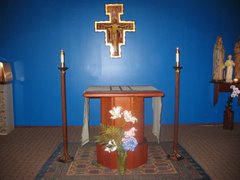
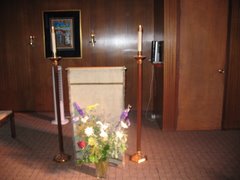
Thanks for your question. I think the term chapel is a bit overblown and would consider not using it, especially not in the absence of reserved Eucharist or if the room is mainly used for other things besides prayer. I would use the term prayer space instead (oratory seems to have become the canonical equivalent of what is more commonly understood as a chapel so I am also avoiding it here). The answer is simply, "Whatever one needs to pray regularly and assiduously." My own space includes a comfortable chair for reading and some more occasional quiet prayer, a zafu and zabuton ( these replace my prayer bench for more formal periods of quiet prayer), a portable lectern or ambo (for singing Office) and a desk for journaling and study. There are book shelves, a large crucifix (which dominates the space and signals the cross is the center of my life), some art (Emmaus O'Herlihy, OSB, cf above, and Mickey McGrath, OSFS) and I use a Zen clock which can chime the hours to help mark parts of the day. My cowl hangs on the back of the door and is available any time I pray.
I think the space should be neat, simple, light, attractive and comfortable in terms of temperature. It should reflect the silence of solitude which is so key to a hermit's life. Because I am officially allowed to reserve Eucharist, my own space includes a tabernacle with ciborium, a sanctuary light, and a small monstrance (it fits inside the tabernacle and is usually left there). I keep a small bowl made by a potter friend nearby for 1" x 2" cards with prayer intentions and requests. This can obviously work for lay hermits as well even though the Eucharist is not present. If, for instance, you were to keep a sanctuary light burning near such a bowl, the symbolism of living presence and constant prayer in communion with others -- all in the heart of the Church -- would still be quite strong. Next to or near their prayer chair most people like to include a small table upon which they may have some fresh flowers, a live green plant, or an orchid, a candle, perhaps a small statue of Mary or a favorite Saint, and their Bible and Office book. One might also have a small CD player or iPod with small speakers there or on nearby shelves.
Remember, this is a functional as well as a sacred space; it is a place where the hermit's main work occurs which is how the space is sanctified. It is not a space which should call attention to itself (there should be no "chapel" sign on the door!), but if this is possible, it should be a private space --- a space where guests do not ordinarily go. Most folks do not have enough space for a completely separate room as their prayer space, but a lay hermit (or anyone living on their own) should be able to section off part off their living or sleeping area as an entirely adequate and dedicated prayer space. (By dedicated I mean this space is not used for anything else; it is a prayer space, not a place where one reads novels or connects to the internet, etc.)
If your prayer space is a portion of a room also used for other purposes (sleeping, etc), you can use wooden or shoji screens to separate the actual prayer space from the rest of the room. The latter especially are movable, relatively inexpensive, simple and attractive. They also allow light to fill the space. I have seen pictures of a variety of personal prayer spaces or "chapels" and the ones which do not appeal to me at all are the ones where with a myriad of statues, relics, holy cards, etc. Usually these cover a table or some other structure the person mistakenly refers to as "an altar." I feel uneasy the moment I see these busy, incredibly noisy spaces. They tend to strike me as "showy" and perhaps "pious" (if Catholic kitsch is pious) but they are distracting to me and hardly prayerful. Of course, that is my own taste, my own aesthetic; it may not be yours.
The basic question I think is, "What do you need to pray?" What do you need to quiet yourself, center, in and give yourself over to God acting within you? What do you need to do lectio, pray Office, do quiet prayer, or do the personal work spiritual direction requires? A corollary is, "What would distract you from your relationship with God or being present to and dependent upon God alone?" (This includes what might distract you from the demands of truly being alone with God. Sometimes it is a fine line between having what one needs -- books, a bit of art, liturgical music -- and having too much.) In other words, "What needs to be absent from a space dedicated to prayer?" I think only you can really answer these questions.
[[Dear Sister, what are the symbols of an eremitical perpetual or solemn profession?]]
Generally speaking the cowl is the primary traditional symbol of solemn or perpetual profession in monastic and eremitical life. A second symbol is the ring signifying espousal. Another is the crucifix worn or carried somewhere on one's person. So is a profession candle marking both baptismal consecration and this new consecration. My diocese required both ring and cowl (or other prayer garment --- whichever seemed best. Since I was a Camaldolese Oblate my diocese agreed the cowl was appropriate and the Camaldolese were consulted as well; they asked that the hood be cut differently from that of Camaldolese monks and nuns since I was not being professed as Camaldolese).
Temporary profession, on the other hand, can be marked by the giving of a prayer garment other than the cowl, by clothing in a habit and/or veil, by a scapular, etc. Not all diocesan hermits or their dioceses choose to use habits or cowls but all that I have heard of require the profession ring. Office books can be given to mark profession, as can a bound copy of one's Rule since this becomes legally binding on the day of profession. Strictly speaking, I am not sure the Office books are symbols of profession, but they are certainly meaningful signs of one's commitment and probably should be included in the rite. The Rule, however is a rich symbol and in particular, is both essential to the living of the life and plays a role almost daily in the mediation of God's continuing call and the hermit's faithful response to that.
[[Hi Sister Laurel, your posts about legal standing and what happens if a diocesan hermit disagrees with a Bishop give the impression that the relationship between hermit and legitimate superiors is oppressive. Am I mistaken? I admit I don't really care for the way the Church seems to want to be in charge of our lives or make moral decisions for us. Have you ever had a disagreement with your Bishop where you needed to rethink things and come to a different conclusion on them about the way you live your life?]]
Well, I am more than a little sorry if that is the impression I have given. It was certainly not my intention nor does it correspond to my experience. In my own experience the place of law and legitimate superiors do not ordinarily interfere with my freedom or my choices at all. When I think or write about the freedom of this life I have tried to make clear that there are constraints, as in any life, but that these qualify and focus my life in ways which serve my ability to explore the depths of eremitical solitude in the name of the Church. That is the fundamental thing I have been called to, the fundamental thing I have committed to doing, and it is the thing which my superiors and law itself are responsible for assisting me to do with integrity. Let me be clear that no one is heavy handed in this matter. Neither my Bishops (there have been several) nor my delegate simply tell me what to do. The point of my post regarding a disagreement with one's Bishop was that when there were differing conclusions with discernment in a genuinely serious matter (and whether or not hermits may work full time, especially in highly social situations, is one of these) a hermit may be asked to resolve the situation differently than her original discernment led her to do. This was because her vocation is an ecclesial one which is responsible for and affects more than her own life alone.
Unfortunately, the hermit may not see this as clearly as her Bishop or delegate (though she might also see things more clearly, as might other diocesan hermits who live the life and are knowledgeable about the tradition); in such cases it is important that all parties share their own discernment in the process of seeking a resolution to the problem at hand. It remains true that if the Bishop should decide that whatever the best solution to the hermit's need for financial support, it is not (and can never be) full time work, she will not be allowed to do (or continue in) this. Hopefully, both Bishop, hermit, and the delegate will work together to seek a better solution which ensures the hermit's ongoing wellbeing but also protects her witness to the solitary eremitical life and the integrity of the eremitical tradition itself. Part of the reality of any vocation is ongoing discernment of the ways God is calling us and our continuing responses to that. A vocation is less something we "have" than it is something we receive and respond to freshly day by day.
One of the important pieces of standing in law is that one is, for the most part, protected against arbitrary actions by others which might interfere with this ongoing responsiveness. If you have ever lived in a community or situation in which "power figures" inappropriately dictated what members might or might not do in the name of "governance", you will know what I mean when I say that standing in law can prevent and protect one from such vagaries of personality and agenda. Experiments in the governance of religious life have sometimes left openings into which stepped those whose (perhaps unconscious) desire was more for power than service. When I write about the relationships which are essential to the canonical eremitical vocation I am speaking about relationships that allow a hermit to live freely in the heart of the Church and devote herself to the silence of solitude while these others provide feedback and a sense of the needs of the Church more generally. It is, in my own experience, a true dialogue in which people cooperate for the good of the Church, her proclamation, and the eremitical life entrusted to her by the Spirit and is not at all oppressive.
I have not had had any situations in which the way I live or propose to live my life have conflicted with the way a Bishop, Vicar, or others discern is appropriate. I have, on the other hand, certainly had conversations with my delegate which have caused me to rethink things and modify the way I live. Similarly we have had conversation which have furthered or clarified my own discernment in matters and occasionally we have had conversations where my own failure to adequately discern a course of action was "unmasked". (Actually, it was only unmasked to me, not to anyone else. As I once recounted here, my delegate once said, "I will be interested to hear your discernment [in this matter]" and my immediate thought was, "Busted!" because I knew at the moment she made the comment that I had not really done a thoughtful discernment.) It was pretty funny really. Certainly the demand that one discern seriously and discuss the process with superiors is not oppressive because in all cases my decisions are my own! Sometimes they simply aren't made alone. In my experience this ("I really am interested in hearing your discernment"--- whether stated implicitly or explicitly) is more typical of the way conversations go between myself and any superiors than simply being dictated to.
Dear Sister Laurel, thank you for your response to my question about elderly and infirm hermits. I am the one who asked whether their vows would be dispensed. I am glad you also thought the blogger mentioned made some good points. She mentioned two other situations. One of them which dealt with full time work you have already responded to indirectly in a separate question. The blogger asked: [[ What if a hermit's financial circumstances are such that a change has occurred, and he or she needs to work part time or full time and the job available or to of which the hermit is capable is among many people or in highly interactive and noisy environment? Do they then need to be removed as hermits? Do they cease being part of the Consecrated Life of the Catholic Church? Would any charitable or wise spiritual director (bishop or not) demand the hermit's withdrawal, or negate the consecrated vocation? Would church law no longer recognize those who are CL603 hermits--with the bishop making a public statement to that effect?]]
The second one has to do with wearing a habit.She wrote the following: [[What if a hermit goes along wearing a habit for awhile, approved by spiritual director (or a bishop), and then realizes it prohibits the degree of passing unnoticed or being hidden from the eyes of men--that the hermit and his or her director have determined to be best for that particular hermit? What if the hermit decides to dress so as to blend in and not be noticed as different or be mistaken as a consecrated religious if not in the religious life? And is it wrong for a hermit to wear a habit if and when no longer a part of the consecrated life of the church as a religious? These aspects are determined by the hermit and his or her director, for there are always personal, individualized, and unique considerations to be made. Not up to others to judge.]] So here are my questions. Can [a] person's spiritual director determine these kinds of things? Can Bishops demand something other than the person's SD and the person discern are best for him. Should someone continue wearing a habit if they have left the consecrated state?
Thanks for writing again. Regarding the place and role of a spiritual director in such matters, the spiritual director will work with a person to help her discern what is best for herself and her vocation at any given point in time but cannot decide this unilaterally and sometimes may not agree with the decision at all. It is not her decision. Ever. She is not a legitimate superior but one who assists a client be attentive and responsive to the voice and movement of God in her life. Similarly if a directee working together with her SD discerns something seems to be the best decision or course of action, etc. this absolutely does not mean a Bishop must automatically agree with this discernment if he is the person's legitimate superior. (By this I mean if he is more than her Bishop but has assumed the place of legitimate superior in the rite of perpetual profession made in his hands.)
The Bishop will certainly consult with the person in this matter and she will share her discernment with him; he may also ask the SD to contact him with her opinion in the matter, but, so long as there is also a delegate in the picture, this is unnecessary and unlikely due to the confidential nature of the spiritual direction relationship.On the other hand he will speak with the hermit's delegate since she serves in precisely this role for both the hermit and the larger Church. Remember that the Bishop has other concerns and perhaps a wider vision of the matter at issue which must be accommodated as well as this specific discernment by the hermit. For instance, in the case of a consecrated solitary (diocesan) hermit let's suppose she determines (with her director's assistance) that it would be best for the hermit to work full time in a highly social job and that she believes the hermit can do this for a period of months without it adversely affecting her vocation. However, let's suppose the Bishop says no to this because as he understands things, 1) the canon does not allow this, 2) the witness it gives to the local and possibly the universal Church is disedifying, and 3) he is not entirely convinced the discernment is really cogent for someone with a genuine eremitical vocation.
In such a case the Bishop will make a decision which contradicts the hermit's own discernment and he is entirely within his rights and obligations as Bishop to do so. If a hermit cannot live with this, then she will have to decide what happens next. Will she obey or not? Will she seek dispensation from her eremitical profession or not? Again, the Bishop has concerns which overlap those of the hermit (both are concerned with her vocation specifically and the eremitical tradition generally) but he is responsible canonically to protect c 603 and the consecrated eremitical life it expresses. Sometimes what seems best for the individual hermit is not also what is best for the Church or for the vocation more generally.
The hermit has to try and get her mind and heart around this fact and either embrace the sacrifice it requires --- if this is possible without compromising her own conscience --- or she will need to find another good-conscience resolution which protects not only her own vocation but the solitary eremitical vocation more generally. However, in such a significant matter -- a matter which weighs directly on the integrity and meaning of the canon --- if she cannot do this and the Bishop is unable to assist her to achieve a workable resolution while standing by his own prudential decision on the matter, then yes, the hermit's vows will very likely need to be dispensed and the hermit will cease to be a consecrated hermit in the Roman Catholic Church. You see, the Bishop, as the hermit's legitimate superior can certainly demand something the hermit does not feel is the best thing for her. This will usually not be done facilely and not without consultation, but it can happen. The judgment is NOT the individual hermit's alone precisely because her vocation is an ecclesial one; others (the church at large, other diocesan hermits or candidates, their own Bishops, etc.) have a stake in the decision being made and the local Bishop and to a lesser degree, the diocesan hermit's delegate, have responsibilities for making binding judgments in these cases.
On Wearing a Habit if One has left the Consecrated (religious) State?
Should someone continue wearing a habit if they leave the consecrated state? No. While I understand the allure of such a decision and the difficulty of letting the habit go, the fact is that habits are symbols of public vocations. They are ecclesial symbols and the individual does not have the right to adopt these without the Church's permission and supervision. (A spiritual director, by the way, would not of him or herself have the right to grant this permission.) I wrote recently that symbols are living things, that they are born and can die but they cannot simply be created by fiat (cf, On Symbols and Ongoing Mediation or, On the Significance of the Designation Er Dio). When we are clothed with the habit and/or prayer garment (something the Church does, usually through the mediation of an institute of consecrated life, but also in the profession of hermits) we accept this symbol as our own; we step into a stream of living tradition and witness to it with our lives.
One of the reasons diocesan hermits do not adopt the habits of specific congregations (Dominican, Franciscan, Carthusian, Camaldolese) for instance is because they are not professed as part of this tradition. Their lives are neither canonically committed to nor shaped by members of these congregations who teach and model for them what this habit means in the history of the Church and the life of a religious of this specific spiritual tradition. In any case, the bottom line is that the wearing of a habit is an ecclesial act, an act of witness which the Church commissions and supervises. It is part of the rights and obligations associated with consecrated life. If one leaves the state she leaves these rights and obligations as well. Again, with rights come obligations and both rights and obligations are mediated by the Church, not by the individual.
[[The blogger also wrote, [[Again, no consecrated Catholic hermit is like another anymore than there are two fingerprints the same in the whole world or that have ever repeated throughout the history of mankind.]] I think this blogger was trying to suggest that Canon law cannot place arbitrary constraints on an individual hermit and that each hermit is free to discern what is best for themselves. She seems to have a fundamental belief that canon law is harmful, especially in regard to hermits. Can you comment on this opinion?]]
I have written recently about the profound characteristics shared by diocesan hermits in spite of their uniqueness here: Significance of Er Dio as post-nomial initials. I don't want to repeat that since it is quite recent but I do suggest you take a look at it if you missed it or perhaps simply to refresh your memory. It is true that every consecrated hermit differs from every other hermit just as individual fingerprints differ. But all fingerprints have shared characteristics or overarching patterns of whorls, arches, loops and their subsets. Eremitical life also has such patterns and basic characteristics. Canon 603 lists these and the hermit uses them to define her life with her own necessary flexibility as she codifies these in her Rule or Plan of Life. Any individualism is at least muted and (one hopes) transformed by this process of configuration and the conversion it empowers. Hermits differ one to another, yes, but to the extent they are authentic hermits their differences represent a variation on a more important shared theme and charism, namely, the silence of solitude they are each and all called to live in the name of Christ and (for those who are ecclesially professed and consecrated) in the name of his Church. I believe that canon law is important for protecting a rare and fragile though vital ecclesial vocation; I have written about that here several times so please check out past posts on this. My opinion has not changed.
On shifting discernment regarding wearing a habit:
There was also a slightly different question posed in the passage you cited re the wearing of a habit, namely, what does one do if one is granted permission to wear a habit and then decides down the line that doing so conflicts with the hiddenness of the life, for instance? Ordinarily, a bishop gives permission for the wearing of a habit and may also approve the habit itself. He does not typically mandate the wearing of a habit. If a hermit discerns that the positive reasons for wearing a habit conflict with something as essential as the hiddenness of the eremitical life, the hermit will take a couple of steps in moving towards relinquishing the habit: 1) she will discuss the matter (with her director, delegate, and probably, her bishop) to share her discernment; these persons are able to evaluate the degree and quality of discernment achieved, 2) she will rewrite the portions of her Rule that deal with wearing the habit and anything in her treatment of the vow of religious poverty which is affected, and 3) she will seek approval for these changes (if, in fact, her Rule addressed these things in the first place). A bishop may or may not approve such changes in the hermit's usual praxis and/or Rule, but if the discernment is good it is unlikely he would disapprove.
Postscript: there has been some confusion, I believe, because in Canon 603 the hermit is said to live her life "under the direction of the local Bishop". This has caused some to write "under their director's authority (whether bishop or not)" [paraphrase] and similar things. However, "direction" in canon 603 does not refer to a bishop doing or serving as spiritual director nor does it elevate the ordinary spiritual director to the same role as the Bishop; such levelling and confusion of roles is a serious misunderstanding of the language being employed here. Instead, the term "direction" (and thus, the director) refers to the general current usage in religious life where a director is a superior under whose legitimate supervision one lives one's life --- as in the case of a novice director or director of candidates, etc. Thus, to avoid confusion when speaking of canon 603, I tend to speak of "director" for spiritual director and of "legitimate superior" under whose supervision (rather than direction) one lives as a canonical hermit to refer to the local bishop. I will also use Director (capitalized) for the delegate and director (lowercase) or SD or spiritual director for that role/person.
[[Hi Sister Laurel, does the term "diocesan eremitic" have an official meaning or is it used for any hermit living in a diocese? From your writing I have gotten the impression that it has a special meaning but I asked a Catholic friend and she hadn't heard the term.]]
Hi there! Yes, the term "diocesan hermit" or "diocesan eremite" has a very specific meaning in the Church. It refers to a publicly professed hermit who make his or her profession under c 603 in the hands of the local (diocesan) Bishop. A couple of things are the result of such an arrangement. First, the local Bishop becomes the hermit's legitimate superior. Secondly, the hermit thus embraces a kind of stability of place which relates to her life in the diocese itself. If she desires to remain a canon 603 hermit but finds it necessary to move to another diocese, she must find a Bishop who is willing to take responsibility for her as legitimate superior. Not all Bishops at this point in time are willing to accept such obligations. Her current Bishop must also "approve" the move. (While he will include a statement that the hermit is in fact a consecrated hermit under c 603 who is in good standing, this is probably less a matter of genuine approval and a little more like "signing off" on the matter; after all, he is relinquishing jurisdiction while that is being assumed by another Bishop.)
It is especially important, I think, that this not be seen as a bit of legalism or some meaningless (or worse yet, oppressive) hoops the hermit has to jump through, but instead, a way of protecting the vocation and the relationships which are essential to it. Thus, this requirement witnesses to these essential relationships and says something crucial about the ecclesial nature of the c 603 vocation itself. Every authentic Christian life and vocation are rooted in relationships, first with God in Christ through the mediation of his Church and then to all others. and all have associated rights and obligations. The eremitical vocation, which is uniquely subject to the temptation of individualism and uniquely called to witness to a dialogical solitude which opposes individualism, also requires the structure of law with the ecclesial rights and obligations established in law if it is to serve as it is meant to do. Saint Benedict wrote quite critically about "gyrovagues" --- monks who moved from place to place without real stability. These 6C "individualists" were anathema to monastic life. In our own day this specific requirement helps prevent the same kind of individualism in hermits.
I suppose the closest thing to this with which your friend might be familiar is the diocesan priest who is incardinated into a diocese. Diocesan priests may move to another diocese but the Bishop there must be willing to incardinate them into this new diocese. In fact a diocesan hermit moving from the jurisdiction of one Bishop to another may well be said to be "excardinated" from one diocese and "incardinated" into another. The literal meaning of excardinate is to "unhinge", 'unplug", or, in other words, to "set free" from the jurisdiction of one Bishop. To incardinate, then is to bring under the legitimate jurisdiction of a Bishop. Moreover, similar to a diocesan priest who cannot simply wander from place to place and function as a priest because he is "interdicted" or prevented from exercising his priesthood unless and until another Bishop incardinates him, a Canon 603 Hermit cannot simply wander from place to place and be considered a diocesan hermit.
One major difference, however, is that a diocesan hermit is usually perpetually professed and consecrated when they seek to move; diocesan priests are neither professed nor consecrated. In such a case, were the hermit simply to up and move to another diocese without providing for excardination and new incardination, she is liable to the dispensation of her vows because of a significant material change in the conditions of those vows. (Personally, I find it incomprehensible that a diocesan hermit would behave in such a way so a diocese needing to take such steps also seems unlikely to me; I am really merely pointing out a similarity between the diocesan stability of priests and of c 603 hermits.) Lay hermits residing in dioceses are not diocesan hermits (or "diocesan eremitics"). They have no legitimate superior, nor have they embraced the canonical rights and obligations of the consecrated solitary eremitical life within a specific diocese. Lay hermits are entirely free to pick up and move without permission of either their current or their new bishop just as any lay Catholic may do.
Dear Sister, I have included two quotes from Therese Iver's article on full time work for hermits in Full time Work for Hermits? In the first one I wondered if she means vows become invalid if a person starts working full time in case of need or if this only applies if the person is working full time when professed? Have there ever been cases where such vows were considered invalid? [[It is actually an abuse of the canon to profess individuals with employment outside the hermitage that isn’t done in solitude. Further, because the canon must be followed in its entirety for a person to be a canonical hermit, either the vows are invalid in the case of a full-time worker in a normal job that isn’t done in strict solitude or the vow of obedience is being violated.]]
I have not spoken to Therese in regard to the article you cited but it seems clear she means that vows would be invalid if made while a person was working full time outside the hermitage and doing so in a non-solitary job. Validity is a matter of the patency of vows when made. Otherwise, as Therese says, the vows would be valid but, should circumstances change and the person begin working full time in a highly social job, she would then be violating her Rule (assuming it is adequately detailed in this regard) and her vow of obedience. I don't know if there have been cases where vows were determined to be invalid but there have definitely been cases where individuals working full time in highly social jobs at the time of their profession were still professed under canon 603.
Those vows, I sincerely believe, should have been determined to be invalid. (I say that because it seems obvious to me that they should never have been allowed to have been made in the first place given the work situations and the lack of true eremitical experience that existed. Dioceses do not generally allow persons to make invalid vows, (or eremitical vows in these circumstances) nor should they.) Exceptions have occurred and they have raised serious questions among dioceses, diocesan hermits, and those who are interested in canon 603 vocations. Two of these are from the Archdiocese of Boston; another involves a hermit working full time as a social worker while a fourth involves a hermit canonist working for her diocese. The usual question is "How can one live an eremitical life and also work fulltime outside the hermitage?" Corollaries include, "How well-conceived is canon 603?" "Isn't it merely created for stopgap or fall back vocations to religious life?" and "What kinds of formation are required when a person can work full time and treat a contemplative prayer life in the silence of solitude as secondary?"
Since I believe c 603 is well-conceived --- though demanding in what it expects of candidates' and chanceries' knowledge of desert spirituality --- and since I believe there are real eremitical vocations out there, I also believe it is critical that dioceses do not "settle" in professing those who treat eremitical life as a "metaphor" or as analogous to the Anglican canon 14.3 on "solitary religious" and treat hermits as though they are individuals who simply live alone and take a desert day once a week or so! In one of the cases noted it is unclear whether the person's vows were ever declared invalid but both she and her Archdiocese still refer to her eremitical profession (referred to by date) as the basis for her communal life (she has begun a new community) while dropping any mention of canon 603. In any case, significant questions regarding this apparent bit of legal or linguistic sleight of hand are thus also cropping up amongst hermits and canonists. Since this person no longer lives an eremitical life under the Rule she submitted for perpetual profession, it seems her vows have ceased to be valid or binding on the basis of a significant material change in the circumstances involved.
Appropriate Accommodations for Emergency Circumstances?
What does sometimes happen is that a hermit will need to work temporarily while waiting for some kind of assistance to be settled on (like SSI or disability for instance). This will usually be part-time work at best because the hermit cannot do more than this (after all, a life of assiduous prayer and penance and the silence of solitude is a full time work in and of itself; add to this the fact of disability and one ordinarily is simply unable to work full time). In cases, however, where the hermit works outside the hermitage full time this must truly be an entirely temporary situation and she must be working with her superiors to be sure she maintains her Rule as best she can. This is still embraced in profession as the defining and governing document of her life; it expresses the shape of her commitment to canon 603 in particular. I would argue there are better ways to deal with such a situation and that, at the very least, a diocese should set a time limit on the period involved. If, in the case of a hermit waiting for SSI or something similar, the assistance is truly expected to come eventually, then perhaps the diocese DOES need to consider helping the hermit out financially until this occurs. Whether the hermit pays the diocese back or not once the award is granted is a separate question. In any case, a time limit would be important in signaling that this situation is contrary to the life of canon 603 and neither can nor will be allowed to continue indefinitely.
If a hermit needs to change from working within the hermitage (as noted above, this cannot be full time work since the life itself would not allow it) to working full time outside it (especially in a highly social job) on something other than a clearly temporary basis, then the diocese should seriously consider whether it needs to dispense this hermit's vows or grant a decree of exclaustration or something similar for a period of time. After all, such a hermit would no longer be living the terms of the canon or her own Rule; she would be violating her profession commitment if not the vows themselves (remember profession is the commitment of the whole person within a state of life; vows are the ordinary way this is expressed). In such a situation something like exclaustration (a good temporary solution I think) or dispensation might well be the only prudent and honest solution open to the diocese.
Again, this is a difficult situation because customarily dioceses do not support hermits in any material way while the canon obliges to religious poverty; even so they have
every right to expect a hermit to be living the terms of the Canon and
to be doing so in ways which are clear to others looking on. One thing
Therese Ivers suggests is that the ability to support oneself is a kind
of acid test today for the presence of a c 603 vocation. Personally I
would not go quite that far because I think in the later years of a hermit's life dioceses may need to consider assisting them in material ways simply so they can remain in situations of some clear solitude. Still, for admission to perpetual profession and for the foreseeable future of a hermit's life, I think the capacity to support oneself in some way is an absolute requirement of canon 603 vocations.
On the Terminology Semi-Eremitical:
[[My second question has to do with Carthusians as semi-hermits. Ms Ivers writes: [[What can we learn about the “silence of solitude” when analyzing the lives of the Carthusians? That if they consider themselves semi-hermits because they get together daily once or twice for prayer/Mass and have recreation together once a week, how does a person with a full time job as a parish finance manager or a social worker fit the description of living as a hermit?]] I have never heard them referred to in this way. Are they really only "semi-hermits"? Does the Church use the language of "full hermits" and "half hermits"?]]
Personally, though I completely agree with Therese's point about the importance of "the silence of solitude" in c 603 life and understand why she underscored it in this way, I think this "semi-hermit" usage is an overstatement and possibly a too-literal misrepresentation of the real meaning of the term semi-eremitical. Carthusian monks are hermits in the fullest sense of the word. They are not monks who also highly value solitude, but hermits who also value and need community because of their commitment to eremitical solitude. As I understand it, the term semi-eremite refers more to the context in which a hermit lives his or her solitary life, that is, within a community than it does to the hermit him/herself.
The communal context protects the hermit's solitude, provides for the hermit's sustenance, clothing, medical care, etc, allows for communal liturgy which also protects the hermits' stricter separation and silence of solitude, and ensures his clear ecclesial identity and sensibilities. Thus the context is semi-eremitical but the life is fully eremitical. Canon 603 hermits, on the other hand, are solitary hermits. Both terms are important; neither is redundant. Canon 603 hermits too are fully hermits but the context for their lives is solitary. They do not belong to an institute of consecrated life, they are self-supporting and must shop for themselves, maintain their own physical solitude in all the ways that is required, and do so without the support of "lay" sisters or "conversae" as the Carthusians have. They live out their ecclesial commitment within the context of a diocese and parish but despite the stability this provides (and I am not speaking here of monastic stability per se) it does not rise to the level of stability provided in a religious community or monastery.
While it is true that Carthusian hermits attend Office and Mass together daily and c 603 hermits attend Mass perhaps once a day in their parish and generally pray Office alone, it would be a mistake. I think, to refer c 603 hermits as (full) "hermits" and Carthusians as semi or "half-hermits". Similarly it would be a mistake to think of solitary hermits under c 603 as "semi-hermits" because they attend parish liturgies while reserving the term hermit or "full-hermit" for those who, for instance, live more isolated lives --- sometimes as self-dedicated but living without real ecclesial identity or involvement. Therese Ivers was rightly underscoring the importance of the silence of solitude for canon 603 hermits. The term "the silence of solitude" is a Carthusian term so the connection to this tradition for c 603 hermits is a significant one. Even so, semi-eremite generally refers to a hermit who depends on professed membership in a community to protect his/her solitude and allow for a truly contemplative life while solitary hermit generally refers to a hermit who is entirely self-supporting and lives a desert existence alone.
Eremitical life occurs along a spectrum of involvement in ecclesial life. Generally today there are three main points along this continuum: solitary eremitical life, semi-eremitical life or eremitical life lived within a community context, and reclusion (which always requires communal support of some sort but is bereft of direct social or communal involvement). What differs in each of these is the degree of separation from others, the degree of physical solitude involved. Still, all of these folks are hermits in the fullest sense of the word. The Church does not use terms like full-hermits or half-hermits. One is a hermit or one is not. There are no part time hermits, no married hermits, and no dilettantes. How one negotiates the necessary and intrinsic ecclesial dimension of the vocation and protects one's call to prayer in solitude may differ one from another but all of these vocations are eremitical in the fullest sense of the term so long as they live out the non-negotiable elements which define all authentic eremitical life.
[[Dear Sister, Though I have not been impressed with a lot of posts on the blog you referred people to a while ago, I thought the author did raise some good questions about what happens to consecrated hermits when they get older and can no longer live silence or solitude to the degree they once did, or maybe to the degree their Rule calls for. Do these hermits then cease to be consecrated hermits? If it is true that a younger hermit who was not living the terms of the canon could not be validly professed, then what does happen to an aging hermit who needs assistance with everyday needs? Also, I was wondering what happens to you when you get too old or too infirm to live on your own?]]
Yes, there were a couple of good questions embedded in the blog you mentioned. First of all, a hermit revises her Rule with the assistance or input of her director and her Bishop whenever there are significant changes in her life situation or circumstances. However, she continues to be responsible for living the non-negotiable elements of the Canon --- even when this does not look like what it did when she was younger. In some ways an aging hermit's solitude may actually be greater despite the presence of caregivers because she will be dealing more full time with illness and, of course, with separation from others who 1) cannot accommodate the rhythm of illness when added to eremitical solitude, or 2) who themselves will be dealing with illness and aging and may no longer be able to visit or call occasionally as they once did. One lives what one can and, in whatever way is possible, one gives her life to Christ and his People in an eremitical life --- even when there is a greater degree of contact with caregivers, doctors, etc. What we are describing here is not a highly social life but instead, a more isolated one which may also be made more difficult or even more significantly penitential because of a lack of sufficient physical silence.
Understanding the Silence of Solitude is Critical Here
What becomes critical here is that one understands the Canon calls for "the silence of solitude" and while this ordinarily requires significant physical silence and solitude, it remains the life's defining value even when one cannot secure for oneself the degree of physical silence or solitude one once could have and, indeed, needed daily. Here "the silence of solitude" especially means the quies or rest one finds in God alone, no matter the chaos that surrounds one or the pain one suffers daily. Here it is a matter of the quality of one's heart more than a matter of external conditions. A life given over to the silence of solitude in the midst of significant physical silence and solitude is essential to achieving this particular form of quies I think. It is the hermit's life of these realities along with assiduous prayer and penance which allows her to be a hermit even in the midst of a more populated and busy world --- including that more populated and busy world she may need to rejoin to a limited extent when she grows too old and infirm to care for herself in all the ways she is used to doing.
But let me be very clear. I am not speaking of pretense here or semantic sleight of hand. One cannot simply exchange a merely nominal "silence of solitude" for genuine and significant physical silence and solitude at the beginning (or at any other point) of one's eremitical life. One cannot, for instance, work full time outside the hermitage in a highly social job and then claim, "Well, the canon literally says, "the silence of solitude" NOT physical silence and solitude! I am living the canon just as it is written, Profess me!!" That would be a lie and destructive of the vocation. One is sufficiently formed in or comes to the silence of solitude as understood by hermits and monastics throughout the centuries only through diligent living of the other requirements of canon 603, namely, assiduous prayer and penance, stricter separation from the world (that is, from that which is resistant to Christ or which promises fulfillment apart from him or God), the evangelical counsels, and observation of a Rule all under the supervision of one's Bishop, one's delegate, and the direction of one's spiritual director. I have written before that the silence of solitude is not only the environment of the hermit's life, but that it is also the goal of her life and the unique gift or charism she brings to the Church and the world. For most solitary hermits there will come a time when in some ways at least, the silence of solitude is less clearly the environment of her daily life but perhaps all the more striking for that, more vividly the goal and gift of her life.
No hermit who has given her life to Christ and his Church in eremitical solitude for 25 to 35 or more years of her life and who then becomes infirm and elderly to the point of needing caregivers or assisted living will cease being a consecrated hermit. There is no diocese, I sincerely believe, who would then dispense this hermit's vows or thus "secularize her" because "she is no longer living the terms of the canon." Should her mental faculties fail, she will continue to be what she lived --- a hermit consecrated by God through the Church's mediation, and she will die as that as well, as impaired as her human poverty may have left her in her final years. What will not leave her, what will not cease to be true and a vital part of her continuing identity is her covenant with God who loves her in her poverty and sustains her in this as he has done in all other things in which she has given herself to him. This covenant and the rest it leads to has shaped her life. So too will it shape her elder years and death.
What Happens to Me?
So, what happens to me when I get too old or infirm to live alone? I honestly don't know. This is one of the difficulties facing diocesan hermits who are not, therefore, part of a community, and who must be self-supporting with a vow of poverty. Here in the diocese of Oakland there is a large residence connected with the Sisters of Mercy. A lot of retired priests and religious needing assisted living go there. Perhaps I will be able to take advantage of that myself. I really don't know. Here you have put your finger on one of the more neuralgic questions facing diocesan hermits and at this point in time there is simply no real answer for many of us --- especially if we are very poor and need an environment where we can continue to live our solitude with God as best as we are able. I am afraid most nursing homes would simply not accommodate such needs.
[[Dear Sister Laurel, are you aware of a "Catholic Hermit" who has recently written the following: [[No one else [besides the hermit, the SD, and God] really knows the whys or wherefores of how a consecrated Catholic hermit is or should be or has to be living his or her life. In fact, no one should be declaring a Catholic hermit consecrated or not consecrated in the Catholic Church, based upon his or her own interpretations of what is specified in Church documents, or presuming someone has an impediment to being in the Consecrated Life of the Church. A Catholic hermit's bishop and/or spiritual director or other Church authority can make that determination when it comes down to validity, if that designation even matters ultimately, eternally (and not the least) to His Real Presence!]]
And also, [[But it is not to judge them, or decide they are not living their lives "according to Hoyle" (according to some other Catholic hermit or non-hermit, or through the eyes of various individual priests or bishops or lay persons who have their own notions but not necessarily God's omniscience for each consecrated Catholic hermit living or dead.]] How can a Catholic hermit argue that an individual Bishop cannot be considered authoritative because he doesn't have God's omniscience? How can she argue that a Bishop's determination that someone's consecration is invalid (or valid I guess) might not even matter ultimately or eternally? It all sounds like a very Protestant approach to vocations and authority, but not very Catholic.]]
Thanks for the questions. Yes I am very aware of the post this all came from. I read it two or three days ago. It is a followup to a post this lay hermit already put up which asked the question, "Who do they think they are?" It seems that a "young canonist" (and member of another consecrated vocation) wrote something upsetting about hermits working full time and opined that vows would be invalid in certain circumstances. If I am correct in this, the offending posts (these were the only pertinent ones I could find that were at all recent) were on the blog, "Do I Have a Vocation?" which is written by Therese Ivers, JCL, a canonist and Consecrated Virgin I consider a friend. Beyond this she specializes in the law of consecrated life and is working on a doctorate in canon law focusing on Canon 603 so she certainly knows what she is talking about. (By the way, though written the 1st of February I only saw this article for the first time about a week ago; I was very gratified by Therese's referral to my blog.)
Now Therese and I don't always agree on everything (who does?), and sometimes we even disagree on relatively small details in regard to canon 603, but her posts on whether or not a hermit should work full time and on private vows were spot on. cf: Can Diocesan Hermits Have Full Time Jobs?, etc. Most importantly she dealt with abuses of canon 603 which have happened because dioceses have used the canon as a stopgap solution to profess non hermits who worked full time in highly social jobs. While you did not quote this portion of the post, you can hear I hope, the incredible irony of a blogger who is herself a privately dedicated hermit dismissing Therese's expertise in Canon 603 on the grounds that she, though a canonist and consecrated virgin, is not a consecrated hermit.
The Church is very clear on who is considered a member of the consecrated state of life and who is not. There is one sentence in the Catechism of the Catholic Church which has caused some confusion because of its location in paragraphs on eremitical life under the heading "The Consecrated Life", but this is really a minor problem since the catechism's own glossary and other paragraphs make it very clear that (except for consecrated virgins living in the world) entrance into the consecrated state always comes to be through profession made in the hands of a legitimate superior with both the authority and the intention of doing this. The sentence refers to hermits who do not make vows publicly but canon 603 allows for sacred bonds other than vows so the sentence could be an awkward reference to this or an attempt to speak to lay hermits without duplicating the paragraphs in another section of the CCC. The c 603 profession itself, however, (whatever form it takes) is always public. In any case, when confusion exists it is up to canonists to make clear the requirements and Therese Ivers is certainly capable of authoritatively doing this --- and does do so for dioceses seeking clarification.
Also, the Church is very clear what constitutes an eremitical life lived in her name. Canon 603 says it is a life of the silence of solitude (not just silence and solitude), stricter separation from the world (that is, from all that is resistant to Christ or promises fulfillment in the way the God of Jesus Christ does), assiduous prayer and penance, profession of the evangelical counsels, all lived according to a Rule or Plan of Life the hermit writes herself and lives under the supervision of the local Bishop. For this reason, the Church has every right through canonists, Bishops, theologians, and others to say what the terms of this canon and all it requires actually means, both explicitly and implicitly. This is especially true when the Church seeks to understand this canon in conjunction with the history of the eremitical life generally and this canon's history specifically.
Beyond this, the actual living out of this vocation in the contemporary world means that Catholic Hermits who deal daily with the tension that exists between the canon's pure or ideal expression (if there even is such a thing!) and the hermit's necessary existence in time and space means the Church will also pay attention to the input of those who are publicly professed and canonically obligated to live the canons governing their life. To state that only the hermit, the SD, and God [[really know the whys or wherefores of how a consecrated Catholic hermit is or should be or has to be living his or her life]] flies in the face of canon 603's explicit and implicit requirements. The Diocesan Bishop and/or Vicars for Religious as well (especially I would argue) as the hermit's delegate (and to a lesser degree or in a different way, the hermit's Pastor) are required to know "the whys and wherefores" of the hermit's life if they are to meet their own ecclesial obligations in her regard.
I can't overstate the importance of understanding vocations to the consecrated state as ecclesial vocations. They are gifts of the Holy Spirit TO the Church, yes, but they are also entrusted to the Church to discern, protect, nurture and govern. That means that they are given to the WHOLE Church and are up to the WHOLE Church to receive and protect -- even when this mainly occurs through legitimate superiors acting in the name of the Church. They are vocations belonging to the Church and she legislates then way they are to be understood and lived. While this does not mean that everyone has an equal voice in the matter, it does mean that folks knowledgeable in the history of the life 'called "consecrated", or those who have lived such lives, do have the right, and often the obligation, to make their opinions known. At the end of the day it is the institutional Church herself who will clarify what is acceptable or not but until that happens, folks with knowledgeable or authoritative opinions will discuss matters and give their opinions when asked. What having an ecclesial vocation does NOT mean is that one can do whatever one wants and then conclude "it's up to me and my director and the omniscience of God" just because they belong to the Church that is entrusted with the vocation. This is simply untrue.
No competent director I know would declare a person "consecrated", that is, a member of the consecrated state because he witnessed their private vows. Neither would any competent director suggest one need not listen to what canonists, theologians, or Bishops say about such vocations. None would suggest that a person could assert she knows God's will better than the entire Church and then approve of her living her vocation "in the name of the Church" with out ever being legitimately commissioned to do so. There is a loose usage common regarding the verb "to consecrate" and I hope it ceases sooner rather than later, but even if a spiritual director did mistakenly encourage a directee to declare herself a consecrated hermit or professed religious because she had dedicated herself to God as a hermit, this does not change what the Church herself authoritatively says about initiation into the consecrated state of life.
Let me close this with a quote or two from Pope Francis speaking about vocations to the conse-crated state. It can be found in Keep Watch! A Letter to Consecrated Men and Women Journeying in the Footsteps of God. Francis says, [[ When the Lord wants to give us a mission, he wants to give us a task, he prepares us to do it well, just like he prepared Elijah. The important thing is not that you've encountered the Lord but the whole journey to accomplish the mission that the Lord entrusted to you. And this is precisely the difference between the apostolic mission that the Lord gives us and a good, honest, human task. Thus, when the Lord bestows a mission, he always employs a process of purification, a process of perception, a process of obedience, a process of prayer.]]
And then there is the following one, which, while written with cenobites in mind applies equally well to hermits with ecclesial vocations. That is especially true bearing in mind St Peter Damian's characterization of solitary hermits as "ecclesiola" or "little churches": [[Thanks be to God you do not live or work as isolated individuals but in community: and thank God for this! The community [local Church] supports the whole of the apostolate. At times religious communities are fraught with tensions, and risk becoming individualistic and scattered, whereas the need is deep communication and authentic relationships. The humanizing power of the Gospel is witnessed to in fraternity lived in community [the local parish and diocese, etc] and is created through welcome, respect, mutual help, understanding, kindness, forgiveness and joy.]]
I have written many times here that the really deadly sin of the solitary hermit is individualism. This is the real route of destruction for an ecclesial vocation and a destructive caricature of eremitical solitude. No one who prays regularly much less assiduously can separate themselves from the community of the Church. No one living a vocation in the name of the Church can eschew the opinions of those who knowledgeably comment on the requirements of the canons governing their own vocations. They certainly cannot suggest that no matter what the Church says, they don't need to listen to anyone's opinion but those of their spiritual director and God and (if they have even been given this right) still legitimately call themselves a Catholic Hermit. For those who are lay hermits but not living their eremitical lives in the name of the Church I think they must still be concerned with what the Church says about the eremitical vocation; they can make their own opinions heard in this matter and are relatively free to live as they feel called, but they should take care not to exchange individualism for eremitical freedom.
[[Hi Sister Laurel, I wondered if you could explain what you like best about the eremitical life? Since you don't do a lot of active minis-try that would provide variety, I am assuming that is not a favorite part, so what is? Maybe this is not the best way to ask the question. I guess I am really wondering what part of your life is most enriching or what part you look forward to every day especially if every day is the same because of your schedule. I hope you can understand what I am asking here. Thank you.]]
Now that is a challenging question! It is not challenging because I don't know what I look forward to each day or really like, but because there is no one thing I like best. I guess saying that out loud gives me the key to answering your question then. What I like best about eremitical life is the way I can relate to God and grow in, with, and through him in this vocation. This is also a way of saying I like the way this vocation allows me to serve the Church and world despite or even through the limitations I also experience. Each of the elements of my life helps in this and some days I like one thing more than another but still, that is because each one contributes to my encounter with God --- usually in the depths of my own heart --- in different ways, to different degrees, on different days.
So, on most days I love the silence and solitude and especially I love quiet prayer periods or more spontaneous times of contemplative prayer which intensify these and transform them into the silence of solitude --- where I simply rest in God's presence or, in the image I have used most recently, rest in God's gaze. It is here that I come to know myself as God knows me and thus am allowed to transcend the world's categories, questions, or judgments. Sometimes these periods are like the one prayer experience I have described here in the past. But whether or not this is true, these periods are ordinarily surprising, or at least never the same; they are transformative and re-creative even when it takes reflective time to realize that this has been happening.
Another thing that I do each day which is usually something I really love is Scripture, whether I do that as part of lectio or as a resource for study or writing. Engagement with Scripture is one of the "wildest rides" I can point to in my life. It is demanding, challenging, and often exhilarating. Sometimes it doesn't speak to me in any immediately dramatic way. But it works on my heart like water on something relatively impervious --- gradually, insistently, and inevitably. Other times, for instance when reading Jesus' parables or other's stories about Jesus, or even the theological reflection of John and Paul, I have the sense that I am being touched by a "living word" and brought into a different world or Kingdom in this way. It always draws me in more deeply and even when I have heard a story or passage thousands of times before something speaks to me on some level in a new way, leads to a new way of understanding reality, or shows me something I had never seen before.
A third piece of this life I love and look forward to is the writing I do. Some of this is specifically theological and there is no doubt that my grappling with Scripture is important for driving at least some of my writing. Whether the writing is the journaling I do for personal growth work, the blogging I do which, in its better moments is an exploration of canon 603 and its importance, a reflection on Scriptures I have been spending time with, or the pieces which can be labeled "spirituality," they tend to be articulations of what happens in prayer and in my own engagement with Christ. One topic I spend time on, of course, is reflection on the place of eremitical life under canon 603 in the life of the Church herself. Since I am especially interested in the possibility of treating chronic illness as a vocation to proclaim with one's life the Gospel of Jesus Christ with a special vividness, and since I have come to understand eremitical solitude as a communal or dialogical reality which is especially suited to the transfiguration of the isolation associated with chronic illness, etc, I write a lot about canon 603 and the solitary eremitical vocation.
A second area of theology I return to again and again is the theology of the Cross. I remember that when I first met with Archbishop (then Bishop) Allen Vigneron he asked me a conversation-starter kind of question about my favorite saint. I spoke about Saint Paul (wondering if perhaps I shouldn't have chosen someone who was not also an Apostle --- someone like St Benedict or St Romuald or St John of the Cross) and began to talk about his theology of the cross. I explained that if I could spend the rest of my life trying to or coming to understand his theology of the cross I would be a happy camper. (I have always wondered what Archbishop Vigneron made of this unexpected answer!)
I saw incredible paradoxes and amazing beauty in the symmetries and strangely compelling asymmetries of the cross and I still discover dimensions I had not seen. Most recently one of these was the honor/shame dialectic and the paradox of the glory of God revealed in the deepest shame imaginable. I have written previously about God being found in the unexpected and even the unacceptable place. This paradox is a deepening of that insight. The Cross is the Event which reveals the source even as it functions as the criterion of all the theology we have that is truly capable of redeeming people's lives. It is the ultimate source of the recent theology I did on humility as being lifted up to be seen as God sees us beyond any notions of worthiness or unworthiness. My life as a hermit allows me to stay focused on the cross in innumerable ways, not only intellectually (reading and thinking about this theology), but personally, spiritually, and emotionally. That is an incredible gift which the Church --- via the person of Archbishop Vigneron and the Diocese of Oakland --- has given me in professing and consecrating me as a diocesan hermit.
There are other things I love about eremitical life (not least the limited but still significant (meaningful) presence and ministry in my parish it makes possible or my spiritual direction ministry); these are also related in one way and another to the person I am in light of living contemplatively within the Divine dialogue I know as the silence of solitude. One of the things which is especially important to me is the freedom I have to live my life as I discern God wills.
Whether I am sick or well, able to keep strictly to a schedule or not, I have the sense that I live this life by the grace of God and that God is present with me in all of the day's moments and moods. It doesn't matter so much if writing goes well or ill, if prayer seems profound or not, if the day is tedious or exciting, all of it is inspired, all of it is what I am called to and I am not alone in it. This means that it is meaningful and even that it glorifies God. I try to live it well, of course, and I both fail and succeed in that, but I suppose what I love best is that it is indeed what I am called to live in and through Christ. It is the way of life that allows me to most be myself in spite of the things that militate against that; moreover it is the thing which allows me to speak of my life in terms of a sense of mission. The difficulty in pointing to any one thing I most like about eremitical life is that, even if in the short term they cause difficulty, struggle, tedium, etc., all of the things that constitute it make me profoundly happy and at peace. I think God is genuinely praised and glorified when this is true.
I hope this gives you something of an answer to your question. I have kind of worked my way through to an actual answer --- from the individual pieces of the life that are most life giving to me to the reasons this life as a whole is something I love. One thing I hope I have managed to convey is that even when the schedule is the same day to day, the content is never really the same because at the heart of it is a relationship with the living and inexhaustible God. Your question focuses on the absence of variety and in some ways, the absence of novelty (neos). But really there is always newness rooted in the deeper newness (kainotes) of God.
Imagine plunging into the ocean at different points within a large circle. The surface looks the same from point to point but the world one enters in each dive is vastly different and differently compelling from place to place. So, following the same daily horarium, I sit in the same chair (or use the same prayer bench) to pray; I work at the same desk day in and day out. I open the same book of Scriptures and often read the same stories again and again or pray the same psalms, and so forth. I rise at the same hour each day, pray at the same times, eat the same meals at the same hours, wear the same habit and prayer garment, make the same gestures and generally do the same things day after day. There is variation when I am ill or need to leave the hermitage, but in the main it is a life of routine and sometimes even tedium. But the eremitical life is really about what happens below the surface as one opens oneself to God. It is the reason the classic admonition of the Desert Fathers, "Dwell (remain) in your cell and your cell will teach you everything" can be true, the only reason "custody of the cell" is such a high value in eremitical life or stability of place such a similarly high value in monasticism.
Preparing to profess solemn (perpetual) vows in the hands of Bishop Allen H Vigneron, Diocese of Oakland (Videos and slideshow of the liturgy are found in early September 2007 Blog entries)
"Sister, receive this ring for you are betrothed to the eternal King: Keep faith with your Bridegroom so that you may come to the wedding feast of Eternal joy."
love is a place & through this place of love move (with brightness of peace) all places
yes is a world & in this world of yes live (skillfully curled) all worlds
e.e. cummings
Canonical Granting of Cowl, Solemn (perpetual) Eremitic Profession
"Sister, Be faithful to the ministry the Church entrusts to you to be carried out in its name."
Contact Information
Questions and comments are always most welcome. That is especially true of questions that "seem" basic and which I may never really address (or reflect on!) otherwise. Please email all queries to me at SRLAUREL@aol.com. I will share and respond to them as appropriate here on the blog, or privately if you wish.
Sometimes, email ends up in my spam folder. This is particularly true if you have not written me before. If you haven't received a response, please write again or resend the original while changing the subject line to indicate this is a second attempt.
Clothing in Cowl, Solemn Monastic Profession (not my own of course)
"We have already mentioned above that the basic motive for choosing the solitary life in a hermitage consists in an existential longing to meet and talk to God. The hermit chooses silence in order to enter fully into a dialogue; (she) chooses solitude in order to meet closely a personal presence. The way of the desert is thus not a stray and arid path, it does not lead to the negation of all the values of the world and of other people. Just the opposite: it is the way of mutual presence, dialogue, and friendship that shines where two freedoms and two hearts, divine and human, meet." The Eremitic Life, Fr. Cornelius Wencel, er cam, p.96
The Eucharist is the center of everything that happens in the hermitage.
"Hope is not the conviction that something will turn out well, but the certainty that something makes sense regardless of how it turns out" Vaclav Havel
"Thanks to his consecration, the hermit step by step makes true in his life those words about being the light of the world that is not to be put under a bushel, but on a lampstand. Indeed, the hermit's calling is rather paradoxical, which causes a good deal of suffering for him. On the one hand, he is called to solitude, but on the other hand, he must bear witness to God's Kingdom to countless people. This only seems to be a contradiction. Its ultimate meaning and value becomes clear to the hermit over the course of his life. The contradiction can be understood only in the context of the Trinitarian mystery. The mystery of an inner exchange of love that constantly overflows in the bosom of the Trinity is on the one hand secret and silent, but on the other hand it initiates historical revelation and the redeeming mission of the Son and the Holy Spirit. According to Origen, God is simultaneously the Silent One, the One who speaks and the One who is spoken about.
The hermit also wants to see his mission between, so to speak, two extremes: between his solitary and hidden prayer and the testimony he gives to the world; between silence and the need to speak out. The hermit's life would have been torn to pieces and left miserably incomplete if he had tried to build on the foundation of his own ideas. But fortunately, the way of the desert is not his own invention, but a gift of the Holy Spirit. This Spirit, the unifying principle of the mutual relationships of the Holy Trinity, is also the source of unity and peace in the life of the hermit. " (pp 107-8, The Eremitic Life, Fr Cornelius Wencel, er cam.)
"The Christian solitary today should bear witness to the fact that certain basic claims about solitude and peace are in fact true, [for] in doing this [they] will restore people's confidence first in their own humanity and beyond that in God's grace." . . . The hermitage represents for the individual and society that place where the hermit, 'can create a new pattern which will fulfill (her) special needs for growth. . .and confront the triple specters of boredom, futility, and unfulfillment, which so terrify the modern American." (Thomas Merton, Contemplation in a World of Action, pp 242, 241)
Links for other Diocesan Hermits" Blogs and Websites
"What the eremitic life aims at is an inner, unifying meeting with God. Thanks to such a meeting, the hermit can understand better (her) existence. The hermit, by an intuition of faith becomes aware that (her) calling makes no sense without Christ and his revelation. She learns that her dignity and the meaning of her life are clear and decipherable only in the context of proclaiming God's Kingdom. That is why the eremitic life means finding the meaning and goal of our life in Christ who is the Word of God pronounced in history. That is faith. Here we can say that the dynamism of faith is always present where a simple and loving heart listens carefully to God's word pronounced still anew in the course of time. This word is so powerful and creative that it leads off and renovates the faith of a Christian who, as a result can participate in eternal things. " The Eremitic Life, Fr Cornelius Wencel, Er Cam, p.97.
"The decisive point is that God has spoken. God has addressed us and the human person is created by God as dialogical. The human being is created by God to be addressed. Faith is receptivity to this word. This receptivity becomes explicit in the language of prayer. If I know who and what I really am (God's dialogical partner), I will burst spontaneously into the prayer of praise and thanksgiving." J O'Connell, The Mystery of the Triune God, (London, 1987), p. 146.
"The Christian's life with the Word is the decisive point which distinguishes Christian prayer from all other types of prayer. This point follows naturally from the unique foundation of the Christian experience, namely that God has spoken. Hence God is ever to be found in his Word and this Word can never be bypassed. The danger of bypassing the Word is the danger of all types of mysticism." (J O'Donnell, The Mystery of the Triune God, pp 148-9)
i am a little church(no great cathedral) far from the splendor and squalor of hurrying cities --- i do not worry if briefer days grow briefest, i am not sorry when sun and rain make april
my life is the life of the reaper and the sower; my prayers are prayers of earth's own clumsily striving (finding and losing and laughing and crying) children whose any sadness or joy is my grief or my gladness
around me surges a miracle of unceasing birth and glory and death and resurrection over my sleeping self float flaming symbols of hope,and i wake to the perfect patience of mountains
i am a little church(far from the frantic world with its rapture and anguish)at peace with nature --- i do not worry if longer nights grow longest; i am not sorry when silence becomes singing
winter by spring,i lift my diminutive spire to merciful Him Whose only now is forever; standing erect in the deathless truth of His presence (welcoming humbly His light and proudly His darkness)
e.e. cummings
Fr Arthur Poulin, OSB Cam
Fr. Poulin’s paintings echo the Impressionists, yet he has developed his own original style. All his paintings begin with a black canvas. Through his contemplative process he starts with minute brush strokes, creating dots (mustard seeds) that will grow into the completed image. In the process he moves from darkness to light, the major theme of his work. When asked about his painting he speaks in terms of moving from the unknown to the known, from chaos to unity; which he sees as a sacred journey not to be feared.
The River, Fr Arthur Poulin, OSB Cam
Big Sur Spring, by Fr Arthur Poulin, OSB, Cam
Brief Rule of Saint Romuald
Sit in your cell as in paradise.Put the whole world behind you and forget it. Watch your thoughts like a good fisherman watching for fish. The path you must follow is in the Psalms — never leave it. If you have just come to the monastery, and in spite of your good will you cannot accomplish what you want, take every opportunity you can to sing the Psalms in your heart and to understand them with your mind. And if your mind wanders as you read, do not give up; hurry back and apply your mind to the words once more. Realize above all that you are in God's presence, and stand there with the attitude of one who stands before the emperor. Empty yourself completely and sit waiting, content with the grace of God, like the chick who tastes nothingand eats nothing but what his mother brings him.
Radiant Light by Fr Arthur Poulin, OSB Cam
Full Moon Over Big Sur by Fr Arthur Poulin, OSB Cam
The Dialogue of Love
"Christian prayer unfolds in a dramatic rhythm of two freedoms --- divine and human ---that interact with each other through the whole range of mutual relationships and attitudes. God gives us his love through the Spirit and He actively takes care of the world in dramatic action involving the whole of creation, a performance we can call Theodrama. (The Eremitic Life, Fr Cornelius Wencel, er cam, p 140)
Bursting Blooms, by Sr Kristine Haugen, ocdh
"God is bestowing a special favour on you by drawing you into the desert. The call is a matter of God's free choice; you will only be able to persevere in it by his condescension. You will always remember how privileged you are that God should love your soul, and as time goes on you will appreciate this all the more. . . . Humble and detached, go into the desert, For God awaiting you there, you bring nothing worth having, except your entire availability. . . .He is calling you to live on friendly terms with him, nothing else." The Hermitage Within
Blue Poppies, Sr Kristin Haugen, ocdh, Hermitage Arts
"Therefore, an authentic prayerful dialogue is possible only in the perspective of love. When two persons entrust themselves to each other in love, a wonderful drama of self-giving and co-possessing is played out. The closer the mutual relationships are, the more they determine all the levels of the two partners' personalities. The stronger the ties are, the more silence is needed and, paradoxically, the fuller the mutual understanding is. The knowledge and the fullness of self-giving that spring from prayer are related to the silence of love." (The Eremitic Life, Fr Cornelius Wencel, er cam, p 140)
Blue Lilies, Sr Kristine Haugen, ocdh, Hermitage Arts
"The hermit knows that it is possible to reach communion with God, who reveals his majesty and his mysterious, elusive presence in nature in a swift stream, in a quiet, misty valley, in the rolling waterfalls, in the ravishing smell of flowers. Prayer rooted in admiration of the world's natural beauty is an attempt to capture the manifest, but at the same time hidden presence of the eternal Mystery, a Mystery so great that it surpasses all that can be named, measured, or touched. Coming into a close, meditative contact with a mountain, a tree, or a flower, the person of prayer discovers that they are all anchored in a wonderful presence that reaches far above all we can know through hearing or sight." Fr Corneilus Wencel, The Eremitic Life, p160.
Cascade, by Sr Kristine Haugen, ocdh
Herons, by Sr Kristin Haugen, ocdh
"While discussing the eremitic life, solitude, and silence, we must never lose sight of the fact that the hermit , like any other Christian, lives in the community that is the Church. There is no doubt that (her) form of participation in the life of the Church differentiates (her) from many other brothers and sisters in faith. However, (her) whole existence is rooted in the community, and that is the key element that decides the Christian character of the way of the desert." (Fr Cornelius Wencel, The Eremitic Life, p 151.)
 [[Dear Sister, when a person is going through the discernment process of becoming a diocesan hermit can the cowl be worn?]]
 In monastic communities a modified cowl (short sleeves, for instance) is given with simple (temporary) vows (and sometimes a shortened tunic, cape, or otherwise modified cowl (sans sleeves) is given with entrance into candidacy and the novitiate). The full cowl is always reserved for solemn profession (in the picture to the right Sister Ann Marie, OCSO, will receive the full cowl after she signs her vows just as Sister Karen, OSCO is shown doing below). Generally. a person just discerning whether or not they are truly called to consecrated eremitical life under c 603 is not allowed to wear a habit of any sort. Doing so is also linked to a public state of life with public rights and obligations as well as with the Bishop's permission and ordinarily someone in initial discernment is not in such a position.
 Remember that a candidate for possible profession under c 603 is usually a lay person with the rights and obligations of any lay person. Because they are not being incorporated into a community in stages (postulancy, novitiate, juniorate, perpetual profession) with commensurate legal (canonical) rights and obligations they are solitary individuals bound "only" by their baptismal commitments. (I do not disparage such commitments by using "only" here. Baptismal commitments are extremely significant but public profession and consecration imply added canonical rights and obligations.)


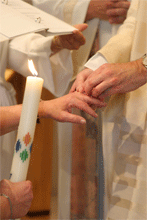


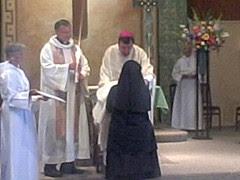

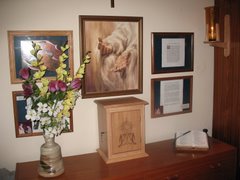


 Posts
Posts