Showing posts with label Eremitical Hiddenness. Show all posts

16 August 2024

On Public Ecclesial Vocations: Rights, Obligations and the Responsibility for Transparency in Consecrated Life

[[Dear Sister Laurel, I was wondering what it means for you to have a "public vocation". You claim that having such a vocation implies that it comes with certain public rights and responsibilities so let me see if I understand some of what that means. Let's say that I disagreed with the theology you provided, or that I thought you were not representing eremitical life well and thought it important enough to speak to you directly about it. It would be important that I have a way of reaching you, true? If I was not satisfied with your response to me, then I would be able to contact your diocese, wouldn't I? It might even be morally necessary for me to do that, true? Are these examples of what you mean when you say you have a public vocation? And what if you claimed to be a diocesan hermit but refused to provide your name or diocese? That seems like it would be a problem if you are responsible to the People of God for what you do or say in public. And yet, how about the Carthusian monks who write books and sign them "anonymous"? They have public vocations but remain hidden in this specific way; why doesn't this work for c 603 hermits? Is my analysis on point? I have more, but I want to hear your response first if that's okay.]]

Wow, such great questions!! And yes, your analysis is pretty much on point -- with some nuances and expansions to be added. Also, of course, you can come back with more. I'll email you this first answer, and then you can reply with more. How does that sound?

So, ordinarily, the rights and obligations identified as part of an ecclesial public vocation have to do with representing the vocation one has been commissioned to live in the Church's name and to do so well. The obligations refer to living the vows well, understanding, valuing, and conveying the nature of c 603 similarly, living one's Rule and the values that comprise its central elements well, and I would say particularly, giving evidence that one lives the Gospel of God in Christ in a way that convinces people that God really is of primary importance to oneself and also to any really compelling spirituality one holds. 

One should be a person of prayer, live from the Scriptures, reflect a vibrant sacramental life, be faithful to spiritual direction, mentoring, and any other disciplines necessary to live this life attentively and obediently, and do all of this for the sake of God and all God holds as precious (essentially, the entirety of God's creation)! At my perpetual profession and consecration, I assumed all of these obligations (and likely a few I haven't called to mind here); in doing so I gave the whole Church the right to expect that I would do all I could to meet these obligations faithfully --- including asking for assistance of those who might help me --- particularly in regard to my responsibility to grow in this vocation over the years.  

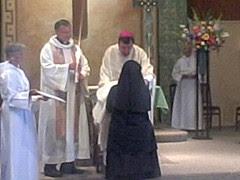
What I was given in exchange was the right to identify myself as a diocesan hermit, a member of the consecrated state in an ecclesial vocation bound publicly by the Evangelical Councils and a Rule of Life I had written and that was vetted by canonists and approved by the Bishop professing me. I was also given the right to style myself as a religious Sister, to wear a habit with my bishop's approval and a monastic cowl (after perpetual profession only). In other words, I was given the right to call myself a consecrated Catholic hermit who lives this vocation in the name of the Church. A year after perpetual profession, I was also given permission to use the post-nominal initials Er Dio as part of my signature indicating my identity as a consecrated c 603 hermit. And, although I have not used this right (and likely can't do so the way some might be able to), I was given the right in civil law to set my hermitage up as a 501(c)3 religious house. So, with that out of the way, let's get to your questions.

The Questions:

Yes, I would agree that if you found me posting bad theology, you might eventually be required to contact my diocese, particularly if I had not been sufficiently responsive to your attempts to speak with me directly. Let me point out, however, that I should be culpable for something serious here and not a matter of a simple theological disagreement. And yes, you are right about the importance of my providing a way to reach me or my diocese so long as I claim to be a diocesan hermit. Part of the obligations I accept in claiming a public ecclesial vocation is a certain relinquishment of the right to absolute privacy. If I am going to express myself publicly and represent myself as a diocesan hermit, people should be able to verify my bona fides. That ordinarily means folks have a right to know my name, as well as the date and diocese of my consecration. If I should want or need to withhold my name for safety's sake, but still choose to express myself publicly, then I must identify the diocese to and through which I am responsibly professed. This would not be optional because my vocation is a public and ecclesial one. (Please also see, OnAnonymity and Accountability in c 603 Vocations )

As noted above, the right to claim an identity as a diocesan hermit comes with correlative obligations. This vocation, as ecclesial, is about more than just me and God alone. People in the Church and larger world have correlative rights and legitimate (valid) expectations re a consecrated person in the Church. This is one of the things new candidates for profession have to be helped to understand. It is not just that one can now be identified as a diocesan hermit. That right comes with correlative obligations to all whom one's life as a hermit touches! I am responsible not just for what I say or do; I have obligations to others to be who I say I am and that includes being transparent about my identity and canonical bonds within the Church. If I claimed to be a diocesan hermit and yet refused to provide my name or at least my diocese, then it would be a betrayal of the public and ecclesial nature of the vocation. The only way to remain anonymous would be to also refuse to claim an identity as a diocesan hermit; in such a case, however, one would be emptying a God-given public and ecclesial identity of any real meaning.

How About Carthusian Monks signing "A Carthusian?"

So what about the Carthusian monks whose books are signed "A Carthusian"? (I'm pretty sure they use this more than they use "anonymous.") Strictly speaking, they are neither remaining anonymous nor refusing to be transparent. They are providing the name of the Order they belong to and that Order is the responsible party here. That Order is publishing in a way that makes the entire congregation responsible to the Church and larger world for what is being published in their name. And that is the key to the situation, being responsible for what one says or does and who one is in the Church and larger world. But c 603 hermits do not belong to an Order. They are diocesan hermits, hermits admitted to public standing by a diocesan bishop and responsible to the People of that local Church as well as the larger Church for this public vocation. Can they remain anonymous? Yes, once professed, they could choose to make this part of their eremitical hiddenness (though it need not be). But let's be clear, they could not do that AND violate their chosen hiddenness by public expressions (blogs, videos, articles, publications) as a diocesan hermit! One simply cannot claim anonymity AND a public ecclesial identity at the same time. That is inconsistent, dishonest, and disrespectful of those to whom one is writing or speaking, as well as to the diocese that has entrusted one with this vocation.

On the internet, I sometimes find folks who insist on remaining anonymous and often tend to be dishonest, exploitative, and selfish. It is striking to me that they are free to publish almost anything they want, truth be damned, if that is what they desire, and they do it in the name of freedom. (It is really about license, not authentic freedom!) Were a c 603 hermit to claim anonymity while at the same time claiming to say or do what they say or do as a diocesan hermit, they would especially not be able to justify this claim in terms of eremitical hiddenness. Again, it would instead be an act of irresponsibility, perhaps even cowardice, and it would certainly fail to respect the persons who listen to or read their works. The only place this might be acceptable would be a situation where a journal (for instance) had taken responsibility for the quality of the hermit's published piece and the author's bona fides. But again, in this situation, as in the example from the Carthusians, someone is taking appropriate responsibility for readers, listeners, et al who have their own rights

Fortunately, diocesan hermits I know who had to deal with the question of not revealing their names or dioceses because of privacy and safety concerns chose to cease being active on the internet, while those who maintain a presence here do so openly and accept any reasonable risk. Both groups of individuals maintain an appropriate eremitical hiddenness (not an explicit element of canon 603 in any case), a sufficiently protective privacy, and also a clear sense of respect for the public and ecclesial character of their vocations. I think you can see the striking difference between a public ecclesial vocation and a private non-canonical vocation, and also why I have insisted for more than 18 years that "public" in these matters is not about notoriety, etc., but correlative public and ecclesial rights and obligations.

20 July 2024

On Supervision of c 603 by Bishops, Eremitical Hiddenness, and Calls for Anonymity

[[ Hi Sister, were you aware that because of the Brother Christian Matson situation, someone is now putting up videos saying that bishops do not have the time or the understanding to supervise diocesan hermits and canon 603 should be "tabled until the bugs can be worked out?" You have raised some similar concerns, haven't you? If canon 603 requires diocesan hermits to be under the supervision or direction of their bishop, and bishops are so busy, how does such a one direct a hermit? I guess the video I saw made me wonder if c 603 is even possible for bishops to fulfill? Also, aren't hermits to remain hidden and anonymous?]]

Hi there and thanks for your questions. Yes, I am generally aware of the situation. It is not a new criticism. Thanks for making contact, however. Please read some of what I have already written about delegates as those posts will fill out what I will say here. The Lexington, KY situation indeed demonstrates how little some bishops and many canonists as well (!) understand the c 603 life --- at least before they have to deal with candidates for c 603 profession. Even more importantly though, it demonstrates how little they regard this vocation, the centuries and history it took for c 603 to be created and promulgated, or the time and effort many dioceses have spent in trying to implement the canon wisely and faithfully. In particular, as I have written before, bishops' lack of understanding of the charism or gift-quality of this vocation is at the heart of any disregard for or misuse of it shown not only by Bp Stowe but also by others in the past (cf., Archdiocese of Boston, Archdiocese of Denver, et al.).  Thus, it might be helpful to you to read more recent posts on charism as well.

I have written about some of what you raise in your questions and agree to some degree, yes, but contrary to what the video you reference apparently asserts, canon 603's terms do not necessarily mean that ongoing supervision by a bishop cannot use intermediaries to assist him in this; often, humility and true regard for the vocation, in fact, seem to call for such "delegation"! As I wrote recently, and have written before, in @2006 my own diocese (Oakland, then-Vicars for Religious, Revs. Raymond Breton and Robert Herbst, OFM Conv.) asked me to choose someone who would act as a delegate for myself and the diocese. That person was meant to be able to meet with me as needed and contact the bishop in the same way. (In my experience the Bishop can and does also contact the delegate if he wants to communicate something to me.) At the same time, the hermit is usually going to meet annually with the bishop himself (more frequently if there is a need) so the two things together seem to be sufficient for intelligent supervision or direction (not spiritual direction!). Others have found this to be true as well. Supervision can therefore mean, "done with the assistance of competent professionals", and of course, because Bishops are so busy and oftentimes, themselves are not expert in formation or spiritual direction, that is precisely the model dioceses generally use. It means that the Bishop's role in directing c 603 vocations is more than possible, though it ordinarily requires the assistance of others with appropriate expertise and an openness to learning.

Adding to this Model today:

Today, we are adding to this model, the model used by the Desert Fathers and Mothers, namely, the addition of mentorship with already well-established and experienced diocesan hermits. This is the suggestion included in Ponam in Deserto Viam. In particular, this mentorship can be very effective in assisting with discernment and the initial formation of candidates. In the model I have been working on, a competent c 603 hermit works with a small diocesan team to assist in the discernment and formation of these vocations. The initial contact is ordinarily made by the candidate or their Vicar for Religious and the c 603 hermit discerns whether or not they can work with the diocese in this regard. If they can, they will accompany the candidate in assisting them to write a liveable Rule of Life. At the same time, they will be available to the diocesan team or chancery staff to educate them on the nature of c 603 and the life it describes and governs.

For ongoing post-profession supervision, the person selected need not be a c 603 hermit or a hermit at all. Still, for the period of initial formation, it is important that the diocese at least look to a diocesan hermit as a resource for the diocese and hermit candidate. Canonical hermits from other traditions (Camaldolese, Carmelite, Benedictine, etc) can also work here, though it seems to me they need to be in touch with a c 603 hermit to help with dimensions of discernment, formation, and diocesan education (education of those who will be responsible for admitting this person and those who come after them to profession and consecration) that are unique to c 603 life itself.  For instance, the vow of poverty will likely need to shift from the way it looks in community, establishing oneself in a parish and finding resources for daily living will also differ to some extent. The major temptations, stresses, transitions, and challenges of c 603 life may also be best understood by another c 603 hermit.

Remember, all of this is not about "working the bugs out," so to speak. C 603 represents a vision of solitary eremitical life that names the essential elements of any authentic eremitical life. There is a learning curve in determining how to implement it intelligently and faithfully, particularly in a world where silence is rare and individualism and isolation have generally supplanted real solitude. Add to that a tendency in the Church to not truly understand or appreciate contemplative life itself while it stresses active ministry, and eremitism seems to be an anachronistic way of living with little relevance to the contemporary church or world. In light of all of this, the learning curve can be steep. That does not mean the canon has "bugs", as you quote. Rather, it is another indication that the Fathers of the church who composed c 603 wrote better than many have seen. Eremitism is a countercultural vocation. That implementing it takes time, experimentation (which includes mistakes), and creative input from the whole church, including those living eremitical life in all its forms, shouldn't be surprising. 

Hiddenness and Anonymity:

You ask about hermits remaining hidden and anonymous. Let me be clear, hiddenness is not mentioned in c 603, the normative legislative text defining this form of life for the Church. It is part of a descriptive section of the Catechism of the Catholic Church that is not legislative and refers to a major dimension of the heart of the hermit's life with and in Christ. I have written here a number of times regarding hiddenness including my sense that it is a derivative characteristic and also that it has more to do with one's life and ministry being hidden in Christ rather than open as it is in apostolic ministry so I would invite you to check these posts out. As far as anonymity goes, that is neither required nor even necessarily a value of c 603 life. Remember that c 603 defines and governs a public vocation defined by public rights and obligations. (These rights and obligations give a public vocation its character as public!) If one wishes to remain anonymous for some good reason (say for safety's sake), one is still responsible for at least making clear in what diocese one was professed and remains in good standing. (One's bona fides must be made known to whatever extent one claims to be a Catholic hermit living eremitical life in the Church's name.) 

If one refuses to do this much, or truly cannot for safety's sake, for example, then I would argue one should not be doing other activities in public either (including online videos). This is particularly true so long as one represents oneself as a Catholic hermit, diocesan hermit, consecrated hermit, consecrated religious, and the like. All of these are public and ecclesial vocations entered with public profession. They all imply both a specific content, along with ecclesial "vetting" and the right to minister in specified ways in the name of the church. The people to whom one ministers (i.e., speaks, writes, teaches, opines, preaches, etc.) have a right to know with what authority (generally speaking) this occurs, and thus too, to what extent (again, generally speaking) one can be trusted with the precious dimensions and vulnerabilities of one's life.

18 July 2023

On the Hiddenness of Eremitical Life

[[Hi Sister, I was trying to understand what the Catechism means by the hiddenness of eremitical life. Can you help me understand that?]]

Hi there, yourself! Yes, I think I can help you understand this. I say that because this is one of the terms I have struggled over a long time to understand more deeply in my own journey. As with the elements of the canon itself, hiddenness occurs on a number of levels; all are important; some are more superficial than others and I have tried to understand the ways in which that is true. For instance, the canon calls for stricter separation from the world and that seems to imply the hermit is called to a stricter separation from that required by other Religious, particularly ministerial or apostolic Religious. This separation, to whatever extent and in whatever way it is lived, is defined for religious by their vows and congregational constitutions or Rule. At the most superficial level it implies the qualification of all of one's relationships --- including with power and wealth. We misread stricter separation if our understanding of it stops at a literal closing of the hermitage door on everything outside us or on giving up all relationships, or fail to truly school our hearts with regard to material wealth, and power. 

We must penetrate this term (and the others in the Canon) more deeply. Yes, we need to close the hermitage door on certain realities as both a literal and a symbolic way to express all that is essential to this vocation. For instance, this expression helps us embrace the physical silence and solitude that is necessary if one is to eventually understand all the ways we ordinarily give ourselves to false gods or become enmeshed in things that are unworthy of us or our vocation and need to turn instead to the God of Jesus Christ. That growth in perception and integration takes time as we move from superficial to profound understanding and our similar embrace of deeper and deeper truth. Also, earlier forms of meaning (say the literal closing of the hermitage door on relationships and activities) may be more strict in the beginning of our eremitical lives, and may actually need to be relaxed at other points as we embrace less literal or less superficial meanings of the term hiddenness. 

For example, learning to turn to the God of Jesus Christ in all things and allow him to shape us into Temples of the Holy Spirit, may require regular work with others (spiritual directors, superiors), participation in some limited form of parish ministry (e.g., teaching Scripture), more intense spiritual direction or inner work with specialists, etc. The functional cloister or anachoresis (withdrawal) of eremitical life remains and contributes to hiddenness, but the constraints on moving outside the hermitage or allowing others into the hermitage may well be relaxed in measured ways as one gives oneself to Christ to be remade more fully and deeply as is possible in specific ways in relationship with some few others. In part this leads me to my understanding of the hiddenness of eremitical life.

In all of this what is mainly hidden from the eyes of others is the hermit's relationship with God in Christ and all the work and growth (metanoia) that comes over time as one focuses on this relationship and becoming the person one is called by God to be. Hiddenness is not an end in itself. It serves our relationship with Mystery and for that reason, it is characteristic of assiduous prayer and penance, stricter separation from the world, and engagement with others that grows out of and even intensifies one's silence of solitude. Hiddenness is the most intimate shape of one's personal journey to and in communion with God, but as I have argued earlier, it is an important and derivative value, not a primary one. 

For each of us, growth in love of God, and maturation in our relationship with God as we move from darkness to light, from blindness to sight, and from brokenness to wholeness is a hidden process. For most, the relationship with God itself is always hidden --- though one can see symptoms and signs of the quality of the relationship by the way the person loves others, themselves, and the whole of creation. The hermit gives over her entire life to this hidden commitment and growth. She will embrace the elements of Canon 603 in order to be sure she is intensely focused on this commitment alone. She does this for God's sake as well as for her own, for the sake of others, and for the sake of the vocation she has been entrusted with. In some ways, we could say that the hermit lives for God alone so that others may understand that this relationship with God is the primary Good in her life --- and should be primary in everyone's life. 

The NT saying, [[Seek ye first the Kingdom of God and all these things shall be added unto you,]] is a way of saying, [[ Seek you first and last this relationship with God, and all the other things you need will be added unto you.]] The hermit's witness to this truth is the most vivid one I could imagine here. It witnesses to the completion that is ours in God --- to the eschatological goal of every life. It is a hiddenness that witnesses to the heart, or deepest Being and vocation of the human person. Even the most perceptive spiritual director or Anam Cara cannot completely penetrate the hiddenness of this relationship --- though dimensions of it can be shared. 

You also wrote: [[One writer criticizes hermits like you who wear a habit or use Sister as a title or let people know you are a hermit in your blog. She says that is against the hiddenness of the life (though she also has a blog and writes about being a hermit). I think she believes because she insists on being anonymous, that is what makes her life hidden and that you (or anyone calling themselves a hermit) should be the same.]] As I wrote in an earlier piece, [[The authors [of canon 603 and also the CCC passages] did not merely mean it all happens alone (with God) behind closed doors --- though of course it mainly does this; they knew that the real fruit and processes of eremitical life (and thus, of eremitical formation and discernment) have to do with the functions of the human heart being redeemed and transfigured (made whole and holy) by the invisible God within the context of silence and personal solitude in an intimate relationship which is mainly invisible and ineffable.]] Everything about eremitical life is meant to foster and witness to this deep and profoundly relational Mystery which is served by hiddenness and all those elements of desert spirituality that contribute to the vocation's hiddenness.

I sincerely hope this is helpful.

09 May 2023

A Look at the Coronation of King Charles III: Hiddenness at the Service of Mystery

Sorry to have been out of touch for a week or so. I came down with something last weekend, spiked a high temp (103.1+), and just have been returning to normal. No worries, everything seems to be resolving even if it is slowly so, and my temp is back to normal or nearly so. (I have now tested for COVID and the results were negative. YAY!! Will repeat the test tonight to verify the results.)

One of the things I did recently (before the temp spiked!) that was more than a bit out of the ordinary was to watch the coronation of King Charles III. I had seen the coronation of  Queen Elizabeth II when I was just shy of 4 yo and it was a memorable occasion viewed on a small black and white TV. It may even have contributed to my response to Catholic liturgy when I was in my teens. In any case, I knew I wanted to watch this coronation even though it meant losing most of a night's sleep to do so. I am not sorry I did. And, while it was all beautifully done and moving (the 3&1/2-year-old still inside me seemed gobsmacked at the COLOR and the horses!!!), one moment especially stood out, not only because it differed from the coronation of Charle's Mother, or because the symbolism was incredibly well-done, but because it was the holiest moment of the coronation per se. 

In 1953 when it came time for Queen Elizabeth II to be anointed, a large gold canopy was moved over her and people stood looking away from her. TV cameras were somehow blocked from any real view of what was happening and I remember trying to see under the canopy and being puzzled by it all. The Queen had been divested of all of her regal finery and was wearing a (relatively) simple white dress. But then came this great canopy and the commentators were talking (more softly I seemed to remember) about something I could neither see nor understand. What I did register somewhere deep within myself was the gravity of the moment, especially as steps were taken to shield the queen, and what was happening to her, from view --- even in the midst of a great throng of interested and supportive people.

Move forward 70 years. Charles III is similarly stripped down to his pants and a simple white shirt. The royal finery is folded and carried away for the moment. Members of the household guard carry in three large decorated screens, the poles which will hold them in place, and assemble them around the King with an opening toward the high altar. There is no canopy, but the King is hidden even more entirely than his Mother had been. As a really nice touch, the household guards face away from the screens except for those holding the poles in place. All have their eyes averted, looking down at the ground. In the midst of this huge cathedral, innumerable digital cameras, people hungry to see every last detail, thousands of guests, and millions of onlookers via media, the Royal family and the Church of England have managed to say clearly, [[Here at the heart of our monarchy is something hidden and inviolable, something incontestably intimate and sacred, something dynamic, living, that --- through the mediation of the church --- occurs between God and the monarch him or herself.]]

It was striking to me that the most profound and profoundly mysterious moment of the coronation was marked by hiddenness. At this moment when the King was anointed, it was hiddenness that was the most powerfully articulate expression of and witness to Mystery. In a ritual enveloped by layers and layers of pomp and color, history and tradition, ritual and symbolism, here was a moment in which an individual temporarily enclosed and shielded from the eyes of others, went into the hiddenness of his own heart and, despite the presence of priests, soldiers, family, and the nations of the world, was alone with his God, seeking and consenting to allow God to do what only God could do, namely, to consecrate him for service to God, his Church, and his people. All of the pomp and pageantry paled for me in comparison to Charles in his simple pants and plain white shirt assenting to being enclosed in the hiddenness of this sacred-making moment. That was underscored for me when I learned that Charles had asked for greater hiddenness than the canopy had allowed his Mother and others in the past.

There are numerous reasons for embracing some degree of hiddenness. They can be good or bad, desirable or undesirable, worthy or unworthy of us. Hermits choose a life of relative hiddenness which serves in significant ways as a witness to Mystery at the heart of life. They choose, not hiddenness as an end in itself, but Mystery and participation in Mystery. They choose hiddenness indirectly because, as was true for Charles III, this is a privileged context for meeting the living God and letting ourselves be vulnerable to him. Today, I am particularly grateful to have seen this value chosen and celebrated by Charles III for the sake of an encounter with the living God. Charles put hiddenness at the service of a moment of ineffable intimacy with Mystery which pomp and ceremony needed to be made to serve. It was liturgy very well done!

26 November 2019

Why I do not Remain Anonymous

[[Sister Laurel, why don't you insist on anonymity? I read where one Catholic Hermit says she wants to remain anonymous as part of her hiddenness, though she has at least a couple of blogs (she has dropped the pseudonym Joyful Hermit) and has made videos as well. She points out that some communities have hermits who publish anonymously so she sees this as common. I wondered how you think about this and your own blogging.]]

Thanks for your questions. Similar questions have been posed here a number of times so you might check the labels to the right. To repeat a lot of that, I am a  (solitary) Catholic Hermit which means I am publicly professed and consecrated to live eremitical life in the name of the Church. When my bishop presented me with my cowl he very specifically did so at the part of the liturgy that commissioned me to take this sign of my consecration and minister faithfully in the name of the Church. While I could certainly decide to remain anonymous I would at least need to identify myself as a "Hermit of  the Diocese of Oakland" (as, in addition to my name, I am identified in the affidavit given to attest to my public profession and consecration). Because my vocation is a public one it is associated with public rights and obligations, and also with expectations others have every right to hold in my regard. To claim to be a Catholic Hermit or a consecrated Catholic Hermit means to accept and even claim that others have the right to verify such claims. It seems to me that one needs either to remain entirely hidden (no blogging, no videos, no online participation) or to be open about who one is. As I have said before, the moment one claims to be a Catholic Hermit, one ceases to be able to remain entirely anonymous; at the very least one is obligated to provide (or indicate) the identity of one's legitimate superior and/or diocese as a necessary expression of the accountability associated with the vocation.

Note well that when Carthusian or Camaldolese hermits, for instance, publish anonymously, they also indicate their congregation or order. The congregation or order accepts responsibility for the book or piece being published and add their name; often they will run the work past censors in the order before allowing it to be published (less common today than was once true). Whether censored or not, the fundamental point however remains, namely, anonymity for someone claiming to be a Catholic monk, nun, or hermit is linked to a very real accountability and thus, to canonical structures and relationships even when one's name is not used. If one ministers in the name of the Church (including contemplative lives of assiduous prayer and penance), then one is publicly accountable both for one's identity and for one's ministry. One cannot claim to be a Catholic hermit (not a Catholic and a hermit, but a Catholic hermit) without also taking on the accountability related to it. Yes, there are frauds or counterfeits out there (the author of A Catholic Hermit blog is, though perhaps without knowing this, one such counterfeit; she claims the rights of such a vocation without accepting the responsibilities or obligations linked to these); in any case, those who are truly Catholic Hermits living ecclesial vocations will be identifiable by name and/or in terms of the diocese or order which has admitted them canonically to profession and consecration.

Thus, (and I sincerely hope some of this is new!) I do not remain anonymous because I am legally and morally accountable for what I  write here as part of a public ecclesial vocation and because I attempt to live a solitary eremitical life in a way which is edifying to others. My commitment is not a private one though it is essentially hidden. I write in the way I do because I believe it is a service for this vocation and for the Church more generally, and because, to the extent this is true, I am sometimes consulted on this vocation. I do it because God, through the whole of my life, has formed me for this while through the Church's own discernment God has entrusted me with such a unique call and the challenge to explore its depths, breadth, and contemporary shape. I also do it so folks can contend with, deepen. or correct my own insufficient understanding and misunderstandings. Canon 603 hermits are a new and relatively rare breed of hermit life; it is similar to all other forms of Catholic eremitical life but it also differs in the way accountability is established and exercised. People need to understand this --- especially those who have never heard of the vocation, those who might consider it for themselves, and those who might be taken in by those showing up at their parish claiming to be a Catholic Hermit who won't participate in the liturgical life of the community or even give their name because of claims regarding the demands of "eremitical hiddenness".

I don't think I approach your questions much differently than any other canonical hermit. We don't refuse to remain anonymous because of arrogance or "vainglory"; we do so because the way to this ecclesial vocation has been long, sometimes arduous and even traumatic, but always a rewarding journey to find our path to remain faithful to God, to our truest selves, and to the call to love one another in and as Christ loves. God takes improbable personal stories and transforms them into the rare but very real love stories of hermits. I and the other Catholic hermits I know exult in the gift God makes of our lives in this way. We embrace an essential hiddenness and witness to it as well. This paradox of our vocations (canonically public and responsible yet also hidden) matches the paradox of what God has done with our weakness and personal inadequacy, but also with our potential for covenantal life; it is an awesome thing we are called to, an awesome thing we live and witness to.

I hope this is helpful.

25 November 2019

On Eremitical Hiddenness: Crucified with Christ, Hidden With Christ in God

The question of eremitical hiddenness continues to be raised and some have wondered how it is I can be involved in a parish, much less be teaching Scripture there or being identifiable and known as both a nun and a canonical hermit when the Catechism describes eremitical life in terms of hiddenness. I wrote recently in Hiddenness as Derivative Value, that the hiddenness of the hermit is not primary but secondary to more fundamental values like stricter separation from the world, the silence of solitude, and assiduous prayer and penance. What all of this has in common, what each of these terms from canon 603 share is their description of what it means to exist in Christ. Existence in Christ means being crucified with him and also being raised to new life in him. There is a dying to self and the world and a rising to new life in Christ involved in each of these canonical terms defining eremitical life in the Church. Another term describing each of these is being "Hidden with Christ in God" (Col 3:3).

It should be no surprise that a life lived more and more in Christ and less and less in terms of the world (that which is contrary to Christ, is resistant to Christ, or which seeks to be its own source of life and meaning) should also be described in terms of hiddenness. We are all called to be hidden with Christ in God. Our very humanity, to the extent it is authentic is, like Jesus' own, utterly transparent to God. Hiddenness in God is a way of saying truly human! Hermits are called to this in a way which accentuates not only its possibility but its truth. After all, the truth that we achieve authentic humanity in a way which involves dying to self and living a life which is transparent to God is a difficult thing to get our heads and hearts around. The paradox of living a public vocation of hiddenness in God is also something that sounds incoherent or nonsensical as does living a vocation in solidarity with others and ministry to others when we remind one another that that is actually also the shape of a solitary (eremitical) life hidden in God.

But of course the physical silence, external solitude, and "silence of solitude" which is the goal and charism of eremitical life work as powerful and paradigmatic symbols of this hiddenness. So do prayer and penance which are always so profoundly linked to dying to the self which is something less than our truest, deepest self. Because hermits say with their lives that God alone is sufficient for us ("(God's) grace is sufficient for you, my power is perfected in weakness,") so also do we speak of hiddenness with Christ in God through our commitment to prayer. We live our lives in a solitary and God-centered way so that in us others hear and see the life and consolation of God in Christ at work bringing us to wholeness and holiness. We are essentially freed from trying to make a name for ourselves, trying to live a life measured in terms of usual achievement and success, and live out lives in the name of God and -- for canonical (consecrated) hermits -- in the name of the Church. We will even mainly give many of our discrete gifts and talents over to a life relatively free of apostolic ministry so our witness to the Gospel of God's sufficiency and gratuitous love is as radical as we can make it.

How ever we define hiddenness in our individual Rule of Life, we must begin with Col 3:3 (or similar passages) and the theology underpinning these. We cannot start from Webster's dictionary and what it says of hiddenness. Still less can we use it as an excuse for misanthropy, social failure,  psychologically disordered withdrawal from others, or the other stereotypes so deeply connected to misunderstandings of hermit life. Neither can we treat hiddenness as a primary value that stands on its own; instead it must be seen as a derivative value stemming from more fundamental realities like participation in Christ, assiduous prayer, the silence of solitude, etc. These are the foundational realities that give hiddenness its true content and meaning; they are what allow us to understand it in terms of transparency to God and God's own revelation through us; they allow us to see hiddenness as profoundly allied with incarnation and authentic humanity. As I noted in the September post, hiddenness is a derivative reality, the result of death and resurrection with Christ in God which can only serve paradoxically as a form of witness.

Folks have asked about my own ministry and life in my parish. It should be noted that hermits have always been seen as living in the heart of the Church, and in some ways representing a dimension of that very heart. Solitary consecrated hermits today (c 603 hermits) are professed either in their Cathedral and/or parish church in the hands of their bishop; this marks the fact that they are called forth from the midst of the People of God, especially as embodied in this local faith community. The local church is responsible for assuring access to the Sacraments for the hermit just as the hermit is responsible for receiving these regularly and for sharing in the faith life of this Church. Eremitical hiddenness is not a sufficient reason for failing to be an integral part of one's faith community; if hiddenness enters the equation the hermit (along with her bishop and pastor) should find ways to simultaneously underscore her integral place in her parish. Since she has been commissioned to live this life in the name of the Church, her life really must be lived concretely in the heart of the Church.

My own limited ministry (including teaching Scripture or doing spiritual direction) is part of the very natural outgrowth or overflow of the way God has loved and acted to bring me to completion in the silence of solitude, but also through the life of the Church. It is the celebration of who God and God's Messiah are for me and a way to share this. And, it is a way of thanking God and those people who are part of my parish family. At the same time it is an  important way I grow in Christ and in my capacity to love. It is the fruit of my solitude (a unique expression of community) with and in God and it calls me back to that. I have carefully discerned this with my director and it is something we both keep our eyes on. But some ask how I can do this or be known as a hermit and the answers include: 1) the Church, under whose specific authority I live this life allows limited ministry and requires self-support, 2) my Rule (approved with a Bishop's decree of approval) allows it and in fact, identifies it as important for my own well-being, 3) it enhances my life in Christ in solitude and is the fruit of that, and 4) limited ministry including teaching a bit of Scripture and doing direction is, again, carefully discerned with the assistance of those responsible for this.

04 September 2019

Hiddenness as a Derivative or Subordinate Value for the Hermit

[[Dear Sister Laurel, I need you to clarify something for me. Are you saying that hiddenness is not an important value for the hermit? I think hermits make sacrifices so wouldn't remaining hidden be one of these especially when one is ill and needs medical care? Wouldn't a hermit accept the sacrifice of hiddenness and forego some kinds of contact with medical personnel? Why would it be different for someone who is privately vowed than it is for someone publicly professed?]]

Thanks for your questions. Hiddenness is a characteristic of eremitical life. It can be and often is an important value but in the eremitical life it is also a derivative one. Hermits do not make vows of hiddenness, for instance. Canon 603 does not even mention hiddenness much less make it normative. Instead solitary canonical hermits are bound to a life of "stricter separation from the world", "assiduous prayer", and "the silence of solitude" for the praise of God and the salvation of others. Hiddenness stems from these normative elements. It is derived from them and is a helpful description of a significant dimension of these elements; clearly the  Catechism of the Catholic Church knew this. However, this also means it is not normative in a way which allows it to supersede more fundamental values and obligations -- the obligation to live well, to take care of one's health, to be sure one's eremitical life is a witness to the Gospel of Jesus Christ to others in ways which edify (build up), and any number of other obligations.

Think about this from the perspective of witness value. The central elements of canon 603 I mentioned are normative because of themselves they have a witness value. Assiduous prayer has meaning in itself and witnesses to the fact that God alone completes us as the covenantal people we are meant to be. Every human person is called to significant and even assiduous prayer in one form and another because every human life is meant to be completed and made true in and through the powerful presence of God's love. We are all called to allow this Presence/love to work by being attentive and open to it --- though hermits do this in a way which defines their lives in terms of prayer.

The "silence of solitude" has a fullness of meaning beyond mere silence and solitude; it points directly to the wholeness, integrity, stillness, and completeness of the life lived in and for God alone. Every human being is called to "the silence of solitude" as the goal of their lives even if they are not called to live in eremitical silence and solitude or witness to this specific wholeness and holiness with lives defined in terms of "the silence of solitude" per se. "separation from the world" is a value in and of itself because every human being is called to be separated from those things which promise fulfillment apart from God or which resist the God who comes to us in Christ. Most, however, are called to live this separation while living within the world of everyday affairs and concerns. Hermits live a stricter separation in a more intense and paradigmatic way; they do so to witness to the importance of "cleaving to God" in every person's life. But hiddenness is different. It may be a value  and will be if it serves these other values, but it may also be a disvalue. Consider what hiddenness means if it is linked to fear, escapism, a lack of integrity, or hypocrisy and dishonesty.

My canonical eremitical life is an essentially hidden one marked by assiduous prayer, study, inner work, contemplation, recreation with God for the sake of balance, wholeness, and so forth. But the hiddenness is meaningful and of witness value only because and to the extent it serves and reflects these things --- only to the extent it serves the central elements of c 603 life outlined above. If I spent my days merely watching TV or sleeping, reading, and eating bon bons etc, if, that is, I lived in ways which actually gave the lie to my eremitical commitment, my life would also be hidden but the hiddenness would actually be a disvalue and it would be destructive and disedifying to the eremitical vocation and the Church who received my commitment and consecrated me. (Please note, I am not referring to days or parts of days when illness prevents my more usual eremitical life here. I am just trying to contrast what my eremitical life is meant to be vs something it is NOT meant to be and how both of these reflect hiddenness.) Thus, again, hermits do not make vows of hiddenness nor are they called to hiddenness except as a derivative or subordinate value which serves more primary values. To reject necessary medical care or refuse to build a necessary network of folks who can assist one in case of serious illness or other need in the name of "hiddenness" is wrongheaded and, I would argue, unwise and illegitimate.

Your questions about sacrifices fit in here. Yes, eremitical life is marked by sacrifices -- as is any life which is truly given to God in all things. But note that this means it is a moral life in which objective values are discerned, prioritized, and acted upon. Hiddenness of itself is not a value which can trump a commitment to fullness of life. Were I, as a canonical hermit, to decide to forego necessary medical and/or post-surgical care (especially after I had appropriately discerned the rightness of having the surgery in the first place!), my superiors (bishop, Director/delegate) would have every right (and obligation) to question my decision and to work with me to be sure my decision was well-founded and served not just myself but the eremitical vocation I live. In something serious like this they would need to agree with the quality or soundness of my discernment or they could even require me to accept the care my physicians have said is required for good post-op recovery.

Note well, that the question of elective surgery itself is something that requires discernment; assuring sufficient assistance for a good post-operative course would be part of that. I could not agree to elective surgery as the will of God in my life unless I also could affirm that the necessary post-operative care was something I could commit to in this way.  If the surgery is not elective the necessary post-operative care is still undertaken as part of the necessary surgery itself. As you might guess, for most hermits the real sacrifice in any of this would be to accept the necessary medical care and assistance of others because we do love our physical solitude. And yet, in accepting assistance in this way the hermit witnesses to her solidarity with others even in the essential hiddenness of her life. She reminds every person that eremitical solitude (which, again, is very much more than just physical solitude) is actually a unique way of living community; she reminds us all that Love is the highest value of her life and that loving and being loved is the highest dynamic in every life --- but certainly in the life of a consecrated hermit living a solitary vocation affirming the sufficiency of God as Love-in-Act.

In light of all this the consecrated (publicly professed) hermit cannot make hiddenness an absolute value; even less can she put hiddenness above this most foundational witness -- especially when the Church will allow the mitigation of even physical solitude in order to accept appropriate care and assistance. Moreover, in a point I made in the last post, if a canonical hermit is allowed and even required to accept such mitigations, how much more so would this be true for a lay hermit whose commitment is a private one? I hope that to some degree at least this answers your question about the difference between publicly professed hermits and those with private commitments. If you feel it does not I would encourage you to read other articles on the differences between private vows and public profession, especially those dealing with the public rights, obligations and expectations which are part and parcel of any public commitment. And of course, if that is not sufficiently helpful to you, please get back to me with your questions.

06 December 2016

On the Hiddenness of Eremitical Life

 [[Hi Sister, I wondered if you find the idea of the hiddenness of your vocation difficult. I was especially wondering if there is some part of "remaining hidden" that is particularly challenging to you? Have you chosen to blog in response to this or maybe in spite of this?]]

Really terrific questions! Yes, there is a dimension of eremitical hiddenness that has been difficult for me, namely, it has been challenging to come to a really adequate or more complete understanding of what I am being asked to witness to or how my life proclaims the Gospel if it is hidden in the sense most folks understand the term. When I considered eremitical life originally I thought it was supremely selfish and in one way and another I have been dealing with residual bits of that conviction throughout my own struggle with the vocation's hiddenness. After all, we have texts like Jesus' clear teaching that one ought not put one's light under a bushel basket but instead place it on a lampstand so that all may see (by) it, and of course there is the clear commandment that we love one another as God loves us. Eremitical solitude and hiddenness seem to fly in the face of these and similar central bits of the Gospel Tradition.

Trusting the Light Mediated by Hiddenness:

If you notice the way I amended the text above regarding putting one's light on a lampstand you will see one of the ways I have come to deal with the apparent conflict between the importance of eremitical hiddenness and also the imperative to share with others. You see, I came to see more clearly the basic truth that it is not so much that we see light itself but rather that we see by virtue of the light. In thinking about eremitical hiddenness I came to see there is a difference between putting one's light on a lampstand so that others might see it and putting the light there so that others may see by virtue of it. The second "translation" allowed me to see that a hermit's hiddenness might prevent folks from looking directly at "the light" (to whatever degree this particular life really is a source of light) but that the light of the hermit's life could still (and in fact MUST still) illuminate the world around her and be a source of light to those within in. In many ways eremitical life is the most radical expression of the truth that we must grow less so that God's glory lives more fully in and shines more fully through us or that it must be Christ in us that is the most critical reality we witness to.

What I must trust is that, in ways I am mainly unaware of, the light of Christ DOES shine through me --- especially through the fact that life in eremitical solitude is something which completes and makes me genuinely happy --- and that it is the real purpose or calling of my life, in the main it is the way I truly DO love others. When I write about the redemptive reality which MUST exist in the life of any hermit and the fact that this must come to the hermit in the silence of solitude I am writing about the same thing Merton wrote about when he said that "the first duty of the hermit is to be happy without affectation in (her) solitude".  The whole quote says, [[The . . .hermit has as his first duty, to live happily without affectation in his solitude. He owes this not only to himself but to his community [by extension diocesan hermits would say parish, diocese, or Church] that has gone so far as to give him a chance to live it out. . . . this is the chief obligation of the . . .hermit because, as I said above, it can restore to others their faith in certain latent possibilities of nature and of grace.]] (Emphasis added,  Contemplation in a World of Action, p. 242)

In a world where there is such an emphasis on active ministry (and rightly so) and such a need for concrete acts of love it is simply hard to see that it is the very hiddenness of the hermit that is actually a very significant act of love which witnesses to the grace of God that has redeemed the hermit's life. So often activism is not a reflection of a contemplative or prayerful core; so often it is an expression of insecurity, the need to achieve for one's own sake more than for the sake of the other. So often active ministry is undertaken in an approach that is more symptomatic than systemic --- it deals with symptoms more than the underlying disease (though the best priests, religious, and laity I know manage an active ministry aimed at the core problem as well and even primarily.) The hermit serves to remind us all that before we reach out to others we must be able to point to God's love and redemption with the wholeness and capacity to remain in solitude, secure even in our hiddenness.

Inner Work and the Witness of the Hermit:

Recently I wrote about inner work I was undertaking with my director. At one point we had a discussion of why this work was personally imperative for me and how it was that it was consonant with my vocation --- especially because the work meant a frequent and regular contact with my director and some significant temporary changes in my Rule. I explained that my own sense was that since the Church had consecrated and commissioned me to live this vocation in her name she had also commissioned me to undertake anything essential to living an abundant life in union with God more and more fully. That meant, I explained, that not only had the Church given me permission to do this work but that insofar as it was essential to my own healing and growth it was something that was an essential part of this vocation the Church had publicly called me to.

Also, despite the intense interaction with my director --- an interaction in which the Grace of God was consistently mediated --- it was done mainly in solitude and would enhance my solitude --- especially since solitude differs so radically from isolation and the brokenness associated with isolation. All of this was done so that I could truly be a hermit living out the primary obligation of the eremitical life as Merton had defined it and as I had come to know it to be. All of it witnessed to what the hermit knows most acutely in solitude, namely that there are incredible, awesome latent possibilities or potentialities marking the place within us where nature and grace meet --- where, in fact, God bears and is allowed to bear witness within us. It can be essential for the health of every minister to be reminded of these deep potentialities and the terrible hunger every person may know to have them realized in relation to God. Thus, hermits serve the Church --- sometimes by remaining completely hidden and sometimes by maintaining an essential hiddenness despite a very limited active ministry --- as I do in my parish and with this blog.

On Blogging:

Thus, the answer to your second question is that blogging is not something I have chosen to do in spite of a call to eremitical hiddenness but rather, something I have chosen to do because of it. I am convinced there needs to be a way of sharing the incredibly positive reasons hermits choose the silence of solitude, why their hiddenness is an antidote to the epidemic need for notoriety so prevalent today, and why solitude is not necessarily a selfish choice but can be one which is made for the sake of others. My own choice to blog also has to do with the need for reflection on hermits' lived experience of canon 603 and the way it is implemented and needs to be implemented for the good of the Church and solitary hermits. Eremitical life per se is so little understood in chanceries throughout the world and so often understood in terms of "being a lone person" or isolation rather than eremitical solitude by so many others. We have to allow the love which drives this vocation to illumine the world --- both in its hiddenness and in the limited access we give others to that hiddenness.

What I have come to understand over the  past decade especially is that the vocation is not selfish and that, paradoxically, hiddenness in the eremitical life is a dimension of one's love for God, for oneself, and for others because it reveals the God who loves us simply for ourselves; similarly it reminds us that allowing this to really be the foundation of our lives is the one thing necessary and the deepest potential of our humanity.

29 September 2015

On Anonymity and Accountability for Hermits

v[[Dear Sister. What are your views on anonymity for hermits? I read an article today by a Catholic Hermit who has decided to remain anonymous since that helps her prevent pride. You choose not to remain anonymous so I am wondering about your thinking is on this.]]

It's a timely question and an important one not least because it points to the responsible nature of ecclesial vocations. The first thing to remember is that if one claims to be a Catholic hermit, that is one who lives eremitical life in the name of the Church via profession (always a public act) and consecration, then one has been commissioned to live a public ecclesial  vocation. If one claims the title "Catholic Hermit" or "consecrated hermit", etc., in creating a blog or other website, for instance, then one really doesn't have the right to remain entirely anonymous any longer. This is because people who read the blog have commensurate rights to know who you are, who supervises your vocation, who professed and consecrated you and commissioned you to live this life in the name of the Church. If they have concerns with what you write then they must be able to contact you and, if really necessary, your legitimate superiors.

Ways of Maintaining Appropriate Accountability:

One thing that is possible, of course, is to say that this blog (etc) is the blog of a "Diocesan Hermit of the Diocese of Oakland," for instance, without providing one's given name. In doing so I would still be maintaining accountability to the Church for this vocation and what comes from it.  If there is ever a serious concern, then the Diocese of Oakland (for instance) will know whose blog is being referenced. (In this case, they may not ordinarily concern themselves with my everyday writing because they do not micromanage my activities --- my delegate would tend to know more about my blogging, I think --- but they will know whose blog this is and deal appropriately with serious complaints or concerns that might arise.) However, it seems to me one still needs to provide a way for folks to contact one so the chancery isn't turned into the recipient of relatively trivial communications which are an actual imposition. (I, for instance, do not usually provide my hermitage address, but people who prefer not to email may write me at my parish. This would work even if I did not give my name but used "Diocesan Hermit" instead because the parish knows precisely who I am and provides a mailbox for me.)

A second solution is to blog or whatever the activity without claiming in any way to be a Catholic hermit, Diocesan hermit, consecrated person, professed religious, etc. As soon as one says I am a Catholic Hermit (or any version of this) one has claimed to be living a vocation in the name of the Church and the public writing one does, especially if it is about eremitical life, spirituality, etc, is something one is publicly accountable for as a piece of that living. So, the choice is clear, either write as a private person and remain anonymous (if that is your choice) or write as a representative of a public vocation and reveal who you are --- or at least to whom you are legitimately accountable. Nothing else is really charitable or genuinely responsible.

Some may point to books published by an anonymous nun or monk, books published with the author "a Carthusian monk"  (for instance), as justification for anonymity without clear accountability, but it is important to remember that the Carthusian Order, for instance, has its own censors (theologians and editors) and other authorities who approve the publication of texts which represent the Order. The Carthusians are very sensitive about the use of the name Carthusian or the related post-nomial initials, O Cart., and they use these as a sign of authenticity and an act of ecclesial responsibility. (The same is true of the Carthusian habit because these represent a long history which every member shares and is responsible for.) The Order is in turn answerable to the larger Church and hierarchy who approve their constitutions, etc. Thus, while the average reader may never know the name of the individual monk or nun who wrote the book of "Novices Conferences" for instance, nor even know the specific Charterhouse from whence they wrote, concerns with the contents can be brought to the Church and the Carthusian Order through appropriate channels. This ensures a good blend of accountability and privacy. It also allows one to write without worrying about what readers think or say while still doing so responsibly and in charity. Once again this is an example of the importance of stable canonical relationships which are established with public profession and consecration --- something the next section will underscore.

The Question of Pride:

It is true that one has to take care not to become too taken with the project, whatever it is, or with oneself as the author or creator. With blogs people read, ask questions, comment, praise, criticize, etc, and like anything else, all of this can tempt one to forget what a truly tiny project the blog or website is in the grand scheme of things. But, anonymity online has some significant drawbacks and a lack of honesty and genuine accountability --- which are essential to real humility I think --- are two of these. How many of us have run into blogs or message boards which lack charity and prudence precisely because the persons writing there are (or believe they are) anonymous? Some of the cruelest and most destructive pieces of writing I have ever seen were written by those who used screen names to hide behind.

Unfortunately this can be true of those writing as "Catholic Hermits" too. I have read such persons denigrating their pastors (for having no vocations, caring little for the spiritual growth of their parishioners, doing literally "hellish" things during Mass, etc), or denigrating their bishops and former bishops (for whining, lying and betraying the hermit to the new bishop) --- all while remaining relatively anonymous except for the designation "Catholic Hermit" and the name of her cathedral. How is this responsible or charitable? How does it not reflect negatively on the vocation of legitimate Catholic hermits or the eremitical vocation more generally? Meanwhile these same bloggers criticize Diocesan hermits who post under their own names accusing them of "pride" because they are supposedly not sufficiently "hidden from the eyes of" others.

Likewise, over the past several years I have been asked about another hermit's posts which have left readers seriously concerned regarding her welfare. This person writes (blogs) about the interminable suffering (chronic pain) she experiences, the lack of heat and serious cold she lives in in Winter months which causes her to spend entire days in bed and under blankets and left her with pneumonia last Winter; she writes of the terrible living conditions involving the ever present excrement of vermin --- now dried and aerosolized, holes in walls (or complete lack of drywall and insulation), continuing lack of plumbing (no toilet) or hot water despite her marked physical incapacities, the fact that she cannot afford doctors or medicines or appropriate tests and may need eventually to live in a shelter when her dwindling money runs out. Unfortunately, because all of this is written anonymously by a "consecrated Catholic Hermit" presumably living eremitical life in the name of the Church, it raises unaddressable questions not only about her welfare but about the accountability of her diocese and the soundness and witness of the contemporary eremitical vocation itself.

This poster's anonymity means that those who are concerned can neither assist her nor contact her diocese to raise concerns with them. Here anonymity conflicts with accountability. While it is true diocesan hermits are self-supporting and have vows of poverty readers have, quite legitimately I think, asked if this really the way the Church's own professed and consecrated hermits live. Does the Church profess and consecrate its solitary hermits (or facilely allow them to transfer to another diocese) and then leave them to struggle in such circumstances without oversight or assistance? Is this the kind of resource-less candidate the Church commissions to represent consecrated eremitical life? Would this be prudent? Charitable? Is it typical of the way consecrated life in the church works? Does a hermit's diocese and bishop really have nor exercise no responsibility in such cases? How are such hermits to be helped?? Unfortunately, the combination of this poster's relative anonymity and her lack of accountability, prudence, and discretion can be a serious matter on a number of levels.

In other words while pride may be a problem (or at least a temptation!) for those of us who blog openly, it may well be that anonymity itself may lead to an even greater arrogance whose symptoms include writing irresponsibly and without prudence, discretion, or real accountability. Thus I would argue that anonymity can be helpful so long as one still exercises real accountability. Importantly, one needs to determine the real motives behind either posting publicly or choosing anonymity. Simply choosing anonymity does not mean one is exercising the charity required of a hermit. It may even be a piece of a fabric of deception --- including self deception.  For instance, if one chooses anonymity to prevent others from learning they are not publicly professed, especially while criticizing the "pride" of diocesan hermits who choose to post openly, then this is seriously problematical on a number of levels.

At the same time some authentic Catholic hermits choose to let go of their public vocational identities for a particular limited project (like participation in an online discussion group or the authoring of a blog) and write as private persons. This is a valid solution --- though not one I have felt justified in choosing myself --- because one does not claim to be a Catholic hermit in these limited instances. And of course some of us decide simply to be up front with our names, not because we are prideful, but because for us it is an act of honesty, responsibility, and charity for those reading our work or who might be interested in the eremitical vocation. The bottom line in all of this is that anonymity may or may not be a necessary piece of the life of the hermit. For that matter it may be either edifying or disedifying  depending on how it protects an absolutely non-negotiable solitude or privacy and allows for true accountability or is instead used to excuse irresponsibility, disingenuousness,  or even outright deception.

Summary:

The hiddenness of the eremitical life is only partly that of externals. More it has to do with the inner life of submission to the powerful presence of God within one's heart. Sometimes that inner life calls for actual anonymity and sometimes it will not allow for it. Since the vocation of the Catholic hermit is a public one any person posting or otherwise acting publicly as a Catholic hermit has surrendered any right to absolute anonymity; they are accountable for what they say and do because they are supposedly acting in the name of the Church.  The need for and value of anonymity must be measured against the requirements of accountability and charity.