I received a response (well, really more of a reaction) to my post on the visibility of hermits, canonical standing and their supposed betrayal of the clear meaning of the Catechism, and Canon 603. It was sent by email the day before yesterday morning by someone who reads blogs on eremitical life, but included no specific question --- and in fact no comment at all. I suspect she felt the post rather spoke for itself and left her a bit speechless as it did me as well. It begins with a quote from the CCC (Catechism of the Catholic Church), paragraph 921, and raises questions of fact, competency, and character, among others. I will mainly respond to the questions of fact in this post and have omitted some of the venom and most of the language of personal attack.
[["...HIDDEN from the eyes of men, the life of the hermit is a silent preaching of the Lord, to whom he has surrendered his life simply because HE [Christ] is everything to him. Here is a particular call to find in the desert, in the thick of spiritual battle, the glory of the Crucified One" (emphases added).
I do not know what is so difficult to comprehend in the fact that hermits are called to be HIDDEN from the EYES of MEN. This surely means among other externals, not to be displaying oneself either in signature religious garb or other visibilities (the outer does not the inner make), promoting oneself, placing oneself as authority and expert above others, self-identifying with inventive order initials (hermits are not order religious), nor to seemingly fixate upon being the vociferous solo voice of hermit vocation and life. Why not benefit self or others by writing about a hermit's spiritual life: the spiritual battle, the glory of Christ, the silence of solitude, assiduous prayer and penance, the praise of God and salvation of the world to which hermits are supposed to devote their lives?
It is not about labels, identifying garb, temporal technicalities squeezed from scouring the canon laws, attempts to create yet one more exclusive group, politicizing or institutionalizing a vocation not ever intended to be anything other than what the Catechism and the actual Canon Law 603 states. This law of 1983 was revised to clarify and guide, perhaps in some instances those who had vocation confusion or over-stepped ego decorum. Just because a person or group is canonically approved by one Bishop, the viability and voracity (sic) of a hermit's actual living the vocation may stray into questionable practices.]]
The Preliminaries: The Catechism and the Code of Canon Law
In responding to these comments it is probably important to note that the Code of Canon Law and the Catechism function very differently from one another in the life of the diocesan hermit (and for that matter, in the life of the Church). For instance, the diocesan hermit is professed under Canon 603 and legally obligated to embody (respect and fulfill) its specific terms with her life. As I have said a number of times the Canon lists essential and non-negotiable elements which MUST be honored by hermits, and for that matter, by Bishops as well in discerning, professing, and supervising such vocations. The Catechism on the other hand is a summary statement of the general nature of eremitical life (religious, lay, and diocesan) as it is found in the church and though somewhat useful in teaching, in the main, it is far less helpful to hermits living into their vocations than it is to those generally unfamiliar with the vocation. For them, it is cursorily descriptive but not prescriptive. In the CCC, paragraphs 920-921 do in fact describe an essentially hidden and even mostly unknown vocation, and the description should certainly be attended to and not disregarded, but they do NOT have the force of law for the diocesan hermit that Canon 603 does.
Also, despite the fact that I write mostly about Canon 603, it is NOT the only canon that is applicable or binding in the diocesan hermit's life. For instance, while all of the canons I will mention here apply to those professed in institutes of consecrated life, CC 662-664 (obligation to follow Christ as highest rule of life, ongoing conversion of heart, etc.) clearly apply to anyone living a consecrated life. The same is true of others: in some dioceses, c. 668 (cession of administration of goods) is held to apply to hermits making vows of poverty, as c 669 often is (wearing of the habit). Canon 673 (the responsibility to witness to consecrated life) is held to bind the diocesan hermit, and so does c 674 (requirements pertaining to contemplative life) especially. C 678 (authority of Bishop) binds the diocesan hermit of course (though seeming superfluous perhaps), as do a number of other canons.
Because of this diocesan hermits have obligations that are not described in the Catechism paragraphs cited, nor delineated in C 603. These affect the way "hiddenness" is understood and lived out, for instance. One who is charged with the responsibility of witnessing to consecrated life, or who is invested with the habit will live out this hiddenness a little differently than a lay hermit with none of these legal obligations. The point is simply that one cannot read C 603 in a vacuum whether that vacuum be linguistic, canonical, theological, spiritual, philosophical, etc etc. Diocesan hermits especially cannot and do NOT do so, and to accuse them (or any one of them) of scouring canon laws for technicalities and squeezing meaning or justifications from them because of some legalistic bent, or somehow betraying the simplicity and humility of their vocations because they actually attend to and reflect on ALL the canon law which governs their lives is completely off-base, naive, and uncalled for.
While the blogger is free to hold an opinion on what hiddenness actually looks like and what it allows or disallows, it would be more helpful in an actual discussion to provide reasoned arguments rooted in genuine expertise rather than simple ungrounded assertions. After all,"It (hiddenness) SURELY means this because I say it means this" is not very compelling. Neither is, "the Canon was intended to mean this because I say it was." When the facts are wrong (see below) and these ungrounded assertions essentially conflict with the way Bishops, Vicars, Canonists and even the Sacred Congregation generally understand the vocation or Canon and what these may and may not allow, then there are good reasons to doubt the cogency of that opinion. With regard to all of the material externals decried by this poster, NONE OF THEM are simply appropriated without at least one's own Bishop's approval.
For instance habits, cowls, and post-nomial initials all are assumed only with one's Bishop's permission and sometimes at his request. They are not "self-assumed." Nor is the designation, "Catholic hermit." Not every diocesan hermit wears a habit or a cowl, for instance, but the simple fact is most do at least the former and in every case, the practice was permitted or even requested by the local ordinary. Not every hermit uses post-nomial initials, but most do of one sort or another. In my case, and that of a number of others, we use Er Dio or Erem Dio (or even just ED) which stands for Eremita Dioecesanus (diocesan hermit). It is very specifically meant as an alternative to initials which might seem to indicate that one is part of a religious order (Franciscan, Carmelite, etc.) even while it points to public consecration. In any case, it was approved initially by Archbishop Vigneron in 2008 after serious consideration and consultation and has since been allowed by a number of other Bishops in several countries. None of these things is adopted carelessly or unthinkingly, and the motives for doing so (or desiring to do so) are scrutinized by all involved.
The Heart of the Matter: The Reasons Canon 603 was Promulgated
Finally, a relevant correction in the supposed "facts" set forth in this blogger's post: Canon 603 is not a revision of anything. It is a completely new Canon with no true precedent in universal law. It was not included in the Code to correct abuses ("over-stepped ego decorum"??), but rather because Bishops who had firsthand experience of hermits in their dioceses and this vocation's lack of inclusion in the earlier Code or church documents, BEGGED Vatican II to address this lack in its own Council documents. They also pleaded for its inclusion in what would become the Revised Code of 1983. Even in Perfectae Caritatis, the early drafts included no mention of the anchoritic/eremitical life. When this plea was first made by Bishop De Roo it happened that monks and nuns who discovered a valid call to solitude later in their religious lives were required, if their communities made no provision for eremitical life in proper law, to leave their vows and consecration behind and pursue the eremitical vocation outside religious or consecrated life. In other words, despite being called to an intensification of solitude which grew within and could be considered a deepening or development of their consecrated state, hermits could only pursue this vocation by leaving their communities and accepting secularization. This has absolutely NOTHING to do with "vocation confusion" as the blogger above rather offensively puts it. It is actually the esteemed way to eremitical life St Benedict describes in the Rule of Benedict.
Several other reasons were given by Bishop De Roo for including hermits in the Revised Code of Canon Law in order to rectify their omission from the 1917 Code. These included: 1) The fact of growing renewal of the life, 2) the sanctifying value of the hermit's life, 3) the hermit's contribution to the life of the church. This would include the hermit's prophetic role, a modeling of the Church's call to contemplation and the centrality of prayer, being a paradigm of the way we are each called to confront evil within our own lives and world, or allow heaven (God's own life shared with others) to interpenetrate our reality, etc 4) the ecumenical value of the hermit's life (especially re dialogue between Eastern and Western Christianity) 5) a correction of the impression that the evangelical counsels is limited to institutionalized community life known as religious life. (This is something post-nomial initials help do, by the way, as does the habit, etc.) Remi De Roo was the Bishop protector of a colony of 10 -12 hermits. He wrote about these benefits and needs on the basis of the lives lived by these hermits and others and "earnestly request(ed)" the Council "officially recognize the eremitical life as a state of perfection in the Church." (taken from Vita Eremitica Iuxta Can 603, p 137 reporting on Acta Synodalia Sacrosancti Concilii Oecumenici Vaticani II, vol iii, pars vii, pp 608-609)
If we look at all the reasons Bishop de Roo gave for the inclusion of something like Canon 603 in what would become the current (1983) revised Code, two things stand out in light of the complaints made by the above poster: 1) a needed law to correct abuses is not mentioned; abuses are not mentioned at all in fact, and 2) each of the reasons have something to do with hermits witnessing to or representing something important of which the Church and world needed to be aware. There is absolutely an essential hiddenness about this vocation, but at the same time (as has always been true really) the vocation is lived in dialogue with the Church and the world as a whole. Further, institutionalization of the vocation was a way of correcting injustices (for instance, the kind of required secularization in order to follow this call already mentioned) and allowing in Law for a vocation that was in a state of growth and renewal. It was therefore a dynamic vocation that Bishop de Roo described, one which was even an evolving one as hermits explored the very traditional life of the desert Fathers and Mothers (et al) and --- as was mainly true of the desert Abbas and Ammas --- doing so in a way which was prophetic, contemplative, ecumenical, and eschatological (as hermits battled evil) in terms of the contemporary world and its needs.
Thus, Canon 603, when it was finally promulgated had all this history at its back, as well as the history of the eremitical vocation more generally. While the Canon could certainly be used to correct abuses if necessary this was not the reason for its inclusion in the Revised Code. Thus too, Canon 603 did not merely spell out non-negotiable elements that would look the same in every eremitical life. Instead, it combined these with the requirement of the hermit's OWN Rule (or Plan) of Life and the relationship with the diocesan Bishop which generally ensured not only the fidelity of the life, but its vitality, flexibility, and creativity as well.
In What Regards is this Blogger Correct?
Of course, the poster is absolutely correct when she says the following: [[It is not about labels, identifying garb, temporal technicalities squeezed from scouring the canon laws, attempts to create yet one more exclusive group, politicizing or institutionalizing a vocation not ever intended to be anything other than what the Catechism and the actual Canon Law 603 states.]] Diocesan eremitical life is not about any of these things. Nor is Canon 603. However, the diocesan hermit is bound to consider the place in her life of Canon Law, identifying garb, networks of other diocesan hermits that may help address problems or concerns lay hermits do not share, and so forth. She is bound to explore the parameters of ALL the Canons which apply to her life even if she is not called to share this exploration publicly. She is obligated to do whatever she can to live this life with integrity not only in its essential hiddenness but in in its prophetic and public aspects as well. As I have noted before this vocation is a paradoxical one. It is also diverse in its expressions and only the hermit living the life from within the grace and challenge of the consecrated state and with the assistance of her director, delegate, diocesan Bishop, pastor, etc. can determine what shape this must take in HER own call and response.
Further, she is correct in suggesting that one may start out fine and go off track. Negotiating the tensions implied in Canon 603 is not always easy: the problem of supporting oneself while living a full-time eremitical life of the silence of solitude, maintaining an essential hiddenness while also witnessing to the consecrated life (habit, cowl, blog, etc.) can lead to real errors. Each hermit works these things out with her Bishop, director, and delegate. Again, this is one of the reasons for something like the Network of Diocesan Hermits which allows for dialogue between hermits, candidates for profession, and even between hermits and dioceses. We sincerely want to minimize errors and live this life with the greatest integrity possible, but that also means honoring the diversity that is truly allowed us by the Canon(s) and called for by the Holy Spirit! Followup on the Visibility of the c 603 Vocation
23 October 2010
Followup on Visibility, and Betrayal of the C603 Vocation


16 October 2010
On Visibility, Canonical Standing, and betrayal of the Eremitical Vocation
[[Dear Sister O'Neal,
Do you feel the visibility of your vocation detracts from the "hiddenness" of the eremitical life? Does living according to Canon 603 limit and taint the purity of the contemplative life? Someone calling themselves "Catholic Hermit" writes the following: [[This journey is for anyone, and to be consecrated by a canon law label or an increasingly visible, institutionalized hermit vocation would not allow for writing and living out the Order of the Present Moment, a spiritual order without temporal limits that confine by labels, definitions, visibility and temptation to personal hubris. While the hermit vocation is viable and willed by God for some, it is to be lived then, as the Church defined in the Catechism and then in CL603, which very much requires being hidden in Christ. Since the trend being promoted by some is not that, there is resultant taint and limitation in the label.]]
I have written about this before so I ask you PLEASE to check out posts with labels like "essential hiddenness," "eremitism and hiddenness" or "institutionalization of the eremitical life" which deal with the paradox of a public vocation which is also one of being "essentially hidden in Christ", etc. The obvious answer to your questions is no, I don't think there is any necessary conflict or detraction or else the Church would be guilty of this herself in promoting a public vocation under Canon 603. Further, it makes very little sense to 1) suggest that the Church, precisely in nurturing and governing the solitary eremitical vocation with specific definitions, requirements, ritual, etc is buying into increased institutionalization which is destructive of the vocation, and then 2) affirm that one should live the life just as C 603 and the catechism outline. What diocesan hermits and their Bishops are doing is exploring the meaning and limits of Canon 603 with their lives and commitments. This is what it means to live a vocation in the name of the Church. They are seeking to honor and foster precisely this meaning in her rituals, etc. Despite the elements of the canon sounding simple or obvious, the life defined in the Canon is NOT so very self-evident as the author of this statement would like.
The fact that I have needed to write about the distinction between lives of some degree of silence AND solitude and lives of the silence OF solitude, or that the term hermit is widely associated with stereotypes which look nothing like the life fostered and governed by C 603 should underscore this. The idea of married hermits, communities of "hermits" including parents and children, "hermits" who work full time in active ministry during the week and spend Saturdays in silence and contemplative prayer, misanthropic, selfish, or merely deranged "hermits." etc, also suggest that the nature of the life defined in Canon 603 (which precedes the Catechism in normativity and in publication date) is not so clear and self-evident as some would like. The same is true regarding the nature of the hiddenness of the life. Note, by the way, that hiddenness as a defining term is not included in the Canon anywhere and anonymity is certainly not alluded to. What is spoken of is "stricter separation from the world," "the silence of solitude," and "assiduous prayer and penance". If we are to understand what hiddenness is necessary or essential to the vocation itself it will only be as diocesan hermits live the vocation and contribute what they learn about it to the Church as a whole. In these and so many other ways the need to spell out what Canon 603 does and does not allow or call for, especially in regard to the contemporary world, is simply necessary if the Canon is to do its job in nurturing, protecting, and governing the solitary eremitical vocation.
Freedom is not the Absence of Limitations or Constraints
As far as there being limitations in the label "diocesan hermit" or C 603 hermit, yes indeed there are limits involved. Again, one can hardly suggest that exploring these limitations and the eremitical realm they define is problematical or that there should be no such limits while in the same breath affirming that "the trend promoted by some" diocesan hermits is contrary to the Canon." That is a bit like saying, "I am going to use the word hermit any way I would like --- none of these silly limitations or canonical definitions for me -- but you others, YOU must use the term as I define and use it!" In any case, are limitations necessarily perversions? Do they define a life contrary to eremitical freedom? I would say not necessarily. This is so not only because the absence of limitations creates meaningless amorphous blobs of reality and little more (actually, one can argue there would be nothing at all without limits or "lines" of definition), but because the very nature of Christian Freedom is that it is a life lived fully and abundantly within the constraints of life. Words, for instance, are free to have and take on meaning only to the extent they are limited by context and usage. Without limits (definitions or defining parameters) they are meaningless and are not free to be used fruitfully. Human lives are truly free not when there are no constraints, but when they are empowered to fullness and transcendence in spite of and even within and through various constraints. That is why Catholic theology (and the NT) defines freedom as the power to be the persons we are called to be within the spatial temporal reality of historical, embodied, existence.
The Freedom of canonical eremitical Life and the Present Moment
By the way, this notion of freedom is actually necessary to understand what it means to live in the present moment. Despite the author of the comment you cited desiring it otherwise, "the present moment" is a temporal designation but it is a paradoxical one. It does not mean ceasing to be temporal but rather discovering in the temporal the presence and meaning of the eternal. Living in the present moment means dwelling in a way which allows that "eternal now" (to use Paul Tillich's terminology) to become clear and lifegiving. It means living within space and time, but as those not bound in slavery to the past or in useless anxiety about or fear of the future. It means living within the constraints of space and time, but in a way which allows the eternal to fill and redeem it. It is an exercise in attentiveness, obedience, and freedom, but only insofar as one does NOT attempt to escape the limitations of time into some imaginary atemporal and non-spatial existence. When contemplatives speak of living in the present moment they speak of being completely present to whatever is at hand, however ordinary, however limited, but doing so in a way where eternity (God's own life) is allowed to break in and pervade that reality, or where that reality mediates God's presence (eternity) --- just as Christ's incarnation of the logos did for God in our world.
I don't particularly understand how one could suggest that canonical (diocesan) eremitical life would not allow for writing or living out "the order of the present moment," because of institutionalization, etc, unless of course one simply does not have or understand a call to this life. I have the freedom in my life to freely explore the infinite and eternal realm of union with God precisely BECAUSE of canonical standing. It is a freedom I possess because in being professed publicly I am also publicly free from the common requirement that my life make sense in worldly productive, competitive, and consumerist terms. The Church supports me in this at every point. She asks me in fact to do this in her name and on her behalf. And of course I am responsible to do so --- to do, in fact, what my heart yearned for. If my relationship with God and my experience of the silence of solitude ALSO leads me to write (or compose, or minister to some limited degree, etc, etc) I am completely free to do that.
Do I need permission for these things? Yes and no. If by permission one means prior authorization for every little thing, then no. (Big changes in my Rule, etc are a different matter.) However, what "permission" actually means ordinarily is the responsibility to genuinely discern the place of these and other things in an authentic eremitical life and generally my delegate or my Bishop (who share in this discernment process in varying ways) will permit or encourage this. Thus, I explore the "limits" (parameters) of this vocation with care and fidelity, prayer and reflection, and I act on what I discern. Regularly I meet with my delegate or my Bishop to inform them of what this means. Occasionally it becomes clear I have not discerned wisely or accurately as they reflect back to me their own perceptions (or as I realize in explaining my discernment that it was really inadequate!) So, again, this requirement of my vow of obedience is hardly a limitation of my freedom, but rather an expression and extension of it.
Concretely this means I am free both to fail and to succeed in this life, free to try again as often as I need precisely because I AM consecrated (set apart and specifically graced by God through his Church) as a diocesan hermit, free to explore everything it does and doesn't include, free to explore the gift this life is to the church and world, free in fact to understand my own life AS a gift when once I saw it as meaningless and unproductive. I am free to love, and therefore to minister in the ways my vocation and limitations in life permit --- and to constantly find I can transcend some of these limits because of the "constraints" of Canon 603. I am free to withdraw (in the sense of anachoresis) in greater reclusion, or to move into more activity at my parish or diocese and some greater visibility otherwise.
Will I make mistakes? Yes, and with the help of God and my superiors (not to mention that of my friends!!) I will also correct them. I am free day in and day out to spend my life in prayer, study, writing, and to explore the source and "limits" of human fulfillment and joy without worrying that perhaps I am called to something else. I am free to attend to the requirements of my own true self, to work on healing and integration, to give myself over to the process of redemption and becoming whole and holy as a result of God's love without fear that I am really being selfish. (What selfishness there is will soon be revealed and dealt with!) It is canonical standing with perpetual vows which guarantees these freedoms and many more. How can one argue that such constraints limit or prevent one's ability to dwell in the present moment???
Temptation to Hubris
And as for the accusation of "temptation to hubris", well temptation is not sin, nor is it something we need be protected from so long as we can triumph over it in the power of Christ. Indeed in the real "order of the present moment" we continually transcend or triumph over temptation. It is part of the dynamic of not being enslaved by anxiety or past memories, etc, which do still pull at us and the way we exercise continuing choices for God and his Christ -- choices which strengthen, purify and mature us. Hubris can easily be projected onto another, so we ought be careful concluding that a diocesan hermit who accepts public profession, wears a habit and/or cowl, writes a blog, or carries on her rightful ministry (which may include doing some theology or reflecting on the nature of eremitical life) is doing these things because of hubris. At the same time, we also ought be very careful not to call hubris a person's joy at being called or their very humble (i.e., honest) awe and pride that the Holy Spirit deigns to use her as s/he does!
When Mary says, "My soul magnifies the Lord and my spirit exults in God my savior because he has done great things for me" we hardly identify that as hubris! I would say instead that she is rightfully and humbly proud. When she ponders these things in her heart we see the essential hiddenness of such a life. When she speaks to her Son regarding the needs of the wedding party or tells the disciples to "do as he tells you" at the Cana feast, we hardly fault her for failing in this essential hiddenness! We see very little of Mary in the Gospels really, but when we do see her she has a tremendous impact. It is important not to mistake this for the kind of visibility our world cultivates today and which eremitical life especially opposes.
Visibility of "the World" and Hermit Bloggers
While my life is not anonymous, it is essentially hidden, and besides what the term means in eremitical life through the centuries, it is hidden in ways the world seems no longer to understand. We all know people whose every daily detail goes on their blog or facebook page, or is put up on twitter. Within limits some of this is fine. We are a global village and some of this contributes to growth and maturation in this. But most of it is simply the inability to respect others, ourselves, the nature of privacy, and the need to aggrandize and publicize every aspect of one's life as a result. I will think more about this issue of visibility, what is acceptable, what drives it, etc but for now I can honestly say that my own limited visibility is not driven by anything more than the need to share what the Holy Spirit is doing through this relatively unknown vocation and the way it is a gift to Church and world. I believe that is what drives other diocesan hermits with blogs, for instance. It seems that our Bishops agree, by the way, or, of course, there would be no blogs!
However, even within this blog there are limitations in what I make known or "visible." I have been asked in the past to share more about my everyday life, and I have once considered allowing comments on this blog. Both possibilities I rejected as serious intrusions into my solitude, privacy, and essential hiddenness (of which this blog is actually an extension). In fact this blog serves as a kind of grill or turn --- or better, an anchorite's window on her world --- where I pass things out to the world outside the hermitage and the world has a chance to address or at least read what I share as well. But most of the time the world outside my hermitage has no sense of me whatsoever, and certainly no sense of what is happening on a daily basis in my life. I have the sense it is this way for other diocesan hermits with blogs as well. So, yes, my life has a certain visibility but as I have explained before, the fact that I am a diocesan hermit is a public matter; what goes on in my daily life is mainly something that remains between me and God (which includes my director and/or delegate).
24 July 2008
Can Canonical Eremitical Profession Be Kept completely Secret?
[[I was told recently that a hermit was anticipating accepting canonical profession and consecration but that if s/he did so, it would have to be completely secret. By this s/he meant unknown to parish, family, etc. (As far as I could tell, it was the hermit who insisted this needed to be the case, not the Bishop.) Can you explain how this can be so? Thanks.]]
I am afraid I cannot explain what s/he means by this. It simply makes no sense except possibly in countries where there is pronounced and widespread religious persecution which might mean that consecrated life must grow underground. By definition canonical profession and consecration is a particular and public gift or charisma of and for the church and world. It establishes a person as a public person therein and, as I have noted before, entails certain rights and responsibilities as s/he acts (lives, prays, ministers) in the name of the church. It involves public promises and therefore, it is meant to be a public witness (not least to the action of the Holy Spirit in the Church) even though the majority of the hermit's life is hidden. Even so, people are to KNOW there is a consecrated hermit in their midst, look to them as a source of prayer and a kind of spiritual presence or even center in the parish and diocese, and also be able to turn to them within established limits to meet spiritual or other legitimate needs.
A Gift With Necessary Expectations:
Beyond this, the parish and diocese are allowed certain necessary expectations of the diocesan hermit, not least that they publicly witness to the fact that a life of the silence of solitude, prayer, and penance lived in God's grace is possible and says certain things about the human capacity for God AND for authentic humanity; this means it says certain things about the relationship of nature and grace, and that the meaningless human isolation, estrangement, or alienation so often experienced today can be redeemed and transfigured into the almost infinitely meaningful reality of true solitude by the grace of God. The same is true of lives lived ensnared by what Thomas Merton calls the myths and fixations of a consumeristic, secularized society.
Other expectations which necessarily attach to public profession and consecration, as I have written here before, involve personal integrity, spiritual and personal (that is moral, emotional, and psychological) health, adequate and ongoing spiritual formation, the quality of the Rule of Life which is officially approved as part of the process of canonical approval and admission to profession, adequate education and training to carry on in this life and minister in the occasional ways legitimately open to the hermit, and above all, that the person accepted for profession, called forth publicly and professed and consecrated publicly, is motivated by love of God and others and is responding to a Divine call the church herself has also discerned.
On the Vocation's Essential Hiddenness:
The eremitical life is one of essential hiddenness, but that does not mean it is secret, and it certainly does not mean that a public commitment (canonical profession and consecration) can or should ordinarily be kept secret. The fact is that though my own life involves the free and public commitment to a life of eremitical hiddenness and people are apt not really to know what that looks like, etc, they still know who and what I am, and that I am in their midst. No, a secret canonical profession and life is not simply a contradiction in terms, it is completely wrongheaded and shows one has not thought sufficiently about the reasons for seeking (or being granted) canonical status. Additionally, in a church where vocations to the consecrated or religious states are suffering, and some wonder if God is working in his church in this way any longer, it hardly makes sense to admit someone to the public rights and obligations of canonical status and then allow them to keep the whole thing secret. Again, hiddenness and secrecy in this whole area are different and, in some significant ways, contradictory realities.
I personally can't imagine a Bishop going along with such an arrangement (except in the condition first mentioned re religious persecution). It seems far more likely he would simply ask the person to remain non-canonical if s/he had such "conditions." But again, Canonical profession and consecration are, by definition, public commitments. While this does not entail notoriety, and may well involve relative or absolute reclusion for the hermit, these persons ARE known to exist and to have been professed.
On Recluses: Hiddenness Without Secrecy
In the Camaldolese Benedictines there have been recluses (there are none right now as far as I know)**. These hermits never see the public, are free from the obligations of attending community liturgies, meals and the like. The community supports them in their reclusion as a special instance of the eremitical vocation. However, this kind of reclusion is not secret. Everyone knows the monks exist and that their vocation is a special gift to the community, church, and world.
We note or mark all of this in a number of ways. Publicly professed/consecrated hermits' participation in public liturgy is marked by the wearing of a prayer garment or cowl and ring, for instance, and everyday life by the wearing of a habit (though this latter is not essential). Even if the hermit never attended public (parish) liturgy (and I admit I don't know how this would be possible unless the hermit is also a priest), the parish has a right to know who and what s/he is for s/he is "theirs" and serves them precisely as hermit. As mentioned above, one of the things which allows us each to be faithful to our own calls are the expectations the church as a whole, and the people in our parishes and dioceses in particular are allowed to have of us. We serve them, and their expectations serve our vocation as well. Public profession means a public life of service EVEN IF that life is mainly hidden in a hermitage.
** Excursus. A fellow Oblate informed me that there are apparently two recluses associated with the Monte Corona Camaldolese (Er Cam) living at this time. One, Fr John Mary, lives outside Padua, Italy. The second, Fr Nicolas lives at the hermitage in Ohio. In the Roman Catholic Church only the Camaldolese (OSB Cam and Er. Cam) and the Carthusians are permitted to have canonical recluses or anchorites; thus, as rare as canonical hermits are, canonical recluses or anchorites are far far rarer. It is true, however that the OSB Camaldolese have no recluses at the present time. Until just recently New Camaldoli Hermitage in Big Sur, California did have two canonical anchorite (recluses), however both died relatively recently. The most recent to die (April 8, 2005) after years of reclusion was Fr. Joseph Diemer, OSB Cam. So, are such lives hidden? Absolutely, but CERTAINLY NOT secret!!
14 January 2008
Followup Question on Canonical Status, Ecclesial vocations, etc

A follow-up question to the one on canonical status arrived in my email box:
[[Thank you for explaining that canonical status does not mean "status" in the usual sense of the word. I really had not heard that before. It is probably true that everyone thinks of canonical status as indicating what you called, "relative ranking" and "perks," but not the responsibilities or legal standing leading to these. You said too that the discernment period is often protracted. That raises two questions for me:1) why does one need to undergo such a process, and 2) why does anyone else need to be involved in discernment in the first place? Isn't this between the individual and God? The idea of a "unique charism" is new to me too. Doesn't this conflict with what you called the "hiddenness" of the hermit? And what about people who do not feel called to the kind of parish or diocesan ministry you referred to? Can't they be canon 603 hermits too? Shouldn't they?]]
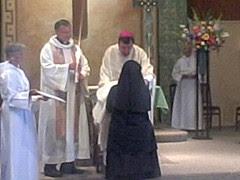
I'm pretty sure I have written about some of these matters before (I will try to link you to the pertinent article down below), but let me also reprise that here. The answer to both your questions has the same root, namely, vocations like the eremitic, religious, ordained priesthood, or call to consecrated virginity, are what are called "ecclesial vocations." This means that although the individual can feel personally called to them (and of course MUST feel so called!), the Church herself plays a role in mediating God's call to the individual. If you look over the rite of religious profession or of ordination you will see there is a place where the candidate is formally called forth on behalf of the Church, but speaking as the mediator of God's own will in the matter. She stands and responds, "Here I am Lord; you have called me, and I come to do your will," or something similar. This is more than a bit of superficial pro forma ritual. It is the symbolic expression of the fact that the church herself mediates God's OWN call to this candidate and extends this call formally at a public liturgy. In the question and response which follow immediately, the Bishop will ask the candidate what she requests of God and his Holy Church. She may respond, "The privilege (or grace) of perpetual profession," or something similar, adding a request for "the grace of perseverance," etc. At that point the Bishop, says something like, "With the help of the Holy Spirit, we confirm you in this charism and choose you for this consecration. . ." Only after this dialogue is concluded, a homily is given, and an examination of the candidate's readiness to assume the responsibilities of this call are carried out along with (in perpetual profession) the prostration and litany of the Saints symbolizing the whole Church's involvement in this act, does the actual profession of vows take place.
I think it is not understood sufficiently that vocations like this in the church are NOT matters of individual discernment alone. When I say the vocation is an ecclesial one, I mean several things: 1) the Church herself discerns who is called to this vocation; 2) the Church regulates and oversees the vocation because specific expectations and responsibilities are involved, 3) the Church mediates the ACTUAL CALL of God TO the person, and 4) she receives the hermit's vows authoritatively and publicly consecrates her to the service of God and his Church. There is no doubt that a person can feel a call years before the local church (the diocesan church) is ready to move on such a vocation, and the person needs to remain true to that in the meantime, but it is ALSO true that in Roman Catholic theology, vocations to consecrated, religious, and priestly life, the Church herself mediates God's OWN call; she does not merely recognize or validate that the individual's discernment is sound --- though of course, she does this too. So, to answer your second question first, yes, the call is between the person and God but not ONLY between them. Even more accurately it might be said that the call to an ecclesial vocation involves God, the individual and God's Church in a mutual dialogue of discernment, call, and response. We might also say that unless and until the Church formally calls the Sister forth to make her perpetual profession and to consecrate her to God (or at the very least DECIDES OFFICIALLY to admit her to these things), the call is at best incomplete or only partial.
Your first question was also good: why does such a process have to take place (and why, I will add, is it often so protracted)? The fact is, it is easy for an individual to make a mistake regarding vocation. I would say that with regard to an eremitic vocation it is even easier. But even when one is correct about one's own discernment, it takes some years to grow into the vocation, especially as, in the case of canon 603, one may not be coming from a monastic background or background in other formation to religious life. On the diocese's side a number of things must be clear to be sure they are dealing with a DIVINE vocation: the person must be psychologically and spiritually sound, they must be able to support themselves in some way, shape, or form, and must demonstrate the ability to carry on with this vocation in relative independence from superiors or other church leadership (as well as in obedience and fidelity to them) for the WHOLE of their lives.
The local diocese must also feel this vocation is right for the local church (diocesan eremitism is relatively new so reflection on what it means for any dioceses involved is ongoing). Details need to be worked out: what kind of communication and how much will take place between the hermit, her Bishop, Vicar, etc? How will the vow of obedience work out in terms of everyday and unusual requirements or requests on the hermit's behalf? What about ongoing formation, education, spiritual direction, routine "permissions" or oversight, and the like? The simple fact is most diocesan personnel have no experience dealing with candidates for the eremitical life, and sometimes themselves see the vocation as unnecessary, a waste of time, or too eccentric to attend to seriously. And, since candidates have often lived out commitments to other forms of religious or consecrated life before coming to the conclusion that they are called to eremitic life, or they have come to eremitic life rather late in life after significant changes, trauma, etc, greater care may be taken than would be the case otherwise --- and rightly so!

And of course I have not even discussed the unique charism of the diocesan hermit here (though I have done so in another post below). The fundamental vocation is defined as one of silence, solitude, prayer, penance, and greater separation from the world. However, an ability to relate well to people, to be a vital part of a parish, professional competence (in and out of cell), and genuine compassion are also part of this vocation. It is not generally enough to be temperamentally a loner (and in fact, this may be a contraindication of/to such a vocation. Those who are not temperamentally loners can make wonderful hermits and they are not coming from a place where their temperament also disposes them to isolation rather than solitude!). One embraces eremitical silence, solitude, prayer, penance and greater separation from the world in order to spend one's life for others in this specific way. Whatever FIRST brings one to the desert (illness, loss, temperament, curiosity, etc) unless one learns to love God, oneself, and one's brothers and sisters genuinely and profoundly, and allows this to be the motivation for one's life, I don't think one has yet discerned a call to diocesan eremitism.
While this was not part of your question, let me say something here about the phrase "the world" in the above answers. Greater separation from the World implies physical separation, but not merely physical separation. Doesn't this conflict with what I said about the unique charism of the diocesan hermit? No, I don't think so. First of all, "the world" does NOT mean "the entire physical reality except for the hermitage or cell"! Instead, "the world" refers to those structures, realities, things, positions, etc which PROMISE FULFILLMENT or personal completion apart from God. Anything, including some forms of religion and piety can represent "the world" given this definition. The world tends to represent escape from self and God, and also escape from the deep demands and legitimate expectations others have a right to make of us as Christians. Given this understanding, some forms of "eremitism" may not represent so much greater separation from the world as they do unusually embodied capitulations to it. (Here is one of the places an individual can fool themselves and so, needs the assistance of the church to carry out an adequate and accurate discernment of a DIVINE vocation to eremitical life.)
Not everything out in the physical world is "the World" hermits are called to greater separation from. Granted, physical separation from much of the physical world is an element of genuine solitude which makes discerning the difference easier. Still, I have seen non diocesan hermits who, in the name of "eremitical hiddenness" run from responsibilities, relationships, anything at all which could conceivably be called secular or even simply natural (as opposed to what is sometimes mistakenly called the supernatural). This is misguided, I believe, and is often more apt to point to the lack of an eremitical vocation at the present time than the presence of one. (Let me say that even in these cases, these journeys can grow and mature INTO authentic eremitical vocations. It may take some time, and it ALWAYS requires really good spiritual direction sometimes along with psychological assistance and therapy, but it is possible!)

You also asked: {{. . . the idea of a "unique charism" is new to me. Doesn't this conflict with what you called the "hiddenness" of the hermit? And what about people who do not feel called to the kind of parish or diocesan ministry you referred to, or who are unable to do it because of illness or other limitations? Can't they be canon 603 hermits too? Shouldn't they?]]
One of the things mentioned in Canon 603 is that the eremitic life is lived for the praise of God and the salvation of the world. The idea of praising God is not problematical, I don't think,(that is, I don't think you need me to say more about what this means, true?) and obviously one does (or SHOULD DO) this whether one remains in cell or goes out occasionally. One's whole life SHOULD BE a psalm of praise, a magnificat to the Lord, as I have written before. The idea that the eremitic vocation is not geared towards self-indulgence, escapism, pathological introversion and the like is underscored by this phrase. The phrase "for the salvation of the world" does the same. At the same time, I think these two phrases, while applying to all eremitical life, especially ground the vocation to DIOCESAN eremitism as one with the unique charism I have outlined.
ALL hermits, solitary, monastery-based, non-canonical, laura-based, etc, are concerned with the salvation of the world. We all pray for the world; we all serve as a still-point leavening our world with the peace of contemplation, and mediating the energy or reality of the Kingdom through our prayer. My point in the earlier blog entry was that for the diocesan hermit, the relationship to parish and diocese symbolized in a vow of obedience to God in the hands of the hermit's Bishop comes into greater focus and occasions specific expectations and responsibilities other hermits might not share. Still, the actual outworking of this charism occupies a spectrum, from praying for parish and diocese while remaining secluded, to ministering in more active ways occasionally while maintaining an essentially eremitic life.
Obviously the individual hermit's gifts, talents, capacities, training, education, inclinations, resources, and the like help determine where along the spectrum she falls. Also, while the charism is part and parcel of the vocation, I believe, how it is expressed or embodied over time can shift as well. There will be rhythms to the hermit's ministry: sometimes greater reclusion will be called for, sometimes greater apostolic work. The point I wanted to make is that with public profession, the parish and diocese have rights and expectations in the diocesan hermit's regard which do not obtain with non-canonical status, for instance. One's eremitism is not merely between oneself and God, but is meant for the well-being of others as well, especially of one's parish and diocese. So long as one demonstrates a true willingness and capacity to be a hermit FOR these others in identifiable ways, then yes, the hermit can and should be a diocesan hermit in spite of personal limitations or disability.





 Posts
Posts