Sister I read the following online. It was written last September and I wondered if you could comment on it since you have written on the issue yourself.
[[As for someone who keeps tabs on such matters has informed, there is still the niggling over what hermits call themselves or not, whether a Catholic hermit or a whobody hermit, whether Jesus' Catholic hermit or Canon Law's Catholic Hermit. Whether a priest can call a hermit a Catholic hermit, or whether a Bishop must call a hermit a Catholic hermit.
Of course, ultimately and presently, it does not matter. Such niggling only brings the nigglers to the imprisonment of Kohlberg's fourth stage (or even down to the second) of moral development. To a hermit of Christ, a Catholic hermit without identity, it does not matter. It does not matter to pew Catholics, nor to non-Catholics. And it will never matter to anyone but those few who are caught up in identity and need for renown in the visible Church.]]
Yes, I have read the comment, but as you note, it was a while ago. In fact I also responded to a question regarding another post from the same blog just a month later so I am certainly familiar with it. The author has an interesting and, to my mind anyway, somewhat cynical perspective on diocesan eremitical life. The question from the same time period I already responded to had to do with visibility as a betrayal of the authentic eremitical vocation. In answering that I referred to the essential hiddenness of the hermit life. I also clarified the source of Canon 603 and how both Canon Law and the Catechism impact the life of the canonical hermit --- for they do so quite in different ways. At this point I should note that the blogger in question is no longer adding posts to this blog, and claims to have moved beyond the designations "hermit" or "Catholic hermit" --- though of course the older posts are still extant and apparently still being read. Because of that, I suppose I will continue to respond to occasional questions regarding older posts.
Kohlberg's Stages Misunderstood
In dealing with Kohlberg's stages of moral development, it is probably important to clarify that, at least as I understand the matter, when one moves to another stage of moral development, elements of the earlier stages do not simply drop away. Instead, they are transcended through integration into a more comprehensive and less one-sided or undifferentiated stage of moral decision-making. So, for instance, a person who went through a stage in moral development where law was their driving concern (and we all do this) may still allude to law in making moral decisions without becoming legalistic, or to the place of authority (4th stage development) without subscribing (or regressing) to a "law and order" way of justifying moral behavior and choices. We see this in people who respect the law and authority but who are capable of creative responses to moral situations law is too general to address. That person might well refer to law or legitimate authority, but be quite far from being driven by a "law-and-order" mentality or legalism of any kind. In fact, it is a sign of relative maturity that in their creative responses to reality they can allow law and authority a proper place.
Thus, one may be well-anchored in what Kohlberg identifies as the post-conventional or more mature and less self-centered stages of justifying moral decisions and still point out that law is important. The same with genuine authority. My own position that Canon Law serves love in various ways (to the extent this is actually true and allowed to be true) is an example of this kind of justification I think. What is preeminently important in determining what is moral (and truly human) here is charity, but the person who loves well does not simply or generally jettison law or authority in the process. Neither does a theologian who refers to authority in the Church, or to the rightful (pastoral!) application of canon law, automatically regress to earlier stages of moral development and motivation in so doing. The opposite is more likely true if the emphasis is truly on the pastoral. On the other hand, the person who dismisses the rightful place of law and authority in life may well be regressing to a more infantile and individualistic "anything goes so long as it serves me" stage of moral decision making.
So Who Cares?
The second point the poster makes is that who is or is not a Catholic hermit does not matter to anyone except those "few who are caught up in identity and need for renown in the visible Church." I suspect the author meant ego rather than identity (for existing in Christ is a matter of significant identity, though not of ego) but I can only respond to what she said. Of course I disagree, and I do so because words have meaning and the meaning of words (and the lives and other realities they describe) is important to people. As I have noted before, there is a thing called "truth in advertising" and if one says they are a Catholic Hermit, others have the right to expect that they are using the term in the way the Catholic Church uses it and have accepted all the rights and commensurate obligations which are linked to it. That is only fair and only charitable to others who seek to understand and trust the reality to which the term points. It is also only fair to the word itself, for to use it any way one wishes is to empty the word of meaning and make it untrustworthy or unbelievable. As I have noted before, a word that comes to mean anything at all simultaneously comes to mean nothing whatsoever.
This blog has noted a number of times that the term Catholic Hermit indicates a public vocation accepted and lived out in the name of the Church, and perforce, it therefore means that others necessarily have a right to certain expectations of the one so designated. They do not necessarily have the right to those same expectations when the person is a privately dedicated hermit. Again, while this emphatically does not mean that the lay hermit is less a hermit or lives the life less well than the diocesan hermit, it does mean that 1) the diocesan hermit is responsible to the Church and in a formal and objective way that differs from the more private responsibility of the lay hermit, and 2) this results in expectations on the part of the faithful which are their right by virtue of the hermit's public profession and consecration.
 To argue that speaking of the import of canonical standing or the designation "Catholic Hermit" and all these things mean for the hermit and others is "niggling" or that people in the pew don't care who is called these things is naive, and perhaps disingenuous. If a person showed up at Mass and introduced herself as a "Catholic Hermit", but later on made it clear that she really only meant she was Catholic and living a relatively pious life alone, one doesn't have to think hard to see what the result would be. It would be especially problematical if, for instance, that person calling themselves a hermit proved to have serious emotional difficulties and used the term hermit to justify social isolation, an inability to love people, or a spirituality which was so individualistic as to interfere with one's capacity to participate in or build community. In all these instances the person would be furthering destructive stereotypes of the term "hermit" --- something which is, unfortunately, not uncommon. (Remember the post about Tom Leppard.) It would, if qualified as the life of a "Catholic Hermit", be especially detrimental to a general understanding of the vocation the Church has only recognized in Canon Law for the first time beginning just 28 years ago.
Of course, it is absolutely true that most people are unlikely to care which Canon prohibits the use of the term "Catholic" for individuals and groups except as appropriate authority allows, but they will surely care whether a person IS what they claim to be or not, especially if they are not using the terms in the same sense the Church does more generally. The above examples of stereotypes aside, consider a person showing up at a parish in a habit, or using the title Sister or Brother (and expecting others to do likewise in their regard) because by baptism we are all sisters and brothers to one another. Would a parish congregation really not care that the title and garb were self-assumed? Would it really not matter that the person has no authority to do this, no formation, no legitimate supervision, no formal and binding commitment in law, and apparently, no real concern for or responsibility to the people (or local church and community) to whom they are presenting themselves? I have to say my own parish and diocese would certainly care. In any case, even if they failed to care would this be a cogent argument? Do we really want to say, "No one really cares about the truth here, so it doesn't matter"?
On A Desire For Renown
Finally, a note regarding identity and being caught up in the need for renown. First, as noted above, ego and identity are very different things and should not be confused with one another. As Christians we have a unique identity in the world. It is a significant identity, and one which is a gift to us and to the rest of the church and world whenever it is lived with integrity. To be clear about our own identity can be a way of honoring the Spirit who graces us and forms us in this identity. To indicate that one is a diocesan or "Catholic" Hermit is a way of being clear that the Holy Spirit is working in the Church this way, and in fact, in one's own life specifically. Since this work is essentially redemptive and a source of hope to many, it is no small matter! And if this is true, then admitting one's identity in the Church is a piece of humbly accepting oneself and glorifying God. It need have nothing whatsoever to do with a desire for personal renown, so one ought to be wary of judging motives on the basis of external conditions alone.
 For instance, I have a blog and this last year did a podcast. Did (or do) I do those for personal renown, or because these serve the Church and this vocation by helping people become aware of it and transcend some of the stereotypes which still attach to it? The external reality (the blog, the podcast) is the same, but the motives cannot be seen merely by looking to the external reality. The same is true of habit, title, and post-nomial initials. Did I adopt and do I use these because of ego and a desire for renown, or is there a more legitimate reason? As the blogger you quote also says, "The habit (externals) does not make the person." True enough but this truth cuts two ways: it may refer to the arrogant or hypocritical religious (or hermit) in a habit, of course, but it may also refer to the person who is smug and condescending in his "hiddenness" or exterior obscurity while judging the other on appearances. The simple fact is that most likely there are elements of both stellar motives and less stellar ones present in any person's divided, ambivalent heart. Once again, last Sunday's parable of the weeds and wheat is appropriate here, I think. When dealing with the motives of another, we must allow these to stand and grow alongside one another for fear of uprooting (or in this case, mis-judging) what is of God. We should trust the person to deal with her own ambivalence or ambiguity over time. Judgment is rightly and ultimately left to "God and his angels."
Regarding hermits and renown more generally though, it should be recalled that they have, at times, been drawn kicking and screaming (or the inner equivalent of that) --- but obedient nonetheless --- into the ecclesiastical and even political limelight, sometimes becoming Cardinals and even Popes in the process. One hardly considers they agreed to this as part of a hunger or drive for renown (much less a regression to a more primitive stage of moral decision-making defined in terms of self-interest and benefit). My mind goes back to Peter Damian (Camaldolese) who was one such hermit-Cardinal and Doctor of the Church. He was a reformer and prodigious writer, battling against simony and other problems through open letters and pamphlets. Was he accepting of the title Cardinal (etc.) because he was hungry for renown? Did he get involved in questions of reform and renewal out of mere self-interest? A prudent or judicious person would hardly suggest this without real evidence!
20 July 2011
Kohlberg's stages, Ego, and the Desire for Renown


10 July 2011
A Question on Catechism Paragraphs 920 and 921

Sister Laurel, what you write about the following texts is different from what this other hermit writes about it. Could you explain why that is?
[[What constitutes a consecrated Catholic hermit? The Church is specific in sheer simplicity: "920 Without always professing the three evangelical counsels publicly, hermits 'devote their life to the praise of God and salvation of the world through a stricter separation from the world, the silence of solitude and assiduous prayer and penance.' "921 They manifest to everyone the interior aspect of the mystery of the Church, that is, personal intimacy with Christ. Hidden from the eyes of men, the life of the hermit is a silent preaching of the Lord, to whom he has surrendered his life simply because he is everything to him. Here is a particular call to find in the desert, in the thick of spiritual battle, the glory of the Crucified One." . . .So it is, too, with the reality of what is a consecrated hermit. It is written out in the Church's Catechism, in two clear-cut, line-item paragraphs. The [specific person] is advised to not debate, question, or reinterpret. Best to succinctly and simply: read; ponder, accept. And live it. ]]
Sure, though I have written about this before so please check out related posts in the labels' list on the right. The two paragraphs taken from the Catechism come from a section called "The Consecrated Life." They are very brief statements about essentials and therefore presume all the other things the Church teaches about consecrated life to contextualize and understand them properly. Part of that is that initiation into the consecrated state of life is achieved via a public commitment received in the name of the Church. It requires admittance into a stable state of life. State of life here refers to something like lay, consecrated, or ordained states. It does not refer to eremitical life itself.
So, for instance, the glossary at the back of the Catechism reads in part, "Consecrated Life: A permanent state of life recognized by the church, entered freely in response to the call of Christ to perfection and characterized by the profession of the evangelical counsels. . ." Note that private vows do not lead to a permanent state of life. Consecration is defined in the same glossary as, "The dedication of a thing or person to divine service by a prayer or blessing. . ." Thus, the prayer of consecration in Mass in which bread and wine are transformed and set aside as holy, or the prayer of consecration in rites of profession which complements the dedication of the vows. (In the instance of hermits, this prayer is prayed by the Bishop with hands outstretched over the hermit at the rite of perpetual profession.)
Thus, and contrary to what I have written before about these paragraphs including a reference to lay hermits, they do not refer to private vows or private commitments despite the phrase, "without always professing the evangelical counsels publicly." Here, the accent is not on publicly (vs privately), but instead on the possibility of using "other sacred bonds" than the three vows. Diocesan hermits (consecrated solitary hermits) may use a form of commitment other than vows, and are the only form of consecrated life who may do so. This somewhat confusing and clumsy sentence (at least in English!) is a reference to this fact because the definition of Consecrated life refers specifically to the profession of evangelical counsels with vows of poverty, chastity, and obedience. The exception in the case of diocesan hermits needed to be explicitly mentioned, so the sentence needs to be understood as saying something like, "Diocesan hermits always make a public commitment, but they do not always use vows to do that".
The mistake made by the person you quoted is the mistake of failing to contextualize what s/he read, and treating these paragraphs as though they can be read apart from the established ecclesial definitions of consecrated life, consecration, and the Church's own theology of these things. They cannot, and to do so is to engage in not a simple but a simplistic reading. My own failure in reading these paragraphs was similar: I was confused by the reference to "publicly" and thinking it was used to contrast with "privately." While I was aware Canon 603 says, "or other sacred bonds" (besides vows) I had never heard of a case and thought vows were, at least customarily the way every diocesan hermit went. It took a conversation with a canonist friend to sort that out. In any case, for these reasons I thought these paragraphs also referred to lay hermits (in a somewhat confused way given the heading of the section, The Consecrated Life). I no longer think so, although I think these paragraphs should be edifying to lay hermits.
P.S, the Catechism definition of consecrated life is generally correct (if truncated and minimally helpful to actual hermits) but Canons 603 and 604 both represent exceptions. Canon 603 (diocesan hermits) represents an exception because they may use "other sacred bonds" besides vows. Canon 604 (consecrated virgins) represents an exception because there are no vows at all. Still, they both represent public commitments with initiation into the consecrated state.
13 May 2011
Followup Questions: On Formation as a Lay Hermit
 [[Hi Sister Laurel, I understand why you insist one should live as a lay hermit for some time before approaching a diocese to be publicly professed as diocesan. I hear you saying Lay eremitical life serves as the usual formative and discernment framework for any call to [solitary] eremitical life. But how does one determine and get the formation necessary to live as a lay hermit? Is the diocese's advice you referred to, "Just go live in solitude; it's all you need?" really sound advice? Is it really all one needs or is this the diocese's way to shunt a person off and not take them seriously?]]
Great questions. Yes, you clearly heard what I have said recently and have written here in the past as well. Living as a lay hermit is the most common way to discover and discern the shape of a vocation to solitary eremitical life. It is therefore also the usual state against which one must weigh any possible call to diocesan eremitical life. The other main way is by entering a community or monastery and, over time, determining that despite being called to the consecrated state one requires more solitude than this context provides. Even if this is true and one has lived as a religious for 25 years or more, one is not yet a hermit. The essential truth is that hermits are formed in solitude. There really is no other way. Lay eremitical life is the usual way one is formed in the life. But within solitude what helps with formation?
Eremitical life involves prayer, penance, study, lectio divina, and manual and (for many of us) intellectual labor done within the context (and for the sake of) of the silence of solitude. Formation in the life then includes formation in all of these things. Work with one's spiritual director can assist with prayer (and in learning and discerning all the various forms of prayer to which one might be called), penance, as well as with lectio divina. The director will maintain the focus on God's own voice within our lives, but she will be sure we recognize this voice in all the ways it calls us to wholeness, as well as all the ways it summons us to more abundant life in Christ. This is really the heart of one's formative work since it is through prayer, lectio, and the resulting inner work these require, that we really become persons who listen to the Word of God and allow it to be our constant companion, counterpart, center, and challenge(r).
However, one will also read about these things and doing so will allow one to be taught by authors one will likely never meet otherwise. This reading does not replace prayer, penance, lectio, or the required inner work they call us to, of course, but it will support them. If one is going to be doing intellectual work (theological, psychological, historical, sociological, etc) one will need an academic grounding in whatever discipline one will want to pursue. This is meant to provide not advanced degrees (though it's fine if you can get them), but a strong background which supports continuing well-directed solitary reading, research, and reflection. If one is lucky one will find mentors within the field who will help direct one's reading and writing. All of this is formative --- not least in the self-discipline and inner directedness required to live the eremitical life with integrity --- and it is a formation which will continue as an ongoing need and responsibility for the rest of one's life.
There are a few pertinent areas a lay hermit will read regularly in including, the desert Fathers and Mothers, the history of eremitical life (including contemporary eremitical life), contemplative prayer, Scripture (including contemporary commentaries, books of homilies, etc), desert spirituality more generally, the evangelical counsels (important whether one lives these as a lay Christian or a vowed hermit), theology, monastic life -- its history and values, etc. Any specialized areas of interest, including those having to do with her work, will also be included in the hermit's bibliography. While these general areas of reading will apply to most serious hermits, the ways each one will specifically go within them -- the focus one will take at any given time -- is entirely up to what one determines one is called to. If one wants to take formal courses in monastic life under recognized specialists, these can be done online for very reasonable tuition. One should probably consider doing some work in theology in a Master catechist program, etc or online if one can. (Some dioceses require a Master Catechist's certificate for those aspiring to diocesan eremitical life just to be sure they have a minimum of theological grounding.) Meanwhile, any specialized areas of interest, including those having to do with her work, will also be included in the hermit's bibliography.
Your last questions regarding the diocese's response about "just living in solitude" are excellent and perceptive. Even so, while it is true that dioceses sometimes don't believe in or esteem eremitical life, have no intention of professing diocesan hermits under Canon 603, and sometimes use this line about "Just go(ing) and liv(ing) in solitude; it's all you need" as a way of shunting the person's petition aside, this is not, I don't think, the usual reason one hears this advice. Instead it is often given to those who have not lived as a hermit at all (merely living alone is not the same thing!), much less for any length of time, and who may tend to believe the diocese will make them into hermits by putting them through some formal formation program with recognizable stages and public recognition for those accomplishing those stages. In such cases the dioceses that use this line are really saying, "Go, live in solitude and see if solitude is what God is calling you to for the rest of your life. We cannot form you as a hermit; only God in solitude can do that, so if you feel called to the silence of solitude, go and live it out." This is advice the desert Abbas and Ammas would have also given, "Just dwell in your cell, and your cell will teach you everything."
So long as the diocese is not simply dismissing the person in this way, and is being honest with them, the advice is sound. So long as this advice includes the requirement of regular spiritual direction with a qualified person, and allows for followup appointments with someone in the chancery the advice is sound. So long as the time one is asked to wait for more formal consideration is not more than several years and is at least loosely (but really) supervised, then the advice is sound. Finally, so long as the diocese will engage in serious and formal discernment of the person's petition for profession under Canon 603 if they persevere in this way for several years, then yes, the advice is far more than just shunting the person aside. It reflects the Church's wisdom on how it is any person comes to know a call to eremitical life, namely by living it and trying to persevere in it with God's help.
[[When you say that formation takes place in solitude, does this preclude spiritual direction, mentoring and other forms of personal work?]]
Not at all. As I have already written it includes these things in significant measure. However, the work of spiritual direction mainly takes place apart from the meeting with one's director. One prepares for these meetings and follows up on them with the kind of writing, journaling, prayer, reflection, reading, etc that the meeting points up the need for. In one's struggles within solitude one comes into contact with all of the false, distorted, and inauthentic parts of oneself. One meets face to face those characteristics which come from woundedness, sin, etc, and require healing and conversion. While these things may require the assistance of directors, physicians, etc, the work remains mainly done in solitude where one battles things out alone with God as one's only immediate companion and support. Mentoring is similar. The one being mentored may write or otherwise talk to the mentor about difficulties she is having and the mentor may make suggestions on ways to approach these areas, but the doing of it is up to the one being mentored to accomplish in the silence of solitude.
As I have written recently, my own life was especially blessed with people who assisted me in working through the things I needed to work through, but they could not do this work for me. Certainly they could and did meet with me regularly (and in some instances still do!) but I would never have become a hermit, much less a diocesan hermit, without the capacity to internalize and process in solitude what those meetings raised or revealed --- both the divine and the human realities this involved! Some have the mistaken idea that obedience means mainly doing as one is told, but actually, it is an attitude towards reality which one cultivates --- an attitude of active and respectful listening and engagement where one meets and comes to terms with truth as well as coming to love its source and all those who reflect it in even the slightest way. Learning this kind of obedience requires assistance usually, even if the majority of the cultivating occurs in the silence of solitude.
I hope this helps!
Questions on When to Approach One's Diocese and Formation as a Lay Hermit
 [[Dear Sister Laurel, I find it difficult to understand how this [process of becoming a diocesan hermit] works. [It is especially hard to understand since there is no process of formation spelled out and no guidelines on when to approach one's chancery, etc.] For instance, when Entering a monastery or convent, one is guided in their discernment in the period of time as a Postulant and continues with studies as a Novice. As a Canonical Diocesan Eremetic, you work by yourself for the 2 years or so then approach the Diocese. I have the fear that after 2 years and I approach the V.G. or Bishop, only to find out that I don't meet the requirements that may be in place or that I have done something all wrong, making this life as an Canonical Diocesan Eremetic unreachable. If I was younger, 2 years would not be a long time to wait. Now, time is certainly at a premium:) . . . Would it be feasible for you or myself to write my Diocese so they could implement some sort of recognition and acceptance for those who would be interested in living the life as a Canonical Diocesan Eremitic?]] (Sections marked in single brackets [] are clarifications, additions, or other redactions added for the purpose of posting here. Sister L)
I can understand your concerns and frustration. Unfortunately, living as a hermit (an eremite) is ordinarily necessary before one can effectively approach a diocese about such a thing. It is necessary so that one will be treated as a serious aspirant who has been discerning seriously already, and also so that one is not told to "simply go live in solitude; that is all that is necessary." Yes, it is risky (desert-dwelling always is) and one may indeed discover at the end of several years that 1) the diocese will not profess one no matter what at this point in time, or 2) that one has made a mistake and that eremitical life (lay and/or canonical) is not what one is called to, but living the life already is what every diocese I know of requires as a prerequisite to consideration for profession under Canon 603. Risky though it is, it makes complete sense because of the very nature of the vocation itself: individual, solitary (worked out between oneself and God), marginal, countercultural, independent though ecclesial, generally statusless, and rare. Canon 603 itself is not about making or forming hermits out of whole cloth or according to a particular mold, nor is it about creating a queue of hermit candidates, but of recognizing and consecrating those hermits that exist who require this canonical protection, structure, and responsibility for the complete and integral living out of their vocation. This particular discernment can take many years to be clear, and there is simply no formal process which can replace something which happens in its own time and in solitude. Because of this dioceses are not apt to change the way they approach the matter, and while vocations might be missed in the process, those which are recognized are far more apt to be authentic.
If one really believes she is called to canonical solitary eremitical life (under Canon 603), she will live this call out without canonical standing as a lay hermit for some time first. The only way to discern the vocation is to live it, and the only way to know whether one is called to Canon 603 profession/consecration, is to live as a lay hermit first. This, so far as I know, is the only way a person can really get her "ducks all in a row" so to speak, apart from originally entering religious or monastic life, being formed in that life, and then finding one requires greater solitude than that supplies. Even then, there is no guarantee a diocese will profess her or anyone else under canon 603. At that point the hermit may request canonical standing and be rebuffed (by this I mean one may be told the diocese is not ready to profess anyone under Canon 603, not that one does not have such a vocation). That can go on for quite some time (23 years 17, years, 10 years, etc, are all numbers that I have heard from diocesan hermits who waited a long time for consecration under Canon 603). On the other hand, the diocese might respond positively (or negatively) to one's petition right away. There is no two year period written into the canon anywhere even though that is a commonly used number to indicate the usual time to live something out before contacting the diocese. Even here it is a completely minimal guideline number, not a hard and fast rule. (In fact, Bishops I know of tend to require one live as a lay hermit for five years before revisiting the question of even temporary public profession.)
What is profoundly and historically true is that if God is calling one to eremitical life, one will embrace that life alone with God whether or not canonical approval is anywhere in one's future. She, for instance, will embrace it and risk never having such legal standing because that is what the desert Fathers and Mothers did, and what all solitary hermits before her have done. One will do it because one is called to maturity as an obedient person and, so, answers God's call to be with him in this way no matter where it leads or does not lead in terms of canonical standing. One will do it because its very anonymity and lack of standing prepares her for the paradoxical reality of eremitical life lived in terms of canonical responsibility and status. One will do it because it serves the Church and world, and because only those who have lived such service are in a position to teach the church about their vocation.
Canon 603 is designed to protect and nurture solitary eremitical life, but not really to cultivate it except in those who have already embraced the relative statuslessness of such a vocation. It is an interesting and difficult paradox: status (legal standing) for those who have discovered they do not really need status (social privilege) at all. When dioceses tell potential candidates they need to just go off and live in solitude (something that happens a lot really), or that they do not need to be professed under Canon 603 to be a hermit, etc, they can certainly be mistaken in individual cases, but at bottom of such advice or insistence is the recognition that Canon 603 will always be the rare and paradoxical way for hermits in the Catholic church to embrace eremitical statuslessness. It will always be a life formed and discerned in solitude with the initiative and discipline provided by God's own immediate call itself. Lay hermits will always be the more prevalent and normal form of the life, and lay eremitism will always the main way which precedes and illuminates one's discernment of a call to Canon 603 profession as well.
Again, my best advice is to work regularly with your director. You are not yet free to live a solitary life, but when you are, embrace it and discern whether you are called to this as more than a temporary and transitional reality. Consider making private vows with your director (or pastor) witnessing to assist you. Will your diocese accept you as a candidate for canonical eremitical profession if you do this? Not necessarily. There are no guarantees at all. However, if you are living the life, meet the requirements of the Canon (stricter separation from the world, silence of solitude, assiduous prayer and penance), have written a Rule of life reflecting your own lived experience of the life, demonstrate a personal understanding of the vows (from having lived their values) and the elements of the canon, and are canonically free from impediments to public profession and consecration (prior marriages with divorce sans annulment, for instance), there will be no reason for the diocese to suggest you have done something wrong, etc. They will ordinarily work with you at this point as they discern the character and reality of your vocation; they will look at your own personal maturity, the integrity demonstrated in embracing and living out this life without canonical standing, etc, and their eventual decision will be on the basis of whether you have demonstrated to them you have such a vocation and the capacity to live it out even apart from them. IF you can do this your chances of being accepted for canonical profession are very much better, but so too is your own ability to live this life for some time or the rest of your life even if the Church declines to profess and consecrate you under Canon 603.
The Guidebook on Eremitical Life from La Crosse was a good, if limited, guidebook for those who would eventually seek to become diocesan hermits (as well as for those who might profess them!). It covered the qualities needed by the person, the education (gotten by personal initiative), the requirements of the diocese (spiritual direction, self-sufficiency and maturity, temporary profession, etc.) and a number of other things. If you can get a copy of it, I would recommend it. It did not establish a postulancy, novitiate, or juniorate for hermit candidates, nor could it really have done so without giving the wrong message about the life and the wholly individual and solitary process of formation involved. Many dioceses have access to this guidebook and require SOME of the same things La Crosse did (my own borrowed from it, but not slavishly). Usually, however, dioceses turn to this guidebook only after they have a good candidate. In my experience dioceses don't usually know much about eremitical vocations (some few do) and one role of a serious candidate may well be to help educate them. Again, only one who has lived the life for some time will be able to do that.
25 November 2010
My Own Credibility in Speaking of Valuing the Lay State (Reprised with Additional Explanation)
Originally posted in November, 2008 (Heading for the additional section is marked in bold below)
[[Doesn't your own canonical status undercut your ability to speak to the importance and witness of the non-canonical or lay hermit? Doesn't it make what you say even a bit hypocritical? You have written any number of times about the importance of canonical status/standing so how believeable are your opinions on the lay eremitical vocation? Why didn't you become/remain a lay hermit instead of seeking profession and consecration according to Canon 603 if you believed as you say you do in this?]]

These questions were not raised by a hostile reader, but in my own prayer and reflection on the matter. However, I suspect that they are questions which my own status and comments might well occasion in others, so I am including them here. First. let me say that there is truth in each question: to each, except, I think, for the one about hypocrisy and the last one which asks "Why didn't you become/remain. . .", I have to answer "Yes" before I qualify or nuance my responses. With regard to the last question ["Why didn't I become/remain. . .?], let me say right up front that I do not have a complete answer at this time, but only large parts of one, and that those parts involve both positive and negative elements.
In my previous post on the importance of lay hermits I noted that I had not realized how effectively I was cutting myself off from witnessing to particular segments of our church and world. My life as a canonical hermit still speaks to these people, I know that full well, but I suspect not nearly as powerfully as had I eschewed profession and consecration under Canon 603 and embraced a vocation as a lay hermit. I would have needed to find ways to do this, but those avenues are open to anyone really. This blog is an example. On the other hand, I have experienced both sides of the fence here and am aware of the shift (in witnessing) which has occured. Thus, I think I am able to speak effectively to the importance of both lay and consecrated eremitical vocations. The point of course is that a person who is consciously and voluntarily lay and eremitical can, in some ways. do so better than I can ever do.
So what about possible hypocrisy? Well, it is true that I am unabashedly excited by and enthusiastic about the eremitical vocation which is canonical, and that personally I see a lot of reasons to seek canonical standing, especially as a diocesan hermit with its unique charism. It is also true that on this blog I have posted a lot in order to combat misconceptions about canonical status, etc. In my Rule I wrote (several years ago now) that I felt that canonical status was imperative except in the early stages of a vocation or foundation --- though my views on this have changed considerably in the meantime. Is it possible to be enthusiastic about the graces and benefits of one way of living an eremitical life without denigrating another? I sincerely hope and believe so, otherwise there is no way to be honest about the gifts of the Holy Spirit in one vocation without denigrating them in another. And despite seeing this happen often in the history of mankind with regard to different religions, etc, surely none of us believe that is necessarily the case [with different vocations]!
With the issue of canonical and non-canonical hermits I believe the Holy Spirit is working in both ways in our church and world, speaking to different segments and calling them to different responsibilities, emphases and witness. So long as the eremitical life is being led with faithfulness these differing emphases, commissions and witnesses will emerge and reveal themselves clearly. That said, I must also say that I don't believe just anyone should call themselves a hermit, and I especially don't believe that someone who simply has a bent for some degree of solitude part of the time should do so, or be allowed to do so. (Here is one of the real benefits of canonical standing and oversight: one knows, at least generally, that the term is being used accurately and that the witness being given is genuine.) Still, if someone is living a fulltime life of prayer and penance, a life centered on God in silence and solitude --- not reclusively necessarily, but really --- then they have every right to call themselves a hermit and should do so, for this too is the work and gift of the Holy Spirit to the Church and world.
Again, it is not that canonical hermits are "real" hermits while non-canonical hermits are "pseudo" or "wannabe" hermits. While it is true that sometimes people use the term hermit too casually (for an active life with chunks of solitude, a part-time semi-solitary existence, for instance, as in a married life where the days are spent in prayer and work while children and husband are off to school and work!) or for the wrong reasons (social awkwardness or misanthopy, the need for self-indulgent introversion or simply for creative time and space are among these) -- these folks ARE pseudo hermits or wannabe's --- when the term really applies (that is, to a LIFE OF fulltime and genuine solitude lived for and in God) it signals the "realness" or inspired nature of the vocation, and whether this is a call to eremitism of the consecrated or lay states does not matter.
And regarding the last question, "why didn't I become and remain a lay hermit?" well, I am going to [mainly] leave that for another time and more thought. The simple answer is that initially and eventually I determined I was not called to this as did the Church, but that can be evasive as well as being true. Part of the answer is that it was this context which made sense of the whole spectrum of my life and the kind of freedom needed to live this call fully and faithfully, but that too needs some explaining --- which again requires both more thought and time to write. Still, the question is important, not only for me personally, but because it is really the question every hermit must answer in some form in discerning and embracing the call not only to eremitical life, but to lay or consecrated states as the critical context for their own charism, witness, and mission. At this point I wish to say merely that whichever choice one discerns and makes, the eremitical life they are discerning and choosing is a real and significant vocation and that we must learn to esteem not only the similarities they share with their counterpart (lay or consecrated), but especially their unique gift quality and capacity to speak variously to different segments of the church and world. Addition to the Original Post:
Why did I not become or remain a lay hermit? Why pursue a call to the consecrated state if I truly value the lay vocation? I have thought about these questions more since I posed these queries to myself and here are the elements of my answer: 1) I felt called to an ecclesial vocation, one which the Church also discerned, 2) I did so because I became aware of a particular gift or charism this vocation was to the Church and world with regard to those who were marginalized in both church and world by chronic illness, old-age, and other isolating factors. Eremitical life spoke directly to these situations and their redemption whether or not any of the persons were called to eremitical life (though I supposed some would be and wished to assist them in knowing about and even hearing this call). 3) There was a certain unfreedom I experienced personally with regard to representing this charism fully as a lay hermit despite the fact that I published about it and had come to terms with the diocese's unwillingness to profess anyone under Canon 603 for the time being. I concluded (after another @20 years) that I still needed canonical standing to put an end to this "unfreedom".
(The solution to unfreedom of this type is often the assumption of new responsibilities. So it was for me. The assumption of the rights and responsibilities associated with canonical or consecrated eremitical life freed me to live the life (and my own life of course) as fully as I felt called to do. For some, as for instance the person who writes about the taint of increased institutionalization and the constraints of that preventing her living fully in the present moment, this would not be true. The same is the case for the person who wrote most recently with regard to, "what's the big deal?" or who desires to push the meaning of words in whatever way he personally likes. It would also be true for those who (more positively I think) just want to live in solitude without more ecclesial rights and responsibilities, or who wish to imitate the lay status of the desert Abbas and Ammas.)
4) I was living the final vows I had made in 1978 and desired to do this within the context of Canon 603 in a specifically eremitical framework and with the guidance, supervision, and assistance of the Church rather than privately in a way which did not allow others to have necessary expectations with regard to these vows. It also meant being present in a way which allowed others (lay, consecrated, and clerics) to appreciate the way the Holy Spirit was working in their midst with regard to both chronic illness and eremitical life, and 5) I had become more knowledgeable about the nature and history of eremitical life as a still-vital tradition and I wanted to assume what I discerned to be my own place in that tradition in ways which were both faithful to it and yet enlarged or added to it in contemporary terms. This included wishing to bring the diocesan hermit dimension more strongly into the Camaldolese charism while allowing the Camaldolese charism to be more explicitly present in diocesan eremitical life. In both of these I had the sense of being called to be part of a tradition, creatively, in faithful dialog with it, not in unthinking or careless rejection of it as I simply "did my own thing".
24 November 2010
Follow-up on Part-time Eremitical Life
 Well, I've riled some feathers in responding to questions about the "Saturday-only" hermit. Mainly, I think I have been misheard or misunderstood so I am going to post the comments received and try once again to make clear what I am and am not saying.
[[For heaven's sake, the life of the monastic or hermit is not holy orders. I don't think you have the right to claim that if one's particular vocation in that mileau (sic) is not precisely what has developed heretofore (or, considering how canon law develops, which flavor or style of the life 'won out' over others) that they ought to go back and reconsider their baptismal vows. My goodness, what an uncharitable remark. My mother is a Ph.D. in nursing; is she a better nurse than a first year? She'd be the first to tell me, after 45 years in nursing, it depends on the nurse. All of your arguments in your responding post seem to follow the fallacy that more time in service or more closely aligned with a particular mode of canon law makes one a better hermit. Bah. Is my close friend, a Jesuit of 50 years a better priest than the newest member? Is a Saturday only theologian better than a 7-day-per-week theologian (frankly a closer analogy since neither involve a sacrament)?]]
 I am honestly not sure what I said that was uncharitable in suggesting that anyone in the lay state (or for that matter anyone in any state) reconsider their baptismal promises and commitments. The situation I was addressing was this: there is a failure throughout the church to esteem the lay state, to see it as possessing the dignity it does. What has happened over time and for a number of reasons (including the clericalization of the church) is that when adults desire to make adult commitments to and in Christ they look not first to their baptismal promises (or even to their marriage vows) and to specifiying those vows as needed at this point in time, but automatically to the idea of multiplying vows (and so making private or public vows) as the only form of adult commitment possible besides ordination. Sometimes these even conflict with marriage vows as when married people seek to make vows of celibacy.)
Further, because the Church has consistently given the impression or explicitly stated because of a misreading of Thomas that the laity are in an inferior state of vocation, those who really desire to live the fullness of discipleship have come to believe it will only be possible for priests, nuns, brothers, sisters, monks, hermits, and consecrated virgins --- and not as lay persons. But this is untrue. Vatican II was clear about this. The lay state is part of a universal call to holiness, an adult and exhaustive form of holiness which glorifies God every bit as much as any other vocation or state of life. How it is uncharitable to ask people to START here, and if they are in the lay state to take responsibility for that and for the call to holiness and the dignity of this vocation, I really can't see. This has nothing to do with hermits or non-hermits. It is a problem in the church as a whole, and a quite serious one. We have hundreds of thousands of lay people who believe their vocations are second-class or juvenile and less exhaustive forms of discipleship than those of nuns, brothers, priests, etc. They live and are pained everyday by the sense that their call from/by God is an inferior one. I have simply said this is not the case. The Church has emphatically said this is not the case. So I don't see this as uncharitable but charitable.
I do not know why the discussion morphed into terms of better/worse or younger/older either. I have tried assiduously to reject characterizations framed in terms of better and worse. For instance, I have written time and again that consecrated hermits are no better than lay hermits, but rather that the rights and obligations they have in the Church because of their canonical standing are different. Again, I think we are seeing in your comments the deeply entrenched holdover from the misapplied scholastic language of "objective superiority". That is especially true of your comment that neither monastic nor eremitical lives are holy orders or matters of a Sacrament -- as though that makes them less significant. It does not. For certain, the better/worse language did not come from my posts because in regard to vocations and states of life I reject it absolutely. Thomas also rejected this language and so he drew careful arguments noting that an objectively superior state of life does NOT mean a subjectively better or more holy Christian. Today, the solution needs to be formulated differently than Thomas did; the various states of life are different from one another, with different rights, obligations, and responsibilities, but none are better than the others. Each one is rooted in a call by God and is invested with infinite worth and dignity. Again, different, not better.
 Regarding younger/older and experienced/in-experienced, there is no doubt that we all grow into our vocations. Those who wish to be hermits may begin by building in silence, solitude, prayer, penance, and stricter separation from the world. In and of itself this does not make them a hermit. At some point solitude herself MAY open the door to these people and a change takes place if they accept the invitation to enter. In such a case they are no longer solitary persons grappling with the individual elements of the canon or life. Instead, they are hermits in a fundamental sense now living the silence of solitude and allowing (or learning to further allow) everything else to flow from and support that life. Once the door has been opened and one has walked through it in response, growth continues (or should continue). Meanwhile, the central reality of these persons' lives -- the silence of solitude which is a short hand reference to union with God and the quies that flows from it --- will call for greater external silences, stricter separation from the world, etc. Again, not better or worse, but different!
[[And please, Sister, let's not use the straw man fallacy. Comparing a person's Saturday only eremitc life with a saturday only state of motherhood is pathetic. Sorry, it is. Do I need to spll (sic) it out? If one has committed one's heart to a solitary life as best as they are able, but it involves work outside the home, what is that to you? A mother and spouse have an entirely other promise--of course they don't get (much) time off. The point is that I am and many are pushing the meaning of words and of particular callings. You are not, and neither is canon law, the first or last word on what constitutes an eremitic life. You certainly are the last word on what it constitutes to you and those of your persusion or particular charism, but that's it. Period. Don't lay down roadbloacks to others. The fact that is that there IS a groundswell, a grass-roots movement of folks, in the married or other secular states looking for a deeper commitment to their spiritual development, with expression in their lifestyle and self-styling--they are allowed to use old words in new ways. Especially when they don't impinge on the nature of the sacramental forms.
 I think the analogy holds. If a person babysits a child once a week, that does not make her a Mother no matter how badly she would like to be one. If a person lives an eremitical or desert day once a week, this does not make her a hermit or desert dweller no matter how much she would like to think it does. The illustrations can be multiplied: if a person leads a Communion Service once a week (or even several days a week) on his pastor's day(s) off, this does not make him a priest or pastor (though he may be very priestly and pastoral). If a person prays contemplatively once a week this does not make them a contemplative. A person who spends a day a week at a monastery or enclosed in their own house is not necessarily a monk or nun who lives a cloistered life. It is simply not appropriate or accurate to speak of a Saturday-only eremitical LIFE as you have done --- unless you are speaking about a hermit who is actually failing to live her call to a LIFE of the silence of solitude, assiduous prayer and penance, and separation from the world, etc. Here the distinction another diocesan hermit once drew might be helpful: many people are called upon to build in elements of eremitical spirituality in their lives, but this does not make them hermits nor argue that they are called to eremitical life per se. Put another way we could say that some people's lives have an eremitical flavor or cast without being eremitical lives.
You can and probably should feel free to push the meaning of words all you like, but in doing so you need to beware of emptying them of meaning altogether and making them incapable of communicating anything substantive. You should also not be surprised however when the onus of demonstrating the legitimacy of your usage falls directly on you. Whether we like it or not, the Church has a normative understanding of what constitutes eremitical life. Those of us who live that from the inside know the wisdom of this definition. We know from the inside what the struggles and joys of FULL-TIME silence of solitude, etc, mean -- as opposed to a single desert day a week -- for instance. There is simply no comparison. Both are good, but they are also not the same thing, and they require different names as a result. The Church's normative statement (Canon 603) has been formulated in a way which ensures certain non-negotiable and foundational elements even while it allows flexibility and diversity in expression. You are mistaken then if you believe canon law is not open to newness in this regard, and you are certainly mistaken if you say that I am not. However, to push words in ways where they may mean anything one would like is simply to ensure they mean nothing at all.
As I have written now a number of times, a hermit who needs to work outside the hermitage on a part-time basis is not ideal but this can still be made to work on a case by case basis. However, someone who needs to work FULL-TIME, especially outside the hermitage has, I sincerely believe, ceased in essential ways to live the fundamental elements which define the life. Meanwhile, back to the Saturday-only example which is even more troublesome: one day a week of contemplative prayer, silence and solitude is NOT an eremitical LIFE. It is a wonderful and helpful thing, but it is not what Canon 603 (or the Catechism of the Catholic Church or the whole eremitical tradition) recognizes as an eremitical LIFE. The reason this is important is because the Church recognizes eremitical life as she discerns it is to be defined as a pastoral gift to the Church and world. (See below.)
[[So, I think we should just agree to disagree. I guess it comes down to who is the more accepting here? What is the most compassionate response? For that matter, why don't you go back and consider your own baptismal vows---why weren't they enough? What makes your life intrinsically 'other' than other's? It doesn't sound very nice the other way, does it?]]
While we may agree to disagree, there is a distinction between being genuinely accepting and merely being uncritical and uncaring of meaning or truth. Compassion requires that we be truly loving, and it is not loving to allow a person to live a lie, or to empty meaningful terms of content when that content is a gift of the Holy Spirit to the Church and World. Canon 603 is such a gift. It defines the nature of eremitical life in a world and at a time when dislocation, isolation, alienation, and the search for meaning in our isolation and alienation are rampant. Even so, it is a canon which allows for great diversity even while (and perhaps because) it clearly spells out foundational, or non-negotiable elements comprising authentic solitary eremitical life. It is the entire vision of eremitical life which it provides us which is a gift of the Holy Spirit to both the Church and world.
I will repeat my main point from the other post because this is the true answer to "What is it to you?" above as well. FULL-TIME hermits who have allowed isolation and marginality to be redeemed and thus transformed into the "Silence of solitude," can speak effectively to all those persons in our parishes, dioceses, neighborhoods and world who CANNOT leave their situations for time off one day a week -- those who are chronically ill, disabled, the isolated elderly, impoverished, etc. Hermits' lives are compassionate answers to many of the most significant questions these myriads of people have and are. These people need to know that their aloneness is not a sign of the senselessness of life or abandonment by God, but the ground out of which God can call them to the silence of solitude and union with himself. I don't think a person who is busy, engaged, working, socializing 5-6 days a week, and then takes a day for silence, solitude, and contemplative prayer can effectively serve in this way. Hermits, whether lay or consecrated, who live the terms of Canon 603 with the whole of their lives CAN minister to these people in a way I believe no one else can do quite as fully or effectively. I believe this ministry is part of the charism of eremitical life and a reason the life (not the avocation) is growing today. It is certainly a reason eremitical spirituality is growing today, but again, embracing elements of this spirituality does not make one a hermit anymore than my own embracing of elements of Ignatian spirituality makes me a Jesuit.
 Finally then, on the question regarding my own call to something other than the lay state. This is not a new question and I have written on it before two years ago or so, so please check that out. Notes From Stillsong Hermitage: My credibility regarding the Importance of the Lay Vocation My own discernment of this took several extended periods of time, and my discernment of a call to consecrated eremitical life rather than lay eremitical life took about 25 years. In answering that call finally (with perpetual profession and consecration) I did so because I felt called to accept rights and responsibilities that did not flow from baptismal commitments, but from a different call as well: I was called (both subjectively and objectively) to consecrated celibacy and a nuptial or spousal relationship with Christ, and I was called to witness to that publicly with a form of love which was more eschatological and universal than otherwise. I was called to be obedient in a way which specified my usual call to obedience with a legitimate superior, the elements of Canon Law, the Church's definition of eremitical life, etc, and again, I was called to do that publicly. The same is true of poverty. I felt called to a degree and kind of poverty which does not automatically flow from the baptismal or lay state. I found I needed this commitment to live freely what I felt called to.
But let me be clear, I did indeed live my baptismal commitments fully before this and I realized that I might well never be admitted to the consecrated state as a hermit if the Church did not agree that this was God's own Call for me AND FOR THE CHURCH. (In that case, I would need to come to terms with the idea that perhaps I had not discerned properly). In fact the Church DID agree, and mediated God's own call, my response and profession, and God's consecration to me. Had the Church said no, I would have remained in the lay state, a lay hermit, and tried to live this full-time life in a way which glorified God and gave honor to the lay state. It would have been a different life, one where I would still be doing much of what I am doing now, but with different rights and responsibilities in terms of the Church. (I need to say here that the fact that I DID come to terms with living as a lay hermit is important to who I am today as diocesan hermit and allows me to esteem lay eremitical life better than I think some do. It also allows me to appreciate the differences between the two forms of eremitical call. So again, as I well know --- these are not to be seen in terms of better or second-best, but different.)
Those different rights and responsibilities include the living out of Canon 603 with the whole of my life in as faithful a way as I can. Part of the responsibility means learning more and more about the forms and fundamentals of the eremitical life over the past @2000 years of Church life and why they are included in the canon. It means standing in that tradition and taking it on in ways which allow it to speak to the contemporary world. It does not mean emptying the term of meaning or trying to apply new senses to it before I understand from WITHIN the life and have thus accepted a personal responsibility for it. "Hermit" is not a word without history or meaning, and while the application of this meaning can certainly vary, like most things we need to accept the basic meaning and live it before we start jettisoning bits in the name of some sort of individual liberty.
I hope this clarifies some points of misunderstanding.
06 September 2010
On the title "Catholic Hermit" (Response to Question)

[[Dear Sister, I am a lay hermit. I have read blogs by other lay (privately professed and consecrated) hermits who call themselves Catholic Hermits and also online comments by a canonist saying this is improper. I am Catholic and a hermit. Why aren't I a "Catholic Hermit"?]]
Hi there,
I have written about this before so please check for these under the labels in the right hand column, but the bottom line answer (and something I did not originally mention in the pertinent post) is that the importance of being officially commissioned to live, act, or minister in the name of the Church is addressed in canon law. One is prohibited from calling oneself a Catholic hermit, religious, etc, unless specifically authorized to do so. Let me begin there and then explain the reasoning for this.
Canon 216 states that any person may adopt apostolic activity through their own undertaking as appropriate to their own state and condition in life, but no such undertaking will adopt the name Catholic without the express consent of the competent ecclesiastical authority. What this means for you is that you may indeed live as a lay hermit without further permission; your baptism gives you this right and responsibility if you discern God is calling you to this. But you do this in your own name, not in the name of the Church for the Church has not been involved in the discernment or the mediation of such a vocation. Similarly then, you do not publicly represent the eremitical vocation on behalf of the Church, for the Church has not publicly accepted your commitment and commissioned you to do so. In other words you have not been commissioned to live eremitical life in the name of the Church. You DO represent the lay vocation on behalf of the Church and your own eremitical vocation is a part or expression of this.
Canon 216 may have been formulated to deal with new groups wishing to become religious institutes (though this is handled by C 300 which also limits the use of the term Catholic), but it works as well for hermits too. (By the way, it also works for theologians. Some of us are theologians while others with a specific commission from the Church have a right to the title "Catholic Theologian." Such a "missio" can be withdrawn and the person no longer has the right to call him or herself a Catholic theologian. One cannot, on one's own initiative, then, call oneself a Catholic Theologian simply because one is a theologian and a Catholic, for instance.) The reasoning, I think, is sound even if one is doing Catholic theology without a missio: One must be doing what one does in the sense the Church uses the term and with her formal approbation. We must be acting in her name when we use the qualifier "Catholic". Otherwise almost anyone could call themselves a Catholic theologian, or a Catholic Community/Congregation, etc and, unless they were working in academia, there would be no oversight at all --- and the meaning of the terms could be lost in the process. (Note well though: because one has not been given the right to call herself a Catholic theologian in no way indicates the person is anything other than profoundly Catholic IN her theology. It simply means she is not doing theology in the name of the Church with an actual formal commission or mandatum and all these entail or require.)
With regard to hermits, I think this reasoning is especially sound. We have people experimenting with all different degrees and expressions of solitary life. Only some are authentic life vocations. Some are transitional paths which are primarily therapeutic, for instance; others are attempts to build appropriate degrees of solitude into an active or apostolically oriented life, but are not really essentially eremitical. Some experiments are done by married people, some by those who really desire to live in community but have not been able to make that happen, and some are merely the choice of isolation (not eremitical solitude) by those who have been unable to succeed at life and whose motivations and lives are far from those the Church necessarily associates with Catholic hermits. Some bear no real resemblance to eremitical life at all, and only some are inspired by the Holy Spirit in a way which gives them lasting value. Only a few, therefore, fulfill all the requirements the church affirms should be absolutely characteristic of eremitical life in the Church --- and this includes the significant mutual discernment and mediation of the vocation which includes a public calling, consecration, and commissioning by ecclesiastical authorities and the acceptance of this by the hermit herself in a corresponding public act of dedication (profession).
The vocation of the Catholic Hermit therefore also includes embracing all the rights and obligations of such a commitment because this life is understood to be a gift to the Church and world given by the Holy Spirit, and one must consciously and publicly undertake the commitment to live out this charism (gift) as gift with integrity. (I think there is a huge difference between living a life because it works for me, and living a life because it is itself a gift of the Holy Spirit to Church and world. In my own eremitical commitment, for instance, a significant focus for reflection is on precisely the way this specific life is charismatic and meant to be lived for the good of church and world, and not simply on "what works for me". It continues to challenge and console me every single day, but it is NOT something I appreciated clearly before perpetual profession under Canon 603. I think this gift of appreciation is a piece of the grace that comes with profession. The reflection is certainly part of the commission of the diocesan hermit. My Bishop indicated this in his homily during the profession Mass when he noted for the assembly that I would be exploring what contemporary hermit-life meant and should look like.) For all these reasons then, it is these rare instances that the Church affirms with consecration by allowing public profession under Canon 603 (or under Canons governing religious eremitical life) and signals with the descriptive term "Catholic Hermit."
As noted in my prior post then, the term Catholic Hermit is applied to those who are canonically constituted and consecrated as hermits. It is applied to religious hermits as well as to those who have entered the consecrated state via Canon 603 and are examples of consecrated solitary eremitical life in the Church. These latter are persons whose entire life is publicly defined in terms of the central elements of the Canon, and the way they live these elements out is supervised by ecclesiastical authorities. As also noted in the earlier post then, parishioners and members of the dioceses where these persons live and are professed are allowed, necessarily, to have certain expectations of them which they are not necessarily allowed to have with regard to the lay hermit living some form of solitude in her own name (that is, privately). The key word in all of this is 'necessarily,' because public profession is linked to legal rights and responsibilities which are publicly assumed. It absolutely does NOT mean the diocesan hermit is a better hermit than the lay hermit, but merely that they each have assumed different rights and obligations; some (the lay or non-canonical hermits) have assumed those that come with and from baptism alone, while others (canonical hermits) assume rights and obligations that come from both baptism and public (canonical) profession and consecration.
I hope this helps. As always, if it raises more questions or is unclear, please get back to me. Also do check the labels below for related posts. Some will be repetitive and some will approach from a different perspective. They also may raise more questions.
15 June 2010
Canon 603 as a Stopgap Means of Achieving Profession.
[[Sister, I am involved in [a named group]. . . seeking to become a religious institute. I have been told I need the following before I contact the Bishop about becoming a diocesan hermit:. . . the Seven Pillars of New Foundations (rule, constitutions, horarium, formation program, remunerative work, stable source of habit parts, and four persevering members). When I have these in place. . . I will present my information to the Bishop. I live in my own home and the others in [the group] do that same in different cities, and dioceses. We decided we were not yet ready to live a cenobitical life so we are 'going the diocesan hermit route.' Can you give me any advice on these pillars or on approaching a diocese about this? Also, which Bishop do I contact, my own or that of the foundress of our group?]]
Hi there. I think there is some confusion on a number of points both in what you have cited and in your own understanding of Canon 603. Assuming then you only know what you have been told by the person you cited, I am going to answer at some length here. Pardon me if some of this is already clear to you. You will find this repeats other articles found in this blog as well.
First, Diocesan hermits are not part of communities. That is they are not religious hermits, but instead they are solitary hermits who MAY but need not join together for mutual support with other hermits from the diocese in what is called a laura. This possibility, contrary to popular opinion is NOT written into Canon 603 itself. It is seen by some as implicitly allowed, but the Canon itself clearly gives every preference to solitary eremitical life so lauras (some suggest) may NOT really be in accord with Canon 603. (They may instead be a form of eremitical life which requires use of Canon 605 which deals with new forms of consecrated life.) A laura (a name that comes from the Greek word (lavra) for the paths which link the individual hermitages) is not the same thing as a religious institute or community. Juridically, that is in Canon Law, the hermits remain solitary hermits even if they come together in a Laura (which, by the way, would be in a single diocese under the Diocesan Bishop).
Discernment is therefore a matter of determining a call to a solitary vocation, and while the process can (and ideally, I think, should) include an extended time in community or a monastery setting (or even in a Laura) --- say for a month or two -- discernment of this vocation for lay persons is primarily done outside these contexts. I say this not only because lay people usually do not have the kind of access to these that discernment requires, but more significantly, I think, because it makes no sense to discern a solitary eremitical vocation, or the form that is to take --- for instance whether lay or consecrated --- mainly (much less only) in community or even in a Laura. The same is true of formation. One can hardly say one has discerned or been formed in a vocation as a diocesan hermit if one has not largely done so in the ordinary setting of that life, namely, in solitary living where the parish is one's primary community and where one is responsible for one's own horarium, living situation, chores, business "in the world", ministry, income, etc.
This last comment does not apply to you directly it seems, but it does raise the pertinent question about both discernment and formation: What are you in the process of discerning a vocation to? Is it community life or is it diocesan eremitical life? You said you all decided to "go the diocesan hermit route" because you were not ready for cenobitical life. Besides the fact that the cenobium is traditionally and psychologically an important, even crucial, preparation for solitary life --- and not the other way around --- there seems to be some confusion about what you are either discerning or being formed in and for here. If you are trying to become a diocesan hermit you will do so under your own Bishop and no other. Further, you will need to be pursuing this because you believe in your heart of hearts that God has called you to this, not as a stopgap measure until something else is possible, but because it is a LIFE VOCATION and therefore, the way to your own and others' wholeness and holiness for the whole of your life from this point on.
Another question this raises then is, unfortunately, that of fraud. It is not uncommon to hear of people who believe Canon 603 is the "easy" way to get professed until they can find or found a community. I have written here before about this problem, especially in an incident occurring in Australia. Canonists, Vicars, and Bishops are increasingly aware of this difficulty and some are taking simple steps to make sure the person being professed under Canon 603 is doing so as a solitary person who has discerned a life vocation to diocesan eremitical life. One step is to include an introductory line as part of the vow formula itself: ". . .I earnestly desire to respond to the grace of vocation as a solitary hermit. . ." Another is to require the candidate for profession to sign an affidavit which states clearly that they are not and do not intend to become part of a religious community (even a fledgling or putative one), and are accepting profession as a solitary hermit. This leaves the option open in the future of joining with other diocesan hermits in a laura, but it makes it clear that the vocation being embraced is a life vocation and, as far as one knows and intends, not that of a religious hermit (one in community). If one made vows under Canon 603 while part of the kind of initiative you mentioned above, they would then be committing fraud, their vows would be invalid and they would conceivably be open to sanctions. These are, unfortunately, merely prudent safeguards of which I completely approve.
So, assuming that you have discerned you are truly called to life as a diocesan hermit under Canon 603, what about the other things you need before approaching your own Bishop? What you cite is correct about a couple of things. You will need to be able to support yourself in some way, and you will need a proven track record (or secure source) here while you are living as a hermit. You will need a Rule or Plan of Life which you have written on the basis of your own lived experience. (Ordinarily it takes several years of living as a hermit before one is really ready to write such a document, but it is one of the most crucial elements of the Canon and one of the most formative experiences a hermit can participate in.) Constitutions are appropriate for a religious community but diocesan hermits don't require them (the Rule is analogous to a Constitution in some ways). However, you will likely need a delegate who will serve you on a more day to day basis than chancery personnel usually can do. This person will assist you to work out the nuts and bolts of your calling, balancing activity with contemplative life, community and solitude, changes in horarium, concerns with physical welfare, finances, etc. She will also serve as someone whom the Bishop can call on if he has concerns or wishes additional input re the hermit's life. The passage you cite is also correct about a horarium. Ordinarily this schedule is simply part of your Rule of Life and has been worked out over time to make best use of time, and including what is fundamental to eremitical life in light of individual needs and capacities.
The passage you cite is not correct about formation program or habit parts or four persevering members, however --- not with regard to Canon 603 anyway. You will need to have provided for and achieved your own formation for a while before you approach a diocese, though dioceses may point you towards other resources you can pursue on your own. Your Rule of Life will also make clear your need and provisions for ongoing formation --- at least that this is a clear ongoing concern with some basic ideas on how this need will be met. As for habit parts, not all hermits wear habits (it can certainly be an important witness but is hardly a foundational element of eremitical life --- or of religious life for that matter) and those who do require their Bishop's approval to do so.
If you choose to wear a habit you will need to speak to your Bishop about whether and when that may be allowed. Ordinarily permission comes only when admission to profession is sure or with profession itself since the right to wear a habit is part of the rights and responsibilities associated with canonical standing. This is a reason part of temporary profession can include investing with the habit. (The cowl, if used, comes with perpetual profession -- as it always has in monastic life.) Too often today I hear of people styling themselves as religious and wearing habits on their own initiative who have no concept that it is actually a responsibility with which one must be vested --- not one they can honestly assume on their own. Again, four persevering members is unnecessary and does not refer to solitary diocesan eremitical life in any case.
But let's also back up a bit in looking at when it is likely time to contact your diocese. Assuming you are (and have been) working regularly with a trained and/or approved spiritual director, and that you have lived as a lay hermit for several years -- long enough to know eremitical life of some sort is your vocation -- you will be in a position to discern whether you are called to lay or to consecrated eremitical life. I think it is important to spend some time on this dimension of your discernment because the church recognizes both lay and consecrated eremitical vocations, but also because the need for lay hermits, their ministry and witness, is very great. (See other articles on this topic for an explanation of what I mean here.) After that, and if you truly determine it is the latter you are called to, you will need to determine whether that will be in community (as a religious hermit) or as a solitary (diocesan) hermit. If and once you have determined the latter is most likely, then it will be time to contact your diocese with your petition to discern further with them (since they mediate this particular call to the individual, they also need to discern the reality of the vocation!) and to be admitted to profession under Canon 603.
Note again that all of this is done within the context and competency of your own diocese with your own Bishop --- who becomes the hermit's legitimate superior, and whose "subject" you now are anyway. While it is possible to move to another diocese after profession, one must get the permission of both Bishops involved in the move to do so. (Remember that a Bishop must determine that this vocation is something the diocese can benefit from and is ready for. Some (perhaps many) have not yet done so. Moving to another diocese is not something one undertakes lightly, not only because of the monastic value of stability, but also because one's life is affirmed as a gift to the local Church at profession.) I personally can't even imagine how a religious-institute-to-be hopes to have individual members professed separately under different Bishops (not to mention under a Canon which deals with solitary and diocesan hermits who, because of something similar to monastic stability implicit in the Canon, cannot move to another diocese without the permission of both Bishops involved) and then, having planned to do so from the beginning, seeks to bring them together in another place under another Bishop and Rule as a religious institute! The whole set up, premeditated as it is, up smacks of manipulation, insincerity or hypocrisy, and not a little lack of understanding of or confusion regarding the gravity and nature of the vocations they are speaking about. Besides being a canonical nightmare it is a completely irresponsible and dishonest way to proceed.
In any case, I do urge you in your work with your director to discern whether or not you are called to life as a diocesan hermit. If so, you will then need to sever ties with the group you mentioned so that that piece of the confusion is cleared away and you can proceed more honestly and with more genuine commitment to this vocation rather than to another. (If, on the other hand, you wish to remain with this group, or otherwise determine you are called to cenobitical life, you should give up the idea of being professed under Canon 603; it is not meant for this situation.)
I hope this helps. As always if my response raises more questions or requires clarification, I hope you will get back to me.
08 January 2010
Followup on the Institutionalization of Eremitical Life
[[Dear Sister Laurel, what I hear you saying is that hermits and their superiors are leading the way in the increased institutionalization of eremitical life and are doing so cautiously and only because lived experience leads to this. You said that love is prior to law. Is that right? Doesn't increased institutionalization endanger the hermit vocation? Is it really necessary to have public vows, rituals, religious and special garb, rings, initials after one's name, etc? Isn't all this elitist and doesn't it conflict with the individualism, simplicity, and hiddenness of the vocation? Also, is it the case that female hermits are forming clubs or groups which maybe they will allow male hermits to join? What is this all about?]]
Thanks for writing again. Yes, you heard me correctly regarding institutionalization (although I don't agree there is really much "increased institutionalization" going on). What there always is is reflection and dialogue about the nature of the vocation and how best to protect, and encourage its authentic growth. What I would stress again in regard to the issue of institutionalization though, increased or otherwise, is the need to maintain a balance between codification and individuality, etc. Generally Canon 603 does this by setting forth the essential characteristics of the life: silence of solitude, assiduous prayer and penance, stricter separation from the world, vows of poverty, chastity and obedience, lived under the supervision of the local Bishop --- as well as mandating a Personal Rule or Plan of Life written by the hermit herself, and all of this for the praise of God and the salvation of the world. (Note therefore that the Canon itself protects the individuality and freedom of the vocation!)
Beyond this, as already mentioned then, individual hermits'(or their Bishops' and dioceses') lived experience continues to inform the contemporary approach to Canon 603, problems will arise, particularly helpful practices or guidelines will be developed, and other things will need to be addressed with norms or precedents (discernment, initial formation and its length, ongoing formation, ministry, etc). Most of these things are simply reflections of what is generally necessary for any person wanting to live healthily and fruitfully as a hermit. The solution to the tension between institutionalization and individual freedom continues to be the interplay between Canon 603, and the individual's own Rule as these are supervised by Bishop, and worked out with one's delegate, spiritual director, etc.
What we are speaking about on a deeper level in these questions is balancing the profoundly ecclesial or communal nature (koinonia) of the eremitical vocation with individual gifts, sensibilities, practices, weaknesses, and desires, or better stated perhaps, finding appropriate and effective ways a very individual vocation's ecclesial nature is best protected and expressed. In turn, this will help the individual and it will assist others in discerning such vocations. Additionally of course, it will ensure that an individual is living a vocation which truly contributes to the salvation of the world --- which is the very heart and reason for the eremitical vocation as it is for any other authentic vocation.
Throughout the history of eremitical life some degree of institutionalization has been necessary to prevent this vocation from becoming merely a refuge for excessive individualism and personal eccentricity, and to ensure that it retains the ecclesial dimension any truly human life or vocation always has. It is further necessary to ensure adequate formation, both initial and ongoing, and to make sure that vocational discernment is seriously undertaken by both the individual and the church. To mention a tiny part of eremitical history which I have noted before, the founder of the congregation I am associated with as an Oblate, St Romuald, was known as a reformer who went around sometimes gathering individual hermits into Lauras, generally giving them the Rule of Benedict to live under, and otherwise making sure they were living genuine eremitical lives and not eccentric, overly-individualistic ones.
Later (again to repeat history I have noted before) other Camaldolese like Peter-Damian continued reforming and reflecting on the ecclesial dimension of all hermit vocations. Sensitivity to koinonia was at the heart of their efforts. Even later, Paul Giustiniani determined that since the establishment of the Church's requirements that all faithful have regular access to the sacraments and so forth, solitary hermits living essentially cut off from these were now invalid. He saw the formation of Lauras as the best solution. Though Giustiniani's concern seems legalistic, it represents increased reflection on the ecclesial underpinnings of any vocation, but in particular, the eremitical call. Bl Paul saw the formation of Lauras as the best solution because Lauras could be established far from inhabited centers protecting solitude and at the same time these would serve to curb all the dangers that beset solitary eremitical life. They provided the mix of community and solitude so essential to even the vocation of the recluse. Throughout the history of the Church the tension between institutionalization and individual freedom has existed. At many points institutionalization served to protect the vocation itself, especially in its communal or lived-within-the-church and for-others dimensions. Once again koinonia is at the core of these hermits' concerns and sensitivities.
Canon 603 is an option which allows hermits the same standing as others with public vows, etc, but without demanding they give up their solitary hermit existence. It seeks to balance both dimensions precisely so hiddenness is eremitical hiddenness and not something else. It consecrates lives marked by the silence of solitude, assiduous prayer and penance, etc while it ensures they are instances of authentic and ecclesial vocations. Further, with some of the symbols you mentioned (ring, garb, ritual), it makes it clear that such vocations are lived in the heart of the church today witnessing to others. Of course it also makes clear that such calls come out of the church's own life, that they are mediated to the individual through God's church and not otherwise.
Certainly there are other options for living the eremitical life in the church today. Religious hermits (Camaldolese, Carthusians, Brothers and Sisters of Bethlehem, some Carmelite foundations, etc) are wonderful examples of one option. And of course, as the Catechism of the Catholic Church makes clear, lay eremitical life is always an option, and one which is less institutionalized than diocesan eremitism. For those who believe that "institutionalization" taints the purity or simplicity of the eremitical life, rather than protecting and enhancing it, this is certainly one way to go. From my own perspective such a path is at times more difficult than diocesan eremitism (especially in terms of perseverence and the freedom fostered by obedience), and in other ways (especially in terms of accountability on many levels), far less demanding. However, both are valid and significant ways to live an eremitical life today.
As for your last question, I really don't know what this refers to. Hermits don't have "clubs" nor are they generally or as a group given to gender bias. If you can clarify the reference for me it would help. Regarding elitism linked to rings, initials, rituals, etc please see other posts I have put up here on these. If these are inadequate, feel free to get back to me.


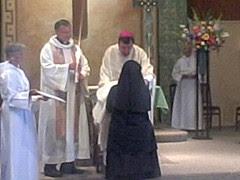



 Posts
Posts