Showing posts with label Rule as tool for discernment. Show all posts

05 June 2015

Witnessing to God's Power Made Perfect in Human Weakness: On Chronic Illness and C 603's Requirement to Write a Rule

[[Dear Sister,  in Writing a Rule, More Questions, you said that someone who is chronically ill and trying to write a Rule should include, [[a horarium which, at least generally, specifies the shape of one's day: rising, meals, prayer, lectio, work, ministry, recreation and errands, hours of rest and sleep. (If one has significant personal exigencies which bear on these (chronic illness, for instance) it is usually a good idea to state these up front and note that these occasionally demand some flexibility with regard to horarium, etc, rather than trying to minimize the demands of the life throughout the Rule. One's descriptions should be about what is generally possible and prudent for one --- not an idealization of what another hermit MIGHT live if they were able.)]] But what if a  person is so ill that they cannot live an ordered life in the way you describe? What if the disruptions they experience are not just occasional? How do they write a Rule? Could they still live as and be professed as a canonical hermit?]]

Thanks for what are really an important set of questions. They are also quite difficult to answer except in a general way. First though, as a kind of preamble, let me say that I wrote what I did to save someone from the difficulty of endlessly trying to qualify the Rule they write. I wanted each person to write a Rule reflecting how they really do live except for situations that cropped up relatively unexpectedly or occasionally. If the situation is more constant or frequent than occasional it is best simply to deal with it by spelling out the parameters of one's illness, including the situation in question in these along with what is usually possible and necessary for one to live a faithful life. Any diocese or Bishop will understand that illness will also produce some unexpected disruptions here and there. These don't ordinarily need to be spelled out unless they are more common than not.

Regarding your actual questions, I have to say up front that the situation you describe is too vague to answer. Each case would need to be discerned individually and perhaps revisited at different points in the person's life. You see, they might not be able to live as a hermit or be professed at one point in time but later on that could well change. I do believe the person should be able to write a Rule for their own lives if they reach a point of vocational certainty and readiness.

I am personally familiar with chronic illness that can completely ruin any attempt at orderliness or regularity. At the same time during  large periods of this illness, even when it was profoundly disabling, I was still able to pray, rest, eat, medicate myself, do most chores, and, during some years, even engage in significant study --- all in an essentially solitary context. While I could not maintain a strict schedule I could do what was really essential to my life with God --- though there were limits of course. I could not do all I wanted to do and there were times when illness didn't allow much at all. Still, it always allowed (and called for) faith and a significant dependence upon God's love --- mainly in solitude. It still does. That is one side of my considerations and my ambivalence in answering your questions. Would it were the ONLY side!!

The Source of my Ambivalence:
 
What makes this situation difficult to address without serious ambivalence is that looking at myself at this point in time I could not have called myself a hermit, either formally or essentially. Perhaps I was a solitary person, but I had not embraced or even considered embracing eremitical life in a conscious way, and for that reason would not use the word to describe my situation. Even so, had I thought about the possibility of being a hermit at that particular time of my life (instead of beginning to do so five to ten years later) it might have been possible. I don't really know. That would have required serious discernment. What I do know is that every person that tries eremitical life must do so in a conscious way as a response to what they perceive to be God's own call while the life they propose to live must fit both them as an individual and the living eremitical tradition as well.

I am also clear that at that point (about six years before canon 603's publication) I could not have represented eremitical life either in the name of the Church or as a lay hermit unless it was very specifically as a recluse. Moreover, I could not at that time have said I thought God was calling me to this. While it might have seemed a way to give meaning to my life, that is not necessarily the same thing as a Divine call. Even more critically I believe the degree of illness I dealt with at that time did not leave me free enough to discern an eremitical call. I certainly could not have made a life commitment. Until and unless this freedom became a real part of my life --- even as illness continued to be a daily reality --- there was no way to claim I had such a vocation. No one else could have discerned such a vocation in me either.

So, I am sorry for all the autobiographical rehashing and dithering. The reasons for running through all of this are several fold. First, I want to indicate my opinions in this are not without personal experience; second, I am concerned to indicate they are neither arbitrary nor without significant reflection and even personal anguish; and third, they help explain why I believe each case should be discerned individually by the candidate and diocese with significant input from knowledgeable physicians, spiritual director and psychologists -- in other words, whoever is necessary to help the diocese really see the person before them.

Overall, unless the discernment from all of these sources argues that a life of the silence of solitude is a source of authentic freedom and human wholeness --- and thus, is truly God's own call, my inclination is to say no; if one is so sick that they cannot live a life which is regular enough to write and generally live a Rule which witnesses to their freedom in spite of illness, they ought not be professed as canonical hermits. The Rule they write does not need to look like that of other hermits (what constitutes assiduous prayer and penance may certainly differ, for instance, and illness with its correlative treatment, dependencies, and limitations will feature large here) but it does need to indicate a God-centered, profoundly peace-filled and authentically free life lived in the silence of solitude.

While my own ability to seriously  consider and then discern a vocation to eremitical life was partly influenced by chronic illness, even more fundamentally it was made possible by the freedom to envision my life and act in ways which were not merely determined by illness, but by gifts and talents as well --- not least the ability to lead a genuinely contemplative life in solitude, with all that generally requires. I have always believed both dimensions were essential for my own identity and for becoming a hermit. Especially, I have known from 1983 (when I first considered eremitical life) onwards that illness could not be the only or even the defining characteristic of such a life. Had this been the case, had illness been more than an important but definite subtext to a life with God, I could not have written a Rule or considered eremitical life as a vocation no matter how isolated illness caused me to be. In those early years I was certainly an isolated individual with profound gifts and yearnings (as well as very significant deficits) but I was not a hermit, nor again, until changes occurred, was I ready to become one much less make a life commitment to live eremitical life in the name of the Church.

The Requirements of Canon 603:

As I have written here many times Canon 603 is both demanding and very flexible. It requires a life of stricter separation from the world, assiduous prayer and penance, the silence of solitude, and the evangelical counsels lived under the supervision of one's Bishop and according to a Rule one writes oneself. The foundational life being described here is a contemplative one of pervasive and persistent prayer and penance entirely dependent upon the grace of God and ordered to union with Him. There are no more details given than this --- but how rich and profound are each of these terms! Of course "the silence of solitude' is a tremendously positive element which refers to the quies that results from living in the love of God. It indicates a sense of relatedness and psychological well being,  a sense of being relatively comfortable with oneself despite human weakness and sin, and capacity for creative engagement with the world despite embracing "stricter separation from the world". The evangelical counsels are our commitment to live out a life marked by a fundamental simplicity and richness in God even as we forego some of the legitimate 'richnesses' associated with a more ordinary life.

Through profession of these we promise to be open to the truly new, the future God summons us into moment by moment, and to close ourselves to the merely novel and distracting, to listen for the voice of God in all the moments and moods of our lives, and to love as only God can empower us to love. Stricter separation from the world is equally positive because it involves a commitment to be truly attached to that which is of Christ and detached from that which is not. It is a valuing of loving engagement without self-centered enmeshment as well as to really seeing the sacramental nature and potential of all reality. Because eremitism is not about escapism but about the disciplined and courageous commitment to a profound inner journey where God is hidden in everything including illness, it can certainly be made by someone suffering from serious chronic illness; it cannot, however, be made by someone whose whole life IS illness or who has ceased to believe in anything beyond the limitations and negativities of illness.

Growing in our capacity to transcend illness:

My own experience says it takes time to reach a point where illness is merely a subtext in what is a wonderfully personal and cosmic divine narrative. That narrative was summed up for me by Saint Paul who wrote to the Church in Corinth, "God's power is made perfect in weakness." It takes time to really know the victory faith can bring over illness so that while it remains problematical perhaps, it no longer defines who one is. It takes time, personal work, and discipline to embrace a life which is essentially affirmative and engaged with God's world in the silence of solitude rather than being negative and enmeshed in the isolation of illness and its prison of disappointment, disillusionment, self-pity, and fear. It takes time to move from God and faith as either opiates or facile justifications for the disorder caused by a state of sin (the state of reality's estrangement from God of which illness and suffering are signs and symptoms) to the God of Jesus Christ who does not explain away (much less cause!) the tragedies of our lives but instead redeems them --- if only we will trust in Him and the present and future he will weave with our collaboration.

The eremitical journey requires discipline, courage, love and the generous vision all of these give one. Though these two forms of "ordering" exist together in any life, the meaning and vitality which a creator God's love and mercy bring to chaos and emptiness is far more important than that imposed by external code, clock, and calendar. If the hermit is chronically ill she must show with her life that God is the true center of things, not her pain, not the disorder, inconstancy, and especially not the isolation illness occasions. Unless a person who desires to be a hermit can do this effectively and convincingly (and one piece of doing so which is required by Canon 603 is by writing of a Rule reflecting this), I would have to argue they have not yet discerned a call to eremitical life.

Summary:

Each situation is unique and each vocation must be discerned individually. What a genuine eremitical life looks like for those dealing with chronic illnesses can be seen today by looking at many of the lives of diocesan hermits who are pioneering this vocation for the Church. A number of c 603 hermits have been professed not despite their illness, but because God had redeemed their lives in ways which allowed illness to become transparent to a life giving grace which is much greater and stronger than the power of illness to disrupt, derail, and destroy.

Of course, it is also possible to find examples of isolated individuals who claim or aspire to be hermits, but whose lives are truly rooted in and centered not on God but on illness, pain, personal suffering and the limitations associated with these. It is actually not very difficult to discern the difference between these two if one gives just a bit of time and a listening ear to them. The first group is generally characterized by freedom and a kind of spiritual expansiveness even when chronic illness is seriously problematical because this person's life and attitudes toward reality breathe with the compassionate freedom and vitality of the Spirit. The second group is characterized by bondage and relative blindness to the lives, needs, and suffering of those around them, as well lacking insight into their own selves because these are precisely what the self-centeredness, disappointment, and self-pity associated with serious illness often occasion.

One day, with the grace of God, some of these latter individuals may make the critical transition from being the lone scream of anguish they are now to being the complex Magnificat which the grace of God's mercy and love makes possible. Often I think this suffering-tinged Song of joy and praise is what the Carthusians and c 603 call "the silence of solitude." In any case, I believe when this critical transition occurs and one reflects on it one will be able to see, articulate, and finally, codify what was essential to its realization in terms of asceticism, prayer, lectio, direction, therapy, rest, recreation, contact with others, etc. These "channels of grace" revealed in weakness along with the vision of reality they make possible will become the nuts and bolts of one's Rule.

18 May 2015

Jumping Through Needless Hoops? More on Writing a Rule of Life

[[Hi Sister, maybe you have already answered this, but isn't it unreasonable to expect a person to write several different Rules over a period of 6-9 years? It does seem like a lot of needless hoops to make someone jump through. I can't believe that a first Rule would differ from a third or fourth Rule so much as all that. I mean it covers the basics or fundamentals of one's life. These don't change so dramatically in the life of a hermit do they? Isn't this really just busy work to give the diocese something to look at? So what do they look at if nothing really changes from one Rule to another? And what do they do if the hermit is not a writer? I am certainly not one so the whole prospect of my diocese asking me to do this would completely turn me off from pursuing profession under c 603!]]

Thanks for your questions. For those who are relatively new to this blog, and because I have not written about this recently, let me say that they refer to a suggestion I have made which allows a diocese and a hermit to engage in a process of formation and mutual discernment which 1) protects the freedom and solitude of the hermit, 2) provides a meaningful way the diocese can gauge the growth of the individual vocation before them and discern the suitability for and timing of eremitical profession and consecration, and 3) allows the hermit to take the initiative in working at both discernment and formation but in a significantly accountable way. Specifcally, over a period of about 6-9 years a candidate for consecration under c 603 will move through various natural stages in her formation and discernment as a hermit; as she does this she will mark --- as well as signal to those discerning with her --- her readiness to enter the next stage of the process by writing a Rule which, depending on the stage involved, will serve either relatively casually or more strictly and even canonically to structure and govern her life. The posts introducing this idea can mainly be found at Why Several Rules over a Period of Time? and under the labels, "Formation Programs?" and "Discernment" as well as, "Writing a Rule of Life".

Do Rules Change Much in the Life of a Hermit? 

Yes and no. The central elements of the Rule are unlikely to change significantly but the person's understanding of and relation to these elements will change significantly over time. The Rule this person writes at different points in her formation will reflect these changes especially as the person's life comes to embody them in more and more integral ways. Similarly then the elements of the Rule will cease to be merely external constraints as the person comes to explore and understand the depths of the realities to which they point. So, for instance, a Rule might speak of the silence of solitude in the beginning of a person's formative process and reflect a sense of external silence and solitude. While this sense will always remain, always be presupposed in any maturation in the silence of solitude, it will become less important than the deeper reality it expresses. Later on in her formation then, her Rule will reflect a sense that this element (the silence of solitude) is the goal of her life; for the hermit it will involve an essential quies which results from union with God and reflect a sense of being comfortable in her own skin --- possessing a wholeness without noisy striving or self-centeredness. In other words, the Rule's central elements begin more and more to define not only what the hermit does but who she is!

Similarly one might begin their approach to 'stricter separation from the world' by focusing on the things and people she cannot do or see but in time this element of the canon will reflect more the remaking of the hermit's heart into one that loves with a singleness and purity of focus. The physical separation remains and is presupposed in all else that happens in this solitary life, but it is the vision of the Kingdom and the claim the God of Jesus Christ has on her heart that will come to drive her understanding of this element or aspect of her eremitical life. The same kinds of changes tend to occur with the other non-negotiable elements of canon 603: poverty, chastity, obedience; there will be a deepening and broadening of experience and understanding which will be reflected in the subsequent Rule one writes.

As this process of internalization and integration occurs, the way the hermit comes to envision these elements changes and the emphasis in the Rule itself will also change to reflect this. In some cases an emphasis that was entirely absent will emerge as will a vision of eremitical life that was not present in one's first and/or second Rule. In this process the Rule's central or defining elements cease to be disparate requirements governing different parts of the hermit's life and instead come to express related emphases in a life reflecting the Gospel of God lived in solitude with God. A Rule written just prior to perpetual profession, for instance, is more likely to represent a vision of eremitical life lived in the 21st century with specific essential emphases than it is to be simply a list of things one contracts to do. Again, the Rule will often shift to define who the hermit is and her sense of mission and charism than it is merely a list of things she covenants to observe.

If one were to look at the various Rules a hermit writes over time this is the pattern one is likely to find. Even when the Rule itself does not explicitly reflect such changes through various versions, conversations with the hermit or hermit candidate is apt to elicit a clear sense of such change and growth. (If these conversations do not reflect such changes one has good reason to suspect either, 1) there is no eremitical vocation here, 2) the candidate is not living her Rule well (faithfully or wholeheartedly), or 3) something else is going on that is stunting or short-circuiting the formation process --- whether that centers on the failure of her (relationship with her) director, medical problems of one sort or another, or other difficulties. In such instances there need to be conversations with the candidate, her delegate, et al, to ascertain and resolve the problem.)

Jumping Through Needless Hoops?

As you can tell, I believe this process is not mere "busy work". It is important for discernment (both the hermit's AND the diocese's) and for formation. Likewise, it assures accountability on both the hermit's part and on the diocese's while it provides an objective focus for evaluating a life lived in solitary hiddenness. I have already discussed the major aspects of these things so I won't repeat them here. It is important that dioceses give hermits sufficient time to discern suitability and, when determined, achieve readiness for profession. It is similarly important that candidates allow themselves sufficient time while negotiating a process that is not marked by somewhat arbitrary time frames like those associated in canon law with postulancy and novitiate. The writing of appropriate Rules to focus and mark the hermit's personal stages of formation can substitute in a vocation that does not lend itself so well to such arbitrary time frames --- 9 mos for candidacy and 1-2 years novitiate, etc; while these work well for communal or coenobitical vocations, they work less well for the solitary eremitical call. At the same time, the process I have outlined does not allow the process to go on forever and especially not without accountability on both sides, diocese and candidate.

Further, while it is true that the use of this process does give the diocese something to "look at" this is not objectionable; it is part of what they require as part of their own call to discern, encourage, assist in the formation of, and protect ecclesial vocations. The process I have outlined eliminates some of the guesswork and complete subjectivity from the entire discernment and formation process, and I believe it does so while protecting the hermit's freedom to respond to God as she hears God in solitude.

What if the Hermit/Candidate is not a Writer?

I don't think this is really an insurmountable problem. After all, I am not speaking of writing a dissertation or book or something similar on eremitical life. I am talking about writing a Rule of life which is actually required by the Canon itself. It is a document which reflect the hermit's experience and codifies her own wisdom about how God calls her to live her life. On the whole it is less about writing per se than it is about attending to and reflecting on the vocation one is called to live. The Rule codifies what is necessary for a person to do that. In my own experience, in writing the Rule I submitted to my diocese prior to perpetual profession, I spent about one full month writing (at least a few hours a day) but months and even years were given to reflecting on canon 603 itself and how its elements related to the way God was working in my own life.  It seems to me that one needs far less to be a writer than one needs to truly be a contemplative who has come to know herself in light of God through an experiential knowledge of the constitutive elements of canon 603. I think that is by far the harder task, and probably the real obstacle to being able to write a Rule.

At the same time writing is an important way of becoming clear about who one is and why one is doing something. It is one of the ways we come to be articulate about what is most life giving for us and what is indispensable and normative in our lives. We shouldn't really expect to be able to write a liveable Rule unless and until we have spent time writing really unlivable and inadequate Rules or at least practice Rules we are comfortable using to "walk around in" for a time in order to learn more about ourselves and the way God is working in our lives. In the beginning hermit candidates ordinarily write Rules which are really little more than lists of "Thou shalts" and "Thou shalt nots".  In time they come to see these are wholly insufficient to describe or govern lives marked by the power of the Holy Spirit,  much less to challenge and even to inspire them adequately. That is why I say over time one will come to write a Rule which is more a vision of eremitical life as God inspires one to see and live it than it is a list of do's and don'ts --- even when it includes these, as it inevitably must. In any case, one comes to learn what being a hermit is by living the life; likewise one comes to learn to write a Rule which serves as c. 603 requires and envisions by writing several of them over time.

In a genuine eremitical life, none of this time and effort will be wasted. One is, after all, growing in, exploring, and learning to articulate who one is in light of one's solitary relationship with God. If one is never professed as a canon 603 hermit one has still benefited by the canon's requirement that one write a Rule because it has been a formative experience, not merely a sterile requirement to "get professed". Meanwhile, if one's diocese admits one to profession and then consecration as a diocesan hermit one will only be grateful for all the work it took to get there and will benefit from it in a more direct way every day for the rest of her life. In either case it is something like last Friday's Gospel passage: when the labor is accomplished and the child born, one forgets the pain it all took and feels only joy at the new life which has been brought forth.

12 April 2015

Questions On Writing a Rule of Life

[[Dear Sister Laurel, I am writing a Rule for myself and I have checked around online for examples and advice. I have read the articles you have written and also found an example of a Rule from another Catholic Hermit which is called "the nine S's". I think hers is a very different way of approaching writing a Rule than you suggest but it sounds easier to do. I am wondering if I could make it work for myself. Not sure I would use S's but I can't think of another letter that would work in the same way. Do you have any suggestions for me in this? You also recently said something about if a hermit's Rule was detailed enough. What did you mean?]]

Thanks for your questions. I appreciate them, but I also need to ask you a couple of questions. Why are you seeking to write a Rule? Is it for yourself as you are currently living because you think it is a good idea, or is it because you are seeking to become a hermit? If it is the latter, are you seeking to become a canonical or consecrated hermit under canon 603 or will you remain a lay hermit? I will address each of these in turn so take them for what they are worth to yourself personally. The question about a Rule being detailed enough is answered implicitly here. If this is not clear, please let me know that and I will add a bit which addresses this explicitly.

Writing A Rule for Yourself:

If you are seeking to write a Rule for yourself alone (and not, say, for your diocese and profession under c 603) then there are many ways to do it. How ever you choose to do this, you will want to make sure you manage to reflect how it is that God works in your own life as well as the practices and principles that support that. The Rule needs to function 1 ) to inspire and 2) to regulate or, in some instances, even to govern your life. For this reason some of the posts you have already read will help you. For instance, one post recommends you start by writing about how God is at work in you and your life. That remains good advice no matter what reason you are desiring to write a Rule.

Also, when you get to the point where you are ready to write an experimental Rule, while you won't want to get bogged down in details you will want to spell things out to some degree. For  example, if your Rule includes prayer, then you will want to indicate the main ways you pray and when (meaning that you will note whether and how you generally pray at dawn or morning or noon, evening, or night, not necessarily that you specify a specific hour). You see, writing "prayer" all by itself will not really be sufficient.  Not only is it "rootless", but neither is it linked to any concrete praxis or goals. After all, we all know that prayer is an important part of the Christian's life. Simply listing "prayer" will not serve in the way a Rule should serve. (More about this below.)

As another example, if you wish to build in silence then you will probably want to look at what ways your own life is too noisy, or is not geared to attentive listening to God and your own heart and begin by correcting those. Then you can consider what kinds of silence you want to build in as well and do the same thing you did with prayer. It will not be enough to simply list "silence" as part of your Rule because, again,  you would not be indicating where or when (much less why) you keep silence.  A Rule is not merely a piece of personal law to which you are committed (though for the publicly professed hermit it is certainly that); it is also meant to serve as a trellis or handrail that helps you know and honor in all of your activities and choices the shape of the journey you are making with God and why. If you (or I for instance) were to say, "Silence is one of the main terms of my Rule" or even "Silence is my Rule," the logical questions anyone would have a right to ask are, what and when do you mean? Do you answer phone calls? Do you talk to friends? Do you use sign language to communicate with clients?! Do you mean you never pray out loud or speak to others? Why are you doing this? Why is silence important and how does it contribute to a really responsive and loving life centered on Christ?

This leads to my next observation, namely, it is true that the "Rule" you referred to is a lot easier to write, but, in my personal opinion, it hardly makes sense as a way to either inspire or regulate the way one lives. Nor does it do justice to the dignity of your own calling which is meant to be an organic whole reflecting an integrated response to God. Let me give you a couple of examples. One of the "9 S's" is serenity, but how does one regulate the practice of serenity? How does one commit to or grow in it? Does it refer to an external appearance or to an inner state? If one is not serene in a time of crisis or great grief then is one transgressing the terms of her Rule?  How does serenity fit in your life and why is it part of your Rule? Why was this chosen as a central element of a "Rule" and how does it relate to other elements?

The same is partly true of "slowness." What is one committing to here and why? Is it because the person is hyperactive? Careless about things or usually rushed? When is one failing to observe one's Rule? When is one succeeding? If one has to complete a project because of a deadline, can one simply proceed as slowly as possible and forget about the deadline? And how is slowness related to serenity or any of the other "9 S's"? In some way or shape one has to determine the dimensions of Christian spirituality which are defining characteristics of one's own life and commit to these in a way which truly makes one's life Christ like in the way God is calling one to. It is very unlikely a list of disparate words without theological or personal context will do this, much less a list of "spiritual terms" which are more or less arbitrarily chosen because they all start with the same letter of the alphabet. The elements of a Rule need to fit together as recognizable dimensions of a single clearly integrated call while the one writing the Rule is responsible for achieving this insofar as she is able.

I agree that it is true that writing this kind of Rule is not an easy project, but I think especially that it cannot be short-circuited by merely creating a list of relatively impersonal characteristics one would like to live. A vocation is about the person you are and are becoming, not merely about characteristics and, at least the way I understand a Rule, it needs to provide a way to be the person God is calling you to be.
In any case, while lists of characteristics can be helpful, especially if they help call our attention to ways we often fall short in or remind us of the ways God gifts us, unfortunately, such a list is not a Rule or Plan of Life in the sense most Christians or the Church herself understands the term. First of all, it has no demonstrable contact with us as persons or with the shape of our everyday life. Secondly, a Rule like the one you mentioned is not livable because nothing is actually defined --- neither as expectations or as limits. How much silence and when? How much poverty and of what sort? Obedience to whom and with what limitations? When we have limits we may transgress them occasionally, but without them we don't even have a way to begin attempting to live our lives. To specify "prayer" as a piece of our Rule, for instance, without some concrete expectations and goals makes success impossible and failure a foregone conclusion. Thus, if you choose important terms like the "9 S's", make sure they have a clear connection to your own life and reflect the concrete ways God is calling you to live that.

If You are Thinking of Becoming a Lay Hermit:

If you are thinking about becoming a hermit, and here I mean a lay hermit whether with private vows or not (because, after all, you will need to start here before seriously considering, much less actually discerning consecrated eremitical life if that is in your mind or heart at all), you will need to have a clear idea first of all what the central elements of any eremitical life are. Canon 603 lists these (Stricter separation from the world, meaning from that which is resistant to Christ, the silence of solitude, assiduous prayer and penance, the evangelical counsels of poverty, chastity in celibacy, and obedience, all lived according to a Rule for the praise of God and salvation of the world). This last element is really important since it says to you and everyone else why you are doing this (and in fact, why any authentic hermit embraces a solitary desert existence). Once again, your Rule should not simply list these elements but indicate the shape of the life which embodies them. Moreover, it should indicate the shape of your own life; your own life is a specific and unique embodiment of these elements and the Christian and/or eremitical life they characterize.

If you are Thinking of Becoming a Solitary Consecrated (C 603) Hermit:

Finally, if you are thinking of becoming a canonical hermit, that is a professed and conse-crated solitary hermit who lives the eremitical life in the name of the Church, then you will take all of the above, live the elements listed for some time, and then write a Rule which will serve your own life but also be exemplary for others seeking to live similar lives. I have written a lot about this already and there is no need to say more about it at this point. What is important to reiterate here is that this Rule will not be unlivable. It will not be a simple list of unrelated terms without specifying limitations and expectations. If you do choose to write this kind of "Rule", for whatever reason, please be aware your Diocese is simply unlikely to approve it. More, they are unlikely to view you as someone who is ready to be professed under canon 603.

You see, in my experience, the Rule a hermit produces is an important part of the diocese's discernment of the nature and quality of the vocation in front of them. Writing an adequate Rule of Life is a lot of work, yes, and it will require several drafts over time before it truly is both livable and sufficiently challenging. Even so, it will reflect your formation, persistence in prayer and otherwise, capacity for introspection, discernment, and obedience, and it will witness to the way God has been present in bringing you to this point. I urge you, therefore, to read again the posts having to do with writing a Rule, where to start, etc, and especially those which refer to formation and the different Rules which are apt to mark different stages of personal formation. You might decide to start with a list of words like the "9 S's" you referred to, but within a year or two you should be ready to write something approaching a more livable and organic Rule and in several more years you will have refined that even further into something that is truly your own --- that is, truly a reflection of and way of honoring the vital  and dynamic shape of your journey with God AND an application and continuation of the ancient eremitical tradition in our own time and circumstances.

23 March 2015

What Specifically does the Church Hold you Responsible For?

[[Dear Sister Laurel, recently you wrote: [[Especially we do these persons no favors by encouraging them to embrace pretense in the name of the God of Truth. In the end to do that is to betray their deepest longings and treat them as though they are either too unimportant to God to be called to live a significant (meaningful) vocation, or simply too weak to bear the vocation God truly HAS extended to them. This is so because in the Church, standing in law ("status") is always associated with the gift and challenge of responsibility. We do not recognize a person's real dignity nor show genuine respect for them by extending  standing --- much less allowing them to pretend to standing --- which is without commensurate responsibility.]] I understand what you are saying here and I am beginning to understand why you are concerned about people who pretend to a status they don't actually have. What is hard to see clearly is what responsibility or responsibilities a hermit takes on. When you talk about [being a hermit] "in the Name of the Church" that refers to responsibility, I know that. But what specifically does the Church hold you responsible for? Is any of this based on the Bible or is it all about Canon Law?]]

Thank you for the questions.  Let me begin with the last one which I believe is critically important. I think there are very clear Scriptural precedents for the Church's insistence that standing is inevitably associated with commensurate responsibilities. One of the most vivid is the parable of the Prodigal Son/Merciful Father. Remember that when the younger Son demanded "the property that would be his at his Father's death" he very specifically does NOT ask to assume the responsibilities of inheritance. In fact he rejects these outright. Despite some English translations of the text, he asks for the "ousia", the very "substance" of the material or wealth portion of the patrimony that would come to him at his Father's death, but he does not use "kleronomia", the usual word for inheritance. This is significant because asking for the inheritance (kleronomia) necessarily includes acceptance of leadership for the family, their wealth, honor, and general well-being. In fact, it includes the pledge that one will give one's life for the family if need be.

Instead this son effectively wishes his Father was dead, separates himself from the family, sells off his portion of the property for cheap (he does not bargain as is typical in the Middle Eastern culture but liquidates things quickly for whatever he can get in the moment) thus leaving his family in reduced circumstances; he then squanders the proceeds of his impulsivity, greed, and lack of compassion in "riotous (exorbitant) living" among foreigners. He becomes rootless, a wanderer without value or responsible role, someone who has exchanged the lasting or eternal for the entirely ephemeral. (By the way, it should be noted that in Jesus' day calling someone rootless in this way was an unpardonable offense; making oneself rootless was incredibly degrading.) 

Meanwhile, skipping ahead in the story, when the younger son returns home in yet even greater disgrace he is restored to Sonship and will be honored by all the village as the Father's Son because of the robe, ring and shoes with which his Father has clothed him. In other words, he has been re-established as one with genuine standing  in the People of God and real responsibility within and for the family and the family's honor and wealth. With standing comes responsibility. To take what is due a Son and to do so while cutting all ties, betraying and sundering all relationships, and selfishly relinquishing all responsibility for one's family or the People of God is the very essence of sin in this NT parable. Despite some distorted approaches to spirituality, and the genuine limitations of life as a  hermit, I would argue one cannot do these things in the name of eremitical life either. That way lies the disedifying isolation of counterfeits and curmudgeons rather than the ecclesial solitude of the Christian hermit.

Canonical Standing and Responsibility:

 To accept canonical standing then (e.g., that which comes with public profession and//or consecration) is to accept the responsibility to act in whatever way one is commissioned by the Church to do in her name. The same is true with regard to Sacramental relationships and standing: Baptism (Sacraments of Initiation), Marriage, Ordination all come with specific responsibilities within the Church and for the very life OF the Church. In my own life the specific obligations include: 1) an ecclesial vocation lived as an integral part of the Church's own life and holiness governed by both universal and proper law, 2) an eremitical vocation whose nature is defined by canon 603 and other canons related to consecrated or religious life. It includes stricter separation from the world (those things contrary or even resistant to Christ as well as those things which promise what only God can promise), assiduous prayer and penance, the silence of solitude, the evangelical counsels and all those imply, life according to an approved Rule I write myself, and the supervision of the diocesan Bishop and those he delegates to act as legitimate superiors and/or delegates (quasi-superiors).

In all this I (and all diocesan hermits) are specifically responsible for living the eremitical life in the heart of the Church as a continuation of the prophetic life of the Desert Fathers, the pastorally significant lives of medieval anchor-ites, along with the hidden witness of so many other hermits, and for extending this rich tradition in ways which meet contemporary needs and speak to contemporary culture. 3) As a representative of these I am also part of a parish and diocese; I was called forth from their midst and professed and consecrated in their presence with them witnessing, supporting, and celebrating. As solitary as a hermit's vocation is it is ecclesial and so I live this life in my parish's midst and serve them and others as my eremitical life makes possible.

Bearing the parable of the Prodigal Son/Merciful Father in mind, as a Sister (that is, as a professed religious), I am responsible in various limited ways for dimensions of the life of this parish family. There is something similarly true with regard to the diocese as such though ordinarily this is expressed in my commitment to parish life, or, occasionally, in diocesan events and diocese-wide celebrations, funerals, etc. It always means the parish and diocese are kept in my heart and prayer, but it sometimes means speaking at other parishes in the diocese, doing an occasional presentation at Contemplative Outreach or similar groups in the area, regarding desert spirituality, eremitical life, contemplative prayer, etc. In any case I am responsible not merely to be a hermit, but to be a hermit in the heart of the Church and to appropriately allow the fruits of my own solitary contemplative life to nurture the life of the familiy I know as the local parish and diocesan Church.

In terms of the universal Church I really do feel the obligation to live a life which is truly an extension of the eremitical tradition which has been part of her life since the 4th Century and certainly was an element of Jesus' own life, that of John the Baptist, Elijah, etc. And even beyond the universal Church is the world-at-large --- also searching, hurting, and yearning. Every person comes to communion with God in an essential solitude and the hermit's life reminds them of this. At the same time some effectively marginalized persons especially need the example of the hermit's solitude to come to a sense that their own isolation, no matter the circumstances causing or exacerbating it, can be redeemed through such communion.

Canon 603 is very specific about the hermit living her life for the praise of God and the salvation of the world. Her own prayer --- intercessory and otherwise --- is very important here, but so is the entire solitary life she lives as a public person in the Church. The very hiddenness of the hermit's life is, paradoxically, actually part of her public identity and witness. After all, most of the struggle, love, work, and prayer we all do in our lives is hidden "from the eyes of men" and sometimes that can tempt us to abandon this for notoriety, etc. A hermit reminds everyone that this is unnnecessary and perhaps even illegitimate depending on what God wills in our lives. At the very least, the hermit's own life of essential hiddenness encourages patience and suggests a new way of seeing things. Especially it encourages us to see the dignity of our lives and the significance of whatever we do in and with God, no matter how ordinary or how hidden.

So I have a strong sense of responsibility in all of these ways. Moreover, as you very perceptively put the matter, the Church herself rightly holds me morally and legally responsible for living my life in these ways. Public profession and consecration establish a covenant between the individual professed and the Church more generally --- usually through an institute of consecrated life, but now with canon 603, through the hermit's diocese and local Bishop. The Church spells out some of this in the canon, but she fully (and rightly) expects the hermit who is publicly professed to concretize or make these obligations more specific in terms of her own prayer, study, reflection and response to the grace of God as it comes to her through the relationships that constitute her life. This is another reason it is very important that there be sufficient formation and mutual discernment before admitting someone to profession and (then) consecration under canon 603. Through canon 603 diocesan hermits give their lives to Christ and to those who belong to him in what is intended to be an irrevocable gift. Thus the Church that receives this gift needs to have the sense that the candidate has the necessary tools, sensibilities, maturity, and constitutive relationship with God and his Church to truly "flesh out" (or even incarnate) all of the potential which is profoundly embodied in this brief but richly pregnant canon.

Canonical or non-Canonical Hermits: Standing Comes with Responsibility, Rights with Obligations:

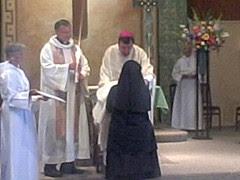
My own understanding of the Parable of the Merciful Father (aka Parable of the Prodigal Son) colors the way I see people who seek (or pretend to!) the status or standing of consecrated solitary hermits without accepting the responsibilities the Church associates with such standing. One's life in the Church always comes with commensurate responsibility. Standing as a publicly professed and/or consecrated person in the Church codifies such responsibilities in law. The Prodigal Son was given a robe, a ring, and sandals signifying his new standing in the family. It is not hard for the diocesan hermit to see or hear echoes of this story as the Bishop presents (or clothes her in) the prayer garment, eremitical tunic or scapular, and profession ring, or as he presents her a copy of his formal approval of her Rule which establishes it as binding on the hermit in law as well as morally.

Resonances of the Son's renewed acceptance of his place in protecting the patrimony of his family and People are not far from the hermit's heart when she makes her vows in the hands of the Bishop while resting them on the book of Gospels, or signs those same vows on the altar, or is congratulated and welcomed in her new standing by friends, family, and especially the whole parish community at the Eucharistic Feast. I would think the lay hermit who lives her eremitical life by virtue of her baptismal consecration alone might well perceive similar resonances with 1) her baptism which initiates her into the family of followers of Christ, 2) her anointing with chrism, 3) her clothing with the white baptismal garment, and 4) the giving of the baptismal candle which is accompanied with the commission to keep it burning brightly as a witness to others. In either case, and in all other instances of ecclesial commissioning, standing in the Church comes with responsibilities and rights are accompanied by obligations. The matter is both canonical and profoundly Scriptural but as I understand it, it is Scriptural long before it is canonical.

21 March 2015

Some Reflections on Why Canon Law is Important to the Diocesan Hermit

[[Hi Sister, have you always been interested in Canon Law? Do diocesan hermits have to have this kind of interest or knowledge? (Suppose I couldn't care less about this kind of stuff, could I still be a hermit?) One friend said that hermits usually don't care about laws, their freedom is contrary to that and everything I have read about hermits stress their freedom. Is there some way in which he is right or are consecrated hermits kind of "law and order types"? Are those hermits who do their own thing misrepresenting this vocation?]]

Have I always been interested in Canon Law? Nope, definitely not. My own interest is very limited and circumscribed, namely, it is confined to canon 603 and to the life defined there. In a broader sense that and my own history means being interested in the canons on religious life as well; after all a number of those apply to those professed as c 603 hermits, but I can't say canon law per se holds much interest for me apart from the life I have been commissioned to live in the name of the Church. Theology is a much more compelling and pervasive interest for me and my interest in this canon specifically often has to do with the theology and spirituality it seeks to express and protect. Often this involves ecclesiology (theology of the Church) and the way individuals are made responsible for embodying theological truth.

Thus, my interest has also grown over time. It has been spurred by several ideas which are integral to canon 603, not least, 1) the ecclesial nature of the vocation, 2) the amazingly beautiful combination of non-negotiable elements and individual flexibility c 603 codifies, 3) the responsiveness of this canon to history and its capacity to reflect and protect the solitary eremitical tradition as part of the Church's own patrimony, and 4) the lesson that canon law follows life and law serves love. I don't think we necessarily always see these things clearly in canon law (or any law for that matter) but we do see it in the case of canon 603. Especially important here and with regard to #1 above is the way the canon (and canonical standing more generally) creates stable relationships which are essential for ecclesial vocations. The idea that the canon legislates, establishes, and protects those relationships necessary to live this life well and in a prophetic way was tremendously surprising and impressive to me.

While canonical hermits do not usually need much of this kind of knowledge (we have canonists and Vicars who handle canonical details with regard to vows and other things), some, like myself, are interested to the degree that c 603 is new and codifies in universal law a new form of consecrated life. Thus, we tend to be interested in this canon, how it came to be, why it exists, and so forth, and some few of us reflect on the way the canon works in our own lives and the vocation more generally; as noted above we are interested in the relationships it establishes in law, the purpose of these, what we would be living apart from the canon and how it differs because of the canon and things like this. Because as hermits our need for legal recourse or canonical consultation is rare at best once we have been admitted to perpetual profession we are ordinarily otherwise completely free to follow our own Rule of Life without worrying about canonical matters. On the other hand, most of us do have an interest in the canon and its normative character when this is being denied or contravened publicly by folks pretending to represent consecrated eremitical life. In any case at least one diocesan hermit here in the US is a canonist working for a diocese so an interest in canon law is at least not antithetical to the eremitical life!

Am I a Law and Order Type? 

I don't think I am particularly a "law and order" type, nor are most of the hermits I know. Of course we respect law and see its importance in society and the life of the Church. We are not antinomians or anarchists. Rather, we recognize that c 603 is an historic canon and those I know do feel both honored and obligated to live our lives with a real cognizance of what is finally possible in universal law because of it. There is something really startling and humbling when one realizes one is part of a long-awaited and fought for extension of an ancient tradition into a contemporary situation, and therefore, that one is part of a relative handful of hermits now living a new ecclesial vocation in the name of the Church. Personally, I believe the eremitical vocation has the capacity to redeem (heal and give meaning to) the lives of many people who are isolated by life's circumstances and I feel proprietary about the significance of the canon for this reason as well.

Sister Ann Marie OCSO signs Solemn Vow Formula
Especially clear to me is that if the canon is to be used in this way however, it needs to be mediated by the Church and cannot simply be one more occasion of the divisive, individualist, "do your own thing" tendency of our modern world. As far as I can see, that tendency only leads to greater isolation and greater need for redemption. We all know how empty a life of merely "doing your own thing" can be. Imagine how that is exacerbated when one is already searching for meaning, or already feels isolated or as though they do not fit in! My own experience of this vocation says that whether lived canonically in the consecrated state or non-canonically as a hermit in the lay state, for instance, the eremitical life lived in the heart of the Church witnesses to a solitude which is dialogical and contrary to any individualistic isolation. Canon 603 recognizes this clearly when she defines the life as one "lived for the praise of God and the salvation of the world." If the eremitical vocation is allowed to be degraded into another instance of "do your own thing" or "don't give a damn about the Church's laws or decrees", etc, then we will have lost one of the really unique gifts of the Holy Spirit!

Misrepresenting Facts to the Vulnerable, A serious Pastoral Matter

Thus, when a person who neither understands canon 603 nor lives under it or in an institute of consecrated life, but still falsely claims to be a "professed religious" and "consecrated Catholic Hermit" while writing, [[Perhaps it is best for all of us, and maybe especially us consecrated Catholic hermits, to not get too caught up in the ins-and-outs of the temporal Catholic rules and laws and the raft of interpretations of those rules and laws]] it strikes me as particularly self-serving and pastorally insensitive. (Neither is it particularly accurate; a single  two paragraph canon is hardly a raft of laws nor is c 603 exactly a hotbed of interpretive controversy.) It especially says to me this person has not really understood the reason the Church takes care whom she consecrates and how, whom she professes in this or that vocation and why. In my experience people searching for a way to belong, a way to redeem their own isolation, a way to ensure the meaningfulness of their lives are legion in our world --- and perhaps especially in our culture. They are also more vulnerable to people offering a less difficult or at least more individualistic way to embrace religious life.

We do these persons no favors when we tell them to do whatever they wish, call themselves whatever they wish and never mind about the "temporal laws" of the Church. We do them no favors when we misrepresent facts, misread texts, or treat Canon Law as though it is an option we can ignore while arrogantly calling ourselves "consecrated Catholic hermits" and thus claiming under our own authority a designation only the Church herself can permit us to use. Especially we do these persons no favors by encouraging them to embrace pretense in the name of the God of Truth.

In the end to do that is to betray their deepest longings and treat them as though they are either too unimportant to God to be called to live a significant (meaningful) vocation, or simply too weak to bear the vocation God truly HAS extended to them. This is so because in the Church, standing in law ("status") is always associated with the gift and challenge of responsibility. We do not recognize a person's real dignity nor show genuine respect for them by extending standing (much less allowing them to pretend to standing which is) without commensurate responsibility. In any case, while the institutional Church is not perfect, generally speaking she uses canon law to order and protect her charismatic life, not to stifle it. She uses law to make certain that freedom is not degraded into an irresponsible license. The diocesan hermit does something similar with her Rule and, of course, Canon law, legitimate superiors, and the other mediatory structures and relationships of the Church. These things ordinarily help INSURE the freedom of the hermit, they do not hinder it.

Authentic Freedom:

You see, authentic freedom is the power to be the persons we are called to be in spite of limitations and constraints. In the diocesan hermit vocation, or any vocation to the consecrated state in the Church God calls the person and that call is mediated through the structures of the Church. The charismatic dimension of the Church is always mediated in this way. Catholic hermits are not folks who simply do whatever they want (your friend's more commonly held sense of what it means to be a hermit sounds like more of a stereotype to me); they are persons who do what God wills; Catholic hermits are those who live an eremitical freedom (the will of God) as that is mediated not only in solitude, but in and through the structures of the institutional Church.

In my own experience the Church's canon law here provides some of the necessary structure permitting a person to concern themselves wholeheartedly with prayer, the silence of solitude, and the rest of the eremitical life without concern for whatever the world says, believes, values, etc. Moreover, they do so within the very heart of the Church. That is true whether they do so as canonical (consecrated) or non-canonical (lay).  In fact, that is true even when they are fighting for a new way while accepting the current truth of their situation. (The monks who accepted secularization while struggling for something like Canon 603 and living under the protection of Bishop Remi De Roo are exemplars of this kind of creative and risky freedom.) Freedom involves constraints. License is a different matter.

Doing your own thing may pass for freedom, at least for a time, but such persons tend to find they are marginalizing themselves and exacerbating their own sense of unfreedom and meaninglessness. In theological terms they are opting not for the way of the Kingdom and the Life of the Spirit but instead for the way and spirit of the world. The irony is that such persons are therefore more apt than those living fully within the Church's constraints and structures (canonical, liturgical, theological, etc) to be in a destructive bondage, whether that is to insecurity, shame, their own personal failures in life, a fear of meaninglessness, loss, grief, illness, or whatever drives a need to define themselves; whatever creates and grounds this kind of arrogance is not a symptom of freedom but of slavery.

Living Eremitical life inside and Outside the Church:

But let me be clear. A person who truly lives the hermit life without doing so under canon 603 is still a hermit and can live the life in a completely authentic and exemplary way for others --- whether those folks are hermits or not. In this these hermits would be in line with the Desert Abbas and Ammas who actually lived their lives in protest to the worldliness of the Church that had allied itself with the State after Constantine's Edict of Milan. If one has not been consecrated through the mediation of the Church as part of an Institute of Consecrated Life or under c 603, one can certainly still live eremitical life as a lay hermit, a hermit in the lay state of life (or, if one is a priest, in the clerical state of life).

One could also leave the Church and pursue an eremitical life in open protest to what one might see as the Church's compromises with worldliness (and the way some folks write of Canon 603 and the Church's use of law more generally seems suggest they see these as a terrible compromise with worldliness). I personally think this is unnecessary and misguided; I would not understand it but it is a choice I would respect at the same time for its honesty. What is not okay, what I personally cannot respect, is effectively thumbing one's nose at the Church's clear understanding, law, and sacramental structures while fraudulently calling oneself a "Catholic Hermit" and thus, claiming one is living this life in the very name of the Church. I do think that is a clear misrepresentation of this vocation. Of course, if any person claiming to live eremitical life in the name of the Church is also not really living an exemplary eremitical life but instead is merely trying to validate personal isolation and failure, that, it seems to me, would also be a serious misrepresentation of what the Church understands as the eremitical vocation.

21 November 2014

Questions on Formation of the Hermit

[[Apart from having a good spiritual director, study and of course prayer; how else can one learn the eremitic way? Do you suggest that someone discerning such a vocation put themselves under the tutelage of a professed hermit (this seemed to be the norm in the early Church and  Middle Ages. There are many stories of young anchorites being guided by holy women in their vocation) or perhaps spend time with a solid hermit community, like the Monastic Family of Bethlehem or the Carmelite Hermits in Texas, to learn this vocation?

As you've noted, Vatican 2 and the new Code of Canon Law revived this  vocation. While the hermit life is ancient, those reviving it are also pioneers in that they are at the forefront of reviving this call. My concern is that without being properly formed one could run into m[an]y (sic?) mental and spiritual difficulties. How do I learn to live this life? I'm trying to discern this and apart from reading, study and most of all prayer, frequenting the sacraments and solitude I have no idea if I'm doing any of this right. Are there support groups or something for those in discernment? What do you advise?]]


Hi there and thanks for writing again. First, the idea of being guided in this vocation by a perpetually professed hermit (largely today's equivalent of the elders and mentors of old) is a good one. It is traditionally the way most folks came to eremitical life and is ideal. However, opportunities for going to live with an eremitical community apart from seriously discerning a vocation with such a group do not really exist today. What I mean is that today a person cannot generally determine they are called to life under canon 603 (life as a solitary hermit) and also go off to live with a community like those you have mentioned. One can ordinarily do one or the other but not both (though one might, with one's diocese's help, arrange to stay occasionally for a number of weeks at a monastery or hermitage to experience certain values and realities which are a daily reality there -- not least the rhythm and balance of the life and the pervasive silence and attitudes of attentiveness that accompany everything one does; this differs from what you have described I think).


To ease this difficulty a little at least, members of the Network of Diocesan Hermits** (perpetually professed diocesan hermits) will consider working with an individual if their diocese requests it. (While we may work informally with others, the fact is there are relatively few of us and none of us has the time to mentor every person who writes or contacts us about becoming a hermit; some initial discerning needs to be done by dioceses!) Ordinarily this means that someone who has lived solitude for a time, who is considered by a diocese to be, potentially at least, a candidate for canon 603 profession, and who is working with a spiritual director and meeting with diocesan personnel regularly, can also talk regularly with someone from the Network to be sure they understand what it means to be living an eremitical life (as opposed to an individualistic life of physical isolation), are able to discern whether or not they are well suited to it, and are growing in this without getting stuck on relative trivialities or superficialities, etc. The Network also has a group/website set up for aspirants which gives them a chance to share with one another -- though at the present time no one is part of that group.

Remain in your Cell and Your Cell Will teach you Everything:

Even so,  these possible pieces of assistance aside, it is important to remember that the main teacher of any hermit is going to be God in and through the silence of solitude itself. The desert Fathers' and Mothers' wisdom about dwelling or remaining in your cell and your cell teaching you everything remains essentially as true today as it was in the 4-6th centuries. Add to this the main elements of canon 603, which define a life of assiduous prayer and penance, stricter separation from the world, the silence of solitude, the evangelical counsels all lived for the praise of God and the salvation of the world, and you will find set before you a way of living a profoundly Christian life in solitude which you and God together will live out in your own way. As you move more and more deeply into this life with the help of your director (who, it seems to me, functions as the desert mentors of old once did), you will find either it truly resonates with you or does not; you will also find that it is a means to abundant and mature life in Christ for you or is not. If this way of living leads you to abundant life in Christ, if in fact it makes you more loving, patient, longsuffering, compassionate, honest (humble), etc, then it itself is right for you and your response to God is, at least generally, also as it should be.

The question about "doing it right" for the hermit is at its heart, always really a question about what God is calling us to in solitude and how integral and generous our response to this call has been or is coming more and more to be. For instance, as part of praying my life I pray in several different ways each day; these forms of prayer allow me to respond to God with all parts of myself (heart, mind, body, etc). Over the years I have dropped certain ways of praying or adopted others, always in response to God's own call to be fully alive and fully myself in and as a response to God's summons and love. No one says I must pray in this way or that. Assiduous prayer and penance is the goal and means to living this life but no one spells out what this means in detail. Over a period of several years you will try all the forms of prayer which are central to a life of prayer and determine which of these are best for you at this time. Over a period of more years you will discern which ones are important for you during times of illness, which ones are especially helpful in getting you through periods of stress or tedium, which ones almost invariably speak to your heart or kindle the fires of your mind, or are most difficult for you or console you in loss and grief. Even more importantly you will come to know the ways God calls you to wholeness and in responding you will become God's own prayer in the world.


The same is true of penance and the other central elements of the canon. There are certain building blocks for a life of assiduous prayer and penance. One explores these and, in response to God's call to, life, truth, beauty, integrity, wholeness, holiness, justice, love, compassion, etc, discerns which of these building blocks lead one more and more to become an expression of these dimensions of God's own life. Of course, it is not merely a matter of learning to be a hermit but rather of discerning whether or not one is CALLED to be one. If one is, then the central elements of canon 603 will lead to greater and greater personal wholeness and holiness with all these entail. If not, then no amount of teaching can help a person embrace this life or move from external silence and physical solitude to the silence of solitude which is a matter of the heart. As I have written before while citing Thomas Merton, Solitude herself must open the door to the hermit. If she does not, then no degree of teaching, tutoring, direction, or supervision, etc, will help.

On the other hand, if one is truly called to this life (whether as a lay hermit or a consecrated hermit), then provided one has a good spiritual director with whom one meets regularly and is assiduous in keeping her vows and other commitments (including to the personal work which stems from direction), the chance of making serious mistakes is truly minimal. There WILL be difficulties to negotiate; that is part and parcel of any vocation leading to true growth in authenticity. Formation is an ongoing reality and for the hermit, unless she enters a community of hermits, even "initial" formation takes a period of many years (and certainly more than canon law calls for for those in formation with a community). The point is, however, the heart of this vocation is a solitary relationship with God in which one responds to God's love and mercy in all that one is and does. There is no cookie cutter pattern of what this looks like nor of what formation entails but to the extent it is authentic it all goes by the name "the silence of solitude" and one knows it when one sees it. (What I mean here is that the fruits of such growth in authenticity will be plain for all to see.) Neither does one reach a point at which one can say "I'm done with formation!" Instead the fundamental Rule, again, is to remain in one's cell and one's cell will teach one everything. (By the way, among other things, this can mean for one called to solitude that the cell will become a place in which new life is fostered and incredible growth nurtured; for one not called to solitude, life in cell will torment the unfortunate aspirant and leave them in misery, personal disintegration, and pain. God is not absent in such circumstances but he calls the aspirant to fullness of life elsewhere.)

Committing to a Spirituality of Discernment:

Because this is true all one can really do is commit to a spirituality of discernment which requires spiritual direction and regular frank discussion with others who accompany one in one way and another. (One's pastor, confessor, Vicar or Bishop --- if one is working with a diocese --- good friends who are honest with us, etc.) At every point one attends to the way life in solitude affects one and acts accordingly. Is one growing? Is one profoundly happy in Christ? Is suffering --- to whatever degree it is real, a subtext of one's life, not the main theme? Is one able to use the gifts God gives them and does one love better and more deeply in real concrete situations with real persons? Is the call of solitude herself something one experiences or does it seem that one has embraced an ascetical discipline which is merely external to oneself? I should note here, one's goal must not be to become a diocesan hermit but rather to be a hermit (a desert dweller) living the silence of solitude day in and day out. I cannot stress this enough. Over time one MAY find that one is called to be a diocesan hermit professed and consecrated under canon 603, but even if one does not find this to be the case, one has lived each day well as God called one to do. That is and always will be the measure of "success" for any hermit, whether lay or consecrated; for that matter, it is similarly the measure of success of any Christian and any human being. In approaching questions of success and failure, or fears regarding serious mistakes, this is far and away the most important thing.

It occurs to me that perhaps you have questions about specific mistakes which I might address more particularly. If that is the case, please let me know what kinds of things you are thinking of; that would be helpful to me as well. In the meantime, all good wishes.

**The NDH is not currently active (2024). Instead, we have an informal network of c 603 hermits who may come together in small groups. For assistance with discernment and formation of c 603 hermits, please contact Sister Laurel O'Neal, Er Dio, at SRLAUREL@aol.com and we can discuss diocesan and candidate needs. Depending on your location, there may be a c 603 hermit I can refer you to, or I may be able to help you myself. Please indicate "c 603 Discernment and Formation" in the subject line. Thanks!

24 October 2014

On Making the Transition from Lone Person to Hermit and then Diocesan Hermit

[[Dear Sister, I have the impression that you did not choose the circumstances that eventually led you to become a hermit. I also get the impression that you stress that those circumstances weren't enough to make you a hermit or to discern a call to eremitical life. What was it that made the difference for you personally? Did your circumstances change? How did you make the transition from being a lone person to being a hermit "in some essential sense," as you put it, and then, a diocesan (Catholic) hermit who embraced not only an individual vocation but a place in fostering the eremitical vocation in the Church? Is this typical of diocesan hermits?]]

Wow, I am impressed! You have managed to summarize so much important stuff in a few sentences, some of it stuff I have not really written about directly here. Your impressions are spot on too. Add to that your questions are good ones and I have to give you kudos across the board! Thanks! But that being said, the question about making the transition from being a lone person to becoming a hermit in some essential sense is not an easy one to answer. That is true because it is not about any one thing that was helpful, but about a number of things which all came together to confirm a call to eremitical solitude. Anyway, great questions. Let me give them a shot!

No, I did not choose the circumstances which eventually led me to become a hermit. As an adult (and while still a Franciscan) I developed or manifested an adult form of  mixed seizure disorder (Epilepsy) which later proved to be both medically and surgically intractable. Coupled with that, probably because of injuries that occurred during seizures, I developed chronic pain, eventually diagnosed as Reflex Sympathetic Dystrophy or (the preferred term these days) Complex Regional Pain Syndrome. Both conditions isolated me from others (including from Mass attendance, or contributions to parish and diocesan life), prevented me from pursuing the career I had been educated and trained for (mainly teaching systematic theology but some clinical pastoral work as well), and caused me some serious and extended questioning about the meaning and value of my life more generally. Today the seizure disorder is better controlled for several separate but mutually contributory reasons (including physical solitude and silence!) while the chronic pain remains a daily reality which requires medications and adjunct therapy "to keep the fire down." While this was enough to isolate me from others, including from the local faith community and most friends, you are correct that it was no where near enough to conclude, 1) I was actually called to become a hermit, nor (much less!) 2) that I was actually a hermit in some essential sense! A transition was required!

Making the Transition from Lone Person to Eremite:

The first real shift occurred in my prayer. Over time I began to develop a more contemplative prayer life and I began to trust that more and more. By the early 80's besides my own doctors who continued to try to control both the seizures and the pain, I was working regularly with a spiritual director and was developing the tools I needed to work through the various bits of healing required by having my life sidetracked by illness and injury. At the same time she helped me begin to trust the various ways God was working in my life and I began to imagine this thing called eremitical life as a result of reading canon 603, which had been published in October of 1983, and then Merton's Contemplation in a World of Action and LeClerq's Alone With the Alone. Merton's work especially fired my imagination here. More and more my work with my director had to do with essential wholeness in the face of disability and my work with doctors became less about control of seizures and more about dealing with disability. While I continued medications, etc, for the medical stuff, the work I was doing with my director became far more important in freeing me to embrace life and become open to seeing the good God would bring out of the situation.

I had begun to experiment with living as a hermit in a conscious way and it began to be the focus of reading, discernment, research, and so forth. Early on in this process I began to write for publication (mainly Review for Religious) so it became clear that as a context for my life eremitism of some sort was truly fruitful in these terms and would lead me to contribute to the life of others and to that of the Church more generally.

Within this context then several things happened. Among them, I embraced a contemplative prayer life marked out by monastic regularity and liturgy, I undertook the lifelong work of regular spiritual direction in a focused way which led to my own increasing and essential wellness in spite of disability, I began to understand the importance of a vocation to be ill within the Church as potentially a way of proclaiming the Gospel of God (whose power is made perfect in weakness!) with a special vividness. This meant that I had begun to see my life and prayer as an important opportunity to make God manifest to others where in the past I would not have seen disability as anything other than an obstacle to a life of such significance.  In time I began to consider and write about Chronic illness as vocation and, for some relative few, as a potential call to eremitical life. Additionally then, I began to understand the main focus of my prayer as being there for God's own sake; solitude took on a distinctly communal hue, the silence of solitude assumed a more Eastern and Desert Elders cast of quies or hesychasm, while ministry to others seemed the natural expression of the compassion empowered by the silence of solitude. Thus, over time I also came to understand the terms of canon 603 radically differently than I had in 1983. All of this growth and integration was spurred by reflection on the eremitical life outlined in Canon 603 and expanded on in other texts.

Throughout these years (@1983-1995+) then, my life shifted from being mainly about myself and my own disability along with the lost opportunities or potential associated with disability and grew in this new perspective. The focus on the illness, and all it brought in its wake had been necessary for a time but now it needed to become more of a subtext in my life -- even as it continued to bring a degree of pathos and gravitas to my life. That is the shift that occurred during this period.) It became very clear that whether I eventually lived my life as a lay hermit or continued pursuing perpetual profession as a diocesan hermit,  eremitism was truly the vocational path which made my own life fruitful and other-centered. Thus, I continued to reflect on and research canon 603; I did so within a Camaldolese context now because I understood the threefold good of the Camaldolese (community, solitude, outreach or evangelization) to be a dynamic expression of the very best that eremitical life could be, not only for hermits but for the whole Church and world-at-large as well.

In other words, eremitical life began to be not only the context of a life of essential wholeness and communion with God which embraced disability and transformed it into an opportunity to proclaim the Gospel with my life, but it was the vocational pathway which made essential wholeness as well as real generosity and concern for others possible. It drove my reading and my theology to some extent (though my theology, which centered on the cross in Paul and Mark, supported this vocational pathway at every point), and it challenged me physically and spiritually to become both more truly solitary (in an eremitical sense) and contemplative as well as more open to community. In short, it engaged me on every level in a constructive way; it made me more compassionate and capable of love, more genuinely dependent on the grace of God for the meaning and shape of my life, and, while it did not bring physical healing, it deprived illness of the power to define, fragment, and dominate my life and over time would even make a gift of disability and limitations. It is what allowed me to eventually write here:

[[In the power of the Spirit and from the perspective of the Kingdom --- it is all of a piece:  Mountaintop experiences and years in the desert; a power made perfect in weakness; a  bit of human brokenness and poverty made a gift to others by the whole-making grace of God; mute isolation  transfigured into the rich communion and communicative silence of solitude; a life redeemed and enriched by love. It is all of a piece ---  epilepsy and ecstasy. I am grateful to have learned that. In fact, I am grateful to have needed and been called to learn that!]] Ecstasy and Epilepsy: It is all of a Piece

When I look back at the main stages this journey required it involved (in a pretty simplified form) movement from 1) being a lone or isolated person who merely imagined what being a hermit might mean to 2) being a hermit as the Church herself understands the term, and finally to 3) being a hermit who lives the life in the name of the Church. Each stage was either preceded or accompanied by significant and entirely necessary theological preparation and spiritual formation. This process has taken 31 years so far and exploring the last stage, both in terms of communion with God and the ecclesial implications of the vocation as I continue to grow personally, will no doubt occupy the rest of my life. I am grateful to God for what (he) has done; God is indeed a master story teller who, from the perspective of absolute futurity, weaves amazingly coherent tapestries with the most inadequate and broken threads!

Transition to Diocesan Eremitical Life:

The last question you ask has to do with the last piece of transition, namely embracing canon 603 life in a way which allowed me to be concerned not only with my own vocation, but with the eremitical tradition itself and diocesan eremitical life as a piece of that living reality. I pursued canon 603 profession beginning in 1985 or so and continued doing so right through perpetual profession in 2007; this is a complicated story and there is no reason to detail it here or now. What is important is that until a few years prior to admission to perpetual profession in 2007 and the years immediately after that, I did not have a particularly strong sense that I was part of a living eremitical tradition, much less that I would have some (small but very real) place in handing on or nurturing that tradition.

Oblature with the Camaldolese certainly was important here but I found that with perpetual canonical profession one comes to know that one has been gifted with rights and obligations beyond baptism; this sense developed especially as people asked questions about the difference between private and public vows or between personal dedication to God and public consecration by God. The difference between validating one's isolation and allowing God to redeem it so that it is transfigured into eremitical solitude was another huge piece of my developing sense of the gift and obligation held in my own eremitical life. It also developed for me as I became more sure I not only understood canon 603 but embodied it in my own way.

Something similar happened with regard to the Camaldolese charism as I moved from understanding it intellectually to having the sense I was a living expression of it and the dynamic within the threefold good which is so characteristic of it. (My life in my parish during the past 8 years contributed greatly to this bit of internalization and integration; in fact it would be hard to overstate its importance here.) A final piece of all this, and one which is not yet solidified within me has to do with my own Franciscanism and where that actually fits. You see, St Francis lived as a hermit for a time and wrote a Rule for hermits which is pretty different from the monastic approaches to eremitical life. I have the sense that my own Franciscanism is stronger than I realized and I am freer to explore that now that I have not only understood but internalized the Camaldolese charism in a foundational way.

I don't know how this Franciscan piece of things will actually shake out but it is part of my own history and life which I am currently examining more closely; in one way or another it will be another piece of becoming responsible for the living tradition we call eremitical life in the Church. It seems to me this concern with the vitality of the tradition itself is really a normal culmination of the movement in my adult life. I moved from an active and largely other-centered life of ministry and preparation for ministry, to a life isolated by chronic illness and concerned with making sense of itself; from there my life shifted again to a solitary and contemplative one which, through the context of eremitical life, was empowered to be lived for God and others in the silence of solitude. Next my life shifted to one which consciously embraced and reflected the place of the Camaldolese charism in achieving this movement, and finally, it involved canonically and publicly embracing eremitical life more generally as a gift of the Holy Spirit to the entire Church and world. Many things mediated the grace of God and brought me to embrace eremitical life; it is this vital if rare and fragile tradition which has made a gift of my life. I am responsible for it both morally and legitimately (in law) --- a responsibility I accept with real joy and not a little awe.

Is this Typical of Diocesan Hermits?

To be honest I don't know if there is a "typical story" for diocesan hermits. I do know that a number of us contend with disability and chronic illness of various types and severity. I also know that none of those with whom I am acquainted believe it is enough to be chronically ill or disabled and isolated in the way this can bring about to conclude one has a vocation to eremitical life! Still, over time each of us discerned that eremitical life created the potential for significantly meaningful and fruitful lives when our illnesses militated against that. We each recognize that eremitical life allows us to live an authentic religious life which is not self-centered even while it requires signifcant physical solitude. Moreover my sense is that each of us has come to an essential wholeness and even holiness in which illness is deprived of its capacity to define and dominate our lives despite the symptoms that trouble us every single day. (This is one of the reasons I personally have very little tolerance for self-labeled "Catholic hermits" for whom eremitical life is little more than an opportunity to justify and wax endlessly about their own "God-willed" isolation and unrelenting physical problems.) Here as in everything in Christian life the truth is, "By their fruits ye shall know them!" --- that reflection of what God has done in one's life in the desert is, perhaps, the only really typical (and compelling!) piece of any genuine hermit's story!

I hope these answers are helpful. It is unlikely I will write about some parts of this again very soon. Still, if I have been unclear or raised additional questions, I hope you will get back to me with those.