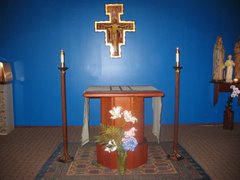
At today's service I read the Gospel from today's daily readings. It was the very familiar, " Whoever wishes to come after me must deny himself, take up his cross, and follow me." (Matt 16:24-28). It was not the optional readings for the Feast but certainly suited the day given who Sister Teresa Benedicta was and is. I think it is easy for us to think of taking up our crosses as an exhortation simply to embrace suffering. It certainly means that but it means more besides, namely, it calls us to grow in what some call cruciformity as we adopt an attitude of vulnerability and love towards all we meet in our world. It asks that we open ours arms and our hearts to embrace those we meet with the love of God that empowers us. In short we allow the love of and our love for others to shape us in a cruciform way. Two elements brought this home to me this week besides the fact of our Feast.
Last week and this I reread several novels by Chaim Potok. One of these was My Name is Asher Lev. Asher Lev is a Hasidic Jew growing up in the earlier to mid 1900's. His devoutly religious family are Ladover Hasidim who seek to counter the murderous anti-Semitism so prevalent in Europe in the 1930's and 1940's by establishing Ladover communities, synagogues and yeshivas. They have lost dearly-loved relatives in pogroms and the holocaust and have heard again and again that anti-Semitism is a justifiable result of the supposed fact that "It was Jews that killed Jesus". (It must be said that this is an undeniable, and unutterably shameful piece of our Christian history which has blasphemously victimized the innocent in the name of the greatest act of selfless love we know.) So these people too are marked by the Cross of Christ; it is linked for them to the senseless and hate-filled deaths of brothers and sisters, mothers and fathers, aunts, uncles, and cousins --- and yet, at great risk to himself Asher's father travels in faithfulness to the Master of the Universe to support Jews and extend Ladover Hasidism throughout Europe.
That is one part of the story. The other is that Asher Lev has a prodigious gift; he is an artist, a young man with an irresistible and insatiable desire/need to draw and paint. As he grows up in this fundamentalist Ladover community, his family is torn between dealing with Asher's gift (which, his father, especially, thinks is demonic in origin) and the desire to honor one another and Ladover Hasidism. Asher's Mother stands torn between her love for her Son and his gift, her love for her husband, her God and the Ladover tradition; she is a buffer for everyone's pain.
Eventually Asher is led to paint the story of his family's anguish. When Asher's Father travels Rivkeh, his wife, waits for his return and stands looking out the living room window, sometimes for hours; this becomes the basis for Asher's greatest paintings, two crucifixions. Each has his Mother framed in the living room window, tied there with the ties from the venetian blinds and stretched between her husband returning from his travels and her son (whose paint brush represents a spear which penetrates her heart). All are held together by love, but of course it is not an easy thing. It is an anguished, tortured love. Asher has drawn on crucifixion because it is the only aesthetic frame he knows as an artist which is sufficient to "hold" and express the torment, pain, and passion of his life. His family are bewildered by his art, offended, betrayed, torn by his gift and profoundly saddened by the way in which Asher has hurt them with it. Asher is exiled from the Brooklyn Ladover community. Cruciformity marks every life in this story. As Christians we know the profound anguish and today, to a lesser degree, the offense of the cross but for us it has primary notes of joy and triumph as well.
The second element which brought this dimension home to me especially was the fact that this is August, the month associated with entrance to religious life for many of us, the month of professions and jubilees, the month when we celebrate the commitments we and our Brothers and Sisters have made to life in Christ. It is the month when the appropriate refrain I have heard several times is: He is faithful and so are we!! This year is my pastor's 50th jubilee and I entered 50 years ago this month as well. All over the world stories of jubilees are shared: one I heard was about an IHM Sister who is 102 yo and celebrated her 85th jubilee last week; she processed into liturgy determined to walk the distance on her own two feet. She did it and was joyful and triumphant when she reached the altar as were those celebrating with her. This too was a symbol of her long and faithfully-formed cruciform life. Another Jubilarian at the same liturgy processed in with her niece, a young Sister who had just made her first profession. The two walked in hand in hand, the younger supporting the elder, both radiant with joy. When I shared this story with another Sister I was reminded then of a Franciscan from her congregation who died at 107 yo and who also celebrated 85 years of religious life; her niece is also a Franciscan (same congregation) and is alive, though quite elderly, today. Stories of lives dedicated to Christ and shaped over years in vulnerability to and in the service of Incarnate Love. Cruciformity. The shape of the faithful, sometimes anguished, joy-filled and persevering discipleship Jesus calls each of us to today.
 The third element, of course, the element which brings all of this together for me, is the life and witness of St Teresa Benedicta of the Cross whose feast we celebrate today. Edith Stein was a brilliant Jewish philosopher who studied for her doctorate under Edmund Hussurl. As a youth she ceased believing in God but as a young adult she read St Teresa of Avila's autobiography and recognized it as truth. She became Catholic. As her life experience and spirituality broadened she wrote a dissertation on Empathy. Prevented from taking a professorship first because she was a woman, and later because of her Jewishness, she continued her reading in philosophy and theology and eventually became a Carmelite Nun. At the center of her life was the cross; she called it "our only hope". Sister Teresa Benedicta's last significant work was on St John of the Cross.
That same year, on 02 August 1942, the Gestapo came to her convent to arrest Sister Teresa and her blood sister, Rosa, also a Catholic who served at the convent. They were moved to a transit camp, Westerborc, and on 07. August, were transported to Auschwitz. She and Rosa were gassed there two days later on 09. August. 1942. As she left the convent with her sister, she said, [[Come, we are going for our people.]] Meanwhile, a good friend said of Edith: [[She is a witness to God's presence in a world where God is absent.]] In the seemingly godless world of Nazi death camps, in the face of meaningless slaughter Sister Teresa Benedicta showed others the face of Love incarnate. Cruciformity, Jesus' call to embrace the cross with our lives was modeled by Edith Stein as John Paul II noted at her canonization, a "daughter of Israel" and a "daughter of Carmel."
Whether in anguish, joy, triumph, or all three at once and more besides --- we celebrate that we and our Brothers and Sisters in Christ are called to embrace a life of vulnerability and love empowered by our trust in the God who will be there both for and with us in the unexpected and even the unacceptable place. That is what it means to take up our cross, to live truly in Christ. We are not victims but victors in him for the sake of creation. This is the shape of discipleship and all authentic humanity --- a life of transforming generosity, where self-centeredness is replaced by self-emptying, and our hearts are opened to others in compassion; a life of cruciformity.
09 August 2019
Feast of Sister Teresa Benedicta of the Cross


24 June 2019
Followup on Suffering Well: Suffering and the Will of God

Thanks for your comment and questions. I think you have put your finger on a really neuralgic place in the Lord's Prayer, Gethsemane, and our own approach to God's will. (And no pun intended with the term "neuralgic".) It is very common to think of the will of God somehow being related to suffering. We get a difficult diagnosis and say, "Well, it must be the will of God!" Or, some terrible tragedy happens and we (unfortunately often carelessly and blithely) say, "We must accept the will of God!" --- as though God wills the tragedy. Isn't it "funny" (peculiar, strange, uncritical, unreasonable, etc.) the way we 1) associate the will of God with suffering, and 2) assume we know what the will of God is in these and similar cases? In fact, when the Lord's Prayer speaks of the will of God being done on earth as it is in heaven, it is talking about something very much different than suffering. It is the coming of the Kingdom of God, the realm of justice, peace, meaning, hope, and authentic humanity here on earth that is the will of God in the Lord's Prayer. The petition for the will of God is the third "Thou" petition, that is, third petition that refers to God's being God for us. All three "Thou" petitions refer to God as verb, God as actor and initiator, God as the One who brings creation into being and to fulfillment of being. All three petitions are ways of opening ourselves to dimensions of what it means to allow God to be God.
 I believe something very similar is happening as Jesus says, "Not my will, but Thy will be done", when he is struggling in Gethsemane. Jesus struggled with temptation to use his identity as Son of God to do works of power when he was driven in to the desert by the Holy Spirit after his baptism. He very definitively chose the way of weakness even though the temptations he experienced would have involved the use of his power for good things in and of themselves. (There is nothing wrong with getting food when one is starving or to accept leadership of kingdoms when one would be a wonderful leader, etc.) I think this was a choice he made many times during his public ministry. Now, at the end of the story Jesus must choose again in a final and exhaustive way; he must commit himself to a way of seeing God's purposes and plans that depend on Jesus' own weakness, his own helplessness, and his total dependence on God to bring meaning out of the senselessness people will commit against him and the mission of God, not only unto death "but (unto) death on a cross". I think of this choice as both qualitatively the same and distinct in terms of intensity and difficulty as the decisions Jesus has made right along through his public ministry. He continues to choose "left-handed power" (God's power being perfected in weakness). But now he will have to journey to that far place the NT calls sinful or godless death without any precedent for understanding this in terms of either Judaism or the Greco-Roman world. He will have to trust and depend entirely on God even when he cannot feel God's presence (in fact, when he feels God's absence and abandonment by God).
 I think this is what Jesus is saying yes to; this is the will of God he is committing to, despite not being able to see it, imagine it, understand it, etc. But I also think if we were to ask Jesus if his Abba willed his suffering, he would look at us as if we had gone off the rails completely, and I think he would exclaim, "Of course not! How could you suggest that?? That's not the One I have been revealing (making real) to you all this time!!" And yet, God wills to enter into sinful death and transform it with his presence. He wills that Jesus choose the way of weakness. He knows what we human beings will do to Jesus. What we will do (and, it often seems, what we almost inevitably do to holiness or true humanity when confronted with these) is NOT the will of God. That is something the Cross shows us without doubt. The cruelty, treachery, cowardice, duplicity, betrayal, human abandonment, etc hardly argue this (trial and crucifixion) is the will of God. But a God who reveals himself in weakness, a God whose grace is sufficient for us, a God who can and will bring meaning out of absurdity, wholeness out of brokenness, righteousness out of sin, and fulfillment out of emptiness --- these things ARE the will of God. Our God reveals himself as the One from whose love nothing whatsoever can separate us; this is the lesson of the Cross. Not that God wills suffering, but that God wills an end to anything that can cause suffering due to separation or alienation from God.
Your question about Jesus accepting his suffering is a different question though than the question of whether or not God wills Jesus' suffering. It is one thing to determine suffering is somehow inevitable and something else to believe God wills that suffering. It is one thing to consent to journey wherever one's life takes one and to commit to doing so with God; it is another to assert that every step, no matter how skewed or painful was actually willed by God. God can certainly use Jesus' suffering; God can and does bring an almost infinite good out of it (this, after all, is part of the Good News we Christians proclaim); but this does not mean God wills the suffering per se, nor the degradation, torture, and inhumanity human beings take on in their reaction to Jesus!! Surely we cannot say the religious and civil leadership and crowds in Jesus' passion were cooperating with the will of God!!! But Paul faced the same paradox. He wrote, "Where sin abounded grace abounded all the more. What should we say, sin more so that grace may abound even more? God forbid!!!" Our God does not will our suffering any more than he does Jesus' --- but at the same time we should be consoled that where suffering abounds grace will abound all the more!!! Nothing can separate us from the Love of God.
 Thus, my answer to your final question re accepting our own sufferings as a share in the Cross of Christ lies in line with all of this. Do what we can to remain open to the God whose power is revealed in weakness. Do not believe that God wills one's suffering per se, at least not when we are speaking of things like illness, tragedy, sinfulness, and death, but believe they will never have the final word or the last silence. Do what Jesus did when he accepted his own cross (the weight of his own authentic humanity), namely accept a humanity that makes God known (or at least CAN make God known) even in those realities which seem antithetical to Divinity and Holiness. Trust this. We do what we can reasonably do medically, etc to relieve suffering, but when there really is nothing that can be done, we trust that our God will be there for us in this way; God has revealed in the cross of Christ that he will be present with and for us in the unexpected and even the unacceptable place. This is the Good News we must cling to in the midst of any suffering.
05 March 2019
Once Again on Right-handed vs Left-handed Power: Mark 4 and the Stilling of the Storm
 [[Dear Sister, in two of your recent posts you are saying that the kind of Messiah Jesus becomes depends on how he discerns the will of God, am I right? And that means that the kind of disciples he calls us to be depends on the kind of Messiah he will be and we will accept. If Mark is saying Jesus wants his disciples to accept a Messiah who needs to suffer and die to do the will of God why does he still the storm at the end of Chapter 4? I read the chapter and that seems to conflict with the rest of it. By the way, thanks for sharing more of that prayer experience. Has it caused you to conclude that God did not want you to be well or that He wanted you to be sick? I think that could be very difficult to hear!]]
Great questions! Thank you! As I read the piece about stilling the storm I hear it in two or three ways: First, it serves as a kind of second bookend pairing the one in the section preceding the chapter of the seed parables with the statements about Jesus as the strong man who will destroy the kingdom of Satan, or being recognized as one who speaks/teaches with a hitherto unknown authority (exousia, power). That first section (Mark 1-3) is full of healings and exorcisms --- right-handed acts of power. Jesus is affirmed as "Son of God" ---and "beloved Son" which means he is a hearer of the Word; in Judaism he would have been understood to embody the foundational Shema: "Hear, O Israel, the Lord your God is One. . ." and thus, be the human being uniquely empowered by the creative Word of God. All of this is followed by parables which point away from a Kingdom of God as commonly understood --- a Kingdom establishing Israel as preeminent amongst the kingdoms of this world with a militaristic Messiah. But Jesus is still the "Strong Man", the One who represents and reveals (makes known and real in space and time) the Creator God. If he embraces a Messiahship that is worked out in weakness, suffering, and even in death, it must be seen as a choice rooted in his discernment of the will of God and a paradoxical act of power.
 Secondly, I think in stilling the storm Jesus essentially says to his disciples, "Remember who I am! Remember whom you are asking whether I care if you perish!!" We can think of it as an enacted parable perhaps, a way of saying, "Will you follow me in my understanding of the will and mission of God or not?" The right-handed use of power serves to ease the disciples' fear, to assure them of Jesus' identity, and remind them that he does indeed participate in the power of God in ways they have never seen before. It underscores that Jesus is compassionate and can work wonders (in the NT, what we call miracles are called works of power) that only God would be expected to do.
 Finally and above all, I think this enacted parable asks the disciples yet again if they will trust Jesus and follow him --- even if his choices take them along a path to violent death. Mark writes his story this way to address his community who are being persecuted and are in some real danger of death. Similar questions are put to them when they wonder if God cares that they are in danger of perishing: can you trust the Crucified Messiah is really the "Strong Man", the embodiment of the Wisdom and Word of God?
And as he addresses them so does he address us: Can you trust that the way Jesus brings redemption is the left-handed way of power that will include suffering, that reveals itself in weakness but that accompanies us in every moment and mood of our existence thus transforming our lives with God's presence? Can you trust the paradox of the Cross, that eternal life and the reconciliation of the whole cosmos comes through scandalous (offensive) death revealing that ultimately no one and nothing is abandoned by the God whose Love is stronger than death? Do you believe not just in the death of Jesus but in his resurrection? Do you believe the Messiah who reveals that when all the props are kicked out God accompanies us in an ultimately meaningful way? Can you trust that when patience seems impossible and perseverance may feel meaningless, when the notion of a God whose power is made perfect in weakness seems ridiculous and your own discipleship feels like foolishness in the face of the world's power that the Crucified Messiah is truly Emmanuel, God-With-Us? Can you believe that he makes known and real in human history a God who can be absolutely trusted to be with and for you even to the depths of sin and death and that this God will bring new life forth from these even as he reconciles the whole of creation to (Him)self?
On God Willing Illness:


30 March 2018
Madman or Messiah? In the Darkness We Wait in Hope (Reprise)

Silence is appropriate during these times; Easter is still distant. Allowing ourselves to live with something of the terrible disappointment and critical questions Jesus' disciples experienced as their entire world collapsed is a significant piece of coming to understand why we call today "Good" and tomorrow "Holy." It is important to appreciating the meaning of this three day liturgy we call Triduum and a dimension of coming to genuine and deepening hope. I have often thought the Church could do better with its celebration of Holy Saturday, but spending some time waiting and reflecting on who we would be (not to mention who God would be!) had Jesus stayed good and dead is something Good Friday (essentially beginning after Holy Thursday Mass) and Holy Saturday (beginning the evening after the passion) call for.
* * * * * * *
In explaining the theology of the Cross, Paul once said, "Where sin increased, grace abounded all the more." During Holy Week, the Gospel readings focus us on the first part of Paul's statement. Sin has increased to an extraordinary extent and the one people touted as the Son of God has been executed as a blaspheming godforsaken criminal. We watched the darkness and the threat to his life grow and cast the whole of Jesus' life into question.
In the Gospel for last Wednesday we heard John's version of the story of Judas' betrayal of Jesus and the prediction of Peter's denials as well. For weeks before this we had been hearing stories of a growing darkness and threat centered on the person of Jesus. Pharisees and Scribes were irritated and angry with Jesus at the facile way he broke Sabbath rules or his easy communion with and forgiveness of sinners. That he spoke with an authority the people recognized as new and surpassing theirs was also problematical. Family and disciples failed to understand him, thought him crazy, urged him to go to Jerusalem to work wonders and become famous.
Even his miracles were disquieting, not only because they increased the negative reaction of the religious leadership and the fear of the Romans as the darkness and threat continued to grow alongside them, but because Jesus himself seems to give us the sense that they are insufficient and lead to misunderstandings and distortions of who he is or what he is really about. "Be silent!" we often hear him say. "Tell no one about this!" he instructs in the face of the increasing threat to his life. Futile instructions, of course, and, as those healed proclaim the wonders of God's grace in their lives, the darkness and threat to Jesus grows; The night comes ever nearer and we know that if evil is to be defeated, it must occur on a much more profound level than even thousands of such miracles.
 In the last two weeks of Lent, the readings give us the sense that the last nine months of Jesus' life and active ministry were punctuated by retreat to a variety of safe houses as the priestly aristocracy actively looked for ways to kill him. He attended festivals in secret and the threat of stoning recurred again and again. Yet, inexplicably "He slipped away" we are told or, "They were unable to find an opening." The darkness is held at bay, barely. It is held in check by the love of the people surrounding Jesus. Barely. And in the last safe house on the eve of Passover as darkness closes in on every side Jesus celebrated a final Eucharist with his friends and disciples. He washed their feet, reclined at table with them like free men did. And yet, profoundly troubled, Jesus spoke of his impending betrayal by Judas. None of the disciples, not even the beloved disciple understood what was happening. There is one last chance for Judas to change his mind as Jesus hands him a morsel of bread in friendship and love. God's covenant faithfulness is maintained.
 But Satan enters Judas' heart and a friend of Jesus becomes his accuser --- the meaning of the term Satan here --- and the darkness enters this last safe house of light and friendship, faith and fellowship. It was night, John says. It was night. Judas' heart is the opening needed for the threatening darkness to engulf this place and Jesus as well. The prediction of Peter's denials tells us this "night" will get darker and colder and more empty yet. But in John's story, when everything is at its darkest and lowest, Jesus exclaims in a kind of victory cry: [[ Now the Son of Man is glorified, and God is glorified in him!]] Here as darkness envelopes everything, Jesus exults that authentically human being is revealed, made known and made real in space and time; here, in the midst of the deepening "Night" God too is revealed and made fully known and real in space and time. It is either the cry of a messiah who will overcome evil right at its heart --- or it is the cry of a madman who cannot recognize or admit the victory of evil as it swallows him up. In the midst of these days of death and vigil, we do not really know which. At the end of these three days we call Triduum we will see what the answer is.
 Today, the Friday we call "Good," the darkness intensified. During the night Jesus was arrested and "tried" by the Sanhedrin with the help of false witnesses, desertion by his disciples, and Judas' betrayal. Today he was brought before the Romans, tried, found innocent, flogged in an attempt at political appeasement and then handed over anyway by a fearful self-absorbed leader whose greater concern was for his own position to those who would kill him. There was betrayal, of consciences, of friendships, of discipleship and covenantal bonds on every side but God's. The night continued to deepen and the threat could not be greater. Jesus was crucified and eventually cried out his experience of abandonment even by God. He descended into the ultimate godlessness, loneliness, and powerlessness we call hell. The darkness became almost total. We ourselves can see nothing else. That is where Good Friday and Holy Saturday leave us.
 And the question these events raises haunts the night and our own minds and hearts: namely, messiah or madman? Is Jesus simply another person crushed by the cold, emptiness, and darkness of evil --- good and wondrous though his own works were? (cf Gospel for last Friday: John 10:31-42.) Is this darkness and emptiness the whole of the reality in which we live? Was Jesus' preaching of the reality of God's reign and his trust in God in vain? Is the God he proclaimed, the God in whom we also trust incapable of redeeming failure, sin and death --- even to the point of absolute lostness? Does he consign sinners to these without real hope because God's justice differs from his mercy? The questions associated with Jesus' death on the Cross multiply and we Christians wait in the darkness today and tomorrow. We fast and pray and try to hold onto hope that the one we called messiah, teacher, friend, beloved, brother and Lord, was not simply deluded --- or worse --- and that we Christians are not, as Paul puts the matter, the greatest fools, the most pitiable of all.
29 March 2018
On Why God cannot Forgive Sin by Fiat (Reprise)
 [[Sister, I know you might not be able to answer this until after Easter and that's okay. I can see why a lot of individual miracles would not have been enough, I think, but couldn't God have just have defeated sin and death with a word? Jesus raised Lazarus from the dead so why couldn't God not have done something similar for all of us? Thank you for your posts. I really enjoy them.]]
Thanks for your comments and questions. They are good and important ones. They arise for us especially around the Triduum. In fact, the question of what was possible for God came up in a discussion I had with a priest friend on Holy Thursday so it's pretty fresh for me. Your reference to Lazarus' being raised not only sharpens the question, but is actually also the key to answering it. You see, one of the things biblical scholars and theologians point out is that Lazarus was not resurrected in the way Jesus was. Lazarus was not raised to new or eternal life but to a mortal life in and of this world, a life which would one day end again in death. Sometimes they will point out the difference between resuscitation and resurrection in speaking of Jesus himself; the distinction works for what happened to Lazarus as well. What they are trying to point out in this is that there was something lacking in this event; the raising of Lazarus was somehow insufficient to deal definitively with death.
In Jesus' raising of Lazarus, godless death itself is not destroyed and until this happens the victory needed over sin is not accomplished in any life much less brought to completion in every life and the whole of creation. It is therefore possible to understand this particular miracle of Jesus as the climax of a history of acts of power --- healings, exorcisms, etc --- which are still insufficient to destroy godless death and death itself. Even were Jesus to do this for every person he could have, it would simply not have been enough. Death itself must be transformed from the godless reality it is to a reality in which God is met face to face and one day, destroyed completely. This entry into the realm of godless death (or, from another perspective, the taking up of godless death into God's own life so that it and the whole of reality is transformed and made sacramental) is the heart of what we understand as the reconciliation of the world on a cosmic level.
 On a more personal but intimately related level it is important to remember that the death we die is understood theologically as a consequence of sin. There is a natural perishing which is intrinsic to the evolving, imperfect (unfinished) world we know. But human beings are broken and estranged by sin and this complicates the death we each will die. It is no longer a natural perishing but what I have referred to a number of times as godless death. Every time we make a choice for something other than God or for life in God, we effectively choose godless death as well. If we choose to live without God so then we choose to die without God --- and that means we choose death as emptiness without Love, without God. We not only choose it as a future reality, we build it into our lives and even into our very selves (body, etc.) so it affects every moment of our lives. Paul asks, "Who will save us from this body of death?" He is clear in his theology that the situation is more dire and intractable than a merely natural perishing. It is something from which we must be saved.
When we are being saved from godlessness this occurs by God transforming this, and in fact the whole of historical existence with his presence. And when godlessness is a dimension of the death which dwells within us and which we ourselves set loose in this world, we are speaking of a personal reality which God cannot simply destroy by fiat --- not without destroying us as well. God must be "given access" to this reality, and that access, which is achieved in a generous self-emptying motivated by love of God, must be more radical, more profound, than any sinner can manage. This is so because it can only occur through one's openness and attentiveness to God --- an openness and attentiveness which is deeper than human sinfulness, an openness to the will of God which can only be seen clearly by one whose selflessness and love are entirely uncompromised by human alienation and brokenness.
 The NT word for this kind of openness is obedience; to express the radical or exhaustive quality of Jesus' own salvific obedience Paul says more; namely, he defines it as [[obedience unto death, even death on a cross]]; Jesus' radical, exhaustive obedience, opens the way for God to enter the most godforsaken dimensions of our lives and world. But this is not a miracle he could have done "from the outside" or "without complete self-emptying" in the profoundly compassionate but still somewhat personally distanced way he healed illnesses or exorcised demons. It required he take on sinful death itself in an act of complete identification with out state and in an exhaustive helplessness and kenosis. In this way Jesus' obedience allows for "God's power [to become] perfected in weakness." In both his miracles and in his resurrection Jesus mediates the grace of God. In the miracles he has not yet relinquished the degree of agency or authority he yet possessed nor the distance from our sinful conditions or situation he entirely relinquishes on the cross.
This kind of relinquishment or self-emptying is only "learned" --- if it is ever "learned" or "achieved" in one's life --- through radical suffering. (Words are difficult at this point and in speaking about this "learning" and "achieving", "revealed" in the sense of "being made real (realized) in space and time" may be the best word here.) The process is not automatic --- as though suffering alone produces the change; it does not. But through such suffering the person of faith gradually becomes entirely dependent on the grace of God; thus, self-emptying occurs. One moves from faith to deeper and deeper faith as human weakness is transformed and transfigured by Divine power. We have all experienced this process in our own lives in various ways and to various depths and degrees, but to remain open to God's presence and power even as one experiences God's complete absence (something I believe only Jesus has experienced) was necessary to destroy godless death. The bottom line in all of this is that God could not have destroyed godless or sinful death simply by fiat; human obedience (openness to God's power and presence) was necessary to allow God access to this essentially personal reality. In his exhaustive openness to God Jesus achieved this in and through his death by crucifixion; as a direct consequence he was raised from godless death to eternal life at the right hand of God.

14 September 2017
Feast of the Exaltation (Triumph) of the Cross (Reprise)
[[Dear Sister Laurel, Could you write something about [today's] feast of the Exaltation of the Cross? What is a truly healthy and yet deeply spiritual way to exalt the Cross in our personal lives, and in the world at large (that is, supporting those bearing their crosses while not supporting the evil that often causes the destruction and pain that our brothers and sisters are called to endure due to sinful social structures?]]
The above question which arrived by email was the result of reading some of my posts, mainly those on victim soul theology, the Pauline theology of the Cross, and some earlier ones having to do with the permissive will of God. For that reason my answer presupposes much of what I wrote in those and I will try not to be too repetitive. First of all, in answering the question, I think it is helpful to remember the alternative name of this feast, namely, the Triumph of the Cross. For me personally this is a "better" name, and yet, it is a deeply paradoxical one, just like its alternative.

(Crucifix in Ambo of Cathedral of Christ the Light; Feast of the Exaltation of the Cross, or Cathedral Sunday in the Diocese of Oakland)
How many times have we heard it suggested that Christians ought not wear crosses around their necks as jewelry any more than they should wear tiny images of electric chairs, medieval racks or other symbols of torture and death? Similarly, how many times has it been said that making jewelry of the cross trivializes what happened there? There is a great deal of truth in these objections, and in similar ones! On the one hand the cross points to the slaughter by torture of hundreds of thousands of people by an oppressive state. More individually it points to the slaughter by torture of an innocent man in order to appease a rowdy religious crowd by an individual of troubled but dishonest conscience, one who put "the supposed greater good" before the innocence of this single victim.
And of course there were collaborators in this slaughter: the religious establishment, disciples who were either too cowardly to stand up for their beliefs, or those who actively betrayed this man who had loved them and called them to a life of greater abundance (and personal risk) than they had ever known before. If we are going to appreciate the triumph of the cross, if we are going to exalt it as Christians do and should, then we cannot forget this aspect of it. Especially we cannot forget that much that happened here was not the will of God, nor that generally the perpetrators were not cooperating with that will! The cross was the triumph of God over sin and sinful godless death, but it was also a sinful and godless human (and societal!) act of murder by torture. (In fact one could argue it was a true divine triumph only because it was also these all-too-human things.) Both aspects exist in tension with each other, as they do in all of God's victories in our world. It is this tension our jewelry and other crucifixes embody: they are miniature instruments of torture, yes, but also symbols of God's ultimate triumph over the powers of sin and death with which humans are so intimately entangled and complicit.
In our own lives there are crosses, burdens which are the result of societal and personal sin which we must bear responsibly and creatively. That means not only that we cannot shirk them, but also that we bear them with all the asistance that God puts into our hands. Especially it means allowing God to assist us in the carrying of this cross. To really exalt the cross of Christ is to honor all that God did with and made of the very worst that human beings could do to another human being. To exult in our own personal crosses means, at the very least, to allow God to transform them with his presence. That is the way we truly exalt the Cross: we allow it to become the way in which God enters our lives, the passion that breaks us open, makes us completely vulnerable, and urges us to embrace or let God embrace us in a way which comforts, sustains, and even transfigures the whole face of our lives.
If we are able to do this, then the Cross does indeed triumph. Suffering does not. Pain does not. Neither will our lives be defined in terms of these things despite their very real presence. What I think needs to be especially clear is that the exaltation of the cross has to do with what was made possible in light of the combination of awful and humanly engineered torment, and the grace of God. Sin abounded but grace abounded all the more. Does this mean we invite suffering so that "grace may abound all the more?" Well, Paul's clear answer to that question was, "By no means!" How about tolerating suffering when we can do something about it? What about remaining in an abusive relationship, or refusing medical treatment which would ease mental and physical pain, for instance? Do we treat these as crosses we must bear? Do we allow ourselves to become complicit in the abuse or the destructive effects of pain and physical or mental illness? I think the general answer is no, of course not.
That means we must look for ways to allow God's grace to triumph, while the triumph of grace always results in greater human freedom and authentic functioning. Discerning what is necessary and what will really be an exaltation of the cross in our own lives means determining and acting on the ways freedom from bondage and more authentic humanity can be achieved. Ordinarily this will mean medical treatment; or it will mean moving out of the abusive situation. In all cases it means remaining open to and dependent upon God and to what he desires for our lives in spite of the limitations and suffering inherent in them. This is what Jesus did, and what made his cross salvific. This openness and responsiveness to God and what he will do with our lives is, as I have said many times before, what the Scriptures called obedience. Let me be clear: the will of God in any situation is that we remain open to him and that authentic humanity be achieved. We must do whatever it is that allows us to not close off to God, and to remain open to growth as human. If our pain dehumanizes, then we must act in ways which changes that. If our lives cease to reflect the grace of God (and this means fails to be a joyfilled, free, fruitful, loving, genuinely human life) then we must act in ways which changes that.
The same is true in society more generally. We must act in ways which open others to the grace of God. Yes, suffering does this, but this hardly means we simply tell people to pray, grin, and bear it ---- much less allow the oppressive structures to stay in place! As the gospels tell us, "the poor you will always have with you" but this hardly means doing nothing to relieve poverty! Similarly we will always have suffering with us on this side of death, and especially the suffering that comes when human beings institutionalize their own sinful drives and actions. What is essential is that the Cross of Christ is exalted, that the Cross of Christ triumphs in our lives and society, not simply that individual crosses remain or that we exalt them (especially when they are the result of human engineering and sin)! And, as I have written before, to allow Christ's Cross to triumph is to allow the grace of God to transform all the dark and meaningless places with his presence, light and love. It is ONLY in this way that we truly "make up for what is lacking in the passion of Christ."
The paradox in today's feast is that the exaltation of the Cross implies suffering, and stresses that the cross empowers the ability to suffer well, but at the same time points to a freedom the world cannot grant --- a freedom in which we both transcend and transform suffering because of a victory Christ has won over the powers of sin and death which are built right into our lives and in the structures of this world. Thus, we cannot ever collude with the powers of this world; we must always be sure we are acting in complicity with the grace of God instead. Sometimes this means accepting the suffering that comes our way (or encouraging and supporting others in doing so of course), but never for its own sake. If our (or their) suffering does not result in greater human authenticity, greater freedom from bondage, greater joy and true peace, then it is not suffering which exalts the Cross of Christ. If it does not in some way transform and subvert the structures of this world which oppress and destroy, then it does not express the triumph of Jesus' Cross, nor are we really participating in that Cross in embracing our own.
05 May 2017
Followup on Death as Decision
[[Dear Sister, [in your last post] are you saying that dying is a decision? We decide to die? I don't think most people would agree with that. If today I just decided to die could I die? Why wouldn't that be suicide? Do you see what I mean?]]
 Thanks for the questions. They open up some extremely important distinctions and nuances. Let me try to explain. If I am standing at the sink doing dishes or am vacuuming or something and "decide to die" despite being perfectly well physically, well no, that is not what I mean by calling death a decision. But if I am in the process of dying, of physical dissolution, or the moment of death has arrived because of illness or accident, for instance, then death itself has the quality of decision; it IS a decision, an act of entrusting ourselves first of all to the infinite uncertainty of death rather than holding onto the limited certainties of our life here and now. While other processes (physical, biological) are also at work the essence, the fundamental nature of death is its quality as decision.
Secondly, and especially for the person of faith, this act of giving ourselves over to death is a decision to entrust ourselves entirely to God, the source of life --- even as we let go of self and mortal life with our own plans and dreams and visions of the future. (To be sure, every act of selflessness, every act of faith in God, every commitment we make to not live for self or to sacrifice the things we prefer for the sake of God and His Reign, is a kind of prefiguring of the more radical decision just described.) We see both dimensions of the act of dying most clearly in Jesus' passion and death. Jesus was faced with the terrible uncertainty of death (his cry of abandonment and complete aloneness was an instance of this I think) and yet he remained entirely vulnerable and open nonetheless. At the same time his openness was not without content; it was an openness to God, specifically to the One he knew as Love-in-Act and called by name as Abba, the One whose love was stronger than death. In spite of every cultural, religious and even every personal indication otherwise, Jesus trusted that his death, and so too his life, was not meaningless, or perhaps would not remain meaningless. Jesus gave himself over entirely to both dimensions of death but at bottom this "giving-over" was a radical and exhaustive decision for and on behalf of God.
This decision is implicit in every human act and activity. The task of faith is to make it explicit, to shape our lives according to choices for God (and this means all revelations or manifestations of God up to and including life itself). It means refusing to shape our lives in terms of selfishness but instead choosing selflessness. It means refusing to grasp at life as something we gain by our own efforts and skill, but instead receiving it as a gift of God. In the act of death (dying is a process, death the final event of decision) we make this choice as radically as possible because we finally and truly accept there is simply nothing we can do to make ourselves live. We want to live of course and we choose to live; even more we choose LIFE and especially therefore, life as gift, but at the same time we entrust ourselves both to the unbounded uncertainty of death and to the God who is greater than death, even --- if we believe the resurrection of Jesus --- sinful godless death.
 The difference between this and suicide (and here I am only speaking generally about suicide) is that in suicide we do not accept life as a gift, as something we can and must only receive even when we are too weak or helpless to do anything else. In suicide, generally speaking, we cannot or do not see any possibility of God endowing our lives with meaning or beauty or rest (sabbath) or dignity, etc., despite our own frailty and helplessness. One's vision is limited, for whatever reasons, and one's capacity to trust in something larger than oneself is exhausted. One chooses to close oneself to anything larger and decides for the only apparent or putative act of control one has at hand. One acts to end everything --- as though that is ever possible.
In suicide one can convince oneself s/he is doing the selfless thing (and in some situations --- for instance, where death (and life!) is actually being forestalled by medical technology or treatment), this makes sense), but ordinarily one is deluding oneself. Generally speaking, in suicide one takes death into one's own hands and closes oneself to life-as-gift. In seeking to limit one's vulnerability one makes of death a small or calculable reality and, at least implicitly, judges that nothing more is possible. In so doing one does not give oneself over to the uncertainty of death. Instead one makes death the one certainty, the one reality one believes one can completely comprehend and control. One does not embrace a mystery in the act of suicide; one rejects that there is mystery --- whether in life or in death --- and affirms that one has the whole truth in one's own hands.
So, back to your question about death as a decision and dying simply because we decide to die. In some situations death is also something that occurs because we decide to allow that to happen. I am reminded of something I saw a number of times during my work as a hospital chaplain. In ministering to the dying it often occurred that a patient's family was unable to let the patient go. They urged the person to hang on, affirmed how they needed the person --- how they "could not live without" them sometimes --- and generally were unable or refused to accept the situation or to assist the patient in their need and task to embrace death with grace and peace! As a result the patients hung on, often days and sometimes weeks beyond what the hospital staff knew was normal or natural. (Sometimes they hung on for other reasons as well, sometimes in terror, but I am not speaking about those deaths here except to say once their terror was truly allayed -- something chaplains can and do assist with --- the dynamics were mainly the same as those described next.) When a patient's family could come to terms with the impending death, when they could reassure the patient they would be fine despite missing the patient, tell them they would live as fully as possible in memory of the patient, affirm that the patient's love would continue to empower them, continue to be a gift, and so forth (there were an infinite number of versions of the basic message), then, usually within hours, the patient would simply die quietly.
 Often the death occurred soon after the family left the room. Many times it was when nursing staff had finished their tasks and the patient was alone for a few minutes. Again and again I saw evidence that the person was making a terribly intimate and private choice to give themselves over to death --- and perhaps more profoundly --- into the hands of the God Who transcends and conquers death. They left those they loved behind; they needed permission to do this in order to finally let go. They did not cease to love their families but something else was in front of them --- something they had, at least implicitly and often explicitly in faith, spent their entire lives coming to terms with in one way and another. (When we learn to receive life as gift, we are also learning to die and preparing for this final decision.) These patients illustrated for me the theological truth that death is a decision as they relinquished control in a final way and gave themselves over to a mystery that was unfathomable. This is part of what I mean when I say that death is a decision.
I hope this is of some help in clarifying my previous post.
03 May 2017
Dying as Ultimate or Definitive Decision for or Against God
[[Hi Sister Laurel, I wanted to thank you for posting your reflection from Wednesday of Holy Week. Also, I wanted to say thank you for posting the additional paragraphs you put there recently on death as "radical, definitive, and final decision". I wondered if you would consider posting these paragraphs separately though? I have never heard of death defined as "a definitive decision we make for or against God." It makes so much sense of saying "God willed Jesus' death!" --- something I guess I "took on faith" because I have always had trouble believing God could do such a thing. I mean, as you have written yourself, how could an infinitely loving God have willed the torture and death of his beloved one?]]
Yes, here are the paragraphs I added to the earlier blog post. Responses to your further comments or considerations are posted below these.
 [[a central and defining dimension of death is the final decision one makes for or against God. It is possible to say that God willed this dimension of Jesus' death but not the circumstances that occasioned the death or the manner in which this whole event comes about. In Christian theology this decision is the very essence of death; it is a final and definitive decision for or against God. For this reason to speak of "willing one's death" is to speak of "willing one's final decision"; from this perspective the word "death" means "definitive decision". The two terms are interchangeable or synonymous.
When we consider the question of "What did God will and what did God NOT will?" through this lens, what God willed was not Jesus' torture and crucifixion, but his exhaustive self-8emptying --- his definitive decision for God and the sovereignty of God. In Jesus' death this kenotic decision was realized in ultimate openness to whatever God would be and do ---even in abject godlessness. Understanding death in this way allows us to tease apart more satisfactorily what was and what was not the will of God with regard to Jesus' passion and death. In referring to this defining dimension of death we are allowed to say, "God willed Christ's death." It is also by forgetting this very specific definition of death (i.e., death as radical or definitive decision for or against God) that we have been led to tragically and mistakenly affirm the notion that the torture Jesus experienced at human hands and as the fruit of human cruelty and injustice was the will of God.]]
 I was first introduced to the notion of death-as-decision during a course on Eschatology (c.1972 or 1973) as we read through Karl Rahner's book On the Theology of Death. At the same time we were reading through Ladislaus Boros' The Mystery of Death where Boros raises the philosophical question of "what happens to the whole [person] at the moment of death?" We can speak by observation about the person before death and after the separation of soul from body has occurred, but what happens "between" these two "moments"? What is the active dimension of death, that dimension marked by human agency and not simple passivity or "being done to?" Boros goes on here to speak at length about "the hypothesis of a final decision." As I understand it it is the work of Boros and Rahner (primarily Rahner) that has provided cogent articulations of the notion of "death as final decision".
Unfortunately, I never directly applied the theology of death-as-final-decision to the entire question of what is willed or not willed by God until this Easter. Specifically, I had never worked out in my own mind how it was possible to say, "God willed the death of Jesus" without at the same time making of God some sort of monster in whom it would be impossible to believe. (Some have decried the Christian God as one vindicating child abuse and therefore being a God whom they had to reject. This sense that death is a final decision is the key to disassociating God from the inhuman treatment Jesus received at the hands of so many Human beings and human institutions.) When I look at what made it both critical and possible for me to finally apply this definition of death to the question I realize it was the inner work I have been doing this past year. At every turn I was required to ask what was the will of God with regard to this or that event or series of events in my life --- and what was not! Again and again I saw that some things were the will of God and some things were emphatically not!
As Holy Week approached, these iterations of the distinction between human actions and Divinely-willed reality were especially raised again by the question of Jesus' death. Was this an exception? Was God "a monster" who willed inhuman cruelty and torture only in this case? I had "used" or at least suggested this limiting solution in an article I had published a decade or so earlier but had never been entirely comfortable with it. I had explained things to myself as analogous to a military commander who does not will the death of those under his command but who must put them in harms way to accomplish a mission; additionally I used the idea of a Peace Corps administer who must do something similar with volunteers but who does not will the injury of volunteers in accomplishing the mission of the Corps. Neither was entirely satisfactory but both were steps along the path to explaining how we could say that God willed Jesus' death.
 It was the inner work I have been doing with my director that was decisive for my making the connection to what God did or did not will during Jesus' passion. This was because it was very clear that a number of things in my life were NOT the will of God but God DID will that I remain open to life and love (that is, to God) during these events (because there is no doubt that God accompanied me throughout them). Similarly God willed that I decide for and commit to Him in the healing work undertaken this year --- though God, I am sure, did not will the pain and suffering associated with this healing work. These decisions involved death --- all of them more and less "little deaths" to be sure, but forms of death nonetheless. They reminded me that ultimately dying or death itself, as Rahner says, is an act of radical and final decision for or against God. Dying is the final and irrevocable decision we each make for the source of all reality as we choose either life or death. Lent made this choice explicit; it set the key in which the entire season was to be heard , "I have set before you life and death, blessing and curse. Therefore choose life, that you and your offspring may live." "Dying to self" in a final and definitive way (or refusing to do so) and thus similarly choosing God (or not) is the heart, the essential nature, of the event we know as death.
Death to self means opening ourselves to falling into and resting in the hands of God as opposed to clinging to the (limited) security of self; it means entrusting ourselves more and more wholly to God, living into God's love and thus, into the power and presence of God. We spend our entire lives learning to give ourselves over into God's hands more and more completely or radically. Death is the event in which we finalize the choices we have made throughout our lives for life, for truth, for love, for God. How ever death comes to us it never loses this quality of decision. While we may never accept a particular kind of death and dying as the will of God for us or for those we love, we must accept that the ultimate or definitive moment of decision for God this (or any) death represents is indeed the will of God.
 In Jesus' passion we see the truth of this theological perspective worked out in ultimate clarity and depth. What Jesus revealed (showed and made real in history) on the cross is an authentic humanity which decides exhaustively for God even as Jesus enters into the profoundest depths of suffering, loneliness, and godlessness. Jesus dies a godless death but he remains open to God even when he cannot find or experience God's presence in the depths of sin and godless death. While Jesus made decisions to go to Jerusalem so that eventually he could not avoid execution, once he had fallen into the hands of those who would torture and kill him he made decision after decision to remain open to the presence of Love-in-Act, the same decisions we know as his "obedience unto death, even death on a cross", the same decisions to trust God even in the realm of sin and godless death where God had, by definition, no right to be. These decisions are the very essence of faith and prayer, of dying to self --- indeed, of dying per se.
At the same time we must recognize that everything Jesus was subjected to at the hands of human cruelty, venality, insecurity, will to power, and so forth --- none of this was, strictly speaking, the will of God. God in Christ brought incredible good out of them through Jesus' "Yes"; God in Christ through Jesus' decision for radical openness and trust in God was allowed to enter fully into the depths of sin and the consequences of sin and to transform these with his presence. In Christ God both entered into godless sinful death and destroyed it with His presence; God could also be said to have brought this reality into himself without being destroyed by it. He has made these realities a part of his own life, embraced them with --- as it proved in Jesus' death and resurrection --- a love that death cannot overcome.
09 April 2017
On Bearing the Crosses that Come our Way (reprised)
[[1) Are there such things as "unworthy" crosses, or "unholy" crosses? 2) Is God only able to use "holy crosses", or "worthy crosses" in our lives?? 3) Does he simply remove these ["unworthy"] crosses for us??]]
Well, it's an interesting couple of questions, but the answer to the first one is no (or potentially so), and the answer to the second question is a definite no!! The third one is a bit more nuanced, so see below. Let me start with the second question, (Can God only use Holy crosses?) which is more straightforward, and more clearly theological. It will provide the basis for answering the first and third questions as well.
Jesus' Cross as Paradigmatic:
 To begin we must start with the central paradigm and symbol of our faith, the Cross of Christ. When we think of the Cross of Christ and Christ's passion it is critically important to remember that what was most significant about it was not the agonizing physical torture associated with it, horrific as this was, but rather the shame, offensiveness, and scandal of the cross as these were judged by human beings. In terms of Jesus' culture and time there was nothing holy, or worthy, or respectable about the cross Jesus assumed as his own. Quite the contrary. It was in every way the cross formed and shaped from and by human sinfulness, depravity, cruelty, inhumanity, and shamefulness --- not from human nobility, compassion, integrity, or anything similar. This cross represented the antithesis of the holy, the good, or the noble. It was understood to represent Godlessness (anti-life, anti-holiness, etc.) in as absolute a way as anything could. And of course, it is THIS shameful, unholy cross that God uses to redeem and reconcile his entire creation!
With this in mind, I think I can now approach the answer to your first question. There is no doubt that many of the crosses that afflict our lives are the result of unworthy choices, whether our own or another's. Not all the crosses we are called to bear are the result of an unchosen illness, for instance. People hurt one another, sometimes deeply and in ways which leave wounds which are difficult to work with or treat. Children are abused by parents and their capacities to love, trust, or live can be badly impaired. Adults sin seriously and impair their own and others' physical and emotional health in the process. In so many ways we carry the scars of these events, sometimes for years and years, sometimes our whole lives long. When you refer to unworthy or unholy crosses I think you are probably referring to these kinds of things, crosses that are the result of sin, inhumanity, cruelty, and the like. They are not unworthy in and of themselves, but they are the result of choices which are unworthy of both God and mankind, so let me go with that understanding for the moment.
So, what are we to do with such crosses? And further, can God use these for his own purposes even if he does not "send them"? Well, as with any cross we are to bear them patiently and courageously. HOWEVER, to bear them in this way does not mean simply to carry on without treatment, therapy, necessary personal work, healing and the like. To bear these kinds of crosses REQUIRES we work to allow the healing we need to live and love fully as human beings. This correlative work is actually a piece of bearing our cross patiently and courageously, ironic or contradictory as that may initially sound.
Let me give you an example of what I mean. A child who is abused will grow up scarred; it is a cross she will have to bear for her whole life, though not necessarily always in the same way. However, it is a cross which will need to be borne precisely by taking on therapy and the hard work of healing. Were she to refuse this work and allowed her life to be dominated or defined completely by the past, she would not be embracing her cross or bearing it patiently, but denying and rejecting it. One does not embrace one's cross by refusing to live fully. To bear a cross patiently means to take on LIFE in its shadow, and marked by its weight and imprint and to do so with the grace of God which brings life out of death, wholeness out of brokenness, joy out of sorrow, and meaning out of senselessness. It does NOT mean to forego the challenges of living fully in the name of some piously-rationalized cowardice and "victimologization". For example, the abused person would not be bearing her cross patiently if she said, "Well, God sent this cross, so I will simply accept all the consequences, dysfunction, crippled human capacities, and distortions that come with it. Don't talk to me about therapy, or moving out of this abusive relationship, or working hard to change the situation, etc. This was God's will!"
Prescinding from the idea that God sent this cross for the moment (a notion which I personally reject), what this attitude describes instead is capitulation to what Paul calls the powers of sin and death which are so active in our world. It is the refusal to allow God to redeem the situation, the refusal to be free in the Christian sense; it represents the embracing of bondage or slavery instead. Whether witting or unwitting it is an act of collusion with the destructive effects and process of the cross. Whether one is motivated by cowardice, hopelessness, masochism, or some other similar motivation, in this case the pious sounding, "God sent this cross so I will accept it, all its consequences, dysfunction,. . ." is a refusal to live fully, a failure to seek or embrace the call to genuine holiness and humanity which is one's birthright. It is a refusal of God's grace as it usually comes to us as well, for in such a situation God's grace ordinarily comes to us through things like the processes of therapy, spiritual direction, personal work, and all the relationships and changes which bring hard won healing and wholeness.
Can God Use the Crosses that Come to Us?
 Can God use these "unworthy" crosses for his purposes? Of course. Why would he not be able to? To suggest otherwise is to say that God is incapable of redeeming certain aspects of his creation, or of making all things work for good in those who love him or let him love them. It is to suggest the Christ Event was a failure, and today's passage from Romans 8 (nothing in heaven or on earth can separate us from the love of God) is hyperbole at best, and a lie at worst. God may not have sent this cross, but there is no doubt that he can use it as a unique source of grace in one's life. We grow in all kinds of ways when we embrace the unavoidable difficulties life throws our way, but especially when we do so in faith and in concert with God's grace. This points up another way of refusing to carry one's cross, an unusual way I think, but a refusal nonetheless.
It is a refusal to carry one's cross to say, "God did not send it, so let's just be rid of it (or ignore it, etc). I cannot grow in this virtue or that one in light of this cross because it is unworthy, unholy, and God did not send it." In fact, God ordinarily does NOT send the crosses that come our way. They are forged instead in the workshops of human sin, illness, stupidity, cruelty, venality, and violence --- just as Jesus' cross was. And yet, God expects us to take them on with his grace so that he might redeem us and our world. I don't for an instant believe that God sent chronic illness, injury and pain for me to live with, however, with my cooperation he can use these to transform both me and my world. I don't for an instant believe that God sends the crosses that are the result of abuse, neglect, carelessness, cruelty and the like, but there is no doubt that he can use these to transform their sufferers and our world.
Could God Just Remove our Crosses?
Your last question was a bit more of a surprise than the other two and you may need to say more about it for me to answer adequately. Let me take a stab at it though. Does God simply remove these crosses for us? My first answer is no, though I am sure he COULD do. My second or related response is a question, "why should he?" I suppose in some way this question stems from your other two: if a cross is unholy and unworthy and God did not send it, then why shouldn't he simply remove it? But the simple fact is that crosses become holy and worthy in the bearing of them! They are "worthy" or "holy" crosses only when the one afflicted by them bears them worthily and in holiness. These crosses become something other than the result of human sinfulness and cruelty when they are borne with grace --- and here grace does not simply mean superficial equanimity (or something less noble like grudging resignation!); it means our "humble openness to the life-giving power of God's accompanying love with and through which we embrace healing and wholeness, holiness and fullness of life." Similarly WE become holy as we bear these crosses because in bearing them we become persons defined by the grace of God.
God has chosen to redeem this world by participating in its crosses, but as with Jesus, that means that one has to take the cross on in a conscious way and walk with it. Of course we will fall under its weight from time to time. Jesus did as well. But even though he could not see the future results he remained open to what God would bring out of it all. This is why Paul's summaries of Jesus' achievement focus not on his pain but on his obedience: "Jesus was obedient (open to God) unto death, even death on a cross." In the end, it is only in this way that God can take on sin and death, enter into them exhaustively, and transform them with his presence. He must be allowed to touch them with his compassion and Life. We take these things on, we embrace the crosses life brings our way as a part of Jesus' own redemptive work --- a share of his ministry of reconciliation; we cannot eschew such a burden and be true to our callings because at bottom our vocations always mean being the recipients, bearers, and mediators of God's transformative love in Christ.
Distinguishing Between Worthy and Unworthy Crosses?
Theologically, it makes no sense to me to try and distinguish between those crosses which are sent by God and are worthy of being borne, and those which are not. Partly that is because I don't believe God sends crosses so much as he sends the means by which they may be redeemed and become redemptive. Partly it is because it is precisely the unholy and unworthy that God takes on WITH US (and in us!) transforming them into something of value and holiness. Did God send Jesus the cross he took on! NO, it was entirely a human construct made with our own bloody hands and twisted, frightened hearts, but absolutely he sent Jesus into our world to TAKE IT ON! Do you hear the difference? Does he send us the crosses that come our way? No, but he sends us into the world so that we might be part of its redemption and fulfillment; that means he sends us into the world to take on the various crosses that COME OUR WAY "naturally" (and by "naturally" I mean that come our way through the human sinfulness, illness, cruelty, and violence we meet everyday.
Summary:
 No cross is worthy or holy until it is borne with grace and courage. God does not send crosses per se, but he sends us into a world full of them expecting to help us in their redemption, and he certainly commissions us to carry the crosses that come our way. The only other point that needs to be reiterated is that we bear crosses patiently only when we choose to live fully in spite of them and by taking them on with the grace of God accompanying and empowering us at every step, faltering or not.
That means we take on the therapy, medical care (including appropriate medications for pain, etc), personal work of healing, and so forth that are part of these crosses. If someone has hurt us, even if they have hurt us very badly, it also means taking on the work and the PROCESS of healing which leads to genuine forgiveness. This can take years and years of course; it is not simply an act of will even though it involves such acts (often innumerable acts of the will in renewed intentions to let the crippling past go and live fully in the present). It requires assistance, not only of God, but physicians, psychologists, confessors, spiritual directors, and friends. The bottom line is there are many ways to refuse to carry a cross including by labelling them unworthy or unholy and waiting for God to simply remove them; to carry them means more than simply accepting the events that forged them initially; it means accepting --- and more, embracing everything necessary to transform and redeem them and ourselves as their bearers as well. Ultimately it means trusting that God is the one who brings good out of all things; it means trusting the One whose Love makes whole and holy as He weaves a tapestry of grace, beauty, and meaning from the awesome threads of potential we each carry along with our wounds and scars.





 Posts
Posts