[[Dear Sister O'Neal, I have heard that professions of diocesan hermits need not take place during Mass and that those insisting on making their profession during Mass are opting for something which canon law does not require; I also heard it is something which goes against the hiddenness and simplicity of the hermit vocation. Is that correct? The person who said this asserted that the Catechism and Canon law say that there needs to be no big service and there can even be just a sign of commitment. A public celebration is not necessary or even appropriate. The idea of having lots of people attending seems to be something some hermits need for ego, or as a sign of being "approved of" etc. You made vows at a public Mass. Why did you choose that option?]]
 It has been a while since I heard these arguments about ego and canonical "approval". I am disappointed they are being made once again. I have tried to be tactful in responding to the attitude and errors involved, not always successfully; I admit that that is a bit taxing sometimes. Still, there is an essential tension between the public character of this vocation and the call to essential hiddenness or stricter separation of the diocesan hermit. Exploring this tension is something I enjoy and believe is important even apart from statements like those you have asked about; for that reason let me approach your questions from that perspective.
While it is true that initiation into religious life (what is called reception into the community for instance) is not allowed to take place during Mass, and while first, simple, or temporary vows which will be liturgically a relatively simple matter may or may not take place during Mass, perpetual or solemn vows are a different matter and the Church says clearly that it is appropriate that these occur within the context of a public Mass where attendance can be high (par 43 Rite of Religious Profession for Women, "It is fitting that the rite of profession by which a religious binds herself to God forever should take place on a Sunday or a solemnity of the Lord, of the Blessed Virgin Mary, or of a saint distinguished in the living of the religious life." and again, no 45, "Notice of the day and hour should be given to the faithful in good time so they may attend in greater numbers." )
Other prescriptions delineated in this Rite involve the use of the cathedral or parish church, making the profession at the chair and in the sanctuary, use of fitting solemnity but also eschewing lavishness unbecoming religious poverty, sufficient bread and wine for all, what is necessary for the giving of insigniae, etc. Could a hermit choose to do something else? I suspect they could; whether it would be theologically and liturgically appropriate is something the hermit and her Bishop would need to determine. Certainly the hermit could choose a Mass with a more intimate setting, especially for temporary profession, but again, it is the Church herself that specifies the appropriateness of wide attendance and publicity in her own Rite of Religious Profession.
You see, none of this has to do with ego or the hermit's desire for public recognition; it has to do with the Church's esteem for this vocation and the appropriateness of a liturgical celebration for life commitments like this. (Thus we do the same with Baptisms, marriages, consecrations, and ordinations --- whenever public commitments are made which establish the person in a new public identity or state in the Church .) As
for the claims that the CCC and Code of Canon Law say a hermit need not have a service
and may use only a sign of commitment, I don't know anywhere that either book says anything about this with regard to canon 603 hermits. Canon Law (cc 654-658, the section spelling out the law re profession of religious says nothing about this; C 603 itself is merely clear that the hermit may
make vows or other sacred bonds. It says nothing about the context in which
these are to be made. The CCC does not address either issue of course. In other words,
these claims seem to me to be specious and simply plucked out of the ether.
It is true that in
dealing with private vows the Church tends to expect these to take place outside
Mass so people do not confuse them with public vows or vows made and received in
the name of the Church. Perhaps the person you are quoting was speaking of
private vows rather than public ones and something other than either the CCC or
Canon Law per se. Alternately perhaps s/he got the references wrong. The issue of sources aside, it remains possible s/he was speaking of temporary canonical vows or professions, but perpetual or solemn vows and actual consecration are a different matter and there is no way one makes a solemn commitment like this without a liturgical celebration (Mass).
 Your
question about my own profession taking place at a Sunday Mass seems to be tied to
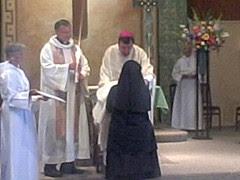
the notion that it was done out of ego. Let me correct that idea. First , I did not choose to have a Mass; my diocese naturally set up a date and
time when the Bishop would preside at my profession and the appropriateness of
this occurring at a Mass was understood by everyone. This is not simply custom but at heart a reflection of our sacramental theology and theology of church. So my pastor and I worked with the diocese and used the official texts for the Rites of Religious Profession; I also worked with a canonist and Vicar for Religious to assure all was done in a way which was legitimate and
appropriate.
Your
question about my own profession taking place at a Sunday Mass seems to be tied to
the notion that it was done out of ego. Let me correct that idea. First , I did not choose to have a Mass; my diocese naturally set up a date and
time when the Bishop would preside at my profession and the appropriateness of
this occurring at a Mass was understood by everyone. This is not simply custom but at heart a reflection of our sacramental theology and theology of church. So my pastor and I worked with the diocese and used the official texts for the Rites of Religious Profession; I also worked with a canonist and Vicar for Religious to assure all was done in a way which was legitimate and
appropriate.
Details which were worked out in advance included the texts of the
vows or vow formula (I used a vow formula I had used before but with some slight changes for the occasion), the insigniae (ring, cowl) and other things (candle, vows to be signed during
Mass), readings, and all the persons who would be participating in the liturgy
apart from the assembly (servers, lectors, cantors, delegate, concelebrants, etc). The diocese provided a worksheet for all of these
things and, immediately prior to the Mass, provided several legal documents which needed
to be signed apart from the vow formula itself. (That is signed on the altar --- in this case by the bishop, myself, my delegate and the pastor of the parish.) In other words, this was a diocesan matter undertaken on behalf of the universal Church, not something I desired out of ego; it was undertaken because the Church clearly saw it as completely appropriate and significant.
But let me be equally clear: there is no doubt I would always choose to make perpetual profession
during a Mass. Theologically and liturgically this would have been completely fitting
for the solemnity and significance of the event. It should be clear that life
commitments of this sort which also mediate God's consecration and the commissioning of the Church are appropriately done during
Mass where the effective (real-making) symbolism of self-gift, consecration, and commissioning are clearest and
paradigmatic. This is also important since the person making the commitment is assuming public/legal rights and obligations which affect the entire Church, and
which most intimately affect her local Church --- both diocesan and parish
communities. While the hermit may live a life of essential hiddenness, the act of
perpetual profession is both a public and an ecclesial one. It is an act of love celebrating the God who calls us to life in union with him, espousal to Christ, and communion with one another. It marks and implicitly celebrates all the forms of love that have brought the person to this moment: Divine, familial, community, friends, et. al. It is only appropriate that all of these people should be able to participate in such a celebration of love and grace --- and of course that it be done at Mass where Christ is uniquely present, proclaimed, and received.
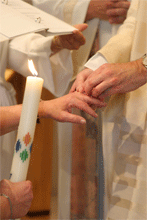 Further, the Rite of Profession marks a commissioning to make this love even more fruitful in the future and says we do this together. No authentic hermit is ever truly alone and that is certainly true of a diocesan hermit. Not only does she live with and from God, but she lives at the heart of the Church and is publicly commissioned (at the very liturgy we are discussing in fact) to do so in an essential hiddenness. Such life is always nourished by the Church (especially in Word and Sacrament) even as this same life nourishes the Church as a whole. Finally, I should note that if it is appropriate for strictly cloistered nuns to celebrate their own solemn professions in the
sanctuary of a church open to visitors (and in the mind and position of the Church it certainly is!), then it is appropriate for the diocesan hermit to do similarly because in either case we are celebrating the Holy Spirit's gift to the Church, a gift which is part of her call to prayer and holiness, a gift which is meant to inspire and nourish her in this goal.
Further, the Rite of Profession marks a commissioning to make this love even more fruitful in the future and says we do this together. No authentic hermit is ever truly alone and that is certainly true of a diocesan hermit. Not only does she live with and from God, but she lives at the heart of the Church and is publicly commissioned (at the very liturgy we are discussing in fact) to do so in an essential hiddenness. Such life is always nourished by the Church (especially in Word and Sacrament) even as this same life nourishes the Church as a whole. Finally, I should note that if it is appropriate for strictly cloistered nuns to celebrate their own solemn professions in the
sanctuary of a church open to visitors (and in the mind and position of the Church it certainly is!), then it is appropriate for the diocesan hermit to do similarly because in either case we are celebrating the Holy Spirit's gift to the Church, a gift which is part of her call to prayer and holiness, a gift which is meant to inspire and nourish her in this goal.
14 March 2013
Should Hermits be Professed at a Parish Mass?


19 December 2012
Writing a Rule of Life, Negotiating the Tensions between tradition and the contemporary situation
[[Dear Sister O'Neal, when you write about writing a Rule of Life you speak of needing to draw from or even "subsume" the Rule under a larger "vital" Rule like that of St Benedict. You explain that most of us are not spiritual geniuses capable of writing a Rule which challenges to sufficient growth. At the same time you are clear that the hermit must write her own Rule and that it must be more than a list of things to do and not do. You don't like the idea of a hermit simply copying a Rule nor do you think someone should write the hermit's Rule of Life for them.
 What I am wondering is if there isn't a conflict between some of these things. For instance, if we are not spiritual geniuses and need to subsume any Rule we write under a larger living Rule, why not simply adopt that one? Or why not allow someone else to write the Rule for us? Wouldn't it be safer spiritually? There have been times when the Church demanded new communities adopt already-established Rules. Doesn't canon 603's norm that the hermit write her own Rule fly in the face of the wisdom behind that decision? ]] [redacted]
What really terrific questions! You have clearly read everything I have written on this (meager though it is!) and thought about it along with some pertinent Church history I never mentioned. In responding I suppose the first thing I would suggest is that conflict is not the right word, but yes, I agree completely that there is tension between what we read in other Rules, what we live and write ourselves, and also between that and the larger Rule under which we might choose to subsume the Rule we write. The process of becoming able to write and then writing a Rule is complex. The work MUST be our own in some really deep and essential way --- and that will include the deficiencies and weaknesses in our own spirituality and lives which must be grown beyond with the help of spiritual leaders who surpass our own wisdom in every way. It is only in dialogue with these others (and other Rules) that we can truly find our own voice and, more importantly, the will of God which shapes the way we will live our vocations.
As with any dialogue there is the danger we will lose (or simply give away) our own voice, distrust our own perceptions and wisdom or our own experiences and sensibilities. On the other hand, there is the danger that we will not really engage the "other" in this dialogue but merely carry on a self-centered monologue. But a true conversation and this specific dialogue is essential; it is the way tradition is honored and extended in new ways and into new situations. It is the way genuine charisms are discovered and incarnated and mission fruitfully embodied and fulfilled. Dialogue of this sort has always been important. When we look at the relationship of canon law and proper law in religious life, or the similar relationship between the Rule and the congregation's constitutions we are looking at a dialogue. At every point the need to negotiate the tensions between these, to honor tradition and the universally valid and the new historical situation which also mediates God's call and will is a central piece of living our vocations --- whether we are contemplatives, ministerial or apostolic religious, hermits, lay persons, or priests.
Canon 603 requires the hermit write her own Rule because it requires the hermit be an active participant in the dialogue between contemporary eremitism and the long history of Christian (and other) eremitical life. As I have said before, no one can do this for her; it is part of being a diocesan hermit publicly professed under Canon 603. In a very real way, it is a key element in claiming this unique vocation for oneself and for the contemporary Church.
 My limited sense of the reasons for the Church's practice of requiring the adoption of already-existing Rules by new congregations or commun-ities is that this was intended to limit the spread of heretical practices and beliefs within religious congregations. There is some wisdom in this, especially when the proper law of the congregations can allow for necessary flexibility and adaptations in praxis and mission. What this means is that the dialogue mentioned above was and often still is carried out in this particular way in religious congregations. But, when it is authentic, eremitical life has always been more individual without being individualistic. In some ways each hermit, especially when they are solitary hermits as opposed to those belonging to a congregation of semi-eremites, is analogous to the founder of a congregation, the one in whom the tension between traditional and contemporary is specifically negotiated. The Rule they write and live by is not meant for a community but for an individual and a great deal of what characterizes cenobitical Rules and the spirituality of their founders simply will not apply to them in any meaningful way.
Thus, Canon 603 calls for each hermit to take on this task of 1) negotiating the tensions mentioned above and 2) writing a viable Rule themselves which is the expression of their ongoing commitment to this task. Living such a life may not be free of risk, but it is certainly the task every solitary hermit must embrace or cease to be solitary hermits. Similarly, then, the Rule the hermit writes is not free of risk either; one may lose one's voice entirely or fall into mere idiosyncrasy and individualism. When this happens the Rule one writes will either not be adequate to live an eremitical life or at least to live one's OWN eremitical life, but despite these risks, writing a Rule is the natural expression and codification of the dialogue the hermit is negotiating. Of course, several things can help minimize the risk involved including subsuming this personal Rule under an established Rule, submitting to the supervision and input of Bishops, canonists, other hermits, and delegates, and reading widely in the history of eremitical life are some of these, but at the same time care must always be taken that these steps do not short-circuit or betray the dialogue the hermit is called to negotiate and embody in her daily response to her call. After all, in a very general sense, this is part of the gift she brings to the Church and World and a piece of the challenge with which she confronts every Christian seeking to live the Gospel in contemporary life.
29 October 2012
Followup Question on Ongoing Formation for the Diocesan Hermit
[[Dear Sister, is ongoing formation really necessary once one has been professed? If a person spends almost 10 or more years becoming a diocesan hermit, why should more formation be required?]]
 I think too often the sense we all have of "formation" is of the initial making of the person into a nun, or priest, or monk, or hermit. It is as though once we have reached perpetual profession or ordination then ongoing formation isn't at all necessary. But remember that a vocation, important as definitive (perpetual or solemn vow) commitments are, is not something one answers once upon a time and then just sails along in. Instead a call is something that comes to us each day and the response we give is one which is renewed and both extended and intensified day by day as well --- at least that will be true if we are growing in this vocation. In my own life I hear this call variously but I describe it as God calling me by name to be more completely his in the state of life to which I have been called. I can't imagine God ceasing to call me by name --- and of course the Scriptures affirm that this is the case (Isaiah 43), nor can I actually imagine a time when I will not have some further response, some part of myself to give more completely or some way in which I need to grow more authentically human.
 Ongoing formation is meant to allow this process to continue. It takes cognizance of the needs and deficiencies one has at various stages of life, and of course it honors the gifts and strengths which are evident at different points along the way. Diocesan hermits, like all religious at the point of perpetual profession, are admitted to definitive commitment because they have been determined to have a life vocation; they have been entrusted with a responsible role in that vocation's future with all that implies. In a sense such admission is a bit like an advanced degree; such degrees don't say the person has learned all they need to learn, but rather that they have achieved a level of education and growth which allows them to be trusted with the responsibility of securing their own continuing education and of sharing what they know in a new way. In a sense such degrees mark the person as a competent and responsible learner (rightly approached, one of the significant ways we continue to learn is through teaching others). Perpetual profession does something similar but with a tradition of prayer, spirituality, and faith; it is often only with perpetual profession that we begin to really claim as our very own a particular tradition --- especially as it is a promise to others. It certainly marks the event which makes us fully responsible for that tradition.

There are depths in any vocation which open to the person only over time. There are aspects of the history of eremitical life which may not have seemed too interesting or pertinent the first time one read or heard about them; and yet as the hermit claims this vocation and becomes responsible both for the eremitical Tradition and for the contemporary world's redemption these aspects may assume a new prominence for her. Note well that this is not merely an academic matter but one which demands the hermit be sensitive to the needs of the world around her and become more and more capable of addressing these by applying some piece or dimension of the charisma (gift) eremitical life is meant to be to the contemporary world. The more deeply she comes to live the charism of diocesan eremitical life, and the more attentive she is to the needs of those around her, the more fruitful her life will be.
I hope this is helpful. If it confuses or raises more questions, please get back to me.
06 October 2012
Implications of Abuses of Canon 603 on the Diocesan Level
 [[Dear Sister Laurel,
you have written that Canon 603 hermits are solitary hermits and that while they can come together in a laura, they cannot form a community in the proper sense. You have also written that canon 603 is not meant to be a stopgap means of achieving profession on the way to another vocation. While all that makes sense to me isn't it true that the Archdiocese of Boston has a diocesan hermit perpetually professed in 2005 who is now the superior general (Mother) of a new community? Are you aware of the situation I am currently speaking of? I am from Boston and was confused at this Sister's approach to eremitical life. You may remember I wrote you back then. But given what you have written about using c 603 as a stopgap means of profession and other things, I am now even more confused. Can you clarify things for me?]] (Redacted for this blog)
Thanks for your letter. I do remember your email from about two or three years ago. While I did not write about the situation specifically here (at least not by name of Archdiocese), it was one of the reasons I subsequently wrote posts about c 603 misuses and abuses, the use of Canon 603 as a stopgap means to profession, etc. (cf, Notes From Stillsong Hermitage: Solutions to Using C 603 as a Stopgap way to Profession) At the time the situation you ask about raised a lot of questions and as I may have mentioned then, your own were not the only ones I received. What was at issue then was a diocesan hermit who was working full time as head of campus ministry at Boston University and later became Chaplain for the University's student body. Now, to be very clear, Sister Olga had an amazing background, was much-loved, worked very hard and, as I have noted before, is someone I would personally be really privileged to know. The problem then was that she was no hermit, despite being professed under canon 603. Since admission to profession under canon 603 was not her decision or responsibility, I cannot point to her as the source of the problem. Instead, it seems to me that it is more likely that she became caught up in something that was not truly right for her or for the solitary eremitical vocation under canon 603. The responsibility for professions under canon 603 falls ultimately to the (Arch)diocesan (Arch)Bishop.
Looking at Sister Olga's Story:
A little of Sister Yaqob's story is important --- not least because it points up the exceptional person she is. Sister Olga had come here to study from Iraq. She was not Roman Catholic but had begun a congregation of Sisters in the Assyrian Church of the East. After she came here she became a Roman Catholic. However, this was something of a problem since she could not remain a professed religious in light of this change of affiliation. Canon law had two and only two options she might have pursued which deal with the consecration of individuals apart from communities. The first was canon 604, the canon for consecrated virgins living in the world. In such a case, however, the CV is not a Sister, does not have public vows, does not wear distinguishing garb, etc. She belongs to the order of Consecrated Virgins, but is not a religious and cannot begin a religious congregation. The only other option was and is Canon 603. However, this canon governs solitary eremitical life, not merely any form of pious solitary living. As you and others made clear, it seemed to everyone looking on that Sister Olga, who once claimed the term "hermit" as a "metaphor for her life", was not living an eremitical life. A description of her life noted that she set Saturdays aside for contemplative prayer and solitude and mainly worked full time at the University in a highly social job.
 For whatever reason, her Archbishop had professed her in 2005 under canon 603 then, and this raised serious questions for others all around the country and the world. Some dioceses heard from people who wanted to make vows, wear a habit, and work full time outside the "hermitage" (residence) in a similar way. They were completely comfortable committing to one day of contemplative prayer per week, never mind the LIFE the canon demanded, and some had had experiences which isolated them so that they felt okay about using the term hermit as a metaphor for their lives --- just as Sister Olga had characterized her own life. Bishops mainly refused to admit them to profession under canon 603, and rightly so.
Yet this raised serious questions for those wishing to become canon 603 hermits. I received several questions, letters, or emails from people wondering how, if an Archbishop could profess a person involved in full-time ministerial activity as a University chaplain as Sister Olga certainly was, their own Bishops could refuse to profess them because they were "not living an eremitical life" or needed to work full time outside the hermitage. One of these persons was living an essentially eremitical life but still needed to work alone at nights outside the hermitage. It was a difficult situation. Still, some were professed and so today we have "hermits" living primarily non-contemplative lives given mainly to active apostolates instead of the silence of solitude, assiduous prayer and penance and stricter separation from the world. The precedent was destructive and even yet threatens the vocation itself --- a vocation canon 603 was designed to protect and nurture. Thus, it continues to be problematical.
Where we Stand Today
Current descriptions of Sister Olga's life today mention her perpetual profession in 2005 but they do not mention that her vows were made under Canon 603 nor that she was (and perhaps still is) professed therefore as a diocesan hermit. It may be that her eremitical vows were dispensed, but apparently no new public vows have been made. It sounds like the Archdiocese has decided to allow the entire diocesan hermit portion of Sister Olga's life and profession to slide into the oblivion of forgetfulness in order to avoid further stumbling blocks for folks both within and outside her diocese. However, the situation still raises significant problems canonically and a number of questions are left unanswered by such silence and obscurantism.
You see, diocesan hermits cannot allow their lives to morph into ministerial religious lives. There is often a constant pressure to do more active ministry for one's parish or diocese and most of us feel some pain or regret in needing to say no (or to fail to offer to serve in various ways) because we have embraced a contemplative vocation to solitude which is much less understood and whose value is much less evident to those around us. This example of the Archdiocese of Boston thus makes living c 603 with eremitical integrity much harder for those of us who are tempted to become more active in a directly ministerial way. At the same time, c 603 hermits cannot (as I have been told at least) simply transfer their vows to a congregation. They must be dispensed from them, discern another vocation and then be admitted to vows within the congregation according to universal canonical procedures and time frames.
In fact, diocesan hermits cannot even move to a new diocese without the permission of both ordinaries involved. Though they are diocesan hermits wherever they visit and anywhere in the Church, their professions are very specific and circumscribed by a form of diocesan stability. And, though this second point (moving) is not directly applicable to Sister Olga's situation it points to the narrow constraints involved in Canon 603 profession and of course it could become significant should Sister Olga Yaqob seek to leave Boston as her new community grows. After all, if her vows are still canon 603 vows, then a new Bishop will be placed in the position of accepting a non-hermit living according to a canon governing eremitical life. Consider the precedents and questions this would raise in the new diocese!!!

As it apparently stands, the situation in Boston also raises the issues of hypocrisy and non-comp-liance: namely, if a diocesan hermit ceases to live an eremitical life she can (and should) certainly be dispensed from her vows. That remains true even if one discerns and embraces a new and different vocation to ministerial religious life . One has still ceased being a hermit and is living as though they are no longer bound by either an eremitical Rule or eremitical vows nor by the canon governing such vocations. How can one ask the Bishop of a new Diocese to merely accept such a situation (and the person's vows) and turn a blind eye? How can one ask a new incoming Archbishop to do something similar?
And what of other newly-fledged congregations who would like to take short cuts in becoming canonical? Should canon 603 be used to profess at least the superior/moderator of such congregations? Why not if it was once appropriate in the Archdiocese of Boston and there is still someone living out public vows made under canon 603 but now doing so as the founder of a new community? Why pay attention to expert commentators on c 603 and its history and nature, who note lauras are permissible but that these should not rise to the level of communities? Why not simply use c 603 as a stopgap means to profession for any and all individuals desiring admission to public vows never mind whether they live anything remotely resembling eremitical life? Why, that is, should we not simply turn a blind eye to the gift of the Holy Spirit which c 603 seeks to nurture, govern, and protect?
Protecting against the Repetition of this Situation
As part of the hermit's own vow formula, some dioceses require the specification that these vows are made as a part of responding to the grace of a solitary eremitical vocation. The wisdom of this requirement is clearer to everyone involved with the canon as time goes on. Further, since canon 603 governs solitary eremitical vocations which allow for coming together in lauras but not the establishment of communities per se, it seems clear that a hermit should be dispensed from her vows in order to begin a community. Further, as one dispensed from her vows she cannot ordinarily simply begin a canonical foundation. Not only does she cease to be a vowed religious in such an instance, but ordinarily, any community she begins will need to move through the same stages any other aspiring group needs to move through: private association of the faithful, public association of the faithful, and, if all goes well over time, institute of consecrated life. This process is not only codified in law but reflects simple prudence.
Because of all these factors the extraordinary situation in Boston is still a thorn bush of difficulties. It is understandable, I think, that 1) Sister Olga dropped the pretense of being a hermit to fully affirm the truth of what she is apparently more truly called to, and 2) the Archdiocese of Boston has allowed all this to merely slip from view and memory by focusing (a) on the fact of vows while omitting the fact that they were solitary eremitical (c 603) vows and (b) on the new community. Diocesan hermits and others, however, are interested in and perhaps could be said to have a right to know how the situation is resolved canonically because this has significant implications for how the diocesan eremitical life is lived out concretely.
 The primary reason for bringing all this up is to make sure that canon 603 is never misused in this manner again. Sister Olga (or Mother Olga as she is now known) is an exceptional person (and apparently an exceptional religious) and it makes sense that the Archbishop of Boston was particularly open to accommodating her in some way -- especially given her history, her faith and people skills, and her ethnic background and skills in Arabic language and Iraqi culture. I very much appreciate the integrity Sister Yaqob has personally shown in leaving the diocesan hermit designation behind. However, professing her using canon 603 was a serious mistake which threatened the diocesan eremitical vocation in the process.
The secondary reason for bringing this situation up then is because the canonical questions it raised are still with us and require answers. Similarly, the pastoral questions it raises are also significant and, in part, will only be answered over time with the education of the episcopacy and church as a whole regarding the nature of the solitary eremitical vocation along with a history of well-discerned professions which ensure the integrity of the life which canon 603 governs. At some point the Archdiocese of Boston also needs to clarify publicly how they resolved this situation. Sister Olga's eremitical profession could have been determined to be invalid, for instance, but if that proved to be the case then what is the canonical standing of Sister Olga now and what precedent does her situation vis-a-vis the new community set for other aspiring founders and communities? Aspiring hermits? Remember, Sister Yaqob cannot have made canonical vows as an individual under any canon but 603. Again, the situation is a thorn bush of difficulties and unresolved questions.
I know this doesn't really clarify what is largely still obscure for many of us, but hope this is of some help.
17 May 2012
Further Questions on Increased Institutionalization
 Sister Laurel, is the following portrait reflective of something happening today with regard to your vocation?
[[[Poster] has noted from internet blogs, articles and updates, that there is a growing trend among some hermits, mostly the canonical approved variety, that some through much wordage and repetition, based upon assumed authority, or even stated expertise, have begun to make regulations by setting precedence. What can evolve are rules, laws, set ways of how this or that must be done, called Precedent Law. Noticed a few Dioceses have bought into it, adopted the regulations and are imposing them. Perhaps without even knowing from whence they came. . . .
These more highly developed, highly educated clubs and club makers even create certain ways the others are initiated. They develop ceremonies, and certain clothing to be worn, or at least to have a pin to wear, and a handshake and lots of people at the ceremony. And then certain parts of the ceremony, and words said, certain words, and pledges, and then they are identified by certain letters after their names, as belonging to this or that club, and then they are to have certain body positions at certain times, and then publication of who is in the club or sorority. Everyone can know who is this or that, and some members and some clubs are very important indeed, more important than other clubs or other members of other clubs. Or in the hermit vocation? Is that what CL603 has in mind for hermits? Where did all this hoopla come from? Who is making up these rules? Is it one person, or a handful? By what authority and right?]]





 Posts
Posts