03 November 2024

Once again on Matters of Conscience and One-issue Voting

 In 2012 I posted the following as part of another piece occasioned by situations involving partisan political positions being taken on parish grounds of distant US local Catholic Churches. In that post I reminded folks that this kind of activity was contrary to Church teaching, contrary to the separation of Church and State, and something which actually endangered freedom of religion and the Church's tax-free status. At the same time I had been asked something about how I was voting, especially when neither party seemed particularly acceptable to Catholics and may differ from Church teaching and praxis --- for instance on the issues of abortion and contraception. In light of Tuesday's Election probably a good time to restate some of this, especially the Church's teaching on the primacy of conscience.

So, since a couple of people have asked me about voting (they actually asked about how I am voting but I am not going there) let me restate 1) the pertinent part of the Church's teaching on the nature and primacy of conscience, and 2) Benedict XVI's analysis of elections which involve, for instance, the issues of abortion and contraception when neither candidate or party platform is really completely acceptable to Catholics.

First, we are to inform and form our consciences to the best of our ability. This means we are not only to learn as much as we can about  the issue at hand including church teaching, medical and scientific information, sociological data, theological data, and so forth (this is part of the way to an informed conscience), but we are to do all we can to be sure we have the capacity to make a conscience judgment and act on it. This means we must develop the capacity to discern all the values and disvalues present in a given situation, preference them appropriately, and then determine or make a conscience judgment regarding how we must act. Finally we must act on the conscience or prudential judgment that we have come to. (This latter capacity which reasons morally about all the information is what is called a well-formed conscience. A badly formed conscience is one which is incapable of reasoning morally, discerning the values and disvalues present, preferencing these, and making a judgment on how one must act in such a situation. Note well, that those who merely "do as authority tells them" may not have a well-formed conscience informed though they may be regarding what the Church teaches in a general way!)

There are No Shortcuts, No Ways to Free ourselves from the Complexity or the Risk of this Process and Responsibility:

There is no short cut to this process of informing and forming our consciences. No one can discern or decide for us, not even Bishops and Popes. They can provide information, but we must look at ALL the values and disvalues in the SPECIFIC situation and come to a conscientious judgment ourselves. The human conscience is inviolable, the inner sanctum where God speaks to each of us alone. It ALWAYS has primacy. Of course we may err in our conscience judgment, but if we 1) fail to act to adequately inform and form our consciences, or 2) act in a way which is contrary to our own conscience judgment we are more likely guilty of sin (this is  actually certain in the latter case). If we act in good faith, we are NEVER guilty of sin --- though we may act wrongly and have to bear the consequences of that action. If we err, the matter is neutral at worst and could even still involve great virtue. If we act in bad faith, we ALWAYS sin, and often quite seriously, for to act against a conscience judgment is to act against the very voice of God as heard in our heart of hearts.

And what about conscience judgments which are not in accord with Church teaching (or in this case, with what some Bishops are saying)? I have written about this before but it bears repeating. Remember that at Vatican II the minority group approached the theological commission with a proposal to edit a text on conscience. The text spoke about the nature of a well-formed conscience. The redaction the minority proposed was that the text should read, "A well-formed conscience is one formed in accord (or to accord) with Church teaching." The theological commission rejected this redaction as too rigid and reminded the Fathers that they had already clearly taught what the church had always held on conscience. And yet today we hear all the time from various places, including some Bishops, that if one's conscience judgment is not in accord with Church teaching the conscience is necessarily not well-formed. But this is not Church teaching --- not the teaching articulated by Thomas Aquinas or Innocent III, for instance, who counseled people that they MUST follow their consciences even if that meant bearing with excommunication.

Benedict XVI's Analysis:

Now then, what about Benedict XVI's analysis of voting in situations of ambiguity where, for instance, one party supports abortion but is deemed more consistently pro-life otherwise? What happens when this situation is sharpened by an opposing party who claims to be anti-abortion but has done nothing concrete to stop it? MUST a Catholic vote for the anti-abortion party or be guilty of endangering their immortal souls? Will they necessarily become complicit in intrinsic evil if they vote for the candidate or party which supports abortion? The answer is no. Here is what Benedict XVI said: If a person is trying to decide for or against a particular candidate and determines that one candidate's party is more consistently pro-life than the other party, even though that first party supports abortion or contraception, the voter may vote in good conscience for that first candidate and party SO LONG AS they do not do so BECAUSE of the candidate's position on abortion or contraception.

In other words, in such a situation abortion is not the single overarching issue which ALWAYS decides the case. One CAN act in good faith and vote for a candidate or party which seems to support life as a seamless garment better than another party, even if that candidate or party does not oppose abortion. One cannot vote FOR intrinsic evil, of course, but one can vote for all sorts of goods which are clearly Gospel imperatives and still not be considered complicit in intrinsic evil. By the way, this is NOT the same thing as doing evil in order that good may result!! Benedict XVI's analysis is less simplistic than some characterizations I have heard recently; theologically it seems to me to be far more cogent and nuanced than these, and it is [an analysis] Bishops who are supposed to be in union with him when they teach as the ordinary Magisterium should certainly strongly reconsider and learn from.

In Thanksgiving for my own Faith Community:

Meanwhile, I want to take this opportunity to say how very grateful I am for my faith community. We stand together around one Table; we share one Word; we drink from one Cup. We are very different from one another politically, theologically, economically, and so forth --- and we are all aware of it. Yet we trust one another to vote their consciences and pray that the will of God will be done. We do NOT allow differences in politics to divide us in a literally diabolical way. We may not agree on a specific issue or candidate, but we recognize the Church's theology of conscience allows that and respect one another in our disagreements. Thus, we continue to worship together and grow together in Christ. As the USCCB's  1999 document, "Faithful Citizenship" reminds us, "Our moral framework does not easily fit the categories of right or left, Democrat or Republican. Sometimes it seems few candidates and no party fully reflect our values. We must challenge all parties and every candidate to defend human life and dignity, to pursue greater justice and peace, to uphold family life, and to advance the common good." I find that in my parish at least, we are generally Christians first and trust one another to be that to the best of their ability. In this time especially, that is a very great gift and precisely what the Universal Church should be as a sign to the world!

Follow-up On Ecclesial Vocations as those Belonging to and Assisting the Church to be the Church God Wills it to Be

 Dear Sister Laurel, thanks so much for the piece on ecclesial vocations and what that means! I had been thinking that every vocation must be ecclesial and that such a call is a vocation in which one loves and serves the Church by doing Christian things for people both in and out of the Church. It never occurred to me that some people serve to help the Church be the Church it is meant by God in Christ to be [in a dedicated  or focused way]. So, I think I have it now, but if someone says their vocation has them loving the Church so of course they [have an ecclesial vocation], they may not understand the term, right? I mean every Catholic belongs equally to and loves the Church, but not every Catholic has what you call an ecclesial vocation, have I got that right? When you speak about the rights and obligations of your vocation or when you have emphasized the public and ecclesial natures of it, you have been trying to sensitize your readers to a term they might be completely unfamiliar with haven't you?

Wow, thanks for this. Yes, you've got it right! And yes, I have been trying to sensitize readers to a term (that is, a peculiar usage of the word ecclesial in terms a particular kind of vocation) they are unlikely to be familiar with. I've also been writing about this because in my own work it is a term I need to look at with greater attention myself because it comes up with candidates for c 603 profession and consecration and is something I suspect no diocese explains to such candidates when they petition for admission to canonical standing. One of the candidates with whom I work, recently had me concerned over whether she might have a vocation to some other form of eremitical life than c 603. That she might have such a vocation was no problem at all. Still, she is at least two years into discerning a c 603 vocation and should my vague discomfort or concern truly point to the possibility that she would be happier in some other form or context (or not called to eremitical life at all) it would be a huge change we really needed to get right! 

This situation led me to think freshly about the whole notion of ecclesial vocations. It took me a couple of weeks to come to be able to articulate what my own concern actually was. Fortunately, the Holy Spirit had also been working in this hermit candidate and she also came up with reflections on her own calling that led her to appreciate a dimension of ecclesial vocations in a new way, namely, the importance of the local Church community in the c 603 hermit's life. She was beginning to work out the implications of the hermit belonging integrally to a local Church community for the way she would live out solitary eremitical life and it was incredibly gratifying and exciting to discover the way the Holy Spirit was working with and in both of us. This was around the time I began writing, and too, fielding questions about requirements for candidates and their Rules, and also about public and ecclesial vocations. This was also around the time I posted e e cummings' poem, i am a little church (no great cathedral) and a couple of paragraphs about ecclesial vocations.

We are all of us used to thinking of consecrated persons or religious serving others through all of the active ministries they carry out, and of cloistered religious doing this through intercessory prayer, for instance; still, I believe it is almost unconsidered by most members of the Church that these vocations are critical to the life of the Church itself --- to helping the Church be Christ's own Body and not some other kind of institution. To think of vocations "belonging to the Church" before they belong to the individuals and so, understanding that the Church herself must also discern such vocations, not merely the individual herself doing the discerning is something persons desiring to be religious have a very hard time with! And that is understandable!! Still, the Catholic Church has taught and continues to teach that consecrated life belongs to and serves the Church by reminding priests and other Church authorities that they are called to a leadership of humble service and reminding laity that they are called to union with Christ and to living out the fullness of their baptismal consecration so they may be Church wherever they work, play, or go otherwise --- often where Popes and Bishops and Priests will never be found and in situations they will never have the chance to specifically address.

In all of this "ecclesial vocations" are vocations that belong to and serve the church directly and explicitly as well as implicitly. They are not "greater" vocations than those of clerics or of laity and those called to these are not "more Catholic" than any other Catholic person. "Ecclesial" in this phrase instead points to the nature of the vocation and to the "owner" to whom this vocation is entrusted by God before it is entrusted to individuals, namely the Church; it also points to the Church as the one who is the most important beneficiary of this vocation. It does NOT say or imply that those called in this way are more Catholic than others any more than priests are more Catholic than laity or consecrated persons, but it does involve additional rights and obligations established canonically. 

This is also why the Church makes it very clear that consecrated lives are not a third level in the hierarchy of the Church. Because consecrated life is called from both clerics and laity, it is able to speak to both groups from within them and call them both to the fullest realization and exercise of their vocations. (Remember that persons in the consecrated state who are not priests continue to belong to the laity in the Church's hierarchical sense of that word.) I believe JPII saw this clearly when he spoke of ecclesial vocations and the importance of vocations to the consecrated state and the second consecration involved in such vocations in what I quoted earlier. (Vita Consecrata #29 and 30) It's a tricky line here between unity and diversity because one needs to affirm the additional rights and obligations of the Consecrated state while eschewing any sense that such a vocation makes the person "more Catholic" or "higher" in standing than others. (Vita Consecrata #31 addresses this more directly.) To affirm this essential equality and to speak more effectively to the rest of the laity as well as to priests, is one of the major reasons a lot of religious women let go of the habit.

02 November 2024

Ecclesial Vocations: Foundational Vocations Belonging to the Church and Allowing it to truly be Christ's own Church

[[ Hi Sister, you have been speaking about ecclesial vocations in what sounds like a special way. I see that these are vocations that belong to the church first before they belong to individuals but does it mean more than this? You write about living for the sake of the church, is this also part of what you call an ecclesial vocation?]]

Thanks for your questions. I realize I haven't really explained why ecclesial vocations differ from those that are not considered ecclesial in the proper sense of the term, and also, I never really defined the term. So yes, thanks!  Lumen Gentium said the following: [[(the profession of the evangelical counsels) indisputably belongs to the life and holiness of the church.]] and also, [[The evangelical counsels which lead to charity join their followers to the Church and its mystery in a special way.]] (#44) In Vita Consecrata, John Paul II enlarged on the first citation above, saying, [[This means that the consecrated life, present in the Church from the beginning, can never fail to be one of her essential and characteristic elements, for it expresses her very nature.]] (#29) When I speak of the vocation belonging to the Church herself before it belongs to the individual to whom it is entrusted, or that consecrated eremitical life is lived for the sake of the Church herself or (another way of saying this) that it is lived so the Church can truly be the Church she is called to be, yes, I am talking about these two points made by Luman Gentium and John Paul II, just as you also noted in your question. 

Every vocation to the consecrated state recognizes they belong as an essential (foundational and necessary) part of the holiness and life of the Church. As JPII also wrote in the same section, "The idea of a Church made up only of sacred ministers and lay people does not, therefore, conform to the intentions of her divine Founder as revealed to us by the gospels and the other writings of the New Testament." (VC# 29) Moreover, this essential part of the Church's very constitution as the Body of Christ serves both sacred ministers and laity while technically belonging to neither group (it is drawn from both). It is an eschatological sign to both regarding what it means to be more fully conformed to Christ. It reminds members of both these hierarchical groups, that following Christ is not about power or the exercise of power, nor is it about slavish subservience, but instead, it is about close union with Christ that leads to the freedom to respond maturely as Church (ecclesiola) in service to every need in both Church and world. 

You can imagine what distortions might well occur if the Church were only comprised of "sacred ministers and laity"!! Clericalism is a terrible and destructive form of this which fails both clergy and laity as it fails Christ and his Church. Vocations to consecrated life call both hierarchical groups to greater holiness and humility as servant disciples of Christ. This presence of consecrated persons in the Church serves as an immediate summons to clerics to truly be priests in the mode of Christ and to members of the laity to realize the fullness and great responsibility of their baptismal consecration. 

In other words, consecrated life in the Church is a moderating and mediating presence that helps the Church to be Christ's own Church, and not fall into the pattern of some sort of not-so-sacred fiefdom composed only of rulers (priests) and ruled (laity). Thus, we are reminded that consecrated life does not constitute a third layer of a triple-level hierarchy, but that members of this state of life are drawn from both clerics and laity while serving in an undeniable role regarding the life and holiness of the Church. Some, including myself, call this role prophetic because of the way it speaks Gospel values to both clerics and laity. It serves as a kind of leaven affecting the whole life of the Church. 

Thus too, God and the Church herself calls persons to the consecrated state. These persons enter this state through a second and special consecration that differs from baptismal consecration. John Paul II continues in Vita Consecrata, [[In the Church's tradition religious profession [now including the profession and consecration of c 603 hermits] is considered to be a special and fruitful deepening of the consecration received in Baptism, inasmuch as it is the means by which the close union with Christ already begun in Baptism develops in the gift of a fuller, more explicit and authentic configuration to him through the profession of the evangelical counsels. This further consecration, however, differs in a special way from baptismal consecration, of which it is not a necessary consequence.]]

John Paul II continues, [[In fact, all those reborn in Christ are called to live out, with the strength which is the Spirit's gift, the chastity appropriate to their state of life, obedience to God and to the Church, and a reasonable detachment from material possessions: for all are called to holiness, which consists in the perfection of love. But Baptism in itself does not include the call to celibacy or virginity, the renunciation of possessions or obedience to a superior, in the form proper to the evangelical counsels. The profession of the evangelical counsels thus presupposes a particular gift of God not given to everyone, as Jesus himself emphasizes with respect to voluntary celibacy (cf. Mt 19:10-12). This call is accompanied, moreover, by a specific gift of the Holy Spirit, so that consecrated persons can respond to their vocation and mission. For this reason, as the liturgies of the East and West testify in the rite of monastic or religious profession and in the consecration of virgins, the Church invokes the gift of the Holy Spirit upon those who have been chosen and joins their oblation to the sacrifice of Christ.]]

We can look at some more of what Vita Consecrata (and maybe Lumen Gentium) says about ecclesial vocations later, especially if these posts raise more questions, but for the purposes of this article, I want to emphasize the way vocations to the consecrated state "belong to [and serve] the Church" as Church in an essential and characteristic way. When I speak of ecclesial vocations then, I am speaking about vocations that belong to the Church and help constitute her as Church in a very direct and immediate way. God, through the Church's mediation calls these vocations forth, and entrusts the Church with their supervision and governance. (This means too that these vocations are established in law (canon law) and that those who are called to such vocations take on the appropriate rights and obligations (expressed in additional canon laws) of such vocations.) Above all, I think, vocations to the consecrated state of life are a source of hope to the whole Church that it will remain the Church Christ wills to represent him to the World.

01 November 2024

Why Should a Diocese Write the Guidelines?

[[ Hi Sister Laurel, why couldn't you just write the guidelines for a diocese?]]

Important question, Thank you! To a certain extent, what I provided in the earlier post are the guidelines I might provide for any diocese. They focus on the essential or defining elements of c 603 and so too, on the elements any Rule lived in the universal Church under c 603 should address. They are, I think, the minimum guidelines anyone considering profession under c 603 should be able to speak to and write about based on their lived experience. I believe any diocese writing guidelines should include these and also fill in the subsections I merely alluded to in the article. But a diocese is a local church within a communion of churches, a living reality with its own history, needs, character, qualities, leadership, and so forth. These may call for guidelines I have never thought of and for that reason, the diocese itself needs to create at least some of the guidelines for a c 603 vocation lived in this local church.

This is one aspect of having someone petitioning to be professed and eventually consecrated in an ecclesial vocation. They are seeking to be professed within the universal Church, yes, and they are also seeking to live this vocation within and on behalf of the diocesan (and often a parish) faith community itself. The stability associated with monastic life (specifically Benedictine life) is duplicated in this particular way. (Hence, if a diocesan hermit wants to move to another diocese and remain a diocesan hermit, the new bishop must agree to accept her profession and consecration.) Though I can see the need for and say something to a candidate about dealing with this specific form of stability in her Rule, I simply don't have a sense of the history or character of a local church other than my own to do more than this.  So, while I might be able to suggest ways a candidate can think and pray about making the ecclesiality of her vocation clear in her Rule, the actual quality of that ecclesiality in the local church is not something I can speak to nearly so well as the diocesan personnel also working with the candidate, and, one hopes, as the candidate herself once she becomes fully sensitized to this.

The other reason I believe a diocese needs to formulate guidelines (and this includes working in consultation with someone living a c 603 life or, perhaps, with staff from another diocese that has professed and consecrated c 603 hermits successfully) is what I have mentioned before: the discernment and formation process is meant to be educative for everyone involved --- though in different ways. Often we write to learn. Paradoxically, often we write to truly listen as well.

31 October 2024

Follow-up on Dioceses and Guidelines

[[ Dear Sister, I liked the piece on Dioceses and Guidelines, particularly because you indicated mistakes made by both the diocese and by hermit candidates. You gave me the sense that moving from guidelines to a livable Rule took a lot of dialogue between the candidate and diocesan personnel. Is that common? Do dioceses balk at providing this kind of attention? How frequent should such conversations be? And who should take part? I'm concerned because in my diocese we only have a single person in the vocations office (not counting the secretary) and I wonder if he could create the kind of guidelines you are talking about. 

Beyond that, I wonder if he would have the time to meet with a candidate very often as part of ongoing discernment and formation. Hermits are not a big part of his job; priests (or baby priests) are! [I think the reference here is to seminarians. s.l.o'n] I can see how the process is supposed to lead to mutual education as well as discernment and formation of/for the candidate. Are dioceses usually open to this kind of learning? Aren't vocations people supposed to understand the various vocations?? How about candidates? Are they open to such an intense process? If I gave your article to my diocese would they be able to fill in the guidelines from the four main points you drew? And if they could not do that, would you be willing to help them?]]

WOW! Lots of very good questions!! Thank you! Yes, the process I envisioned in the last post and more generally, in the process of discernment and formation I have already described before, is meant to involve a lot of conversation and mutual education. One of the difficulties with c 603 is that it likely envisioned candidates with a history of religious life working with other religious who are all experienced with living a Rule and community constitutions and such. While it is unlikely that any of these folks would have ever written a Rule, they would have a strong sense of the importance of drawing from experience and would be able to recognize or distinguish promising from unsuitable candidates at little more than a glance. At the same time, they would be familiar with the need to give someone a really good shot at a fruitful process of discernment, growth, and maturation in eremitical life, understanding that such a process can bear fruit even if the candidate does not have or fails to persevere in a c 603 vocation. Finally, they would be pretty comfortable with the way the Holy Spirit tends to surprise us with a God who comes to us in the unexpected and even the unacceptable place!! But generally speaking, our diocesan offices are not staffed in this way today.

This means that most dioceses do not understand c 603 vocations (or eremitical vocations more generally) and may not be clear how to work with them. They may hold the same kinds of stereotypes and biases re hermits and hermit life prevalent in the general population. But in my experience, diocesan staff want to learn what they can, especially about vocations they have little experience with. When I was waiting for the bishop's acceptance of my petition, we met and talked and he said at the end of the conversation, [[Well, now I have a lot to learn!!]] It was a very promising statement and I have been grateful in all of these years since that he was open to learning! Before this I worked with a Sister serving in vocations and as Vicar for Religious. She came to my hermitage regularly and we talked. She also took a road trip with (I think) the Chancellor of the Diocese to meet with the Prior of the Camaldolese monks at New Camaldoli in Big Sur about what they looked for (and what she should look for) in a healthy hermit. That meant a several-hour ride down the CA coast, and very likely, an overnight stay as well as an equally long drive home!! I am still impressed by the care this indicated.

Sister Fiacra, OCSO, Glencairn
In the handful of dioceses and candidates I have worked with, there have been varying degrees of eagerness to work with the process, but my sense is still that these people want to do the best they can for candidates for c 603 profession and consecration. Yes, vocation personnel should have a working knowledge of the vocations they work with (or may work with !) but remember that most dioceses do not have c 603 hermits and of those that do, Vicars for Religious coming into office after the hermit has been consecrated may never even have met her! They certainly don't call her for advice or information without setting this up ahead of time! We want Vicars for Religious or Vocation directors to gain their knowledge of this vocation from conversations with real hermits who live the life and can speak to what it looks like from within the vocation itself. One way of securing this kind of education is with a process like the one I have discussed in the past that uses a c 603 hermit to mentor the candidate in her process of writing a Rule. In such an arrangement, everyone learns!! Not just the candidate!!

Some candidates are very focused on this process and give it their time, energy, prayer, study, and reflection. When this is the case, working with them is a complete joy, and ordinarily I have found their dioceses enthusiastic and very cooperative as well. Occasionally, someone is less enthusiastic or careful about the nature and quality of the vocation in front of them. You asked about frequency of meetings so let me address that here. There are a couple of different ways to do this but here is my preference: 1) as mentor I work with the person @ once a month and we talk about how they are doing with the life, the elements of the canon, the process of writing a liveable Rule, etc. 2) When the person has made progress on a section of the Rule, a meeting is scheduled with the diocesan team so they can get to know the person better and hear how these last several months have gone. This is a chance to see how the person is growing, how a Rule develops over time, and the ways the candidate lives the guidelines and understands (or is coming to understand) the critical dimensions of this ecclesial vocation.

Ideally, the Rule and how it is coming along as one transitions from living guidelines to composing a vision of how one is called to embody c 603, is what drives the meetings. Some candidates will set up such meetings for themselves and the diocesan representatives and apprise them of their progress; I think this is by far preferable since it accents a candidate's initiative and confidence; it also allows her to develop relationships that may have lasting value within her diocese. The team might be composed of the Vicar for Religious, Director of Vocations, and perhaps a canonist along with a c 603 mentor. Meanwhile, in such a process, the diocesan team can contact me anytime with questions or concerns or with a request for an evaluation of how the process is coming along, and I will do the same with my own questions or concerns!! The process is not meant to be onerous for diocesan personnel or for anyone else for that matter. It is meant to be authentically discerning and formative. As noted above, in such a process everyone is educated.

If you would like a copy of the last article (and this one as well), please email me. If your diocese wants to talk about it for any reason, I am happy to do that. We can talk about that more down the line if there is a need.

Should Dioceses Supply Guidelines for the c 603 Hermit?

One of the questions that comes up in regard to Dioceses and the Hermit's Rule of Life is whether it is appropriate for the Bishop to write the hermit's Rule and simply require she live accordingly. In the past I have argued that it is inappropriate, and I have put forth reflections on c 603 vocations and the importance for both discernment and formation that the hermit write her own Rule. Also, of course, this respects the unique way the Holy Spirit works in each hermit's life and assists her to be truly attentive to that. But the idea of the diocese supplying guidelines on living eremitical life in this diocese that one lives prior to writing a truly liveable Rule, and that will also be subsequently embodied in some way in that Rule is a really good one and one I have written about only a couple of times perhaps a decade ago or so. It's time to pull that topic up once again, partly because it belongs to my larger project on the discernment and formation of diocesan hermits, and partly because both hermits and dioceses need to understand the appropriateness, nature, and place of such guidelines as they move forward with processes of discernment and formation.

Quite often I hear stories about dioceses that tend to expect a hermit to go off and write a liveable Rule in a few weeks. They may leave this single concrete requirement of the canon to the last on a "to do" list while considering it the easiest part of the canon to fulfill. They will sometimes do this saying something like, [[There, now all we need is your Rule of Life!! Just go off and write that and we will be all set!]] But such an approach misunderstands the nature of a Rule and the difficulty of writing one, especially a liveable one or one that belongs integrally to the diocese's own discernment and formation processes with a c 603 hermit-to-be! Other times, dioceses go the opposite direction and write the hermit's Rule for her, although my sense is this is a much rarer problem. I addressed all of this in 2012, Should a Bishop Write the Hermit's Rule?

Failures by Diocese and Hermit:

Bearing that article in mind, what happens when either a diocese refuses to treat what they provide as true guidelines or the hermit decides s/he knows too much about eremitical life to accept such guidelines -- the two entirely antithetical possibilities? The basic answer to both questions is that strong and authentic ecclesial vocations will be lost, immature and slavish ones incapable of mature obedience will be established, and the Church's understanding of c 603 and its vocations will not grow as these need to -- meaning further solitary eremitical vocations will not be admitted to profession or even to mutual discernment processes. If the bishop or other diocesan personnel write the hermit's Rule for her, they are failing to discern this vocation. Likewise, they are failing to listen to the Holy Spirit and the way she is working in the contemporary church. If, on the other hand, the hermit acts as though she knows it all already and refuses to at least prayerfully consider the vision of the life the Diocese has provided as preparation for a meeting to discuss what works and what does not and why, she is simply demonstrating a lack of calling to an ecclesial vocation and possibly her unreadiness for vows of obedience or religious poverty.

A set of guidelines is important for the diocese to provide for all candidates. Not only will this assist the hermit in writing an adequate Rule of life based on lived experience, but every candidate will have the same starting point and the adaptation they each make will be able to be assessed more easily in terms of the Holy Spirit, contemporary eremitical life, and the healthiness of the individual hermit's spirituality. Still, it is critical the Diocese regards these as guidelines the hermit herself will flesh out (or prune as she truly feels called to) over time. The diocese might say, your Rule should cover religious poverty, but not spell out what that must look like in a particular hermit's life. At the same time, it is critical the hermit uses these guidelines in considering her Rule of Life, and that she tries to embody them in some real way in whatever Rule she eventually writes. (Thus, to continue the example, a hermit will take what is in the guidelines re religious poverty, and spell out the nature of that poverty and how she personally lives this out before profession and, after profession, how she will live it in law under c 603.)

What Should Such Guidelines Include?

So what should such guidelines include? It seems to me that these need to spell out the elements any liveable Rule must address. These include, 1) the requirement of a brief history and discussion of the place of eremitical life in the life of the Church. (Here, because of the way she recounts this story, is where the candidate begins to formulate the vision of eremitical life she intends to live in the 21st century as a piece of living history!) 2) The central elements of c 603 and the Evangelical Counsels; in dealing with this guideline, the candidate must be able to spell out how she understands each of these, why she understands them as she does, and how she lives them out in the present. 3) The importance of the public and especially the ecclesial nature of the vocation. Here the candidate will need to address her place in both the universal and the local Church, including her sacramental life, any limited ministry she needs to undertake, and the degree and nature of contact she will have with the parish community. 4) Relationships with the Bishop, delegate, and spiritual director. Here the candidate or hermit needs to spell out how she understands herself to be related to and participate in the Church's ministry of authority; she would include the role of a delegate (if she has one), frequency of meetings with the Bishop (once or twice a year is typical but not carved in stone), spiritual direction, and the way she regards both c 603 and her own Rule of Life.

Such guidelines will have subsections that spell out expectations and, for the hermit's part, the nuts and bolts of each larger section. For instance, in section #2, the hermit will discuss finances, living poverty, provision for health insurance, living space, work and how this meets her needs for stricter separation from the world, religious poverty, the silence of solitude, penitential life,  persevering prayer, and so forth. Also included, for example, will be use of social media, to what extent this is allowed and for what legitimate purposes, etc. This list is not exhaustive, but suggestive of some of what guidelines might list and what any good and liveable Rule must contain.

What if the Diocese and Hermit Cannot Agree?

If the diocese and the hermit find themselves far apart on this or on any element of the guidelines, these can be worked out in a series of conversations over time as both parties come to know the nature and quality of the vocation in front of them, and the hermit/candidate writes this or that draft or draft portion of a liveable Rule. The point is that the diocese provides guidelines of what she requires a hermit life to reflect along with what a sufficient Rule will include, and the hermit tries to accommodate all of these elements in a mature way as she explores the nature of an ecclesial vocation as she personally is called to live it!! As the process of discernment and formation moves forward, both parties will learn from the other, flexibility will increase, trust between the candidate and diocesan staff will grow, as will the sense either that this vocation is truly of the Holy Spirit, or it is not. 

Eventually, either the Hermit's Rule will be granted a Bishop's Decree of Approval and the guidelines will have done their job and be left behind for the more adequate and personal Rule of Life, or the candidate will be unable to write a liveable Rule that both meets the requirements of both the universal and the local Church and is true to the way God is calling her, and she will cease to be a candidate for c 603 profession and consecration -- at least for the time being!! So long as both parties have truly listened to one another and the Holy Spirit in this process and grown in their understanding of contemporary eremitical life under c 603, it can be considered successful.

30 October 2024

The Unique Charism of the Diocesan Hermit: Another look at Aspects of Desert and Benedictine Stability (reprised from July 2008)

 As part of reflecting on the ecclesiality of c 603 vocations I am going to reprise one of the first posts I ever put up about this. It stresses the relation of the hermit to the local faith community and what Benedictines and other monastics call stability. In other posts I moved to reflect on the silence of solitude as the unique charism of the diocesan hermit. My hope is to bring these two threads together in the near future, particularly in light of the Guidebook (Ponam in Deserto Viam) put out by DICLSAL and its emphasis on the local community.  To that end I am moving this forward in time and space.

Throughout its history monasticism has recognized several kinds of stability. Augustine Roberts, OCSO, in his work, Centered on Christ, A Guide to Monastic Profession lists five different forms: 1) stability in cell,(this form was made famous by the Desert Fathers and Mothers) 2) stability under an Abbott (who might be the spiritual Father of several monasteries), and associated with Cistercians of the 12-13th centuries; 3) Stability on the pillar (associated with Simeon the Stylite, certain hermits, anchorites, and recluses who were closed up, walled off, or chained to walls); 4) stability of a traveler, which may seem like an oxymoron, especially given Benedict's comments on gyrovagues, but which allowed temporary movement to another monastery; and 5) stability in (the) community, which is Benedict's interpretation of the value, and which involves stability in the community of profession.

It seems to me that the diocesan hermit is asked to embrace implicitly (if not explicitly by vow) the fifth and first forms. (Non-diocesan hermits (that is non-canon 603 hermits) may be called primarily to that stability associated with the desert Fathers and Mothers but are not called to stability in the community in the same sense the diocesan hermit is. If they live in a laura or monastery, they would certainly be called to stability in community, but not in the same way a diocesan hermit with her commitment to diocese and parish.) I think everyone is used to thinking of a call to stability of the cell; who has not heard the comment, "Remain in your cell and your cell will teach you everything"? But, the notion of a "stability in community" which binds the diocesan hermit in a particular way is less familiar, I suspect.

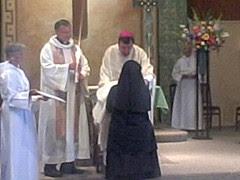
During the rite of my solemn profession last year, Marietta Fahey, shf (rather than a Deacon) did the formal "calling forth" on behalf of the diocese. Since the profession liturgy involves the literal mediation of God's call to the hermit as well as her response, and since the rite of calling forth is a direct expression of this, the formula we used was, "On behalf of the Church of the Diocese of Oakland and the Faith Community of St Perpetua('s Catholic Church), I call forth Sister Laurel O'Neal." At the time I was clear that diocesan status bound me to the diocese itself, but I had not considered as much the parish dimension of my commitment. And yet, I was clear that I was being called out of this specific assembly, this specific faith community and also as I have written before, it is this specific community which supports me in my vocation on a daily basis. Yet, it seems clear that the rite of profession itself prepared for my own reflection on the unique charism of the diocesan hermit and its relation to Benedictine stability; it (the rite) was also informed by it and became an expression of it.

But another thing this particular piece of my profession rite underscores is the personal nature of that stability. While it is true stability generally binds one to a place, it is far more fundamentally communal or relational. As Roberts affirms, [[Stability is personal. It is interpersonal communion, or, more precisely, it is perseverence in this communion.]] In embracing Benedictine stability as a diocesan hermit one commits oneself to a community, first (or more generally) to a diocese, and then (or more immediately) to a parish. For the diocesan hermit this is the community in which one's profession is made and in which it is lived out. While for truly legitimate reasons one might change one's stability, it seems to me that a diocesan hermit considering the unique charism of their vocation would need to discern these with the same seriousness a Benedictine monk or nun in a monastery discerns such things.

If the vow or value of stability is essentially personal or interpersonal, what are its most fundamental values for the hermit, especially compared to other Benedictine values, for instance? Both forms, stability in cell and stability in community have them and they are very high values indeed. The first would be communion or koinonia I think. The hermits is, for all her solitude, still a community builder and nurturer. Certainly that happens through her prayer, but it also happens as she brings an essentially contemplative presence into her contacts with the parish. It happens as she learns to love in this context more fully and exhaustively not only because stability binds her here, but because it is the logical outgrowth of her vows of celibate love/chastity. Of course, koinonia is built on charity, and especially one's love relationship with God. It is stability though which helps assure that one's commitment to loving others in God is not some abstract, intellectualized form of "loving" in which no one is really touched or nourished or healed. And of course, it is stability which ensures the hermit grows personally. We do not grow in isolation from others, nor when we run from situations, conflicts, challenges, and the like (an important reason eremiticism cannot be built on the desire to escape the demands of human society), but only in communion with others, and especially in faithful communion --- whatever the form that takes.

A second value of stability it seems to me is hope. Hope is rooted in the certainty that God can work to the good in all situations in one (or in those) who love him and therefore allow him to love them. Stability very much addresses this virtue because it underscores the need (and ability) to find God where one is, to come to holiness in the limited and conditioning circumstances in which one finds oneself. Stability is the value that underscores the incarnational essence of Christianity, the fact that our God comes to us in weakness, in the unexpected, even shameful events of our day to day lives. Ours is the God who dwells and remains with us in all of life's moments and moods; He calls us to remain with him in the same way. Prayer happens not in idealized situations (though it happens in ideal ones), but more usually in the situations that are far from ideal and often apparently adequate for nothing else! Stability commits us to lives of holiness and prayer wherever we find ourselves. For the diocesan hermit who often lives as an urban hermit, stability is the value that reminds us all that it is the nitty gritty pressures and irritations of everyday life that become the womb of the pearl of great price. Contemplative life need not be lived in the literal desert or mountain environment, but it must be lived in the solitude and communion of the heart of God, and THAT reality is available to us wherever God is found if only we will "remain in him." (John 15)

A related value of stability is perseverance. In the Rule Of Saint Benedict they are synonyms. Our society or culture is not particularly committed to this. It is instead a culture of quick fixes, and when that is not possible, quick escapes. We run out on marriages, children, relationships where the going gets demanding, courses of study, jobs, our employees and employers, parishes, particular church denominations, etc, etc. You name it and we ordinarily look for the easy way out, the place or situation where the "grass is supposedly greener," or where we face less difficulty and need to be less concerned with doing right in difficult circumstances, acting with patience, sustained courage, integrity, or loving profoundly and faithfully. This disvalue is personal, yes, but it is also interpersonal and affects negatively our culture and society. Meanwhile, its opposite, perseverance/stability cuts the heart out of our tendency to look for quick fixes and escapes; it commits us to giving each situation, each person, each set of circumstances all the time, prayer, effort, and work needed to allow the seeds of life, growth, wholeness, and indeed, holiness, to take root and grow to maturity. In this sense it is the parable of the wheat and the tares that remind us of the value of and need for stability.

In any case, it seems to me that the diocesan hermit is called upon to embody these values in unique and intense ways. Yes, she is to remain in her cell and allow it to teach her all things. Even this can be a witness to others simply in their knowing it is happening somewhere in their midst (which, as noted in other places on this blog, is a central reason for public profession and consecration). But a diocesan hermit is also called to stability in community. She is able to catalyze or otherwise contribute to the growth of community in hidden and not so hidden ways --- and she has an obligation to do this as part of the eremitical life and mission! Most particularly she will do so on the parish level, and in a day when sensitivity to the vitality and importance of local churches and base communities remains quite high, this is a significant aspect of her unique gift/charism to church and world. Stability is rooted in other personal and interpersonal or communal values as well. Perhaps I can say more about those in another post.

Have I been About the Creation of Precedents and Protocols with this Blog?

[[Hi Sister Laurel, I wondered what you make of the charge that you have made up all kinds of precedents and protocols for solitary hermit life under c 603? Is that really what you have been about with this blog? Does the charge have any merit, after all, not everything is written in c 603? Thanks!]]

Thanks to you as well; I am grateful for the question and surprised I have never received it before. Someone asked recently about the age of c 603 given that I have only been consecrated as a hermit for 17 years, but that was not quite the same question. When I look back at this blog over the past 17 years, I see one in which I have explored the nature and implications of c 603 and the vocation it governs.  As far as I know, I am responsible for only two precedents: 1) the post-nominal initials Er Dio (and variations like Erem Dio and ED), which Bishop Vigneron approved in 2008 on the anniversary of my consecration, and 2) a process of discernment and formation for c 603 hermits and their dioceses, drawn from my own experience of the challenging and formative nature of writing a liveable Rule, and which I have outlined here in brief form over the past several years. The first of these is pretty well established as diocesan hermits from a number of countries are permitted by their bishops to use these initials to indicate they are diocesan hermits. Everything else has been a part of my exploring this vocation and looking carefully at the implications of the canon and the public and ecclesial nature of the calling.

I am particularly pleased that these two precedents either already have been or are now being more widely adopted. The second one is by far more important, but I am still working on writing up the process of discernment and formation I have used with several dioceses/candidates thus far, so that is not yet ready for publication. One problem (but not the only one) is that some dioceses, it seems, don't have the staff to create a small team to accompany the candidate. Accommodations can be made, though this (small team with competent c 603 mentor approach) is still an ideal way to proceed to assist a good candidate, 1) to write a liveable Rule, 2) to educate themselves and the diocesan staff on this vocation, and 3) to discern and cooperate in God's formation of a sound vocation. Everything else here, I think, has been a function of my learning about my own vocation, exploring its depths and all of the rights and obligations which I embraced at perpetual profession and consecration. Though perhaps too repetitive, the questions folks ask have been really helpful here. Sometimes they stem from what I have written, sometimes from misunderstandings they are passing on, sometimes from simple curiosity or a hostile spirit, and sometimes they have been the result of someone wanting to become c 603 and asking questions that apply to their aspirations. 

The answers are never simply made up, however. Of course, they don't simply restate c 603 or the Catechism's paragraphs 920 and 921, because these are not the only texts that apply to the c 603 hermit. Other canons apply, whether because of the vows, the use of the term Catholic, religious garb, not-for-profit status, etc. Hermits' individual Rules also apply here. Too, I know to some extent how my diocese handled things (including frequency of meetings with three bishops and the Vicar for Religious while we had an interim bishop), and I have anecdotal material on other dioceses as well that I can draw from, including from the years before I was consecrated. And of course, the Church's theology of consecrated life applies, as it does to any consecrated vocation in the Church. So, what do I make of the charges that I almost single-handedly created precedents and protocols for c 603 vocations and distorted the canon and the vocation in the process? Well, at best they are exaggerated or significantly overblown, and at worst they are simply made up out of whole cloth while disregarding not only the canon's prehistory beginning with Vatican II, but the 24 years of c 603 life that preceded my own consecration and writing. 

What I find particularly hard to wrap my head around is that anyone could actually believe I have been so wildly influential rather than seeing instead that the Bishops, canonists, other c 603 hermits, and I are both exploring canon 603 in light of the Church's theology of consecrated life and therefore are simply coming to some of the same conclusions!! Yes, I write about the vocation from within it. I explore the implications of this new and ancient form of life. I think I appreciate what is possible for and required by it better than someone looking at the canon from the outside (which would include a lot of chancery staff and canonists), but c 603 already had a history of people living and exploring it before I was consecrated or began to write!  Of course, Bishops can and do certainly imagine, study, speak to others with experience of the canon, and have done so since @1983. And yes, today this might even include a few of them reading this blog, but that is still a far cry from my having been as influential as the "charges" have sometimes made out!

To summarize, when I began this blog, I wanted to explore the vocation and perhaps share it with anyone interested. It was relatively new despite the years since it had been published in the Revised Code and was similarly unknown in parishes or among parish priests. I had not expected to find c 603 beautiful in the way it combines a vision of eremitical life embodying non-negotiable elements with the flexibility of a personal Rule inspired by the Holy Spirit in a way that captures the unique freedom of the consecrated hermit; I had not expected questions and answers would become the basic format of the blog, nor did I anticipate becoming something of an authority on this vocation. If that is what has occurred (and I believe that to some limited extent it has), then I am grateful to God for that. Still, that I have overturned the "traditional" solitary hermit vocation and distorted c 603 with my writing here, or that I have single-handedly established all kinds of precedents and protocols is simply inaccurate! 

29 October 2024

Caring About non-canonical Eremitical Vocations

[[Dear Sister, do you want to cause the more traditional hermit vocation to die out? You mainly write about c 603 so I wondered if you care about non c 603 vocations to eremitical life.]]

Thanks for your questions. I answered some similar questions a number of years ago. As I recall they were posed in terms of canonical vs non-canonical or lay hermits and pretty much wondered if I preferred c 603 over non-canonical hermit life. What I said then still holds but with development as well, namely, I care about non-canonical eremitical vocations, and I write about my own vocation because it is what I know best and what I feel the need to explore. I believe the Church requires this exploration as well and it is my desire to contribute to the sound implementation of this canon in a way only someone living the vocation can actually do. While I have lived as a lay hermit, it is not my vocation, nor one I can argue for most passionately and convincingly. 

 Writing about the vocation in this way really does require someone (or several someones!!) living this vocation themselves. For instance, it might be the non-canonical hermits in the Archdiocese of Seattle who discover a vocation within their own eremitical vocation to do that. It might be a non-canonical hermit in the Diocese of Boise who does not want the "traditional" hermit vocation to go away now that c 603 is better known and more frequently used to profess diocesan hermits! It might be Regina Kreger, whose actual location I no longer know (she was in Europe the last I heard). She is a fine writer and hermit and might turn her talents to this at some point. It might be lay hermits from any number of dioceses in the US or elsewhere who have written me about being a lay hermit when c 603 is not being used in their dioceses, or those who contribute reflections to Raven's Bread, the hermit newsletter put out by the Fredette's!! The bottom line in this is that non-canonical or lay hermits really need to be writing about their vocation themselves, particularly if they see real benefits in not embracing or petitioning for admission to c 603!! Still, every eremitical call involves a charism, mission, and some form of ministry; those living these in the non-canonical state as lay hermits need to be writing about this for the sake of this specific eremitical vocation!

What especially doesn't make sense to me is for someone who believes in the importance and authenticity of non-canonical eremitical vocations, to opt for becoming c 603 when they believe this canon betrays the older just-go-off-and-do-it form of eremitical life! No, the answer is to live one's lay eremitical vocation and do it well!! While c 603 has been normative of the solitary eremitical life from the moment it was promulgated, it has grown in its implementation and more dioceses have used the canon successfully now. Even so, it still is experiencing significant growing pains and finds resistance in those who wonder how to implement it properly or don't believe it is a valid form of life. Canon 603 hermits can help in this by writing about the vocation or giving significant feedback to their dioceses on what they have learned about the vocation and their own preparation to live this calling, but non-canonical hermits have really significant things to add to the conversation for the sake of eremitism in the Church and for the sake of the Church's own life as well.

So again, yes, I definitely care about non c 603 eremitical vocations. I see them as important and also as being the lion's share of vocations to solitary eremitical life in the Church today. I don't believe many of these vocations will discover a vocation within this vocation to write about and explore the life in a more public way, but I believe there will be some few who will do this. Given the Archbishop of Seattle's stand on c 603 vocations and his decision to allow non-canonical (lay) hermits to make a commitment within the context of Mass (which I applaud!), I would hope Seattle is a source of the kind of reflection that is needed here. (Of course, I recognize that others could well be such a source!! What is important is that those who live this vocation reflect on it and make it better known and appreciated --- not as antithetical to c 603 vocations, but as a complementary expression of solitary eremitical life that remains as viable and cogent today as it was in the days of the desert Abbas and Ammas!!) Perhaps this will lead to the recovery of a strong sense of the prophetic character of such vocations for the sake of the Church! I think all of that is a real possibility, but such a project needs to be led by those living the life!!

28 October 2024

Questions on c 603 and Reclusion, and the Sufficiency of the Solitude Possible under the Canon

 [[Hi Sister, if I wanted to be a recluse under c 603, could I do that? How would that work? Do you ever worry that you will not have enough real solitude or silence as a c 603 hermit? I was thinking about not being part of a congregation that allows for recluses. With c 603 you have to support yourself and belong to a parish, so doesn't that detract from what you need to dwell solely with God?]]

Many thanks for your questions. Reclusion is possible with c 603 but only if that is understood as a profoundly communal or ecclesial calling supported by your parish and/or diocese, or others who wish to do so. You will need to be supported (psychologically, spiritually, socially, and to some degree, physically) by a faith community who makes sure you have all that you need to live your life; you also will still need to take care of yourself financially. One of the often-unconsidered truths about recluses is that they are truly and profoundly embedded within a faith community. The other piece of things is that your diocese will need to approve this and test this vocation which will take some years of living eremitical life itself under supervision. No one I have ever heard of is admitted to reclusion without a strong sense of being called first, to contemplative life, then, to eremitical life, and finally to reclusion. Even then, it is ordinarily only granted on a temporary basis for some time. This is much easier within a religious congregation, but even then, in the Roman Catholic Church only two congregations are allowed to accept reclusion by members, namely, the Carthusians, and the Camaldolese.

My own sense in this is that you would need to take some years establishing yourself in a parish context and allow them to come to know you and your vocation to eremitical life first of all.  You would need to be a living and significant part of the parish community's faith life, however it is that you establish this for them. Only after such a relationship is established could you even think about depending upon this community for the daily needs you have. (Of course, since the pandemic, it is possible to get many things delivered!) However, you will still need a spiritual director, diocesan delegate, confessor, etc., who will keep you connected to both the wider Church and the local faith community. You also need some form of ministry, which can include prayer, and which allows your life to serve others --- even in reclusion. Reclusion is definitely not a vocation for those who simply want to go it alone; within the Church it has always been deeply communal.

When you ask about my own silence and solitude, I have to say that no, there is no detraction. Canon 603 provides each hermit with as much as they need because they write their own Rule based on how God works in their lives, and how this shapes their prayer, work, study, limited ministry, etc. My own schedule allows or provides for several hours of prayer in the mornings, several in the evening, and often two in the middle of the night. Each of these includes a period of quiet prayer and some writing or journaling. That's a significant dedicated time spent with God, and I am alone most of the rest of the time as well. God is with me in all of this, and I can turn to him at all times, including when I work with clients. I also work with my Director weekly, most of the time, and that involves a profound and intensely prayerful attention to my own inner life, which I prepare for each week, and also follow up on each afternoon or evening after we meet Because of all of this, I have to say no, I don't think I am missing sufficient solitude or the silence of solitude.

Recently, and for a number of years, one lay hermit has been writing about my blog and speaking about how c 603 eremitical life is too taken up with the temporal Church and not enough with the spiritual. My own take on this appraisal is that it is theological nonsense. That is true because we are temporal beings modeling the Incarnation in our lives, while the Church is the primordial sacrament, and so, both spatio-temporal and suffused with the Spirit's presence, which it mediates. Yes, the Holy Spirit empowers this, just as she did for Jesus, and that means that we can be both spatio-temporal persons bound to space, time, and matter, and profoundly spiritual persons whose lives are given over to God in deeply committed ways at the same time.  I know that the following theology is not yet commonly held, but it is profoundly Scriptural. Because heaven is not our ultimate goal and we are not made to be disembodied, but rather embodied**, and embodied as part of a new creation constituting a new heaven and a new earth that interpenetrate one another and make a single reality, I am really skeptical of any approach to spirituality that tends to divorce it from the spatio-temporal world (the world of space, time, and matter). 

I was taught as an undergraduate that Christians are materialists, though in a unique way made fully real (realized in fullness) in the Incarnation; this view emphasizes the depth and sufficiency of Jesus' prayer life and Communion/Union with the One he called Abba, Pater! This is the God who comes to us as Emmanuel, God-With-Us in this world, so that this world might be wholly redeemed and made new by God's presence. Human beings are not angels. We are embodied spirit. Our spirituality is profoundly influenced by our bodiliness, and the Spirit qualifies our bodiliness in return. Similarly, we are not isolated beings, but part of a community of faith, love, and hope grounded in God! Our humanity is a task achieved in Communion with God and others. C 603 and those who implement this canon recognize these things. That is true when discerning vocations to reclusion, or even "just" the balance of a normal eremitical life.
_________________________________________________
cf especially Pope Benedict XVI writing as Cardinal Ratzinger in his work on Dogmatic Theology: Volume IX Eschatology.

Why isn't a Sense that God Consecrated One Enough for the Church?

[[Dear Sister Laurel, so why isn't it good enough for God to consecrate one? Why does there need to be a canon law with the Bishop consecrating the person? If someone has the sense that God consecrated them, why isn't that enough?]]

Thanks for your questions. I have written about this several times quite recently and am not sure what else to say about the matter. I would ask you to check out the following posts and others under the labels ecclesial vocations or ecclesiality as well as canonical vs non-canonical vocations, etc: Follow-up, Who Can Live c 603? and Once Again on "Illegal" Hermits. In these posts and many others, I have focused on the distinction between ecclesial vocations and those that are not, why it is important for the Church herself to extend God's consecration to the hermit with an ecclesial vocation, what it means to belong to a stable state of life, and several other things including ministry of authority, sound spirituality, competent discernment and formation, etc. The only other dimensions I have not dealt with are that of potential self- deception and the problem of being unprepared for an authentic hermit life and perhaps incapable of living it well.

To claim one is consecrated by God in a private act may or may not be true or accurate. One may or may not have gotten it right and there is no way for the Church to verify it. (One can certainly examine the rite used and the intentions of the minister if there is paperwork to try and determine the reason for the rite. If it involved private vows, then there would be no consecration.) In any case, in the Roman Catholic Church, admission to Divine consecration requires initiation into a stable state of life where this gift of God can be verified, protected, nurtured, and governed. Because such a gift is NEVER for the individual alone, and because the vocation belongs to the Church before it belongs to the individual, the Church establishes such vocations in law and provides for the structural elements I spoke of recently that will allow them to be lived as the Church understands they need to be lived out. The discernment of such vocations is mutual, involving both the individual and the church because they are ecclesial vocations. The Church is responsible for selecting and professing those with such vocations and God works through the Church via a second consecration beyond baptismal consecration. No one can validly claim God consecrated them in the RCC unless this Divine consecration is mediated to the individual through and in the hands of the diocesan bishop or, in communal religious vocations, in the hands of other legitimate superiors!

If someone insists otherwise, they are at least mistaken and perhaps even deluded in this matter. There is simply no such thing as private consecration in the Roman Catholic Church. Yes, one may make private vows. Many people do! But this is not the same as consecration. Neither are private vows an act of profession. Profession is an act that includes one's dedication of oneself in avowal and the taking on of the canonical rights and obligations of a new state of life. In other words, it is a broader act than just the making of vows. Meanwhile, consecration is part of the entire rite of perpetual profession where the individual dedicates herself to God with a perpetual avowal, and God consecrates that individual as they take on the rights and obligations of this new state for the whole of their lives. 

 As I noted above, Divine consecration that is part of initiating one into the consecrated state of life is a gift of God entrusted to the Church and only then to the individual. Also, please note that this is not a matter of putting Divine consecration up against Episcopal consecration. These two belong together or there is no consecration. It is not that bishops consecrate if by that we mean they do this for some while God consecrates others! No!! God consecrates hermits, and God does so in the hands of his bishops (or other legitimate superiors when we are speaking of hermits in congregations). The Bishop is not a "stand-in" for God, as I heard it put recently. Rather, God works in and through the Church specifically in the person of the bishop by empowering him to mediate God's consecration of the individual.

Self-deception aside (somewhat), the greatest difficulty of asserting God has consecrated one privately, is that one may be completely unprepared for living out an eremitical vocation. They may not understand it and critically, they may not be able to negotiate the tension between the modern world and eremitical life that allows the hermit to be a gift to the contemporary Church and world. As I have said here many times, it takes time for both the individual and the Church to discern and form the vocations of solitary hermits. It takes probationary living out of the calling under the supervision of the Church while working with a competent spiritual director and continuing to discern. It takes study, collaboration, and deliberation; above all, it takes humility and docility. 

One must be able to be taught and consider that ultimately one really might have gotten things wrong. When someone continues to insist, "God consecrated me," apart from canon law, apart from a bishop's permission and entrusting of the vocation to one, or according to established Church structures and rites, and particularly when they do so while denigrating the need for these ecclesial elements and context or while banging on and on about how they are the ones to show dioceses and other hermits the true way hermit life is to be lived, they are unlikely to be showing either humility or docility. 

This is not the same as saying "I am convinced God is calling me to this vocation; I know it" and persisting in that even when a diocese is unwilling to profess one under this canon for the time being. One may be called to persevere in good conscience in such a situation and do this with an openness to be taught about why dioceses make the decisions they do.  In the meantime, perhaps one will also learn about ecclesial vocations and what one is proposing to take on and for whose sake!! Until and unless one does this, one is more an isolated person than a hermit. And that argues against one's having been consecrated by God (or called to this), not for it!