11 March 2025

What to do if One is Full of Oneself?

[[Dear Sister, if someone is full of themselves, is there a way they can empty themselves of this tendency? It seems to me to be kind of ironic. What I mean is I know someone who believes that God has asked them to take care to not be so full of themselves and in trying to "empty" themselves of this self-focus, they become even more focused on themselves!! It is really sad to watch!! It also makes me laugh [not because it is funny but] because it almost seems to be impossible to spend time trying to prevent oneself from being too full of oneself without causing the exact opposite thing!! So, is there a way to empty oneself of "being full of oneself"? Because you are a hermit, let me also ask you if this is a harder task for you than it might be if you were living in community or were an active religious? 

You know, these are really good questions (cf Part II below for your second paragraph)! One of the first things that occurs to me is how this kind of struggle or these conundrums are a good indicator of the need for a competent spiritual director. While it is not impossible to be emptied of inordinate self-concern and focus, it takes time and real effort, and one can only do so if one opens oneself discerningly to the world outside oneself and comes to depend on someone else's insight and capacity to reflect back regarding what they are hearing or seeing. If one doesn't have access to a good spiritual director, a good friend can often be helpful in the same way. The one seeking to change needs to be able to truly listen to others who know them and are aware of their flaws as well as their strengths and potential. It seems to me this is the only way to get out of the vicious cycle that otherwise ensues in trying to empty oneself of self. This is a beginning, and for me, I would say it is indispensable.

There is another related elementary principle involved here as well. Namely, the only way to empty ourselves of our false self is to open ourselves to the Creator God who makes real and true. But how we achieve this is important and paradoxical. Granted, we are not supposed to grasp at things. Rather, we are to allow ourselves to be grasped by the Mystery we call God and to not resist this. The imagery of emptying our hands so they may hold something else is helpful as a starting point, but it really is not radical enough. The truth is, we don't empty ourselves and then allow God to fill the emptiness. Instead, we allow God to gradually displace whatever it is that takes his place and fills us inappropriately. It is all God's work! 

There is a story in the Gospels of both Luke and Matthew that illustrates this principle. A man is exorcised, and his house is cleared out, swept clean of an unclean spirit, and left empty for a brief time. The unclean spirit returns to the house, and it is then filled by even more unclean spirits than originally; the man and house are left in even worse shape than at first. Luke's point is that the human heart is meant to be filled with God/Love. It is made for that. What is counterintuitive, perhaps, is that in this case, this is only achieved by allowing God to displace the demons and fill the house (heart) as only God can. This is really all about grace and the salvific action of God, not our own, except to the limited extent that we must refuse to stand in God's way as we let him love and move us as he wills! The basic truth here is that only Love can make space for Love; only God can make room for God.

One's life needs to be focused on others and open to growing in one's love of others. Remember that, while it is focused on God and on living one's own self as fully as one can, even the hermit life is meant to be lived for others. This is important in achieving a life that is not solipsistic or inordinately focused on oneself. While I can't say whether it is harder or easier for someone living in community, it is somewhat different. One example might help: Recently, I was surprised to find myself writing about what is happening to this country and the current political situation. I have not done that in the past. When I explored this with my director, it became clear to me that I was not particularly interested in politics, but I was concerned with the state of this country, its people, and the terrible degree of pain that the administration's apparently careless and blatantly cruel actions were causing and will continue to cause as our democracy continues to be dismantled. 

One person I know (a non-hermit) criticized me for my concern with all of this because it didn't comport with her notion of what hermits are to be about, but I recognized it as an instance of my own growth in compassion. At the same time, it led to a unique intensification of my prayer life in the hermitage and a careful limiting and focusing of my consumption of news. All of these factors led me to conclude that this was what God willed in my life, and I am grateful to be called to this as an integral part of my hermit life. I could have said no to this in the name of an abstract definition of eremitism, but again, it was about saying yes to love and discovering how that, in turn, enhanced and strengthened my life as a diocesan hermit. (This is another place c 603's requirement that the individual hermit writes her own Rule is critical for complementing the constitutive elements of the canon that apply to every such hermit. She must have experienced and be moved by love, and she must be free, within the limitations of her vocation, to risk herself for love.)

Yes, it takes some discerning to be able to negotiate an appropriate degree of reliance on and independence from others, but the only way to become less involved with self or "less full of oneself" is to become more involved with others, and specifically, to become more attentive to and loving of others while allowing them to love us. Jesus was called "The Man for Others," and those of us who want to become an imago Christi are called to the same vocation. I have sometimes heard people suggest that hermits are all about focusing on becoming holy and getting to heaven. As Cornelius Wencel, Er Cam, reminds us, 

[[Not in order to achieve perfection does the hermit set out on his solitary voyage. On the contrary, he considers his way and mission to be part of a great common effort to change and renew the cultural and spiritual life of humanity. . . . So, we can hardly take a hermit for a person who limits his entire mission to a few prayers he recites and some daily routines necessary in everyday life. The hermit has to take into account all the difficult problems endangering the world today. . . . realizing how deeply he is rooted in the life of society and how greatly responsible he should be for the world and its future, the hermit wants to take part in coping with the difficulties and anxieties of today.]] pp 121-122, The Eremitic Life

And yet, even hermits cannot depend on God alone to speak to them in the way a good friend or competent spiritual director can and does. God does not relate to any of us, hermits or not, on that level or in that same way. Yes, God loves us each profoundly and communicates Godself to us intimately. God "speaks" to us in innumerable ways, including through others; occasionally, we may even hear a voice inside our heads/hearts that we can identify as God's own. Still, we all need to learn to listen to and trust 1) another human being whose competency is greater than our own and 2) our own consciences as the voice of God within us and our true selves (as opposed to our false selves). Even so, God is Mystery itself, and intimate though our relationship may be, it is not the same as speaking with another human being. This brings me to your second paragraph's questions.

Part II:

My last questions have to do with asking God about every little step one takes during the day. The person I am asking about is trying to "ask God about every little thing" she is considering doing. She even says she asked God, "May I go to the restroom or. . ." do another trivial task and what his will was in that. While I think that turning to God is important in becoming less full of oneself, this [way of conceiving of that] also seems self-defeating to me. She seems to me to be becoming even more full of herself in this way, but I am not sure I can explain why that is so. Do we only do the will of God by losing our own will? Are we to truly be emptied of ourselves and filled with God? Do you understand what I am asking?]]

The situation you have described of asking permission for every little thing was once the way some religious congregations operated in centuries past. It was abandoned as infantilizing, and rightly so. In those days, the novice or junior religious thought of the commands of the superior as the will of God**, and this asking of permission for every little thing was supposed to form men and women who were attuned to the will of God. Unfortunately, it backfired, and the religious found they were unprepared to make significant decisions for themselves, had badly formed consciences incapable of making prudent conscientious judgments except when told what they "should" do, and were incapable of hearing the will of God apart from the voice of the superior. Given that there is apparently no superior in the situation you describe, this also means that God is being asked to micromanage a person's life; God does not do this!!! This is why God gave us hearts, intellects, consciences, and wills. We are to listen to these, and yes, we are to allow them to be formed and shaped according to God's will. But asking God to tell us whether we should use the restroom or do another task first literally places us back before the days when we were potty trained!!!

What you have described is a literal example of a so-called "spiritual" practice that, despite its intention, infantilizes one!! And what it does to God is similar, for it trivializes Him and His role in our lives. Ironically, it makes things all about us again, and this ties into your original question. If we diminish God in the name of some flawed notion of "seeking his will," we divert attention from the real God and substitute ourselves and our own miniscule conceptions in God's place. We will never truly worship him in such a situation. J.B. Phillip once wrote a classic book called Your God is too Small.  It was seen as a significant and common, even universal, error we make, typical of idolatry in all of its forms. In the case you describe, trivializing God, especially by infantilizing ourselves, makes us the center of the universe, something that always happens unless and until our God is no longer too small and we grow in relation to Him! That means, as you say but could not explain, the person you described is making things all the more about herself. Ostensibly, she claims to be seeking the will of God, but really, it is an elaborate charade (she may not even be aware of this), emptying the real God of His true role in her life and substituting a cosmic micromanager who "speaks to her" as she demands and is comfortable with. As I noted above, God does not speak to us on this level or in this way.

Neither are we asked by God to lose our will, but to allow it to be formed and shaped in communion with the loving will of God. That is what allows Paul, who has been crucified in Christ, to say, "I live, yet not I, but Christ in me." (Gal 2:20). Note the paradox in the sentence as well as the emphasis on personal truth. It is I, yet not I. It is really Paul who is alive, but it is Christ in Paul at the same time. Paul is essentially describing what happens when God has made us truly ourselves and freed us from the false self that once held sway. We become truly alive (and that means with our own will), but we are alive in and through Christ. I think this is a much better way of considering what happens and is meant to happen than thinking we are emptied of ourselves in some way that leaves us only a shell that is then filled with God. God wants a relationship with a person, not a receptacle, and he wants an adult who is capable of adult love, not an infant!

** Today, when a superior asks someone publicly vowed to obedience to do x or y, we still consider this a way God is speaking to us, but not the only way. We discern what this means for us and how we prioritize and will carry it out. If we need to pray over and discuss the matter, we will do that. We do these things not to avoid what is being asked of us but to be sure we have rightly attended to and understood what is being asked of us. Today, we speak of the ministry of authority and recognize that this is rightly exercised with love and should be responded to in the same way. 

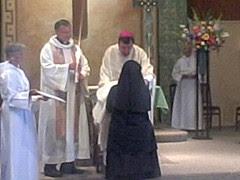
Installation of Cardinal McElroy, Archbishop of Washington DC

07 March 2025

Another Look at the Three Pillars of Lenten and Christian Praxis

[[Dear Sister Lauren (sic), a couple of us were talking about Lent and how to approach it this year. (We're students at Saint _____ College so we are beginning to look at Lent in new ways! My friend wants to be a nun but probably not a hermit and reads your blog.) At a college ashes service yesterday we listened to a homily on prayer, fasting, and almsgiving and thought it was pretty good, but we also saw your article speaking about the crisis in the US right now, where you said it was not the time to give up chocolate or let go of some TV program we didn't really need anyway!! So we thought we would take a chance and decided to write you and ask how you choose something to do for Lent. Do you do fasting, prayer, and almsgiving or something else?]]

The Three Pillars of Lenten and Christian Praxis:

Thanks for your questions. Yes, I pray, fast, and give alms, but this may not look exactly like what you are expecting. The three pillars of Lenten practice also tend to be the three pillars of all Christian life, namely,  

  1. some form of self-emptying or self-denial that allows us to become aware of and pay appropriate attention to our truest and deepest hungers (fasting), 
  2. openness to and reception of the presence and power of God who satisfies those deepest and truest hungers (prayer), and  
  3. giving to others something of what we have received in this process (alms or almsgiving). 
As you can see, our Lenten praxis is not about merely doing something extraneous to who we are; it involves choosing to do things that allow us to be our truest or most authentic selves. And, since we are only our truest or most authentic selves with God and within the human community, it first involves finding ways to allow God to be God for and with us. Likewise, because we are also most authentically or truly human in relation to others, and especially in our compassion for and generosity to others, the third pillar of Lenten and Christian praxis has us giving of our time and treasure to them with a careful eye toward what they most need if they are to be the persons God calls them to be. 

Becoming Truly Human:

Lenten praxis (or practice) is always about the things that make or allow us to be truly human, namely our loving relationship with ourselves, with God, and with others. 

  1. Fasting (or any kind of self-denial that could go by this name) helps free us from selfishness, self-centeredness, and concern with our own comfort or our fear of (or, less often, our preoccupation with) discomfort and actual suffering. It's a way of opening ourselves so we can receive more freely than we ever can when we are self-centered or fearful. 
  2. Prayer opens us to being constituted by and as a dialogue with God (i.e., authentically human life is such a dialogue) that is both challenging and consoling; it helps us affirm that alone we are always incomplete and even inauthentic, while with and in God, however difficult things get, we are never alone and are moving toward fullness of life. Prayer helps us to live our own life more intensely, expansively, and truly as those who are infinitely loved and who, despite our very real weaknesses and incapacities, are called to be God's own counterparts in this world. 
  3. Almsgiving reminds us that the ways God loves and gifts us, especially with Himself, are never for our sake alone. Eventually or ultimately, they are meant for others who need such love/gifts as much as we once needed and still need them ourselves. (As with God, we who are images of God are made to be a self gift. The triad of fasting, prayer, and almsgiving constitutes the heart of a continuing dynamic of Divine self-giving, human reception, and human self-giving that defines us as human beings who glorify (reveal) God with our lives.)
On Making Concrete Choices:

So, that's the theological analysis of the pillars of Lenten praxis and all Christian life. It's all really about a cycle of loving and becoming loving so others can enact the same cycle in their own lives. How do we translate that into concrete choices for any given Lenten Season?  

Fasting asks us to identify what prevents us from being aware of God and others. What is it that makes us less able or willing to depend on or be vulnerable to the love of God or of others? What isolates us and tempts us to believe we can go it alone? What allows us to be less conscious of others and the deepest hungers of our own hearts? (This can include some misguided notions of hermit life, by the way.)  So, for instance, what do we fill ourselves (or our lives) with instead of the "food" that comes from God and truly nourishes us? While this could be some form of unhealthy food, it could also be binging on the computer or being a workaholic, or refusing to take our schoolwork seriously. Thus, paradoxically, fasting might mean getting more rest than we ordinarily do or taking better care of ourselves more generally. We can determine how we might fast during Lent when we have identified some of these things.

Prayer asks us to give time and space to God so that he might love us as he desires so profoundly to do. If fasting helps make us vulnerable, prayer is the courageous and generous act that turns that vulnerability over to God to do with whatever he wills. What this mainly means is that we give God a chance to love us into wholeness. We let God be God-With-Us (for God is Love that wills to be Emmanuel), even if we are not necessarily aware of God's presence during this time. I would encourage you to do whatever helps you remain vulnerable during this time. That might include silent prayer with occasional breaks to walk around the room or prayer space, silent prayer followed by a favorite oral prayer (Hail Mary, Glory be, Our Father, a verse of a psalm or the refrain of a favorite hymn (spoken or sung), for instance). You might want to use a lighted candle to help you return to focus when that wavers. If vulnerability like this is difficult, feel free to wrap up in a blanket and imagine God holding you safely and warmly during this prayer time.

Alms or Almsgiving: Whatever fasting and prayer lead you to experience, I would encourage you to spend some time journaling on what these have been for you and anything you have learned, seen, heard, sensed, or imagined because of it. You need not write a lot, and it would be most helpful if you included an expression of gratitude to God. This practice will prepare you to be ever more aware of and able to give to others as mercy and compassion prompt you to. Some things you might not think of that qualify as almsgiving could include calling your parents or other family members more regularly while you are away at school, giving time and attention to someone you don't ordinarily regard adequately, or tutoring another student. You get the idea.

I don't always use the terms fasting and almsgiving, but the things I choose for Lent correspond to the meanings and dynamics I provided above.  My focus is always on personal growth and that means that it involves my relationship with God, with myself, and with others. Sometimes that means focusing on weaknesses and working through those in ways that strengthen or heal me, other times it means focusing more on potentialities that need to be more fully realized or talents and gifts that are to be used for the larger Church or my immediate faith community. Of course, I have a Rule of Life I live and try to live ever more deeply and truly. Attending to the way I reflect the vision of this Rule is one way I discern what God is calling me to. Another is through meetings with my director, who probably knows me better than anyone. Usually, ideas surface during our conversations, and occasionally, she will make an explicit suggestion of something I might do during Lent.

The current situation in the United States (and thus, the world) almost could not be more serious. If you can find ways to work toward justice as you see this needs to happen while being faithful to your studies, I would encourage you to do this. As I wrote earlier, the word crisis comes from the Greek κρισις, and it means a time or occasion of decision; this Lent is surely calling for such decisions from all of us. Ask yourself what is loving for the country and how you can specifically participate in that love. It may not be the way I do it or your friend does, but it is very important this year. Pray about this and then act as you feel called to act, that is, as is most faithful to God's loving will and most lifegiving for yourself and for others.

05 March 2025

On Hermits and Involvement in Politics

[[Dear Sister O'Neal, are hermits supposed to be involved in politics? You have posted several times on the current political situation, using the excuse of Christianity to do it. You even applauded that disrespectful Episcopal bishop who insulted President Trump. I am not a Trumper, and I am not a hermit either, but I don't believe hermits are supposed to be involved in the things of this world in the way you are, are they? Have you discussed this with your bishop or director?]]

Preliminary Definitions:

In responding to your questions, it is important to be on the same page with several elements of c 603. You need not agree with my usage, but you must at least understand it. The first is the term "the world". In John's Gospel, the term has several meanings, including 1) the entire cosmos, 2) God's good creation here on earth, and 3) that which is resistant to Christ or that promises meaning and salvation apart from God in Christ. When c 603 speaks of "stricter separation from the world," it means, first and foremost, stricter separation from that which is resistant to Christ. This will include some very real separation from even God's good creation (which is better dealt with, I think, in the canon's "silence of solitude"), but this is very much a secondary meaning. Stricter separation from the world means, first of all, that I am required to live a life focused on God in whatever way God is present and to deal with potential obstacles to that in ways appropriate to my education, experience, and vocation.

The second central element that is important to understand is that eremitical life is lived for the sake of the salvation of others.  It is not merely about becoming holy or getting oneself to heaven (were that actually the ultimate goal of Christian life, which it is not). That would be a blasphemous perversion of the vocation! Hermits live their lives 1) for God's own sake --- that is for the sake of God's will to be Emmanuel -- and 2) for the sake of those God loves and all God holds as precious. Hermits live their lives so that all may be reconciled to God in Christ and the Kingdom of God may be realized in fullness. While a large part of this will be reflected in and expressed as solitary and intercessory prayer, it will not be limited to these. God's Kingdom, the new heaven and new earth with the risen Christ as Lord or King, is something Christians work toward. As scripture tells us, it is an inaugurated and often counter-cultural reality that requires some degree of involvement by all Christians. My own involvement tends to be much more limited than that of most folks; it often takes the form of theological reflection, a bit of teaching, and spiritual direction. It does not allow blindness or complete disengagement from our world's struggle against evil because, after all, this precise kind of engagement (not enmeshment!!) is the will of God for every Christian.

A Life Rooted in the Scriptures:

Finally, my life is a life of prayer rooted in God and our Scriptures. Because of this, I pray these lines as part of the Magnificat every evening: [[. . . He has shown strength with his arm; he has scattered the proud in the thoughts of their hearts; he has brought down the mighty from their thrones and exalted the lowly . . .]] Clearly, Luke, and presumably Mary, the Mother of Jesus, were very much aware of the political and religious situations of the time. Clearly, they saw the way the sovereignty of God --- what we often call the Kingdom of God or of heaven --- countered the political and religious powers that thought they were sovereign and stood in God's place. Luke and the early Christians praised God for this, even though "a power perfected in (the) weakness" of a Crucified Christ accomplished this victory radically differently than they had expected. 

Similarly, as I noted in an earlier article, I have been reflecting on Jesus' encounter with Pilate as part of my way of keeping centered on Christ. What this raises immediately for me is the conflict between truth and untruth that these two persons represent. Jesus does this in the name of God. That is, he stands in the power and presence of the God who is truth, and in doing so, he confronts Pilate with the very incarnation of truth, both divine and human. Pilate stands in the name of the supposedly divine Caesar; he, therefore, represents the incarnation of untruth revealed in this-worldly human power and arrogance. 

I think we often tend to hear Pilate's question, "What is truth?" in an innocent or even irrelevant sense --- as though Pilate is inviting an intellectual debate or discussion on the nature of truth while Jesus is on trial for his very life. But Pilate poses this question in a sneering way. From the Gospel's perspective, the question is meant to be provocative and prompt us to ask, "What is going on here?" (or to respond, "What is truth? You're looking at it!). In no way is it innocent or irrelevant! Pilate's contemptuous question is profound and revelatory. It defines the essence of the confrontation between Pilate and Jesus. It demonstrates someone who holds power and is empty and dismissive of truth; he is, therefore, epitomized by this question. Pilate is someone who, when confronted with authentic humanity that thus trusts in the sovereignty of God, can only diminish Jesus' emphasis on the truth ("It is you who say it!") and act to destroy that humanity, even though he does so while ostensibly washing his hands of the matter!! (In our present situation, I can only say, "Let those who have ears to hear, hear this!!") In other words, Jesus IS the very embodiment of Truth confronting an embodiment of untruth and worldly power. I believe every authentic Christian is called to do the same in whatever way they can. This is what it means to proclaim the Gospel of Jesus Christ.

I am absolutely not called to become enmeshed in this world's politics, nor is any hermit. However, to the extent I live in communion with God, I am certainly called upon to proclaim the Gospel with my life and in any other way my talents and training allow. I would argue that my vocation as a hermit gives me the space and time to engage with God and the Scriptures in a way that demands I confront untruth, carelessness, inhumanity, and idolatry when I perceive it. Ordinarily, this does not involve politics in any granular way; today, however, we are looking at a crisis that threatens our entire democracy and perhaps authentic Christianity as well! It threatens millions of lives in this country and around the world. It endangers the ability to pursue authentic religious belief and morality in Christian discipleship and prevents us from following God wherever God summons us. 

Please note where the accent in what I am saying here falls! Check out the posts that caused you to write me as well. Reread them. In each and all of these pieces, my focus is not on politics per se or on countering untruth in some merely abstract way; rather, it is on proclaiming the Gospel of God in Christ so that its light shines concretely in the darkness and untruth of a world God is gradually recreating and transfiguring and will one day bring to fullness. I believe this serves the Church and the larger world and allows people to have hope despite great difficulty. It is precisely because I am a hermit and theologian whose life centers on God in Christ that, in the current situation, I don't believe I can do anything else.

03 March 2025

Touching the Wounds of Christ: Proclaiming a Power Perfected in Weakness (Reprise)

This post was first reprised in 04/2016. I reread it as part of my preparation for Lent and for writing a post that follows up one I posted earlier today or very late last night. It also reflects a book I am reading for Lent this year, namely, The Wood Between the Worlds, A Poetic Theology of the Cross. It is a book about the way God uses Jesus' passion and death to reconcile this world with himself, thus transfiguring this world and the way we are called to perceive it.

Thus, considering the questions that follow and what I have written recently about eremitical life, I find a night and day difference between those whose illness is a sign of "the world's" power and those whose illness has truly been transfigured into a sacrament of the presence of God. Most of us with chronic illnesses or disabilities find ourselves between both of these worlds -- at least part of the time. Lent seems to me to be a good time to focus especially on the kinds of choices that allow us to stand firmly in the light of God's love so that even our illnesses and disabilities are transfigured and we come to know ourselves as precious and a delight to God. All of this is reflected in the following post.

______________________________________________________

[[Dear Sister, if a person is chronically ill then isn't their illness a sign that "the world" of sin and death are still operating in [i.e., dominating] their lives?  . . . I have always thought that to become a religious one needed to be in good health. Has that also changed with canon 603? I don't mean that someone has to be perfect to become a nun or hermit but shouldn't they at least be in good health? Wouldn't that say more about the "heavenliness" of their vocation than illness? ]] (Combination of queries posed in several emails)

As I read these various questions one image kept recurring to me, namely, that of Thomas reaching out to touch the wounds of the risen Christ. I also kept thinking of a line from a homily my pastor (John Kasper, OSFS) gave about 7 years ago which focused on Carravagio's painting of this image; the line was,  "There's Another World in There!" It was taken in part from the artist and writer Jan Richardson's reflections on this painting and on the nature of the Incarnation. Richardson wrote:

[[The gospel writers want to make sure we know that the risen Christ was no ghost, no ethereal spirit. He was flesh and blood. He ate. He still, as Thomas discovered, wore the wounds of crucifixion. That Christ’s flesh remained broken, even in his resurrection, serves as a powerful reminder that his intimate familiarity and solidarity with us, with our human condition, did not end with his death. . . Perhaps that’s what is so striking about Caravaggio’s painting: it stuns us with the awareness of how deeply Christ was, and is, joined with us. The wounds of the risen Christ are not a prison: they are a passage. Thomas’ hand in Christ’s side is not some bizarre, morbid probe: it is a  union, and a reminder that in taking flesh, Christ wed himself to us.]] Living into the Resurrection

Into the Wound, Jan L Richardson
My response then must really begin with a series of questions to you. Are the Risen Christ's wounds a sign that sin and death are still "operating in" him or are they a sign that God has been victorious over these --- and victorious not via an act of force but through one of radical vulnerability, compassion, and solidarity? Are his wounds really a passage to "another world" or are they signs of his bondage to and defeat by the one which contends with him and the Love he represents? Do you believe that our world is at least potentially sacramental or that heaven (eternal life in the sovereign love of God) and this world interpenetrate one another as a result of Jesus' life, death, and resurrection or are they entirely separate from and opposed to one another? Even as I ask these questions I am aware that they may be answered in more than one way. In our own lives too, we may find that the wounds and scars of illness and brokenness witness more to the world of sin and death than they do to that of redemption and eternal life. They may represent a prison more than they represent a passage to another world.

Or not.

When I write about discerning an eremitical vocation and the importance of the critical transition that must be made from being a lone pious person living physical silence and solitude to essentially being a hermit living "the silence of solitude," I am speaking of a person who has moved from the prison of illness to illness as passage to another world through the redemptive grace of God. We cannot empower or accomplish such a transition ourselves. The transfiguration of our lives is the work of God. At the same time, the scars of our lives will remain precisely as an invitation to others to see the power of God at work in our weakness and in God's own kenosis (self-emptying). These scars become signs of God's powerful presence in our lives while the illness or woundedness become Sacraments of that same presence and power, vivid witnesses to the One who loves us in our brokenness and yet works continuously to bring life, wholeness, and meaning out of  death, brokenness, and absurdity.

To become a hermit (especially to be publicly professed as a Catholic hermit) someone suffering from chronic illness has to have made this transition. Their lives may involve suffering but the suffering has become a sacrament which attests less to itself  (and certainly not to an obsession with pain) but to the God who is a Creator-redeemer God. What you tend to see as an obstacle to living a meaningful profoundly prophetic religious or eremitical life seems to me to be a symbol of the heart of the Gospel of Jesus Christ. It also seems to me to remind us of the nature of "heavenliness" in light of the Ascension. Remember that one side of the salvation event we call the Christ is God's descent so that our world may be redeemed and entirely transformed into a new creation. But the other side of this Event is the Ascension where God takes scarred humanity and even death itself up into his own life --- thus changing the very nature of heaven (the sovereign life of God shared with others) in the process.

Far from being an inadequate witness to "heavenliness" our wounds can be the most perfect witness to God's sovereign life shared with us. Our God has embraced the wounds and scars of the world as his very own and not been demeaned, much less destroyed in the process. Conversely, for Christians, the marks of the crucifixion, as well therefore as our own illnesses, weaknesses and various forms of brokenness, are (or are meant to become) the quintessential symbols of a heaven which embraces our own lives and world to make them new. When this transformation occurs in the life of a chronically ill individual seeking to live eremitical life it is the difference between a life of one imprisoned in physical isolation, silence, and solitude, to that of one which breathes and sings "the silence of solitude." It is this song, this prayer, this magnificat that Canon 603 describes so well and consecrated life in all its forms itself represents.

Bowl patched with Gold
We Christians do not hide our woundedness then. We are not ashamed at the way life has marked and marred, bent and broken, spindled and mutilated us. But neither are woundedness or brokenness themselves the things we witness to. Instead it is the Sacrament God has made of our lives, the Love that does justice and makes whole that is the source of our beauty and our boasting. Jan Richardson also reminds us of this truth when she recalls Sue Bender's observations on seeing a mended Japanese bowl. [[“The image of that bowl,” she writes, “made a lasting impression. Instead of trying to hide the flaws, the cracks were emphasized — filled with silver. The bowl was even more precious after it had been mended.”]]  So too with our own lives: as Paul also said, "But we have this treasure in earthen vessels, so that the surpassing power will be of God and not from ourselves."  (2 Cor 4:7) It is the mended cracks, the wounds which were once prisons, the shards of a broken life now reconstituted entirely by the grace of God which reveal the very presence of heaven to those we meet.

Approaching Lent and its Call to Be People of the Cross in this Unique Time of Crisis

I don't think I have ever lived in a time that made being a person "of the cross" of greater moment. I wrote earlier that I am reading a book by Brian Zahnd entitled The Wood Between the Worlds. What I didn't mention was that my own prayer life these days is focused on suffering with Christ in a way that places me very solidly and strangely between two worlds. I think there are several ways to understand where I find myself; one of these is in a world of incredible political change, not to say chaos as the conventional order of our country and global community is turned upside down by an incompetent and self-centered administration and its sycophants who are bent on destroying our constitutional democracy. (This is true and a moral issue whether one voted Independent, Republican, or Democrat!) Also, the Catholic Church is finding itself in something of an increasing crisis of leadership as Pope Francis battles a life-threatening illness. At the same time, and by the power of the cross, we stand in a world on its way to becoming part of the new heaven and new earth, a world in which God is truly sovereign and truth and life triumph over sin and death. It is very clear to me that the only place to stand upright in such a world is provided by that same cross and all that God did and continues to do with it.

In Luke's Acts of the Apostles, as I've noted before, the early Church found itself standing in light of Jesus'death, resurrection, and ascension, between two worlds, namely the world where God is not sovereign, the world of idolatry, unjust power, greed, ambition, self-dealing, and utter lack of compassion for the poorest, least and lost, and the world of the new creation, the world where God is indeed sovereign, where all things are held in common and, as is sometimes necessary, the wealthy sell what they have to provide for their brothers and sisters in Christ. The early Church stood in stark contrast with the Empire, with the dominant religious traditions and leaders of the day (even though they stood in profound continuity with the narrative these leaders claimed as their own but no longer represented), and with the Greco-Roman culture and standard philosophies -- the "wisdom" of the day. We Christians have looked at this early Church and marveled at how it could be so powerfully inspired and inspirational that it grew and took over much of the globe. 

Several centuries later, we saw it become "permissible for Christians to be" with Constantine while Christianity was made the state religion by Theodosius just a decade later. My own eremitical vocation was born during this time as the Desert Abbas and Ammas retreated to the desert to embrace a more radically authentic and less domesticated Christianity. And so, I find myself standing in a place I have read about, prayed over, imagined, taught, written about, and both marveled and shuddered at throughout the whole of my adult life. What I recognize in all of this is that both Christianity and the US Constitutional Republic are in danger of being swallowed up by inauthentic and antithetical versions of the real things unless and until Christians find the courage to be people of the cross in all of the ways that implies, and non-Christians similarly embrace the authentically human values that lead them also to fight with compassion for the dignity and freedom of every person in this world.

Lent begins in just a couple of days and it is one of the most important Lenten seasons we Christians have ever faced. What is called "Christian nationalism" (facism co-opting the name we hold to be above every other name!) must be countered, and we must find ways to make sure that the injustices piling up in our country are righted while the least and lost of our world are recognized as God's very own and given what they need to pursue the lives God calls them to. We are called to work towards a Kingdom where God is truly sovereign and justice is done in mercy while retribution and carelessness are condemned as the marks of a demonic realm. We must embrace the cross of Christ with all of its selflessness, sacrifice, fear, suffering, loneliness, uncertainty, hope, and faith. This is no time for simply "giving up chocolate" or a beloved television program we could certainly have lived without anyway, or any of the more or less unserious forms of Lenten "penance" we have made do with (and been able to make do with) in the past. The situation before us is very much more serious than that and calls for a less rote, more thoughtful, and more personally demanding sacrifice!

We have been presented with a crisis (from the Greek κρισις, meaning a time or occasion of decision) few of us have seen before; this crisis is, therefore, also an opportunity to incarnate and reaffirm what we truly believe. Though God certainly did not create or will the situation in which we find ourselves, we have been asked to suffer with Christ so that through his resurrection and ascension, God's victory over sin and death can be fully realized in this world. As was true in the Acts of the Apostles, the Church of Jesus' disciples grew miraculously by the power of the Holy Spirit. As Dietrich Bonhoeffer reminded us as he moved through incredible activism and towards red martyrdom, the way to real discipleship will be both costly and grace-filled. If we can't be the Christians we claim to be, our world is in greater peril than I believe we have ever known.

Follow-up on Standards for Beginning and Mature Hermits

[[Dear Sister Laurel, I was especially aware that when you write about the standards of your life you are describing what happens in a relationship with God. What you seemed to describe regarding the difference between beginners and the mature hermit was the deepening of a relationship. I could see the variations reflected in the way different people participate in this relationship with God. Too, it seemed to me that the central elements of c 603 had to do with what is essential to live a life in relationship with God. Do you see mature hermits practicing these elements more strictly than beginners? Is there any part of what you live that you practice more strictly now than you did as a beginning hermit?]]

You're welcome, and thank you for making clearer than I may have done myself what is most central in speaking of standards of eremitical life. I agree with you that the essential or constitutive elements of c 603 reflect what is central to a hermit's relationship with God. I do recognize that hermits should be open to living greater reclusion if God calls them to this, and I think hermits from the beginning of their eremitical lives should be open to hearing such a call. I tend not to use the word stricter or more strictly to describe changes in my own life. I prefer the term radical instead of this. That corresponds with increasing depth as well as with an increasingly profound degree of lived personal truth. So I live some things more deeply or more radically, yes, but only occasionally does that translate into being stricter about them.

Yes, prayer becomes deeper and more extensive as well, as the person becomes not just someone who prays, but God's own prayer in the church and in our world. In light of this, one mainly continues to pray in the way one did as a beginner, and at the same time (as your question clearly recognized), the relationship that is the heart and purpose of prayer deepens and becomes not just central to one's life but one's very breath and blood as well. In some ways, it feels like prayer is not only not stricter, but that it becomes less strict. Over time, I have shifted from one form of prayer to another or added prayer periods for certain reasons as needed, but there is no strictness about this. Responsiveness and faithfulness or fidelity, yes, but strictness, no; the word just doesn't feel right to me. I suppose it feels like it fails to reflect the integral nature of a Divine call to assiduous prayer and penance. 

I think the words responsive and faithful fit all of the dimensions of my life where they might not have when I was beginning eremitical life in 1984 or so. All those years ago, I was finding my way into a vocation, wondering what it involved or allowed and did not allow. I was exercised with discovering not only what such a call required but whether or not it could be considered truly vital at all. Yes, of course, it was an ancient vocation, but was it really also a contemporary one, important for the contemporary church and for our larger world as well? Could my sense of this call be justified apart from my own chronic illness and disability, for instance, or was I mistaken? (More about this in another article). 

I began reading and praying and discovered people who helped me see this was very much a healthy, vital, and contemporary vocation. Some of Merton's writings were important (Contemplation in a World of Action and his "Notes on a Philsophy of Solitude" were particularly helpful; so were the essays in Allchin's Solitude and Communion, which, in those days, had to be gotten from the Sisters of the Love of God in the UK, and so, put me in touch with their community. Some Camaldolese writing was critical in my discernment, not to mention the existence of the Camaldolese Benedictines in Big Sur. Now, of course, the vocation and my own identity are more just a single thing; in saying this I mean that they are one insofar as I am responsive to God and live my own identity faithfully. So, in all of this, "radically" is a much better word than strictness or any of its cognates.

 Today, I believe that c 603's constitutive elements are less things we are called to do (though, of course, they are also that) and more about the kind of persons that hermits are supposed to be. I believe if we consider these elements this way, we will put the accent where it must be, namely on our relationship with God and who we are called to be in light of that. Canon 603 doesn't spell out what it means to pray or embrace penance assiduously, nor does it define "the silence of solitude" or "stricter separation from the world," and this means each hermit will define these in the way and to the extent her relationship with God calls for and depends on these things. The same is true of the way we work out limited forms of ministry: What does my own growth in wholeness and holiness in light of this relationship require? The question I must continue to ask is how my life in hermitage spills over into ministry and how that ministry demands responsiveness and fidelity to God's love in hermitage. Questions about strictness, especially increasing strictness, tend to be unhelpful or even off-point for me.

28 February 2025

On Differing and Similar Standards for Beginners and Mature Hermits

[[Sister Laurel, Are the standards for a beginning hermit different than they are for a mature hermit? I am asking because when you write about living eremitical life you accent the idea of living a vision with widows or doors to Mystery. You also speak of everything being part of the "privilege of Love" and that makes me think that it takes time to truly come to live the hermit life in profound ways. I also wondered about the relationship between contraints and freedom that you wrote about recently, and this ties in with my question because it seems that constraints come before freedom. All of this makes me wonder if the way a beginner lives eremitical life will be different than the life of a mature hermit. If someone wanted to participate in some form of limited ministry it would take time to develop the habits and depths of a life of assiduous prayer and the silence of solitude before one could really discern this, don't you think?]] 

This is a really great question and I really appreciate your explaining how you came to it! Thank you!! I understand what you are thinking, and I generally agree with your analysis. At the same time I also need to look at the way c 603 handles the matter. That allows me to suggest on one hand that in terms of spiritual depth and the aquisition of needed habits, beginners do indeed live the life somewhat differently than mature hermits. On the other hand, when I look at the standards the Church recognizes, namely, canon 603, the guidelines of Ponam in Deserto Viam, and the descriptive passages from the Catechism, beginners and mature hermits are both called to the same standards. Every day, we each walk through the same doorways to the same Mystery. Every day, each hermit is called to embrace assiduous prayer and penance, the silence of solitude, and stricter separation from the world, for instance, in order to come to union with God and one's own divinization. It is the encounter with that Divine Mystery that changes and calls for a tailoring of our lives in ways that differ one hermit from another.

The Fathers who wrote c 603 were aware of and provided for this. Paradoxically, one of the main unchanging standards of c 603 is the requirement of a (liveable) Rule of Life that the hermit writes for him/herself. Every c 603 hermit must do this, and the Rule must not only be rooted in significant lived experience of eremitism and other things as well, but it must demonstrate the way she understands and will live the other elements of the canon itself. It is here that the individual hermit's more personal or unique standards may reveal themselves as shifting even as the overarching elements defining the eremitical life remain the same. In some ways it is also here that the hermit will accommodate any changes in her vision of the way she is to live this vocation and clarify both the tensions that exist and the resolution of these tensions in her way of living solitary eremitical life.

The Beauty and Flexibility of C 603:

I have written many times her over the past nearly 2 decades that I find c 603 to be truly beautiful in the way it combines the defining elements without which one would be unable to live an eremitical life, and the flexibility of one's own personal vision of the life lived in a particular place and time by a particular person. The Church wrote really well when she opted for this combination of constitutive elements. Sometimes folks who believe hermits are "adding things" unnecessarily to or in betrayal of the vocation by this activity or emphasis,  or they may suggest that bishops are allowing things beyond some narrow, even unhealthy notion of eremitical life and don't really understand eremitical life. What is more often true in these cases is that those making the accusations have forgotten the requirement that the hermit write her own liveable Rule. 

Remember, this is a Rule that reflects not only all of the specific and explicit elements of c 603, but also personal elements that are part and parcel of the way God has brought this person to eremitical life and continues to speak to her in the silence of solitude. All of these elements are discerned by the hermit, her bishop, delegate, and (before perpetual profession and consecration) the diocesan formation team. The Rule spells out one's own understanding and vision of solitary eremitical life and its constitutive elements; it also spells out those things, additional and otherwise,  that are required for the individual hermit's own wellness, human wholeness, and personal holiness. It is here that elements that do not work for another hermit but are essential for one's own call by God will be found. 

This is also why I advise hermits I work with to use their Rule as a workbook along with their journal as something that inspires them every day. I also advise folks to revise their Rule every 8-10 years or so (or whenever major changes in the person's life makes this advisable). But let me be clear. The standards or constitutive elements of c 603 don't change. The guidelines of Ponam in Deserto Viam don't change either. If my hermit life looks different from one of the others in our laura (and it definitely does look different in some ways!), it is because my vision of the life, my personal background, relationship with God, and unique gifts and limitations differ. In other words, we have the same vocation and are called to union with God under the same standards (c. 603's constitutive elements, charism, and the Evangelical Counsels, etc); meanwhile, the ways in which God tailors his call or invites us to tailor and incarnate our responses --- especially I think, regarding the requirement that our lives be lived for the salvation of others --- will always also differ one from another. They are both alike and dissimilar precisely because we are each faithful to c 603 and God's call to this vocation! This is recognizable to each of us even though it may be hard to see from outside the vocation or the sharing we do with one another.

On the Interrelatedness of Constraints and Freedom:

I understand why you posit that constraints come before freedom. I think you are generally right in your observations. I believe even more strongly that the constraints, however, are opportunities that accompany and are fulfilled by freedom. My fallback example of this is playing the violin. One must certainly argue as you do analogously, that without technique, one could never play music at all. Imagine what would happen if one could not master bowing (or even hold the bow properly) or finger the notes with precision and speed. Imagine what would and could never happen if one's right hand was stiff and cramped or one couldn't shift with one's left hand because one was holding the violin at the neck of the violin rather than with one's jaw and shoulder. The latter posture leaves the left hand free and entirely mobile, while the former paralyzes it! And imagine all of the scales, arpeggios, and etudes required in all of the possible bowing variations that are necessary to master if one is to allow the violin to sing over the whole of its range!! 

Thus, it is absolutely true that one needs to learn proper technique before one can play to the limits of the instrument, the composer, and one's own imagination and abilities. At the same time, one plays to the limits of one's technique, and doing so musically will transform and push one's technique further as well. Technique serves musical freedom, yes, but musicality (which is partly, I believe, about the influence or inspiration of the Holy Spirit) fulfills technique and allows it to be much more than mere technicality. It is always the two together that produces music, and music, I sincerely believe, is a form of prayer and perhaps a model for growth in all prayer.

What I am trying to say is that it is not only possible but also necessary for all things to grow together simultaneously once one becomes a c 603 hermit. It is very much a holistic vocation. Yes, profession and consecration under c 603 require preparation. For instance, one should be a contemplative before discerning a call to eremitical solitude, and one should already have completed one's schooling and any certification or licensure work one envisions needing.  Strictly speaking, one should not be a beginner at eremitical life when one is admitted to profession and consecration as a c 603 hermit. For this reason a good deal of the growth you are speaking of happens before one becomes c 603; at the same time, we hermits recognize in one another the same patterns of growth, the same embrace of values and constitutive elements, the same vocations no matter the differences in our Rules and whether we have been a hermit for decades or for a only a handful of years. I'll end this here for now. There is definitely more to explore, though, so thanks again for your questions!!

26 February 2025

Once Again on Standards for Canonical and non-Canonical Hermits: Potential Discussion Topics

[[Dear Sister, thanks for your response to my questions. I had a different idea about a list of requrements or standards. I am enclosing a list of the kinds of things that were included in the video I watched. Here is the list. Perhaps you could comment on what you think of these standards and of making them universal for all hermits in the Church.]]

  1. Should a hermit do a video log (vlog) or have a blog? Does it make a difference if the hermit is canonical? What are the implications of such a move for the faithful wishing to pray there?
  2. Is anonymity better than being ID'd?
  3. Should "Traditional historical hermits" get their hermitages designated a "place or house of worship"? by the Bishop?
  4. Should hermits wear religious habits?
  5. Should hermits live alone? Is solitude a somewhat flexible term allowing for lauras, etc.?
  6. Should they use post-nomial initials such as Er Dio of CH?
  7. Should the spiritual director be a priest or brother ? Could it be a "girl friend" in a religious community?
  8. Should transgendered persons or persons otherwise sexually disordered be consecrated as hermit?
  9. Should psychological testing be required before admission to profession and consecration?
  10. Who should guide and supervise hermits?
  11. Should hermits have benefactors or be self-supporting?
  12. Is it appropriate to charge for spiritual direction? Should hermits even do spiritual direction?
  13. What kinds of jobs are allowed?
  14. Should hermits teach courses at their parish? Bible or Scripture? Or should they be cleaning the Church alone at night?
  15. How would universal standards be enforced?
  16. What do we do about corpulent or obese hermits and their guilty vice of gluttony?
  17. Should hermits get involved in politics or controversial topics that could lead them to anger, despair, or depression?
  18. Do the USCCB and other English-speaking bishops' conferences need to create a list of such standards or requirements?
Thanks for supplying this list; I see better where your questions were coming from. I will keep these topics in mind for the future because, as you might be aware, I have written about a number of them over the years, sometimes multiple times. At this point, I think the best way to proceed is to suggest that you and other interested readers look first for past discussions from the labels on the right. Then, if you (or anyone else) want to discuss any of these topics further here, you can feel free to raise specific questions or issues in a separate context, and we can go from there. 

Unfortunately, some of these questions are important for the way they reflect on the person raising them as issues rather than on the substance of the question itself; for instance, at least one of them attributes motives to situations or persons no one but the person and God can know. None of us reads minds or souls so, for instance, attributing a physical condition (corpulence) to personal sin (gluttony) is completely out of bounds. So is calling someone's director or delegate their "girlfriend"-- as though there is something improper or unprofessional about the relationship. Only one person I know of has written this way in the past. It was wrong then and is wrong now; it reflects more on the questioner's biases and animosities than it does on anything happening in eremitical life today.  

One question you have listed about a bishop constituting a hermitage as a house or place of worship is entirely new and interests me. I have not heard of this before (though I expect it is linked to becoming 501(c)3) and would need to determine if it is even canonically possible. (Diocesan hermits can, if they can meet the civil requirements, become 501(c)3, but I was unaware of the idea that a hermitage becomes a "place of worship".) I'll do some research on this and see whether it would be a good topic to write about further than I have already done. (Cf articles on becoming 501(c)3.)

Is it Risky Accepting Hermits for Profession and Consecration under Canon 603?

[[Sister Laurel, it sounds to me like there is quite a risk in accepting hermits for profession and consecration. If there is no single list of standards each hermit must meet or cannot trepass against, then isn't it a case of every hermit needing to be directed and supervised individually? Won't some fail? Won't they come to their bishop claiming to be called to this form of ministry or another and won't at least some of them be wrong . . . [redacted]? Who really oversees the life of a hermit? Is it the bishop?]]

Interesting questions. Thanks. I had hoped that in my earlier post I had managed to indicate there are standards in the Code of Canon Law and also in Ponam in Deserto Viam. There are further guidelines in the other texts I cited, especially for formation of contemplatives. If the hermit wants to join with other c 603 hermits in a laura they are free to do so. I am part of a small virtual laura with four, possibly five, diocesan hermits from the US and Great Britain. We meet monthly by ZOOM and though we are quite different from one another in many ways, we are aware we are each called to and live the same vocation in our own significant ways. We are currently slowly discussing Cornelius Wencel's book on the Eremitic Life and exploring the ways we each live the values or constitutive elements of our vocations, how we have grown in this, how we can assist and support one another and so forth. Such virtual lauras allow us to hear the wisdom of our elders (a matter of experience, not age!) and to ask questions when we are dealing with a real problem or something difficult. This kind of situation, combined with spiritual direction, the input of a delegate, and the supervision of one's bishop, is both demanding, challenging, and consoling. It fosters growth more than any list of standards might do.

Even when a diocese has a common list of standards or guidelines, each vocation must be measured, discerned, formed, professed and consecrated, as well as supervised separately. Nothing else does justice to the profound and unique relationship between the hermit and God. This is God's vocation entrusted to the Church and to the hermit through the Church's mediation. Both hermit and Church must be subservient to God by discerning each vocation separately, especially once the essential qualities have been embraced by the hermit. While it is always possible to meet for group direction, each hermit will have her own director as well. This is the nature of the solitary eremitical vocation. I am not sure I would say that someone who tried solitary eremitical life and found it was not what she felt called to a failure. It is simply a step on her road of discernment and human formation. I personally don't believe anything is wasted in such attempts, but yes, many people will try to become diocesan hermits, and the majority will not succeed. There are many different reasons for this, and many do not reflect on the individual candidate at all.

Also, some diocesan hermits will want to try this ministry or that one as part of their eremitical vocation. They will be given time to try these and discern whether or not it is truly consistent with the hermit's life in the hermitage and then, whether it enhances her life in hermitage. Part of discernment is coming to understand not only what one feels called to but why. Some answers to this latter question suggest the hermit should not undertake the ministry, while others encourage the hermit, her director and delegate to support the project. The bishop is ultimately responsible for supervising the quality of the hermit's life, but the way a bishop supervises is not carved in stone (and some who "inherit" diocesan hermits professed by other bishops sometimes simply show no interest in supervising them. There is little a diocesan hermit can do in such a situation beyond requesting a conversation to discuss matters. 

Fortunately, a hermit with a delegate, spiritual director, and even a mentor and/or virtual laura is ordinarily well watched over and assisted by all of these persons. Curiously and ironically, even with so many people involved in various kinds of accompaniment and consultation, the vocation remains a profoundly free and independent one that is dependent on God's love and the divine will more than anything else. Still, given the relative rarity and significance of the vocation, it is not surprising it requires serious dialogue with God and others all along the way.

I sincerely hope this is helpful.

25 February 2025

In Search of a List of Standards? Eremitical Life and The Privilege of Love

[[Dear Sister Laurel, is there such a thing as a list of standards for hermits based on historical hermits? If I wanted to become a hermit and be consecrated by my bishop would I go to my diocese for such a list or just where would I go, particularly if my diocese has never consecrated someone as a hermit before? I want to make sure I am doing all the right things. Does this make sense? It seems to me that different hermits all seem to live hermit life differently than one another. Oh, I'm sure there are similarities, but some live together, others live alone, some do various forms of ministry and others may not, some depend on benefactors, others are self-supporting, some work outside the hermitage and others work from home. It just seems too diverse to meet any single set of standards, but isn't there a list of such standards somewhere? Shouldn't there be a set of standards all bishops agree on?]]

Thanks for your questions. Eremitical life is, paradoxically, both constrained and incredibly free. In the Roman Catholic Church we now have canon 603 that defines eremitical life and allows for consecrated solitary eremitical life which includes not just solitary hermits, but solitary hermits who come together in colonies or lauras which do not rise to the level of juridical congregations or communities. (Some country's bishops, Spain for instance, have created guidelines for such lauras focusing on the limits these should observe.) Canon 603 has several conditions or central elements that are part of the essential definition of the solitary eremitical life, namely, the hermit lives a life of assiduous prayer and penance, the silence of solitude, and stricter separation from the world, within the framework of the profession of the Evangelical counsels; they do this for the praise of God, and the salvation of others, all under the supervision of the diocesan bishop and according to a Rule of Life the hermit writes for herself. Whatever else one does (limited ministry, etc.), one must live these elements if one is to truly be a hermit.

Canon 603 thus also implicitly refers to other canons having to do with the Evangelical Counsels and also with contemplative life in the Church. Thus, dioceses can require things c 603 never mentions explicitly as part of the profession and consecration of a c 603 hermit, and even when additional canons don't apply directly, there are encyclicals and exhortations that do. So, for instance, a diocese wishing to profess a diocesan hermit may refer any suitable candidate not only to c 603 and the Catechism of the Catholic Church, but to texts like The Art of Seeking the Face of God, Guidelines for the Formation of Women Contemplatives, Vita Consecrata (Consecrated Life), The Gift of Fidelity the Joy of Perseverance, New Wine in New Wineskins, and of course, Ponam in Deserto Viam (The Hermit's Way of Life in the Local Church), et al. Hermit candidates and their spiritual directors should be familiar with these writings. Of course, these do not simply provide a list of naked standards as though one size fits all. They provide reflections on a vision of consecrated life that an individual should take on (and be helped to take on) in a way which illumines her life and makes it a gift to the Church and larger world as well. 

As noted above, to try to embrace such a vision in response to God's call is both constraining and incredibly freeing. The life one is called to is both regular or ordered in particular ways and also free to respond to more individual or particular gifts. Both dimensions are of the Holy Spirit and both must be honored if one is to live one's vocation faithfully and with integrity.  Some of this may surprise people when they are reflecting on eremitical life. For instance, this life is meant to be lived for the sake of the salvation of others. This is an integral requirement of what it means to be a hermit, especially with an ecclesial vocation. It is not just that the hermit prays for others, though this is certainly a dominant note in every hermit life, but also, that the hermit may be involved in limited ministry to others so long as such ministry enhances rather than detracts from her eremitical life. 

How does one discern this? Well, not according to an abstract list of standards; rather, one looks to the quality of the whole life one is living. Does this form of limited ministry lead the person to a stronger prayer life, a greater sense of her call and dependence on God, a life defined more completely in terms of the Word of God and as imago Christi? Does it allow for "the silence of solitude" to become not just about the absence of noise in some form of isolation from others, but also the stillness of human wholeness and holiness in communion with others? If it does these things, then discernment affirms that this is likely to be something God is calling one to. In the past I have spoken about this in terms of the ministry calling me not only out to the world around me, but back again and again to the solitude and silence of the hermitage; the limited ministry of the hermit is one legitimate way the life of the hermitage overflows in mission, rather like the image from last Sunday's Gospel: [[Give, and gifts will be given to you; a good measure, packed together, shaken down, and overflowing, will be poured into your lap.]]

Hermits learn over time to honor the various ways the Holy Spirit calls us to serve the Church (both as the Body of Christ and so, as a communion of brothers and sisters in Christ). They are also helped in this by their spiritual directors, delegates, and (though usually less frequently or regularly) by their bishops and pastors or confessors. Those exercising the ministry of authority in our lives generally do so out of love and those who are really good at their jobs have a very clear sense of the ways the hermit needs to grow and change. Thus, a list of standards is often only minimally helpful because it cannot know or reflect the individual hermit's life nor the way the Holy Spirit is working in that. What is essential beyond any external list of standards is faithful and prayerful dialogue with someone knows us well and who lives and knows what it means to live a contemplative life of prayer consecrated by God for the sake of one's own call to holiness and for others as well. To gauge the quality of an eremitical life according to a list of requirements, it seems to me, is to miss the point. 

A hermit is not merely someone who lives alone in silence while saying prayers at various parts of the day. Any misanthrope could do that! S/he is someone who, in the silence of solitude, lives with and in dialogue with God, and who, in light of this intimate relationship, is capable of loving not only God and herself but others as well. The Camaldolese congregation I am affiliated with apart from c 603 speaks about this kind of life as one of The Privilege of Love. It seems to me that this is the single or overarching standard by which a life lived under c 603's requirements is really to be measured. Of course, all of the central elements I listed above are definitive of this form of life, but within one's faithfulness to these, one must ask, is the person growing as one who loves God, themselves, and is committed to the growth in holiness and wholeness of others as well? Is she responding to the Holy Spirit even if this means doing something other hermits are not doing? Do those exercising the ministry of authority in her life agree with this sense of things? If so, then she is living c 603 and the life it describes faithfully!

I sincerely hope this is helpful. I have tried to give you a sense of the codified requirements that bind diocesan hermits and I have tried to indicate why no single list of "standards"-- especially if applied from outside a lived eremitical life -- is insufficient. C 603 is a place to begin. Ponam (cf above) is important as well if one wants to see how the Church views this vocation. Again, this, along with c 603 itself, serves to provide a series of doorways into ever-deepening Mystery whereas a list of standards does not. Your concern with "doing all the right things" is very much a beginner's concern. There is certainly nothing wrong with that and if you want to contact your diocese to see if they have a list of standards or guidelines, I encourage you to do that! Still, if you are truly called to an eremitical life and embrace that call, you will eventually come to a place where your deepest concern is to be yourself in response to God's invitation to life in Him. Similarly, your concern that God calls hermits to different incarnations of the eremitical vocation won't bother you so much as it seems to currently. You will enter the doorways to Mystery provided by c 603 or Ponam and, over time, come to know the deeper dimensions of things like silence and solitude (and the silence OF solitude) and let go of worry about any more rigid, less essential, and more superficial senses of these defining elements. You will understand your call as a vocation to the privilege of love and live this in the ways required of you in particular. 

Postscript: If I have failed to answer your questions, please get back to me with a list of the kinds of standards you were envisioning, for instance, and I can look at these more specifically. Thanks!

21 February 2025

Feast of St Peter Damian

Today is the feast of the Camaldolese Saint, Cardinal, and Doctor of the Church, St Peter Damian. Peter Damian is generally best known for his role in the Gregorian Reform. He fought Simony and worked tirelessly for the welfare of the church as a whole. Hermits know him best for a few of his letters, but especially #28, "Dominus Vobiscum". Written to Leo of Sitria, letter #28 explores the relation of the hermit to the whole church and speaks of a solitary as an ecclesiola, or little church. Damian had been asked if it was proper to recite lines like "The Lord Be With you" when the hermit was the only one present at liturgy. The result was this letter which explains how the church is wholly present in all of her members, both together and individually. He writes:

[[The Church of Christ is united in all her parts by the bond of love so that she is both one in many members and mystically whole in each member. And so we see that the entire universal Church is correctly called the one and only bride of Christ, while each chosen soul, by virtue of the sacramental mysteries, is considered fully the Church. . . .From all the aforementioned it is clear that, because the whole Church can be found in one individual person [Ecclesiola] and the Church itself is called a virgin, Holy Church is both one in all its members and complete in each of them. It is truly simple among many through the unity of faith and multiple in each individual through the bond of love and various charismatic gifts, because all are from one and all are one.]]

Or again, [[Just as in Greek man is called a microcosm, i.e., a little world (cosmos) because in essential physicality the human being consists of the same four elements of which the whole world is made, so also each one of the faithful [including hermits, Peter Damian's special interest in this letter] is a little Church (ecclesiola), as it were, because without violating the mystery of her inner unity, each person also receives all the sacraments that God has given the universal Church. . .]] Dominus Vobiscum, Letter #28 sec 25. (Emphasis added)

Because of this unity Damian notes that he sees no harm in a hermit alone in cell saying things which are said by the gathered Church. In this reflection, Damian establishes the communal nature of the solitary vocation and forever condemns the notion that hermits are isolated or "lone" persons. His comments thus have much broader implications for the nature of eremitical life than the licitness of saying certain prayers or using communal phrases in liturgy per se. In the latter part of the letter Damian not only praises the eremitical life but writes an extended encomium on the nature of the eremitical cell. The images he uses are numerous and diverse; they clearly reflect extended time spent in solitude and his own awareness of all the ways the hermitage or cell has functioned in his own life and those of other hermits. Furnace, kiln, battlefield, storehouse, workshop, arena of spiritual combat, fort and defensive edifice, [place assisting the] death of vices and kindling of virtues, Jacob's ladder, golden road, etc --- all are touched on here. Peter Damian's rich collection of images serves to underscore the classic observation of the Desert Fathers and Mothers: "Dwell (or remain) within your cell and your cell  will teach you everything."