27 June 2025

Returning the Tabernacle to its Pre-Vatican II Placement: A Failure to Honor the Real Presence Revealed During Mass

Dear Sister, not sure how to ask this so I'll just go ahead and give it a try. Last weekend we celebrated the Feast of Corpus Christi and our pastor moved the tabernacle back behind the altar from where it had been located in the main part of the Church. He had been planning this for a while but said the feast was the perfect time to do this. He said it was about putting Jesus right back at the center of things where he should be! Someone sitting near me explained that this was not what Vatican II called for. They said this was against what Vatican II called for but I didn't really understand his explanation. Was it really against Vatican II and didn't Vatican II want Jesus in the center of things?did they move the tabernacle because people no longer believe in the Real Presence?

Also, what I really wanted to ask you, if a hermit didn't want to be part of a parish or diocese, could they still be a consecrated Catholic hermit? How about if they never attended Mass? I know the Church teaches that there is something called the mystical Body of Christ and that the New Testment says we are to become spiritual beings. Can a hermit become a spiritual being and not be able to attend Mass? I thought that Catholics were obligated to attend Mass every Sunday so I wondered how someone could be a Catholic hermit and not go to Mass except once in a while? Too, when you speak about an "ecclesial vocation" doesn't everyone have this kind of vocation? we all live our calling from inside the Church, don't we?]]

These are great questions, all of them! Thanks for asking, not only about the hermit vocation, but about last weekend's Feast (Solemnity) of Corpus Christi and the reasons the Church moved the tabernacle (in most cases) from behind the altar to another part of the Church where the reserved Eucharist could still be honored, but not during Mass itself! The shift in placement did not occur because Vatican II did not believe in the Real Presence any longer, but because having the tabernacle present right behind the altar in most churches was distracting from what was actually occurring then and there during the Eucharistic liturgy itself. If the church was or is a really large one and the location of the tabernacle was or is far enough behind the altar so as not to call immediate attention to itself during Mass, no post-conciliar movement was or is necessary, but in most parish churches, this location focused the assembly's attention on the already-consecrated and reserved Eucharist which was accessed only at the end of Mass when EEM's were given what they needed to accommodate the sick who could not attend Mass itself. Let me explain (I will answer your questions on the hermit vocation in a separate post, I think.).

When we come into church and move to our seats, we either genuflect or (for those of us with old knees!) bow to the altar before sitting down in the pew. We do this in part because of the presence of the Body of Christ reserved in the tabernacle, but also because of what takes place at the altar during every Mass, and because of the presence of the Book of the Gospels which is usually present and symbolizes the proclaimed Word until the entrance procession when it is relocated to be carried aloft during that part of Mass.* Vatican II looked freshly and very seriously at what is happening during every Mass and all the ways Christ is and becomes present during the celebration. Especially, Vatican II recognized that what was important is not what had happened at other Masses (and therefore, what was present already in the reserved Eucharist, but on something we had often not paid sufficient, if any, attention to when our focus was on the tabernacle and the reserved Sacrament, and perhaps on the ordained minister of that Sacrament.

Most everyone would be able to tell you, if they were asked, that what happens at Mass is the transformation of Bread and Wine into the Body and Blood of Christ. But, relatively speaking, many fewer would point to what happens to the assembly during Mass, or what happens when the Word of God is proclaimed, or who is involved in the transformation** of the Bread and Wine during the consecration besides the ordained minister who is presiding. After all, for whom is the priest presiding, and what does this say about the presence and activity of the Holy Spirit amongst the Assembly?  Among the Lectors? In the Prayers of the Faithful and the reception of Communion? And why is it at Mass that the Church prefers the faithful all receive Communion with hosts that were consecrated at that Mass rather than from that reserved in the tabernacle? It is not meant to detract from the reality of the reserved Eucharist, after all. What I have just written here is suggestive rather than explicit, so let me make it more explicit.

These questions all point to the Sacramental or Mysterious presence (Sacramentum mysterium) of the Risen and glorified Christ during Mass and other liturgical celebrations. They call us to look out for and to be aware of, appreciate, and participate fully in what actually occurs at Mass, which includes and, without diminishing our reverence for the consecrated Body and Blood of Christ, is also a good deal more than the transubstantiation of Bread and Wine into the Body and Blood of the Risen Christ. Vatican II asked us to be aware of four related forms of Presence during the Eucharist: 1) in the Eucharist broken and shared (the glorified Christ made present in the species of bread and wine), 2) in the person of the minister who presides on behalf of the assembly, 3) in the proclaimed Word of God (which includes the homily or reflection), and 4) in the assembly, the People of God who have come together in Jesus' name. (CSL#7) 

What I want to call your attention to here are the verbs involved in each of these Mysterious forms and occasions of Christ's becoming present. The assembly gathers in God's name. They listen, pray, support one another, read, make significant gestures indicating faith at work, and so forth. The presider presides on behalf of the entire assembly (of which he is a part; he has been ordained so that God's grace makes him capable of presiding with and for us). He unites his prayer with that of the rest of us, and thus, allows us to be constituted and worship as a single holy People (laos), so that "where two or three are gathered in (God's name), there the Risen Christ is present in and with us. (Mt 18:20). The Word of God is proclaimed and Christ is revealed (both made known and made real in space and time) in the proclamation of the Word of God. During Mass, this disparate group of persons (even when mainly composed of Catholics) is made capable of being and is made into God's own worshipping People in this world. In this worship, the Church comes to be the Church or Body of Christ as God calls it to be.

This consecration, this several-fold revelatory event, this performative act of God exercised through his Word, and God's priestly People (including but not limited to the role of his ordained minister) is what happens at Mass each and every time we come together in the name of the Lord. Vatican II saw this clearly and reformed the liturgy in numerous ways in order to allow people to see and understand this. It is not just the bread and wine that are brought to the table of the Lord as gifts to be transformed. We, too, are brought to the altar to be broken open, transformed, and shared with others. As in the story on the road to Emmaus after Jesus' crucifixion and the destruction of all the disciples' hopes ("We thought he was the One!"), we come to know the risen One in the breaking of the bread and the sharing of the Word of God ("How our hearts burned within us when we heard. . . !"). What the Second Vatican Council wanted us to truly see and fully participate*** in was this Mass, this series of presences being made real in the contemporary Church's liturgy and worship. It is important to recognize the central presence of Christ in all of these ways, even when the tabernacle stands off to the side of the sanctuary, for instance.

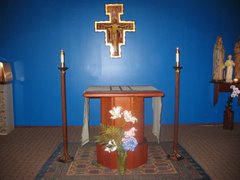
In order to symbolize all of this and to draw our attention away from the reserved Eucharist, the Church moved the tabernacle from directly behind (or even on) the altar to another still-honored place away from the altar itself. She wanted us to pay attention to the coming of Christ in the center of reality in all of the ways he comes to be present there. She wanted our liturgy to have an event at the center of its celebration, a mysterious and hard to perceive event of giving, receiving, and sharing with the world what comes to be on this altar, not something that occurred yesterday or last weekend, but something happening here and now, with, through, and in our very midst!! Thus, one of the pieces of the Church's teaching on Communion during Eucharist obligated the local church to consecrate enough hosts for everyone attending to Communicate without drawing from the tabernacle's store of reserved hosts whenever that was possible. (There is nothing wrong with drawing from reserved stores as needed, but the preference for freshly consecrated Eucharist calls our attention to what is happening here and now, including the fact that we as a People of God are being constituted as the very Body of Christ in both the breaking open of the Word, the breaking of Bread, the sharing of the cup, and our pouring out our own lives to God and one another in this liturgy. It is the altar of God standing beneath the image of the crucified Christ, along with the book of the Gospels enthroned nearby, NOT the tabernacle, that is the central symbol of all of this!!!

The GIRM (General Instruction on the Roman Missal) allows for the placement of the tabernacle behind the altar only when the space is large enough there so that our attention is not drawn away from the altar and onto the tabernacle itself. Most churches do not have adequate space for this so the tabernacle is moved a bit off to the side to another place of honor where it is accessible (to reserve the remaining unconsumed Eucharist after the Communion rite, or to reserve enough consecrated hosts to bring to the sick as an extension of the Mass itself.) If you are in a normal-sized parish church, the fact that your pastor decided to use the Feast of Corpus Christi to celebrate moving the tabernacle back behind the altar, particularly with the idea that Jesus was missing from the center of the events of the Mass, suggests he either does not understand Vatican II's teaching in this matter, or even that he dismisses it.  After all, this movement undercuts VII's Eucharistic theology of multiple forms of presence, 

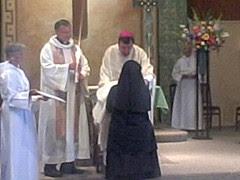
It is also likely to contribute to clericalism (a focus on the importance of the priest alone, to the denigration of the importance of the Sacrament of Baptism and the whole priestly People of God) at the same time. (More about this later if you desire it; the picture to the right should assist in seeing my point!) Moving the tabernacle back behind the altar in most churches does NOT move Christ back to the center "where he belongs". Instead, it assures that most people will not perceive him in the center of things where the Church wishes for us to also look for, listen to, and celebrate his very real Presence, that is, in the proclaimed Word, and among the baptized, the People of God gathered together in Jesus' name as "the called ones" (ecclesia).  I see this as a terribly ironic failure to worship the dynamic and real presence of Christ in the Eucharist, not an honoring of it. The irony seems to me to be especially great when the move is made and celebrated on the Feast of Corpus Christi.

I sincerely hope this is helpful. I'll get to the second part of the question ASAP!!


* A story I have told here before: A few years ago, I was participating in a Mass at Saint Mary's College of CA, where Bishops Remi de Roo and John Cummins were saying Mass for a group attending a presentation de Roo was giving on Vatican II. (Remember, de Roo was the Bishop who made the intervention at the Council to recognize the eremitical life as a state of perfection.) I was carrying the Book of Gospels in the entrance procession. Before Mass, there was a quick rehearsal with everyone involved in the procession to work out who came first, where, when, and with whom to bow, etc, to be sure we were all on the same page and Mass proceeded smoothly and reverently. Bishop Remi de Roo turned to me and said, "You carry the Book of the Gospels. You bow to no one!!" I think that one statement made more of an impression on me and my appreciation of what it means to regard the Word of God appropriately during Mass than anything else I ever learned in school, no matter the level.

** The precise form of transformation involved here is called transubstantiation because the substance of bread and wine is changed into the glorified body and blood of Jesus.

*** When we speak of our full participation in the Eucharist, we are not merely speaking of not praying the Rosary or doing other devotional activities during Mass. Neither is it mainly referring to sitting or standing when asked, or singing along, listening when appropriate, or saying the appropriate responses. All of that is involved, of course. However, our full participation is about praying the entire Mass so that we too are brought to the altar and broken open with the Word,  broken and shared or poured out with the Bread and Cup, made to be intimate members or sharers of the Body of Christ we call Church, and being commissioned to go forth to bring Christ to others as we proclaim the Gospel with our lives.

How Wonderful is my Soul With Sister Briege O'Hare, OSC


I write a lot here about the idea that God redeems us body and soul, and that to truly be spiritual is not about being disembodied, but means for our whole selves to be alive with and transfigured by the Holy Spirit. I wanted to share a bit of this same theology with the assistance of Sister Briege O'Hare and passages from Mechtilde of Magdeburg. This video is one of a series of meditations with the Poor Clare Sisters of Ireland. It is produced at the Monksland Hermitage. One of the images I love is that of God "losing himself in us", but I also love the correlative image of us, whole and entire, body and soul, immersed in the Holy Trinity like a fish immersed in the sea. Sister Brege's second song, Woman, based on Mechtilde's work, is also wonderful with its emphasis on the whole person alive in God and God in us.

I encourage you to listen to this when you have time to be quiet and allow it to speak to you. Sister Briege will introduce the meditation period. The entire period is about 30 minutes long. Other credits include: Poor Clare Monastery: www.poorclaresireland.org Monksland Garden Hermitage: www.cooleyparish.ie Song 1: How Wonderful Is My Soul by Briege O’Hare osc (Lyrics from writings of Mechtilde of Magdeburg) Background music: Flowing Light by Briege O’Hare osc Song 2: Woman by Briege O’Hare osc (Lyrics from writings of Mechtilde of Magdeburg) Singer: Marie Cox rsm Songs are available on iTunes. Read by Sister Marian Bell, OSC. The entire series of meditations is available on YouTube, and you may subscribe in order to get notifications of future meditations.

25 June 2025

On the Importance and Contemporaneity of the Eremitical Vocation (Part 2)

 [[Hi Sister Laurel, I was surprised to find your blog. To be totally honest, I thought that hermits died out a long time ago. It is not that I don't believe someone should be able to go and cut themselves off from the world of relationships if they want to. I believe everyone should be able to do whatever they want so long as no one is hurt, but why would the Catholic Church elevate something like this to the point of consecration? I am sure that most people I know would be quite surprised to find out people choose to live as hermits today, and even more surprised to hear the Catholic Church supports and even celebrates such a choice. After all, the church is about community, and a hermit's life is not, right? So my questions are about whether or not eremitical life is anachronistic. Doesn't it really belong to another time, but not to the 21st Century? Is it meaningful (is it relevant)? Does it have anything to offer the non-hermit (or those who seek to become hermits) besides an escape from everyday difficulties --- if it even does that!? Can eremitical life be justified? Should anyone (you) even try?]]

I sincerely hope the first part of this answer (Importance and Contemporaneity of Eremitical Life) was generally helpful. What I tried to do was to outline the way in which I and the hermits I know or have read regard this vocation and its general importance in the 21C, or any century really. What I would like to say more about here are the questions of this vocation's justifiability and ecclesiality, whether or not it is escapist, and in what senses that word might or definitely does not apply. I also want to say something about the notion of freedom you raise in your questions, and whether hermits cut themselves off from the world, or from the world of relationships, and in what sense those actions are true. Many of these have been addressed in other posts over the years, and I'll try to add some links where I can, but perhaps it will be helpful to write about these again within the context of your basic questions about eremitism's justifiability and contemporary relevance.

I have argued that this vocation is not only not anachronistic, that is, it doesn't only belong to past centuries in terms of relevance, but that it is an important and, in fact, a prophetic vocation for the contemporary Church and world. The Church herself recognized this when, in response to Bishop Remi de Roo's intervention at Vatican II it revised the Code of Canon Law and added canon 603, thus allowing for the first time in universal law, the vocation of the solitary hermit as an ecclesial vocation and call to the consecrated state of life. In your question, you recognized the significance of such a move on the Church's part when you asked why the Catholic Church would raise eremitical life to such a place in the Church's life. 

Bishop de Roo had been the bishop protector for about a dozen hermits in British Columbia. These men had left their various monasteries and accepted laicization after many years in solemn vows because they experienced a call to greater solitude and had to leave their monasteries to follow this call. (Let me be clear; these men were often leaders in their monasteries and were not unhappy with monastic life, their vows, monasteries, or anything of the sort. They simply had experienced a call to greater solitude, and found that this call could not be accommodated under the monastery's own (or proper) law. Eventually, they formed a laura or colony of hermits. Because Bishop de Roo knew these men, their motivations, sensibilities, theologies, and vocations, he eventually wrote an intervention at the Second Vatican Council listing the important positive reasons the church should recognize this vocation as a state of perfection. The reasons he provided in his intervention are listed in, Visibility and Betrayal and at least one earlier blog post in late 2006 or 2007. 

Canon 603 and Ecclesiality:

One way of summarizing all of this history and its meaningfulness, is to point out that c 603 governs a form of life that is ecclesial; that is, it is a form of life that is not only part of the Church's patrimony, but is part of the Church's own holiness and contributes to the Church's health, both generally and specifically in terms of her prayer life, religious life, mission, and ministry. The canonical hermit's life reminds the Church and other religious (especially those in apostolic congregations) that before active ministry there must come a profound relationship with God. It is this relationship that allows the religious man or woman to love others as they ought to be loved in the midst of apostolic ministry. It is also this specific relationship that is mediated along with any other forms of giving that the religious does. The hermit's vocation does the same for cloistered religious and reminds them of the real witness of their lives, namely, a life in community lived for the sake of God and God's place in this world. And of course, the hermit does this for the entire Church, reminding us all that God comes first and can fulfill lives that are not wealthy, powerful, or possessed of much prestige in worldly terms. As I have noted recently, while the hermit may do some limited apostolic ministry, it is the inner journey to union with God that is essential to and definitive for the vocation.

Ecclesial vocations aren't simply lived within the Church; they are also lived for the sake of the Church, that it might truly be the church Jesus calls it to be. Those hermits who accept canonical standing with public vows and consecrations mediated by the local Bishop also embrace this dimension of the eremitical vocation in a public way. Non-canonical hermits live their vocations within the church, but they do not necessarily accept this dimension we call "ecclesiality" in the same way. Canonical eremitism, of course, is not the only ecclesial vocation in the Church, but the emphasis on the inner journey made possible by assiduous prayer, penance, stricter separation from the realm that is resistant to Christ or to Truth, and by the silence of solitude, sets eremitical life somewhat apart from the others, and allows it to emphasize something the others accentuate to a lesser degree or in a different way. As noted in earlier posts, it is the inner journey that allows us to confirm that the Gospel of Jesus' resurrection and God's unconditional Love, from which nothing including sin and godless death can separate us, are real and encounterable today. This allows canonical eremitical life to serve these other vocations and the Church as a whole. When we speak about the relevance or contemporaneity of the hermit today, ecclesiality is an important way of describing this.

Eremitical Life and Freedom:

In your question, you said you believed that anyone should be free to do whatever they felt like, so long as no one was hurt in the process. I believe that is the notion of freedom many people in today's world have. Let me point out that this is not the idea of freedom Christianity understands or embodies. Instead, Christianity defines freedom as the power to be the persons God calls us to be. This, in turn, is made possible by the Holy Spirit and God's unconditional love for us. Hermits live a regular life of prayer and penance, study, lectio, and limited ministry because they live a life focused on their relationship with God and on becoming the persons God calls them to be. One of the most important witnesses the hermit gives others is the fullness of life that is possible whenever God is put first. Some who read here know that one of the persons I have contended with most often over the years is an online self-designated hermit who calls herself a victim soul and writes almost interminably about the suffering she is experiencing. I have sympathy for her, but it is my understanding of eremitical life that it is not about suffering or being what has sometimes been called a victim soul. It is about living life with God. Yes, there will be suffering, just as there is with any life in this world, but eremitism is not a life OF suffering; it is a life of joy, meaning, and fulfillment --- countercultural as each of those actually is.

Canonical hermits (and likely all authentic hermits) are truly free. They are not free to do anything they want, of course. Their lives are constrained by vows involving the main areas of life, including wealth, power, and sex, and still they live lives I recognize as fulfilled because they are full of life, love, and meaning. They live according to a daily schedule, maintaining regularity and balance. They live a stricter separation from "the world," which includes but does not primarily mean separation from much of God's good creation; and yet, they are interested in, committed to, and engaged with that world for the sake of its well-being and the furtherance of God's Kingdom, nonetheless. All of these point to a fundamental freedom the hermit has to live a life as full and meaningful as possible within the framework of a desert context. Freedom, from this perspective, is definitely not about doing whatever one likes so long as no one is hurt. It is about living a responsible freedom where one's life is not only received daily as a gift of God, but also is given daily for God's sake and the sake of all that God loves and holds as precious.

Relationships, Escapism, and Eremitical Engagement:

Most hermits are not recluses, and even recluses in the Catholic Church are only allowed to be so within the context of a loving religious community that provides for such unique vocations. (The last I heard of recluses, only the Camaldolese and the Carthusians were allowed to have recluses. The last Camaldolese recluse I know of died a number of years ago in Big Sur, while the most famous might be Nazarena, a recluse living with the Camaldolese nuns in Rome.) All human beings need to be loved and to love, and for that reason, we all need others in our lives. We hermits say that "God Alone is Enough" for us, and we mean that in two related ways. First, only God is capable of completing us as human beings. Only God is sufficient for this. We are made for God, who is the ground and source of life, love, meaning, truth, beauty, and truly personal existence. Secondly,  our openness to and need for God make us open and responsive to all that mediates God to us in the incredibly varied ways the created world and other beings do that. What this saying does NOT mean is that human beings do not need other human beings, or can become truly human in complete isolation from others. Eremitical life has never meant to affirm such a notion of human being or of the nature of eremitical solitude. 

In my writing on this blog over the past 18 years, I have always drawn a clear line between isolation and solitude. I distinguish these two because one is life-giving and the other can deal death to the human being. I am personally sensitive to the distinction between these two and associate isolation with alienation and forced separation from the community of others. Hermits are more or less physically isolated from others; eremitical solitude requires this in order to spend time with God and the inner journey to healing, wholeness, and holiness we are each called to. However, we are not usually personally isolated from others, though we may not be as social as most people or able to spend much time with the people who are important to us. We are assisted in living this solitude by the Church and her liturgical and sacramental life, by spiritual directors, pastors, members of the larger community of faith, family members, physicians, and many others. I include among this significant group of people, especially other religious, and members of the virtual laura I am part of, as well as those I do spiritual direction with. It is not that I interact with these people every day or even every week or month of my life, but they are all a significant presence, and each one helps to focus my life on the defining relationship with God that makes me who I am and who I am called to be.

You suggested not only that a hermit's life is cut off from the world of relationships, but that it is not about community. I would argue that it is about community, though it is lived in eremitical solitude. In fact, I would argue (and have often done that here) that eremitical solitude is a rare and unique form of community dedicated to building the human family and the community of faith from the most important and original relationship extant, namely, that between the human being with the rest of creation and God. As for escape from everyday difficulties, there is no way c 603 life allows for or encourages that. The (canonical) hermit is self-supporting, publicly responsible, committed to the Church and society, and engaged on their behalf. She lives with the same limitations any other person does and perhaps a few more besides. What is most important to remember about this vocation is that it is identified by the Camaldolese in terms of the Privilege of Love. Indeed, I am not going to run for political office or travel to (or even stay home to do) a job forty hours or more a week, but, because I am called to stricter separation from "the world" in the specialized way c 603 uses that term**, it also means I am committed to God's will for the whole of this larger world. Thus, I stay updated on current events, work to ensure my education remains up to date, and I engage in whatever ways I can within the limits of my state of life to make our world all that God calls it to be.

So, this is the second part of my answer to your question. I hope it clarifies some things and raises more questions for the future. As always, if I have been unclear, please feel free to get back to me with comments and questions. Again, thanks for your questions. I enjoyed thinking about them freshly. I will post this before adding the additional links, so in the meantime, you can look at the list of topics on the right-hand column of the blog for additional information. All my best.

** The Church recognizes that "the world" in the c 603 phrase, stricter separation from the world, refers to that which is resistant to Christ, and not first of all to the larger world we identify with God's good creation. As a result, while the hermit is thus more strictly separated from aspects even of God's good creation, she is also well able to engage with and on behalf of that world within the limits of her state of life.

24 June 2025

Feast of John the Baptist

 Today is the feast of John the Baptist, a desert dweller par excellence. Hermits, therefore, esteem him as a forerunner of our own vocation as eremites, desert dwellers.  John's life was marked out in the Scriptures as someone related to Jesus as family, and who stood as a witness to Jesus' messianic identity when he baptized Jesus in the Jordan. I have only written about John the Baptizer twice in this blog. Once, indirectly, on the Feast of Jesus' Baptism, and here, when I contrasted the forgiveness marked by John's baptism and preaching with that of Jesus. I wanted to post that second piece again, because it ties in with the witness of contemporary hermits whose lives proclaim Jesus and all that God accomplished for us in Jesus through his life, death, resurrection, and ascension. It also reminds us that God's revelation of his own justice depends on each of us opening ourselves and our world to a love and forgiveness that is even more profoundly countercultural and prophetic than John the Baptist's expression of it was. Lest that seem to be "damning John Bp with faint praise", let us remember that on Feast days, we celebrate people who are remarkable precisely because they pointed away from themselves to Christ and the God he revealed definitively and exhaustively.

Reprised: Gospel Reading referred to below is Matthew 11:16-19


Recently, I watched the story of a woman (Eva Moses Kor) who survived the holocaust. She was one of a pair of twins experimented on by Dr Mengele. Both she and her sister (Miriam) survived the camp, but her sister's health was ruined, and years later, she died from long-term complications. Mrs Kor forgave Mengele and did so as part of her own healing. She encouraged others to act similarly so they would no longer be victims in the same way they were without forgiveness, and she became, to some extent, despised by a number of other survivors. What struck me was the fact that Eva had come implicitly to Jesus' own notion of forgiveness and justice (where her own healing is paramount and brings about changes in others and the fabric of reality more than other notions of justice) while others clung to the Jewish teaching which states that amendment and restitution (signs of true repentance but more than this as well) must be made before forgiveness is granted. What also struck me was that she was indeed freer and less a victim in subjective terms than those who refused to forgive, saying they had no right. Further, her forgiveness and freedom freed others (including another doctor at the camp (Dr Hans Munch) who had, until he met Eva and heard of her own stance towards Mengele, been unable to forgive himself) --- though her forgiveness of Mengele and related freedom also pointed up the terrible bondage that can come from either refusal or inability to forgive which other survivors experienced --- especially as this became complicated by their newfound anger with Eva.

Matthew's Gospel lection reminds me of this video (and vice versa) because of the close linkage of John Bp and Jesus, and so of two very different (though still-related) approaches to repentance and forgiveness. On the one hand, a strictly ascetic John the Baptist preaches what John Meier describes as a "fierce call to repentance, stiffened with dire warnings of fiery judgment soon to come." (A Marginal Jew, vol 2, pp 148-49) In general, John's preaching is dismissed, and John himself is treated contemptuously as being mad or possessed by a demon. In the language of the parable, John piped a funeral dirge, and people refused to mourn.

On the other hand, we have Jesus of Nazareth preaching the arrival of the Kingdom of God and offering "an easy, joyous way into [that] Kingdom" by welcoming the religious outcasts and sinners to a place in table fellowship with himself. Meier characterizes the response to THIS call to repentance in terms of the parable, [[With a sudden burst of puritanism, this generation felt that no hallowed prophet sent from God would adopt such a free-wheeling, pleasure-seeking lifestyle, hobnobbing with religious lowlifes and offering assurances of God's forgiveness without demanding the proper process for reintegration into Jewish religious society. How could this Jesus be a true prophet and reformer when he was a glutton and a drunkard, a close companion at meals with people who robbed their fellow Jews . . .or who sinned willfully and heinously, yet refused to repent. . .?]] In other words, in terms of [the Matthean] parable, Jesus piped a joyful tune, a wedding tune, and people refused to join in the celebration and dismissed Jesus himself as a terrible sinner, worthy of death.

There is wisdom in both approaches to repentance and forgiveness. Both are part of the Judeo-Christian heritage. Both approaches are rejected by "this generation" --- as Jesus calls those who refuse to believe in him. Both lead to greater freedom. But it is Jesus' model which leads to the kind of freedom Eva Moses Kor discovered, and which is meant to mark our own Christian approach to repentance and forgiveness. After all, repentance is truly a celebration of God's love and mercy, and these we well know are inexhaustible. Still, entering the celebration is not necessarily easy for us, and we may wonder, as some of the other survivors wondered about Eva's forgiveness of Mengele, do we have the right to forgive? Is it wise to act in this way towards someone who has not repented and asked for our forgiveness? Isn't this a form of "cheap grace" so ably castigated by Dietrich Bonhoeffer --- also a victim of the Nazi death machine? (cf The Cost of Discipleship) Where does forgiveness become enabling, and does it demean others who have also been harmed? What about tough love: isn't John Bp's approach the better one? Am I really supposed to simply welcome serious sinners into my home? Into our sacred meal? To membership in the Church? To my circle of friends?

And the simple answer to most of these questions is yes, this is what we are called to do. The Kingdom of God is at hand, and Jesus' example is the one we follow. It is this example that leads to the freedom of the Kingdom, this example that made Christians of us and will, in time, transform our world. In particular, it is this example that sets the tone for [post-Easter] joy and festivity and allows God's future to take hold of our lives and hearts. It is not merely that we have the right to forgive in this way, but that we have been commissioned to do so. It is an expression of our own vocations to embody or incarnate the unconditional mercy of God in Christ.

Most of us will find ourselves caught between the prophetic example of John the Baptist and the Messianic example of Jesus' meal fellowship with sinners. We have great empathy both for the approach of Eva Moses Kor AND those survivors who could not forgive Mengele --- often because they felt that doing so was contrary to justice as spelled out in the Scriptures and elaborated in rabbinical tradition, as well as because it demeaned his victims. We know that "tough love" has a place in our world and that "cheap grace" is more problem than solution. The Feast's Gospel underscores our own position between worlds and kingdoms, and it may cause us to recognize that there was a deep suspicion of Jesus' table fellowship, which was grounded in more than envy or fear. We may see clearly that the Jewish leadership of Jesus' day had serious and justified concerns about the wisdom of Jesus' actions and religious praxis. Even so, it is also clear regarding which model of repentance and forgiveness we are to choose, which model represents the freedom of the Kingdom of God, and which model allows us to be Christ for others. As Matthew's version of this parable also affirms, the wisdom of this approach will be found in its fruit --- if only we can be patient and trust in the wisdom of Jesus, the glutton, drunkard, and libertine who consorted with serious sinners.

22 June 2025

On the Importance and Contemporaneity of the Eremitical Vocation (Part 1)

[[Hi Sister Laurel, I was surprised to find your blog. To be totally honest, I thought that hermits died out a long time ago. It is not that I don't believe someone should be able to go and cut themselves off from the world of relationships if they want to. I believe everyone should be able to do whatever they want so long as no one is hurt, but why would the Catholic Church elevate something like this to the point of consecration? 

I am sure that most people I know would be quite surprised to find out people choose to live as hermits today, and even more surprised to hear the Catholic Church supports and even celebrates such a choice. After all, the church is about community, and a hermit's life is not, right? So my questions are about whether or not eremitical life is anachronistic. Doesn't it really belong to another time, but not to the 21st Century? Is it meaningful (is it relevant)? Does it have anything to offer the non-hermit (or those who seek to become hermits) besides an escape from everyday difficulties --- if it even does that!? Can eremitical life be justified? Should anyone (you) even try?]]

Thanks for your questions. I once said almost exactly the same thing about hermit life having died out. Similarly, I once thought that contemplative life, more generally, was a "waste of skin." Clearly, I am in a much different place today! In much of what I have written over the past two or three months, for instance, I have tried to maintain a balance between a potentially disedifying focus on personal details and the way my own experience illustrates the more universal meaning and significance of the eremitical vocation in today's Church and world. My own eremitical journey, my own journey with and to God, especially in the inner work required by, and associated with personal growth and healing, is at the center of everything I have written, and what is remarkable to me is the way that experience comports with that of contemplatives, hermits and mystics throughout the centuries. In some ways, that journey is precisely what makes me a contemplative and hermit. The nature of it is what also makes my journey a mystical one

But why is this important? You are correct in posing the question of a hermit being anachronistic (i.e., displaced in time). This is the overarching question posed to contemporary hermits by the 21st Century generally -- both by the Church and the larger world. It is the basic argument I hear reflected in others' questions (and my own as well): "If your vocation is anachronistic, then it is meaningless, irrelevant, and has no place in today's world and Church." Of course, most people never actually say this or ask the question outright. They tend just to look puzzled as I explain I am a consecrated (or a Catholic) hermit, and you can see them trying to work out what I have just said in terms of the church and world they know and understand. Usually, the next question I get after explaining I am a hermit is a disbelieving, "So (pause), what is a hermit?"--- as if the two of us can't possibly be thinking of the same reality, not in today's day and age!! (I can imagine them thinking, "Maybe the meaning of this changed with Vatican II or something!!")

And so, I explain a bit of the history of the hermit life and the establishment of c 603 within that. And I wait for other questions. "What do you do all day?" is usually one of the early ones. "Wouldn't you rather...?" tends to be another, along with, "How many of you are there?" once the conversation actually gets going. And it is a deep hope of mine that such a conversation will get going. After all, if, on the other hand, this vocation is meaningful and has a place in today's Church and world, that means it is meaningful not only for the hermit, but for God, for the Church itself, and for God's larger creation as well." Unfortunately,  most people tend to smile politely and move to other topics. So, I am really grateful you have asked what you have, because as I understand things, it is up to the hermit to explore the eremitical life and these associated questions as we come to a coherent sense of their answers. No one but the hermit can do this in quite the same way!

Most hermits I know firmly believe their vocations are important, not only for what they mean for the hermit him/herself, but for the way they witness to others in our Church and world about really foundational human and societal questions and needs. Merton once wrote that hermits say something fundamental about the relation of nature and grace, and I think he was exactly right. The fundamental truth that human beings are made for God and that God wills to dwell with and within us is the truth Merton was speaking of. He recognized that human beings have a "made-for-God" quality that is rooted in God's own will for creation and for Godself. In other words, human beings are incomplete and less than truly human without God. At the same time, God has chosen to turn to us so that his love might be known and fulfilled in this way. Using an older language to say this, nature is perfected in grace, and grace intends to reveal itself fully, even exhaustively, in nature. 

In a Church where apostolic ministry is (quite rightly) esteemed, and the relevance and value of the contemplative calling is, at least tacitly, questioned by even some of the highest up in the Church, eremitical life is, again, a radically countercultural vocation. In a world where individualism reigns, consumerism is rampant, and, far too often, the accumulation of wealth and privilege are supposed to be the marks of real success, the eremitical life again stands as a radically countercultural witness and challenge. The same is true in a world where privacy and discretion are sacrificed on the altar of superficial "belonging" via "friending" or vlogging and blogging. This means that the eremitical vocation, besides being countercultural, is a prophetic calling; it witnesses to deep truth in a world hungry for it, and in need of the wisdom derived from it. At least that's what I and the other hermits I know believe. To apply an observation St Paul made in another context, if the hermit vocation to witness to God and the human seeking of God is not truly serious and seriously true, then we hermits are the greatest fools of all!

Hermits' lives are not meaningful merely because we pray for others, though undoubtedly we do that, and yes, that (we claim!) is significant. Hermit's lives are meaningful because they are dedicated to seeking God and living with, in, and from God, and moreover, they are meaningful because this seeking is engaged in for the sake of others (first of all for God's sake and then for that of the whole world) as well as for the hermit's own sake. What we say to others is that every prayer, every act of attentiveness and responsiveness to life and love, every gesture of generosity, or decision leading to self-sacrifice. and service, every moment spent by anyone in this world cultivating the values at the heart of the Gospel, making neighbors and friends of those distant from or "other" than we are, is meaningful and contributes to the sovereign life of God-With-Us we Christians call the Kingdom of God. Hermits (authentic Christian hermits) say with their lives, that God wills to dwell with us here and now and that where that is allowed and even seriously pursued, human life becomes what it is meant to be, joyful, fulfilled, simple, loving, free, hopeful, and engaged for the sake of the whole of God's creation.

And hermits witness to more than this as well.  In the inner journey we make while seeking God, we explore the questions of meaning and meaninglessness, the existence and nature of the God we seek to know and be known by, questions about prayer and suffering, the nature of the human person, the importance of relationships in every life, personal integrity (or holiness), etc. --- questions every serious person asks in varying ways throughout their lives. We don't ordinarily do this in the formal academic way theologians do (though some of us may also do that); we do it experientially. Recently, a couple of diocesan hermits responded to an observation I made about my blog and the questions I get. "You write about the same things again and again, but you [continue to] do so from a[n ever] deeper place (or in a deeper way)." I sincerely hope that is true because if it is, it means this blog is a witness to the nature of my own journey with, in, and for God and what is precious to God. In any case, the inner journey is a journey of profound questioning; it poses the question we human beings are as well as those we pose. It is the journey of faith and doubt, woundedness and healing, despair or near despair, and ultimate hope. Hermits make this journey with Christ into the darkness of sinful (godless) death and the blazing light of resurrection. We seek God in every dark and wounded place, especially within our own hearts and minds, our own memories and deep aspirations, and to the extent we do this and find (or are found by!) God in our searching and hunger,  we proclaim, with St Paul et al., the truth of the Christian Gospel, namely, there is no place and nothing at all that can separate us from the love of God.

Individuals within the Church have always made this journey. Lay persons, religious, priests, contemplatives, hermits, mystics, have all made this inner journey with Christ into darkness and death, and discovered the reality of Jesus' resurrection and the truth of Romans 8:31-39. I would argue that there is nothing whatsoever to justify such a journey, or such vocations, apart from this seeking of God and the truth of the Gospel. At the same time, I have to note that making this journey so that others can know the truth of Jesus' resurrection and the depth and expansiveness of God's love, not as a matter of doctrine but as one of personal experience, is imperative for the vitality of contemporary faith and the life of the Church. So, when you ask what the hermit does for the non-hermit, I would need to say that all of this is applicable. I don't know a single person, believer or non-believer, who doesn't wonder if their life is meaningful, if they are loved or really capable of loving, if "this is all there is," or how is it one lives life in a way that truly honors who they are most fundamentally. The hermit says with her life that even when stripped of the various things the contemporary world believes make our lives meaningful (health, wealth, prestige, power, appreciated societal and service roles, etc), our lives can be full, truly free, given for the sake of others, and ultimately meaningful. Moreover, such stripping can lead to persons with the perspective needed to move our world forward into God's own future.

I'll return to your comments and questions (especially the nature of freedom, on escapism, and on the creation of eremitism as an ecclesial vocation) with another post. Consider this the beginning of an answer on the meaningfulness of the eremitic vocation. If it raises different questions for you, please get back to me as soon as you can. It would be helpful for the way I put together a second post.

19 June 2025

Feast of Saint Romuald, Founder of the Camaldolese Benedictines


Romuald Receives the Gift of Tears,
Br Emmaus O'Herlihy, OSB (Glenstal)

Congratulations to and prayers for all Camaldolese, monks, nuns, oblates, and friends! Tomorrow, June 19th is the feast day of the founder of the Camaldolese Congregations! We remember the anniversary of solemn profession of many Camaldolese as well as the birthday of the Prior of New Camaldoli, Dom Cyprian Consiglio.

Ego Vobis, Vos Mihi: "I am yours, you are mine"

Saint Romuald has a special place in my heart for two reasons. First he went around Italy bringing isolated hermits together or at least under the Rule of Benedict --- something I found personally to resonate with my own need to seek canonical standing and to subsume my personal Rule of Life under a larger, more profound, and living tradition or Rule; secondly, he gave us a form of eremitical life which is uniquely suited to the diocesan hermit. St Romuald's unique gift (charism) to the church involved what is called a "threefold good", that is, the blending of the solitary and communal forms of monastic life (the eremitical and the cenobitical), along with the third good of evangelization or witness -- which literally meant (and means) spending one's life for others in the power and proclamation of the Gospel.

Stillsong Hermitage
So often people (mis)understand the eremitical life as antithetical to communal life, to community itself, and opposed as well to witness or evangelization. As I have noted many times here they mistake individualism and isolation for eremitical solitude. Romuald modeled an eremitism which balances the eremitical call to physical solitude and a commitment to God alone with community and outreach to the world to proclaim the Gospel. I think this is part of truly understanding the communal and ecclesial dimensions which are always present in true solitude. The Camaldolese vocation is essentially eremitic, but because the solitary dimension or vocation is so clearly rooted in what the Camaldolese call "The Privilege of Love" it therefore naturally has a profound and pervasive communal dimension which inevitably spills out in witness. Michael Downey describes it this way in the introduction to The Privilege of Love:

Theirs is a rich heritage, unique in the Church. This particular form of life makes provision for the deep human need for solitude as well as for the life shared alongside others in pursuit of a noble purpose. But because their life is ordered to a threefold good, the discipline of solitude and the rigors of community living are in no sense isolationist or self-serving. Rather both of these goods are intended to widen the heart in service of the third good: The Camaldolese bears witness to the superabundance of God's love as the self, others, and every living creature are brought into fuller communion in the one love.

Monte Corona Camaldolese
The Benedictine Camaldolese live this by having both cenobitical and eremitical expressions wherein there is a strong component of hospitality. The Monte Corona Camaldolese which are more associated with the reform of Paul Giustiniani have only the eremitical expression which they live in lauras --- much as the Benedictine Camaldolese live the eremitical expression.

In any case, the Benedictine Camaldolese charism and way of life seems to me to be particularly well-suited to the vocation of the diocesan hermit since she is called to live for God alone, but in a way which ALSO specifically calls her to give her life in love and generous service to others, particularly her parish and diocese. While this service and gift of self ordinarily takes the form of solitary prayer which witnesses to the foundational relationship with God we each and all of us share, it may also involve other, though limited, ministry within the parish including limited hospitality --- or even the outreach of a hermit from her hermitage through the vehicle of a blog!

In my experience the Camaldolese accent in my life supports and encourages the fact that even as a hermit (or maybe especially as a hermit!) a diocesan hermit is an integral part of her parish community and is loved and nourished by them just as she loves and nourishes them! As Prior General Bernardino Cozarini, OSB Cam, once described the Holy Hermitage in Tuscany (the house from which all Camaldolese originate in one way and another), "It is a small place. But it opens up to a universal space." Certainly this is true of all Camaldolese houses and it is true of Stillsong Hermitage as a diocesan hermitage as well.

The Privilege of Love

For those wishing to read about the Camaldolese there is a really fine collection of essays on Camaldolese Benedictine Spirituality which was noted above. It is written by OSB Camaldolese monks, nuns and oblates. It is entitled aptly enough, The Privilege of Love and includes topics such as, "Koinonia: The Privilege of Love", "Golden Solitude," "Psychological Investigations and Implications for Living Alone Together," "An Image of the Praying Church: Camaldolese Liturgical Spirituality," "A Wild Bird with God in the Center: The Hermit in Community," and a number of others. It also includes a fine bibliography "for the study of Camaldolese history and spirituality."

Romuald's Brief Rule:

And for those who are not really familiar with Romuald, here is the brief Rule he formulated for monks, nuns, and oblates. It is the only thing we actually have from his own hand and is appropriate for any person seeking an approach to some degree of solitude in their lives or to prayer more generally. ("Psalms" may be translated as "Scripture".)

Sit in your cell as in paradise. Put the whole world behind you and forget it. Watch your thoughts like a good fisherman watching for fish. The path you must follow is in the Psalms — never leave it. If you have just come to the monastery, and in spite of your good will you cannot accomplish what you want, take every opportunity you can to sing the Psalms in your heart and to understand them with your mind. And if your mind wanders as you read, do not give up; hurry back and apply your mind to the words once more. Realize above all that you are in God's presence, and stand there with the attitude of one who stands before the emperor. Empty yourself completely and sit waiting, content with the grace of God, like the chick who tastes and eats nothing but what his mother brings him.

Looking Again at Merton's Comment on the Likeness of Despair and Hope

I have been asked by a couple of people to say more about what Thomas Merton meant by stating that hope and despair are very much alike, as I raised the question rhetorically without providing a direct answer. The original post can be found here Why does the Church Need Hermits? and includes the pertinent Merton quote.

The passage in that post that I want to write about here is the one reflecting on Jesus' cry of abandonment from the cross, because I think that it is here we see most clearly a hope that could be mistaken for despair.  What I wrote there said, "And in the very depths of Jesus' journey into the darkest absence of being and meaning, life and love, God was there. But Jesus' question in the Garden was also sharpened there on the cross: why can't you pluck me out of this situation? Why HAVEN'T you rescued me? How will you vindicate me and, more importantly, my proclamation of the truth of your Reign, your sovereignty, if sinful, godless death is allowed to win out? Don't you see, godless death is swallowing me up!! I have nothing whatsoever left to give!! My God (not the more intimate, Abba!), why haven't you rescued me?"

What I think it is important to recognize about Jesus' so-called cry of abandonment is the fact that, despite the use of a more formal, "O God, my God" rather than Jesus' more usual and intimate, "Abba" Jesus was speaking to God and remained open to God doing whatever he willed to do to vindicate Jesus and his proclamation of God's coming Kingdom. The questions I posed in the above passage were meant to reflect a sharpening of the question Jesus posed in Gethsemane, "Isn't there another way?" It was as I meditated on and struggled with Jesus' experience on the cross that it became clear to me that I might have a sense of what Thomas Merton was saying about the kinship of hope and despair. 

In my own experience, I described these two realities as being "an eyeblink apart". When I said that, I was thinking of the parallax phenomenon where we look at an object first with one eye, and then with the other, without moving our head. There is a decided difference between the two views, yet they are still views of the same reality. I think in some ways this might have been what Merton saw about the relation of hope and despair, whether the source was his own experience or his meditation on Jesus' cry of abandonment or both together (which is what I believe he was speaking of).

Imagine yourself closing your right eye and looking at the events on Golgotha with just your left eye, so to speak. Jesus had reached the end of his own resources. In many ways, his situation seemed hopeless. It was a situation that struck fear and revulsion in the hearts and minds of those who even considered such a death. Crucifixion was considered a literally godless reality, and this was true for Jews as well as for the Greco-Roman world. Jesus' cry of abandonment (or any inarticulate cry, such as Mark gives us) could well be seen as a cry of abject despair, particularly as Jesus shifts his usual Abba to O God! Everything about the situation seems worthy of despair. When someone comes to the end of their resources and their life project seems to have collapsed not only in failure, but in abjectly humiliating failure underscored by personal betrayal and rejection because that life project was built on the proclamation of a God who loved without condition or limit and willed to be with us in every moment and mood of existence, well,  this is the stuff human despair is made of.

But let's look at the events of Jesus' crucifixion from that slightly different perspective using the idea of parallax and what it might be able to show us. Imagine you now close or hold your hand over your left eye and look at the same events with only your right eye. The change in perspectives is very slight, but the shift in the image being perceived is very real. Jesus had reached the end of his resources. In almost every way, his situation seemed hopeless. It was a situation that indeed struck terror and revulsion into the hearts and minds of every person in Jerusalem that day. It was a literally shameful, godless death in Jewish theology and abject foolishness and ignominy from the Greco-Roman perspective. Jesus' cry of abandonment (or his inarticulate cry in Mark's Gospel), even if it is taken from the first half of Psalm 22, appears at first to be a mockery of the eventual vindication that comes in the second half of the psalm --- perhaps a repudiation of his faith. Yes, Jesus has been betrayed and rejected by those who most loved him, except for his Mother and a couple of hangers-on. The God Jesus proclaimed with his life is apparently powerless -- if he exists at all. This is definitely the stuff despair is made of. And yet, what you can just barely see from this slightly different perspective is that Jesus has not closed himself off to God. His cry is not just a plaint of horrific suffering. It is also truly a prayer, the giving up of the last vestige of self-defense, the whole-hearted and heart-breaking embrace of a God that is bigger than even the greatest of human resources or their loss.

From this perspective, one can glimpse more clearly than one was able from the first perspective, that Jesus knows this God whose sovereignty he proclaimed and, despite the loss of everything else that could be called a resource, Jesus has not given up all hope.  This is not failure. This is what it looks like for the one who was utterly open and transparent to God to show us precisely how far this God would journey to truly be with us in every moment and mood of our lives. And Jesus allowed this; his own journey of integrity made it possible for God to enter this darkest and most senseless of realities, and transform it with his presence.  I believe this may have been what Thomas Merton was talking about when he referred to how similar despair and hope are. It is very like what I experienced at the beginning of Lent when I realized my deepest hungers and yearnings showed me the face of God and my own deepest self as well. For me, hope and despair were only an "eyeblink apart". They were so closely related that there were times I could not (thanks be to God!) tease them apart. But it was only in entering into the shadow of death and the precincts of despair or near-despair that an even more vibrant hope was possible.

Nothing and no one but God could have redeemed my own experience, just as only Jesus' Abba could have redeemed his experience and raised him to new life. I believe Thomas Merton's own life, prayer, and human struggle for wholeness and holiness brought him to something of the same experience that led him to say, " I have been summoned to explore a desert area of man's heart in which explanations no longer suffice, and in which one learns that only experience counts. An arid, rocky, dark land of the soul, sometimes illuminated by strange fires which men fear and peopled by spectres which men studiously avoid except in their nightmares. And in this area I have learned that one cannot truly know hope unless he has found out how like despair hope is.How alike indeed! Sometimes that huge difference really is only an eyeblink apart.                                         

Feast of Saint Romuald and the Camaldolese Congregation

 From the Camaldolese newsletter regarding today's feast:


June 19th is an official feast for the Camaldolese congregation. It marks the feast of the founder of the Camaldolese Congregation, Saint Romuald of Ravenna.

Born in 951 AD, Father Romuald lying on his bed, gave his life back to God on the 19th of June 1027- (Saint Peter Damian: The Life of Blessed Romuald). As a young man, Romuald did penance for 40 days at the monastery of Sant’Apollonare near his home region of Ravenna, which was then an administrative city for the destroyed western Roman Empire, simply for being a witness of a duel where there was a death. He then became a monk there, but shortly afterward came under the tutelage of a hermit monk in Venice named Marino with whom, among other things, he prayed the 150 psalms every day. Venice was at that time considered Byzantine territory. It was common practice for hermit monks to pray constantly, especially to pray the entire psalter daily. This was a tradition shared with the Levite priests of Judaism praying the Tehillim, the same tradition for monks of the desert in the north of Africa and the Middle East, as well as among both the eastern and western monks of the Roman Empire. In 978 Romuald left Venice to travel with an abbot of Cluniac tradition, Abbot Gari, to one of his monasteries under his jurisdiction located in Cuxa (the Pyrenees). There Romuald lived for almost 10 years as a hermit, but also participated in the cenobitic life with other monks. There he was also ordained a priest.

These two pivotal places, Venice and the Pyrenees, marked the formative moments in his monastic life, where he realized the importance of a balance of eremitism and cenobitism in the spiritual life. After Cuxa, Saint Romuald returned to Ravenna and immediately to Montecasino for a short period of time. Then, and for the rest of his life, he moved through different areas in central Italy, mainly within what was then the Papal states, and Istria, which was part of the republic of Venice and is now Croatia, founding hermitages, reforming monasteries, and mentoring other monks.

Saint Romuald lived in tumultuous times, where alliances, principalities, empires, duchies, provinces, and new marquisates were forming. Unfortunately, during this period in history, nepotism (the favoring of relatives or friends) existed in order to secure geographical territory. Monasteries and abbeys were appointed or granted in order to secure some favor in government, alliances or power. Simony (the buying and selling of religious posts or pardons) was also common.

Within this environment, Saint Romuald was appointed to various abbacies and also twice threatened with death. He rejected the threats and avoided compromising situations with his religious fervor and piety, always responding to the call to serve and surrender to God’s call. He preferred times of prayer and seclusion above all; in his interactions with other monks as is stated in both documents that narrate his life (Saint Peter Damian’s The Life of Blessed Romuald and Saint Bruno of Querfort’s The Life of the Five Brothers), he always gave counsel to monks to return to their cell and pray. He attracted multiple candidates to monasticism and his fame grew in the region of what is now Tuscany, Venice, Croatia, and Rome.

17 June 2025

Follow-up Questions on the Bishop's Responsibilities in Regard to c 603 Professions

[[Dear Sister, what I hear in your response on the situation in Lexington is that your concern is mainly with the bishop of Lexington. Isn't a fraudulent use of c 603 the responsibility of the candidate seeking admission to profession? When you say that Cole Matson made first vows even though she didn’t believe she was called to this vocation, I am confused. She claims to be a diocesan hermit, doesn’t she? Can one make vows or profession without really believing one has this vocation? How is that possible? I have an acquaintance in my parish who is trying to become a diocesan hermit. She said our impression that he wanted to be sure my ‘friend’ is really a hermit before he agree bishop is the final authority in these matters, but that he cannot just do whatever he wants. I got that he wants to be sure she is a hermit before he admits her to profession.]]

Thanks for your questions.  Part of what you are confused by with the situation in Lexington, KY, I think, is built into the situation itself by both Bishop and Matson. At the same time, I agree with your friend’s observation on the Bishop’s role in the matter of professing people under c 603. While a candidate is responsible for discerning this vocation in good faith, something Cole failed to do in this case, the Bishop has the final say as well as the responsibility for discerning such vocations, and protecting and nurturing them as part of the Church's eremitical tradition. This means 1) he cannot and must not profess someone who doesn’t truly believe they have such a vocation, and 2) he must do all that is necessary to understand, appreciate, and help candidates discern and secure the necessary formation required by a genuine eremitic vocation. (He may, of course,  delegate other chancery personnel to help with this.)

In all of this, one thing should be clear. The bishop serves the Church and her own patrimony, including canonical vocations God has entrusted to the Church. With all this in mind, your question, “How is this possible?” is an important one. I have never before heard of a situation where a bishop has admitted someone to profession (an act that is larger than just the making of vows) when s/he claims to know she is called to something else. Had the Bishop truly determined Cole had some kind of new vocation to consecrated life requiring public profession, he could have tried to profess Cole under c 605 which is dedicated to new forms of consecrated life, but this would also have required the agreement of the Vatican, so I think it is understandable why he did not chose to do this. Instead, he used c 603, giving the really poorly-considered grounds for professing Cole under c 603 posted here recently and last year.

What this required was an abdication of the bishop’s responsibility to protect and nurture c 603 vocations themselves. It also led to the inability to have faith in the adequacy of the discernment process of any other professions under c 603 that might take place in this specific diocese. That especially includes any further attempts at making a canonical profession made by Matson in the future. As I noted last year, even if Cole were to say he has “discovered” a genuine eremitical vocation before making such a commitment, it would be very difficult to trust his "discernment" or believe his motivations were valid this time around. Still, the primary responsibility with regard to this vocation falls to Bp John Stowe and secondarily to any canonist giving the bishop advice on the use of the canon in Cole's regard. Bishop Stowe was entrusted with this specific vocation as belonging to the Church, as well as with being the last (though not the only) word in assessing candidates’ discernment processes. It is also the bishop's job to determine, more generally, what is best for the diocese in terms of such a vocation. Because c 603 is an ecclesial vocation, admission to profession should be a sign that the candidate understands her place in building and representing the heart of the Church, and expressing with her life the Church’s theology of consecrated life.

I am glad to hear what your friend said about her own bishop. It is reassuring to hear that that is the minimum criterion he must see in order to admit one to profession and eventually, to perpetual profession and consecration. Last year, a friend of mine said something very perceptive, viz, “Sure one can be a male or a female [under c 603], but one still needs to be a hermit!!” I would add that that implies as well, 1) that one is already a contemplative, 2) that one has lived the vows (or the values associated with these) for some period of time before seeking to be canonically professed, 3) that one has discerned a need for even greater solitude than one required as a non-eremitical contemplative, and 4) that one has a way of supporting oneself that does not require time away from the hermitage and/or can be done in solitude.

What we are left with in the Diocese of Lexington is the injudicious and even fraudulent use of c 603. I am sure it is confusing and problematic for members of the diocese. Until the USCCB and DICLSAL weigh in to clarify matters, I cannot personally accept that the profession was valid, and I suspect I am not alone in this, particularly once Cole made his Pentecost revelation last year. I am sure some people will accept him as Brother Christian because it seems the charitable thing to do; I, however, believe it is uncharitable and cannot do it. While I expect Cole to be the hermit he claims to be called to be, at the same time, since he has been clear this is not his vocation, I don't see how he can live the vocation he has claimed as his own for the time being. It is not an easy vocation, and I believe it would be impossible to live without a strong divinely-rooted sense that God is calling one to this life. 

Beyond the questions of Matson's "hermithood" and the validity of his vows, I find that I still cannot accept that Cole is "Brother Christian". Of course, Cole is my brother/sister in Christ, but at the same time, it remains Church teaching (and medical opinion) that despite any radical medical interventions]', Cole remains a female.**  If, after having truly discerned a c 603 vocation, Cole really chose to be professed and make the vow of celibacy appropriate to that profession, it should have been as Sister (C___), and even then, only after renouncing the transgender changes made medically to whatever extent that was really possible. I cannot see any other way forward. This means that if Bishop Stowe attempts to perpetually profess and consecrate Cole as Brother Christian in this vocation in the near future, for example, it will exacerbate the questions of validity and even sacrilege, as well as concerns that the Bishop's own agenda was allowed to overwhelm his ability to discern c 603 vocations and fulfill his office in regard to such vocations. It is also likely to create difficulties for other dioceses as similar candidates without an eremitical vocation seek to be professed in this way based on the precedent now set by the Diocese of Lexington. Unfortunately, no one (USCCB, DICLSAL) has acted on this, or, at the very least, clarified the Church's teaching on all of this.

As I noted last year, the situation with Bp John Stowe and Cole Matson impacts the c 603 vocation as such. It is, in some ways, both an ancient and a quite new vocation, and for these reasons it is also both vital and fragile. The really serious content, charism, and mission of the eremitical vocation is difficult for most people to perceive or understand, even without examples of "hermits" who are not called to the same journey, or who have been deceptive about the nature and content of their vocation and vows. Many c 603 hermits with chronic illnesses or disabilities faced accusations, or at least strong suspicion, that this was really just a stopgap "vocation" with little true content or reason for being. The usual "suggestion" was that these persons could not live in community, so they used c 603 as a way to get professed. While this was not generally true, the possibility haunted candidates with disabilities, even when they were relatively sure of the authenticity of their vocation and their faithfulness to it. 

Some others were refused admission to profession and consecration simply because the diocese involved did not want to take a chance on harming the vocation by professing someone who was chronically ill, never mind the fact that illness is a desert situation which can open one to a profound seeking of God --- the very essence of the vocation! After 41+ years, most diocesan hermits had shown the Church that this suspicion was unfounded. And then, in one act of mind-boggling ignorance, arrogance, and blindness, the Diocese of Lexington did exactly the thing we were all trying (quietly, patiently, in whatever ways were appropriate) to demonstrate was not true of c 603 vocations! Bp Stowe admitted to using c 603 to profess someone who had admitted he did not have this vocation, but who was claiming it as a stopgap way to get himself publicly vowed and in a habit "for the sake of justice" for the transgender community. After all, despite being informed about this concern of "stopgap" vocations, Bp Stowe reasoned, it was a "little-used" canon that could be utilized by both men and women, so who could it hurt? The canonist he consulted apparently provided little more than this on the vocation itself. Several people, then, contributed to what was a stunningly insensitive and irresponsible act, and it apparently continues today, without any real ecclesiastical resolution. 

** As you may know (from your use of feminine pronouns for Cole Matson), one's sex does not change, even with radical medical interventions to shape and conform normal characteristics of gender. This is what both medicine and the Church's theology of the human person and their sexuality currently teach. I don't see this changing.