Really good point about terminology. Thanks!! I don't know how common this kind of thing actually is. It does not surprise me when someone who is Catholic and a hermit calls themselves a Catholic Hermit. It is an easy mistake to make, and the line between what one does "in the name of the Church" and what one does not is not always an easy one to draw. It is easier, of course, when the Church itself sets up norms for certain things, and one meets these norms (including accepting standing in law according to a particular canon or set of canons). Once the norms are set and the Church implements these canons, there is a way to determine what it means to be a hermit, 1) as the Church understands the vocation, and 2) as she calls people forth to live this in her name. Before such norms (canons) anyone who was an isolated pious person AND a faithful Catholic could say "I am a Catholic hermit", but, after Vatican II the Church made the decision to establish this vocation as a state of perfection with a central (though hidden) place in the Church's own call to glorify God; it established this vocation in law, and so, certain norms must now be met.

Yes, it is important to me to live my hermit life "in the name of the Church", and so, to live it well. At the same time, this importance has shifted over the years. It is awesome still, and what has deepened is my sense of the nature of the Church and my place in allowing it to be that. Because I studied and still read and do theology, I have had a good sense of the nature of the Church, that is, what constitutes sound ecclesiology, and what does not. It is a different (and maybe always awesome) matter to see God calling me to be a living stone in this edifice Jesus builds day by day and person by person. Recent shifts in my own understanding of eremitic life all have to do with the ecclesial nature of the vocation, and the inklings of all this were present when I approached my diocese @ 1985 or more strongly when I met with Bp Vigneron for the first time in 2005. To see some of the ways my understanding has clarified and deepened is so gratifying!

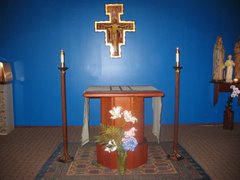
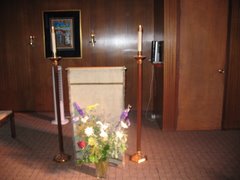
In my own life, the depths and darknesses that have colored so much of it have given me the opportunity to witness to the truth of this ecclesial vocation. With the assistance of and within the context created by the Church, I have been able to plumb those same depths along with all the questions and doubts they raised for me over the years, and find both God and my truest self together there. As I have said before, Frederick Buechner once remarked that "Vocation is the place where our deep gladness meets the world's deep need". For me, the hermitage is the place where all this happens. It is the place God called me to so that I might have the time and space to truly explore not only the complex question(s) I have lived (and been!) for so many years, but also so that I might allow myself to hear the answer God is as Emmanuel. Even more profoundly (and very much a continuing source of awe!!), it is the place I have been called to become myself, the place of intercession where the love and mercy of God meet the anguish and yearning of his creation and the Good News of Jesus' death, resurrection, and ascension proclaimed as lived experience. I think this is true of all c 603 hermits.

About 18 years later, after I had spent some years in community, worked in clinical lab (hematology), developed an adult-onset seizure disorder (epilepsy), finished academic studies, had some experimental neurosurgery, worked as a hospital chaplain, and begun working with my current spiritual director (not necessarily all in that order), I read the newly published Canon 603, and had a similar experience. On the third or fourth reading, I reflected, "My entire life could make sense in terms of this way of life -- wholeness, brokenness, limitations, talents, giftedness, deficiencies, etc. -- everything could be meaningful." It took years to discover the experience at that first Mass was actually a promise God was making me, and many more to understand the paradoxical, counterintuitive, and truly perfect (though still painful) way God was shaping the answer He and I together within the ecclesial context established by the Christ Event and Canon 603, would become!





 Posts
Posts