I don't really have a question. Or rather, I probably have a lot of questions that are bubbling around inside of me and haven't yet come to articulation. But having said that, it seems to me that the guidebook from the Dicastery was important for you to come to understand yourself as the place of intercession, is that true? And while I am asking, do you think the pseudo spirituality you wrote about is common to hermits today? It seems really, really dangerous to me, though I think it helped you come to where you are as well. Is this distortion of eremitical life one of the reasons you say the Rule, with its three-stranded braid, needs to include ecclesiality? Oh, right, one more question. When you wrote about the canon honoring individuality and referred to the range of meaning in the elements of the canon, what did you mean, and how does that help prevent individualism? I didn't quite get that. I wasn't going to write except to thank you for hanging in with this blog for such a long time. It is interesting seeing it all come together in the way it has. It gives me a deeper sense of my own vocation and maybe a bit more patience with myself as well, so, really, thank you! By the way, if any of this is helpful for your blog, feel free to use it. ]]

Hey, hi! Thanks for reading and writing! When you have further questions, please be sure to ask! I am going to start by clarifying my meaning in the sentence you asked about. What I actually wrote was,
[[Given this flexibility, individuality (which is deeply honored by c 603's requirement of a personal Rule of life the hermit writes herself, the range of meaning contained in each element, and the absence of time frames, stages of formation, etc.) mustn't devolve into individualism.]] What I had in mind was the fact that c 603 honors the individual hermit and the flexibility of the life, not only with the requirement that the hermit writes a Rule of Life that will not be like any other hermit's, but that the constitutive elements of the canon have a range of meanings the deeper one goes into the vocation and her relationship with God. So, for instance, the most obvious meaning of the silence of solitude refers to the quiet of life lived alone (assuming no television, etc!).
Over time, however, if one continues in the various disciplines of eremitical life, one will also come to realize that silence also means the inner state that results from personal healing, maturation, and sanctification. The same is true of genuine solitude; it became a state of wholeness. This means they both depend upon profound and very real relatedness, which leads to their growth. Then, too, in time, one will also come to understand that "the silence of solitude" points to what it means to exist in deep relation to and learn to "hear" while being enwrapped in
God's own silence, and so, to learn to love from that place.
Solitude reflects a range of meanings just as silence does. Most superficially, it means aloneness, but as one's experience of eremitical solitude deepens, so too does it come to mean relatedness (to oneself, God, and the world whose cries the hermit hears with increasing clarity and compassion). Eventually, solitude will come to indicate the community that results from being oneself in and for the Love of God and all that God holds as precious. I believe each of the central elements of c 603 has a similar range of meanings, and this means that each hermit's journey with and to God can lead to growing understanding that will differ from the understanding of other hermits. This also means that someone asserting that solitude means "being alone" in an absolute and univocal way may be knowledgeable about the dictionary definition of solitude, but not about the range, depth, and even the paradoxical senses of eremitic solitude. It also means that these differences in understanding cannot be allowed to devolve into individualism, and the quickest way to that is by absolutizing any single meaning.
.jpg)
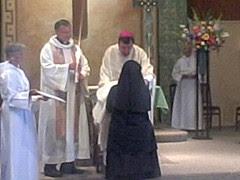
You also asked about the "three-stranded braid" and my emphasis on ecclesiality. [[Is this distortion [individualism] of eremitical life one of the reasons you say the Rule with its three-stranded braid needs to include ecclesiality?]] I have been interested in nature and importance of the ecclesiality of the vocation since around the time I petitioned for admittance to profession and consecration with (then) Bishop Allen Vigneron. We had a brief conversation on this during our first official appointment, and my interest in it has only grown over the years. What Abp Vigneron and I talked about was the fact of this vocation's ecclesiality and how very few people seem to "get that". (He gently reminded me that he knew what it meant, and I was appropriately chagrinned since I had not
meant to imply he did not!! I remember nodding
and shaking my head -- laughing some at myself, and wondering how else I might manage to insult the man at this first official meeting! Fortunately, the conversation proceeded easily.)** You see, I had been surprised at conversations I had had with other c 603 hermits or candidates who had no sense at all of the ecclesial nature of this vocation. Over time (after consecration), my own understanding of the linkage between ecclesiality and the prevention of individualism became clearer (more explicit) and deeper; when
Ponam named the Church as one of two contextual poles preventing individualism, I felt really gratified. It did put things into a single sentence, which was important to see from the Church; in that way, it may have helped crystallize what had been a long-standing interest and conviction for me. When I began working recently on a project regarding the important implications of the hermit writing her own Rule, I had to look again at what was essential in such a Rule. It was not entirely surprising that ecclesiality was the third strand and that this included the fact that the Church herself must look for this (or at least a budding sense of this) in c 603 vocations and the Rules these persons write.
In part, my sense of this importance has come from my experience of hermits or would-be hermits who were seeking to use c 603 or eremitical life as the validation of their own estrangement from others, their own personal failures at living life in the Church, their own desire to do their own thing and be a religious while doing so, etc. I had honestly not anticipated running across hermits who were exaggerated individualists, so finding this particular distortion in several hermits or would-be hermits was a bit of a surprise. Still, the ecclesiality of the eremitical life has more positive roots than the need to avoid individualism. This is what we see when we begin to explore what this vocation means for the Church itself. Here, as I have said several times recently, we see a life that reflects the hidden heart of the Church and what it means for the human being to be hidden in Christ and become the very place of intercession in him. These are far more important than the mere avoidance of individualism, and it was the sense of ecclesiality and its importance in consecrated hermits that led me to see this!!
.jpg)
Good luck with your own questions and discernment. I know you will do what you sense God calling you to. If what I have written on ecclesiality and individualism (and perhaps what I wrote in this post on the range of meanings in solitude, silence, and the silence of solitude, for instance) has helped, I am glad!
**In that meeting with Bishop Vigneron, the conversation ended with the two of us standing facing each other, taking the other's hands in our own, and each praying aloud our own prayer for the process we were stepping into! It was a powerful moment for me.


.jpg)
.jpg)





 Posts
Posts