.jpg)
Important questions, so thank you for asking. One of the real strengths of Vatican II was its recognition that every person is called to holiness, no matter their state of life. Of course, this is rooted in Scripture. Every person is called to (learn to) abide in God and allow God to abide in them. Every person is made for this. It is actually what it means to be truly human. This "abiding in God/Love-in-act and letting God/Love-in-act abide in us" is what holiness is all about. We sometimes speak of wholeness and being made true and the way this all happens is in the power of the Holy Spirit. All of this points to the fact that we are essentially spiritual beings. That is our truest nature. What we often live are wounded and even distorted versions of our truest selves insofar as we are estranged or alienated from the ground and source of life and love we know as God.
With all of that said, I am in a position to answer your first question and probably a couple of the others as well. I define spiritual life or spirituality in terms of "living and learning to be our truest selves in the power of the Holy Spirit." To be a truly spiritual person means to live an authentically human life in the power of the Spirit of God. It is nothing more nor less than that, though it is true that because of the richness and dynamism of this experience, we can describe it in terms of dialogue with God and a number of other ways as well. This also means that spirituality or "the spiritual life" does not refer to the life of the human spirit disembodied or otherwise divorced from the rest of the person, but rather to the life of the whole person under the power of the Holy Spirit. Because of this, I believe that any person in any state of life, especially if sufficiently loved and supported in this journey to union with God, can learn to allow God to love them "into" their own deepest truth and potential. After all, Jesus calls all of us, though we are in the world, to not be of the world!

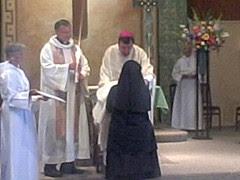
I became a hermit because I felt called to spend my time in prayer, study, and the silence of solitude to truly become my truest and best self with and in God. This is also to say I became a hermit to glorify God, since in becoming our truest selves in the power of the Holy Spirit, we reveal God at the same time. Hermit life gave me the space and time to do this in spite of limitations and outright obstacles. Others are called to do this in more active and less hidden ways, and while I consider hermitage a great gift of God. I recognize others' paths to wholeness are an equally great gift. The key to understanding what constitutes a spiritual life is that it is always a life empowered by the Holy Spirit, God's own Spirit of love, truth, and wholeness.
That means that, in light of the crucified and risen Christ, there is no place or reality from which God's Spirit is now cut off, no godless place or realm, no part of ourselves the Holy Spirit does not and cannot embrace and transfigure with her presence. In Jesus' crucifixion, death, and resurrection, the whole world is transformed with God's personal presence, and as a result, there is no longer any place we can call godless or even entirely profane. Learning to see reality in this new way, however, requires practice and conversion of mind and heart. This is what Jesus called coming "to see with new eyes," and it is the mark of the truly spiritual person, a person empowered by and able to recognize the Holy Spirit wherever and in whatever surprising way that Spirit "shows up" in our world.

Regarding your last question and what I believe about myself, I don't tend to compare myself to others in those terms. Secondly, I have no way of knowing how spiritual anyone is (myself included) unless I can see the fruits of the spirit of their lives, and even then, I think, it is impossible (and likely worldly or fleshly) to compare ourselves with others in the way you describe (cf rivalries, envy, and jealousy above). The ability to "see with new eyes" is the ability to see someone's deepest potential, to see God in them, to see them, in fact, as God sees them. At the same time, when I listen to or watch the news, I do see people today who yet leave wreckage and ruination (enmity, strife, dissensions, idolatry, divisions, and rivalries) in their wake, and who appear to be motivated by the spirit of this world (fits of anger, rivalries, jealousy, envy, drunkenness, (sexual) immorality, etc.).
More and more, I see these persons as "unanswered questions" (where God and the love of others in God are the answers they yearn for and need so desperately), or I see them as people who are tortured by homesickness (as in my last post), and who lash out and hurt others as a result of their own suffering. My prayer for these persons is the same as Paul's was when he spoke to the Galatians regarding those disrupting their faith community: [May they] live by and keep step with the Spirit. [May their flesh] with its passions and desires be crucified in Christ, and, as persons of the Spirit, "Let (the rest of us) not become conceited, provoking one another, or envying one another."





 Posts
Posts