Because of recent posts and the phrase "God alone is enough" which I have used therein, I have been asked if this isn't misanthropic, anti-Christian, or downright isolationist --- all things I often and consistently write against. In Lent 2012 I posted the following piece which describes the meaning of this difficult affirmation. An added section (italicized) is included on the place of friendship and other significant relationships which, I hope, clarifies some of the brief comments in the original piece.
 [[Hi Sister! What does it mean to say that God alone is enough? I need my family and friends and I wouldn't be the person I am without them. Does saying God Alone is Enough mean that we don't need others? Does it mean something different for you as a hermit than for me as a single teacher?]]
Wonderful questions! The phrase God Alone is Enough is an ambiguous one, meaning it has different and overlapping meanings which can also be misunderstood. So, for instance, the word "enough" can either basically mean we don't need anyone or anything else in our lives, or it can mean that God is the one reality which answers every fundamental or foundational need and completes us as persons. For most persons, the truth is that in adulthood we do not come to human wholeness apart from our relationships with other people and so it is ordinarily the case that the affirmation God alone is enough refers to the second sense: only God is sufficient to truly complete us, to empower us to the transcendence of genuine humanity, to serve as the source and ground of being and meaning in our lives.
This is especially true when one asks what the word "alone" means. Does it mean the person needs no one and nothing else besides God? Does it mean one can go one's own way motivated merely by individualism (what monastic life critically refers to as singularitas) and even a form of narcissism? Does it mean that one can dismiss the world around them as unworthy of their spirituality and live a kind of falsely "spiritualized" isolation? Or, again, does it mean that only God can answer every human need and complete us as persons? In every case, that is, for every person [whether hermit or not] it means the latter. For most people their reliance on God as the foundation of their lives will actually lead to more -- and more healthy -- personal relationships, not to fewer much less to less healthy ones. Only in the case of hermits or anchorites does it mean that the hermit relies on God alone to the significant and lifelong limitation or relative exclusion of human relationships. We do this not only because we are called to do it for ourselves and for God who desires and wills our love, but again because it witnesses in a rather vivid way to that foundational relationship which stands at the core of every person.
So yes, my sense of the meaning of this phrase may be different than yours in some ways. The two senses I have spoken of also overlap to a significant degree though. By the way, as we approach Holy Week it is important to note that the church will be looking at a related way in which "God alone is enough." What we will hear proclaimed is the fact that only God can overcome sin and death: only God is that love which is stronger than death, only God is generous enough to empty himself completely and become subject to the powers and principalities of our world so that they might also be defeated. I will write about that a bit more though in the next weeks.
[Please note, when I spoke above of the relative exclusion of human relationships I really mean the accent to be on [the word] relative. Hermits are not misanthropes but at the same time they limit contact with others for the sake of the witness they are called to regarding the foundational place of God in every human life. Hermits, at least in my experience, because again they are not usually recluses or ordinarily called to reclusion, must cultivate some few but quality relationships --- friends, directors, and those who accompany them in more "professional" or formal ways --- not only because there are real limits on the number of relationships in which the hermit can actually participate if their solitude is to be real, but because at the same time one's physical solitude requires such significant, even "sacramental," relationships if it is to be the rich and nourishing environment of the heart hermits require and commit to in the name of the Church.
It is hard to describe this paradox but it is linked to the distinction between being merely alone and living the silence of solitude. Consider that the ecclesial nature of this vocation provides a communal context for all authentic eremitical solitude; within this ecclesial context there will be the sustaining warmth, love, challenge, discipline, and consolation of the kinds of relationships I mentioned above --- limited though these will necessarily be. Each will mediate the presence and will of God in ways which supplement the way God comes to us in physical solitude and solitary prayer. Each will help shape the human heart in ways which allow it to embrace God fully -- and be more fully embraced by him -- in the rigors of solitude. They will thus also help the hermit maintain her commitment to all dimensions of the truth that "God alone is enough" for us --- but (and this is the sharpest form of the paradox) especially the solitary dimension she has freely embraced and is publicly responsible for.]
04 September 2017
God Alone is Enough (Reprise)


18 April 2016
On Attachments, Detachment and Friendships in the Eremitical Life
 [[Hi Sister Laurel, I have been thinking about attachments and detachment recently and I was remem-bering when nuns had to let go of family ties and "particular friendships". As a hermit do you give up family ties or particular friendships? If you are trying to live a life given to God alone can you have attachments to friends? I know you write about having friends so how does that actually work? As you grow as a hermit will you let these go? If I wanted to develop a strong spiritual life it means being stripped of attachments doesn't it? Should I be letting go of friendships or is that only for hermits?]]
Thanks for the questions. Let me start with the way friendships are viewed today in religious and eremitical life generally and then tackle the nature of detachment and the kinds of attachments we are called to eschew. Then maybe I can say something about the paradoxical nature of giving one's life to God alone and how it is friendships are ordinarily an indispensable part of that. Finally, I can say something about how it is hermit life changes this somewhat, what it retains, and what might be necessary in the recluse. What you should be doing is a separate question which I think (and hope!) will build on these things.
Friendships are Indispensable Gifts of God:
First it must be said that friendships are a gift from God to each of us and one of the primary ways God's own life and love is (for these are identical) mediated to us. Friendships are also one of those places we can learn to truly love as the great commandment requires. We tend to appreciate this a bit better than has sometimes been true in the history of spirituality. Religious today have friends and good friends. So long as this does not detract from the person's love for her Sisters and commitment to her community which will have priority, such friendships add to her own life and can add to that of her community as well. Especially I think, we see better today than sometimes that to genuinely love another does not prevent us from loving God with our whole hearts, mind, and strength any more than loving God in this way prevents us from loving ourselves or others. Love, which is a transcendent reality and of God, is not divvied up or divided into discrete units so easily as this.
 What I mean is we can't treat it in pre-cisely the same way we would some sort of finite resource like groceries in our pantry. While it may be we do not have enough bread and peanut butter and jam to feed every kid in the neighborhood and still have enough for our own children, we are more apt to find that love is like the loaves and fishes we read about last Friday --- there is enough to feed everyone with plenty left over --- simply because this is how genuine love really is. Even more, we tend to find with love that the more we give the more we have to give. To spend significant time with a friend listening, sharing, laughing, and loving is really to open ourselves to greater and greater love --- and that means opening ourselves and that relationship up more and more to the living God who is love. To do that, in fact, is to love God himself and to open our whole world to him is to love God in the way the great commandment calls us to.
Real Personal Love Involves Detachment:
I think the real problem comes when we are not really loving others (or letting them truly love us) but instead are relating to them for some lesser reason. To be "attached" to someone because we truly love them (and have been able to allow them to love us) really implies significant detachment. We are delighted to be with them; they console and challenge and inspire us, but at the same time we "hold them lightly" and may need to let go of them in the name of love. We cannot cling to them precisely BECAUSE we love them. This paradox I suspect was not always understood enough --- thinking in terms of paradox is not always easy for us, and often feels very unnatural. We tend to think in terms of either/or --- either attachment or detachment, but love introduces us to relationships that are variously intimate, fiercely loyal and committed ("attached") while at their heart being open to what is best for the other to the point of sacrificing our own needs and desires (detachment) in small ways and large for their sake.
 The detachment we want is that of selflessness. The "attachments" we are allowed -- and in fact are commanded to embrace because they are uniquely human and humanizing -- are those of real and personal love. I don't think, by the way, I am meant to live a life which is given to God alone (nor is any hermit), but rather I am called to live a life given to God in all things. Moreover, I am called to live a life given to God in this way in the silence of solitude and which is thus lived for others. Specifically it is meant to witness to the fact that for each and every one of us God alone is sufficient for us, God is the ultimate source of life and love and meaning for each one of us, the source and ground which makes us capable of marriage and family, of friendship, ministry, etc, and the absolute future to which we are drawn. No one and nothing else completes or empowers us in the way God does. We are made for God and in that way we are made for community.
The Witness of the Eremitical Life:
The hermit's life is meant to witness to this fact --- not in an elitist way as though it is only true for her or for the rare vocation to eremitism but in a way which affirms this is truth for all of us. She does it in silence and solitude because, in fact, this strips away many of the things we might use to "complete" us falsely, to obscure our vision, or which we mistake either for God or for our truest selves. She does it in the silence of solitude (and with the silence of solitude as the goal and gift of her life) to reveal the truth of who God is and who we all are most fundamentally --- namely, persons who are always and everywhere in intimate dialogue with God. This is the primary reason, I think, why canon 603 does not define the vocation in terms of individual salvation but in terms of being something lived for the redemption of all. I think Thomas Merton saw this clearly when he spoke of the one first duty of the hermit. You may remember that he said,
[[The . . .hermit has as his first duty, to live happily without affectation in his solitude. He owes this not only to himself but to his community [by extension diocesan hermits would say Diocese, and parish] that has gone so far as to give him a chance to live it out. . . . this is the chief obligation of the . . .hermit because, as I said above, it can restore to others their faith in certain latent possibilities of nature and of grace.]] (Contemplation in a World of Action, p. 242) While I agree completely with Merton I would say that to live happily and without affectation in one's hermitage witnesses to the fact that the human being is made for and incomplete without God and therefore is defined by her potential and capacity for Love.
Maturing in Eremitical Life:
 As I grow in my eremitical life I don't think I am going to "let go of friends". It may be that maintaining them will be done a bit differently than is done now, but generally speaking, I need friends to empower me to love --- and that means to love God too. My need for them is not a weakness or some form of inordinate attachment (meaning an improperly ordered attachment --- one that is not ordered to becoming more loving and holy); often I have thought some of my ability to live without them is the real deficiency --- though that is certainly less true than it might have been once upon a time. In any case relationships can make real selflessness possible and selflessness (meaning being God-and-other-centered in authentic love) is both the heart and the very purpose of Christian detachment. It remains true that I am open to being called to reclusion and if that happens the time and contact necessary for friendships will be even further significantly limited, but at this time I don't think this is where I am being called.
It should be clear from all that I have said that growth in the spiritual life does not necessarily mean letting go of authentic friendships. It is far more likely to demand their cultivation --- something we should be aware of in this time and culture of superficial and utilitarian "friending!" Sometimes the literature of exclusion and separation was simply selfish (and not particularly Christian); it failed to see that love of God and love of others are inextricably intertwined and, in some ways, it prevented even the genuine friendships that are so necessary for growth. That is as true for the hermit as it is for everyone else. In fact, it should be noted that the capacity for authentic friendships and relationships generally is presupposed in eremitical life; this is one reason it is considered a second half of life vocation or is perceived as being possible only after years of formation in monastic life. For the hermit the relationship with God is always given absolute priority, and this must occur in the silence of solitude -- which limits and conditions the friendships which are possible. Still, so long as the hermit is faithful in observing these priorities, she may very well find her vocation calls for a few really special friendships as well. The hermit may not see these friends often, but their love supports and challenges her in ways a solitary vocation really requires.
12 October 2014
Diocesan Hermits and Community, part 2
 In On Community and the Hermit I began an answer to a questioner asking about friendships and the shape of community in the hermit's life. In one way and another I have been dealing with that question for the past several weeks --- even prior to receiving the question. It may have been that fact that prompted the reader's question in the first place! In any case, the first part of my explicit answer I focused on those friendships and relationships which were essential to the well-being of my vocation because they fulfilled my own needs. In this second part I want to say something about the shape of community in my life because of the diocesan hermit's responsibility that her solitude be a fruitful reality and a gift to the Church and world.
Diocese and Parish as Ordinary Community of the Solitary Hermit
For any diocesan (c 603) hermit the diocese and parish within which they finds themselves, and from which they have actually been called to live the silence of solitude is ordinarily their primary faith community. It is usually here they celebrate or receive the Sacraments, here they are nourished on the proclaimed Word of God, here they meet the people they are praying for and with, and here they come to understand the complex challenges which are currently facing those living life outside the rarefied environment of the hermitage. I meet truly holy persons here whenever I come for liturgy. It is also here though, that the hermit witnesses to the contemplative and eremitical life and the gift (charism) of the silence of solitude lived in their midst! Personally I find it a significant, if complex, relationship and presence in my life. I am sure that my presence and involvement in the parish is both somewhat other than straightforward and yet fruitful as well!
 You see, I cannot take on the responsibilities or ministry that a ministerial Sister can and does ordinarily take on. While I am actually part of the parish staff (pastoral assistant) I do not generally attend Staff meetings nor retreats, nor do they look to me to fill staff roles at parish events. They know I cannot do that and that my real ministry is contemplative life and prayer in solitude. I do minister otherwise in a limited way when I attend Mass (I rotate in as Sacristan, cantor, lector, EEM, etc), and I lead Communion services when we have no priest. Occasionally too I will write a reflection on the day's readings, do a presentation for Lent or Advent or for the school kids (on prayer and being a hermit).
So, I am present and active and certainly personally integral to the parish. People actually miss and pray for me when I am spending more time in solitude and cannot be at daily or Sunday Mass, but at the same time this means there are very real limitations which my parish generally understands (or tries to understand!) and respects! (One small but telling way they show me they understand and regard my vocation, for instance, occurs when they quietly slip a small note with a particular prayer request into my hand because somehow they know it will go into a handmade bowl near the Tabernacle in my hermitage where it will be held in prayer. That the story of the "prayer bowl" has gotten around the parish and to members I don't really know yet suggests, I think, that my presence is discussed and valued.) When I speak of a diocesan hermit belonging to a parish it is this integral yet "eremitically" limited relationship I am speaking of.
On Being a Bit of a Mystery
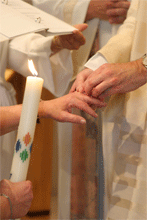 I suppose for many in my parish I am a bit of a mystery and of course, that is okay! If my presence sparks questions or real curiosity then that is well and good! If people admit they don't understand what a hermit is or how there can be such a thing as a hermit in the 21C. much less right here in this relatively well-to-do suburban parish, then also well and good. (If they ask me about these things directly and we have an opportunity to get to know one another a little and (among other things) dispel a few stereotypes or misperceptions, then even better!) If our school kids hear me cantor or lector and wonder about me singing and reading Scripture even at home, if they have questions about my habit or cowl, if they ask their teachers what the heck it means to be a contemplative or pray all day, if they ask me to come to talk to them about all that occasionally or sometimes also slip me notes with their most urgent prayers on them, and if they can see that I am a pretty joyful person who likes to laugh even while I am also pretty serious (humor can be serious business!), then I think my presence is an effective one and over time will bear real fruit in addition to that which already comes from prayer itself.
Am I "like" these folks? Well, no, in many, many ways I am not; but in some much more fundamental ways I am VERY like them; my sense of that fundamental sameness is a grace that I thank God for almost every day! The bottom line here though is that I belong to this community because we are a Christian faith Community. (cf Belonging vs Fitting In) Different as most of our lives are, I truly love them and they love me as well. We make it work because that's what Catholics living in and for Christ do; love transcends differences and builds community! It is significant, I think, that our parish motto is "All are welcome." So long as I allow it to be so, that is true even (and, I think, especially) for a hermit!
A Slight Detour and Return
I remember when I was in Graduate School in Theology. The Catholic students and faculty (which meant a LOT of religious, priests, theologians, liturgists, and ministers from all over the Diocese were converging on "Holy Hill" on Sunday mornings and celebrating some of the most fantastic liturgies I have ever attended. The St Louis Jesuits were "in residence" at that time (they were also students, but attending JSTB) and every Catholic theological school had some group that sang during the week for their school's Mass and came together as part of this more general Mass on Sundays. The assembly naturally participated fully, were knowledgeable and were inspired by this Sunday liturgy. But there was also something wrong with this picture! It was elitist in a certain way but more to the point, it deprived all the parishes in the Diocese of Oakland of the liturgists, theologians, homilists, musicians, religious, and priests those parishes could have used as resources so their own liturgies and the music, homilies, and other aspects there were equally participative and perhaps more genuinely inspiring. So, Bishop John Cummins decided to let us all know that he wanted us in those parishes so that the liturgical and faith life everywhere might be enhanced and he closed the Sunday morning GTU Mass down!
 Originally I was disappointed by this action but over time it is the wisdom of what John Cummins did that has stayed with me. Vatican II renewed the importance of the local community, first diocese and then parish! Every Catholic is related to the local Church in some way and that means that every hermit is as well. As has been said many times in the history of eremitical life, Catholic hermits live our lives of solitude in the heart of the Church; each hermit is an "ecclesiola" --- but not in some form of independent solitary splendor. In other words, we live eremitical solitude in real, concrete circumstances within the heart of real, concrete faith communities. We may be seen but rarely; our lives may not be understood, nor may we even "fit in" (or seem to "fit in") all that well in some things, but I, for instance, know without question that the profound questions that drive my life and quest for union with God are the very same questions the rest of the people in my diocese/parish pose with their lives and this means to the extent we hermits are in touch with these and the God who grounds us all, we are more the same than we are different! That too is an important witness the hermit can give to those who focus more on differences than on what unites us or what we hold in common.
In conscience, but also theologically and spiritually I believe it is both right and necessary for the hermit whose vocation is ecclesial to find ways to be a gift to her parish --- even and especially if a large part of that gift is the silence of solitude so many seem to fear and resist (but which we all need to learn to embrace as we age and come up against other liminal experiences in our lives)! The paradox is that to do so we have to belong! (cf Belonging vs Fitting In) In any case, in my own eremitical life, I have to belong in this way, limited though it is, or I cut myself off not only from one of the main ways my life of solitude bears fruit, but from one of the main sources of Divine presence and spurs to personal growth in holiness and authentic solitude in my life. All the diocesan hermits I know or know of live in eremitical solitude and "stricter separation" but that means they do so in relation to (and relationship with!) a parish or monastery or other religious community. Eremitical solitude, once again, is not isolation. As I noted in earlier posts from last week, even actual reclusion requires we be profoundly and mutually related to a faith community of some sort. Thus it is with ecclesial vocations!
05 October 2014
On Community and the Hermit, part 1
 [[Hi Sister, I have a question that may seem odd, perhaps even funny, but I
ask it in all seriousness.
[[Hi Sister, I have a question that may seem odd, perhaps even funny, but I
ask it in all seriousness.
Should hermits have friends? I know
there are lots of admonishments in monastic literature against having
"particular friendships" etc. that could take away from community life, but a
hermit has no community in that same sense. Scripture teachings that its
not good for humans to be alone, so community of some sort is necessary for our
emotional and spiritual well-being. What does community look like for a hermit? ]]
 First, the focus on "particular friendships" is something I experienced first hand when I initially entered religious life and it was something which was quite often destructive rather than helpful in the spiritual life. Today we recognize clearly that vows of celibate love (consecrated celibacy or 'chastity') require affective maturity and the richness of loving generously and chastely; all that will necessarily mean friendships! It goes without saying that these friendships must also be mature, neither exclusive nor grounded in either (or both!) persons' neediness (which is not the same thing as a need for mature friendship!), and they must be focused in a way which allows each person to grow in their capacity as a human being and thus too, in their vocations. Enmeshment is not true friendship, nor is it really loving. It also goes without saying then that friendships cannot (and when genuine, will not) detract from one's vocation. This, especially for the hermit, comes with its own set of tensions, uncommon limitations, and difficulties --- particularly when one person in the relationship is a hermit and the other is not. However, negotiating these in a loving and mature way is part and parcel of the healthy eremitical vocation; eschewing them or simply ruling out friendships and other relationships entirely is not.
 I count among this group my delegate and director (Sister of the Holy Family), a Dominican Sister, my pastor (Oblate of St Francis de Sales), a Franciscan Sister (whom I have seen in person a mere handful of times in the past two decades), and two friends from the parish. Additionally there is one diocesan hermit from another country; we don't speak or write often but when we do there is a lot of laughter and we pick up as though there was no gap in time. At present I don't have a regular confessor but even so, each of these persons understands my vocation and helps me to live it with integrity. Each adds to it in a number of ways, challenging me, filling me in on things I might otherwise be unaware of, instructing me, calling me to love and be loved. Generally they are folks I can talk with about the Church, prayer, theology, religious life and the vows, Scripture, spirituality more generally, as well as literature, music, etc. In the time between meetings they hold me in prayer and I do likewise with them. They are the sort of "inner circle" within the community I count on.
What is true and critical about this circle of friends is that they understand and value me and my vocation in a way others cannot. (Others I will also mention later value me and my vocation but in a different way.) Most (all but two) are religious and all but one of these do spiritual direction or pastoral counseling. Thus, most are vowed, all have significant prayer lives and appreciate the dynamics of physical solitude/concrete loving and contemplation/action as fundamental in their own lives. For each of these persons Christ stands at the center of their lives. We (mainly) speak the same language spiritually, theologically, professionally, and humanly. In my own life I would have to say that these friendships are critically necessary. I do not know if my eremitical life would be a healthy one without them --- though I personally suspect it would not. While in most cases we don't see each other often, we do tend to pick up where we left off even as we try to hear about where the other person has been in the intervening space of time. What I can say about this group of people is that they are a daily source of joy and richness for me as well as of challenge and inspiration. That is so even when it will be days, weeks, months, or even years before I see them again. (We do email and/or write regularly. We also phone or skype occasionally.)
 I suppose it is clear that this group of people are a fairly select group. One of the reasons they are so important to me is because each of them understands and has made and routinely makes sacrifices for the sake of their commitment to Christ; they are neither dismayed nor surprised by my own. Instead they expect these and would be surprised if they did NOT exist. All both are and have good friends but all have significant limitations on how often they see these friends and each one makes sacrifices so their time together is quality time. We share the same vows and values which tends to mean we appreciate the same things, read the same books (or at least the same authors), are interested in the same Church-related topics and concerns, spend money (or try not to spend money!) in mainly the same ways, and so forth. More, we tend to laugh a lot when we are together and cry together when necessary. Prayer is a way of life for each of us and their presence in my life (and I hope mine in theirs) is humanizing and holy-making. Most of these people have community obligations and commitments --- people they love and serve as Sisters and Brothers --- as well as active ministry and prayer lives to keep up. Most are in or have been in leadership and formation in their own communities so you can imagine how full their lives are. My own commitment to the silence of solitude (and all that makes that what it is) as well as my own SD ministry and limited parish service takes the place of these in my own life so when we are able to get together it is a priority --- and a gift of God.
This is the first part of my answer to your questions. While this group is not all the community that exists in my life it is the most profound and intimate, the most challenging, and the most enriching in terms of my life as a religious and hermit. In the main these persons' dedication to Christ and his People (meaning the way they give their lives for love of these through a variety of spiritual traditions and ministries) inspire (and empower) me to live the same way --- though as a hermit who also stands in the Camaldolese tradition. And that, it seems to me, is the essence of community (or the most intimate friendship!) for anyone who seeks to follow Christ.
You may have more specific questions than I have answered here. If so be sure and clarify things for me and I will answer those in the second part. (It occurs to me that what I wrote about this year's retreat also gives a glimpse into the importance of friends and the nature of community for a hermit so take a look at that as well.)
26 October 2012
Ongoing Formation of the Diocesan Hermit
[[Dear Sister Laurel, What does ongoing formation for the diocesan hermit consist of? How would a diocese ensure that the hermit is achieving the level of ongoing formation she or he requires?]]
 Wow, brand new question for me! Excellent as well! In some ways I think this is uncharted territory, at least in the formal sense. Let me suggest some of the things I do to continue my formation as a diocesan hermit and also some things which might be especially helpful to the diocese and hermit together in what is a mutual or collaborative responsibility. It is this latter area where I think we are mainly in uncharted territory and in a general sense could do better for diocesan hermits and their Bishops and delegates.
Things the Hermit does to Ensure Ongoing Formation:
The first thing necessary is anything coming under the rubric, "custody of the cell." What I mean by this is anything necessary to living the silence of solitude in the hermitage. For the most part this means living one's Rule of Life (including every spiritual and other regular practice), reflecting on this in light of one's prayer and journaling (inner work), spiritual direction, and further, in light of one's reading and reflection on the eremitical tradition and the contemporary world. Over some time one will reflect on one's life in the hermitage, one's life and role in the parish, the place of friendships and other relationships in one's life, one's physical, intellectual, and emotional needs, and the demands on one's gifts which all of these make. One then makes whatever changes are necessary to ensure continuing growth in the eremitical life and the essential elements of canon 603. At the same time one will make decisions about needed education (usually online but not always), reading trajectories (if this is applicable to personal work or one's professional competencies), writing projects (or whatever form of work one does), greater reclusion, periods of retreat beyond an annual retreat, and so forth.
 Parts of all this will include then, regular spiritual direction and meetings with one's delegate, regular reflection on one's Rule and vows, regular desert days, at least occasional periods of reclusion, and annual retreat. It may require time away from the hermitage at a monastery beyond what is required for retreat itself. In general all of these things are parts of the hermit's own Rule because, after all, the life itself is formative and living it with integrity is the major piece of actual formation --- no matter whether that is initial or ongoing. Still, the evaluative part of things is usually not treated in one's Rule and it may well be that this should be worked out in the section on ongoing formation. For instance, one might well determine that once a year (or less frequently) a meeting with one's delegate which is dedicated simply to looking at one's needs for ongoing formation for the following year (or several years) will occur. While very little of the hermit's day-to-day life might change as a result and while one might simply continue on as one has, such a meeting could still be invaluable.
Others' Roles in Ensuring Ongoing Formation:
While responsibility for ongoing formation is mainly the hermit's own, her Spiritual Director and diocesan delegate play major roles in helping her grow in holiness and assisting her to articulate regularly how she has grown, where she sees God taking her in terms of eremitical life, how it is the parish and diocese assist (or could well assist) her in this and how that may be improved upon. The delegate might well discuss some of these things with the Bishop if they seem to be something the diocese should assist with. That is especially true if she and the hermit meet for a regular meeting dedicated to ongoing formation needs mentioned above.
 This, of course, suggests that the Bishop also has a part to play in ensuring the hermit's ongoing formation in this life. While this role should not be surprising it is an underdeveloped and under-appreciated aspect of the situation set up by Canon 603. Canon 603 outlines a solitary eremitical life of the silence of solitude, stricter separation from the world, assiduous prayer and penance, the evangelical counsels, all lived according to a Rule the hermit herself writes and is faithful to under the supervision of the diocesan Bishop. While the hermit does not receive any financial assistance or remuneration from the diocese, there is no reason to believe the Bishop cannot or should not assist her in locating or helping make available selected and occasional diocesan or other resources which contribute to ongoing formation in her vocation. Hermits tend to meet with their Bishops once a year. That meeting usually serves to fill the Bishop in on how things are going, how the hermit lives her life, what is most important to her in all of this, and what needs she has run into and how she has managed to meet these. Occasionally (every three to five years or so), an important part of such a meeting might be a discussion of the ways in which the hermit has revised or proposes to revise her Rule before submitting it to the Bishop for formal approval.
With regard to ongoing formation what I would like to suggest is that if necessary and if the Bishop is willing (and I have to say my sense is most would be very willing given their concern with the issue of eremitical formation), an additional meeting with the hermit's delegate might also take place for the specific purpose of discussing specific needs and concerns. With the Bishop's permission, this could free the delegate up to line up (or help the hermit to line up) the resources necessary here or formulate a plan for meeting those needs and concerns. For instance, if the hermit truly needs additional time away in a monastery, or could benefit significantly from a workshop on Scripture or prayer or spiritual direction (etc), a Bishop (or the delegate acting in his stead) might be able to arrange for something which meets the limited resources the hermit has available and at little or no expense for the diocese.
The point is that the hermit vocation is fragile and vital; for this reason the diocese, especially in the persons of the Bishop (legitimate superior) and delegate (quasi-superior), should work with the hermit in helping ensure her needs for ongoing formation are met. At this point the hermit's relationship with her Bishop is a little-addressed and less-understood element of the canon. Hermits and Bishops work to find their way in this matter, sometimes with little sense of what is actually being accomplished (or is meant to be accomplished) by their meetings. A focus or partial focus on ongoing formation and a collaborative relationship with the hermit's delegate in meeting the hermit's needs here might be just what is needed periodically. (For the most part meetings with one's Bishop are not agenda-driven. They are a chance for both persons to get to know one another and to learn about eremitical life lived out in a contemporary context; they are typically fairly relaxed and informative and should be allowed to be this unless there is something specific either party needs to discuss).
 The hermit's pastor may also fill a role in the hermit's ongoing formation. It is certainly true for me that my own pastor plays a very large if informal role here and I think that is both fortunate and a very great gift. For instance he affords me opportunities to use my own gifts in the parish --- always with an accepting eye towards my own fidelity to my contemplative and eremitical vocation. As a result, however, my own regular grappling with Scripture has become more central and fruitful. My pastor has given me opportunities to do Communion Services (Services of the Word with Communion) on days when the parish has no priest available, to write written reflections on the Scriptures or on theological themes, to give or assist with occasional workshops to the parish (Advent, Lenten, Anniversary of Vatican II), to speak to the school children or teen faith formation once in a while (once a semester or year) about prayer, living as a hermit, religious life, etc, and he has made it possible for me to attend a continuing education workshop several times in the area of Scripture.
One of the most helpful features of this relationship with my pastor and parish has been my own discernment of how to negotiate the demands of my vocation to the silence of solitude while sharing the fruits of that vocation and my own gifts. It isn't always easy nor is it always neat, but it is a dynamic which is an integral part of the eremitical (and especially the Camaldolese eremitical) tradition so it is a dynamic which, in all likelihood, is not going to go away. My pastor's respect and concern for my eremitical vocation (not to mention his patience with my own sometimes-awkward efforts to negotiate things) are as helpful as the opportunities he affords me. While this situation may not be typical, I think most diocesan hermits could work out at least a similar situation with their pastors and parishes.
I should also mention the role of friends and other religious in the hermit's ongoing formation. Though more casual there is no doubt that friends, especially when they are Religious, play a significant part here in my own ongoing formation. In the latter case we discuss prayer, reading, Scripture, the Church, spiritual direction, daily struggles and joys, the requirements of personal ongoing formation, and just generally do what friends do for one another in encouraging faithfulness to God's call. I have coffee with one Sister every Sunday I can and we go out very occasionally at other times as well (e.g., once a movie and dinner, once a museum exhibit, etc). Beyond that I have spent a week the last two Spring breaks with her at her congregation's vacation house in what is a fairly relaxed period of shared solitude. Because of this relationship and others I have grown as a human bring and as a hermit. I am also more tuned into the Church, to trends in religious life, and have met other contemplatives I would never have had the chance to meet otherwise. I have been challenged, empowered, and consoled by this and other friendships (especially those I enjoy with a handful of parishioners), for instance, and have to consider these an asset to ongoing formation.
Assessing Ongoing Formation:
 If the silence of solitude is the charism of the diocesan hermit's life and the single element which can be used to mea-sure the quality of all other parts of the hermit's life (and I argue strongly that it is), then the degree to which the hermit is growing in living this reality is the key to assessing the quality of her ongoing formation, or her needs for the same. If it seems that she is distracted or unhappy in solitude, if the opportunities that come her way through the parish detract from her ability to easily step back into the hermitage, or if they are not natural spillovers of her life there, then they are probably not helpful to ongoing formation as a hermit. If her life begins to be disorderly or unfaithful in small and bigger things, then something needs to be addressed. If solitude begins to devolve into mere isolation, then problems requiring a solution exist. The "silence of solitude" is the key here just as it is in initial discernment and formation. Only the hermit, her director, her delegate, and to a lesser degree her Bishop can really discern or determine how well she is progressing in her ongoing response to God's call, but they definitely need to collaborate to ensure this is as God wills and the Church needs.
28 May 2011
Followup Questions on Friendship, Facebook, etc.
 [[I just wanted to write to say a big thank you for your blog - a great addition to the sometimes idiosyncratic and opinionated blogosphere. I have been thinking about friendship in this modern age and would be very interested in your take on the question. I read your posts on Friendship and have thought about them a little. My question is centered on how friendship has been redefined by the use of new media (Facebook, blogs, Twitter, etc) and how you as a hermit respond to these changes. People commonly speak about being "friends" on Facebook but one wonders how deep these relationships really are. (One also wonders if people can really have 5000 friends, the current limit of friends on Facebook.)
Allow me to rephrase with a question: should a Catholic/Christian be on Facebook? Thomas Merton wrote numerous letters while in the hermitage, would a modern Catholic/Christian log into Facebook and comment on Status Updates? Would some of the missionary saints be using new media today to proclaim the message of Jesus? I wonder how St Augustine would see the issue? Modern popes have highlighted some of the problems with the internet. Yet they have also called the faithful to be involved. Yet my question is centered on how - as a hermit - you see these things. And how you see the concept of modern friendship as a psychologist (which I think you are!?!).]]
Thanks so much for both your comments and your questions. First, though, I am not a psychologist. My field is Systematic Theology and I work regularly as a spiritual director. Formerly I was a hospital chaplain, and also worked as a phlebotomist and research assistant in neurosciences.
Facebook, Internet, and Christian Participation
Regarding your questions, I don't see why Christians shouldn't be on Facebook, but I believe they must be very cautious with how they use it (or let it "use" them!). It, like many forms of internet activity is completely capable of trivializing the concepts of friendship and genuine communication, often substituting superficial contact with unknown people for these. Likewise it can insidiously (or not so insidiously!) blur the very real line between a true honesty and openness which respects privacy and discretion, and a kind of careless "letting it all hang out" which seems to have no concept of genuine privacy. I am often appalled at how a phenomenon like Facebook erodes the capacity of folks to recognize the sacredness of friendship, or the distinction between openness, personal transparency, and complete indiscriminateness. Transparency is also actually a function of self-esteem, while indiscriminateness is just the opposite. The internet generally and Facebook more specifically can give us the illusion of being connected or participating in the rhythm and dynamics of life when this is really not true. Finally, social media can be used as a kind of narcotic to anesthetize ourselves from the pain of isolation, inauthenticity, or other difficulties when a major part of the answer is a degree of real solitude and the personal work that can occasion. As I think I mentioned in the earlier posts, what Facebook often offers is the notion of "friending" but, like cheap grace which is the fraudulent and empty version of the real thing, it is often a counterfeit version of "befriending."
As a hermit I generally see Facebook as a kind of noise. It is also something that epitomizes the way I regard "worldliness." It is an ambiguous reality which distorts (or can easily distort) what is truly sacred and can lead to Christ. But I think this means it challenges us to see and use it rightly for the gift it is and can be. I do belong to Facebook (my sister snagged me for it), but I rarely use it and almost never with good friends. It works especially well for allowing acquaintances to contact me on feastdays, birthdays, etc, and for me to do the same with them, or to contact people I have not seen since High School, for instance, but it is not a way I would nurture a friendship or proclaim the Gospel of Christ, etc. The same is true of other forms of internet interaction, message boards, chat rooms, etc.
In part this reticence on my part stems from experience. Back when I got the first computer I had with a modem, etc, I remember being really excited about the apparent opportunities the internet seemed to afford for teaching, sharing, etc, and I did find a few really special contacts who have, in time, become good friends. But generally, I found the faceless, anonymous character of the internet encourages people to behave at their worst, and contributes to acting out which includes outright cruelty, disrespect, bullying, dishonesty, fraud, and often creates a general environment which makes reverence or transparency very difficult if not impossible. One does (or should) not easily cast pearls before swine, and very often sharing online seems to be little more than this. Even this blog, which is limited in scope and readership and does not allow comments, sometimes receives responses via email or other blogs which make me question the prudence of continuing it --- or at least of posting/writing as transparently or autobiographically as seems appropriate given the topics I deal with.
However, there are excellent examples of the use of the internet to proclaim the Gospel, teach the faith, foster genuine community, and inspire friendship. One of the really stellar examples of this is the A Nun's Life website, which, in just the space of several years has grown from a simple blog to a full time ministry of two IHM Sisters of Monroe, Michigan encompassing podcasts, chat (and a community of followers), Q and A, guest speakers with genuine expertise and a down-to-earth approach to spirituality, etc. It represents one of the best examples I know of the use of the internet as something authentically edifying in the every sense of that term. Other religious and clergy, as well as a few diocesan hermits have blogs, and some of those I have seen are truly exemplary in Christian terms. I am positive there are others, but I am simply not knowledgeable enough of what's available to list them.
Granted, the internet is seductive in many ways, and sometimes a near occasion of sin. When I think of Thomas Merton alive in this time of almost instant access to everyone I can imagine his journals being filled with a struggle to balance the draw and capacity of this new medium with the cloistered character of his monastic and eremitical life. It would be a variation on the struggles that permeated his journals anyway of course, but I have no doubt he would have embraced it as a significant medium with great potential for good! Perhaps in some ways we are the better for the fact that publishing as he did required constraints the internet does not have. Had he written as the internet makes possible, we might have a vastly diluted and diffused body of his work. So, again, caution, restraint, and reverence for ourselves and those to whom we speak (as well as for Word or language itself) is essential in using the internet wisely or prudently and effectively. But, as any other thing the Christian (and even the hermit) approaches, we don't simply condemn or reject it. We must try hard to use it in the best way we can --- especially in a way which reflects our own genuine self-esteem in Christ and which contributes to the perfection of our world and the growth of genuine community.
Regarding Friendship
I don't know what more I can actually say about friendship that I have not said in other recent posts. It is true that there have been periods in the history of Christian spirituality when the value of personal friendships was devalued in the name of allowing Christ to be the one true friend. However, whenever Christology has adequately reflected and reflected upon the humanity of Christ and the texts in the NT that deal with relationships, the importance of personal friendships (and especially those in Christ) have come to the fore.
Human beings, as I have written here often, are communal realities. We are incomplete without God who, in part, constitutes a dimension of our very being. Not only does he dwell in our hearts, but his very breath enlivens and empowers us in a way which makes us truly human. Similarly, we are incomplete without others --- whom we are called to love and regard as part of the very same body of Christ we are part of (or are called to make up). Friendship, it seems to me, is one of the holiest realities we can know in our lives. Unfortunately, for that very reason, it is also one of the first things which is distorted and profaned as well. When sin distorts, fragments, alienates, and isolates, it is healthy relationships which are affected first after our own hearts. And so, our hunger for friendship becomes all the keener, but it also becomes distorted and tinged (or pervaded) by deficiency needs which makes our approach to others self-centered.
Our hunger (and also our God-given capacity) for friendship (or simply for connectedness) is something which phenomena like Facebook and the internet more generally both reflect, seek to provide a means to fulfill, and actually exploit and exacerbate. While these things CAN allow true communication, more often they substitute superficiality which does not truly satisfy and merely whets one's desire for more and deeper relatedness. It is a bit like being glutted with non-nutritious food when what one really wants are a few really nourishing bites. We suffer as people from lack of the real thing; we are dehumanized by it to some extent and left glutted but empty. Social media does some good things but it also contributes to this form of personal or social malnutrition. It also, unfortunately, trains or socializes us to accept the objectification, exploitation, and profanation of others as means to self-satisfaction. This can run the gamut from pornography, to the regular disrespect we see on message boards, to the simple counting of people as "notches" or numbers on our facebook "score sheet." It is astounding to me that anyone could read the "number of friends" tally that shows up there as something worthy of the reference to "friends."
Anyway, these are a few of my more critical thoughts regarding your questions. A more positive take on the internet (especially in regard to hermit life) is available in an earlier post. I will stop here or else I may never get this posted! Again, thanks for your comments and questions.
17 March 2011
Hermits and Vacations, A few Questions!

It is rather amazing to me but my post regarding a few days away from the hermitage triggered a number of disparate reactions. Some were quite positive and noted the similarity to retreat. (Had I called this very same period of days away retreat or even a home visit or something similar, I am sure there would have been no problem!) Others were glad for me and for the post itself, and, additionally, for the post on friendship that preceded that one. But there were a couple of reactions which were downright nasty, and one or two that were sarcastic (or perhaps only ironic?). One of the latter treated the combination of the terms "hermit" and "on vacation" as a kind of religious oxymoron, while comments took that term in the direction of other such "oxymorons", like "homocelibacy", for instance. One of the more downright nasty ones sent by email said the following: [[It was nice you had a good time at Tahoe with your friend and all, but is this really the right Lenten practice for a hermit? I mean really, a vacation? At the beginning [of] Lent and a time penance and fasting and all? . . . and you didn't even think about going to Mass on Ash Wednesday. [Sure seems] pretty hypocritical to me! Some hermit?]] The ungrounded assumptions marking the critical comments were as amazing as anything else.
I thought about how to respond to these kinds of things, and in fact IF I should respond. Generally, my sense is that defending or explaining my actions is silly and unnecessary. It could even serve to denigrate or taint the significance (and even the sacredness) and memory of the time I had away. So, to be clear, I have no intention of justifying my own actions or referring further or directly to my own time away. On the other hand, I also have to ask whether these reactions imply questions about hermit life or the state of Canon 603 vocations which should be addressed? Perhaps. For instance, there are questions associated with vacation generally which might be good ones to look at. Some further questions dealing with friendship might also be interesting to look at. The problem of stereotypes crops up again too. I need to think more about all of these. At this point, though, I merely want to raise some of these questions and some observations I personally associate with the notion of vacations.
After all, why do people take vacations? Why, in fact do any of us any recreation at all? Is it simply because our lives are so onerous and demanding of energy and focus that we need to escape it, or are there reasons which are more integral to living our lives with focus, intensity, joy, gratitude, and integrity? Does recreation serve to re-create, to renew, etc or is is really all about abdication of responsibility for who we are and what we are called to generally? On a more immediate or "micro" level, why do we rest our eyes when reading or watching TV, for instance? Why, when driving long distances, do we stop to get something to drink or to stretch our legs? Why is it that a person doing a longer period of contemplative prayer might need to stand and do a walking meditation after 40 minutes or so before returning to their sitting/kneeling posture to continue the prayer period? Why do all religious schedule time for recreation each day? Why do Carthusians take a long walk once a week where they have the chance to talk with one another and relax from the discipline of the cell? While I know these kinds of images could be multiplied many times over, my point is simply that these are important practices for one to function well as a limited and living being. They are necessary psychologically, physically, and spiritually. I suspect every reader would agree with me in this.
My own appreciation of the need for vacation comes from my sense that we each need to see reality occasionally from a new perspective --- a perspective which may allow one to see day to day life more clearly and prevent one from veering off the path altogether. Vacations give us each the chance to step out of our usual public roles and reclaim our more integral identity in case --- and to whatever extent --- there is any discrepancy between the two. They also do so in a somewhat different way than a retreat serves to do. After all, we each need a chance to step out of public roles occasionally to experience a kind of vulnerability and intimacy those roles may not allow. This is not a matter of dropping some sort of pretense (for filling a public role may not and should not be about pretense at all), but rather of relaxing boundaries which cannot and should not be relaxed publicly. Time away provides opportunities for renewal and growth -- growth of self, of relationships, and development of gifts which ordinary circumstance don't allow --- or at least do not allow in the same way. It also provides a chance to try different schedules, to see different scenery, try new activities, and to have experiences which enrich one's life generally. One of these, by the way, is an opportunity to pray in new ways --- ways one is not used to or particularly good at, perhaps. (For the hermit this may mean shared reflections!) And of course, such periods give us the chance to allow friendships the time and focused attention they deserve so they may continue to mature during periods of "unshared" solitude.
In any case, I actually think vacations are pretty serious things --- important times which can function as a servant of living well and with focus, discipline and integrity. Of course there are limits involved when a hermit (or anyone else, for that matter) takes a few days away --- but these are imposed by her identity which does not change. By the way, since it is unlikely that what I say will be convincing, perhaps the following from John Cassian's Conferences will help:
[[IT is said that the blessed John, while he was gently stroking a partridge with his hands suddenly saw a philosopher approaching him in the garb of a hunter, who was astonished that a man of so great fame and reputation should demean himself to such paltry and trivial amusements, and said: "Can you be that John, whose great and famous reputation attracted me also with the greatest desire for your acquaintance? Why then do you occupy yourself with such poor amusements?" To whom the blessed John: "What is it," said he, "that you are carrying in your hand?" The other replied: "a bow. "And why," said he, "do you not always carry it everywhere bent?" To whom the other replied: "It would not do, for the force of its stiffness would be relaxed by its being continually bent, and it would be lessened and destroyed, and when the time came for it to send stouter arrows after some beast, its stiffness would be lost by the excessive and continuous strain. and it would be impossible for the more powerful bolts to be shot." "And, my lad," said the blessed John, "do not let this slight and short relaxation of my mind disturb you, as unless it sometimes relieved and relaxed the rigour of its purpose by some recreation, the spirit would lose its spring owing to the unbroken strain, and would be unable when need required, implicitly to follow what was right."]] I think I am in good company when the Desert Fathers, in this case Abbot Abraham, write in this way. (cf, Conference of Abbot Abraham, chapt XXI, but cf. chapter XX of the same book which is also very helpful in this matter.)
13 March 2011
First Sunday of Lent: We Must Walk this Road Alone

I was unable to post for Ash Wednesday because I was away for a few days with a friend at her congregation's house in Lake Tahoe. These few days of vacation were a gift in every way. Truly wonderful. There was a lot of time for our own prayer, reading, study, and work, but quite often we each did these things in the supportive presence of the other. Evenings we prayed together using the daily readings and then sharing Communion; afterward we ate dinner in front of the fire and spent time just talking. Dishes came next, and afterward we just flaked out --- still in front of the fire --- on either end of a very long (and sort of funky) curved sofa. We read quietly or talked some more until either or both of us were ready for bed. During the week we also sometimes went our own ways of course, my friend off snowshoeing or visiting a relative who lived nearby, I practicing violin or off on a walk (or taking a nap), for instance.
When I look back at the week, I have to characterize it as one of "shared solitude." I would guess that my friend, who is an apostolic religious, might call it one of "community." Anyone at all would call it friendship, and we would each be right. As with any friendship we shared our journeys with one another in many ways and on many different levels, but we also walked them alone. For me it was a time to recall and reflect on the solitude that is my vocation, and that such extended shared moments are necessarily relatively few and precious; but it was also a special reminder of both the communal dimension of true solitude and the solitary dimension of real community. Whether we live our lives in marriages, in apostolic or contemplative religious life, as dedicated singles, or as hermits, we must walk this road alone. To do so effectively requires friendships. One part of the incredible gift we give one another is to make our own journey well, and in a way which enriches the other when we come together. Another part of the gift we give each other is precisely the permission and courage to walk our individual roads alone -- but accompanied in a way which does not allow aloneness to degenerate into isolation or despair --- and also challenges to and empowers hope and integrity. It was wonderful to begin my own Lent in such a way.
For all those who read this blog, it is my sincerest prayer that your own Lenten journey may allow you the solitude and the community you require to live and grow as daughters and sons of God with integrity. We walk this road alone, but at the same time as integral and intimate members of the Body of Christ. May you grow in this paradox in whatever way you need to during this season of discipline (i.e., this period of special focus and instruction) --- and may God give you companions to support and challenge you on the way.
26 February 2011
A Little about "Friending", Friendships, and Eremitical Custody of the Cell
 [[Sister Laurel, do you have friends? Did you have to leave friends in order to become a hermit? How do you maintain friendships and embrace stricter separation from the world? Is it difficult to maintain balance in this?]]
Really excellent questions, especially the timing of them. If you remember, Friday's readings included one from Sirach which gave lots of sage advice on friendship. I was reflecting on the day's readings the evening before and I realized that in many ways friendships work the same as stricter separation from the world. That is, they provide a privileged, even holy, space where we can 1) be ourselves without the distorting lenses and props of "the world," 2) see ourselves as we are, and even 3) come to meet God. So, on Friday I shared some of my reflections at a communion service. One thing I noted was that genuine friendship involves a mutual commitment to the truth and life of the other (and to oneself). I also spoke a little about the vast difference between Facebook's new verb, "friending" and the reality of genuinely befriending or being a friend. What Sirach said several thousand years ago is true today: "let your acquaintances be many, but one in a thousand your confidant." Tragically, it seems that a lot of people don't know the difference between acquaintances and friends while others trivialize one of the greatest treasures in life --- true friends --- in other ways.
But, your questions were about my own life and friendships, especially as these relate to stricter separation from the world. So, to answer those, yes, I have friends, some very good ones in fact, and a number of others as well. I have Sister friends, friends from orchestra and music more generally, friends from the parish and town, several quite good ones from online (yes we have met in person), and friends from school (elementary through graduate school).
I did not have to leave friends in order to become a hermit, but partly that was because chronic illness had already caused a significant rupture in my ability to maintain relationships as I would have liked --- at least, that is, in terms of making just hanging out or regular (and predictable) contact really possible. It is the case, however, that hermits cannot simply call friends whenever they want, or just drop things to go out, nor even allow friends to drop in at any time --- or even very frequently (eremitical hospitality is a very high value even so and is in tension here). Beyond this there will be parts of the hermitage which are essentially or functionally cloistered. Hence, even without the effects of chronic illness, there will be a rupture in relationships (or at least the way these are lived out and maintained)!
I suspect that a piece of your question about maintaining my balance is related to the idea that what is outside the hermitage is "the world" while that which is inside the hermitage is sacred. But this is emphatically not a healthy or effective way to approach the matter. It is not even accurate since the hermitage is very much a place where the hermit does battle with the world inside her own heart and mind. (This was a very large part of the what battling with demons was all about for the desert Fathers and Mothers.) Sometimes then, trips outside the hermitage are actually necessary because a part of my own heart (my personal center) is also "the world" and resistant to Christ.
On the other hand, a challenging (though loving) conversation with a friend, or an uncomfortable confrontation with another musician can point up one's self-absorption and pettiness in short order. The basic Christian requirement that we love another person concretely can unmask all pretensions to having grown significantly in the love of God or true holiness. Eremitical life has always been criticized for its lack of opportunities to love one's brothers and sisters in concrete ways. This is a criticism which MUST be taken seriously in one way and another. The bottom line for discernment is always what is the Spirit of wholeness and true charity summoning me to at this point? Mainly the answer will be, "to dwell in my cell where I learn "everything" I need to know," but some of the time the answer will be, "to spend time with my friends, peers, and acquaintances, so that I might learn to love all the better and share (the fruits of) this great journey with them in the way God wills."
Maintaining balance is not so hard once one realizes that one cannot simply continue as one once did. Penance (and the other essential elements of eremitical life) will likely mean giving up aspects of friendship one enjoyed (hanging around together, for instance, or being able to call someone most any time), and it will assuredly mean a commitment to custody of the cell as primary and foundational context of one's life. But once that is defined and maintained in a way which is integral and fundamentally life-giving, time and space for friendship can (and will actually need to) be worked out as well.
I hope this helps. As always, please get back to me with further questions or needs for clarification.
23 October 2009
Anachoresis vs unhealthy Withdrawal
[[Dear Sister, could you say more about the terms "reactive withdrawal" and "responsive anachoresis" in your last post? I get the idea one is positive and the other negative, but why is one reactive and the other responsive?]]
Hi. I have written in the past about withdrawal as a negative reality and in those posts I offset this against the Greek term, anachoresis the state or act of retiring or withdrawing. Anachoresis is the form of withdrawal associated with monastics and hermits. From it we get the term anchorites: those who are connected to a local church or convent and practice an intense stability of place (living in a single room there off the altar, etc) while still remaining accessible to others in limited ways and degrees via use of a window or grill, etc. By extension anachoresis refers to the withdrawal of hermits and recluses, and not just to anchorites. As I understand this act of withdrawal it is a positive thing which is meant to serve communion with God and with others. Because of this, and particularly because it is a withdrawal which is done in obedience to the call of God in our lives, I have spoken of it as "responsive" rather than reactive.
Reactions and responses are different things after all! We react to stimuli in an immediate, relatively unmediated, and even unthinking or instinctive way. When we are acting up to our potential as human beings we respond to others in a thoughtful, loving, reasoned and generous way with not just some part of our nervous or limbic system dominating, but with our whole selves. Responsiveness can allow us to overcome merely self-protective or selfish impulses and lead to kenosis (self-emptying) and a life lived for others no matter the cost. Reactive "mechanisms" in our lives are more defensive and do not tend to involve the greater awareness of the needs of others (or sometimes the greater needs of our own selves) as human beings; they are, I think, more primitive --- a matter of the preservation of the organism we are and less a matter of attending to the demands of our humanity per se than genuine responses.
Because I recognize and appreciate this difference, I refer to "reactive withdrawal" as the kind of withdrawal from the environment which is defensive or the way we respond to the world when we are clinically depressed or perhaps ridden with anxiety and excessive fears (phobias) for instance. It is a reaction to stimuli, not a response of the whole person to the address and needs of God, another person or even our truest selves. Important as it can be in certain danger situations, apart from these it is less than worthy of the human person than is an obedient response, and this is especially true in the contemplative or the hermit. I distinguish the two this way precisely because while they can look the same superficially (they both involve withdrawal and physical solitude) they are radically different acts (that is, they differ at their very roots). What is difficult is the way they overlap in the lives of sinful human beings. Because they do, those who would be hermits have to learn to discern the difference and be sure their eremitical lives are governed by the responsiveness of a relatively mature and edifying anachoresis, not the reactivity of a more primitive and defensive withdrawal which is disedifying.
I hope this helps!






 Posts
Posts