05 January 2020
On the Way the Church Records Sacraments and Significant Life Commitments
Thanks for the question. The way this works is that whenever a Catholic desires to make a life commitment the Church will need for them to demonstrate they are free to do so. One who is married is not free to be professed or consecrated, nor, of course, can they be ordained. In demonstrating their freedom a person (or their diocese or seminary) will write to the person's baptismal church. The first thing they want to know is whether or not the person is baptized and also whether they have been confirmed, and made first Eucharist. A record of these initial and initiating sacraments will be recorded in the parish's registers even if they happen many years after baptism; the parish where they occur will notify the baptizing parish.
Beyond these, a home parish will receive notices of further commitments (like marriages, divorces, decrees of nullity, professions, consecrations, and ordinations as well as dispensations of vows, laicization, etc.) and will add these to their permanent records. Wherever one is baptized will have a complete record of one's entire sacramental and "professional" history. At the same time, for instance, my own diocese, the diocese that professed and consecrated me as a Catholic hermit, will keep a file with copies of this same record -- and a number of other things as well. Something similar happens in religious communities, seminaries, and so forth, because these keep files on every person that applies, enters, is received, professed (temporary and perpetual), consecrated, and/or ordained, as well as a record of all departures (in whatever way that occurs), and deaths.
Yes, this happens to be sure a person is free to undertake the life step they propose to take, but also because these steps build on one another. One needs to be baptized and have received the other sacraments of initiation in order to move to some forms of commitment (profession, consecration, and ordination). Sometimes a person will not know if they were baptized and may want to enter RCIA. Contact with the person's home parish can clarify whether they will be baptized and receive the other sacraments of initiation, or merely Eucharist and confirmation, or none at all for instance.
The same is true when one approaches marriage. One's home parish can provide a record of reception of the Sacraments of initiation, as well as demonstrating some grounds re one's freedom to marry, etc. (A person will need to provide a death certificate if one's spouse has died; the home parish will not have this recorded nor civil divorces; they will have declarations of nullity recorded.) The Church does not repeat some sacraments so knowing one has received them is a pastoral help to the person and to pastoral staff. Likewise, the Church does not admit to profession, consecration or ordination unless the person is a mature Catholic and free to make this step. Canon law and the proper law of congregations require persons seeking to enter have been baptized for at least two years before they will even consider allowing them to enter a religious congregation, for example; they will need evidence the person is a practicing Catholic free of life commitments beyond this.
This is not mere formality, of course. The Church recognizes the place of the Sacraments in leading to growth in grace and faith. Freedom itself depends on growth in grace and the Sacraments have a place in this. Neither can we allow Sacraments to be trivialized. It is thus important to have a record of these seminal steps in a person's faith life. But yes, mature Catholic life and admission to profession, consecration and ordination require one to be 1) fully initiated into the Church's sacramental life, and 2) (also in the case of marriage) free to undertake such a commitment. The Church thus keeps a record of our Sacramental and life-commitment history.
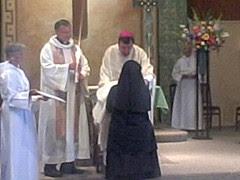
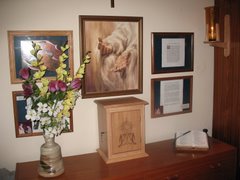
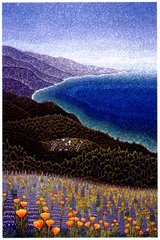
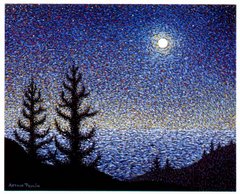
By the way, there is a longer view which I have not really touched much on here, namely the historical import of every person in the life of the Church. Church registers help keep an historical record and sense of the life of the Church for those looking at Sacramental records, etc with an eye towards the place of the Church in the life of a community, a country, or the world itself, etc. The illustrations accompanying this piece help to remind us of this.
Posted by
Sr. Laurel M. O'Neal, Er. Dio.
at
8:46 PM
04 January 2020
Eve of Solemnity of Epiphany (reprised)
There is something stunning about the story of the Epiphany and we often don't see or hear it, I think, because the story is so familiar to us. It is the challenge which faces us precisely because our God is one who comes to us in littleness, weakness, and obscurity, and meets us in the unexpected and even unacceptable place. It is truly stunning, I think, to find three magi (whoever these were and whatever they represented in terms of human power, wealth, and wisdom) recognizing in a newborn baby, not only the presence of a life with cosmic significance but, in fact, the incarnation of God and savior of the world. I have rarely been particularly struck by this image of the Magi meeting the child Jesus and presenting him with gifts, but this year I see it clearly as a snapshot of the entire Gospel story with all its hope, wonder, poignancy, challenge, and demand.
Posted by
Sr. Laurel M. O'Neal, Er. Dio.
at
11:38 PM
Labels: Feast of the Epiphany
Home Again From Tahoe!!
Home! Well, we made it home safely and though I love the house in Tahoe --- not least the fireplace, the sunroom and, of course, the shared solitude with Sister Sue --- it is good to be home! As I had planned, I did some work during the week on 2 Corinthians, though there is still a lot to do, and was able to pray and sleep as I needed. I didn't get done any of the coloring/painting I had hoped to do, but that was also okay because I got needed writing and thinking done and was able to relax and just enjoy the week doing stuff I love. The sunroom where both Sue and I worked and prayed together had an amazing view. Above (left) is a piece of what I could see while writing or reading.
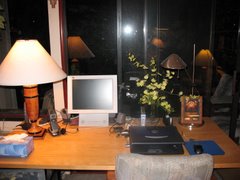
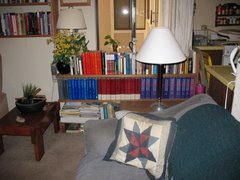
There was not nearly as much snow on the CA side of the lake as had been other times I have been here but the weather was beautiful. It was cold or very cold until the second half of the week. The second picture shows our work space. My stuff is on the left, Sister Sue's is on the right. The window in the above picture is behind Sister Sue's space. Another looking out on the side yard is directly behind my work space.
Posted by
Sr. Laurel M. O'Neal, Er. Dio.
at
6:55 PM
02 January 2020
On working With God Towards Wholeness and Holiness
[[Dear Sister Laurel, you write a lot about working toward wholeness and holiness. I had always thought that holiness was something God gave us and so something we prayed for, like humility or other virtues. Can a person get to genuine holiness without working towards it themselves? Can't they just pray to God to make them holy, or humble, or courageous, or whatever?. It is not that I have gotten the impression that you are trying to make yourself holy, but I have read blogs by people who have a lack of this or that and pray that God will take care of their deficiency. Could you say a little more about what you mean when you speak of working towards Communion and union with God?]]
Completely great questions! Important questions!! Thank you. First, I am very grateful you added that I have never given you the impression that I am working in a way which means I am trying to make myself holy. That would be completely futile but also it would give a very skewed notion of what spirituality is all about. To think we could do this is akin to jumping off a cliff and then trying to stop our fall by pulling on the tops of our shoes!! After all, God is the only source of holiness because God is holiness itself, just as God (him)self is love, truth, beauty, and so forth.
At the same time one can approach things like holiness, reconciliation, humility and other human virtues, as though they are ordinarily and simply infused by God without much more than a prayer for this here or there. These are all great graces but ordinarily this is not how such things work, nor is it ordinarily how God works! Growth in holiness is part of our growth in authentic humanity. We cannot simply pray for God to make us authentically human as though it takes no cooperation (and so, no real effort) on our own part. Cooperating with the grace of God is something learned as well as it is enabled by grace itself. It is also something that requires the healing of obstacles --- obstacles to listening deeply and responding equally profoundly, obstacles to loving and allowing oneself to be loved, obstacles to trusting as profoundly as Jesus or Mary and Joseph (and so many others) trusted!
The work I have spoken of here recently and in the past is work which fosters the ability to cooperate with God and to allow God's grace to flourish in my life. It is particularly helpful in learning to be attentive to my own heart, and therefore, to that place within myself where God laughs, sings, and speaks to me in ways which create me at the same time. Beyond this learning to be attentive, the work I do with my Director helps me to be reconciled with my deepest self and potentialities. What I mean here is that it assists in the healing and doing away with obstacles which prevent these deepest and God-given potentialities from being realized in my own self, and thus too, in my ministry, attitudes, relationships with God and others, etc.
We all have wounds leading to defense mechanisms that cripple or skew our ability to respond authentically --- or which cause the numbing of awareness of the God-given potentialities which exist deep within us. We all have things which stand in the way of our becoming the persons God has created us to be. We all have forms of woundedness which make loving and being loved difficult sometimes, or which prevent us from trusting ourselves and others, or from walking courageously in our world, satisfied with and even exulting in who God made us to be. (Sometimes these wounds and obstacles prevent us from even knowing who we really are made to be!) The work I have spoken here of doing, both alone and with my Director (delegate), is a methodical approach to dealing with the things which prevent us from responding whole-heartedly, responding exhaustively with body, mind, heart, and soul, to the love and creative will of God, just as it helps enable us to make and become that whole-hearted exhaustive response to God's Word we are called to be.
It involves prayer, of course, but also it involves writing which nurtures one's capacity for a healthy interiority; it is focused on learning to listen attentively to everything that goes on within oneself (body, mind, and heart). The aim of the work I have been doing is not just wholeness but also transparency --- meaning that when a person sees me they are seeing the real me in a way which allows the Spirit and Life of God to shine through. It is a simple matter of "what one sees is what they get" -- no pretence, no defenses, no crippling insecurities, and no need to bend to peer pressure or the expectations of others. (Meeting appropriate expectations is another matter entirely!) We human beings, I have written often here, are a covenantal reality, a dialogical "event" where God, who is a constitutive part of our very being, speaks or calls and we respond in ways which create us as God's own persons. We become a response to God's call, to his love, beauty, truth, and simplicity. We become an incarnation of the God Christ himself revealed fully and exhaustively; that is what I believe is the vocation of every human being as we share in the life of Christ and witness to his uniqueness. Again. the work I have spoken of helps enable this to become true as a (more and more) fully embodied reality in my own life. It not only helps me to be completely honest with God, myself, and others, but to be an expression or incarnation of Divine and human truth. I believe this transparency in wholeness is what the tradition refers to as holiness. It is an expression of Union with God.
I suppose that I see all dimensions of this work as prayer or at least prayerful. Of course it is not as peaceful or quietly challenging as quiet prayer, for instance, most usually is. In fact it can be extremely painful and "bloody" (so to speak!). But even so, it is simply part of a life committed to attentiveness and responsiveness to God and God's will for my own life and the life of all creation. There has always been a danger in Christianity that folks would sit back, pray, and wait for God to do it all for us. (Think of Paul speaking to the Thessalonians about those who will not work: "those who will not work will not eat"; he was not speaking to those who were merely lazy, but to those who sat back waiting for the second coming.) Sometimes that route was known as "quietism". While there are such things as infused graces, infused virtues, and infused contemplation, for instance, and while anyone who prays regularly will know these things first hand, these are not the ordinary way God works in our lives. It is possible to see all of those things I spoke of above as obstacles, as manifestations of sin in need of reconciliation. The work I have written here about doing is simply part of cooperating with God, working with God so that he may live and work within me freely and so the creation he seeks to do within and through me can be fully and exhaustively realized.
I have only just touched on the surface of things here (especially the notion of genuine holiness as transparency in wholeness), and I may decide to write more about it as follow up, but if it raises questions for you or leaves anything especially unclear please get back to me and I will give it another shot. Thanks again for a really great couple of questions!
Posted by
Sr. Laurel M. O'Neal, Er. Dio.
at
9:53 AM
Labels: Human being as Language Event, inner work, Naming the Communion that is the Human Heart, PRH, Quietism
01 January 2020
Chronic Illness, Disability and a Question about Dispensation of Vows
[[Dear Sister, I understand you have written that disabled hermits should seek dispensation from their vows. Why should hermits stop being hermits because the suffering gets bad? Someone blogged you said this recently so I am wondering where you get off doing that!]]
Despite the misrepresentation, I have certainly never written such a thing. Nor would I. Not only do I live with chronic illness/disability, but I am also perpetually professed as a canonical hermit who values her profession and the witness illness/disability can lead to through the grace of God. More, one of the things I have written and published articles on in journals like Review For Religious, is chronic illness and disability as vocation --- and in fact, as a potential eremitical vocation! This blog has a number of posts on eremitism and chronic illness/disability including those that point out hermits' vows are not dispensed should they become ill or disabled after perpetual profession and positing the charity and justice of such a practice. That said, I did write a couple of posts recently which referred to chronic illness and eremitical life; one of these discussed the option of dispensation, but not because of disability or illness per se! Instead, I wrote about the obligation a hermit has, no matter their disability or suffering, to witness to eremitical life in a healthy way and as a healthy form of life --- not just generally, but for the hermit him/herself. The question at issue was and is not disability or illness, but the capacity of one to witness to a transcendent, and even more compelling or foundational health in Christ.
What I said there (cf below) was that if, because of illness or disability (and other things as well), one could no longer live or witness to the eremitical life in a healthy way -- and that means a way which edifies --- if folks got the sense that this vocation was unhealthy for one or the hermit was giving others the sense it was itself an unhealthy way of life generally, then one would might well need to consider getting their vows dispensed. A diocese would certainly need to do this in such circumstances. You see, in the main I was speaking of public vocations where responsibility for the vocation also belongs canonically to the Church, but those who have private vows (or none at all!) need also to consider the witness value of their lives. God does not call us to vocations that are unhealthy for us; he calls us to abundant life despite and even through our chronic illness and disability. Should one's vocational path fail to witness to this for some reason or other --- and should there be no evidence of rehabilitating or remediating the situation to change matters -- then it is time to consider seeking or accepting a superior's decision to seek dispensation of one's vows.
Here is the final paragraph of the piece (the entire article can be found at: Chronic Illness as Special Challenge). I would strongly urge you to read the entire thing for yourself -- and that when you write me, you speak on the basis of what you know yourself. I would sincerely appreciate that.
Posted by
Sr. Laurel M. O'Neal, Er. Dio.
at
11:00 AM
Labels: disability as vocation
Happy New Year!
We Christians believe that because he is eternal and living our God is the ground and source of genuine newness. We believe that he is a God who transfigures all of reality into something hope-filled and meaningful. We believe that in Christ we can cooperate with God in his creative and redemptive activity as he brings about a world where heaven and earth profoundly interpenetrate one another and God is all in all. On this holiday, as so many make lists of goals and resolutions for the New Year, may each of us look to the God who is source of all blessings, and recommit ourselves to a time in which God's own projects in us and in all we know and love may be brought to fulfillment. May (he) respond to our deepest needs with a presence that transform need into blessing! All good wishes for a wonderful year!
Posted by
Sr. Laurel M. O'Neal, Er. Dio.
at
12:32 AM
30 December 2019
On Formerly-Married and Consecrated Hermits
[[ hi Sister Laurel, I was just wondering about something. You have written it is not possible for married persons to become hermits. I looked that up this morning. But how about a person who has been married and gotten divorced? Can they become a consecrated Catholic hermit? If so is this usual? What happens with their children if there are any?]]
Thanks for your questions. Yes, it is entirely possible for a person who was married and divorced to become a hermit. There are two provisos: 1) their children must be grown and no longer need them in any substantial way (they, of course, always will need (and should have) their parent's love!), and 2) if the spouse is still alive the Church must have granted a declaration of nullity.** (Please note: I have been told that a dispensation may also be granted as is sometimes done when one wants to enter cenobitical religious life after divorce. This is exceptional and I admit it makes little sense to me because it is an exception not granted for remarriage. If a dispensation is to be granted, there must be no chance that the person's spouse will exercise or demand marital rights.) In any case, to make public profession under canon 603 or as part of a canonical community of hermits, a person must be free of life bonds in order to make her profession (another life bond). Marriage is a life bond and in the eyes of the Church civil divorce by itself does not and cannot end this bond --- although the death of the spouse will do so.
The principle is simple, if we give ourselves entirely (and exclusively) to another in marriage and give ourselves to God through this marriage, we are not free to then give ourselves exclusively to God in religious/eremitical profession. The reverse is equally true: if someone is professed (meaning publicly vowed and given entirely and exclusively to God in this way) they cannot give themselves to another in marriage; they are simply not free to do so until and unless the vows are dispensed or expire, in the case of temporary professions. Until and unless a decree of nullity is granted (and the marriage bond declared void, null, or never to have truly occurred) or a dispensation is secured, the person is simply not free to make profession or be consecrated as either a diocesan (solitary) or religious (community) hermit. In religious life one must demonstrate one is free of other life commitments before one is even allowed to enter the community, much less to make even temporary vows/profession. Though c 603 has no equivalent formal or canonical stages of formation, the constraints on life commitments hold for one seeking admission to profession under this canon.
Again, as for children, a diocesan or canon 603 hermit can certainly have been married and had children but s/he cannot have minor children, nor can grown children require parental care. Such situations (minority or dependency) constitute another way in which the hermit is not truly free to give herself to profession in the way the vocation and profession require. A consecrated hermit may leave her inheritance to her children (or anyone else) just as is true for anyone. She will also arrange to remain in regular contact in whatever way works best for everyone. There will be limits, of course: young adults will not be able to come home to live with their hermit Mom or Dad, there will be no way to borrow money from the hermit (who is unlikely to have any!), and the hermit will not be able to babysit the grandchildren more than occasionally or spend much time away from the hermitage with her kids and grandkids. She will not be free for these things; her life is given over to God and structured in a new way which makes her unfree for what might have been usual otherwise.
Similarly, the family is unlikely to be able to visit the hermitage all that often -- though this is something I expect the hermit will work out with the assistance of her Director (delegate) and/or Bishop. (If it cannot be worked out to the satisfaction of the bishop, et al, the person will not be admitted to eremitical profession. If, for instance, a hermit's family needs her in ways which make embracing eremitical solitude unloving or selfish, admission to profession is unlikely to be extended to her.) Otherwise, I think things will be pretty much as they are for any parent with grown children. I do believe the reality of the former marriage with children will add moments of poignancy and depth to the hermit's life and prayer. Separation from her family/children may well sharpen her solitude and add a dimension to her love of God and humankind that other hermits without such family may not have. Thus the person who becomes a hermit after divorce/annulment and raising her children will find her circumstances add both richness and suffering to her life as a hermit.
I don't think formerly married hermits with grown children are all that usual, but they are not unheard of. I know and/or know of several such hermits. In other faith traditions that also see eremitical life as a second-half-of-life vocation or which see solitude per se as a vocation for the elderly, it is quite common for folks to become hermits for the final stage of their lives. At this point they tend to have fewer responsibilities for their family, have often lost a spouse to death, have a mature faith life, and will really blossom themselves in solitude -- including beyond solitude as therapeutic or part of their grieving process. However, within the Roman Catholic eremitical tradition I would say it is relatively uncommon for there to be formerly-married hermits -- though with the provisos mentioned above it is perfectly fine.
I hope this is helpful.
Follow up Question: [[Sister, yes your answer was helpful so thank you. I thought you would deal with this question in your [original] answer so let me ask it directly. Would someone in the same position be able to make private vows as a hermit? I mean, is there a difference with whether the hermit or wannabe hermit (no offense intended) wants to make private vows or public ones?]]
That's a great question and a good follow up since your earlier question referred only to consecrated hermits but not to those who are hermits with private vows. Yes, there is a very great difference in this. When marriage is contracted the parties enter a new state of life, the married state -- though they remain laity. They become one flesh through the Sacrament of matrimony and, as noted in the earlier question, the bond effectuated in the Sacrament cannot be undone by civil divorce. Instead it must be found and declared to have never actually occurred in a declaration of nullity or a dispensation secured. Unless and until this occurs the Church would consider either member of this couple to be unfree to make another life commitment like religious life, consecrated eremitical life, priestly ordination, etc. In other words, profession is closed to such persons until and unless they receive an annulment/dispensation.
In part, this is because profession is a matter of public vows or other sacred bonds and consecration by the Church by which a person enters another state of life (a religious, or consecrated state) involve now legal rights and obligations. Private vows however, are an entirely private matter which do not ever initiate a person into another state of life; they are an act of self-dedication with no corresponding ecclesial act of reception or consecration. (Private vows are witnessed, but not received.) Thus, neither do private vows ever convey the rights and obligations associated with religious life or consecrated eremitical life. For this reason, a person who has been divorced without benefit of annulment/dispensation can make private vows at any time. Nothing in her state of life changes, there is no canonical life commitment or assumption of new legal obligations or rights to which one's remaining marriage bond would be an impediment.
If, however, such a person were to decide they wanted instead to become a consecrated hermit in the Roman Catholic Church, they would need to pursue the annulment (the declaration of nullity which says the Church finds there to have never been a sacramental marriage bond at all beyond a civil contract). The Declaration of nullity (or, again, the prior death of one's spouse) would therefore establish there is no impediment to profession or consecration and would thus establish a person as free to begin a mutual discernment process with their Diocese, something every person seeking to be admitted to public profession and consecration would need to do.
Again, good follow up question! It really helps to underscore the difference in Catholic theology between private vows and public profession as well as the necessity of responsible freedom to make a life commitment which is truly binding in all the ways such a commitment should be within the Church.
Follow-up Question #2: On the Need for a Declaration of Nullity:
In many things here I post my own opinions based on lived experience as a hermit and my theological expertise; I always attempt to give the very best and most accurate opinion I can and I will always try equally diligently to reflect the Church's own practice. However, in the matter you first asked about regarding the need for ecclesiastical annulment (or dispensation) if one has been divorced and is seeking to be admitted to public profession and the consecrated state as a hermit in community or a c 603 hermit, this is not an opinion; it is the way things work in the Church because matrimony effects the union of two people so they become "one flesh". I am merely stating the Church's theological and canonical position on the freedom necessary to make another life commitment.
Here is the way one religious congregation (Carmelite) states the need for canonical freedom for those seeking to enter them. The requirements are the same for profession under canon 603: [[Yes, we do accept women in our congregation who were formerly married. You would need to produce the necessary documents establishing that you are canonically free to enter religious life; death certificate of spouse, or civil divorce decree and [an ecclesiastical] decree of nullity.]] (Emphasis added.) The pertinent canons are 597 and 643 sec 1.2 and 2.
The author of the blog you referenced (also The Complete Hermit, Christ in the Present Moment, and several others) also once knew the truth of what I have written here, though perhaps she was unaware of the theological rationale for the Church's position. She and I once spoke about the necessity of establishing one's free status to become a canonical hermit when she reached out to me about becoming a diocesan hermit during the Summer of 2007, prior to my perpetual eremitical profession on 02. September. (Remember canon 603 hermits have to submit copies of their baptismal certificates -- which include records of other life commitments -- and prove free status in ways similar to the above if they are to undertake public profession.) After our email conversation, Ms. McClure eventually spoke to someone in her own diocese and subsequently blogged about that. Here is what she wrote (the link to the relevant excerpt of the blog article, which I copied this morning is included at the end):
[[Friday, August 31, 2007
nullity of marriage
Posted by
Sr. Laurel M. O'Neal, Er. Dio.
at
11:03 AM
Labels: Canonical Status and Freedom, declaration of nullity, dedication versus profession, married hermits?, married love, private vows versus public profession, responsible freedom
29 December 2019
Feast of the Holy Family
Bro Mickey McGrath, osfs
|
Posted by
Sr. Laurel M. O'Neal, Er. Dio.
at
11:09 AM
On Being and Becoming a Religious
[[Dear Sister Laurel, when you speak of profession or being admitted to profession you also speak of undertaking and being entrusted with rights and obligations beyond those of baptism. In some ways this sounds sort of legalistic, but in other places you speak as though something changed in you at the moments of profession and consecration. Is there both internal and external change with profession and consecration? Because you have written about the difference between private and public commitments, between authentic and counterfeit Catholic hermits, and coming to act or live your vocation in the name of the Church as opposed to doing so in your own name I suppose, you seem again and again to be saying something changes within you as well as external to you in your relationship with the Church.
Is there such an internal change? Is this part of distinguishing as you do between hermits in the lay state and hermits in the consecrated state? I know that priests when they are ordained are somehow changed so that they can consecrate the Eucharist, and so forth. Is there something similar that actually happens to you and within you when you are perpetually professed and consecrated? Is this why you insist (or why the Church insisted at Vatican II) that the distinction between dedication and consecration be maintained?]]
Yes!!! Yes!! Yes!! You have understood me (and the church's theology of consecrated life) well I think. There are both external changes (the assumption of rights and obligations including the right to style oneself as a religious, the relationships necessary to live one's vows and be adequately guided and supervised in these via the ministry of authority, and the privilege, right, and obligation to live one's life in the name of the Church) along with internal changes (God sets one apart via consecration as a "sacred person" (I am not thrilled with this phrase, but I don't know a better one) and graces the person in ways (or constellations of ways) not necessarily found in the lay (vocational) state. It is traditionally referred to as a second consecration. This "second consecration" has sometimes been explained in terms of betrothal or espousal --- something that does not generally apply to baptism per se and which adds to one's baptismal consecration. While this is not the same as the "character" associated with priestly ordination, what is critical to understand here is that in the making of one's vows and the prayer of consecration associated with perpetual profession one becomes what one was not before, namely, one becomes a religious with a soul configured as that of a religious initiated into an external religious state to match.
When I write that we cannot consecrate but instead, can only dedicate ourselves I am saying the same thing: we cannot change ourselves, we cannot make ourselves into "sacred (divinely consecrated or set apart) persons", or give ourselves the rights and obligations which are intrinsic to the religious state. We cannot claim or assume on our own something only the Church has the right and ability to mediate to us on God's behalf. We can put ourselves in the position of those who desire to embrace these rights and obligations as well as the graces associated with this particular state of life, this identity within the Church (for this too is a reason we call religious or canonical eremitical life ecclesial vocations), but again, we cannot assume, much less claim to have such an identity unless and until the Church extends them to us and, through acts of mediation which are performative in nature, make us into that thing we so profoundly desired. The word performative is important here; it points to a kind of language in which the thing spoken comes to be in the very act of speaking. In religious life the vow formula is such a piece of performative language; so is the prayer of solemn consecration. In the praying of these forms of language the thing spoken is realized in space and time in the very speaking of the words.
A metaphorical way of saying this is that in the act of speech of profession we "say ourselves (an act of dedication) into" a state that stands ready for us; the Church receives this act of profession and extends God's own consecration to us in her own solemn consecration. According to Vatican II and traditionally, we dedicate ourselves but only God consecrates. Speech is the way truth is mediated, the powerful way in which reality is changed -- the significant or meaningful way in which we ourselves are changed and assume a NEW identity, a differently graced identity we did not have even an hour earlier. In religious profession and consecration, God is doing something new just as he was doing something brand new at our baptisms! Vocations are, it seems to me, not about us so much as they are about what God has done and continues to do within us through the mediation (of both call and response) of the Church. In any case, to be a religious, to have this identity means much more than to desire profoundly to be a religious; it means in ways which are both internal and external, to be made a new reality with public rights and responsibilities and the graces (both internal and external) that attend the state. These are not icing on the cake, so to speak, they are absolutely intrinsic to the reality of a religious or public vocation.
Yes, all of this is at issue when I speak of counterfeit hermits vs legitimately professed and consecrated hermits. Those, who, without benefit of public profession and consecration, claim the title Catholic Hermit, for instance, are, whether they realize it or not, claiming to be living eremitical life in the name of the Church. Whenever the word Catholic is appended to an enterprise, project, and so forth, someone is claiming that this reality is being lived, done, undertaken, or enacted in the name of the Church --- and that they have been extended and accepted all the rights and obligations thereto. A Catholic theologian is not a Catholic who is also a theologian but one given a Mandatum by the Church to do theology in her name. When someone claims to be a consecrated hermit they are claiming to have participated in a public rite of profession and consecration where God's own act of making sacred or uniquely blessed has been extended to the person through the formal and authoritative mediation of the Church. Not just any priest, for instance, can act in such a way, nor can just any person desiring this. One online hermit has said that in her belief "we are all religious" if we make (private) vows of poverty, chastity, and obedience. But this is exactly wrong and fails to see especially that the making of a religious involves a divine/ecclesial act in which something that did not exist before comes to be!
Religious today rightly make a great deal of the fact that in a hierarchical sense they are lay persons and not clergy, that they do not stand in an intermediate state hierarchically between laity and clergy. This allows them to assume a rightful place with everyone else in the Church and serve, not from a position of superiority, but of equality. This is right and good and it is an important fruit of the second Vatican Council Sisters and Brothers are right to underscore. But at the same time Religious know that vocationally they are not lay persons and are no longer in the lay state. They have been changed exteriorly with the assumption of rights and obligations appropriate to this new state; but they have also been made new inside as well and become someone formed by new manifestations of the grace of God precisely so they are able to assume the rights and obligations associated with their new state of life.
These two changes, external and internal work together to shape, challenge, console, and shape the person some more, in an ever-ongoing interplay of grace and nature which is distinct to this state of life. If one is consecrated but leaves the consecrated state of life in terms of the external rights and obligations, then one, despite one's consecration, is no longer a religious and cannot grow as a religious (though one can and likely will certainly grow as a person!). If one tries to take on the rights and obligations of the religious state as though grace and ecclesial admission granted and received through public profession and consecration were unnecessary, one will not and cannot be a religious. To be initiated by the Church into this distinct (not superior but distinct!) and formative stream of grace and challenge, this unique dialogue between nature and grace, and to respond in continued dedication to this ecclesial vocation is to become and be a religious. Personal potential and desire notwithstanding, before and apart from this initiation one simply is not and cannot be a religious.
Posted by
Sr. Laurel M. O'Neal, Er. Dio.
at
10:14 AM
Labels: Admission to the Consecrated State of Life, dedication versus profession, private vows versus public profession, public vs private Consecration, religious life
28 December 2019
Feast of the Holy Innocents and other Feasts during the Octave of Christmas (reprised)
When I was an undergraduate at St Mary's College, CA, I worked with friends in campus ministry. One year, we planned the College Christmas Liturgy and, as theological students who were a little full of themselves we pressed the college chaplain to let us choose music that had nothing to do with little babies in mangers, etc. We wanted something less "sentimental", less marked by unhistorical Xmas Stars, angels, adorable lambs, charming shepherds, and so forth. Our instincts might have been good theologically, but to some extent we lacked a strong sense of the liturgies involved in the Church's celebration during the Octave of Christmas and the need to celebrate God now-present in the littlest and least! On Friday we celebrated the Feast of the Massacre or Martyrdom of the Holy Innocents --- Matthew's unique narrative which helps contextualize the Feast of the Nativity. Just as Mark's version of the Gospel led him to write "a passion narrative with a long introduction," Matthew's Gospel eased any tendency to sentimentality in the Christmas narrative by reminding us that the Christmas star is accompanied by significant shadow!
But is the story of the massacre about something that really happened? There are good reasons for believing Matt's account is historical and not "just" the Evangelizer's "theologoumenon" (a narrative construct created to convey theological truth). Herod, after all, was known as a cruel, paranoid man driven by a need for power and a strong obsession with conspiracy theories. He had been made "King of the Jews" by the Roman Senate in 40 BC, took over Jerusalem with a Roman army, and then maintained his hold on power by killing anyone who might have seemed the least threat. These people included not only a Hasmonean Prince, but 1 of 10 wives, his Mother-in-Law (also Hasmonean), 3 sons, a brother, 45 Jewish leaders and a handful of Pharisees, 300 military leaders, and any number of other folks Herod felt endangered his position or conspired against him. In general he was hated and after the death of his Sons, Caesar Augustus noted, "I would rather be a pig than one of Herod's Sons!" When commentators describe Herod's typical pattern of behavior they would note he became fearful, killed whomever he feared, fell into a depression, and then as a response to this, shifted into a more active mode of "build, build, build!!" All of this makes Herod's response to the birth of Christ and account from the Magi read as believable; it does not strain credulity --- though it would also have made a powerful theologoumenon!
No, the massacre of the Holy Innocents and trek of the Holy Family into Egypt are credible as historical events and we trivialize and sentimentalize them at our peril --- and at the peril of our theology of the Nativity and Incarnation when we fail to appreciate the portrait of our world painted by various feasts of the Octave of Christmas. Today it is not uncommon to hear that our world is not as it should be because it is evolving toward the fulfillment God has willed for it; sin is sometimes left out of the equation altogether. But real as evolution is and hopeful as is the image of a world slowly evolving toward fulfillment as well, there are powers and principalities at work in our world which are evidence of sin --- that is, of the universal ratification of anti-Divine powers and principalities and the need for the intervention of God in our historical reality. I sincerely believe that the Christ Event would have occurred, sin or no, as a definitive step in the evolution of our world, but I also know that sin is real and the cosmic light of the Christmas star is bright in part because it stands against the backdrop of sin's darkness.
Christmas is a season of Joy not because there is no darkness, no sin, no oppression and death, but because it reminds us that God has made of our humanity a sacrament of (his) own life and light. History has become the sanctuary of the Transcendent and eternal God. Our God is now Emmanuel (God-with-us) and we, the littlest and the least, have been ennobled beyond anything we might otherwise have imagined; in and through Christ we too are called to be Emmanuel for our world; in and through the Christ Event we are each made to be temples of the Holy Spirit. As Advent reminded us, we live in "in-between" times, a time of already but not-yet. There is work to be done, and suffering still to experience. But the light and joy of Christmas is real and something which will inspire and empower all that still needs to be done: caring for, loving (!) the least and littlest so they truly know they are the dwelling places of God; opposing the Herods of this world in whatever effective way we can so the Kingdom of God may be more fully realized by divine grace through time; allowing the joy and potential of the Christ's nativity in our world and ourselves to grow to fullness of grace and stature as we embrace authentic humanity and holiness.
My very best wishes to all on this Feast of the Holy Family and my special thanks to the Sisters of the Holy Family (Fremont, CA) for the charism embodied by the members of their congregation. As they mark the renewal of their vows on this feast we celebrate that they have been and remain a light to the littlest and the least amongst us, to the lost, abandoned, and rejected, the homeless or those who are otherwise without families, and to all those who have found in them a compassionate Presence capable in Christ of healing the wounds occasioned by sin and death. I personally locate them at the crossroads of Mercy and Grace and I am sure I am not alone in this.
Posted by
Sr. Laurel M. O'Neal, Er. Dio.
at
1:22 PM
Spending the Octave of Christmas in Tahoe!!
Greetings from South Lake Tahoe!! Sister Sue and I drove up the day before yesterday. As some readers know, Sue's congregation has a retreat or vacation house there right on the lake. It is a small but lovely place and my favorite room is the sunroom, located at the back of the house (or maybe it's the front) which looks out directly on the lake. It is mainly made of windows and on one end (where I am sitting now) is a dining room table for 6-8 people where during the day I will work on Scripture, do some writing, and Sue will prepare her next courses for the University where she teaches maths and chemistry.
I have brought several things with me for this next week: 1) the books I need for a course on 2 Corinthians I will be doing at my parish (this includes a massive tome: NT Wright's new Introduction to the NT and its world which was "Santa's" gift to me from my pastor --- a book I believe will be used by introductory courses for undergraduate and maybe graduate studies in NT everywhere for some time), 2) When Silence Speaks, a book on Carthusian spirituality by Tim Peeters, 3) Persons and their Growth, a comprehensive look at the nature of the methodology and process my Director and I are using together for personal formation, and 4) pencils and paints so I can color/paint both as part of this work, and for recreation and relaxation. (My Christmas present from Sue was a coloring book of Cats by B Kliban so I am completely set for this!)
There is no set schedule here but the rhythm of the days for me go something like this: middle of night (2:00-4:00) prayer, then back to sleep (my usual schedule has rising at 4:00 and that was true today); 8:00, morning prayer and breakfast. 9;00 or thereabouts --- to work on Scripture. The evenings Sister Sue and I will pray and celebrate communion together, fix dinner (Sue's a great cook, me -- not so much!), and then watch TV (Sue brings DVD's of PBS programs, concerts, etc) and just talk. Night prayer and bed is whenever we feel like it individually. I brought the book on Carthusian thought because it ties in with what I have written here recently about the silence of solitude. Carthusians understand solitude in the positive way the Camaldolese and I do: it is about coming to wholeness and completion with/in God. They seem to understand silence in a correlative way as well: a kind of stilling of the passions, voices of anguish and yearning of our hearts as we draw closer to union with God who heals, comforts and completes us. At the same time they have a clear sense that one piece of stilling all of these is suffering from and in them as well. (It is impossible to satiate one's deepest hungers, needs and potentials unless, of course, we have allowed ourselves to feel these keenly and come to understand them right to their roots!)
I brought the PRH text, Person's and their Growth, because I am coming to a new place in my growth and need to reread the book from this new perspective. One question I have received from a reader recently (see below) has to do with my need to do this inner work/personal formation and whether it indicates that I was professed prematurely or was even unsuited to this vocation. The very cool thing about PRH is that it is about coming to wholeness and holiness in whatever call one has discerned. Yes, if a person has lived with profound woundedness from childhood or later in life, it is an excellent way to work with an accompanist and heal these wounds, but more profoundly (because deeper than this woundedness) the human person has a deep self, the one they are called to be and become over time and through the grace of God. PRH is focused on coming to live this deep true self in all of its fulness, so once one has done with the healing portion of things (or largely so) one continues on with the process.
What is especially astounding to me is the way the process works at all levels of the person's being and at whatever level of growth. Though it rarely uses the word God, it is well conceived with God and the human potential which is God's eternal gift to us lying at our core at its heart. In-one-on one accompaniment (the kind my Director does with me) the work is explicitly Christian and faith-based --- because she and I are both Religious and bring the reality and language of grace and our personaly commitment to God into the entire process. Prayer and what occurs there is a regular feature of the work and the "process" and it is a joy to be able to speak of these things to someone who understands and lives them well --- indeed, far better than I do -- herself!
Response: It is possible that one's need for healing points to the fact that they have no call to eremitical life; they may well have embraced eremitical solitude because they can't live with themselves or others, because they have failed at life more generally and are seeking to escape all reminders of that, or done so prematurely because they are called to a more temporary period of therapeutic solitude during which they deal with whatever issues they have (bereavement, serious illness and other losses, etc.). But it is equally true that eremitical silence and solitude provide a proper context for undertaking the work of deep healing and reconciliation in an intense and focused way. Indeed, they are a very great gift of God in this undertaking. Each person with her Director's assistance will need to discern which is true --- and this means, of course, that it is possible to come to a point of healing where one also knows for certain that one is NOT called to eremitical life as a life vocation. But again, it is equally possible that one will find one is called to such ongoing and ever deepening work because one is called to holiness precisely as a hermit.
As I have written here before, in my own work I have come to see the way God accompanied me my whole life and helped prepare the heart of a hermit. Physical solitude (not always voluntary or chosen) was almost always a part of that preparation as was my own awareness of God's presence. Thus, what has occurred is that I have found that with some fundamental healing accomplished, I am more certain than ever that eremitical solitude is meant to be the vocational context for the whole of my life and so I will also continue the personal formation through whatever comes next, and after that as well, and do so within the context of canon 603 profession and consecration. While, as you rightly note, I continue to believe that one's foundational healing needs to happen before admission to life profession the inner work I am speaking of is not merely about this kind of healing but about a deeper and deeper reconciliation of oneself with one's deepest self, with all of humanity and creation, and with God who is the very ground and source of one's being.
All of this is what I was referring to when I wrote in a recent post about the Church's act of professing me having implicitly commissioned me to undertake whatever healing and formative work was necessary, and to do so in an intense and focused way. My profession explicitly commissioned me to explore the depths and breadth of contemporary eremitical life under Canon 603. (Arch)bishop Vigneron explained this was so in his homily to me and to the assembly as a whole. What I am finding, what is affirmed again and again in many ways, is that it is eremitical solitude which is my vocation and which itself calls for something like PRH (some way of or approach to personal formation) and enables me to experience my call to ever greater depths and levels of personal wholeness --- beyond the healing of woundedness, beyond the relative comfort of life untroubled by such woundedness and fruitful in all of the ways one might live out this particular wholeness in parish ministry, the academy, hospital chaplaincy, or wherever --- and into a deeper call to genuine holiness in communion/union with God in and as an instance of the silence of solitude.
It is precisely my commitment and fidelity to my vocation which allows me to undertake this process of personal formation with the kind of depth and rigor it requires. As I began to do this work (and long before really), I realized freshly I was hungry for this kind of formation. I had had a sense of yearning for it in the Franciscans and later on as well. When I first began working with my spiritual director back in 1982 or so I fought her on this approach to personal growth, was resistant to it, distrusted it and was perhaps even frightened by it and the demands (and promises) it embodied. Sister Marietta didn't push, though she did offer bits and pieces that were helpful --- tools I could use without "buying the whole package," so to speak; she also continued to teach me whenever I needed her to, and kept encouraging me in ways which tacitly pointed to the power of PRH in spiritual/personal formation. I had no sense what a truly great gift she was offering me. And eventually I became capable of receiving it, and more eventually (within just the past few years, in fact), of seeing it as the great grace it is not just for personal healing of past wounds, but --- especially in conjunction with my eremitical life of assiduous prayer, Scripture, etc --- as a means to responding to God's invitation to genuine holiness and union.
Meanwhile, this early morning, here I am in the dark sunroom in the Dominican House (Our Lady of the Lake) at Tahoe. It is just 6 am, though I have been up for some time now, and the sun is beginning to show itself in the light pinkish brown aura and lightening sky above the mountains across the lake. I understand that somewhere in the sky beginning 28. December there will be a new celestial presence --- perhaps a comet which has never before made its appearance in this part of the universe. Christmastime is about newness of course, new birth, and it seems to me that this particular new celestial presence could well be prophetic -- as was true of the "star" that guided others to Jesus in Bethlehem. For me this presence will mark a step into and along the deeper journey to personal holiness as I continue to explore the depth and breadth of my vocation in the constant presence of God and with the support of my friends, parish, and the accompaniment of my Director. I hope the same sense of God's presence and accompaniment will be true for all of you in whatever way your journey takes you further and deeper into the great Mystery we call God! Merry Christmas!!
Posted by
Sr. Laurel M. O'Neal, Er. Dio.
at
7:22 AM