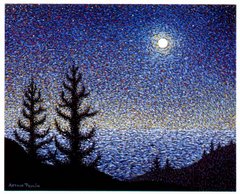
[[Hi Sister, I wondered why you stressed that your vocation was a desert vocation. What is so important about the desert? I know that hermits get their name from the Greek for desert -- I read that here and other hermits talk about it too, but why is that so important? You don't actually live in a desert, and you aren't in some deserted place, so you are not saying a literal desert is necessary. You don't believe that God can only be met and followed in a desert vocation, do you? Do you think that God can be followed better in a desert vocation? And that brings me back around to my first questions. Why are the desert and the hermit vocation so important?]]
Thanks for asking these questions. Because you have already read some of what I have written on this topic, it helps me to see the somewhat different direction they are leading. I appreciate that. What is most important about a desert vocation is that it represents a place where several forms of essential encounter occur and, because the desert leaves one vulnerable in a way that doesn't allow for many distractions, these encounters cannot be easily avoided. Thus, these forms of encounter are radical, foundational, and call for a relatively all-consuming commitment from the desert dweller. In the desert, one meets oneself, both one's true and one's false self. One also meets God, and in this encounter, is called to entrust one's entire self to Him. Finally, one meets the existence of evil, the presence of sin and death, failure, distortion, temptation, and all that can lead us to choose or turn away from God and the fullness of life he offers. The desert is the place where the fundamental choices between life and death, freedom and bondage, and despair and hope are presented to us most radically. That means that it is also the context in which the choice for or against God and one's truest humanity can be similarly made.

One way to think about this whole process, and what is at stake in desert spirituality and desert vocations, is to see it as allowing Christ to come to full stature in our lives. Likewise, it refers to us coming to full stature in Christ. As one author puts it, the desert is a "Geography of Growth," ** and as in Christianity itself,
the Cross is the ever-present measure and standard of desert existence. It marks an event of unprecedented abjection and alienation, and at the same time, it celebrates the divinization and consequent glorification of what had previously been known as godless. This means that in the desert,
as was the case with the whole of Jesus' life, hermits are those committed to a life where God's power is perfected in weakness (2 Cor 12:9), where Divine justice is done in God's mercy, and self-emptying leads to the fullness of meaningful existence.
In Christ, hermits are committed to posing the deepest and most searching questions of their lives, questions of life and death, meaning and meaninglessness, isolation and communion, and in this way, they become those who receive and embody the answer whom God is in its most radical form. The desert (which, in NT theology, includes mountains and seas, as well as the grassy slopes associated with the feeding of the multitude, etc.) is the privileged context in which all of this occurs.
.jpg)
So, no, I am not necessarily speaking of a literal desert as the home of the hermit. Many human experiences are desert experiences and make it possible to live a desert existence. For instance, chronic illness and disability represent such an experience. Poverty, joblessness, homelessness, and similar states of loss and deprivation would also. Whenever and wherever we are thrown back upon our own resources and confronted by existential questions of meaninglessness, and the threat of nonbeing, we have entered the desert with its critical invitation to entrust ourselves entirely to God and to allow the paradoxical Gospel of Christ's Cross to transform us into a new and entirely free creation. While God can be met and embraced anywhere, I do believe that the desert is uniquely suited to encountering and being embraced by God. This is why the desert plays such a central role in both the Old and New Testaments.
.jpg)
Every vocation witnesses especially to some dimension or multiple dimensions of the Gospel. We call these dimensions "charisms" not only because they are spiritual qualities, but because they are gifts of God to us, to his Church, and to the larger world. The hermit vocation brings the desert and Christ's Cross right into the center of the Church with a unique vividness and challenge. As a result of the hermit's witness, it becomes and will continue to become more impossible to marginalize desert experiences like chronic illness, disability, poverty, etc., within the Church. This in turn means that those whom the world devalues, marginalizes, and otherwise excludes find a central place in the Church's life and proclamation of the Gospel of hope. It is no accident that many canonical hermits
once considered "unsuited" for apostolic religious life because of chronic illness and physical disability found their true vocations as solitary hermits under c. 603 and identify profoundly with the Cross of Christ and the radical hope it brings to our world.
** "Geography of growth": this characterization of the desert in the Scriptures is from The Wilderness Years by D. Michael Gross.


.jpg)
.jpg)





 Posts
Posts