Showing posts with label canonical rights and obligations. Show all posts

04 November 2026

What Specifically Does the Church Hold You Responsible For? (Reprised from 2015 with new postscript)

[[Dear Sister Laurel, . . . What is hard to see clearly is what responsibility or responsibilities a hermit takes on. When you talk about [being a hermit] "in the Name of the Church," that refers to responsibility; I know that. But what specifically does the Church hold you responsible for? Is any of this based on the Bible, or is it all about Canon Law?]]

Scriptural Roots Exemplified:

Thank you for the questions.  Let me begin with the last one, which I believe is critically important. I think there are very clear Scriptural precedents for the Church's insistence that standing is inevitably associated with commensurate responsibilities. One of the most vivid is the parable of the Prodigal Son/Merciful Father. Remember that when the younger Son demanded "the property that would be his at his Father's death," he very specifically does NOT ask to assume the responsibilities of inheritance. In fact, he rejects these outright. Despite some English translations of the text, he asks for the "ousia", the very "substance" of the material or wealth portion of the patrimony that would come to him at his Father's death, but he does not use "kleronomia", the usual word for inheritance. This is significant because asking for the inheritance (kleronomia) necessarily includes acceptance of leadership for the family, their wealth, honor, and general well-being. In fact, it includes the pledge that one will give one's life for the family if need be.

Instead, this son effectively wishes his Father were dead, separates himself from the family, sells off his portion of the property for cheap (he does not bargain as is typical in the Middle Eastern culture but liquidates things quickly for whatever he can get in the moment), thus leaving his family in reduced circumstances; he then squanders the proceeds of his impulsivity, greed, and lack of compassion in "riotous (exorbitant) living" among foreigners. He becomes rootless, a wanderer without value or responsible role, someone who has exchanged the lasting or eternal for the entirely ephemeral. (By the way, it should be noted that in Jesus' day calling someone rootless in this way was an unpardonable offense; making oneself rootless was incredibly degrading.) 

Meanwhile, skipping ahead in the story, when the younger son returns home in yet even greater disgrace, he is restored to Sonship and will be honored by all the village as the Father's Son because of the robe, ring, and shoes with which his Father has clothed him. In other words, he has been re-established as one with genuine standing in the People of God and real responsibility within and for the family and the family's honor and wealth. With standing comes responsibility. To take what is due a Son and to do so while cutting all ties, betraying and sundering all relationships, and selfishly relinquishing all responsibility for one's family or the People of God is the very essence of sin in this NT parable. Despite some distorted approaches to spirituality, and the genuine limitations of life as a hermit, I would argue one cannot do these things in the name of eremitical life either. That way lies the disedifying isolation of counterfeits and curmudgeons rather than the ecclesial solitude of the Christian hermit.

Canonical Standing and Responsibilities:

 To accept canonical standing then (i.e., that which comes with public profession and//or consecration) is to accept the responsibility to act in whatever way one is commissioned by the Church to do in her name. The same is true with regard to Sacramental relationships and standing: Baptism (Sacraments of Initiation), Marriage, Ordination all come with specific responsibilities within the Church and for the very life OF the Church. In my own life, the specific obligations include: 1) an ecclesial vocation lived as an integral part of the Church's own life and holiness governed by both universal and proper law, 2) an eremitical vocation whose nature is defined by canon 603 and other canons related to consecrated or religious life. It includes stricter separation from the world (those things contrary or even resistant to Christ as well as those things which promise what only God can promise), assiduous prayer and penance, the silence of solitude, the evangelical counsels and all those imply, life according to an approved Rule I write myself, and the supervision of the diocesan Bishop and those he delegates to act as legitimate superiors and/or delegates (quasi-superiors).

In all this, I (and all diocesan hermits) am specifically responsible for living the eremitical life in the heart of the Church as a continuation of the prophetic life of the Desert Fathers, the pastorally significant lives of medieval anchorites, along with the hidden witness of so many other hermits, and for extending this rich tradition in ways which meet contemporary needs and speak to contemporary culture. 3) As a representative of these, I am also part of a parish and diocese; I was called forth from their midst and professed and consecrated in their presence, with them witnessing, supporting, and celebrating. As solitary as a hermit's vocation is, it is ecclesial, and so I live this life in my parish's midst and serve them and others as my eremitical life makes possible.

Bearing the parable of the Prodigal Son/Merciful Father in mind, as a Sister (that is, as a professed religious), I am responsible in various limited ways for dimensions of the life of this parish family. There is something similarly true with regard to the diocese as such, though ordinarily this is expressed in my commitment to parish life, or, occasionally, in diocesan events and diocese-wide celebrations, funerals, etc. It always means the parish and diocese are kept in my heart and prayer, but it sometimes means speaking at other parishes in the diocese, doing an occasional presentation at Contemplative Outreach or similar groups in the area, regarding desert spirituality, eremitical life, contemplative prayer, etc. In any case, I am responsible not merely to be a hermit, but to be a hermit in the heart of the Church and to appropriately allow the fruits of my own solitary contemplative life to nurture the life of the family I know as the local parish and diocesan Church.

In terms of the universal Church, I really do feel the obligation to live a life which is truly an extension of the eremitical tradition which has been part of her life since the 4th Century and certainly was an element of Jesus' own life, that of John the Baptist, Elijah, etc. And even beyond the universal Church is the world-at-large --- also searching, hurting, and yearning. Every person comes to communion with God in an essential solitude, and the hermit's life reminds them of this. At the same time, some effectively marginalized persons especially need the example of the hermit's solitude to come to a sense that their own isolation, no matter the circumstances causing or exacerbating it, can be redeemed through such communion.

Canon 603 is very specific about the hermit living her life for the praise of God and the salvation of the world. Her own prayer --- intercessory and otherwise --- is very important here, but so is the entire solitary life she lives as a public person in the Church. The very hiddenness of the hermit's life is, paradoxically, actually part of her public identity and witness. After all, most of the struggle, love, work, and prayer we all do in our lives is hidden "from the eyes of men" and sometimes that can tempt us to abandon this for notoriety, etc. A hermit reminds everyone that this is unnecessary and perhaps even illegitimate depending on what God wills in our lives. At the very least, the hermit's own life of essential hiddenness encourages patience and suggests a new way of seeing things. Especially, it encourages us to see the immense dignity of our lives and the significance of whatever we do in and with God, no matter how ordinary or how hidden.

So, I have a strong sense of responsibility in all of these ways. Moreover, as you very perceptively put it, the Church herself rightly holds me morally and legally responsible for living my life in these ways. Public profession and consecration establish a covenant between the individual professed and the Church more generally --- usually through an institute of consecrated life, but now with canon 603, through the hermit's diocese and local Bishop. The Church spells out some of this in the canon, but she fully (and rightly) expects the hermit who is publicly professed to concretize or make these obligations more specific in terms of her own prayer, study, reflection, and response to the grace of God as it comes to her through the relationships that constitute her life. This is another reason it is very important that there be sufficient formation and mutual discernment before admitting someone to profession and (then) consecration under canon 603. Through canon 603, diocesan hermits give their lives to Christ and to those who belong to him in what is intended to be an irrevocable gift. Thus, the Church that receives this gift needs to have the sense that the candidate has the necessary tools, sensibilities, maturity, and constitutive relationship with God and his Church to truly "flesh out" (or even incarnate) all of the potential which is profoundly embodied in this brief but richly pregnant canon.

Canonical or non-Canonical Hermits: Standing Comes with Responsibility, Rights with Obligations:

My own understanding of the Parable of the Merciful Father (aka Parable of the Prodigal Son) colors the way I see people who seek (or pretend to!) the status or standing of consecrated solitary hermits without accepting the responsibilities the Church associates with such standing. One's life in the Church always comes with commensurate responsibility. Standing as a publicly professed and/or consecrated person in the Church codifies such responsibilities in law. The Prodigal Son was given a robe, a ring, and sandals signifying his new standing in the family. It is not hard for the diocesan hermit to see or hear echoes of this story as the Bishop presents (or clothes her in) the prayer garment, eremitical tunic or scapular, and profession ring, or as he presents her a copy of his formal approval of her Rule, which establishes it as binding on the hermit in law as well as morally.

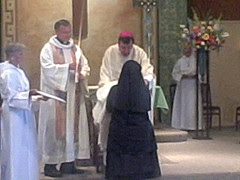
Resonances of the Son's renewed acceptance of his place in protecting the patrimony of his family and People are not far from the hermit's heart when she makes her vows in the hands of the Bishop while resting them on the book of Gospels, or signs those same vows on the altar, or is congratulated and welcomed in her new standing by friends, family, and especially the whole parish community at the Eucharistic Feast. I would think the lay hermit who lives her eremitical life by virtue of her baptismal consecration alone might well perceive similar resonances with 1) her baptism, which initiates her into the family of followers of Christ, 2) her anointing with chrism, 3) her clothing with the white baptismal garment, and 4) the giving of the baptismal candle, which is accompanied by the commission to keep it burning brightly as a witness to others. In either case, and in all other instances of ecclesial commissioning, standing in the Church comes with responsibilities, and rights are accompanied by obligations. The matter is both canonical and profoundly Scriptural, but as I understand it, it is Scriptural long before it is canonical.
_________________________________________________________

** I want to note here something that was not included when I first wrote this piece, namely, that because canonical standing is about both rights and responsibilities or obligations, it is not the kind of "status" associated with pride, arrogance, and some of the things that I  and others associated with c 603 have been accused of recently. 

The obligations assumed with public profession and consecration bind the person under the virtue of religion.  All vows do so. [[“A vow is a deliberate and free promise made to God concerning a possible and better good which must be fulfilled by reason of the virtue of religion.”]] However, this occurs with a different weight with public vows than with private vows: [[ Accepted by the Church’s authority, Public vows are binding in Church law and carry the full weight of the virtue of religion.]] This means that breaking or abandoning a (public) vow is always a grave matter and can thus be a mortal sin. 

Private vows involve a different weight than public vows; even so, this in no way makes them or the vocation they mark to be insignificant, or as something one might treat as a "has-been" kind of thing when one begins to feel they are "no longer [much of a] challenge or sacrifice". One needs to get private vows dispensed by one's pastor, for instance! The dispensation of public vows, even when entirely voluntary, is a bit more complicated and weighty in the eyes of the Church, and so, one presumes, in the eyes of God. 

31 August 2023

Canon 603: a Paradigm for all Hermits

[[When we examine the now two Church-allowed hermit paths, we can see the challenges in each, but the greater challenge to me has remained that of living as a hermit unknown, unnoticed, non-acclaimed. Yet despite many trials and errors, I remain God’s beloved consecrated hermit--and a Catholic hermit. Indeed, some have stated that a privately professed hermit must not call him- or herself a “Catholic hermit” if not a diocese CL603 hermit. It does not matter, other than why cut off all the Church’s hermits who have lived and died living this more rare but special vocation when until recent times, there was no created church law establishing other than what always had been?]] 

Hi Sister, I wondered if you had seen this post and if you had any opinions on it. I wonder how the author can say "It does not matter" while it sounds like it matters a lot to her! Does Canon 603 cut off all who have lived and died as a non-canonical hermit? Was there no church law regarding hermits before c 603? I remember you saying there was but not universal canon law. Is this so? Thanks!]]

I have seen this passage before, yes. I agree that the assertion of an identity as a "consecrated Catholic hermit" despite never having been admitted to consecration as a Catholic hermit by anyone in the church with that authority and/or intention, does seem to matter a lot to the author. She is a Catholic and a hermit but does not live her eremitical vocation in the name of the Church. This is because using the term "Catholic hermit" to indicate a normative quality to the vocation requires someone with both authority and intent to establish one in law as a Catholic hermit. That, in turn, means extending the legal rights and obligations of a canonical (or public**) vocation to someone and the person to whom such rights and obligations are extended must also embrace these in law; this all occurs in the Rites of canonical Profession* and Consecration mediated by the Church in the person of the local ordinary. That the author has not met these requirements is significant given her claims. What is unclear to me is the reason she presses these claims since the Church recognizes all authentic forms of eremitical life in whatever state of life (lay, consecrated, or clerical) as laudable.

Before Canon 603, the main canonical provision for eremitical life was to join a congregation of Catholic Hermits (Carthusians, Camaldolese, some Carmelites, et al.). As you note, in individual dioceses in some centuries bishops did approve the lives of anchorites and cared for them if benefactors failed. During the Middle Ages there were local (diocesan) canons from place to place to regulate things in some ways (there was no universal Canon Law at this time). Otherwise, except for the orders/congregations of canonical hermits, the "traditional" form of solitary eremitical life was lay, not consecrated. Vocationally as well as hierarchically speaking, the Desert Abbas and Ammas were lay hermits --- they lived eremitical life in the lay state. So was every hermit who lived as a solitary hermit (that is, who was not part of a religious congregation) until 1983. Canon 603 recognized the value of solitary eremitical life after Bishop Remi De Roo intervened at Vatican II to ask for such recognition. De Roo requested that the eremitical vocation, which was so positive in his lived experience, should be recognized as a state of perfection, just as all religious life was recognized and established. 

But it took time to do this. There was the need to reflect on the lives of notable hermits and develop a list of characteristics a solitary hermit would live, just as there was the need to create a normative way of governing this life so it was truly exemplary --- not perfect, of course, but exemplary. Almost 20 years after Vatican II ended, the Church published a revised Code of Canon Law and for the very first time in the history of the Church, the solitary eremitical life was recognized in universal law as a state of perfection (that is, it was included as a consecrated state of life with those so consecrated recognized by the Church as Religious); thus it was defined in a normative way in Canon 603.

It is not that non-canonical hermits are being cut off, diminished, or disregarded. That seems to me to be a cynical and inaccurate representation of the facts. The long history of exemplary holiness and prophetic presence of such hermits is precisely what called for a Canon recognizing the value and dignity of this calling as an ecclesial vocation belonging to the Church. These hermits taught the Church this and made the way for Canon 603 as an eventuality!! The normative portrait of eremitical life in Canon 603 is drawn from the lives and wisdom of such hermits; in fact, it honors them!! At the same time, the Church is careful in discerning and governing eremitical vocations not only because these are significant gifts and more difficult to discern than vocations to life in community,  but also because the history of solitary hermits is ambiguous with evidence both of great holiness and disedifying or even scandalous eccentricity. 

The Church wants hermits to live this vocational gift of the Holy Spirit to the Church, and she recognizes the support and guidance of the Church are important if individuals are to live such vocations well. After all, eremitism is neither about being a loner nor a too-common, sometimes rampant individualism. Instead, it is lived within the dynamic and demanding context of the ecclesial community with its long history of non-canonical hermits as well as canonical eremitical congregations and (now) solitary canonical hermits. At the same time, the Church knows that hermits of whatever stripe can be a prophetic presence challenging the Church herself to an ever more radical living out of the Gospel. Canon 603 celebrates and witnesses to this as well. 

This became clear as the Church recognized the significance not only of the Desert Ammas and Abbas but also of both the anchoritic and eremitic vocations on a diocesan level through various eras of her history. Bishops created statutes and devised liturgies recognizing and embracing these vocations because of this recognition. (For instance, recall the rite praying for and blessing the anchorite and her cell, as well as closing her within her anchorhold; note the ways diocesan bishops exercised responsibility for the upkeep of the anchoress when the local community or benefactors failed to do so; consider also the way the right to wear a hermit's tunic or the license to preach and solicit from others as a hermit, came in these same centuries, from the local ordinary.)  Still, what was necessary to truly demonstrate that all such vocations were valued throughout the church in all eras was the hermit's recognition in universal law. 

Bishop Remi De Roo
That only occurred in 1983 with the promulgation of Canon 603. Still, the majority of hermits will likely remain non-canonical. I would argue that it is now easier to live as a non-canonical hermit precisely because the church recognizes the eremitical vocation as such canonically and has made these instances of it a normative and consecrated state. With canon 603 every eremitical vocation, whether non-canonical or canonical is raised to a new visibility and valuation in the Western Church. Canon 603 is still under-utilized and likely will be so for some time to come. Not everyone will or should become a canon 603 hermit or thus live this vocation in the name of the Church, but those who live their eremitic vocations as non-canonical hermits can be grateful that for the first time in almost 2 millennia, the Western church has honored the eremitical vocation in universal law. 

This requires that canonical hermits live the normativity of their vocations well and humbly for they do so for all hermits. They reflect on the terms of Canon 603 for the benefit of every hermit, whether canonical or non-canonical. If canonical, they have embraced ecclesial responsibilities in making Profession and accepting Consecration through the church's mediation, and each one will demonstrate aspects of the life any hermit should be open to learning from. Of course, non-canonical hermits must also live their chosen callings well and humbly. If they choose not to be canonical hermits or are refused admission to canonical standing, I believe they must still let themselves learn from Canon 603 and those professed and consecrated accordingly -- as well as from hermits in eremitical congregations. From before the time I first knocked on the chancery door seeking profession (@1985) to consecration in 2007 (about 23 years), I reflected on c 603 and learned from it despite having been given little hope my diocese might ever implement it for anyone. I also learned from the Camaldolese and others. 

Whether living as a non-canonical or canonical hermit, it was the vision of eremitical life the Church recognized as normative that was important for my own faithfulness and growth in the eremitical vocation. I hope that all hermits can understand the importance of both the Canon and those exploring eremitical life in a canonical/consecrated state. They do this not only for God and the Church more generally, but for all hermits, whether canonical or non-canonical. Because C 603 represents the normative vision of what the Church considers to constitute eremitical life,  to live this life canonically is not about prestige, but about responsibility. This is the meaning of status in the phrase canonical status or standing. Acceptance of this standing and correlative responsibility is reflected in the right to call oneself a Catholic Hermit and such rights and obligations are never self-assumed. Again, they are given by the Church to those whose vocations they have also discerned.

* Profession is a broader act than the making of vows. It is a public act of and for the Church in which an individual commits him/herself to the rights and obligations of a new state in life. Usually, this is done through the making and reception of canonical (public) vows. In final, perpetual, or definitive profession, through the reception of the individual's vows and the prayer of consecration, the Church mediates God's consecration of the person. This sets him/her apart as a sacred person and constitutes his/her definitive entrance into the consecrated state.

** Public in this context refers to the public rights and responsibilities undertaken in a public (canonical) commitment, not to the place this commitment takes place, nor to the number who attend it. Likewise, private means that legal (public) rights and obligations are not extended to nor undertaken by the hermit involved.

02 August 2020

Canonical versus Non-Canonical Hermit Life: Which is Harder to live Faithfully?

[[Hi Sister, given the rights and obligations of the canonical hermit do you think it is harder to be canonical than non-canonical? You said something about the greater freedom to be a hermit associated with canonical standing so I am a little confused. Why do you think non-canonical hermits don't think in terms or rights and obligations or see freedom in quite the same way you do? Is it really just  matter of education or formation? It seems to me that a failure to see things in these terms is a huge piece of the problem of wearing habits as self-assumed costumes. Likewise it is at the core of the problem of seeing nothing different between a public profession and private vows.]]

Thanks for the questions. In fact, I believe that in some ways it is harder to be a non-canonical hermit than to be canonical. You are correct in pointing to my comments on the greater freedom which I associate with canonical eremitism. There is no conflict. While there are greater explicit rights and obligations associated with canonical standing, the discernment and profession/consecration with and by the Church ensures that one also experiences a greater correlative permission to stand in the face of the values of the world around us and to be the person one is called to be by God in his Church. That permission is part of what leads to greater freedom to be oneself.  

Similarly, one experiences a sense of mission and understands one's vocation in terms of charism as a canonical hermit. These elements add to the richness and the purpose of eremitical life and so too, in my experience, they make it easier to live faithfully. The expectations of others in the Church (and larger world as well) work in the same way --- as does the role of those serving in spiritual direction or the ministry of authority. Finally, understanding eremitical life as a tradition that in some real sense "belongs" to the Church, and makes the hermit calling an ecclesial vocation, contextualizes an already meaningful life in a way that assures its communal nature and ecclesial significance even as it helps prevent the vocation from devolving into something less than authentic.

Non-canonical hermits must maintain the same relationship with God, the same stricter separation from the world, and the same values held by a canonical hermit, and do so in the midst of a world that militates against this.  They must choose to grow as a hermit and to continue growing as a hermit with all that demands (vows, spiritual direction, theological sophistication), and they must do so without anyone necessarily recognizing their needs or their commitments to do so. In a world that militates against eremitism and often substitutes individualism, cocooning, misanthropy, and isolation for authentic hermit life, it seems to me to be very difficult to live as a non-canonical or lay hermit.  Thus, while I recognize that hermits living authentic eremitical lives are rare whether canonical or non-canonical,  I believe canonical standing and the elements it ensures, makes it easier to live an eremitical life in today's world.

As to why non-canonical hermits do not speak much of rights and obligations with expectations in living their own eremitical lives, I do believe it is largely a matter of education and formation. When one is in initial formation and preparing for profession as a religious in community, one is carefully initiated into the rights and obligations of the life. These things are made explicit and, in fact, are the way one moves from candidacy to novitiate, to juniorate, and then to solemn or perpetual profession and full membership in the community. Moreover, one is introduced to the consequences of having been initiated into the "religious state" and begins to think in these terms. Nothing is left untouched by initiation into the "religious state" and young religious learn this. Unless such formation occurs I don't think one would think this way. Thus, lay persons who are unfamiliar with the nature of initial and ongoing religious formation are unlikely to appreciate the process or think in the same terms. 

Should such a lay person become a hermit with the accent on "eremitical freedom" and a private commitment which changes nothing in terms of rights and obligations, it becomes doubly unlikely they will understand such life in terms of  these things in either canon or proper law. (It is possible to see an example of the failure to think this way in discussions of "wearing a mask" vs "not wearing a mask" in today's pandemic. So many think of freedom as the power to do whatever I want whenever I want to do it, and not in terms of rights and obligations or ecclesial calling. They have been enculturated to understand freedom very differently than Christian theology requires, and they substitute license instead.)

Thus, I agree with you that it is the failure to either think or be able to  think in terms of rights and obligations that stands at the heart of self-assumed practices like those you mention. Another source of difficulty is the tendency to believe one is owed such rights, or can simply "consecrate oneself",  or assume the wearing of religious garb and title through one's own agency. A similar source of difficulty is the failure to understand that ecclesial vocations are never discerned by oneself alone; they must be mutually discerned and until and unless the Church extends God's call to one in a mediatory and juridical act, one cannot be said to "have" such a vocation, much less live it "in the name of the Church." Calling anything to do with canon law "legalism" is another piece of all of this. I wonder if it would assist folks if preparation for baptism included a section on the canonical rights and obligations of the baptized or lay state of life?  Just a thought.

31 July 2020

The Beating Heart of Canonical Vocations: A Matter of Graced Rights and Obligations


 [[Dear Sister, thanks for your response. Am I right in concluding that when one leaves the consecrated state one leaves the rights and obligations of this state even though one is still consecrated by God? If there are no rights and obligations is there a consecration?]]

 I first added this to the last question you asked because it fits so well; however other  related comments have come my way so I am moving it to a new post and appending those comments. Yes, you are exactly correct. When one leaves the consecrated state even though they were once consecrated by God (something that cannot be undone), they also leave the rights, obligations, and also the expectations behind. A state of life is characterized and structured by the rights and obligations associated with it. The inner spirit of this state of life is illumined by the person's sensitivity to the legitimate expectations others rightly hold in her regard. When she is responsive to all of these elements, she lives a witness which is fruitful and contributes to the tradition her life is now a living part of.

It is important to be clear that one either is or is not in the consecrated state of life. Equivocal statements like, "I am part of the consecrated life of the Church" can be (and unfortunately, have, even recently, been) used to confuse and slide past the actual truth. When one has had extended to them, and when one has accepted the rights and obligations associated with the consecrated state of life, they exist in that state; when those rights and obligations have not been extended to nor accepted by the person, or, when one has relinquished these rights and obligations, one is no longer considered a "consecrated person" because they have left (or never been part of) this state of life. This is not meant to deny that (some of) these people were consecrated by God, but it is meant to underscore the nature of a state of life, and the importance of the rights and obligations associated with the consecrated state of life.

Meanwhile, your last question is very perceptive and follows logically! Consecration in the Roman Catholic Church is ALWAYS associated with public rights and obligations/expectations. To claim to be consecrated without being able to identify public rights and obligations (along with correlative expectations) is to claim a fiction. Just as profession is a broader and richer act than the making of vows alone, so too is the consecration of a person in the Church a broader act than we might think. To set someone apart as a "sacred (or consecrated) person" in the Church is not only to convey God's solemn blessing, but also to explicitly structure their lives in terms of public rights and obligations spelled out in Canon Law,  Rule, and/or Constitutions/Statutes.


[[Dear Sister, I do wish you had spelled out the rights and obligations of a diocesan hermit several years ago! This was the first time I truly understood the difference between a public and private commitment. It also helped me to understand what you meant a while back when you wrote about someone "having their cake and eating it too." It just never occurred to me that I actually have a right to hold expectations in your regard because your commitment is public, while not having the right to expectations on the basis of a private commitment. Also,  I think I understand better what you mean when you speak about a "state of life" or, "living a vocation in the name of the Church". 

Because I didn't understand what the rights and obligations were that were associated with your vocation, I thought having expectations in regard to your hermit life meant that I was overstepping my own rightful bounds and that calling yourself a Catholic Hermit was pretentious, particularly when you wrote that those without public profession could not do so. But  committing to live and living a vocation "in the name of the Church" implies much more than just being  a Catholic and living privately as a hermit! I think I really see that now. I just wanted to thank you for making this clearer for me!! Thank you! 

As I write this, I do have one question: do you think that hermits with private vows understand all of this? One who has written about this a lot seems to think the difference between canonical and non-canonical vocations is just a matter of formal approval. I don't think she gets there is a substantive difference made up of rights, obligations and related expectations. Do most lay hermits get this substantive difference?]]

I am glad you wrote. Thank you! In the years since I first began this blog I have become dependent on folks asking questions and that means that I don't always write about the things I need to. Sometimes I assume that if folks have a question they will ask. But that is not always true, not least because they may not have enough knowledge to raise the important questions and sometimes because they don't know how important the questions they have actually are. The rights and obligations associated with this canonical eremitical life may be among such important questions. For that reason I too am sorry I did not spell this out earlier! It really is up to me to see what is important and explain that --- though I love getting questions and am helped by them a lot!

I really don't know what most lay or non-canonical hermits do or don't understand. You are correct though in your observations that some do not understand my life or the lives of other c 603 hermits in terms of rights and obligations/expectations. At least they have usually not indicated such an understanding nor do they seem to have had it spelled out for them by those who have made such commitments. What does seem to be true is that many lay hermits (and some canonical ones as well!) do have a gut level resistance to others holding legitimate (valid) expectations of them. This is one of the things that gives their lives a distinctly individualistic shape --- and as you probably know, I believe an individualistic hermit life is inauthentic and antithetical to eremitical life within the Church. When some write about remaining anonymous, when they claim the title Catholic Hermit while also claiming they can remain entirely hidden, or when they can post all manner of disedifying things leading others to believe in the eccentricity and selfishness of this vocation, they demonstrate they do not have a clue about the way rights and obligations are extended to someone committing to live this vocation in the name of the Church.

The same is true with regard to those who treat canonical standing as though it is a matter of superficial formalism or legalism. The rights and obligations assumed by a hermit and extended to her by the Church are meant to govern and nurture a specific vocation which 1) proclaims the Gospel of God in Christ, and which 2) is meant for the inspiration and edification of others. The graces associated with a canonical eremitical vocation are the graces God gives which allow these two foundational elements to be lived with integrity and vividness. Canon 603 does this for the solitary eremitical vocation just as other canons do for semi-eremitical life (eremitical life lived in a specifically communal context with other hermits).

All of this points to one reason many bishops tend only to profess and consecrate hermits who have been formed and professed in religious life, namely, such persons understand what we mean by the consecrated state of life; they know what it means to live according to rights and obligations extended to them by the Church herself. They know what it means to have others hold legitimate (valid) expectations about the way they live their life, and they are prepared to accept the obligations as well as the rights that are part and parcel of a state of life. It is hard to get all of this merely from reading about it; one needs to have lived it. In fact, it is one of the most central qualities of religious formation ---readying a person to live a public vocation shaped by public rights and obligations and animated by the graces which make one responsive to these --- even if the life is lived in a cloister or hidden in the way eremitical lives are hidden. An individualistic life whose supposed "freedom" is shaped by selfishness and superficiality may look like eremitical life from a distance or at first glance, but the beating heart of an ecclesial vocation is vastly different than this. It is moved and shaped instead by the Love-in-Act we call God --- and thus too, is it empowered to accept and fulfill the public rights, obligations, and expectations associated with ecclesial vocations to the consecrated state.

I'll leave this here for now. Thanks again!

27 July 2020

Rights and Obligations of Public Profession?

[[Dear Sister, have you ever spelled out the "rights and obligations" which make your vocation different from someone's with private vows or no vows at all? I can't remember you doing that and I thought perhaps it would be a help in coming to clarity for some, but also that it might be important for people discerning whether to live as a hermit in the lay state or the consecrated state, for example. I think that could be particularly true for hermits who fall more towards the individualist end of the eremitical spectrum. Perhaps you have already written about this; if so, my apologies.]]

This is a great request. Thanks!! I remember a friend,  another diocesan hermit (New Zealand), asked me about this once. She wondered if I could spell these out for her and I remember that we constructed a list at one point, but I am not sure I ever blogged about it.***That was several years ago now so I should consider doing it again in any case. The question of rights and obligations (and, let me add, the expectations others are allowed to legitimately hold in regard to these hermits) is the one piece of things that helps us understand what it means to be part of the consecrated state, for instance. It is the one thing which calls for an affirmation of difference between the lay and consecrated states while not allowing us to say one eremitical state is better than the other. It is also the piece of things that prevents anyone from cogently making the argument that solitary canonical hermits are all about externals. Hermits with private commitments are neither better nor worse than canonical hermits, but the two are vastly different in the rights and obligations associated with each vocation. Before I speak of these let me say that the most fundamental right and obligation of the canonical hermit is the right  and obligation (the privilege, that is) to give oneself entirely to seeking union with God. That is presupposed in every other right or obligation and expectation associated with her life.  The rights and obligations associated with the canonical state are meant to help structure and shape a life in which this central privilege can be realized for the sake of all God holds precious.

The Rights:

There are certain rights that come with canonical profession and consecration. The right to style oneself as Sister or Brother and be recognized as a vowed religious despite the fact that one is not part of a congregation or community is a right associated with c 603. One has the right to establish oneself/one's hermitage as a non-profit (301(c) 3), if doing so is actually helpful to one's ministry. (I decided this option does not assist me at all because I don't have retreatants or others coming for whom I might have expenses; nonetheless, I have this right). Canonical hermits have the right to call themselves Catholic Hermits and live this life in the name of the Church. In fact, they are commissioned to do so at profession. (Some have mistaken this as meaning the hermit speaks or writes in the name of the Church, but no, one lives eremitical life in the name of the Church and represents this vocation as best one can do with all the assistance the Church and Holy Spirit provides.)

When given specific permission by one's bishop, canonical hermits under c 603 have the right to reserve Eucharist in their hermitage, and wear a habit (though not the habit of an identifiable Order or congregation).  Additionally they may be given the right to wear a prayer garment (cowl, etc) publicly as a sign of their commission to undertake this specific ministry in the name of the Church and part of  their representation of a place in the Church's long eremitical history. Any other perks attached to civil law having to do with public vows of poverty, for instance, will also apply to the c 603 hermit. Finally, one has the right to expect one's local bishop (and/or the person delegated in this matter) to give one time to meet as needed, to take the time necessary to get to know the hermit and the way she lives this life. This means one (or one's Delegate) has a right to get an appointment with the bishop when needed --- something that others may not be considered to have a right to; this is so because canon 603 refers explicitly to mutual responsibilities entailed in the responsible "supervision" of this vocation.

The Obligations:

Far more important than the rights associated with canonical standing are the obligations. Some are attached to the rights already mentioned.  The right to style oneself as a religious or to wear a habit is associated with the obligations of a religious. There are a number of these: living a formal life of prayer and penance for the sake of others, giving one's residence over to God and to seeking God in all things, living a life informed and structured by the evangelical counsels and one's vows (which means living a life of material simplicity/poverty (which may or may not include a cession of administration), a life committed to loving God, oneself, and others as well as all that God has created, to seeing all of these with the eyes of God, and to proclaiming the Good News of God in Christ rooted in one's own experience of the resurrected and ascended crucified One. One is obligated to be obedient --- meaning one is obligated to be open and attentive to the life and will of God, and therefore to engage in an active way in discernment with directors, delegates, and others who are similarly committed.

Likewise one is obligated to participate in ongoing formation for the whole of one's life. As part of this one is obligated to engage in regular spiritual direction and the related inner work that might call for or include; similarly one is required to make retreat at least once a year, and simply to do all it takes to make that an organic part of  one's life --- not something exceptional to the rest of one's life. One is ordinarily required to make a will before perpetual profession, and to work out what one needs for care as one ages since the diocese does not provide for such needs; this can include nursing or retirement home care or something similar in a convent if this is available,  and one will fill out a durable power of attorney for healthcare or living will, and other similar arrangements. These are the basic obligations of anyone with public vows within the Church.

The c 603 hermit's obligations include all of these and all of those things required by c 603 and her own Rule or Plan of Life. She will live a life of stricter separation from those things which are resistant to Christ, of assiduous prayer and penance in the silence of solitude. This means she will maintain a context defined in terms of all of these things, and she will structure her life in ways which make sure she will embody the silence of solitude and become God's own prayer in the world. Where most religious are active and proclaim the Gospel by what they do (teaching, nursing, ministry to families, to the marginalized, etc), hermits testify in a particularly vivid way to the dignity and meaningfulness of each and every individual life. They witness to the completion and authentic humanity stemming from the relationship we each have and are with God. 

Thus, the obligations of eremitical life are reflections of the basic truth that God alone is sufficient for us --- not in the sense that we can and must exist as isolated monads --- but in the sense that that this single relationship is the heart and ground of all authentic humanity and the one thing without which NO ONE can be whole or their lives truly meaningful. (This relationship always exists, even when it is merely implicit or entirely denied.)  The hermit lives in a way which proclaims the richness and joy of a life with and in God, even when, paradoxically, one must let go of discrete gifts and talents to make this witness. Moreover the hermit will do all of this in a way which is Eucharistic and which speaks of both thanksgiving and the incarnational presence of God in all she says and does. (Eucharist will be central to her life, not just devotionally and liturgically, but in all the Eucharist symbolizes and makes  absolutely real in our world. cf. Hermits and Eucharistic Spirituality)

The Expectations:

 Rights and Obligations imply expectations on the part of others. Because religious vocations (including c 603 vocations) are public and ecclesial vocations, this means that even when we are speaking of cloistered monks and nuns or hermits hidden in their hermitages, others both in the church and in the larger world have the right to hold expectations of such persons. Remember that religious during the Rite of Profession are called forth from the assembly; they answer some questions from the presider (bishop) re their readiness to embrace this commitment and thereafter the assembly witnesses as the vows are made, the consecration is mediated, the symbols of profession and consecration are given, and the vow formulas are signed and witnessed by (in my case), myself, the bishop, pastor, delegate, as well as being notarized by the ecclesiastical notary. All of this says, "What is occurring here is significant and you have the right to expect to be able to trust everything it says about these people, this commitment, and the God who empowers all of this." I cannot say that my life is private or hidden and for those reasons others may not have expectations regarding the way I live the elements of the canon, my vows, or my Rule.

It is true that I have a right to privacy (as does any other religious), but at the same time others have the right to expect I live my commitments as vowed. To some extent there must be trust that the individual will do this without external prompting, but there will also need to be trust that the relationships constituting " the ministry of authority" in supervising, or otherwise working with the individual are serving both individual and church as they ought. Let me be clear, the very fact that there is a structure of authority contributing to the individual's integrity and providing ongoing assistance and support, itself witnesses to the fact that others have the right to expect this vocation will be well-lived. If there are real questions about this occurring in a given case, then one has a right to bring those questions first to the person and then to those who are themselves responsible via the ministry of authority. This does not mean one can intrude on the person's privacy, but one does have a right to have serious concerns heard and responded to. 

That is a very different thing than is true of private commitments. For instance, if someone makes private vows of some sort, even if I know that person, I have no right to expect them to keep that commitment beyond the expectations of simple honesty and integrity. I  certainly have no  right to turn to their pastor or their bishop and complain that this private commitment may not be being kept! Yes, if they are a friend I may have a right to ask them how it is going; I can certainly pray for them, but, beyond a general expectation that a person will do whatever they say they will do, the fact of a private commitment does not create the right to have expectations regarding how or even whether the person keeps this commitment.

 So what concrete expectations do folks have a right to hold in my regard, for instance? Those who know me have a right to expect to see the fruits of a life of prayer, penance, and the silence of solitude in a fairly direct way. If they see me struggling in some way, they have the right to expect me to get the kind of help that assists in this struggle (say, for instance, medical help, financial assistance, or spiritual direction) --- or to accept reasonable assistance from them if they offer it. They have a right to see me living an essentially healthy life in conditions that are wholesome, no matter how spartan; they have a right to see that I am growing in my life with Christ and to some extent to benefit from that life in a more direct than indirect way. (In this regard I am thinking of doing homilies or reflections, leading Communion services, teaching Scripture, and doing spiritual direction, as well as writing or blogging; other c 603 hermits will specify different ways of directly benefiting their communities). Generally speaking people do not have the right to enter my hermitage or check out how I live my life, but they have every right to see evidence of the kind of life only the love of God makes possible, and to get hope from the Gospel my life witnesses to. They have the right to expect and see a life motivated by love --- genuine, passionate, and chaste love --- and thus too,  a life lived simply with a strong sense of what is truly central and essential for every human being. They have a right to expect professional competence and a generous sharing of that and whatever else I have to share within the limitations of eremitical life. (Remember, eremitical life will often mean letting go of discrete gifts and talents for the sake of the vocation itself.)

I have probably left some things out, especially in the sections on rights or obligations, but I think I have gotten the essentials. (I'll add to this piece if other things come to mind!) I am used to saying here that the term Catholic Hermit means one whose public vocation means they live eremitical life in the name of the Church. At this point I should also suggest that a Catholic Hermit is accountable in a catholic way through the structures of authority which ensure both freedom and responsibility. Thanks again for this question. As always, if this raises more questions or omits something you believe is important, please get back to me!

*** Turns out I have written about this before, once only a couple of years ago. Please see, Rights and Obligations Associated with C 603 Vocations, and labels associated with that post,

28 January 2020

On the Profound Benefits of Canonical Standing

[[Dear Sr. Laurel, I am one who considers himself a non-professed solitary. I have considered consecration under Canon 603, but have not found a reason to follow-through. Essentially, I envision formal consecration as a matter of primarily professing poverty, chastity, and obedience, but without benefit. For instance, confessed hermits do not receive stipends, medical insurance, pensions, or help establishing their life work, as other consecrated folk do. Recently, I read one of your posts that mentioned the "benefits" of consecration, but you did not list them; would you please expound on this topic?]]

Thanks for your question. I believe I have recently said "without benefit of consecration" rather than speaking of "the benefits of consecration" but it is true I believe consecration is beneficial to the Church as well as to the hermit and those she serves with her life. It is true that canonical (consecrated) solitary hermits do not receive stipends, insurance, pensions, assistance establishing one's life's work (which is eremitical life, nothing less and nothing other), financial support for library, retreat opportunities, housing, or expenses associated with limited apostolic ministry, and so forth. However, I think that this way of measuring the benefits of this vocation, is narrow and even superficial. It is also, at least ostensibly, self-centered. In any case, it is incomplete at best.

Thus, as I measure the benefits of canonical eremitical life, I do so not only in terms of associated rights, but in terms of obligations as well as in terms of others' expectations and the grace associated with consecration. Especially, I measure them in terms of the responsible freedom and witness value canonical standing and consecration create and sustain. Note that this way of measuring the "benefit" of consecrated eremitical life necessarily points directly to its benefit to others; it points directly to the Church and world as a whole, as well as to the hermit herself. Thus the term I use to "contain" and reflect on these dimensions of the consecrated or canonical eremitical vocation is "ecclesial"; that is, this vocation belongs to the Church and participates in a conscious, deliberate, and public way in the proclamation of the Gospel entrusted to her. 

All of the characteristics of public or canonical vocations contribute to this proclamation, and this is so whether we are speaking of the vows, the Rule a hermit writes, her stricter separation from the world, the silence of solitude, limited apostolic ministry, or the supervision of the vocation by legitimate superiors. All of these elements help produce a responsible freedom in the hermit which is very specifically directed to the living of the Gospel in the service of God, the People of God and a needy world. Moreover, because the Church herself recognizes and constitutes these vocations canonically, they are capable of doing so in ways private dedication ordinarily cannot and will not do. This is one of the reasons I persisted in pursuing canonical standing. It became clear to me that the Holy Spirit was working in my life in a way which made of my life a unique proclamation of the Gospel, especially as it so often is stated in paradoxical terms: divine power perfected in weakness, comfort in suffering, wealth in poverty, completion and wholeness in brokenness, and so forth.

You identify yourself as a solitary. Perhaps I can contrast that with the way I see my own vocation precisely because I am canonically professed and consecrated. Of course, I don't know how or why you use the term so I am not commenting on that, but I will say that because of the ecclesial and eremitical nature of my vocation I just can't use the term solitary as a definition of my life. The emphasis in the word solitary seems to me to stress aloneness and a lack of significant bonds; this, in turn, seems antithetical to who I am called to be.  At the very least it is a dimension I do not want to emphasize at the expense of the significant bonds associated with ecclesial vocations. Neither do I want to substitute a generic or unspecified solitude in place of desert spirituality as the Episcopal canon seems to do. Yes, I am a solitary hermit, that is, one who lives a very particular kind of solitude rooted in desert spirituality but without belonging to a community (aka, an institute) of hermits. Even so, it is my canonical standing which explicitly links aloneness with significant bonds and establishes the whole as a paradigm of paradoxical gospel meaningfulness. It is canonical standing that both requires and allows me to live my whole life in terms of the Gospel and, as one with an ecclesial vocation, to do this in the name of the Church.

At every moment I and other diocesan hermits are both called and empowered to do this in the very heart of the Church for the sake of the proclamation entrusted to her for the salvation of others. I understand the benefits of profession and consecration under canon 603 in these terms. When I write about the vows, canonical standing, responsible freedom, or freedom vs liberty and the capacity to become the person God calls me to be, or about the importance of the ministry of authority in this, etc., I am describing the benefits of canonical standing. I am doing this as one whose consecration means she is participating in and has been entrusted with the rights and  obligations of an ecclesial vocation in which she can become her truest self --- and in doing so, serve others and glorify God. Thus, again, I resist seeing myself as a solitary, while the way I measure the benefits of consecration is not in material terms, but in who I am called and empowered to be in light of this ecclesially mediated Divine call and setting apart.
16 October 2019

On Canonical Standing and Responsible Freedom

[[Dear Sister Laurel, when you write that one of the reasons some hermits choose canonical standing is because of the freedom it gives them from being concerned with peoples' opinions about them was this your own reason for seeking canonical standing? I am asking because it seems kind of petty to be concerned about what people think of you or your vocation.]]

Thanks for your question. Yes, it can be petty to be concerned re what people think about you or your vocation, I agree. But the situation I was responding to in my other post seemed to me to be about more than that. It involved what I heard to be an intensely critical attitude of others which, in my own experience, is an intensification of an entire constellation of beliefs and attitudes which we might call "the world". Namely, the person writing me found that much of his choices regarding prayer, silence and solitude, his likes, attempts to be faithful to his deepest self, and so forth, were being criticized and more, actually conflicted with much of what the world around him considers "normal" or perhaps, "healthy" (although that is not a word he used in his questions). When this sort of global "attitude" is what one meets at every turn in one's attempts to be faithful to one's call, it can be destructive as it eats away at one's confidence in the soundness of one's discernment. Thus it leads to temptation, mainly the temptation to conform oneself to the beliefs, attitudes, activities and general culture of those surrounding one but potentially at the expense of one's integrity and deepest self.

At such times, having one's discernment confirmed by those in leadership in the Church can result in a form of freedom. As a result of such confirmation one is able to trust in one's discernment even in times of difficulty and doubt and this is immensely empowering. In the solitude of the hermitage one continues to pray, work, and study in silence with and in the presence of God; over time one will find one's certainty of one's vocation deepens and pervades every moment and mood of one's life but there must be this essential freedom to disregard the culture that has, until this time, defined a whole constellation of what was considered normal and worthy of being aspired to. Canonical standing, which always comes only after a significant period of mutual discernment and which is accompanied by the assumption of public rights and obligations, is incredibly important in establishing a person in a vocation which is little-understood, less-esteemed, and often caricatured with the help of stereotypes and those who live the vocation badly or just eccentrically. So yes, I affirm canonical standing as an important context allowing hermits, especially those who must live in urban and other populated settings, to persevere and mature in their vocations.

However, while this is a valid and important reason for seeking canonical standing, I don't think it is a sufficient reason for doing so. Instead I think there are two other reasons which are more important: First,  the eremitical vocation I live is an ecclesial vocation. It "belongs to the Church" and was entrusted to her by Christ. This vocation recognizes "the silence of solitude" not only as the physical context of the life, but also as the goal of the life (we are to come to the stillness and peace of life in God, and thus to the fullness of human existence where God alone completes us), and the unique gift or "charism" hermits bring to the Church and world. Second, the ecclesial hermit is meant to witness to the Gospel of God in Christ; she is called to witness to the way in which the Gospel saves. Ecclesial hermits will have had a an experience in silence and solitude which is profoundly redemptive and will need to witness to this movement of the Holy Spirit. (cf., On the Redemptive Experience at the Heart of the Eremitical Vocation)
In my own life I embraced eremitical life and especially canonical eremitical life for these three reasons. The most important one, to my mind, is the need to witness to the redemptive way God has worked in my life in the silence of solitude. It is important to note that as I understand it, this cannot be separated from the ecclesial nature of my vocation, nor from its public nature; instead, it makes this public and ecclesial context essential. The Gospel is entrusted to the Church. It lives and works first of all in her midst and is the very reason for her existence. For me personally, seeking canonical standing was the only way to continue living such a vocation and meet the requirements of eremitical life in real and literally responsible freedom. I hope this is helpful.

29 September 2019

On Sunday Mass Attendance: When and Why Can the Canonical Hermit Absent Herself in the Name of the Silence of Solitude?

 [[Dear Sister, why can consecrated hermits miss daily or even Sunday Mass? If I make private vows as a hermit can I miss Sunday Mass in the name of eremitical hiddenness or stricter separation from the world?]]

Thanks for your questions. There are several posts written about attendance at Mass so I would suggest you check out the labels to the right and locate the pertinent posts under "Eucharistic Spirituality and Solitude".  The answers are pretty straightforward. Consecrated  (canonical) solitary hermits may miss Sunday Mass sometimes if the requirements of the silence of solitude make this necessary. The silence of solitude to which they are publicly committed is not only a way of describing the environment in which the hermit lives her life, but it is also the goal of her life, a particular way of describing fullness of authentic humanity in communion/union with God lived for the sake of others. While it would be relatively rare for hermits to miss Sunday Mass the presence of the reserved Eucharist makes it possible for the hermit to maintain her link with the parish liturgy while also living into the silence of solitude in more profound ways. Still, missing Mass on Sundays is possible because the canonical hermit is legitimately committed (i.e., committed in law) to eremitical silence of solitude beyond her baptismal obligations.

As you can guess, this decision to miss Mass, especially when it extends several weeks or more because of the claims of the silence of solitude will be carefully discerned and discussed with one's Director/delegate and/or one's Bishop. Because the Eucharistic celebration is such a high value for the canonical hermit, to miss more than occasionally without really good and well-discerned reasons is ill-advised at best. On the other hand, missing daily Mass is more common and understandable; Religious are not required to attend Mass every day though they are required to make Eucharistic spirituality the heart of their lives. For canonical hermits daily Mass may truly interfere with the requirements of silence and solitude or the silence of solitude.

Privately vowed hermits are in a different position because their vows are an entirely private matter. Publicly such hermits are, of course, canonically bound to the same rights and obligations as any baptized Catholic; no public profession grants or binds with additional (and sometimes differing) rights and obligations as occurs in the life of the canonical hermit. This is why the Church makes clear a lay person who lives as a hermit with private vows alone (or none at all) are still lay persons --- persons baptized into the rights and obligations of the laity (laos =People). Neither would a hermit in the baptized state alone (private vows do not change this) have a legitimate (canonical) superior/delegate with whom such a matter could be discerned and by whom it might be permitted or even encouraged. (A good spiritual director can and will help with discernment in this case but does not have the authority to allow or give permission for such a thing.) Since you would not be publicly admitted to nor bound canonically (legally) by the silence of solitude (or the hiddenness which is derivative of this), or any of the other elements of canon 603 none of these can supersede your baptismal rights and obligations. Since baptism is associated with the public (legal) obligation to attend Mass every Sunday unless illness or some similar emergency intervenes, private commitments (which are of a different level than public commitments) cannot change these foundational rights or obligations.

Another piece of this answer is a consideration of the meaning of the phrase "the world" in "stricter separation from the world." "The world" does not mean the entirety of created reality outside the hermitage; instead it means that which is resistant to Christ or which promises fulfillment apart from Christ. In this sense "the world" cannot be said to include one's parish or (more especially) Sunday Mass! Only secondarily can it mean dimensions of God's good creation which are not resistant to Christ. In light of this we must point out that if one is taking it upon oneself to miss Mass in the name of entirely private commitments one may really be guilty of acting in a particularly selfish (individualistic) and thus, an entirely worldly way!! Finally, the idea of eremitical hiddenness is, as I have written recently, a derivative value which stems from the canonical elements of stricter separation and the silence of solitude. cf., Hiddenness as a derivative or Subordinate Value for the Hermit. Hermits do not make vows of hiddenness nor is this value even mentioned in canon 603. To privilege this vague term over one's public obligations is a seriously misguided practice; it seems individualistic to me, and therefore, "worldly." Meanwhile, since you are not canonically (legally) obligated to stricter separation from the world you cannot privilege this over the values and practices you are canonically obligated to by virtue of your baptism.

By the way, I want to reiterate something I wrote almost exactly 5 years ago in case I have been unclear, namely, [[. . . I don't feel entirely comfortable speaking of the 'right' to skip my Sunday obligation as though that was one of the rights granted me in profession. It was not. What is more comfortable to me is speaking in terms of competing obligations and even competing legitimate obligations. I (as is the case for any diocesan hermit) am (canonically) obligated by profession, consecration, and Rule to live a life of the evangelical counsels, the silence of solitude, assiduous prayer and penance, and stricter separation from the world under the supervision of my bishop (and delegate); at the same time I am obligated in the ways my baptismal commitment binds every Christian. The challenge is to meet all of these legitimate obligations, some of which are competing, in the best way I can.

(Quote continues:) The rights that came with canonical standing include the right to call myself a Catholic and/or Diocesan Hermit, the right to wear a habit and cowl (both right and obligation attached to perpetual profession), and the right to style myself as Sister. In other words, I was given and assumed the right to live this life and serve my brothers and sisters in this way in the name of the Church. ]] cf., Followup on Hermits and Sunday Mass Attendance In instances where I need to absent myself from public Eucharist for a more extended period, I might then need to have a priest come into the hermitage to say Mass periodically. This would also be something (a right or obligation) canon law speaks to and my bishop or delegate could require and/or permit.

01 September 2019

On Accepting Necessary Medical Assistance and Eremitical "Hiddenness"

 [[Dear Sister, Thank you for writing about chronic illness and the ways one might need to adjust or change their prayer because of it. I don't think I have ever heard anyone write about this before. It makes sense. I always just thought you (one) prayed as always when sick and then I got on my own case if I was unable to do that! It makes a huge difference when prayer is understood as God's active presence and our openness to that presence!! I have some other questions about what happens if you are disabled for some reason. If you need special assistance for a time because of your illness are you allowed to have people come into your hermitage? Are there any limitations on medical needs or assistance which apply because of a requirement that you remain hidden from people? How about for someone living as a hermit with private vows??]]

Thanks for your comments on my earlier posts. I think we need to do a better job educating folks about praying in various situations and developing a kind of repertoire of prayer forms and resources. Also we need to be sure folks understand that prayer is God's work within us and can certainly do that if we are ill or otherwise unable to follow our Rule or horarium. God is the supreme Consoler or Comforter so when we are ill if we allow God to be with us and rest in him what more could God will or we want?

Regarding special assistance in cases of medical need --- of course I am allowed to get what help I need so long, generally speaking, as my insurance will pay for it and my physicians/other clinicians order it. If it is medically necessary there is nothing in canon 603 or my own Rule which prevents this. Were my family located close by perhaps I would expect some assistance from them if and as they were capable of it. As it stands I would ask friends in my parish and from other venues to assist me as they could. Similarly, I would pay someone to come in to do necessary work if and as I could afford to do that. The point is that even (or especially) as a canonically professed hermit the Church would expect me to do what I need in order to heal well and to live as full a life as I am capable of. I remind you that hiddenness is NOT a canonical requirement of the eremitical life. It is an important but derivative quality describing a contemplative life lived in the silence of solitude and stricter (not absolute) separation from the world. This does not mean it is unimportant, but merely that the Church does not demand or require hiddenness as a primary characteristic; were it otherwise hiddenness would be listed in the canon (legal norm) defining the essential characteristics of the vocation.

Granted, I know I wouldn't like to be dependent on assistance to the level it might actually be necessary in situations of medial need, convalescence, etc, but morally I believe I am required to accept whatever degree of assistance is necessary in order to be well enough to live my vocation fully and fruitfully. For me this acceptance would be a bit of a cross I would need to embrace for the larger perspective of my own life and vocation itself. Thus, the acceptance of assistance by others is not just a medical requirement but an ethical one; to refuse it in the name of "hiddenness" is to place a relatively vague descriptive catechism term above the canonical requirements which define the legal and substantive contents of diocesan hermits' professions in the hands and name of the Church and have priority over pars 920-921 of the Catechism of the Catholic Church!

With that in mind it strikes me that it would be even less justifiable to make "hiddenness" (whatever this word actually means --- because it is never actually defined!!) as a reason for limiting necessary medical and social assistance for the non-canonical hermit living in the freedom of the lay state. This is not to suggest private vows are not significant, but it is to reiterate they do not create public rights and obligations which might be given precedence over one's rights and obligations as a lay person. (N.B. When a Rule is approved by the c 603 hermit's bishop and canonists one of the things looked at are places where the hermit is claiming or creating obligations which might be unhealthy or disedifying; such obligations would not, generally speaking, be allowed.) Moreover, when an unforeseen situation threatening a hermit's health arises, neither the hermit's delegate/Director nor her bishop would refrain from dispensing (mitigating or allowing the hermit to mitigate) at least on a temporary basis, whatever part of the Rule is necessary to allow genuine healing and appropriate medical care.

In situations which are equivocal and require discernment and discussion, it is the canonical framework which assures necessary discussions are had and appropriate discernment is reached. My own delegate assures I have someone with whom this can occur. To suggest (or be told by a privately dedicated (or vowed) hermit) that such a hermit might be "obligated" to forego the assistance and relationships needed to allow the same care/healing as a canonical hermit -- despite the fact that s/he has no public obligations beyond those binding any other lay person --- would be to suggest or be told something that has no basis in fact, law, or reason. Instead it represents an individualistic interpretation of a too-vague catechism term, which interpretation the Church would reject as contrary to canon and moral law. Of course, such an individual might decide to cut herself off from relationships, medical assistance, family ties, etc in the name of her own understanding of eremitical life, but this is not a matter of the Church obligating her in this way or accepting a public commitment which  might so obligate her in certain circumstances.

All of this points to another situation in which the assumption of public rights and obligations occurring with Baptism or beyond this with public profession and consecration is of critical importance and distinction from a private commitment, even when using vows. When, as noted in earlier posts, we speak of a stable state of life we are speaking of a life with stable structural, legal, relational and institutional elements. In light of this post, that can be expanded to include the fact that such stable states ensure that the life being lived in the name of God and the Church is lived according to divine, moral, and canon law. When questions arise as to which obligations have precedence, for example, stable states of life will ensure the capacity and obligation for adequate consultation and discernment. In point of fact, one central characteristic of a relatively non-stable eremitical life is an individualism (including the absence of canonical obligations beyond those of baptism) which therefore may not allow and does not sufficiently require adequate medical and pastoral consultation and discernment to ensure divine and moral laws are observed in a genuinely edifying way.

A point of clarification:

Please note, in what I wrote above about relatively unstable states of life I am not referring to lay life per se; again, lay life represents a stable state of life rooted in baptism characterized by a particular freedom marked by specific rights and obligations. I was specifically referring to instances of eremitical life lived in the lay state while claiming to be obliged to the requirements of consecrated eremitical life without ecclesial initiation into the grace or the support and institutional structures of this stable state of life.

To falsely claim to be bound, for example, to the "hiddenness" of consecrated eremitical life without also being obligated to the pastoral consultation or discernment inherent in the consecrated state, and to do so in a way which prevents one from getting adequate medical care and the social assistance genuinely consecrated hermits are allowed (or even obligated) to accept by way of mitigation or exception is to betray the stability of both the lay and consecrated states of life. One cannot pretend to be bound by (or graced in a way which allows one to be bound by!) the rights and obligations of the consecrated state unless one is bound by ALL of these, including the right and obligation to be obedient to the ministry of authority embraced, authorized, and exercised by legitimate superiors or the divine and moral law these individuals help serve in the consecrated hermit's life.