Showing posts with label Ecclesial Vocations. Show all posts

15 November 2026

Becoming a Hermit: Why not just go and do it?

[[Dear Sister, I saw this first question online, but I think it is a good one. "How does one know if they are a religious hermit or just antisocial and rationalizing their aversion to others through a religious lens??" I also wondered why the Church feels that such a simple vocation requires such significant discernment. Can't one just "go and do it?"]]

Thanks for the questions. I don't hear you asking whether you could become a religious hermit, but rather, how can one tell if one is the real deal, or is just unloving, antisocial, and using a religious mask to obscure the truth, no? This is a real problem. After all, it is Jesus who said, "Not everyone who says to me Lord, Lord will enter the kingdom of heaven, but the one who does the will of my Father who is in heaven." As you apparently well know, then, your question is one of discernment. It is also very clear that it comes from your own recognition that some persons throughout history have validated their misanthropy with the name "hermit".

To answer you, I need to begin with our fundamental vocation and the way being a hermit relates to that. Becoming a hermit should be a pathway to becoming truly or fully human. The human person is so precious to God, and the task to become fully human is such an important goal or telos, that he guides us into pathways that allow us to become human beings who are not only imago Dei, but over time become imago Christi. This is our foundational vocation, the call to let God be God with us, in us, and through us so that we might be entirely transparent to God for the sake of others. This transparency is another way of saying love fills us; love has touched us so profoundly that it works in and through us. In real transparency here, nothing in our lives remains an obstacle to the love-in-act that is really God being God in our world (the deep meaning of Emmanuel). Of course, this is something we grow in, just as Jesus grew in grace and stature; the vocational pathway we embrace, if it is of and from God, will help us in this. It will give evidence of this growing transparency (i.e., developing human maturity) to those discerning this vocation with us.

For this reason, in dioceses dealing with applications to admit persons to profession and consecration under c 603, the Church looks carefully at the way the silence of solitude and a life of assiduous prayer and penance transform the person. Remember that someone who is seriously set on petitioning a diocese in this way will need to have lived as a lay or non-canonical hermit for some time before being allowed to even begin to submit such a petition. This preparatory period will need to show some redemptive fruit. If the person was misanthropic, there should be evidence that this is being tempered and that what led to it is being healed in the silence of eremitical solitude. Over the years of mutual discernment with the diocese (because it does take years), the diocesan team, which can include a consecrated diocesan hermit, will watch carefully for further tempering and healing. One's spiritual director will do the same. All of this is meant to assist the person to discover and embrace their God-given vocation to authentic humanity. In genuine vocations, this fruit will become evident.

Over time, one might find the candidate wanting to do some limited active ministry. This can actually also be a fruit of their solitude and lead to its deepening. It does not automatically mean the person is not called to eremitical solitude. In my experience, this is more usually a sign that the person is alive with God and the love alive within them needs to spill out to thers; one wants to love others in very concrete ways. One needs to do so. Since one needs to learn not only to love but to be loved, it is entirely appropriate to allow a hermit to pursue some limited ministry in this way and at this time in their vocational journey. However, what one will also find is that, to the extent it is a healthy part of an eremitical vocation, the ministry depends upon and calls the candidate back into the silence of solitude and to its deepening into a stronger, more conscious sense of the ecclesiality of the canonical eremitical life.

At the same time, then, one will also find that the very nature of solitude itself will begin to change for this candidate; it will become more and more alive with one's love for others as well as for God. (Remember that the word solitude means not only being alone, but also wholeness!) One person I know, eventually (after @ 5 years in her hermitage) described the silence of solitude as having become a sacrament, and her hermitage was experienced as a tabernacle. Notice how profoundly ecclesial these images are and how well they reflect the sensibilities of a hermit called to an ecclesial vocation --- not a vocation pitted against the Church, but one that is part of, and which actually reveals the Church's very heart to herself and others. These kinds of things are some of the signs I would expect to see developing in an authentic eremitical vocation -- particularly a canonical one -- even if the person began their journey as a misanthrope!

The genuine eremitical vocation is rare. Relatively few people are called to achieve authentic humanity this way. After all, we are social creatures to the core of our being, and most of us require a different kind of community than a life of the silence of solitude involves!! I believe that today, the majority of those who call themselves or are self-identified "hermits" are trying to validate failure, self-centeredness, dishonesty (beginning with dishonesty with oneself and going forward from there), the tendency to misanthropy, and unhealed trauma by calling themselves "hermits". When one deals with such people, there will also be recognizable signs. One that I have become aware of over the years is a florid religiosity, full of visions, etc., but only very occasionally showing something that looks like real faith, reverence for the ordinary ways God reveals Godself to most of us, deep prayer, genuine stillness, a commitment to truth, and selfless love.

Such persons' lives may suggest there is a river of anger that flows through everything they say and do even when this is obscured by pious language and superficial praxis; they may live from a sense of victimhood, and a resentment that colors every relationship while giving rise to a sense of competition with the world around them (often including the Church). This too might be masked (and also revealed!!) in a flawed theology of "divine election" and theodicy. I have told the story here before of "Tom Leppard" who looked around and found that whenever there was a problem or difficulty in his life, other people were present and/or involved. The not-so-self-aware solution? Leppard decided not to deal with the problems within himself, but to cut himself off from others and become a hermit! For me, though he was not a religious person, Leppard is a vivid paradigm or symbol of the inauthentic "hermit".

Yes, anyone can go into the desert and try to become an authentic hermit. Some relatively few may actually achieve this goal. These successful seekers will tend already to be asking anguished existential questions that open them to God in a profound way, and their sojourn in the desert will sharpen this situation. Most, however, will find themselves starving, thirsting, freezing, and broiling to death in the wilderness --- or very quickly returning to a world in which their difficulties can be dealt with less openly than the desert demands. Remember that in the days of the Desert Abbas and Ammas, thousands and thousands of people went to the desert for many reasons. Today, when we read the sayings of the desert Fathers and Mothers, fewer than ten names stand out as true elders in this way of life. (There are 27 men and 3 women named in the apothegmata, and the Eastern Church regards 6 men and all 3 women especially.) Many of those who came to the desert were part of a developing monastic system; many others returned to the cities or simply died. The sense, however, is that of the thousands and thousands of people making a city of the desert; only a relatively small handful (hundreds) became true hermits.

Today, our world knows what has become an epidemic of individualism. It should not surprise us that at least some of these individualists would like to have their cake and eat it too by validating their autonomous identities as eremitical. I think they misunderstand eremitical solitude as a form of acceptable individualism, often with a veneer of recognizable piety. Your "borrowed" first question is really an excellent one; it points to a perennial problem, and apparently one Jesus himself was well aware of. To complete Jesus' saying: [[On that day many will say to me, Lord, Lord, did not we prophesy in your name, and cast out demons in your name, and do many mighty works in your name? Then I will declare to them, 'I never knew you; depart from me, you workers of lawlessness,' --- because individualism, marked by the unsound fruit mentioned above, really is a form of lawlessness, especially God's law of Love.

Thus, the Church that took a great deal of time before truly recognizing solitary eremitical life as a gift to the universal Church requires hermits and candidates for profession to work regularly with competent spiritual directors, and to move through a process of mutual discernment with diocesan staff and mentors familiar with eremitical life. Dioceses ordinarily admit such persons to temporary vows and only after several more years, to perpetual profession and consecration. They do so not only because the eremitical vocation is rare, nor even because it is precious to the Church and to God -- all of which reasons are certainly true. Above all, perhaps, they do so because the person's own fundamental vocation to true humanity, itself an inviolable treasure and gift of God within and to creation, is at stake (and possibly at risk!). This gift is the real reason any vocational path exists, and it is likewise the reason serious processes of discernment are both important and, as with this particular vocation, demanding.

13 November 2026

Canonical Standing, Ecclesiality, and Publicly Accepting the Patrimony of the Church as Personal Responsibility

Dear Sister Laurel, posting about the rights and responsibilities you have as a consecrated hermit was helpful to me in understanding the place of law in your life. The reference to the parable of the prodigal son gave me an entirely new insight on the parable, but also on the way one might view canonical rights and responsibilities. You used the word covenant in your piece. Are canonical vows a way of becoming part of a covenant where one is responsible for [some part of] the family's patrimony or inheritance? 

This is a great question! Thanks!! I know I referred to all of these things in the post you referenced, though I may not have explicitly drawn the conclusion you have asked about. That you did so is really excellent and helpful to the conversation on this blog on the nature of ecclesial vocations. I haven't thought through your question sufficiently to give you a really good answer, but let me say a bit about it and come back to it another time. 

First, yes, the profession involved establishes a juridical relationship, but ecclesiality is more than this relationship. Genuine ecclesiality involves mutual responsibility so that not only does the hermit contribute her lived experience and her developing understanding of and ability to articulate the vocation's meaning, but the diocese accompanies, discerns, and, hopefully, learns not only about the eremitical life itself, but finds a vivid witness to the truth of the Gospel. For instance, in my own life, I am sure of the following things I am meant to witness to:

1) The fundamental nature of human existence is to be Emmanuel and to allow God to be Emmanuel. Even in our most abject aloneness, we are God-with-us. The challenge is to allow this consciously and in/with the whole of our lives. Solitude is never about being completely alone. It is always about being alone with God. Hermits know this well, and when they live their vocations in a healthy way, that brings them to human fullness, wholeness, and holiness, they do so through the grace of God alone. It is this observation that caused Merton to write: [[(the Hermit) owes this not only to himself but to his community that has gone so far as to give him a chance to live it out. . . . this is the chief obligation of the . . .hermit because, as I said above, it can restore to others their faith in certain latent possibilities of nature and of grace.]] (Contemplation in a World of Action, p. 242) Each of us is called to live a life where God is Emmanuel. This is the way we are brought to human fullness; it is the very nature of true humanity --- humanity made to be imago Christi.

2)  "God's grace is sufficient for us. God's power is perfected in weakness." In my own chronic illness and disability, this fundamental relationship we speak of as Emmanuel can, and is meant to shine through. It is my sincerest hope that my own wounds and scars become a witness to the fact that nothing can separate us from the love of God. (Rom 8)  As John 12:4 says, [[When he heard this, Jesus said, "This sickness will not end in death. No, it is for God's glory so that God's Son may be glorified through it." (Remember that glorified means not only honoring God, but allowing him to become real in space and time and made known or revealed to others.)

3) That human beings are existential "questions" in search of an equally existential "answer". (I'll clarify this abstract language later.) In my hermit life I know that hermit life reveals the human person most vividly as a profound question in search of the answer that is God. I believe I witness to this and canon 603 serves as a powerful framework allowing that witness.

It is my canonical relationship to the Church that allows my life to witness in these ways in the name of the Church --- both on her behalf, and with her authority (and supervision). The Gospel to which I witness and which I live daily in both weakness and in grace, is one I am covenanted in law to live my entire life for. Here law is important in establishing the stable, lasting state which such a commitment needs if it is to be lived fully, exhaustively, and over the whole of one's professed life in a world that militates against it at every turn. I and the Church understand this as the way I am to live my life for the praise of God and the salvation of others. This is an essential element of c 603 that prevents eremitical life in the Church from being or becoming an isolated or individualistic life lived for one's own sake alone. 

These elements and others are part of the Church's patrimony, the inheritance into which we are initiated and which we call the Good News!!! I have been especially entrusted with these dimensions of that patrimony by the Church. In my perpetual profession and consecration in 2007, I accepted this responsibility along with rights that assist me in carrying it out. Canon 603 itself assists in this by providing not a list of things to do (one who reads the canon in this way has not yet learned to read it adequately), but a vision of Christian life that transcends the limited vision I have been able to see in the midst of trauma, illness, and disability. 

I believe that this Canonical framework and vision help make of my eremitical life something really meaningful within and for the sake of the Church --- especially with regard to the chronically ill, the disabled, and the otherwise marginalized. Each of us needs to know how truly meaningful our lives are in Christ, no matter how limited, poor, powerless, etc. Catholic Hermits witness to this in the silence of solitude and the desert of their hermitages, and because of a specific covenantal relationship entered into at profession and consecration, they do so in the name of the Church. Thus, it is called to become a visible expression of the Church's own mission and holiness; the Church recognizes and celebrates this by giving the vocation a particular standing in law. The bottom line here is, as you say: canonical vows are absolutely a way of becoming part of a covenant in which one accepts specific responsibility for the family's patrimony or inheritance. That is part, and perhaps represents the heart, of the very nature of an ecclesial vocation.

30 March 2026

Holding Privilege and Humility Together by the Grace of God

[[Dear Sister Laurel, thank you for your response to my questions on ecclesiality. I think I understand that a vocation is ecclesial because it serves the Church in a particular way. I also think I am beginning to understand that the solitude a hermit lives is one that is part of a larger relatedness within the Church. Right? What is a little harder for me to understand is how seeking a certain kind of privilege in the Church can be about humility. I know that when I think of being called to live eremitical life in the name of the Church --- a phrase I got from your blog --- it causes me to feel a little shaky and awed that God might be working this way in MY life. Is this what you mean when you refer to this privilege inspiring humility? I grew up thinking that to be humble meant thinking badly of myself or denigrating myself and thinking of others as superior to me. But you are not talking about humility in that way, are you? Is it possible to think of one's vocation as important and still be humble? ]]

Thanks for writing again! Yes, you are essentially right in what you say of solitude. Also, you have answered your own last question with your description of what happens when you think of being called to live eremitical life in the name of the Church. You say you get shaky and feel awed. I have a friend who gets goosebumps and feels kind of shivery when she recognizes deep truth. I wonder if you aren't having a similar response to this sense of your own vocation?! You don't seem to me to be saying you are full of pride (vainglory) and a sense of being better than others!! You seem to me to be describing exactly the kind of humility divine vocations provoke or inspire in us when we realize that God has called us to serve in a particular way, and that way is way beyond anything we thought we were capable of, especially by ourselves! You are aware, it seems to me, of what God is doing in your life and also with your life. I think that is a genuinely humbling experience. 

Actually, I know that is a humbling experience!!! What is a danger to such genuine humility is our own sense of inferiority!! In my own experience, the thing that can especially prevent one from allowing God to work in and through one in a specific way is clinging to the kind of pseudo-humility that is really a form of denigration and an expression of inferiority. (Even worse, it can be great pride masking itself in terms of self-denigration and inferiority!!) What we do when we fall into this kind of pseudo-humility is to deny the effectiveness of Divine grace. What we do in these times is to tell God that he can't call us in this way, he can't possibly use us to serve him in this way! We are too little or inept or "nothing", or simply too great a sinner to be used for such a role!!! We essentially tell God to look elsewhere, to someone better, or wiser, or cleverer, than we are!! Now that is pride!! Imagine telling God that you can't possibly be both privileged and humble, you can't possibly live a vocation in the name of the Church without becoming all puffed up with pride!!! It's a small step to telling God that no one can be called to serve him in this way and remain humble—a not-so-subtle way of telling God he's crazy, that sin really is victorious over Christ, and to stop calling people to ecclesial vocations!!!

Humility is about being grounded in God. It is a form of loving honesty that reflects the awe (your word!!) occasioned by an awareness of who we are and what we do with and through the grace of God. My own appreciation of the ecclesial nature of this (c 603) vocation grew only as my own capacity for genuine humility grew. I do not tend to lack humility when I speak of the privilege of living an ecclesial vocation "in the name of the Church" because I know I am speaking of a constellation of obligations or responsibilities that I have freely assumed for God's sake and the sake of God's Church and world. I do, however, lack humility when I am afraid to affirm that God could or has called me to such a vocation despite having sensed a divine call!! I lack humility when I deny what the grace of God has done in Christ, and can do, and has therefore done with me in this way!

One feels called by God when one truly feels a yearning to live an eremitical life in the name of the Church. Those who are seeking something else will reveal themselves to those doing discernment with them, as has sometimes happened with this and probably every other vocation in the Church. In c 603 vocations, it tends to happen when bishops who are asked to profess someone without such a vocation simply say, "Whom could it hurt? It's an insignificant vocation! It's hidden away so no one will know or be hurt by such dishonesty or by the hermit's own personal problems!" But of course, a lot of people, and the vocations themselves, are hurt in this way! Imagine bishops telling people that a vocation lived in the heart of the Church, and responsible for revealing this heart to the Church itself, can be filled by someone who doesn't believe they are called to this! It would be like a heart surgeon replacing a heart valve with paper clips and chewing gum and expecting the heart to stay healthy and the whole organism to live! I have been involved with such a case myself. The person was clear s/he did not feel called to be a hermit, and had never lived as a hermit, but felt called to "Public profession," in service to a contemporary cultural agenda. His/her bishop became complicit in this despite being aware of the fundamental dishonesties involved; he professed this person, and together they denigrated a vocation that is both infinitely meaningful and incredibly fragile. This short-sightedness, dishonesty, and abject willfulness are also faces of the lack of humility. 

But none of this is what you have described or feared in approaching what may well be your own vocation. Yes, you are seeking to be consecrated in a way that is associated with particular ecclesial privileges. But these privileges are also responsibilities and obligations you accept in and through the grace of God. The hermits who had Bp Remi de Roo as their Bishop Protector may have been open to accepting certain religious privileges, but these were men who knew well that such privileges were responsibilities and obligations they had already lived wholeheartedly for the good of God's People and creation during their years under solemn vows. While I can't say whether or not they urged Bp Remi to bring this up to the Vatican or at the Vatican Council II, and while I don't think this was on their minds when they left their monasteries, it wouldn't be surprising if, in the face of discussions with Bishop de Roo, they might well have recognized that perhaps God called them to eremitical life after long years in the monastery precisely to get the Church to recognize the value of the eremitical life and allow for it in universal law. 

As you move forward, I hope you never lose your tendency to feel awe and get shaky as you consider what God and you together are doing with your life! Through the grace of God, it is possible to hold privilege and humility together in a way that edifies the entire People of God!! Please feel free to write again. Know I hold you in my prayers, especially in this regard!!

17 February 2026

More on Terminology, Individualism, and the Grace of an Ecclesial Vocation

[[ Hi Sister Laurel, . . .I am glad you wrote about terminology again at the same time you have been writing about individualism. Wouldn't someone's refusal to use the term Catholic Hermit in the way the Catholic Church uses it be an example of individualism? I think the same is true of the other terms you discussed as well as the idea that the bishop consecrates as a kind of "stand in" for God rather than God consecrating the hermit. I admit, I have never understood how someone could insist God consecrated them when the only thing they have to show for this is their insistence it is true! How important to you is it to live your hermit life "in the name of the Church"?]]

Really good point about terminology. Thanks!! I don't know how common this kind of thing actually is. It does not surprise me when someone who is Catholic and a hermit calls themselves a Catholic Hermit. It is an easy mistake to make, and the line between what one does "in the name of the Church" and what one does not is not always an easy one to draw. It is easier, of course, when the Church itself sets up norms for certain things, and one meets these norms (including accepting standing in law according to a particular canon or set of canons). Once the norms are set and the Church implements these canons, there is a way to determine what it means to be a hermit, 1) as the Church understands the vocation, and 2) as she calls people forth to live this in her name. Before such norms (canons) anyone who was an isolated pious person AND a faithful Catholic could say "I am a Catholic hermit", but, after Vatican II the Church made the decision to establish this vocation as a state of perfection with a central (though hidden) place in the Church's own call to glorify God; it established this vocation in law, and so, certain norms must now be met.

All of that changes the Church's language, and our own as well.  Because the Church specifically calls people forth to live this vocation in her name, it means that she sometimes does NOT call others. One knows whether one has been called by God via the Church to live a public (canonical) vocation or not. If someone were to mistakenly call themselves a Catholic Hermit, it would be potentially embarrassing, but easily corrected. They merely have to say, "Correction, I mispoke. I am a Catholic AND a hermit, but not a Catholic Hermit." I think the problems really occur when a person's usage is corrected and they refuse to make the adjustment, either in usage or personally, and in their own mind. Then we could be dealing not only with individualism, but, at least potentially, other things, including a lack of flexibility and humility, or even arrogance and self-righteousness. This is tragic because the eremitic life is a significant one, no matter what state of life the person is called to live it in. Each state of life allows the hermit to witness in somewhat different ways to both the Church and the world.

Yes, it is important to me to live my hermit life "in the name of the Church", and so, to live it well. At the same time, this importance has shifted over the years. It is awesome still, and what has deepened is my sense of the nature of the Church and my place in allowing it to be that. Because I studied and still read and do theology, I have had a good sense of the nature of the Church, that is, what constitutes sound ecclesiology, and what does not. It is a different (and maybe always awesome) matter to see God calling me to be a living stone in this edifice Jesus builds day by day and person by person. Recent shifts in my own understanding of eremitic life all have to do with the ecclesial nature of the vocation, and the inklings of all this were present when I approached my diocese @ 1985 or more strongly when I met with Bp Vigneron for the first time in 2005. To see some of the ways my understanding has clarified and deepened is so gratifying!

It is not necessarily easy to understand, especially initially, why God calls one to eremitical life rather than to other vocations, especially given the great need the world has for apostolic ministry. It is difficult (many times!) to understand why God might allow various traumata and associated chronic illnesses to be defining realities in our lives. And yet, whatever the circumstances of one's life, what remains true for each of us is that one is called to authentic humanity in dialogue and communion with God. Another way of describing this foundational vocation is that one is called to allow God to be God, and most especially, to allow God to be Emmanuel, God with us! It seems to me that this gift of God's Self is not only the answer to all prayer, but the call to let this gift be real in space and time is the very essence of the Church's own vocation in our world as well. In the Church's case,  it is not a call to be truly human, of course, but to be the place where God is allowed to fully reveal Godself as Emmanuel, the One who will truly be with us in every moment and mood of creation's history. (Here, by the way, is both the beauty and truth of a sacramental Church that reveals the whole of creation is shot through with the presence of God in the risen Christ and will one day be transformed completely when God is All in All.)

In my own life, the depths and darknesses that have colored so much of it have given me the opportunity to witness to the truth of this ecclesial vocation. With the assistance of and within the context created by the Church, I have been able to plumb those same depths along with all the questions and doubts they raised for me over the years, and find both God and my truest self together there. As I have said before, Frederick Buechner once remarked that "Vocation is the place where our deep gladness meets the world's deep need". For me, the hermitage is the place where all this happens. It is the place God called me to so that I might have the time and space to truly explore not only the complex question(s) I have lived (and been!) for so many years, but also so that I might allow myself to hear the answer God is as Emmanuel. Even more profoundly (and very much a continuing source of awe!!),  it is the place I have been called to become myself, the place of intercession where the love and mercy of God meet the anguish and yearning of his creation and the Good News of Jesus' death, resurrection, and ascension proclaimed as lived experience. I think this is true of all c 603 hermits.

I believe that having been called to a specifically ecclesial vocation has challenged me to explore what that really means, and more, what it means to live it for God, for the Church, and really, for all of God's creation. This dimension of the vocation not only deals with individualism, but it replaces fear of (or concern about) individualism with a sense of mission and charism that mirrors the Church's own, even within the silence of solitude. Because I am a convert to Catholicism, I am even more blown away by what it means to be called to live as a hermit "in the name of the Church". I have told the story of the experience I had when I attended my first Mass with a high school friend. I recognized (or "heard") while kneeling and watching others receiving Communion, that "in this place every need (you) have, whether intellectual, emotional, aesthetic, spiritual, or psychological, (can) be met".  I began instruction that week.

About 18 years later, after I had spent some years in community, worked in clinical lab (hematology), developed an adult-onset seizure disorder (epilepsy), finished academic studies, had some experimental neurosurgery, worked as a hospital chaplain, and begun working with my current spiritual director (not necessarily all in that order), I read the newly published Canon 603, and had a similar experience. On the third or fourth reading, I reflected, "My entire life could make sense in terms of this way of life -- wholeness, brokenness, limitations, talents, giftedness, deficiencies, etc. -- everything could be meaningful." It took years to discover the experience at that first Mass was actually a promise God was making me, and many more to understand the paradoxical, counterintuitive, and truly perfect (though still painful) way God was shaping the answer He and I together within the ecclesial context established by the Christ Event and Canon 603, would become!

11 December 2025

On Peter Damian's Letter #28 and the Ecclesial Nature of c 603 Vocations

[[Hi Sister, you referred to Saint Peter Damian's Letter #28 (Dominus Vobiscum) and cited Ponam in Deserto Viam too. I am not clear why the ability to say, "The Lord be with you" is such a question. Also, Ponam in Deserto Viam speaks of two phrases in par 16. One is solitudo pluralis and the other is moltitudo singularis. I dont understand these or their importance, and I didn't hear Ponam make that clear. (I honestly read par 16 several times and just felt more confused.) Can you help me with this? Why begin with such a meaningless question and take it into the kind of difficult terms Damian does?]]

Important questions. Thanks!! One key to understanding the phrases in Par 16 of Ponam is Par 15. In these references, Ponam is exploring the nature of eremitical solitude and the way it represents and even defines the ecclesial role of the hermit life.  It says, [[In the Latin tradition, as Peter Damian (1007-1072) wrote. . .radical solitude most carefully defines the ecclesial role of the hermits' way of life. Hermits are like a microcosm of the world and the Church in miniature. Therefore, they cannot forget the Church and the world which they represent in their totality. The more one is alone before God, the more one discovers within oneself the deeper dimension of the world. With an expressive phrase, Peter Damian underlined this openness: 

. . .by virtue of the Holy Spirit, who is in each one and fills all, on the one hand one perceives a singularity [or perhaps singleness or solitariness] that has plurality in itself [solitudo pluralis], on the other hand a multiplicity that has singularity [or perhaps, singleness] in itself [moltitudo singularis].

Then, as you know, Ponam (par 16) explains something of these two phrases, solitudo pluralis and multitudo singularis, and concludes, "The hermit's life is not one in which its subjective distinctiveness becomes the criterion of all. Rather, it is a life in which plurality (personal and social) finds meaning in the only One who is necessary. Thus, the complexity of the individual part is integrated as in a microcosm of the whole. True identity is rooted in a vital tradition that neither excludes nor rejects, but includes, integrates, and reconstructs." I think that it might be important to look at some of what Peter Damian says in his 28th letter. In some ways, I think he is clearer than Ponam manages in its brevity. Damian says, 

"Truly the Church of Christ is so joined together by the bond of love that in many it is one, and in each it is mystically complete. Thus we at once observe that the whole Church is rightly called the one and only bride of Christ, and we believe each individual soul, by the mystery of baptism, to be the Whole Church. . . . If you search diligently through the open fields of Holy Scripture, you will find the Church is often represented by one man or one woman. And although, because  of the great number of people, the Church seems to be many parts, it is still one and simple in the mystical federation of one faith and one divine regeneration.. . .  And so we conclude . . . since the whole Church is symbolized in the person of one individual, . . .holy Church is both one in all and complete in each of them; that is to say, simple in many by reason of their unity of faith, and multiple in each through the bond of love and the various charismatic gifts [gifts of the Holy Spirit], since all are from one, and all are one." (The Fathers of the Church, CUA Press, pp 262-263) emphasis added

Peter Damian's letter goes further and speaks about hermits who might misunderstand the nature of their vocation: 

"It is possible that in their simplicity some of the brothers might be tempted while living alone to think that they are somehow separated from the community of the faithful, and that they would also be loathe to use the common language of the Church in their prayers." . . . For we are not here concerned with the number of persons but rather with the mystery of the Church's unity. Here indeed, unity does not exclude multiplicity, nor does multiplicity violate unity, for one body is at once divided among many members, and from the various members one body is made complete. Nor are many members lost in the unity of the body, nor is the wholeness of the body minimized in the multitude of its members." (Ibid. pp 271, 274)

In recent years, I have stressed that the canonical eremitic vocation is ecclesial. This does not mean that other hermits, especially non-canonical hermits, do not belong in an integral way to the Church, nor that they do not give their lives to the Church. Instead, it means that canonical hermits have accepted a public role in the very life of the Church that reminds every person, at least implicitly, of the two dimensions Peter Damian and Ponam in Deserto Viam put at the center of understanding eremitical solitude (in our oneness we are always part of a multiplicity, and in our multiplicity, we are one in the Spirit). Part of this witness by hermits embracing ecclesial vocations requires a canonical commitment to the life of the Church as consecrated hermits to consciously witness to and build up the very nature of the Church and the consecrated life within it. Solitude in such vocations is marked by a serious and radical aloneness, and at the same time, it participates in and reflects community in an equally radical way. One source says it this way, [[the solitude of the hermit is a solitudo pluralis, a corporate solitude, and (her) cell is a miniature Church.]]

The canonical hermit participates fully in the Sacramental life of the Church. She prays the Church's official prayer (Liturgy of the Hours); she may join with other hermits in lauras --- including virtual lauras that are non-geographic and allow for the strengthening of ecclesial bonds and witness. She lives her life according to an approved Rule of Life and under the supervision of Bishops (and often, accepted delegates) and spiritual directors. She does not live an individualistic life where canon law is dismissed as something only legalists or the "less spiritual" or "more temporal" choose. Instead, she allows herself to become subject to additional canons beyond those associated with baptism alone, because she understands that hermit life is a radically ecclesial and incarnational life, that, in a unique way, sees the multiplicity in one, and the one in and as the many. She wants to witness to this double reality in her own life and to do so officially for the sake of the Church and world.** Of course, it goes without saying that no hermit is alone because she lives with and from God, but what is also true is that no hermit is ever alone because we each carry the entire Church with us in our solitude. In fact, we are that Church.

While the question that begins Peter Damian's essay in this letter seems almost meaningless to contemporary readers, I personally love it. What I see Damian doing is taking a tremendously small act in the daily schedule of eremitic life, and demonstrating how it and, in fact, every single act done in the cell is shot through with both the solitude and the multiplicity of the Church. This solitude and solidarity were what Pope Leo XIV spoke to in his address to hermits during recent Vatican festivities. Canonical standing, again, helps witness to these values and distinguishes the eremitical life from the individualism noted above. When I speak of the structure of canonical eremitic life protecting from the dynamics of "the world," the temptation to individualism is one of these.
___________________________________________
** When one does something officially, it really does have greater effectiveness than doing something unofficially. The very fact that the Church chose to create c 603 in response to interventions at the Second Vatican Council indicates the Church's openness to freshly evaluating or re-evaluating the importance of solitary hermits in the life of the Church, as well as looking at the reality of religious life not associated with membership in an institute of consecrated life. The cogency of Peter Damian's ecclesiology in Letter #28 is strengthened by the contemporary establishment of c 603 and solitary hermits. These are very good reasons for the "official" or canonical establishment of the solitary eremitical life.

28 August 2025

Discerning an Eremitical Vocation: From Lone Pious Person to Solitary Hermit under Canon 603

 It has been several years since I have written about this topic in a dedicated way, and I think there is no doubt that I can improve on what I have written in the past. I would like to make a start on that here. Recently, a Vicar from another Diocese wrote me about consecrating a c 603 hermit there, and one of the questions he asked was what missteps I have seen dioceses make over the years. It was a very fine question, and I wrote about six major missteps with some subtopics as well. One of those missteps was "professing a lone pious individual rather than a hermit". While I don't think it is always easy to tell the difference, one of the best ways depends upon the person having negotiated a couple of stages in their spiritual lives before contacting a diocese with a petition to be professed as a diocesan hermit.

The first stage involves the cultivation of a strong prayer life within one's usual parish involvement. This prayer life will likely mainly be communal with strong sacramental participation, though it will also include a significant degree of solitude and private prayer. Most people will find this is challenging and plenty sufficient for their own journey with and to God within their own vocational state. Some persons, at some point, however, will desire greater solitude, as well as greater intimacy with God, and will move to become more clearly contemplative in their prayer and lives more generally. At this point, some will find their yearning for God, and for knowing themselves continues to deepen and their thirst for solitude intensifies. They will find ways to accommodate these needs and yearnings. Some (relatively few) of these last persons are likely to discover they are called to be hermits and, given time, will be most able to fulfill the constitutive elements of c 603, in the Roman Catholic Church, including writing a liveable Rule rooted in their own experience.

Once the person perceives a sense that perhaps they are called to live as a hermit in some way, they will need to take a close look at c 603 and what it claims as integral pieces or dimensions of the solitary eremitical vocation. Over time, the person will build her life around God in a more focused and primary way and embody these elements consistently. They will come to define not only c 603, but her own life. She will come to think of herself as a hermit and will need to make choices about how she is best able to live this vocation. Will it be as a solitary hermit? What about in a laura or lavra, and if so, where will this be? Will it be as part of a community of hermits -- that is, as part of a group of those living eremitical life in a juridical community? During all of this time, the hermit's discernment and formation continue. Does she need a stronger background in Scripture? How about theology? What about praying the Divine Office? Is there a local monastic community that she can join for liturgy who would teach this? Does she need to take some classes, even if online for this or other dimensions of monastic life? Does she have a way to support herself within a hermitage situation? If not, what training or education does she need to do this? A strong candidate for canon 603 life, for instance, will tend to discern and find ways to meet these needs on her own initiative -- which, of course, does not preclude getting assistance as needed!

After a period of some time, the hermit (or candidate) will be in a position to write a liveable Rule of Life. She will know herself well, will have a good sense of how God works in her life, and will have developed the skills necessary to embrace an eremitical life for the whole of her life. In all of this process of preparation and discernment, real growth is occurring, first as a Christian for whom Christ is central, then as a contemplative, and finally as an eremite. The preparatory journey begins with a lone pious person responding more deeply to God as a Catholic Christian, but then moves forward in a way that deepens the person's sense of ecclesiality, especially the ecclesiality of this eremitic vocation lived out in the silence of solitude. The Art of Seeking the Face of God, Guidelines for the Formation of Women Contemplatives, says it this way: 

Deepening one's proper charismatic tradition must be placed in context and interpreted in light of sentire cum ecclesia, in harmony with the sensus fidelium and through intelligent discernment of the signs of the times. . . . In this ecclesial perspective, every aspect of formation will be put in practice according to the original inspiration of one's institute [or, in this case, solitary eremitical life codified in c 603] . . .In this respect, in vocational accompaniment, starting with initial formation, a sincere feeling of heartfelt belonging to the Church should be cultivated: "the path of consecrated life is the path of inclusion in the Church [. . .]. Thus, we are talking about an ecclesial inclusion with ecclesial categories, with an ecclesial spiritual life [. . .]. There is no room for anything else.

 Sometimes today, we find dioceses professing persons under c 603 who do not feel called to be hermits. They are individualists seeking to use the canon as a stopgap means simply to get professed or to start a community, etc. Some of these individuals are lone, pious people who have not made the transition to an eremitic life, or even to a strong contemplative life, and have not subsequently discerned an eremitical vocation. Their dioceses, for whatever reason, have not taken seriously the charism of the solitary eremitical life. They have not regarded, much less required, the profound inner journey a hermit makes in seeking the face of God or their own truest self in the silence of solitude. Neither have they required the commensurate experience needed by the solitary hermit to engage in such a journey in a lifelong public ecclesial commitment. To fail in this way is a betrayal of the gift God has entrusted to the Church in calling people to become desert dwellers in the consecrated state. Nonetheless, the move from lone pious individual, to contemplative, to hermit discerning an ecclesial vocation are the main stages of development anyone seeking to become a c 603 hermit must negotiate in a sound process of discernment and formation. At the heart of each stage is an ever-deepening search for and response to God. This inner contemplative journey, made for God's sake as well as for the sake of the hermit's own wholeness, the holiness of the Church, and the salvation of others, is the raison d'être of the eremitical life and the only reason embracing the silence of solitude in the way the hermit's life requires, makes sense in a Christian context.

06 July 2025

On Hermits, Parish Participation, Mass Attendance, and Ecclesial Vocations

[[ Also, what I really wanted to ask you, if a hermit didn't want to be part of a parish or diocese, could they still be a consecrated Catholic hermit? How about if they never attended Mass? I know the Church teaches that there is something called the mystical Body of Christ and that the New Testment (sic) says we are to become spiritual beings. Can a hermit become a spiritual being and not be able to attend Mass? I thought that Catholics were obligated to attend Mass every Sunday so I wondered how someone could be a Catholic hermit and not go to Mass except once in a while? Too, when you speak about an "ecclesial vocation" doesn't everyone have this kind of vocation? we all live our calling from inside the Church, don't we?]]

These are questions I never got to in an earlier post. Sorry it has taken me time to return to them, though I am hoping some of the footnotes I added to that post may help with these. To answer you more directly, though, I would argue that it depends on what one means by being part of a parish as to whether I answer your first question yes or no. There is the rare situation where a diocesan hermit lives on the premises of a monastery and attends liturgy, and sometimes liturgy of the hours, etc., with the monastic community. Those rare instances aside, most diocesan hermits depend upon the parish for their sacramental life and are a part of the parish in at least that sense. When you ask about not participating in a diocese, the answer is definitely no, because, by definition, a c 603 hermit is consecrated as part of a local (diocesan) Church. She is part of the life of that local Church as well as of the universal Church. This will ordinarily imply being an active member of a parish within that diocese, at least as the source of her sacramental life.

However, some diocesan hermits are involved in the life of the parish in other ways. For instance, I used to do a liturgy of the Word with Communion for the daily Mass group on my pastor's days off. Later, I did that only once or twice a month, and another Sister and lay person took the 2 alternate days, during the month. Once a week, during the school year, I also teach a Scripture class by ZOOM. This is for the parish, but we also have a few people joining us from outside the parish as well. Finally, I do spiritual direction, and while that is open to parishioners, I mainly have clients from outside the parish. So long as a hermit depends on the parish for her sacramental life and contributes even in very limited ways to the life of the parish, especially by being a resource for prayer and for the occasional conversation with parishioners who might want to talk, s/he is an active participant in the parish. I can't see any consecrated Catholic Hermit not participating in parish life at least to the extent of her sacramental life and being a resource for prayer and occasional conversations with those in need. For my comments on Hermits and Eucharistic attendance, please see, Eucharistic Spirituality.

Remember that to call oneself a Catholic Hermit is something only the Church herself may permit one to do. After all, to say one is a Catholic Hermit is to say far more than that one is a Catholic and a hermit. It means to live eremitical life as the Church understands it, and to do so in her Name. To be a Catholic means to be baptized and thus commissioned to live the Christian faith in the name of the Catholic Church and in the way she understands and strives to understand and express that faith. Thus, the Catholic laity is given permission at baptism to call themselves Catholic and to strive to live this vocation ever more fully. With other vocations within the Church, priesthood, religious life, consecrated virginity, eremitical life, etc., the Church herself admits candidates to candidacy and a process of mutual discernment. If, through the mediation of the Church, the person is ordained, professed, and/or consecrated by God, they begin to live this specific vocation in the name of the Church and become a Catholic priest, Catholic Sister or Brother, Catholic hermit, and so forth.

The Mystical Body of Christ (or of the Church) refers to the entire Church, on earth and beyond it. What is mystical about it is the way it is composed and held together by God, especially in the Risen Christ and the Holy Spirit. Mystical ordinarily refers to the absolute Mystery of God and to whatever is empowered by that Mystery. It does not refer to one part of the Church, say a "mystical" or "spiritual" part, to the exclusion of the rest of the Church (say, the embodied and very human part). As I noted in my earlier post to you, just as Paul speaks of spiritual people and fleshly people, meaning, respectively, the whole person either under the power of the Spirit or the whole person under the power of Sin, the Mystical Body refers to the whole Church, both on earth and beyond it, under the power of God in the Holy Spirit. The phrase is meant to indicate that what holds the Church together and is the source of its ongoing life is God; it is not simply a large earthly or human organization or institution, nor simply a good idea put forward by human beings who needed a way to worship once a week. It is a privileged way we participate in, experience, and are empowered to help others to experience God's life and sovereignty (God's reign or Kingdom) in our world today. (It is not the Kingdom, but it participates in that Reign of God and helps mediate it to our world.)

An ecclesial vocation is similarly distinct from merely being a member of the Church (if one can ever be said to be merely a member of the Church), though it presupposes one is an active member of the Church, yes. Most Catholics live their lives for the sake of the Gospel and do so outside the visible boundaries of the Church. They support the Church with their time, talent, and treasure, as the saying goes; however, their vocations are lived for the sake of their families, and society (school systems, businesses, country, state, county, etc.), and not for the sake of the Church itself. Some vocations, however, don't simply support the Church, and are not merely lived for the sake of the Gospel, as critically important as these things are. These vocations are lived for the sake of the Church in a way that directly helps the Church be the Church of Christ, and thus, Catholic. In everything the person with such a vocation does, they directly represent the Church. (Sometimes they will do so publicly and even officially, other times more privately, but in everything the person is and does, they directly represent the Church.) Moreover, they do so for the sake of the Church; they call directly to other persons within the Church with ecclesial vocations to live their vocations as well and as fully as they can. This is their identity in Christ (another reason we tend to use titles like Sister, Brother, Father, etc., for such persons), and they cannot be this person only some of the time.

This responsibility is about not merely being a Catholic Christian for others, though it includes this, but about representing the Church to herself in ways that allow her to grow to be the Church God calls her to be. Religious are called to witness to and challenge both the laity and clerics in a way that caused John Paul II to comment in Vita Consecrata, that he could not conceive of a Church with only priests and laity (cf Ecclesial Vocations) but without religious. The Church herself recognizes that while religious are not part of the hierarchical nature of the Church (they are not a hierarchical position between clerics and laity), vocationally speaking, they are part of her very holiness. All hermits represent eremitical life in some way, shape, or form. Some of us do this better than others, and some of us do it less well. But canonical hermits are specifically called, and respond in their profession, to both live and explore the vocation in a normative way, aware at every moment that they do so for the sake of God, God's Church, this vocation, and all of those whom this vocation might touch. They are not free to live the life of a hermit in whatever way they want or even in whatever way is comfortable. Canon 603 (for solitary consecrated hermits) and canon and proper law (for those in orders or congregations like the Camaldolese, Carthusians, Carmelites, et al) will dictate and shape the way they live eremitical life. Especially, such hermits will live this life for others' sake -- a phrase that includes all those just noted above.
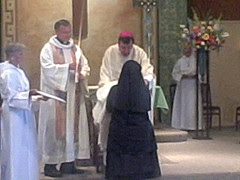
I sincerely hope this answers your questions. You can always get back to me with more questions and comments. Thanks for your patience in awaiting this reply!

19 May 2025

Why does the Church Need Hermits? On the Journey of Existential Solitude and Jesus' Cry of Abandonment

[[Hi Sister, is the inner journey you speak about under the name "existential solitude" frightening? Maybe that's a weird question, but you have said that everyone hesitates to undertake this journey even though it is necessary in order to be truly human. Why is this form of solitude so scary, or why do people want to avoid it? You also said, My sense is that Vatican II gave us a more robust access to Scripture and to a Jesus whose humanity was rooted in faithful prayer (i.e., dialogue with God at every level of his being) and expressed in his active ministry and life with others, as well as in his regular turn to solitude. Both of these revealed Jesus' union with God and the nature of divinity and humanity. But if Jesus was rooted in prayer in this way and united with God, why did he cry out in abandonment on the cross? Did God really leave him, and if he did, then how did God raise him from the dead? I have never understood that or believed that God would abandon any of us, so how could he abandon his only begotten Son? The way I have felt about this is, if God could do that to Jesus, then what chance do any of us have?]]
These are all great questions, and difficult ones. They are questions I have struggled with myself, especially in light of my own recent experience of journeying to the depths of myself and there discovering both God and my deepest, truest self. I haven't asked the questions in the same way you have. What I said to myself was, if Jesus was entirely open and attentive to God (because that is what obedience means), and if he was open in this way even unto death on a cross (even unto sinful or godless death), how could he have not been aware of God's presence unless God truly turned away from him? And yet, how can Jesus reveal God is truly and most profoundly God With Us, if he is a God who abandons us in our sinfulness? I recognize there is paradox right at the heart of this experience of Jesus, but this didn't completely resolve my own questions --- especially as I made my own journey into the center of my Self and discovered the deep darkness and hunger there.

Thomas Merton once wrote, [[My brother, perhaps in my solitude I have become as it were an explorer for you, a searcher in realms which you are not able to visit -- except perhaps in the company of your psychologist. I have been summoned to explore a desert area of man's heart in which explanations no longer suffice, and in which one learns that only experience counts. An arid, rocky, dark land of the soul, sometimes illuminated by strange fires which men fear and peopled by spectres which men studiously avoid except in their nightmares. And in this area I have learned that one cannot truly know hope unless he has found out how like despair hope is.]] It was reflecting and meditating on that last sentence, and in conversations with my spiritual director exploring my own experience and the meaning of all that, that I came to an understanding of what Jesus' cry of abandonment both did and didn't mean.

After all, what does it mean to say that despair and hope are very like one another? This line of Merton's comments fascinated me precisely because of my own inner journey where, in the midst of darkness and anguish, I came to experience light and know hope in a new way. And yet, I also knew I had never felt abandoned by God, was never abandoned by God! So, how could Jesus have been? Was this also something Jesus' death and resurrection changed? Or, did God abandon Jesus and then come back to raise him from the depths of godforsakenness? (I admit, that last possibility didn't make theological sense to me!) Was Jesus' cry of dereliction like my own cry in the darkness of despair or near despair? Did he discover God there in that dark and anguished journey to the depths as I had recently done? But I knew that Jesus' cry was from a darker and more anguished and godforsaken place than my own could ever be precisely because Jesus had made that journey before me, and for that reason, because he implicated God in even that godless place/space/time, I truly never had experienced abandonment by God.

And this still left me wondering what abandonment meant in Jesus' cry. If he was abandoned by God, then how had God raised him from godless death? How could Jesus continue to "exist" at all? And if God continued to hold Jesus in existence in some way, then how could someone entirely open to God, as the scriptures tell us Jesus was, not sense God's presence? I won't multiply my questions further here. Needless to say, there were a number of them. So, I began at the beginning by looking up the Greek word for abandonment. What I discovered was that it is a composite word made up of three words: to leave, as in forsaken; down, as in (experiencing) defeat or hopelessness; and in, as in (left in) a set of hostile circumstances. When I put these together, I saw that "abandoned" meant "left in a hopeless set of hostile circumstances" or better, God "failed to rescue" Jesus from these circumstances. Abandonment thus meant the absence of rescue. And then I remembered several examples of someone loving me precisely in NOT rescuing me from terrible circumstances. One of these involved a story I believe I have told here before regarding my major theology teacher and a group of us undergraduates.

John Dwyer once said, "If I see you (any of you students) doing something stupid, I will not stop you! The majors among us looked bewilderedly at one another and asked, "But he loves us! How could he not rescue us??!!" John saw all this and went on, "If you are impaired in some way, yes, I will intervene, but if you are just making a stupid decision, I will not stop you!" He continued, "Let me be clear. I will always be there for you, and I will do what I can to help you both before and afterwards, but I will not rescue you from your decisions." It took me years to learn that this was what genuine love looked like!! It took me even longer to see this as the key to understanding Jesus' cry of abandonment.

Jesus "set his face toward Jerusalem". He took step after fateful step toward the authorities' violent reactions and subsequent actions as he continued to proclaim his Father's kingdom. His prayer in Gethsemane asked his Father if there wasn't another way, and, I believe that in response, his Abba asked him to continue acting with integrity,  choosing to discern and continue his vocation step by step, wherever those steps led him; I also believe he promised Jesus he would be with him -- for that was also his will. Jesus' Abba promised to reveal himself fully as Emmanuel (God with us), and Jesus continued to act with integrity and trust in his Abba's promises. God did NOT promise to rescue Jesus from the hostile circumstances his integrity led him to face. Quite the contrary. And in the very depths of Jesus' journey into the darkest absence of being and meaning, life and love, God was there. But Jesus' question in the Garden was also sharpened there on the cross: why can't you pluck me out of this situation? Why HAVEN'T you rescued me? How will you vindicate me and, more importantly, my proclamation of the truth of your Reign, your sovereignty, if sinful, godless death is allowed to win out? Don't you see, godless death is swallowing me up!! I have nothing whatsoever left to give!! My God (not the more intimate, Abba!), why haven't you rescued me? 

I don't think there is any sense that Jesus felt God turning away in a failure to love him -- and usually, it seems to me, that is what we mean when we speak of being abandoned by someone, namely, they failed or ceased to love us adequately or appropriately. God did not rescue Jesus from the depths of the darkness and anguish of his journey into godless, sinful death, but neither did he cease loving him profoundly and effectively. Neither did Jesus, for his part, close himself off from God (or from the depths of darkness and anguish). Jesus remained wholly open to God, and God continued to accompany him as Emmanuel into the farthest, most alien land we know. Here is the paradox. In his moment of deepest distress and even despair or near-despair, God was there and would bring consolation and life out of it all -- though not immediately or in the way we tend to expect or desire, perhaps. And this dark, even horrific, journey that Jesus made was made for God's sake and for ours. Indeed, it was the most human journey we are each called to make, the journey of inner or existential solitude where what seems infinitely dark and empty of either being or meaning to us, is also the place where we discover the presence of God, and so, a hope that is capable of sustaining and enlivening us in unimaginable ways.

We often want to be rescued from circumstances, and we cry out to God and others when this occurs, but God does not promise us rescue in the usual sense people mean this, I think. God's rescue means to give us the space to be ourselves and experience the consequences of our decisions (along with the consequences of others' decisions and actions as well, whether these are loving or unloving), and it means he will accompany us there. God's rescue means giving life and meaning to our circumstances, sometimes immediately, often eventually, or even only ultimately. God's rescue means transfiguring our darkness and anguish into sources of grace and hope, life and love, confidence and trust. He does this with his Mysterious presence, a presence we may not always be aware of and can never "comprehend". One point is incontrovertible: God cannot do this if he simply lifts us out of these circumstances and drops us into what is really some (or no) other person's life. That, as I eventually learned from John Dwyer's comments that day in that moral theology class, and from my spiritual director and others, for instance, would not really be loving.

The journey Jesus made, from birth right on up to Golgotha and beyond, was thoroughly human. Yes, in many ways, it was also the journey that human sin colored and made necessary. It was the journey of existential solitude, the journey we each make throughout life as we embrace death in all of its many degrees, forms, and faces so that God might redeem these with and in his life and love. Though you didn't ask about this, Merton understood that hermits (and monks and nuns more generally) make this inner journey in a way most do not because they choose and commit their lives to doing so!** They make this choice so that they might experience genuine hope rooted in God and the Christ Event for the sake of God's Kingdom and Gospel. Doctrine, per se, while important, is not enough for the life of the Body of Christ. Interpretations of the cross by others are a critical start, but what is essential if one is to really witness to the truth of the Gospel to others, and bring them to genuine hope, is the truth of our own experience -- even, and perhaps especially when that experience is one of journeying into the shadow of death and despair or near-despair. Recently, I said to my director, "I would not wish this particular journey on anyone, and yet, what I have come to as a result of this very journey, I want for everyone!" 

I think that too is reflected in Merton's comments cited above and in the following continuation of those comments, The language of Christianity has been so used and so misused that sometimes [we] distrust it: [we] don't know whether behind the word 'Cross' there stands the experience of mercy and salvation, or only the threat of punishment. If my word means anything to you, I can say that I have experienced the Cross to mean mercy and not cruelty, truth and not deception: that the news of the truth and love of Jesus is indeed the good news, but in our time it speaks out in strange places. Recently, as I think you refer to, I wrote about hermits under c 603 as pioneers and explorers. What hermits explore is the realm of existential solitude, and that brings with it both great suffering and ineffable joy. We do this because our experience here undergirds and verifies the Church's proclamation of the Gospel. We do this for her, as well as for ourselves and for the entire world. 

One person recently also asked me if I knew what I was committing myself to when I made my perpetual eremitical profession and accepted consecration. I have to say, no, not clearly. Maybe hardly at all. It never occurred to me that the darknesses and anguished places I explored along this journey could truly benefit anyone -- sometimes not even myself -- yet now I know that in that "strange place" occasioned by trauma and serious and chronic illness, that place where I faced despair and the desire for death straight on while yearning almost beyond words for life and wholeness, is a privileged place where I met God (and my truest self) and was granted the hope, joy, and healing that such an encounter brings. THAT is the journey of existential solitude, and it is also the heart of Paul's theology of the Cross that I, in my youthful "naivete", once told Abp Vigneron I wanted to explore and understand completely. 

I know this doesn't answer all of your questions, but it is already quite long, and I hope it is a good start. May the peace of Christ be with you!!

** Consider what every Benedictine affirms as their primary motivation when they enter a monastery. They declare they are here "to seek God". They do this, not because they do not know God or because God has "gone missing" from the larger world, but because they do not know themselves or God as well or as profoundly as they are called to, and because the monastery (or hermitage) is a privileged place to pursue such intimate knowing. It is this journey of existential solitude, a journey in search of fullness of life and hope rooted in God, that they enter to pursue. So too with every hermit under c 603.